CPT Code 99024 vs 99231: Which Post-Op Code Wins?
CPT code 99024 is not low-stakes. Billing teams, avoid audits and claim gaps with cleaner documentation practices.


CPT 99024 pays nothing and costs more than any code on your claim. Here is what that zero-dollar line item signals to payers, and why thin documentation on it can unravel your entire surgical account.
The common assumption among practice administrators and billing decision-makers is that post-op visit coding, especially 99024, is low-stakes because it pays nothing, and that documentation standards for those visits can therefore be relaxed without meaningful consequences. That assumption is wrong, and it is expensive. CPT code 99024 is the postoperative follow-up visit code used to flag an encounter as included inside the global surgical package. It carries no separate reimbursement, but that zero-dollar line item does real work: it tells the payer that this visit happened, that it was related to the original procedure, and that it belongs inside the global window. See our AI medical scribe for how this works in practice.
CPT 99024 is a postoperative follow-up visit bundled into the global surgical package, so no separate payment is issued for the encounter. According to the AAPC Medical Billing and Coding Forum, the code exists to report visits that occur during the global period but are already compensated through the original surgical fee. It is the formal record that an encounter occurred, that it was post-surgical in nature, and that it fell within the covered window. Payers cross-reference these records against separately billed E&M codes on the same account. A missing or misapplied code creates a gap in the encounter history that auditors notice.

The scope of the code is narrow by design. As TCI SuperCoder / Find-A-Code clarifies, the code applies only to visits directly related to the original surgical procedure; services addressing new or unrelated conditions during the postoperative period must be billed separately. When post-op notes are rushed or incomplete, there is no way to defend which condition drove the visit, and that ambiguity is exactly what a payer audit exploits.
The global period determines how long the code applies. Minor procedures carry a 10-day global period; major procedures carry a 90-day global period. Date-calculation errors are common, and they quietly misclassify code-eligible visits as separately billable E&M encounters, generating revenue on paper and audit risk in practice.
90-day
Global period for major surgical procedures
10-day
Global period for minor surgical procedures
Understanding what the code covers is only half the equation. The other half is understanding why it pays nothing, and what that zero-dollar line item signals to a payer reviewing your account. That is where the real compliance risk lives, and it is where the next section begins.
Key takeaways
- CPT 99024 pays zero dollars, but payers still pull the records, and a note that reads 'wound healing well' is not documentation, it's an audit waiting to happen.
- The global surgical period is not a calendar formality; missing its exact boundary by one day turns a legitimate 99231 into an overbilling flag, or buries a billable encounter under a zero-dollar code.
- Relaxed documentation standards during the global period don't just create compliance risk, they mask E&M undercoding patterns that quietly erode revenue across hundreds of post-op encounters.
- A 33% overcoding rate was found across 941 post-operative encounters in published orthopaedic research, tied directly to global period miscoding, a number that scales fast in high-volume surgical practices.
- CPT 99024 is the wrong code the moment an encounter addresses a condition unrelated to the original procedure; that single distinction drives both recoupment exposure and missed billing in opposite directions.
- iScribe Health's Automated E&M Coding reads clinical documentation in real time and applies coding intelligence to flag global period conflicts, catch 99024 vs. 99231 mismatches, and generate accurate E&M codes before a claim ever reaches a payer.
Why CPT 99024 Has a $0 Charge and What That Zero Actually Costs You
In CPT, that same figure carries a $0 charge because the post-operative visits it represents are already bundled into the global surgical package fee paid at the time of the procedure, but that design decision quietly makes each of those records one of the most consequential documents in a surgical account.

Why CMS Designed CPT 99024 With No Separate Reimbursement
CMS designed the global surgical package to pay surgeons a single, all-inclusive rate covering the procedure and its routine follow-up care, with the assumption that post-op work is proportional and predictable. In practice, however, the documentation burden that assumption creates falls entirely on the clinical team.
Clinicians managing packed post-op schedules regularly find themselves charting two or more hours outside of patient care time because zero-dollar encounters receive zero administrative priority and pile up unaddressed. The result is a documentation backlog that undermines the very records CMS relies on to assess global period accuracy.
iScribe Health's ambient AI documentation addresses this at the source: its conversational AI listens during the encounter and drafts the note in real time, so the that same figure record reflects the actual visit rather than a rushed end-of-day reconstruction.
CMS's 2017 Mandate Proved 99024 Is a Real Compliance Obligation Not a Courtesy Code
CMS mandated that large provider groups (those with 10 or more physicians) begin reporting CPT 99024 for post-operative visits furnished on or after January 1, 2017, establishing it as a formal compliance and data-collection requirement. The primary purpose is to give CMS the data it needs to evaluate whether global surgical package payment rates accurately reflect the post-operative work actually performed. Meeting that obligation consistently requires documentation infrastructure that keeps pace with clinical volume.
For practices already operating a supported EHR, iScribe Health integrates directly into that existing workflow through its EHR integration layer, so clinicians do not adopt a separate system to meet this compliance obligation. The ambient AI drafts each that same figure note automatically at the point of care, capturing the clinical detail CMS needs to calibrate global period payment rates, without adding charting time to the physician's day.
How Weak CPT 99024 Documentation Triggers Costly Audits
Because that same figure tracks the volume and nature of post-operative care, Part B News confirms that inadequate or missing documentation on a zero-dollar claim can still trigger audit findings, overpayment demands, or compliance sanctions. RCM Axis further underscores that global surgery billing accuracy depends on the integrity of the entire chain of documentation across the global period. Gaps anywhere in that chain expose the practice to risk that the $0 charge does nothing to offset.
iScribe Health's real-time denial alerts and E&M coding intelligence are built to close this gap before it becomes an audit finding.
The Global Surgical Period That Determines Every 99024 Decision
The global surgical period is the active decision engine governing every post-op encounter. It is not a passive calendar window your billing team glances at once and files away.

10-Day vs. 90-Day Global Periods and Which Procedures Trigger Which Window
A surgeon finishing a full operative day and then charting two or more additional hours outside of patient care is precisely the environment where global period boundaries get miscounted and entries get misfiled as billable E&M. iScribe Health's Ambient AI Documentation captures the clinical encounter in real time, so the post-op note is drafted by the point of note completion rather than reconstructed from memory at midnight, keeping documentation quality intact even when census volume is at its highest.
How to Calculate the Global Period Start Date Correctly
A billing team that assumes the count starts the morning after surgery miscalculates the end date by one full day, and that single-day error cascades forward: a routine post-op visit on what is actually day 89 gets coded as 99231 and submitted for separate reimbursement.
Verifying the operative date against the global period end date at the time of each post-op encounter is the only reliable way to prevent that cascade.
Specialty Scenarios Where the Global Period Boundary Is Routinely Misjudged
A post-op complication requiring return to the operating room uses modifier 78, not a standard follow-up code. Confusing these scenarios, or failing to document the complication clearly enough to justify modifier 78, leaves the practice either underpaid or audit-exposed. Clear, complete documentation of the complication at the time of the encounter is what makes modifier 78 defensible under payer review.
Ophthalmology practices face a related but distinct challenge, as certain procedures have shifted from bundled global period reporting to separately billable E&M visits following CMS updates, as the American Academy of Ophthalmology notes in its guidance on global period usage. A team still filing global period codes for a procedure recently removed from the global package is leaving reimbursement on the table. iScribe Health's AI Customization allows coding logic to be configured to the procedures and payer rules a specific practice actually encounters, so rule changes at the CMS level surface in the coding workflow rather than remaining invisible until a denial arrives.
Urology's staged lithotripsy scenarios add another layer. eServMD's global period analysis notes that each lithotripsy stage may reset or extend global period obligations, meaning a visit that appears routine can fall inside an active bundled window that the billing team did not anticipate. Real-Time Denial Alerts flag these cross-stage conflicts before they become recoupment events, and because iScribe Health operates through EHR Integration rather than a disconnected billing module, the encounter record and the coding decision share the same underlying data.
When Not to Use CPT 99024 and Which Code Wins Instead
Do not use CPT that same figure when the encounter during the global period addresses a condition unrelated to the original surgical procedure. That single rule resolves most of the confusion billing teams face, yet it gets broken constantly, and the consequences run in both directions: overcoding creates an improper payment that triggers recoupment, and undercoding buries a legitimately billable encounter under a zero-dollar placeholder.
"We're uncertain whether to bill 99024 when the provider did not perform the original surgery and there is no formal transfer-of-care documentation, creating a compliance gray area."
— what we hear from medical billing and coding professionals
According to industry data CPT Guidelines, unrelated evaluation and management services during the global period require modifier -24 appended to the appropriate E/M code, signaling to the payer that the visit is separately billable. Dropping that same figure on that claim instead is a coding error, and the clinical documentation at the time of the visit is the only evidence that can retrospectively justify which path was correct. Code selection and documentation quality are inseparable.
One compliance gray area that genuinely trips up coders at the beginner and intermediate level: what happens when the provider seeing the patient during the global period did not perform the original surgery and there is no formal transfer-of-care documentation? In that scenario, the applying physician has no clear ownership of the global package, and the default assumption that same figure is the right placeholder can expose the practice to audit risk from both sides. The clinical note, captured completely and accurately at the point of the encounter rather than reconstructed at the end of the evening, is the only instrument that makes the billing intent defensible.
iScribe Health's ambient AI documentation captures clinical notes accurately during or immediately after patient encounters, so the note reflects exactly what happened in the room before any coding decision is made. In practices where clinicians regularly chart two or more hours outside of patient care time, that gap between encounter and documentation is where billing intent gets lost.
1. CPT 99024 Is Off-Limits for Conditions Unrelated to the Original Surgery
Do NOT use that same figure when the encounter during the global period addresses a condition unrelated to the original surgical procedure. CPT Guidelines, that same figure is legally restricted to visits directly tied to the original surgical procedure. Applying it to unrelated encounters misrepresents the service, suppresses legitimate E&M revenue, and creates an audit trail that contradicts your own clinical notes. The error runs in both directions: overcoding triggers recoupment, undercoding buries a billable encounter under a zero-dollar placeholder.
2. Modifier -24 - The Correct Code When an Unrelated E&M Occurs During the Global Period

Modifier -24 is the required signal when the same physician provides an evaluation and management service for a condition unrelated to the original surgery during the postoperative period. CPT Guidelines, modifier -24 appended to the appropriate E&M level tells the payer the visit is separately billable. The modifier alone is not enough: documentation must clearly establish the unrelated diagnosis and medical necessity. Without that support in the chart, the modifier will not survive a records pull, regardless of how correctly the code was selected.
3. 99231 vs. 99024 - Subsequent Hospital Care Codes Win for Inpatient Unrelated Visits
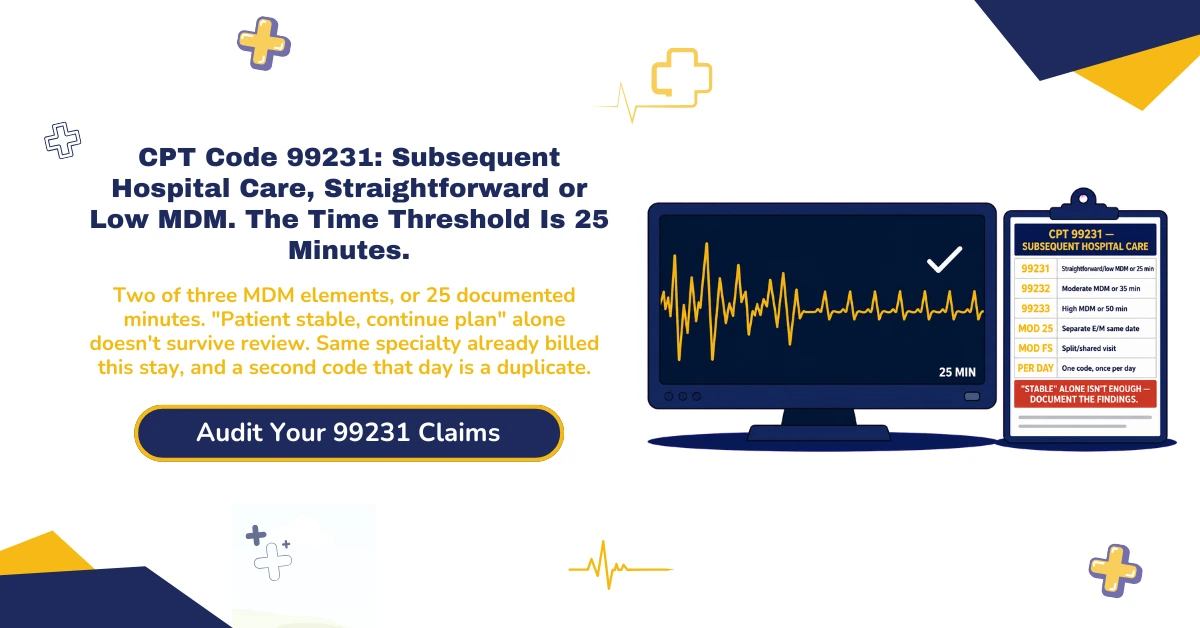
When a provider rounds on a hospitalized patient during the global window for a reason unrelated to the original surgery, CPT 99231 applies, not 99024. CPT Guidelines, 99231 generates actual payment and requires full documentation to support medical necessity, unlike that same figure which carries $0 reimbursement. Billing teams that reflexively assign that same figure to every inpatient rounding visit during the global period leave real reimbursement uncaptured on each of those encounters. This is a recurring, silent revenue leak in high-census surgical practices.
4. Modifiers 58, 78, and 79 - Three Post-Op Billing Signals That Override 99024

These three modifiers govern distinct scenarios where that same figure is categorically wrong. Per the CMS Claims Processing Manual (Publication 100-04, Chapter 12): modifier -58 covers a staged or related procedure; modifier -78 covers an unplanned return to the OR for a complication; modifier -79 covers an unrelated procedure performed during the global period. Each triggers a new global period and separate reimbursement. Treating any of these as a routine post-op follow-up and coding that same figure instead is a compliance gap that only surfaces when a payer pulls records.
5. Behavioral Health and Specialty E&M Within the Global Window - When a Separate Billable Visit Is Justified

In behavioral health and other specialty contexts, a separate E&M service is justified within the surgical global window when the presenting problem is clearly distinct from the surgical diagnosis. Per the CMS Medicare Benefit Policy Manual, proper documentation establishing medical necessity for the unrelated condition, paired with modifier -24, is required to support a separately billable claim and withstand audit scrutiny. A mood disorder follow-up or a new psychiatric evaluation during a 90-day orthopedic global period qualifies, provided the note makes the clinical distinction explicit and unambiguous.
Quick-Reference Decision Table: 99024 vs. Modifier-Driven Codes
Scenario: Routine follow-up, related to surgery, within global window
- Correct Code / Modifier: that same figure
- Generates Payment?: No ($0)
Scenario: Unrelated E&M service during global period (outpatient)
- Correct Code / Modifier: Appropriate E&M + Modifier -24
- Generates Payment?: Yes
Scenario: Unrelated E&M service during global period (inpatient rounding)
- Correct Code / Modifier: 99231 + Modifier -24
- Generates Payment?: Yes
Scenario: Unplanned return to OR for complication
- Correct Code / Modifier: Procedure code + Modifier -78
- Generates Payment?: Yes (new global period)
Scenario: Staged or related subsequent procedure
- Correct Code / Modifier: Procedure code + Modifier -58
- Generates Payment?: Yes (new global period)
Scenario: Unrelated procedure during global period
- Correct Code / Modifier: Procedure code + Modifier -79
- Generates Payment?: Yes (new global period)
Scenario: Behavioral/specialty E&M, clearly distinct diagnosis
- Correct Code / Modifier: Appropriate E&M + Modifier -24
- Generates Payment?: Yes
Most manual coding workflows rely on the coder catching the clinical distinction after the note is already written. The gap between what the encounter actually was and what gets billed is a visibility problem, and it resolves when the note is complete by end of clinic rather than reconstructed hours later.
Knowing which code wins the that same figure vs. that same figure decision is only half the battle: the claim still has to survive a payer records pull. The next section breaks down exactly what documentation has to be in the chart to make every that same figure encounter audit-proof, and why the standard differs sharply between Medicare and commercial payers.
Related Reading
- Cpt Code 99244
- Cpt Code 99203
- Cpt Code 99232
- Cpt Code 99221
- Cpt Code 99205
- Cpt Code 99202
- Cpt Code 99223
- Cpt Code 99222
- Cpt Code 99233
Documentation Requirements That Make CPT 99024 Audit-Proof
A post-op visit note that reads "wound healing well" is not documentation. It is a liability waiting for a payer to find it.
MBW RCM's July 2026 billing guidance is direct on this point: medical record documentation for CPT 99024 must explicitly reflect the routine nature of the postoperative check, because payers can pull global period records at any time and the note must stand on its own during audit review. That is a defensibility requirement. A note that omits that language gives a reviewer nothing to confirm the visit belongs inside the global period at all.
One compliance gap that surfaces repeatedly in busy surgical practices: providers perform post-op services, drain removal, stitch removal, wound checks, without any orders or transfer-of-care documentation in place. The clinical work happened. The patient was seen.
But when a payer pulls that record, there is nothing tying the encounter to the originating procedure or establishing that the performing provider had the authority to deliver that post-op care in the first place. The CPT that same figure claim then has no documentary foundation, regardless of how accurate the code is. This is exactly the kind of upstream audit candidate that iScribe Health's E&M Coding Intelligence is built to surface before the claim ever leaves the practice.
What Every 99024 Note Must Contain
A defensible post-op visit note needs five elements: an explicit statement that the visit is routine surgical follow-up, confirmation the encounter falls within the global period, a complete clinical assessment of the patient's status, accurate ICD-10 coding that matches the documented condition, and a clear date-of-service linkage to the original procedure. Miss any one of these and the note cannot support the coding decision if a payer requests records. As MBW RCM's guidance notes, rushed or incomplete post-operative notes make it impossible to defend coding decisions or demonstrate medical necessity during payer review, even when the code itself carries zero reimbursement.
iScribe Health's Ambient AI Documentation addresses the structural source of this failure. In practices already running a supported EHR, iScribe Health materializes as a seamless ambient documentation experience, listening to the encounter in real time and generating a structured, clinically substantive note as the visit unfolds. At the point of note completion, after the AI drafts the encounter summary, the documentation already reflects the five elements a that same figure record requires. The provider reviews and approves; they do not reconstruct from memory after the next four patients. For high-volume practices where clinicians regularly chart two or more hours outside of patient care time, that shift changes the compliance profile of every post-op encounter.
1. Routine Nature of the Visit Must Be Explicitly Stated in Every CPT 99024 Note
CPT that same figure documentation must contain an explicit statement that the encounter is routine surgical follow-up. A finding description does not confirm the visit's relationship to the global period. As MBW RCM's billing guidance confirms, the note must be able to stand on its own during audit review, and that requires language that directly ties the encounter to routine postoperative care. iScribe Health's Ambient Listening captures that language in context, at the moment the provider establishes the nature of the visit, rather than relying on a provider to recall and insert it manually after the fact.
2. Medicare vs. Commercial Payer Documentation Standards for 99024 Are Not Interchangeable
This is where a single-template approach quietly accumulates risk. Medicare requires that the note demonstrate the visit falls within the global period and reflects routine surgical follow-up. Many commercial payers impose additional or different requirements that diverge from Medicare's framework entirely, including documentation of medical decision-making complexity that Medicare does not mandate for the same encounter.
MBW RCM's billing guidance confirms that commercial payers may apply their own documentation and reporting rules entirely separate from Medicare's global period framework. A note written to satisfy Medicare's baseline may simultaneously fail a commercial payer's audit. Practices billing mixed payer populations that rely on one generic post-op note template are building a payer-specific compliance liability that only surfaces during a targeted record pull, never at the point of claim submission.
The honest trade-off: standardizing documentation to meet the higher commercial-payer bar takes more time per encounter. For low-volume surgical practices, that overhead may feel disproportionate. For high-volume practices billing across multiple payers, it is the only approach that does not create compounding audit exposure. iScribe Health's AI Customization capability allows documentation workflows to reflect the specific requirements of the payer mix a practice actually bills, so the note generated for a Medicare global-period visit and the note generated for a commercial-payer visit are not the same template dressed up differently.
Practices that rely on provider-authored notes to satisfy all five documentation elements consistently are betting audit defensibility on the most time-pressured person in the room. iScribe Health's coding intelligence addresses this directly by generating structured, clinically substantive post-op documentation at the point of care, building the that same figure record as the encounter unfolds rather than reconstructing it afterward. The MedBillingRCM General Surgery Billing Service analysis supports the underlying premise: post-op miscoding patterns are a documentation-capture problem before they are a coder-awareness problem, which means the intervention has to happen at the point of note creation, not downstream in the billing queue.
Getting the note right is the necessary first step. But even a well-documented practice can still let miscoded encounters slip through when global period boundaries are tracked manually across dozens of surgical cases. The next section shows how automated E&M coding catches those miscoding patterns before a payer does.
3. Rushed or Incomplete Post-Op Notes Eliminate Your Ability to Defend CPT 99024 Coding
A thin post-op note removes every option for defending the coding decision if a payer requests records. There is no correcting an inadequate note after the fact without risking a credibility problem during review. MBW RCM's billing guidance states this plainly: rushed or incomplete post-operative notes make it impossible to demonstrate medical necessity or defend coding decisions during payer review, even when the code itself generates no reimbursement. iScribe Health's Real-Time Denial Alerts and E&M Coding Intelligence exist precisely to catch these gaps before the note is finalized, not after a payer has already opened a record request.
4. ICD-10 Post-Op Complication Codes Within the Global Period Create Specific Audit Exposure
Pairing an ICD-10 post-operative complication code with a global-period encounter signals to payers that the visit may warrant separate reimbursement, which immediately draws scrutiny to the supporting documentation. The note must clearly distinguish the documented condition as a genuine complication rather than routine follow-up; without that distinction in writing, the claim is indefensible under audit. As MBW RCM's billing guidance notes, if the documentation cannot substantiate that the condition is a complication and not routine care, the claim cannot survive payer review. iScribe Health's E&M Coding Intelligence surfaces these pairings as audit candidates upstream, giving the billing team an opportunity to confirm the documentation supports the code before the claim is submitted, not after a denial arrives.
5. Date-of-Service Verification Tied to the Global Period Window Is a Non-Negotiable Documentation Element

Every that same figure note must include a clear date-of-service linkage that places the encounter within the global period for the originating procedure. Without it, a reviewer cannot confirm the visit belongs inside the global window at all, and the coding decision has no documentary support. This linkage is the structural anchor that connects the encounter to the global surgical package. A note that omits it forces the practice to reconstruct the timeline under audit pressure, a position no billing team wants to be in, and one that iScribe Health's Automated E&M Coding is designed to prevent by embedding that linkage in the structured note at the point of care, every encounter, every day.
How Automated E&M Coding Catches Global Period Miscoding Before a Payer Does
Reconstructing a timeline under audit pressure is exactly the scenario that plays out when documentation gaps compound across hundreds of encounters. Across 941 post-operative encounters, retrospective research published in the Orthopaedic Journal of Sports Medicine uncovered a 33% overcoding rate tied directly to global period misclassification, errors that no real-time billing alert had flagged and no provider had caught during documentation. Those tools work at the speed of human recall, which is always slower than the speed of claim submission.

Why a 33% Overcoding Rate Goes Undetected Without Real-Time Global Period Validation
The Orthopaedic Journal of Sports Medicine study makes one structural problem impossible to ignore: manual provider awareness alone cannot catch global period miscoding in real time. Without automated coding validation integrated into the clinical documentation workflow, overcoding and undercoding errors accumulate across large encounter volumes before anyone notices. Providers documenting a routine post-op check are not simultaneously cross-referencing the procedure date, the payer-specific global window, and the E&M criteria for a separately billable visit, and treating that same figure as a low-stakes checkbox also masks a second, quieter problem. According to the same research, reflexive filing without documentation review conceals concurrent E&M undercoding patterns elsewhere in a practice's encounter data, compounding both revenue leakage and audit risk at the same time.
How to Catch 99024 vs. Separately Billable E&M Mismatches Before a Claim Is Submitted
Real-time coding validation intercepts the mismatch before the claim leaves the practice.
iScribe Health's Automated E&M Coding generates codes directly from clinical documentation, cross-referencing coding intelligence against the active global period window at the moment the note is completed. If a provider documents a visit that meets the threshold for a separately billable E&M but the encounter falls inside the global window, the system flags it.
Why Every Post-Op Note Is a Coding Defense Document
For real-time coding intelligence to correctly distinguish a global period encounter from one that warrants a separately billable E&M, the note must capture the specific condition addressed, its relationship to the original procedure, the clinical decision-making involved, and any findings that deviate from expected post-operative recovery. These details are the inputs the coding system uses to make the right call. When AI-powered scribing captures that clinical detail in real time, the downstream coding decision has the evidence it needs.
Knowing where global period miscoding hides is half the battle.
Related Reading
Next steps
If your billing team is discovering post-op coding errors weeks after the encounters close, the path forward starts with treating every 99024 record as a compliance document that payers cross-reference against every other code on the same surgical account. Start with our AI medical scribe.
The 33% overcoding rate documented across nearly 1,000 orthopedic encounters surfaced only through retrospective research, with no real-time signal that anything had gone wrong during the global period. That means manual provider awareness is structurally too slow to catch global period miscoding before it accumulates. At the same time, practices writing one generic post-op note template to cover both Medicare and commercial payer visits are quietly building payer-specific audit liability that only appears during a targeted records pull, not at claim submission. Together, these two patterns point to the same intervention: documentation that captures the right clinical detail at the point of care, paired with coding validation that fires before the claim leaves the practice.
Start with iScribe Health's ambient documentation and E&M coding intelligence work together inside your existing EHR. The encounter note is drafted in real time, the coding logic runs against the completed note before submission, and the denial alert fires on mismatches while the clinical detail is still correctable. The next post-op visit is the right place to begin.
Frequently Asked Questions
When should I use 99231 instead of 99024 for a post-op visit?
Use 99024 when the visit falls inside the global period and is directly related to the original surgical procedure. If you bill 99231 for a visit that actually belongs inside the global window, that claim flags the account for broader payer review, and can trigger recoupment of the original surgical payment.
What does CMS actually require practices to report for global surgery data collection?
CMS mandated that large provider groups, those with 10 or more physicians, begin reporting CPT 99024 for post-operative visits furnished on or after January 1, 2017. The primary purpose is to give CMS the data it needs to evaluate whether global surgical package payment rates accurately reflect the post-operative work actually performed.
If a patient has to go back to the OR during the global period for a complication, do I use 99024?
No. A post-op complication requiring a return to the operating room uses modifier 78, not 99024. The post details that confusing these scenarios, or failing to document the complication clearly enough to justify modifier 78, leaves the practice either underpaid or audit-exposed.
Can I bill separately if I treat an unrelated condition during the global period?
Yes. When an encounter during the global period addresses a condition unrelated to the original surgical procedure, you append modifier -24 to the appropriate E/M code to signal to the payer that the visit is separately billable. Dropping 99024 on that claim instead is a coding error, and the clinical documentation at the time of the visit is the only evidence that can justify which path was correct.
Does the 99024 reporting requirement apply to OB-GYN surgeries?
It can, but ob-gyn carries a distinct risk: certain procedures have shifted from bundled 99024 reporting to separately billable E/M visits following CMS updates. A team still filing 99024 for a procedure recently removed from the global package is leaving reimbursement on the table every single time.