CPT Code 99205 Explained: What It Means and When to Bill It
CPT code 99205 billing gaps cost practices real revenue. Give billing teams the visibility to stop the loss on every new patient claim.


Two pathways qualify a visit for the highest new patient code. Most practices forfeit one of them every day without knowing it.
CPT code 99205 sits at the ceiling of the new patient office visit code set, and that position carries more financial weight than most practice administrators realize. The common assumption is that if coders understand the MDM criteria and charts are audited quarterly, E&M coding accuracy is under control. The 99202-99205 range covers every new patient office or outpatient visit, and 99205 is the only code in that range that demands high-complexity clinical decision-making or a substantial time investment from the provider.
Getting it right, every time, is a revenue decision. See our AI medical scribe for how this works in practice. Within the full E/M office visit code set (99202-99215), 99205 is the new patient ceiling and 99215 is the established patient ceiling.
Same complexity threshold; different patient status. The 2021 elimination of CPT code 99201 is the structural event that reshaped this entire code set.
Effective January 1, 2021, the AMA collapsed the new patient range from 99201-99205 down to 99202-99205, simultaneously restructuring complexity thresholds across all remaining codes. That restructure also removed history and physical exam as level-selection drivers. Medical decision-making complexity and total time are now the only two qualifying pathways, a shift that concentrated the highest-stakes coding decision squarely at 99205. Because that figure carries the highest reimbursement in the new patient series, a one-level miss repeated across every qualifying visit accumulates into a measurable, invisible revenue gap. Most practices never isolate it because the error is consistent, not random.
Consistent errors don't trigger alerts. They become the baseline.
The harder question, where revenue is actually won or lost, is whether a given encounter legitimately clears the bar to bill that figure, and that answer runs through exactly two pathways the AMA defines.
:: 99205 Billing Decision Checklist, Use Before Finalizing Any New Patient Level 5 Claim
- 1 — Patient has not received billable professional services from same specialty/subspecialty within the group in the past 3 years
- 2 — Chosen pathway is identified: MDM or Total Time
- 3 — If MDM pathway: 2 of 3 elements (Problems, Data, Risk) are explicitly documented at high-complexity level
- 4 — If Time pathway: total provider time on date of service is documented as 60-74 minutes (specific figure, not approximate)
- 5 — Problems element: note explicitly states threat to life/bodily function, severe exacerbation, or new undiagnosed problem, not merely lists diagnoses
- 6 — Data element: independent interpretation (not just review) of test results is documented as a separate physician-performed act
- 7 — Risk element: intensive toxicity monitoring, hospitalization decision, or SDOH barrier limiting treatment is named explicitly in the note
- 8 — If encounter exceeds 74 min: add-on code identified, +99417 (commercial) or G2212 (Medicare), with specific total time recorded
- 9 — History and physical exam documented (required) but NOT used as code-level drivers
- 10 — Note is finalized before claim is filed; no retroactive MDM upgrades attempted post-sign-off
Add this checklist as a callout block at the end of Section 2 (MDM elements) to serve as a pre-submission gate for billing teams.
Key takeaways
- CPT 99205 is the highest-complexity new patient office visit code, and a single downcoded encounter, billed as 99204 instead, forfeits a measurable reimbursement margin that compounds silently across every qualifying visit in a provider's schedule.
- Two independent pathways qualify a visit for 99205: high Medical Decision Making or total time meeting the minimum threshold, and whichever is better supported by documentation controls the code, not the clinician's subjective sense of complexity.
- High MDM is a structured gate, not a general impression: a provider must meet or exceed 2 of 3 elements, Problems, Data, and Risk, at the high-complexity threshold simultaneously, and documentation must surface evidence for each one before a payer algorithm ever sees the chart.
- New patient status has a specific regulatory definition that front-desk intake forms rarely capture correctly, and getting that gate wrong produces a miscoded claim with no visible alert.
- Industry data shows only about 55% of E&M visits are accurately coded on the first attempt, and one orthopedic group running a one-week internal audit found a 33% overcoding rate they had no idea existed.
- Most practices treat E&M coding accuracy as a documentation problem; it is a visibility problem, the revenue loss happens in the gap between what a clinician observed and what the finalized note actually captured.
- iScribe Health's Automated E&M Coding closes that gap by generating E&M codes directly from clinical documentation in real time, so the code the note supports and the code on the claim are the same number before submission.
What Are the Two Pathways to Bill CPT 99205
Two independent pathways qualify an encounter for CPT that same figure billing, and the American Medical Association CPT 2023 guidelines confirm that either pathway stands alone, whichever is better supported by documentation. Treating pathway selection as something a coder figures out after the fact is the most common and most expensive mistake in Level 5 billing.
Billing teams and clinicians alike face mounting pressure to justify 99205 claims, and that pressure almost always traces back to the same root confusion: a blurring of what MDM requires versus what time requires, and an assumption that the two pathways are interchangeable safety nets.
Pathway 1, High-Complexity Medical Decision Making Qualifies 99205 on Its Own
When MDM is the chosen pathway, the documentation must support high complexity before the note closes. According to the American Medical Association CPT 2023 framework, the provider must meet 2 of the 3 MDM elements at the high-complexity level:
- Number and complexity of problems addressed
- Amount and complexity of data reviewed
- Risk of complications or morbidity or mortality
The American Medical Association CPT 2023 guidelines require a medically appropriate history and exam to be documented, but those elements do not determine the level of service; only the MDM elements do.
Total Provider Time of 60-74 Minutes as a CPT 99205 Qualifier
Per the American Medical Association CPT that same figure guidelines, this includes all time the provider personally spends on that date: reviewing records, ordering and reviewing results, counseling, coordinating care, and documenting, not just face-to-face minutes, and total provider time on the date of the encounter of 60-74 minutes qualifies as a standalone pathway to bill 99205. That time must be explicitly stated in the note, however, or it cannot be used to support the code.
Key takeaway: Either pathway, high-complexity MDM or 60-74 minutes of total provider time, stands alone as a complete qualifier for that same figure. The evidence must exist inside the note before the coding decision is made.
A provider who spends 65 minutes coordinating care for a new, complex patient but documents only the visit itself loses the billing opportunity entirely. Clinicians who are already seeing dense patient panels and carrying significant after-hours documentation burdens are most exposed to this leak, because the time is accumulating but never captured in a form that survives coding review. The solution is a documentation workflow that records the pathway choice and its supporting evidence at the point of care, not hours later.
Why the Provider, Not the Coder, Must Choose the Pathway Before the Note Closes
Capturing physician dialogue and patient context during the visit to generate clinical notes in under 30 seconds changes the workflow at this step. That real-time capture is especially consequential in high-volume practices where after-hours documentation is already a significant burden.
In those environments, iScribe Health's ambient documentation reduces the after-hours burden while its automated E&M coding ensures that the time and complexity those clinicians actually deliver are translated into the code the documentation can support, rather than a code a coder guesses at from an incomplete note.
What Are the Three MDM Elements and What Qualifies as High for Each
High Medical Decision Making (MDM) for that same figure is a structured gate, not a holistic impression of a difficult visit: a provider must meet or exceed 2 of the 3 MDM elements at the high-complexity threshold simultaneously. Those three elements are:
- Problems
- Data
- Risk
A visit can feature the most critically ill patient imaginable, but if the clinical documentation only surfaces evidence for one element, the code collapses under audit. That is the core mechanism billing decision-makers need to internalize before reviewing any chart.
The table below maps each element to its exact qualifying criteria for high complexity.
- Problems → One or more chronic illnesses with severe exacerbation, progression, or side effects of treatment; a new or undiagnosed problem requiring additional workup; or an acute or chronic illness posing a threat to life or bodily function.
- Data → Extensive review including at least two of: independent interpretation of tests, use of independent historians, or discussion of management or test interpretation with an external physician or appropriate source.
- Risk → Drug therapy requiring intensive monitoring for toxicity (e.g., anticoagulation or chemotherapy); a decision regarding hospitalization; or a diagnosis or treatment significantly limited by social determinants of health.
1. Element 1 - Problems - High Complexity Requires a Threat to Life, Bodily Function, or Severe Chronic Exacerbation
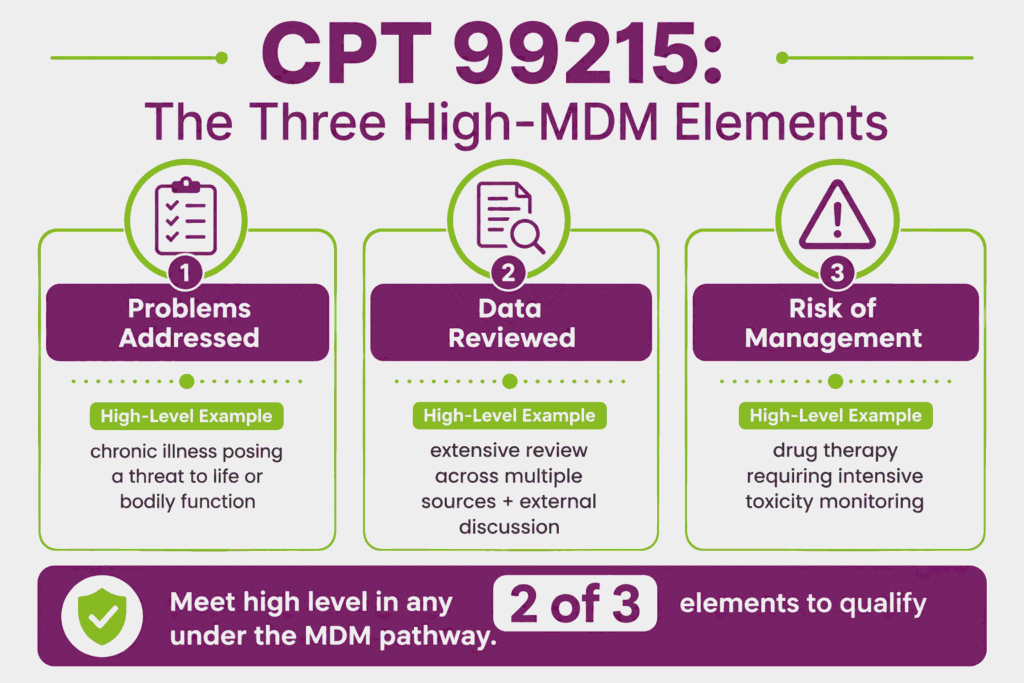
High complexity requires a threat to life, bodily function, or severe chronic exacerbation. The Problems element trips up practices most often on stable chronic conditions. A patient managing three chronic diagnoses that are currently controlled does not meet high complexity here, even if the note is long. Per the IKS Health E/M guidelines summary, high complexity requires documented evidence of severe exacerbation, active progression, treatment side effects, or a genuine threat to life or bodily function. The clinical reality must appear explicitly in the note, not implied by diagnosis count.
This is the documentation gap that generates preventable claim denials at scale. In high-volume practices where clinicians regularly chart two or more hours outside of patient care time, the pressure to move quickly through note completion means the severity qualifier, the phrase that distinguishes a controlled chronic condition from one in severe exacerbation, is the first thing dropped. iScribe Health's E&M Coding Intelligence, operating through Ambient AI Documentation at the point of note completion, flags whether the Problems element is explicitly captured before the code is assigned, so the clinical reality of the visit is preserved between the exam room and the claim.
2. Element 2 - Data - Extensive Review Including Independent Test Interpretation or External Physician Discussion

Extensive review requires independent test interpretation or external physician discussion. The most frequently misunderstood distinction in this element is the difference between reviewing a report and independently interpreting a test. Reviewing a radiology report written by another physician does not satisfy high complexity.
The provider must personally interpret the raw study and document that interpretation separately. Ordering labs also does not count. High complexity requires at least two qualifying data activities: independent interpretation, use of independent historians, or documented discussion with an external physician about management or findings, as confirmed by both the IKS Health MDM analysis and CodingIntel's E/M guidance.
Many encounters that feel data-intensive fail here because the note records what was ordered, not what was independently analyzed. Clinicians we work with in high-volume settings describe finishing a visit confident the Data element was satisfied, only to discover under audit that the note captured orders and results but never documented the independent interpretive work that actually occurred. iScribe Health's Ambient Listening and Conversational AI captures that interpretive reasoning as it happens during the encounter, surfacing it in the AI-drafted note before finalization rather than asking the physician to reconstruct it after the fact.
3. Element 3 - Risk - Drug Therapy with Intensive Toxicity Monitoring, Hospitalization Decisions, or Social Determinants Limiting Treatment
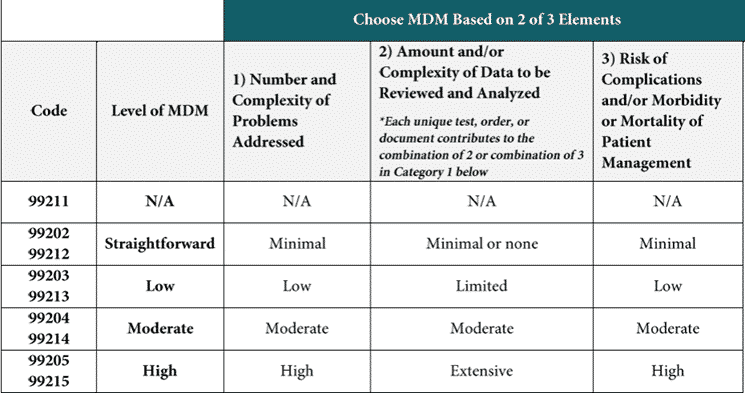
Risk is the element most likely to be present but least likely to be documented with the language auditors require. Concrete examples that qualify include:
- Managing a patient on anticoagulation therapy or chemotherapy, where intensive toxicity monitoring is ongoing
- A decision about hospitalization
- A diagnosis or treatment plan that is significantly limited by social determinants of health, housing instability, food insecurity, or transportation barriers, which qualifies as high Risk under current CMS guidance
Yet the social determinants criterion is routinely omitted from notes entirely because providers document what they did, not the structural barriers that shaped the decision.
The social determinants criterion is the single most under-captured qualifying Risk factor in ambulatory practice. iScribe Health's Real-Time Denial Alerts surface this omission at the point of note completion, after the AI drafts the encounter summary, so the provider can confirm the barrier is recorded before the encounter closes. In practices and health systems running supported EHRs, this happens within the existing documentation workflow via EHR Integration, with no separate system and no added charting step.
High MDM is a conjunctive threshold. Satisfying only the Problems element at the highest possible level, with a patient in acute organ failure, still produces a failed claim if the Data and Risk elements are not independently documented. This is where most Level 5 claims are lost: the clinical work was present, but the note never surfaced evidence across two distinct elements at once.
Most physicians document what they did clinically, not the structured MDM language that auditors look for across all three elements. The impact compounds in high-volume practices or health systems where clinicians regularly chart two or more hours outside of patient care time: accurate, compliant medical coding across that volume maximizes reimbursement and minimizes claim denials on every qualifying encounter, not just the ones that get reviewed. A single miscoded claim downgraded to 99204 represents a measurable revenue loss on every qualifying new patient encounter, and that loss multiplies across every provider in the practice, every day.
Satisfying 2 of these 3 MDM elements is the core qualification test for the MDM pathway, but MDM is only one of two routes to the code. Before a practice can rely on either pathway, the encounter must first clear a separate eligibility gate: the patient must be new, and if time is the chosen pathway, the clock must hit a specific minimum threshold. That gate is covered next.
How New Patient Status and Minimum Time Requirements Gate 99205 Eligibility
The CMS Three-Year Same-Specialty Rule That Actually Defines New Patient Status for 99205
Guidance on new-versus-established patient classification makes clear that telephone triage, administrative contacts, and care coordination calls do not satisfy the lookback window; only face-to-face encounters that generate a billable professional services claim reset the three-year clock.
For time-based eligibility, 99205 requires 60 to 74 minutes of total provider time on the date of the encounter.
The Specialty-Subspecialty Loophole When a Returning Patient Still Qualifies as New
- A practice that bills 99205 for an established patient is exposed to overpayment recovery.
- A practice that bills 99215 for a visit that qualifies as 99205 is leaving reimbursement on the table.
Both outcomes stem from the same upstream failure: status determination made at intake without a structured specialty-level lookback.
This is precisely where iScribe Health's E&M Coding Intelligence and Real-Time Denial Alerts close the gap. Front-desk staff manually adjudicating a three-year same-specialty lookback at check-in is an unreliable control point. iScribe Health's Automated E&M Coding layer operates at the point of note completion after the AI drafts the encounter summary, surfaces the correct patient status classification against the encounter data already captured, and delivers the right code to the claim before submission.
High-volume practices where clinicians regularly chart two or more hours outside of patient care time compound the coding risk: physicians charting under post-visit time pressure are less likely to capture the temporal detail, total provider time on the date of service, that supports a 99205 time-based claim. iScribe Health's Ambient AI Documentation and Ambient Listening / Conversational AI accurately capture clinical notes during or after patient encounters, reducing the time physicians spend on post-visit documentation so they can see more patients per day without burning out.
Related Reading
- Cpt Code 99233
- Cpt Code 99203
- Cpt Code 99232
- Cpt Code 99244
- Cpt Code 99221
- Cpt Code 99202
- Cpt Code 99223
- Cpt Code 99222
2026 Medicare Reimbursement Rate for 99205 and When Prolonged Service Codes Apply
Prolonged service add-ons aside, the foundation is still the base rate, and the 2026 Medicare Physician Fee Schedule puts a precise dollar figure on what a fully documented new patient encounter is worth. The financial exposure from a single documentation gap compounds across every qualifying visit in a provider's panel, not just the one that got missed.
2026 Medicare Rate for CPT 99205 and the Cost of Downcoding
Key takeaway: When documentation fails to support that same figure, it often fails to support prolonged service add-on codes at the same time, one documentation gap erases both the base-code upgrade and all add-on revenue on the same claim.
Which Prolonged Service Code Applies Depends on the Payer
The correct prolonged service add-on depends entirely on who is paying the claim. Both codes apply when total visit time exceeds the base time threshold and are billable in 15-minute increments beyond the base range.
- Commercial Payers → Add-On Code: +99417 → When It Applies: Total visit time exceeds the 99205 base time threshold; billable in 15-minute increments beyond the 99205 ceiling.
- Medicare → Add-On Code: G2212 → When It Applies: Total visit time exceeds the 99205 base threshold; billable in 15-minute increments beyond the base 99205 time range.
Lost Revenue from Untracked Time Beyond 74 Minutes
Unrecorded time is unbillable time, and the financial consequence is immediate.
That missed unit is rarely an isolated event. This pattern is especially acute in high-volume practices and health systems where clinicians regularly chart two or more hours outside of patient care time; under that cognitive load, time specificity is the first detail to drop.
iScribe Health addresses this at the source. Its Ambient AI Documentation and E&M Coding Intelligence capabilities work together to simplify reimbursement and payment workflows by capturing the clinical encounter in real time through ambient listening and conversational AI, with no manual time-tracking required of the provider.
Because iScribe Health integrates directly with supported EHRs, this workflow runs without a separate documentation platform or a manual hand-off between the clinical note and the billing queue. The coding intelligence travels with the encounter, closing the gap between clinical documentation and accurate claim submission at the moment of capture.
Clinical Examples of Encounters That Qualify for 99205
Three clinical scenarios reliably generate that same figure-level complexity. Each one earns the code on MDM grounds. Each one also carries a structural documentation risk that makes the revenue invisible to payer algorithms before a human reviewer ever sees the chart.
1. New Patient With Uncontrolled Hypertension, Type 2 Diabetes, and Stage 3 CKD
According to the AMA CPT E/M Office Visit Guidelines, a new patient presenting with these three interacting, uncontrolled conditions qualifies for that same figure when the encounter involves independent interpretation of labs and a high-risk treatment decision, such as initiating a medication requiring intensive toxicity monitoring. The MDM complexity is real. The documentation failure is equally real: providers routinely record the diagnoses and the orders without capturing the explicit risk calculus, the rejected alternatives, or the reasoning that connects the lab values to the treatment decision. That omission is what turns a legitimate that same figure into a 99204 at adjudication.
This risk is sharpest in high-volume practices where clinicians are already spending significant time on after-hours documentation, conditions under which the MDM narrative is the first thing compressed or dropped entirely. For IT and EHR administrators overseeing documentation quality across a practice, that consistency, captured the same way across every clinician, every encounter, every day, is what standardizes that same figure defensibility at scale.
2. New Patient Post-Motor-Vehicle Accident With Complex Neurological Symptoms Requiring Specialist Coordination
Per the AMA CPT E/M Office Visit Guidelines, this encounter supports that same figure when the physician independently interprets external imaging (MRI, nerve conduction studies) and coordinates care with outside specialists, both of which satisfy the high-complexity data element of MDM. The tradeoff: independent interpretation must be documented as a separate, physician-performed interpretive act, not simply noted as "reviewed." Payer algorithms recode notes that record only "MRI reviewed" without the physician's own interpretive findings downward automatically, well before a coder or auditor weighs in.
iScribe Health's E&M Coding Intelligence and Real-Time Denial Alerts are designed to catch exactly this failure mode, flagging at note completion when the documented language is likely to trigger a downcode, so physicians, nurse practitioners, and the clinical informatics teams supporting them have an opportunity to correct the record before the claim is submitted rather than after it is denied.
3. 99205 vs. 99204 - What Pushes a Visit From Moderate to High Complexity and Why It Is Frequently Missed
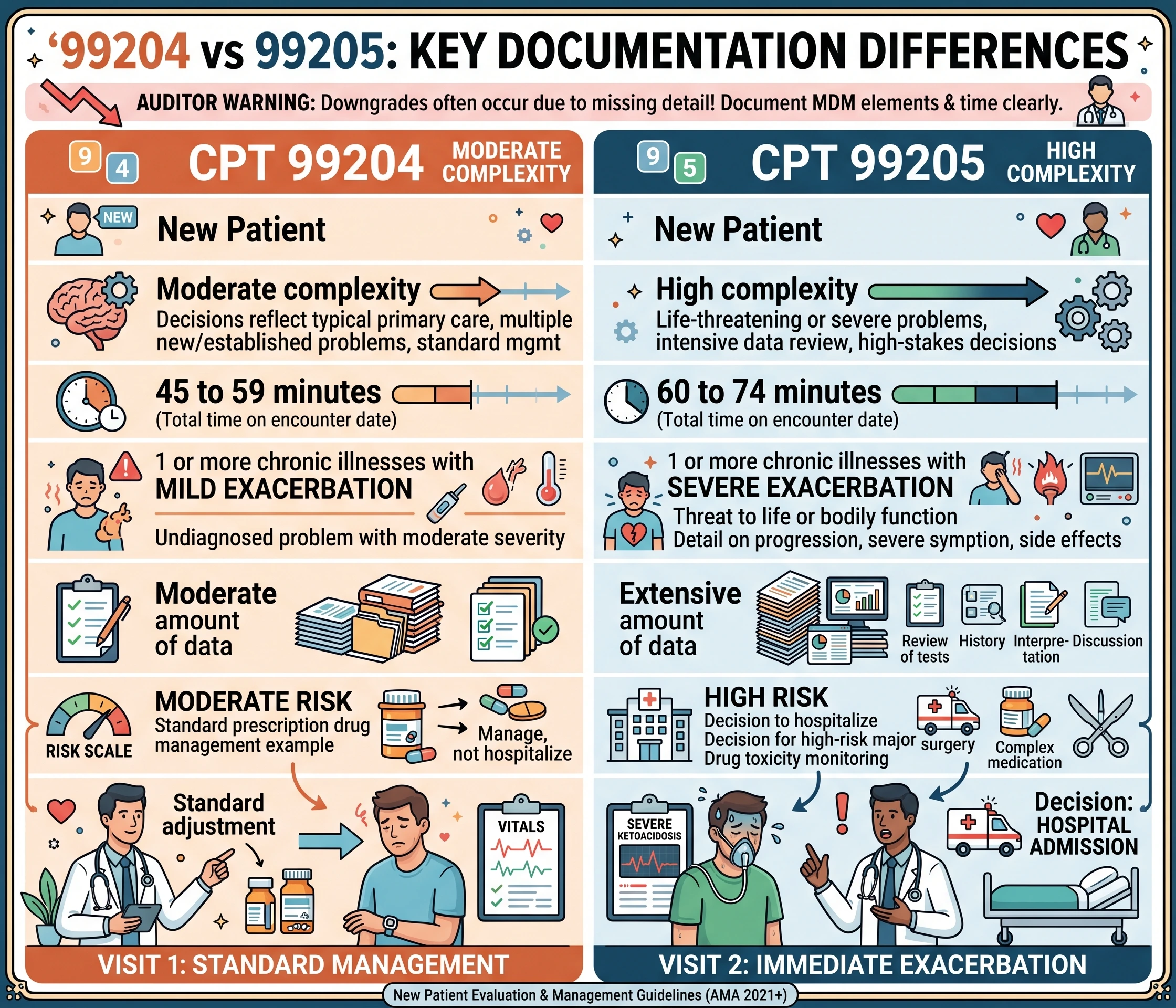
The AMA CPT E/M Office Visit Guidelines are precise: high complexity requires that at least one presenting problem poses a threat to life or bodily function, or that the data reviewed and treatment risk each independently meet the high-complexity threshold. Multiple problems alone do not clear the bar. This is where documentation and clinical reality diverge most often.
Two pressures compound the divergence in practice. First, clinicians who are genuinely managing high-complexity encounters, and who are often running behind in high-volume schedules, frequently record what they did without documenting why the decision carried elevated risk, which is the exact reasoning string that sustains that same figure under audit. Second, some clinicians feel pressured by employers to bill that same figure without documentation that clearly meets MDM or time thresholds, which creates real compliance anxiety and legitimate fear of crossing into fraud, a fear that causes undercoding just as often as it causes overcoding. Both failure modes leave revenue on the table or create audit exposure.
iScribe Health's automated E&M coding, ambient listening, and EHR integration work together to close that gap: the AI captures the clinical conversation in real time, drafts the encounter summary, and applies E&M coding intelligence, so the MDM narrative is documented while the reasoning is still present in the room, not reconstructed hours later during after-hours charting. For practices already running a supported EHR, the integration is designed to make that workflow seamless for physicians and nurse practitioners and straightforward for the IT or EHR administrators responsible for the setup. The result is documentation that reflects the complexity the encounter already earned, and makes that complexity visible to coders and auditors without depending on a clinician's memory at the end of a full schedule.
Each of these scenarios represents a that same figure the encounter already earned. The question is whether the documentation made that visible to a coder or an auditor. That gap between clinical reality and documented complexity turns out to be far wider, and far more costly, than most practices realize, and the next section puts a number on it.
Why Accurate 99205 Coding Is a Visibility Problem Most Practices Are Losing Revenue To
The E&M Accuracy Gap - Why a Significant Share of Encounters Carry a Coding Error
Industry analyses of E/M coding accuracy rates have consistently found that a substantial share of encounters carry a coding error before a claim reaches a payer, a finding reflected across multiple health information management publications.
Undercoding and Overcoding Are Two Sides of the Same Invisible Problem
The OIG's Work Plan flags E&M upcoding as an active audit priority, with overpayment demands and compliance penalties that can be substantial for a pattern of overcoding across a provider group.
- Undercoding shows up as lower collections.
- Overcoding shows up as a denial spike or, worse, a payer audit months after the claims cleared.
Neither is visible in time to fix without a system generating Real-Time Denial Alerts and continuous coding distribution intelligence across every provider. iScribe Health's Automated E&M Coding, integrated directly into a supported EHR, closes that gap by surfacing the distribution before it drifts in either direction.
What a Real-World Coding Audit Revealed About Silent Coding Drift
The clearest illustration comes from a one-week trial iScribe Health ran with the Center for Sports Medicine and Orthopaedics. Across the encounters reviewed, the audit found that across 941 encounters analyzed, provider, AI agreement stood at 54.8%, and a 33% overcoding rate was found relative to what the clinical documentation actually supported.
Key takeaway: Across 941 encounters, a 33% overcoding rate was found, and no internal audit had surfaced it before the trial. Coding drift accumulates invisibly until a systematic lens is applied across the full distribution.
Improving coding consistency across providers, establishing a continuous accuracy baseline rather than catching only the outlier claim, is what iScribe Health's E&M Coding Intelligence is built to do.
How Automated E&M Coding Closes the Revenue Gap That Manual Workflows Leave Open
That gap between observation and documentation is where the real revenue loss originates. A miscoded encounter doesn't fail at the coding stage; it fails earlier, quietly, in the space between what the clinician observed and what the finalized note actually captured. Understanding that timing is the difference between a practice that recovers its Level 5 reimbursement and one that keeps training coders on criteria the note can no longer support.
Why the Coding Error Happens Before the Coder Ever Sees the Note
Industry analysis of the CMS Medicare Claims Processing Manual makes the mechanism plain: a claim lands in the insufficient documentation error category when the reviewer cannot conclude that a service was provided at the level billed, even if the clinical encounter genuinely warranted it. The documentation gap is what drives the denial. Physicians completing notes hours after the encounter compress the nuance. The specific data points that justify high Medical Decision Making, the number of diagnoses considered, the independent interpretation of test results, the complexity of comorbidities, get paraphrased into shorthand. A post-visit audit reviewing that note is reviewing what survived the compression.
That distinction matters because industry analysis identifies E&M undercoding as the largest quiet revenue leak in most practices, with visits billed below the complexity level the documented clinical work actually supports. The note, not the coder, set the ceiling.
How Real-Time Coding Intelligence Captures MDM Evidence Before the Note Closes
iScribe Health's AI medical scribe takes a different structural position. Automated E&M coding intelligence operates during documentation capture, not after note sign-off, surfacing code suggestions and flagging missing MDM elements while the clinical narrative is still being built. The provider reviews and confirms before the note closes. That timing is the only point in the workflow where the qualifying complexity is still present and correctable.
One honest constraint: this approach requires providers to engage with code suggestions during the encounter workflow, not after. Practices where physicians prefer to finalize notes entirely offline will see less benefit. The coding intelligence delivers its full value when providers are using the scribe in real time during the encounter.
That is the condition under which missing MDM elements and undocumented time can still be captured and corrected before the note closes. Under that condition the methodology is straightforward. Point it at your actual encounter volume and see what your current workflow has been leaving on the table.
Related Reading
- Cpt Code 99284
- Cpt Code 99396
- Cpt Code 99395
- Cpt Code 99385
- Cpt Code 99499
- Cpt Code 99386
- Cpt Code 99283
- Cpt Code 99024
Next steps
If your practice is losing 99205 reimbursement on encounters the clinical work already justified, the path forward starts with capturing MDM complexity and total provider time before the note closes, not after. Start with our AI medical scribe.
The conjunctive MDM threshold means one element at high complexity, no matter how extreme, still produces a failed claim if a second element is not independently documented. That is a documentation timing problem, not a coder knowledge problem. At the same time, the $236.81 Medicare base rate for 99205 understates the true financial exposure because untracked minutes above 74 also forfeit G2212 and +99417 add-on revenue permanently once the claim is filed. Together, they point to a single intervention: real-time documentation capture that surfaces MDM evidence and total provider time while the clinical reasoning is still present in the room, not reconstructed hours later during after-hours charting.
Start with iScribe Health. Bring your actual encounter mix. The coding intelligence evaluates documented complexity and time against the 99205 threshold at note completion, before the claim is created, so the gap between what your providers delivered and what your documentation supported becomes visible in time to close it.
Frequently Asked Questions
What's the difference between CPT 99205 and 99215?
Both codes share the same complexity threshold, high-complexity MDM or the equivalent time investment, but 99205 applies to new patients and 99215 applies to established patients. Within the full E/M office visit code set (99202-99215), 99205 is the new patient ceiling and 99215 is the established patient ceiling.
Does a really long, detailed note automatically qualify an encounter for 99205?
No. Note length doesn't determine the code level. For the MDM pathway, the provider must meet at least 2 of the 3 MDM elements (Problems, Data, and Risk) at the high-complexity threshold, and those qualifying criteria must be explicitly stated in the note, not implied by diagnosis count or visit length. History and physical exam are required to be documented but no longer drive code-level selection.
If the MDM documentation isn't strong enough, can I just switch to the time-based pathway after the note is finalized?
No. By the time a coder opens a finalized note, the qualifying evidence is either there or it isn't, a closed note cannot be retroactively upgraded into a defensible 99205. Total provider time must be documented in the note before it is finalized, and that documentation must reflect a specific figure (60-74 minutes), not an approximation.
What are the most common mistakes that cause a 99205 claim to fail under audit?
Three patterns stand out in the post: (1) documenting stable chronic conditions without noting severe exacerbation or a threat to life or bodily function for the Problems element; (2) recording lab orders and results rather than the provider's independent interpretation of a test for the Data element; and (3) omitting social determinants of health barriers from the note even when those barriers genuinely shaped the treatment decision, leaving a qualifying Risk factor uncaptured.
How does missing 99205 and billing 99204 instead actually affect practice revenue?
Because 99205 carries the highest reimbursement in the new patient series, a one-level downcode repeated across every qualifying visit accumulates into a measurable revenue gap. Most practices never isolate it because the error is consistent rather than random, consistent errors don't trigger alerts, they become the baseline.