How to Use Time-Based E&M Coding for Accurate Billing
Time-based E&M coding gaps cost practices thousands monthly. See where billing decision-makers lose revenue and how to close it.


Your denial rate looks clean. Your revenue isn't. Here's why time-based E&M coding loses money before it ever reaches the billing desk, and what it takes to stop the leak.
Most practice administrators assume their billing operation is reasonably accurate. Coders are trained, workflows are running, and claim denials are low. But the common assumption underlying all of this is that the coding decision is made at the desk when the coder reviews the note, and whatever the note says is what gets billed.
That assumption treats the note as a reliable record of everything that happened, when in reality it is a reconstruction, and reconstructions degrade. Denial rates measure payer rejection, not revenue accuracy. A practice can have a near-zero denial rate and still be leaving thousands of dollars per provider on the table every single month, because the loss never triggers an alert.

See our AI medical scribe for how this works in practice. That is the quiet problem with time-based E&M reimbursement accuracy: the gap is structural, not accidental. Platforms like iScribe Health are built specifically around this blind spot, capturing billable time at the point of care rather than reconstructing it hours later.
But before the solution makes sense, the mechanism of the loss has to be visible. Systematic undercoding is the norm across physician practices, not an outlier problem isolated to undertrained billing teams. Practices that audit their own coding routinely discover undercoding rates of 20 to 40 percent, meaning a significant share of visits are billed at a lower level than the documentation and time actually support. The 99213 default is not laziness.
It is what happens when the note does not give the coder enough to justify 99214 with confidence, so the safer, lower code wins. The failure point is documentation timing, not coding skill. Billable time disappears upstream of the billing desk when providers reconstruct notes from memory at the end of a full clinical day. Pre-visit chart review, post-visit care coordination, test interpretation, and counseling time all qualify under the 2021 AMA total-time definition. But under cognitive load, specificity collapses, and the specificity that justifies a higher CPT code selection is gone before the coder opens the file.
Key takeaways
- Time-based E&M coding and medical decision making are equally valid pathways under 2021 AMA guidelines, providers can choose whichever yields the higher level, and most aren't choosing deliberately.
- A single undocumented minute at the 30-minute threshold costs a practice roughly $30–$45 per established patient encounter, and that loss is created by the provider at point of care, not by the coder at the billing desk.
- Forty percent of finalized notes that reach billing each month lack sufficient time documentation to support the code the provider actually earned, that's a documentation design problem, not a coder performance problem.
- The G2211 add-on code, finalized January 1, 2024, lets practices bill alongside 99202–99215 for longitudinal care complexity, most billing teams know it exists but haven't operationalized it.
- Physicians lose an estimated $50,000 or more annually to documentation gaps, the revenue was earned in the room; it disappears before coding begins because reconstruction from memory hours later is structurally unreliable.
- iScribe Health's AI-powered scribing captures total time and supporting language in real-time, inside the EHR, so the documentation that reaches billing already reflects what the provider actually did, before after-hours charting erases it.
What Counts as Billable Time in E&M and What Quietly Gets Left Out
Providers often assume the clock starts when the patient walks in and stops when they leave, and the common assumption among practice administrators and billing decision-makers is that the coding decision is made at the desk when the coder reviews the note, whatever the note says is what gets billed. Under 2021 AMA guidelines for CPT codes 99202 through 99215, that assumption quietly costs practices real money. The definition of total time is broader, more precise, and far more demanding than most clinical workflows are built to capture.
What makes this especially costly is that the documentation burden itself compounds the problem: physicians who spend 2+ hours charting outside of patient care time after every shift are the least likely to have an accurate, timestamped record of how that time was actually distributed across qualifying activities.

The Full Roster of Qualifying Activities Most Providers Undercount
According to the AMA's 2021 E&M guidelines, as detailed by AAPC and Noridian Medicare, total time includes preparing to see the patient (reviewing records and prior test results), face-to-face time with the patient or family, ordering tests, reviewing results, referring to or coordinating with other providers, documenting clinical information, and care coordination on the date of the encounter. A physician who spends 12 minutes on pre-visit chart review, 18 minutes face-to-face, and 10 minutes post-visit on orders and documentation has 40 total minutes, enough for a 99215. If the note reads "time spent discussing management," that 99215 becomes a 99214 before anyone at the billing desk touches it. This is where documentation quality directly determines revenue. iScribe Health's Ambient AI Documentation captures the encounter in real time through Ambient Listening and Conversational AI, then drafts the encounter summary at the point of note completion, before the physician leaves the workflow. Because the AI draft surfaces all the clinical activity that occurred, the physician is reviewing a complete picture of the visit, not reconstructing it from memory an hour later. Practices already running a supported EHR gain this through seamless EHR Integration, so the time captured by the AI flows directly into the note without a parallel documentation process. The practical result: post-visit documentation time shrinks so physicians can see more patients per day without burning out, and the notes that reach the coder accurately reflect the total time that was genuinely spent.
Same-Day Only - Why the Clock Resets at Midnight
The 2021 guidelines impose one firm boundary: every qualifying minute must occur on the date of the encounter. Pre-visit chart review completed the evening before does not count. A care coordination call placed the following morning does not count. The window is a single calendar date, and it closes at midnight. This is not a technicality; it is the structural reason why documentation completed after hours still qualifies, provided the provider finishes before midnight, but why next-morning charting erases legitimate same-day time permanently. For high-volume practices where clinicians regularly carry documentation into the following morning, that midnight cutoff is not an abstract compliance risk, it is a recurring, measurable revenue leak. Reducing the time physicians spend on post-visit documentation so they can close notes on the day of the encounter is not just a quality-of-life improvement; it is a direct protection of billable time. When ambient documentation compresses the charting burden, notes are more likely to be completed, and completed accurately, before that midnight window closes.
The Activities That Look Billable But Aren't, and Why Confusing Them Triggers Audits
Travel time, clerical and administrative tasks unrelated to clinical management, time spent on separately billed procedures, and time accumulated on a different date of service are all excluded from total E&M time under the 2021 AMA framework. The risk is not just undercoding. Providers who inadvertently include excluded activities in their time totals, or who use templated time statements that do not change visit-to-visit, create a pattern that payer audits flag immediately.
iScribe Health's E&M Coding Intelligence and Automated E&M Coding apply coding logic at the point of note completion, the same moment the AI draft is generated, so the code suggested reflects what the documentation actually supports, not what a static template carried forward from the last visit. Real-Time Denial Alerts then surface downstream mismatches before a claim is rejected, helping practices get paid faster and avoid the rework cycle that follows a denial.
Time vs. Medical Decision Making - How to Choose the Right E&M Selection Pathway
Choosing between time and medical decision making isn't a formality; it's a billing decision with direct revenue consequences, and the 2021 AMA guidelines made that explicit by treating both pathways as equally valid. The right choice depends on the specific encounter profile, particularly how much total provider time is documented on the date of service versus how complexity scores under MDM. Understanding where each pathway wins, and capturing the work that supports it in real time, is where coding accuracy translates into recoverable revenue.
The 2021 AMA Rule That Turned Pathway Selection Into a Revenue Decision
The 2021 AMA E&M guidelines did something that rarely gets acknowledged plainly: they made both pathways equally valid and explicitly allowed providers to select whichever method yields the higher, better-documented level of service. What most coding and compliance teams observed at rollout is that the revision was designed to reduce documentation burden while preserving flexibility. The practical implication is that pathway selection is now a financial decision, not a compliance posture. Treating it as the latter means leaving the optimization entirely on the table, a cost that Chief Medical Officers and practice administrators are increasingly tracking as a direct drag on revenue per encounter.

When Total Time Outperforms MDM - The Encounter Profile That Tips the Scale
Total time under the 2021 guidelines includes every minute the billing provider personally spends on the date of service: pre-visit chart review, face-to-face counseling, ordering, documentation, and post-visit care coordination. A diabetes management visit with 45 minutes of fully documented total time qualifies for 99215 via the time pathway even when MDM scores only moderate complexity, which tops out at 99214. The time pathway wins when non-face-to-face work is substantial and documented in real time.
The critical word is documented: time that is spent but not captured before the note is finalized simply does not exist for billing purposes. This is where high-volume practices face their most consistent revenue leak. Clinicians who regularly chart two or more hours outside of patient care, after-hours documentation that physicians we work with describe as "pajama time", are accumulating billable minutes that never make it into a finalized note. The iScribe Health AI Medical Scribe is most beneficial precisely when clinicians are seeing high patient volumes and spending significant time on after-hours documentation, because that is the profile where undocumented time most reliably depresses E&M levels.
When MDM Outperforms Total Time - Complexity That a Clock Can't Capture
Some encounters are clinically dense but brief. A patient presenting with three active chronic conditions requiring prescription drug management and a high-risk treatment decision may qualify for 99215 under MDM even if the visit runs 25 minutes. The time pathway would land that same encounter at 99213.
MDM rewards clinical judgment independent of elapsed minutes, which matters most in specialty settings where complexity is high and visit duration is compressed. The trade-off: MDM documentation requires precise capture of problems, data reviewed, and risk level, and incomplete notes default to lower complexity tiers. iScribe Health's E&M Coding Intelligence and Automated E&M Coding apply at the point of note completion, after the AI drafts the encounter summary, surfacing the supported complexity tier before the note is finalized and filed.
For individual physicians carrying dense panels, that real-time signal closes the gap between the complexity actually present in the room and the complexity that makes it into the record. As the ACEP 2023 ED E&M Guidelines FAQ reinforces, accurate MDM selection depends entirely on the completeness of the documentation supporting it.
E&M Level Thresholds by Time - The Exact Minutes Required for 99202–99215
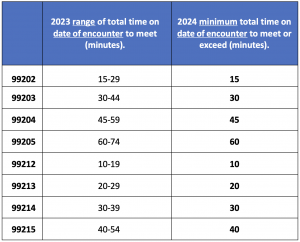
Time-based E&M coding is not a documentation shortcut, it is a precision financial instrument with a hard cliff architecture: a single undocumented minute at the 30-minute threshold costs a practice roughly $30–$45 per established patient encounter, and because the 2021 AMA guidelines require the provider, not the coder, to attest to total time, every minute of that loss is created at the point of care, not at the billing desk. Think of the 99202–99215 time thresholds not as a compliance chart but as a revenue cliff map, where each minute boundary separates one reimbursement tier from the next. A single undocumented minute at the 30-minute mark for an established patient visit means billing 99213 instead of 99214, a loss of roughly $30–$45 per encounter under Medicare rates, according to the CMS Physician Fee Schedule, E&M Office Visit Coding Guidelines (effective 2021, updated 2024).
Across a busy practice, that gap compounds fast, and it compounds fastest in high-volume settings where clinicians are already charting two or more hours outside of patient care time, leaving time attestation to rushed, end-of-day recall rather than real-time capture. That is precisely where iScribe Health's Ambient AI Documentation and E&M Coding Intelligence close the gap. Because the AI drafts the encounter summary at the point of note completion, while the visit is still fresh, total time is captured and reflected in the documentation before the provider ever leaves the room.
For practices running a supported EHR, iScribe Health integrates directly into that existing workflow, so there is no separate step and no separate screen. Real-Time Denial Alerts then surface any time-attestation gaps before the claim goes out the door, turning a potential revenue cliff into a resolved documentation item.
1. 99202 - Minimum 15 Minutes for New Patient Low-Complexity Visits
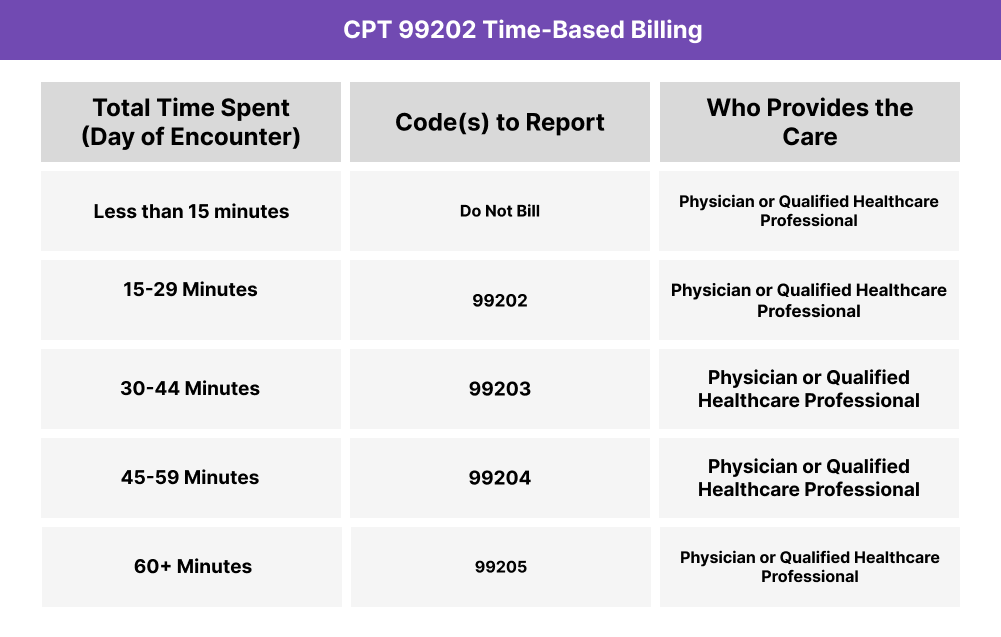
For new patient encounters, 99202 requires a minimum of 15–29 minutes of total time on the date of service when using time-based E&M coding. This is the entry-level new patient code, appropriate for straightforward problems with minimal data review. The tradeoff: providers who underestimate time documentation risk downcoding audits, since every minute must be contemporaneously recorded.
2. 99203 - 30–44 Minutes Signals Low-to-Moderate New Patient Complexity
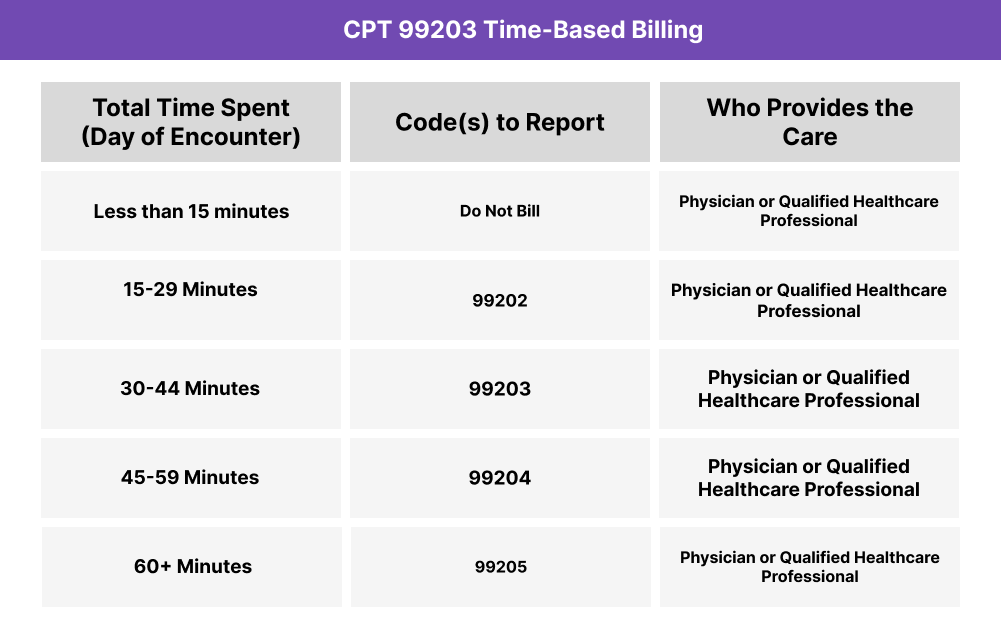
99203 covers new patient visits lasting 30–44 minutes total on the date of service. It suits encounters involving one or more chronic illnesses with mild exacerbation or new presenting problems requiring moderate workup. Coders must note that time-based selection requires documenting all qualifying activities, history, exam, counseling, and care coordination, not just face-to-face minutes.
3. 99204 - 45–59 Minutes Anchors Moderate-Complexity New Patient Encounters
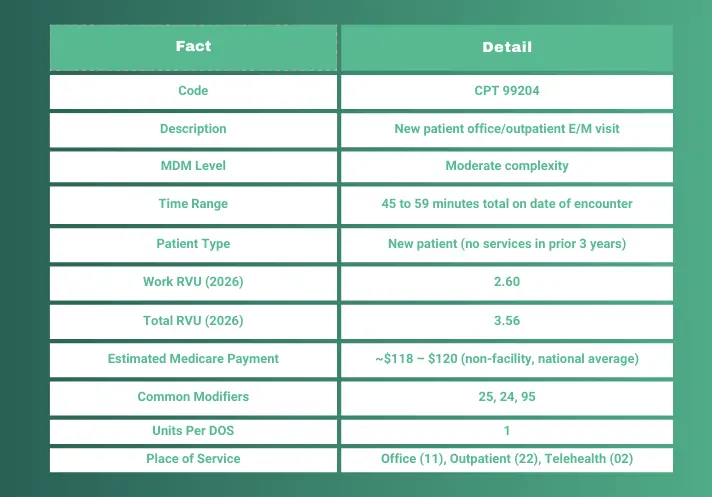
99204 applies when total time on the date of service reaches 45–59 minutes for a new patient. CMS guidance confirms this level reflects moderate medical decision-making complexity, often involving prescription drug management or ordering independent interpretation of tests. The key limitation for time-based coders: all non-face-to-face work must occur on the same calendar date to count toward the threshold.
4. 99205 - 60–74 Minutes Defines High-Complexity New Patient Visits
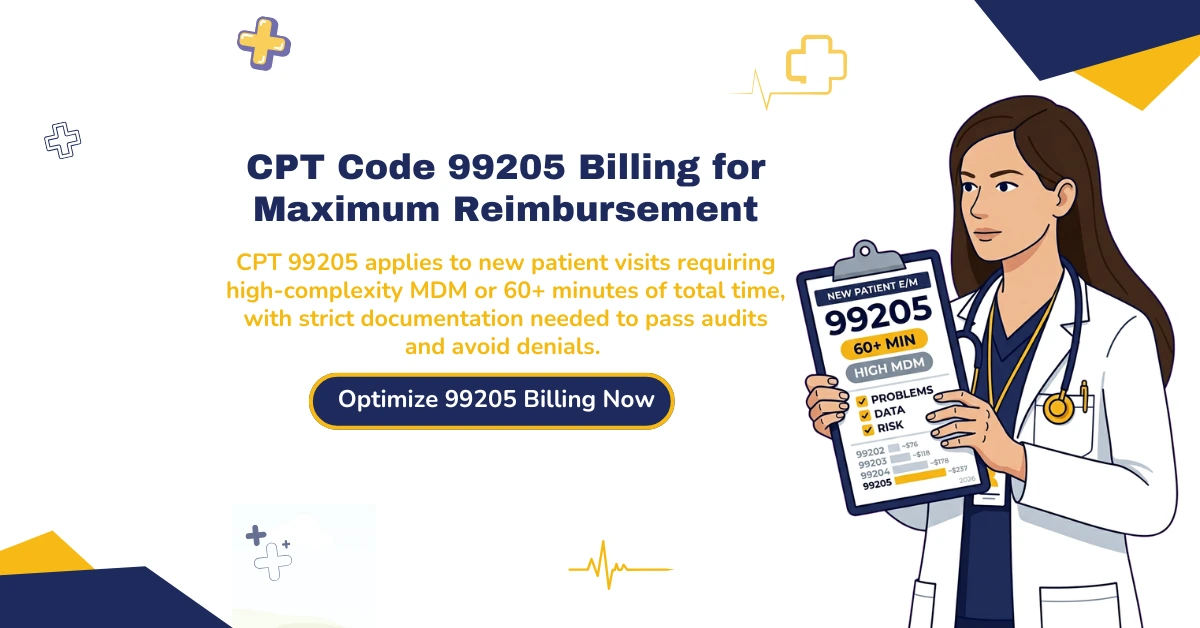
99205 is the highest-level new patient office code, requiring 60–74 minutes of total time on the date of service. It is appropriate for high-complexity MDM scenarios such as severe exacerbations, drug therapy requiring intensive monitoring, or decisions regarding hospitalization. Providers must be cautious: time alone qualifies the level, but documentation must clearly reflect the nature and extent of all activities performed.
5. 99213 vs. 99214 - The 20-Minute vs. 30-Minute Established Patient Dividing Line
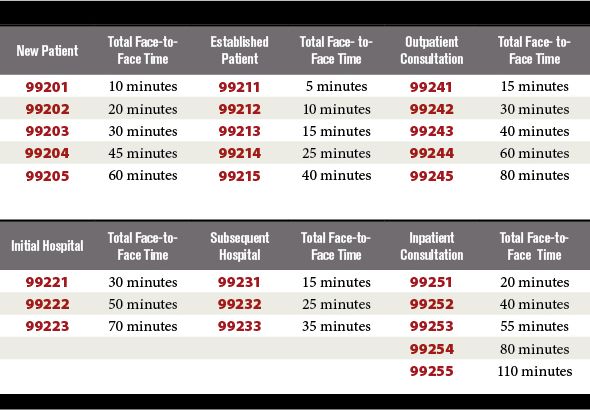
For established patients, 99213 requires 20–29 minutes while 99214 requires 30–39 minutes of total time on the date of service. This boundary is the most frequently audited split in outpatient E&M coding. Behavioral health and primary care providers often hover near the 30-minute mark; without precise time documentation, claims default to 99213, leaving significant reimbursement on the table.
6. 99215 - 40–54 Minutes Required for High-Complexity Established Patient Encounters
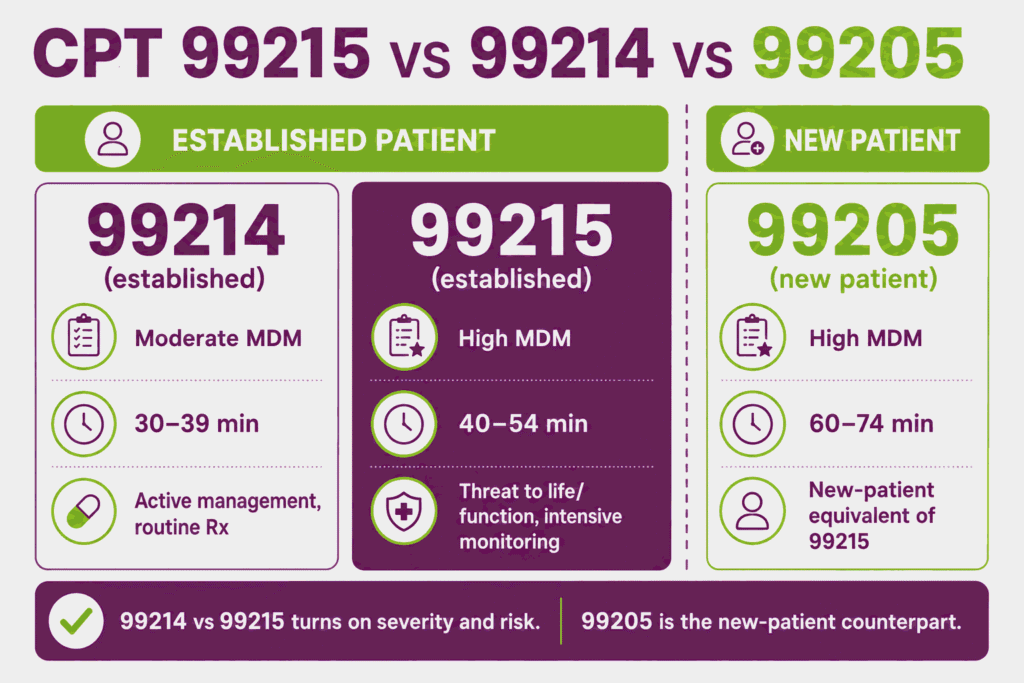
99215 demands 40–54 minutes of total time on the date of service for established patients and represents the highest-level routine office visit code. It is the correct choice for high-complexity MDM, such as uncontrolled chronic conditions, multiple comorbidities, or significant medication management decisions. The primary audit risk: vague time entries like 'approximately 45 minutes' without specifying qualifying activities invite payer scrutiny and potential recoupment.
Related Reading
- Orthopedic Coding Guidelines
- Medical Coding Automation
- E&m Coding Cheat Sheet
- Orthopedic Medical Coding
- Urology Coding Guidelines
Documentation Requirements for Time-Based E&M Coding That Survive Audit
A single number in a clinical note is not documentation. It is a placeholder. And payers know the difference. The documentation requirements for time-based E&M coding go well beyond recording minutes; the language surrounding that number determines whether a claim survives scrutiny or triggers a recoupment demand. Getting this right is not a compliance formality. It is the mechanism that locks in the reimbursement the provider already earned, and it is exactly the kind of downstream risk that OIG auditors are actively targeting in E&M claims.

The Three Non-Negotiable Elements Every Time-Based Note Must Contain
According to guidance synthesized from OIG audit review criteria, a defensible time-based E&M note requires three specific elements:
- The total time in minutes
- The exact date of service on which that time occurred
- A narrative description of the activities performed
Remove any one of these and the note cannot support the code billed. A statement like "Total time spent on 10/15/2025 including pre-visit chart review, counseling, and post-visit care coordination: 42 minutes" satisfies all three.
"Visit lasted approximately 40 minutes" satisfies none of them in a way that holds under audit pressure. This is where iScribe Health's E&M Coding Intelligence directly reduces audit risk. At the point of note completion, after the AI drafts the encounter summary from ambient listening, the system applies E&M coding intelligence to evaluate whether the documentation contains all three required elements before the note is ever finalized.
For high-volume practices where clinicians are regularly charting two or more hours outside of patient care time, that real-time check happens across every encounter, every day, without adding a separate compliance review step.
Audit-Passing Language vs. Audit-Failing Language
The difference between defensible and indefensible documentation is almost always specificity. Audit-passing language names the activities, anchors them to a date, and states a precise minute count. Audit-failing language is approximate, undated, or activity-free.
"Spent time with patient" fails. "Reviewed outside imaging, discussed treatment options with patient and family, coordinated referral: 38 minutes on 11/04/2025" passes. Payers use automated screening tools that flag vague or static time statements before a human reviewer ever sees the file, a pattern well-documented in Medicare audit programs that increasingly rely on algorithmic pre-screening.
iScribe Health's ambient documentation, integrated directly into the practice's existing EHR, produces encounter summaries structured around the specificity that passes that pre-screening layer. The goal is not just speed; it is creating more defensible documentation from the moment the note is generated, rather than retrofitting language after a denial arrives.
Why the Note Must Name Activities, Not Just Minutes
Time without activity is unverifiable. A bare minute count gives an auditor no way to confirm the time was spent on qualifying work. Pre-visit chart review, face-to-face counseling, ordering and interpreting results, and post-visit care coordination all count toward total E&M time under AMA guidelines.
If the note does not name them, they did not happen in the eyes of a payer audit. OIG scrutiny of E&M miscoding specifically targets this gap: claims where a high-level code is billed but the supporting documentation contains no activity-level narrative to justify the time reported. iScribe Health's E&M Coding Intelligence is designed to surface these audit candidates upstream, at the note level, before they become denial events.
Real-Time Denial Alerts extend that protection further: when a completed note carries documentation patterns associated with audit risk, the practice is flagged before the claim goes out the door.
The Copy-Paste Time Statement, A Silent Audit Red Flag
Consider a provider who uses the same templated EHR phrase, "Time spent: 30 minutes," on every visit regardless of what actually occurred. To a human reviewer this looks like inattention. To an automated payer screening tool, it looks like a pattern, and patterns of static, repeated time documentation are among the triggers OIG auditors are trained to identify.
A static template is not documentation. It is a liability that compounds across every encounter it touches. Because iScribe Health's ambient AI listens to and drafts each encounter individually, and because its E&M Coding Intelligence evaluates each note on its own merits at the point of completion, the copy-paste problem is structurally avoided rather than manually policed.
For practices already running a supported EHR and looking for a seamless ambient documentation experience, that protection is built into the workflow, not bolted on after the fact.
Common Time-Based E&M Coding Mistakes That Drain Revenue and How to Stop Making Them
Those upstream failures show up in the numbers: forty percent of finalized notes that reach a billing team each month lack sufficient time documentation to support the code the provider actually earned. That number is not a coder performance problem. It is a documentation design problem, and it starts before anyone in billing opens a single chart. The gap is not effort. The gap is visibility. Providers spend the time. They just do not capture it in a form that survives the journey from exam room to finalized note.
1. Clocking Total Encounter Time Instead of Only Face-to-Face Time
Since the 2021 AMA E&M overhaul, time-based E&M coding for office visits counts all time on the date of the encounter, pre-visit chart review, counseling, care coordination, and documentation, not just minutes spent face-to-face with the patient. Practices that still log only in-room time routinely undercode by one or two levels, leaving significant reimbursement on the table every single day.
2. Failing to Document the Exact Time Spent in the Medical Record
Selecting a time-based E&M level without recording the specific number of minutes in the note is one of the fastest paths to a denied claim or a costly audit finding. Payers require a documented time statement, not a vague reference to a 'lengthy visit', to validate the selected code. The tradeoff is that adding this statement takes seconds but is almost universally skipped under EHR time pressure.
3. Mixing Medical Decision Making and Time on the Same Claim Without Choosing One
Providers may select either medical decision making (MDM) or total time as the basis for an office visit E&M level, but not both simultaneously. A common revenue-draining error is documenting time in the note while the coder defaults to MDM, or vice versa, creating a mismatch that auditors flag immediately. Practices must establish a clear, consistent workflow that commits to one methodology per encounter before the claim is submitted.
4. Undercounting Time Spent on Care Coordination Outside the Visit
Post-visit phone calls to specialists, prescription management, and reviewing outside records on the same calendar date all count toward billable time under current E&M guidelines, yet most providers never capture them. Behavioral health and primary care practices are especially vulnerable because care coordination is a large share of their workload. The limitation is that tracking these activities requires a deliberate time-logging habit that most EHR workflows do not prompt automatically.
5. Applying Outdated Time Thresholds from Pre-2021 CPT Guidelines
The 2021 CPT revisions replaced the old time ranges for 99202–99215 with new thresholds, for example, 99214 now requires 30–39 minutes of total time rather than the legacy 25-minute face-to-face benchmark. Practices still using pre-2021 reference cards or EHR templates built on old rules are systematically miscoding encounters, triggering both underpayments and compliance exposure. Auditing your EHR's built-in time prompts against current AMA thresholds is a non-negotiable first step.
2024–2025 E&M Coding Updates Every Billing Team Needs to Apply Right Now
The AMA overhaul was the headline. But the 2024–2025 rule cycle introduced changes that are quietly reshaping reimbursement right now, and most billing teams have read about them without fully operationalizing them.
1. Confirm Total Time Replaces Key Components for Office Visits - No Exceptions
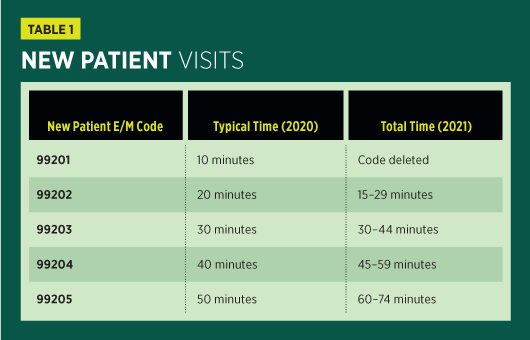
Since 2021, time-based E&M coding for office and outpatient visits has allowed providers to select level solely on total time, including non-face-to-face work on the date of service. Billing teams must ensure documentation captures all qualifying activities: reviewing records, ordering tests, and care coordination. The tradeoff is that any undocumented time segment can collapse the entire level selection, making thorough provider education non-negotiable.
2. Apply the 2024 Revised Prolonged Services Thresholds Before Submitting Any Level-5 Claim
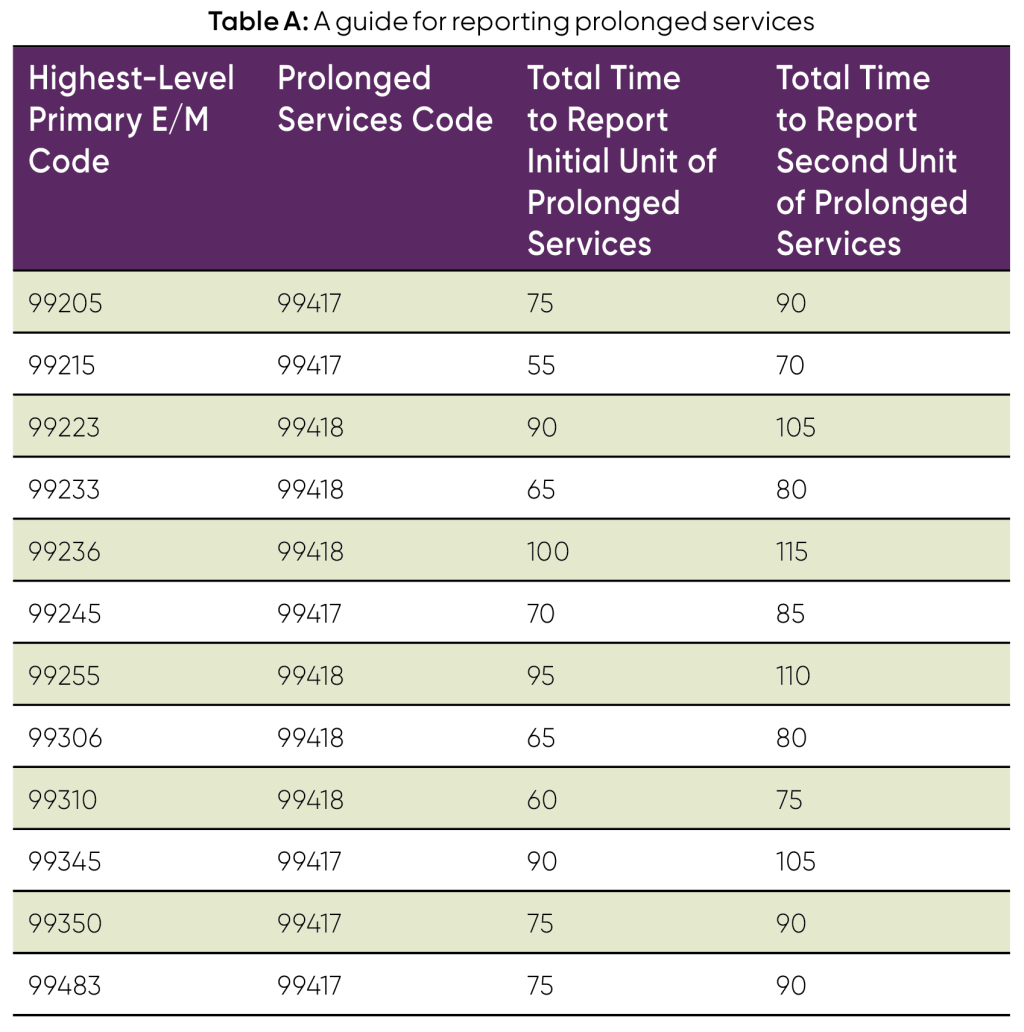
CPT 2024 restructured prolonged services by retiring add-on code 99417 thresholds and aligning them with new time floors above the highest base code. Billing teams must verify that the documented total time clears the minimum threshold, typically 15 minutes beyond the level-5 ceiling, before appending the prolonged services add-on. The critical limitation is that CMS uses a different HCPCS add-on code (G2212) with its own distinct time requirements, creating a dual-track compliance burden.
3. Enforce the 2024 Split/Shared Visit Rule Requiring Substantive Portion Documentation by Time
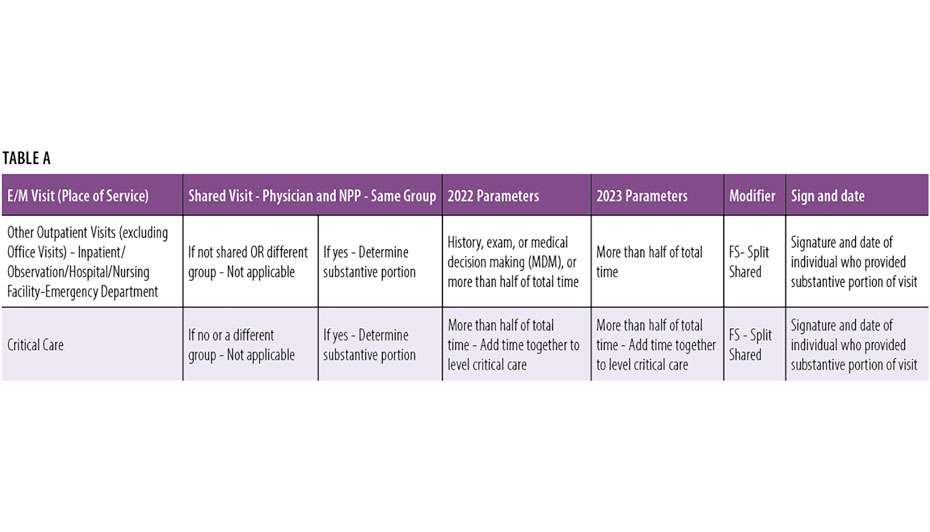
Starting in 2024, CMS finalized that the substantive portion of a split or shared E&M visit must be defined by time when time is used as the basis for billing. The billing provider must be the one who spends more than half the total time, and documentation must explicitly attribute time to each clinician. Teams that fail to segregate physician versus APP time risk downcoding or medical necessity denials on high-volume inpatient and outpatient encounters.
4. Reconcile CY 2025 PFS Conversion Factor Changes Against Time-Based Reimbursement Projections
The CY 2025 Medicare Physician Fee Schedule final rule adjusted the conversion factor, directly affecting the dollar value of time-based E&M codes even when level selection is correct. Billing teams must rerun reimbursement projections for high-volume time-coded visits, especially level 4 and 5 office visits, to catch revenue shortfalls before they compound. The tradeoff is that conversion factor shifts are outside the practice's control, making accurate time documentation the only lever teams can pull to protect revenue.
5. Standardize Documentation Templates That Capture All Time-Qualifying Activities Per CMS MLN Guidance
CMS MLN guidance specifies which activities count toward total time for E&M coding purposes, including reviewing external records, communicating results, and coordinating care with other providers. Billing teams should build or update EHR templates to prompt providers to log each qualifying activity with discrete time stamps. The real limitation is provider adoption, even a well-designed template fails if clinicians skip time fields under visit volume pressure, making ongoing auditing essential to sustain compliant time-based E&M coding.
Related Reading
- Best Medical Coding Software
- Urology Medical Coding
- Ai Medical Coding Companies
- Medical Coding Outsourcing Companies
- Medical Coding Optimization
How AI-Assisted Documentation Closes the Time Capture Gap Before It Becomes a Billing Loss
The gap between time spent and time recorded is not a rounding error; it is a structural flaw in how clinical documentation has traditionally worked. A physician finishes a 38-minute visit, moves immediately to the next room, and reconstructs the encounter from memory six hours later. By then, the precise breakdown of time spent reviewing outside records, counseling the patient, and coordinating post-visit care has compressed into a single estimated total, if it survives at all.
That estimate is what reaches the coder, and it is rarely sufficient to support the level of service the encounter actually warranted. A reality that surfaces repeatedly in practices running internal audits: the coder did not undercode the visit. The note did.

By the time a billing team opens a finalized chart, the decision about which E&M level gets billed has already been made, silently, hours earlier, when a provider reconstructed a 40-minute encounter from memory at 9 PM. In high-volume practices where clinicians regularly chart two or more hours outside of patient care time, this pattern repeats across every encounter, every day, compounding into a revenue problem that no downstream coding protocol can fully reverse.
The Documentation Drag Score - Why Every Hour of Delay Has a Dollar Cost
Every hour between encounter and note completion is an hour in which billable context decays. What most EHR audit logs confirm is that chart completion time is a discrete, trackable metric embedded in EHR metadata, meaning payers and auditors can distinguish notes completed at the point of care from those finalized later. That interval is what a Documentation Drag Score measures: the gap between when qualifying time was spent and when it was captured.
Across the market, a meaningful share of E&M claims are billed one level below what the encounter actually supported, not because coders lack skill, but because the note omitted the time statement that would have justified the higher code. A single undocumented minute can drop a 99214 to a 99213, and no coder protocol recovers that once the note is finalized. iScribe Health's Real-Time Denial Alerts surface exactly this kind of threshold risk at the moment the AI drafts the encounter summary, at the point of note completion, before the chart is finalized and the coding decision becomes irreversible.
How Real-Time Documentation Converts Time-Based Coding from Estimate to Audit-Ready Output
The core synthesis here is this: AI-assisted real-time documentation does not merely reduce physician burden; it structurally converts time-based E&M coding from a discretionary, memory-dependent estimate into a deterministic, audit-ready output. Broader documentation research found that chart completion at the point of care was associated with measurably more complete clinical detail compared to notes finalized hours later, supporting the case that real-time capture directly improves documentation specificity. A study in JAMA Internal Medicine further demonstrated that team-based documentation support measurably reduced the time physicians spent in the EHR, reinforcing that ambient scribing tools have a quantifiable effect on charting burden at scale.
iScribe Health's ambient AI documentation is purpose-built for this problem. Using conversational AI and ambient listening, it captures each qualifying activity at the moment it occurs during the visit, delivering the greatest value precisely when physicians want a completely hands-free documentation experience and cannot afford to pause the encounter to type. The AI drafts the encounter summary automatically; iScribe Health's Automated E&M Coding and E&M Coding Intelligence then operate at the point of note completion, mapping documented time to the appropriate code level before the chart closes.
Because the system integrates directly with supported EHRs, that output lands in the physician's existing workflow without a separate documentation step. The downstream effect is standardization: clinical documentation quality becomes consistent across the practice rather than varying by how tired a physician is at 9 PM or how many patients preceded this one. By capturing each qualifying activity at the moment it occurs, the platform simultaneously eliminates the documentation lag that produces vague attestations, the threshold cliff risk that drops claims one full code level, and the upstream capture failure that makes undercoding invisible until an internal audit reveals it.
The hidden cost is structural: cognitive load compresses "pre-visit chart review: 11 minutes, patient counseling: 14 minutes, care coordination: 9 minutes" into "approximately 35 minutes," and iScribe Health's ambient documentation resolves it at the source, not after the fact.
Next steps
If your billing team keeps landing on 99213 when the encounter clearly supported 99214, the path forward starts with fixing where the decision actually happens. The coding level is determined in the exam room, not at the billing desk. Once a provider closes a note without recording specific, activity-level time, no coder can recover what was never written down. Start with our AI medical scribe.
The 30-to-39-minute threshold for 99214 costs a practice roughly $30–$45 per established patient visit when a single undocumented minute drops the claim one full level, and that loss repeats across every encounter, every day. At the same time, G2211's first-year adoption ran far below CMS projections not because coders missed the code, but because the eligibility criteria were never captured in the note to begin with. Both problems share the same root: documentation completed after hours under cognitive load strips out the specificity that billing depends on. Together, they point to moving time capture to the point of care, before the chart closes and the revenue gap becomes permanent.
Start with an AI medical scribe that captures qualifying activities in real time, drafts the encounter summary at the point of note completion, and applies E&M coding intelligence before the chart is ever finalized. The result is time attestation that is specific, defensible, and coded correctly the first time.
Frequently Asked Questions
What time is excluded from billable E&M time?
Travel time, clerical and administrative tasks unrelated to clinical management, time spent on separately billed procedures, and time accumulated on a different date of service are all excluded from total E&M time under the 2021 AMA framework. Only time the billing provider personally spends on the date of the encounter counts toward the total.
What are the risks of using copy-paste or templated time statements in notes?
Providers who use templated time statements that do not change visit-to-visit create a pattern that payer audits flag immediately. The risk goes beyond undercoding, it can expose the practice to audit scrutiny even when the time spent was legitimate.
Does it matter whether I use the time pathway or MDM pathway for 99213 and 99214?
Yes, the 2021 AMA guidelines explicitly allow providers to select whichever pathway yields the higher, better-documented level of service, making pathway selection a financial decision. For example, a diabetes management visit with 45 minutes of fully documented total time qualifies for 99215 via the time pathway even when MDM scores only moderate complexity, which tops out at 99214.
If I finish charting the next morning, can I still count same-day time toward the E&M level?
No, every qualifying minute must occur on the date of the encounter, and the window closes at midnight. Pre-visit chart review completed the evening before and care coordination calls placed the following morning both fall outside the billable window, making next-morning charting a recurring, measurable revenue leak for high-volume practices.
How much revenue can a single undocumented minute actually cost a practice?
A single undocumented minute at the 30-minute threshold for an established patient visit means billing 99213 instead of 99214, a loss of roughly $30–$45 per encounter under Medicare rates according to the CMS Physician Fee Schedule. Across a busy, high-volume practice, that gap compounds quickly, especially when clinicians are already charting two or more hours outside of patient care time.