CPT Code 99283 Explained: Emergency Visit Coding Guide
CPT code 99283 billing errors start at the note. Help your coding team avoid denials with cleaner claims and less documentation burden.


Low MDM sounds like a single checkbox. It is not, and every ED claim coded by feel rather than verified against all three simultaneous thresholds is either leaving money behind or accumulating audit exposure.
The common assumption among practice administrators and billing decision-makers is that if coders and physicians know the criteria for each ED code level, 99283 billing will be accurate and audit-safe. In reality, CPT code 99283 carries a precise legal definition that most ED billing workflows never actually tools built for ED workflows are only as defensible as the definition they are anchored to.
"Patients receive bills for CPT 99283 without understanding what documentation or clinical criteria justified the code, leading to disputes."
— what we hear from medical billing professionals
Every word in that sentence is load-bearing. "Medically appropriate" is not a checklist; it reflects clinician judgment about what the presentation required. "Low medical decision making" is a structured threshold, not a general impression. If the note cannot demonstrate both, the code is not defensible.
The ED E&M family runs five levels, 99281 through 99285, ordered by increasing MDM complexity. CPT that same figure occupies the middle position, Level 3, sitting above the straightforward MDM of 99282 and below the moderate MDM required by 99284. That position makes it the most commonly billed ED code for urgent but non-critical presentations, which also makes it the most frequently miscoded. Both upcoding and downcoding errors originate at the same point: the note.

CPT that same figure must be billed exclusively with Place of Service code 23, defined by CMS as Emergency Room, Hospital. Filing that same figure under POS 11 or POS 22 renders the claim non-compliant, triggering automatic denial or downcoding in most clearinghouse edits. POS errors are among the most avoidable denial categories, and the fix is upstream verification, not retrospective correction.
Knowing the descriptor is the necessary first step. But the phrase that drives the most billing risk in CPT that same figure is the one that looks the simplest: "low medical decision making." What that phrase actually demands from a compliant note is far more structured than most ED documentation workflows are built to deliver.
Key takeaways
- CPT 99283 requires simultaneous thresholds across three distinct MDM components, missing any one of them shifts the billed level, regardless of how the provider intended to code the visit.
- Payer auditors don't infer clinical reasoning; if the note doesn't state it explicitly, it doesn't exist for billing purposes, and the claim is already adjudicated before your team runs a quarterly audit.
- Industry data puts E&M coding accuracy at roughly 55%, and a single-week audit at one orthopedic group surfaced a 33% overcoding rate no one had detected, both directions of error carry real financial and compliance consequences.
- The documentation gaps that cause 99283 miscoding originate at the point of care, not in the billing queue, which means coder training alone can't close them.
- Medicare Administrative Contractors use bell-curve benchmarking to flag physicians whose ED E&M patterns deviate from specialty peers, making a silent overcoding or undercoding pattern a direct audit trigger.
- iScribe Health's Automated E&M Coding analyzes clinical documentation in real time and generates the appropriate E&M code before the claim goes out, closing the documentation gap at the note-creation stage, where the error actually starts.
Medical Decision Making Complexity That Determines CPT 99283 Selection
Correct coding starts with a fact most billing teams already know: CPT that same figure maps to Low Medical Decision Making complexity.

CPT 99283 Is the Level 3 ED Code and Low MDM Is Its Sole Qualifying Engine
CPT 99283 requires Low complexity Medical Decision Making. That boundary is narrower than many teams assume: a straightforward acute illness treated with an over-the-counter recommendation fits cleanly, but add a complicating factor, say, an immunocompromised status, and the problem complexity alone can push the visit toward Moderate MDM and a higher code level.
Why MDM Replaced History and Exam Counts as the Code-Selection Driver
For ED E/M codes, code selection is driven by Medical Decision Making complexity, not by counting history or examination elements. Part B News (DecisionHealth), reporting on the 2023 AMA guideline revision, states this directly: the pre-2023 approach of tallying history and exam bullets is obsolete for emergency department coding. What matters now is whether the note makes the physician's reasoning explicit and traceable across all three MDM components.
Rather than asking physicians to reconstruct reasoning after the encounter, iScribe Health's ambient AI documentation captures the clinical conversation in real time, then drafts an encounter summary at the point of note completion that surfaces the explicit MDM reasoning a payer auditor requires.
The Three-Legged Stool - How All Three Low MDM Components Must Clear the Threshold Simultaneously
All three MDM components must independently meet the Low threshold for a visit to qualify as 99283. According to the AMA CPT E/M Guidelines (that same figure revision) as summarized by Part B News (DecisionHealth), those components are: (1) a low complexity problem such as an acute uncomplicated illness or injury; (2) limited data review such as ordering or reviewing a single test; and (3) low risk of morbidity, such as over-the-counter drug management or a minor procedure with no identified risk factors.
The stool analogy is apt because removing any one leg collapses the code. A visit with a low-complexity problem and low-risk management but no documented data review does not qualify for that same figure; it may fall to 99282. Each component must be documented with enough specificity that an auditor can confirm the threshold without inference.
iScribe Health's Real-Time Denial Alerts close this loop at the point of note completion: when the AI-drafted summary is missing a component that would undermine the coded level, the system flags it before the claim is submitted, enabling practices and health systems to ensure accurate, compliant medical coding across high patient volumes, maximize reimbursement, and minimize claim denials.
CPT 99283 Low MDM Qualification Checklist
- Number & Complexity of Problems → One acute, uncomplicated illness or injury. Documentation must include an explicit diagnosis or differential, with no high-risk complicating factors stated.
- Amount & Complexity of Data Reviewed → Limited data, such as ordering or reviewing a single test. Documentation must name the test(s) reviewed and who reviewed them (e.g. “CXR reviewed by attending”).
- Risk of Complications / Morbidity → Low risk, such as OTC drug management or a minor procedure with no identified risk factors. Documentation must name the management option and link it to the risk level.
For Chief Medical Officers and practice administrators managing high patient volumes, a single blank row multiplied across hundreds of encounters per month represents both revenue lost to downcoding and compliance risk from overcoding. iScribe Health's ambient AI documentation and E&M Coding Intelligence are designed to make a complete, row-by-row MDM record the default output of every encounter, not a post-hoc documentation task physicians carry home at the end of a shift.
How CPT 99283 Compares to Adjacent Codes 99281 through 99285
Understanding where 99283 sits within the five-level ED E&M range is not just an academic exercise: the MDM complexity boundaries separating each code directly determine what gets billed, what gets paid, and what a patient ultimately sees on an EOB. The difference between a Straightforward and a Low MDM determination can hinge on a single clinical detail, making the 99282-to-99283 boundary one of the most consequential and most frequently misapplied lines in emergency coding. Getting that boundary right consistently is where documentation discipline and coding accuracy translate into both revenue integrity and patient trust.
That boundary runs through three adjacent CPT codes, and the distance between them is measured in MDM sub-element thresholds most coders can recite but few practices systematically verify at the point of documentation.
1. CPT 99281-99285 at a Glance - MDM Complexity Tier for Each ED Level
The five ED E&M codes map directly to MDM complexity tiers, not to time spent with the patient. That same figure requires minimal or no MDM, 99282 maps to Straightforward MDM, 99283 to Low MDM, 99284 to Moderate MDM, and 99285 to High MDM. The practical implication: a coder cannot upgrade a level by pointing to a longer visit.
One downstream consequence worth naming: patients frequently experience the level hierarchy as arbitrary or even punitive. A 99282 facility fee from one hospital can run materially higher than a 99283 facility fee from another, a pricing inversion that makes the numbering feel counterintuitive and opaque to anyone reading an EOB. That confusion is a byproduct of the fee-schedule mechanics underlying each code, not a documentation error, but it underscores why coding consistency matters beyond the claim: when the code is wrong, the downstream patient-facing cost is wrong too, and that erodes trust in the practice as well as revenue integrity.
2. CPT 99283 vs. 99282 - The Low vs. Straightforward MDM Boundary
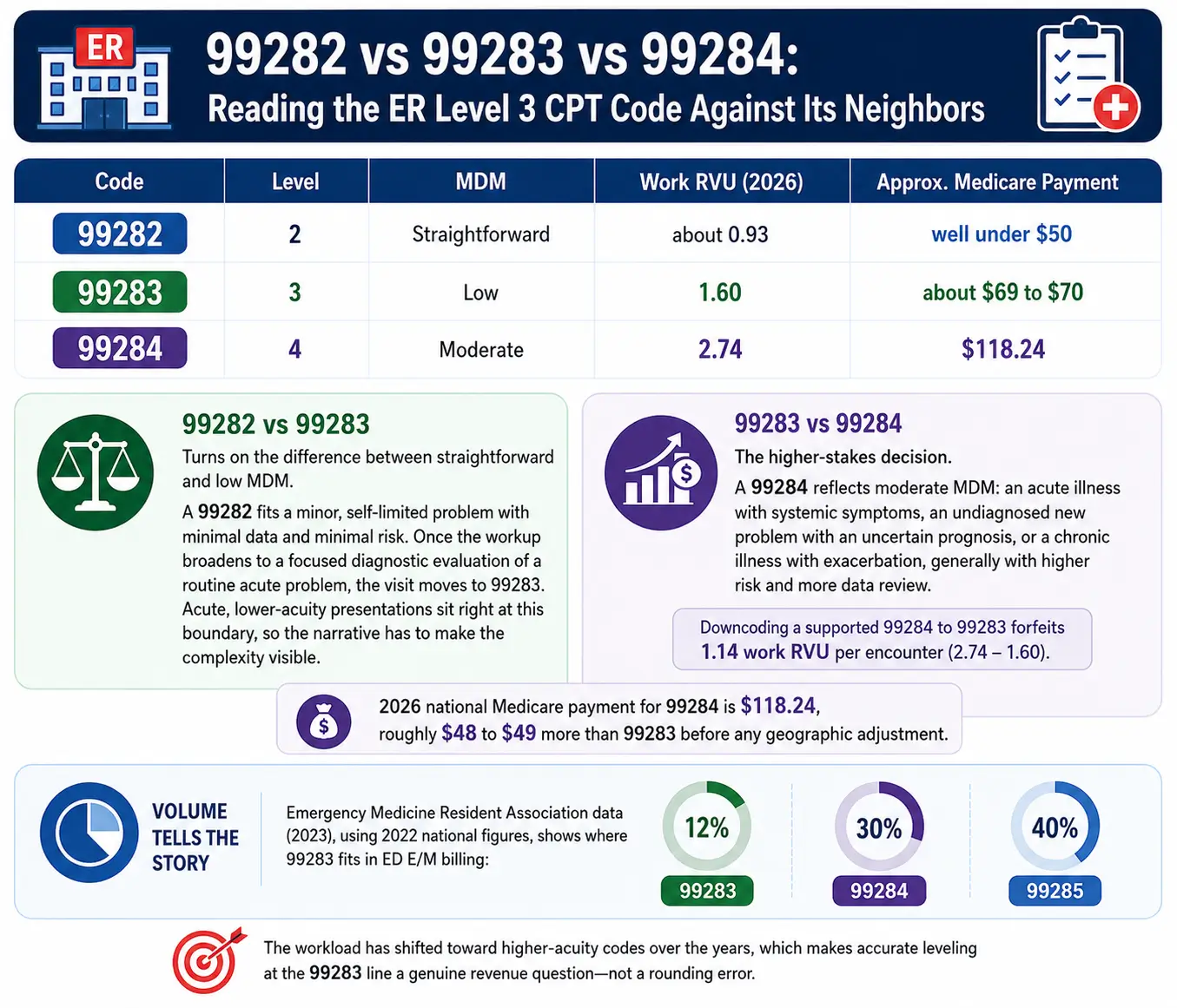
99283 requires Low MDM; 99282 requires only Straightforward MDM. The boundary turns on problem complexity and management risk. A single, stable, acute uncomplicated illness, such as an uncomplicated URI with no complicating factors and no prescription drug management, typically lands at that same figure. Add one element of genuine clinical uncertainty, a worsening trajectory, or a prescription decision, and the encounter crosses into Low MDM territory and supports that same figure. The gap feels narrow in theory; under time pressure, it collapses entirely in the note.
This is where improving coding consistency pays an immediate dividend. iScribe Health's ambient listening and conversational AI captures problem complexity, data reviewed, and management risk as the physician speaks, not after the encounter concludes and memory has faded. Because the AI drafts the encounter summary at the point of note completion, the MDM sub-elements that separate that same figure from 99283 are surfaced in the documentation before the note ever reaches the coder, rather than reconstructed from a skeletal chart entry hours later.
3. CPT 99283 vs. 99284 - The Low vs. Moderate MDM Boundary - the Primary Audit Trigger

Overcoding 99283 encounters to 99284 is the single most common ED audit trigger. 99284 requires Moderate MDM: an undiagnosed new problem with uncertain prognosis, or a chronic illness with severe exacerbation, plus review of independent historian data or ordering of tests requiring independent interpretation, and management options that include prescription drug management with risk of adverse effects or minor surgery. Documenting only a new prescription without capturing the undiagnosed or high-uncertainty problem element is the most frequent documentation gap that collapses a 99284 claim back to 99283.
4. CPT 99285 and Its High MDM Documentation Requirements
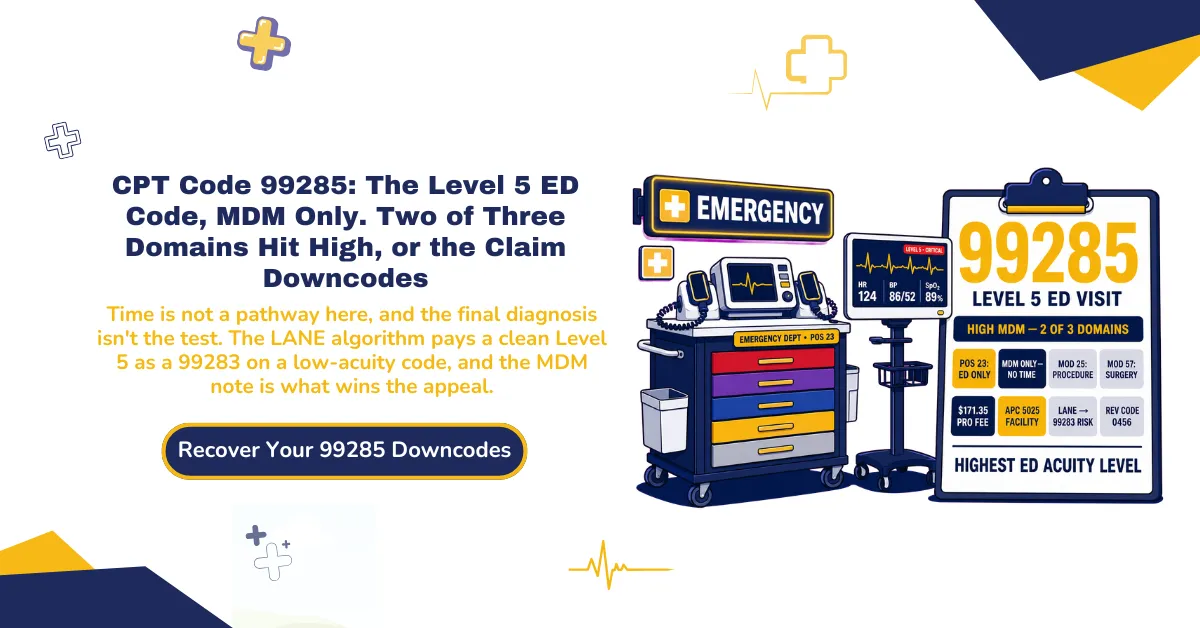
99285 carries the same High MDM designation as 99284 in common shorthand, but the clinical bar is materially higher: the encounter must reflect a threat to life or organ function, and the documentation must make that threat explicit, not implied. Practices that default to 99285 for any high-acuity-feeling visit without explicit MDM evidence face the steepest recoupment exposure in the ED coding spectrum. iScribe Health's ambient documentation captures the clinical narrative as it unfolds, the stated differential, the risk reasoning, the management decision, so that when a that same figure is warranted, the note contains the explicit language payers require, not just the clinical facts that felt obvious in the room.
5. ED Codes Are MDM-Based Only - Time-Based Coding Does Not Apply the Same Way as Office Visits
Unlike office and outpatient E&M codes, ED visit codes cannot be selected on total time as an alternative to MDM. This is the structural difference that makes ED coding uniquely dependent on real-time documentation quality. Most ED physicians mentally classify visit complexity during the encounter but document it under pressure afterward, a gap that silently collapses defensible that same figure encounters to 99283 and inflates straightforward 99282 visits.
That gap is also a primary driver of physician burnout: clinicians in high-volume practices regularly chart two or more hours outside of patient care time, reconstructing clinical reasoning from memory rather than capturing it in the moment. iScribe Health's ambient AI documentation is most impactful in precisely that environment, and it materializes seamlessly when the practice or health system is already running a supported EHR, reducing after-hours charting burden while simultaneously improving the MDM fidelity that ED coding depends on.
Until they ran the trial, no one in the building knew the split. The trade-off worth naming honestly: real-time capture requires a brief physician adoption period and dedicated implementation support before the coding precision gains materialize consistently.
Knowing where each boundary sits is the necessary first step. A decision framework only protects revenue if the clinical note captures the evidence that justifies the level selected. The next section breaks down exactly which documentation elements must appear in a that same figure note to survive a payer audit, and where the gaps most commonly open.
Related Reading
- Cpt Code 99244
- Cpt Code 99203
- Cpt Code 99232
- Cpt Code 99221
- Cpt Code 99205
- Cpt Code 99202
- Cpt Code 99223
- Cpt Code 99222
- Cpt Code 99233
Documentation Requirements for CPT 99283 That Survive a Payer Audit

Research into diagnostic coding accuracy, including work published in peer-reviewed auditing literature, consistently finds that a significant share of E&M visits in audited samples carry clinical records that cannot fully support the code billed (Auditing the Accuracy of Medical Diagnostic Coding, Mirhashemi & Ramezanghorbani). A clinical audit published in the Journal of Medical & Health Sciences Review similarly found that incomplete or templated documentation is a leading cause of medical record deficiencies, with vague or copy-forward language consistently failing to capture the specificity needed to support a given level of service (Evaluating the Quality and Completeness of Inpatient Medical Record Documentation: A Clinical Audit).
Key takeaway: That statistic reflects what the physician wrote, or did not write, before the coder ever opened the chart.
What "Medically Appropriate" History and Exam Actually Means in a Post-2023 ED Note
Instead, the standard is "medically appropriate," meaning the physician documents only the history and exam elements that are clinically relevant to the presenting problem and the decisions being made.
The Three MDM Components Your 99283 Note Must Make Explicit
- The number and complexity of problems: the problem complexity needs a stated diagnosis or differential.
- The amount and complexity of data reviewed: the data section needs to name what was reviewed and by whom.
- The risk of complications: the risk component needs to identify the management option selected and why it carries the level of risk it does.
Red-Flag Phrases That Trigger Automatic Downcoding of a 99283 Claim During Payer Audit
Certain documentation patterns reliably draw scrutiny during a payer audit, including vague clinical impressions, generic exam findings, and unsubstantiated risk statements. Copy-forward notes that repeat prior visit language without visit-specific reasoning are a particularly common exposure point, and, as the Journal of Medical & Health Sciences Review audit confirms, one of the most consistent sources of medical record deficiencies across audited samples (Evaluating the Quality and Completeness of Inpatient Medical Record Documentation: A Clinical Audit).
Most ED physicians document under real time pressure, and templated language feels complete in the moment. iScribe Health's AI medical scribe intervenes at exactly this point. The platform uses conversational AI to listen during the encounter and generate a structured encounter summary in real time, one that explicitly captures problem complexity, data reviewed, and risk assessment using the written language a payer auditor requires.
For practices and health systems already running a supported EHR, iScribe Health materializes as a seamless ambient documentation experience through direct EHR integration, with no parallel workflow required.
Common CPT 99283 Coding Validation Failures Hiding in Plain Sight
Industry audits of ED coding accuracy consistently find that a substantial portion of emergency department E&M claims contain a documentation error significant enough to shift the billed level, a rate that most practice administrators underestimate until an audit surfaces it. That assumption is wrong, and the damage from those errors divides cleanly into two categories: revenue you never collected and liability you don't yet know you're carrying.
1. iScribe AI Audit Reveals 33% Overcoding Rate Invisible to Internal Review

An iScribe AI-assisted documentation audit of 941 ED and orthopaedic encounters uncovered a 33% overcoding rate that no compliance officer, coder, or department head detected before the trial ran. For CPT Code 99283, this means roughly one in three claims carried a level unsupported by documented MDM, a systemic failure hiding in plain sight until algorithmic pattern-matching surfaced it across the full encounter dataset.
2. Time-Pressure Undercoding: 99283-Level Visits Silently Billed as 99281 or 99282
Undercoding is the quieter failure, and it never appears in a denial report because underpaid claims clear adjudication without friction. Physicians working under time pressure in a busy ED routinely omit the complexity details that would justify a Level 3 code, and the encounter goes out as a that same figure or 99282. Industry estimates put the annual revenue leakage from undercoding at tens of thousands of dollars per physician per year, a loss that compounds silently across a group practice.
The note that reaches the coder already has the problem baked in. No downstream correction fixes a note that never captured the encounter accurately. In high-volume practices where clinicians regularly chart two or more hours outside of patient care time, real-time capture is the only reliable way to ensure the note reflects the actual encounter before the claim is ever submitted.
3. Template-Driven Overcoding - Copy-Forward Notes Escalating Claims to 99284 Without MDM Evidence
Copy-forward documentation is the structural cause behind most that same figure overcoding on visits that should have been billed as 99283. Research on EHR copy-forward practices finds that templated notes inflate code levels in a material percentage of audited claims, because the prior visit's complexity language carries forward even when the current encounter doesn't support it. A Health Services Research study by Wardle, Wodchis, Laporte, Anderson, and Baker found systematic discrepancies between what clinicians documented and what was ultimately coded across nearly 10,000 complex admissions, confirming that coding criteria knowledge alone does not prevent this failure.
iScribe Health's Automated E&M Coding operates at the note-completion point, after the AI drafts the encounter summary, and applies E&M Coding Intelligence to flag MDM documentation gaps or unsupported code escalations before the claim goes out. Because the system integrates directly with the practice's existing EHR, that validation happens inside the workflow physicians already use, without adding a separate review step. Payers don't distinguish between intentional overcoding and template drift. The recoupment exposure is identical, and catching it before adjudication is the only correction window that matters.
4. Reactive Payer Record Pulls - The Compounding Consequence of Upstream Documentation Gaps
Post-adjudication record requests are where documentation gaps become dollar consequences. A study tracking Medicare reimbursement trends from 2010 to 2018 found that payer adjudication patterns, not just physician coding decisions, shape the ultimate payment outcome, and that upstream documentation gaps are not correctable after adjudication. When a payer pulls records and the note doesn't support the billed level, the practice faces recoupment on the audited claim and potential extrapolation across similar encounters. The correction window is already closed.
iScribe Health's Real-Time Denial Alerts are designed to surface the signals that precede that moment, but the deeper structural fix is preventing the documentation gap from entering the claim in the first place. That prevention is ongoing, realized across every patient encounter and every day of clinical practice, not a one-time remediation event.
5. Emergency Room CPT 99283 Coding Best Practices - MDM-First Documentation Discipline
Accurate CPT Code 99283 assignment in the ED requires anchoring documentation to the 2021 AMA MDM framework, specifically moderate complexity, rather than defaulting to history and exam element counts. Best practice demands that physicians document the number and complexity of problems, data reviewed, and risk of complications at the point of care, not retrospectively. The single greatest failure mode is treating MDM as implicit rather than explicitly stated in the encounter note.
2026 Reimbursement Rates for CPT 99283 and What Shifts Them
Several layered variables determine what a practice actually collects per encounter.

The 2026 Medicare Rate for CPT 99283 - RVU Breakdown and Dollar Baseline
Key takeaway: CareNiva's Medicare Physician Fee Schedule that same figure data places the facility-setting professional rate for CPT 99283 at $6.68 per encounter, a figure that crystallizes just how thin the per-claim margin is and how quickly volume-driven miscoding compounds into measurable revenue loss.
Three Variables That Move the Real Payment Up or Down From That Baseline
Geographic locality adjustments, facility-versus-non-facility setting, and payer-specific fee schedules each shift the actual collected amount independently, and their combined effect can move realized payment well above or below the published national figure. Practices running iScribe Health with EHR Integration benefit from E&M Coding Intelligence that surfaces the documentation signals tied to each variable, setting designation, locality, and contract-level differentials, at the point of note completion, after the AI drafts the encounter summary, giving coders and clinicians a single, timely view of what is driving the payment calculation.
Why One Physician and One Hospital Can Each Bill 99283 for the Same Visit
When an independent emergency physician group staffs a hospital ED, the physician submits a professional claim and the hospital submits a facility claim for the same patient encounter, each using that same figure as the code anchor. The result is two parallel claim streams, each independently exposed to coding error. As The National Law Review details, a coding level error in a high-volume ED creates compounding exposure: undercoding produces cumulative revenue loss across both claim streams, while overcoding multiplies audit and recoupment liability with every encounter billed at the wrong level.
With the facility-setting professional fee sitting at $6.68 per encounter, a practice billing 50 ED visits per week where a third are miscoded accumulates dozens of revenue-distorting events every week. Clinicians we work with in high-volume practices describe the root problem plainly: documentation that should anchor the coding decision gets written hours after the encounter, often as part of the 2+ hours of after-hours charting that defines physician burnout in emergency and hospital-based settings.
iScribe Health's Ambient Listening and Conversational AI captures the encounter in real time, so the AI-drafted summary reflects what actually happened in the room, preserving the clinical detail that supports accurate level selection before memory and documentation drift can erode it. Once a claim is adjudicated, that outcome is effectively final. Upstream documentation accuracy is the highest-leverage intervention, which is why iScribe Health's coding engine is designed to flag MDM documentation gaps before the claim is ever submitted, before adjudication has locked in the financial outcome.
Related Reading
- Cpt Code 99386
- Cpt Code 99395
- Cpt Code 99385
- Cpt Code 99284
- Cpt Code 99396
- Cpt Code 99283
- CPT Code 99024
- Cpt Code 99499
How Automated E&M Coding Closes the CPT 99283 Documentation Gap Before Claims Go Out
The documentation errors that cause coding inaccuracies originate at the point of care, before a coder ever opens the chart. By the time your team runs a quarterly audit, the defect is already adjudicated.

Why the 99283 Documentation Gap Opens at the Note-Creation Moment Not the Coding Desk
The pattern is consistent across the market: accurate documentation must capture the full clinical picture during the encounter itself, because retrospective coding from a finalized note cannot recover details that were never recorded. A physician finishing a shift at hour eleven does not document the prescription drug management decision that would anchor Low MDM, and that omission becomes permanent the moment the note is finalized.
How Real-Time E&M Code Generation Anchors the Billed Level to What Was Actually Documented
A documentation gap exists before the coder ever opens the chart. When an AI medical scribe captures the encounter in real time, the problem list, data reviewed, and risk stratification are recorded as the clinical reasoning unfolds, not reconstructed from memory after the patient leaves. That complete note then becomes the foundation for code assignment rather than an incomplete proxy for it.
Automated E&M coding applied to a complete real-time note produces a defensible code assignment anchored to what was actually documented.
The Three Friction Points Automated Coding Eliminates Before a Claim Is Adjudicated
Automated coding addresses three distinct failure points, each of which compounds revenue or compliance risk when left unclosed.
- Undercoding disappears when MDM complexity is captured in full during the encounter. Physicians who would otherwise bill that same figure or 99282 because the note did not reflect the decision weight of the visit now have documentation that supports the level actually delivered.
- Overcoding exposure closes just as directly. When the automated system generates a that same figure suggestion but the documented MDM only supports Low complexity, the mismatch surfaces before submission, not in a payer record pull eighteen months later.
- The missing audit trail is resolved because automated coding with real-time documentation creates a timestamped, encounter-level record of every MDM element captured, giving compliance teams an upstream audit trail rather than a post-adjudication reconstruction. AHIMA's coding accuracy benchmarking framework notes that accuracy measurement is applied after documentation is finalized, meaning any gaps created during the encounter are already embedded in the note before any reviewer sees it.
The practical effect is a workflow that respects the physician's clinical judgment while ensuring the documentation that reflects that judgment is complete, timestamped, and defensible before the claim leaves the practice.
Next steps
If your ED encounters are generating claims that look clean on submission but carry invisible MDM gaps that only surface during a payer audit, the path forward starts with closing the documentation gap at the moment of care, not after adjudication has already locked in the financial outcome. Start with our AI medical scribe.
The 99283-to-99284 boundary is the primary audit trigger in emergency coding, and payers use statistical benchmarking against specialty peer norms to flag practices whose coding distributions deviate, meaning criteria-trained coders protect individual notes but not the aggregate pattern that MACs actually scrutinize first. At the same time, the financial case for upstream correction is materially stronger than it appears from any per-claim rate: with the 2026 facility-setting professional fee at roughly $6.68 per encounter, every visit where documentation fails to capture true clinical complexity is a permanent loss, because post-adjudication correction is unavailable and the compounding effect across thousands of encounters dwarfs any upstream intervention cost. Together, those two realities point to one action: capturing complete MDM evidence in real time, before the note is finalized and before the claim is built.
Start by exploring iScribe Health's AI medical scribe to see how ambient documentation captures problem complexity, data reviewed, and risk assessment during the encounter itself. From there, E&M Coding Intelligence and Real-Time Denial Alerts surface MDM gaps before submission, so the documentation deficiency that would otherwise become a payer finding never enters the claim in the first place.
Frequently Asked Questions
What is the specific difference between CPT 99283 and 99284?
CPT 99283 requires Low MDM, while 99284 requires Moderate MDM, meaning at least one of the three MDM components must escalate in complexity. For example, a chest pain visit involving EKG review and troponin interpretation supports 99284, while an uncomplicated musculoskeletal complaint managed with OTC analgesia does not, regardless of how long the note is.
What exactly makes an ED visit qualify as a Level 3 (99283)?
A Level 3 ED visit requires Low Medical Decision Making across all three MDM components simultaneously: a low-complexity problem such as an acute uncomplicated illness or injury, limited data review such as ordering or reviewing a single test, and low risk of morbidity such as OTC drug management or a minor procedure with no identified risk factors. All three must be met at the same time, falling short on any one component drops the visit to a lower level or pushes it higher.
Why does accurate coding of 99283 matter so much for a practice's revenue?
Both upcoding and downcoding errors originate in the note, meaning a single missing MDM component multiplied across hundreds of encounters per month represents revenue lost to downcoding and compliance risk from overcoding. Beyond individual claims, payers use statistical benchmarking against specialty peer norms, so a skewed coding distribution at the 99283-to-99284 boundary can trigger audit scrutiny even when individual notes appear defensible.
What are the most common coding errors at the 99283 level and how can they be avoided?
The most common errors are assigning the code by feel or habit rather than verifying all three Low MDM components are explicitly documented in the note, and filing 99283 under the wrong Place of Service code instead of POS 23. The fix is upstream: ensuring the note contains an explicit diagnosis or differential, a named test reviewed, and a management option linked to its risk level before the claim is submitted, not reconstructed after the fact.
Do ED E/M codes like 99283 ever get selected based on time rather than MDM?
No. Unlike office and outpatient E&M codes, ED visit codes are MDM-based only, a coder cannot upgrade a level by pointing to a longer visit. The five ED E&M codes (99281 through 99285) map directly to MDM complexity tiers, not to time spent with the patient.