CPT Code 99395 Billing and Coding Guide 2026
CPT code 99395 billing errors start at intake. Help your practice stop lost reimbursement before claims are ever scrubbed.


Most 99395 denials are decided before a coder touches the claim. Here is where the real eligibility checkpoint lives, and what it costs when practices miss it.
CPT code 99395 is the billing entry point for one of the most commonly performed services in primary care, yet it is also one of the most frequently miscoded. Most practice administrators and billing decision-makers think that 99395 billing errors are primarily a coder knowledge problem. If the team knows the right modifiers, the right diagnosis codes, and the age rules, revenue will be maximized.
Getting the definition precisely right is not an administrative formality. It is the first clinical documentation decision of the encounter, and when it goes wrong at intake, no amount of claim scrubbing downstream recovers the full revenue that was lost in that opening moment. See our AI medical scribe for how this works in practice.
"Payers like BCBSTX may incorrectly process claims using CPT 99396 (for patients aged 40-64) instead of CPT 99395 (for patients aged 18-39), causing claim denials or incorrect reimbursements due to age-range mismatches."
— what we hear from medical billing professionals
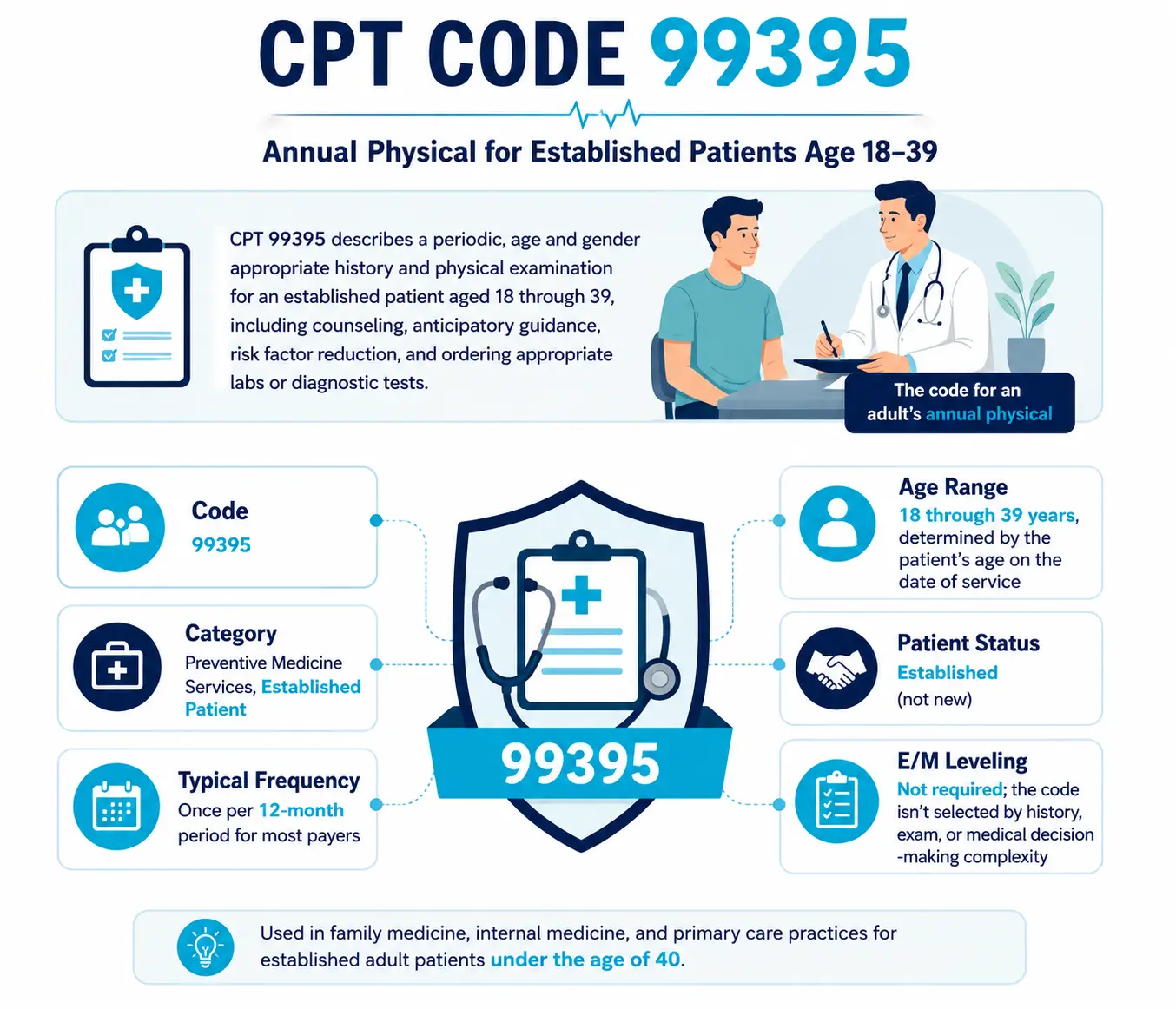
CPT that same figure is a preventive medicine evaluation and management (E/M) service code for established patients aged 18 through 39, representing a routine periodic comprehensive preventive medicine examination, not a problem-oriented visit. Think of a 32-year-old established patient presenting for her annual physical with no acute complaints: that is the prototypical that same figure encounter. The visit centers on health maintenance, age-appropriate screening, counseling, and risk-factor assessment, not on diagnosing or managing a specific condition.

The structural distinction matters. According to the AMA CPT Code Set, preventive medicine codes describe a comprehensive examination of the whole patient, oriented toward wellness and prevention. That is categorically different from an office visit code like 99213 or 99214, which describes an encounter organized around a presenting problem. Confusing the two at the scheduling or intake stage does not just create a coding error. It creates a documentation error, because the provider's note will be structured around the wrong clinical objective from the first sentence.
Preventive medicine E/M codes, including that same figure, do not require documentation of a specific Medical Decision Making (MDM) level or a minimum time threshold. Where office visit codes are validated by the complexity of clinical reasoning or time spent managing a problem, preventive codes are validated by the comprehensiveness of the examination itself: a complete history, an age- and gender-appropriate physical, health risk assessments, and counseling appropriate to the patient's life stage. Payers reviewing a that same figure claim are not asking whether the provider reached a qualifying complexity threshold. They are asking "was this a bona fide comprehensive preventive encounter, and is the documentation consistent with that service type?"
The most expensive that same figure coding errors do not originate with the coder. They originate at intake, when a scheduling team flags an encounter as preventive because the patient presented for a routine annual physical, even though the provider ends up spending most of the visit managing a chronic condition. That misclassification travels through the entire workflow untouched.
Payers like BCBSTX have been documented incorrectly processing claims using age-adjacent codes, such as 99396 for patients who actually qualify under 99395, triggering denials rooted in a mismatch that began before the provider ever entered the room. Getting the definition right is only the first gate. The second, and the one that generates the most mechanically preventable denials, is confirming that the specific patient in front of you actually qualifies for that same figure in the first place, which comes down to two variables: age and patient status.
Key takeaways
- CPT 99395 is an established-patient preventive code for ages 18-39, billing it outside that age band or for a new patient is a guaranteed denial, regardless of how well the visit was documented.
- Medicare categorically excludes routine preventive visits from coverage, so a 99395 claim against a Medicare beneficiary fails at the payer level before a coder ever touches it.
- Roughly one in four primary care wellness visits qualifies for a separate same-day E/M charge under Modifier 25, most practices capture that revenue less than half the time, not because the clinical work wasn't done, but because the note doesn't make the distinction visible to a payer.
- One in three preventive encounter notes contains language that conflates the wellness exam with a separately identified problem, that documentation gap is what triggers audits and recoupment, not coder error.
- The four required components of a 99395 visit must appear in the chart with patient-specific clinical detail; generic or templated language fails payer audits even when the provider delivered a complete visit.
- Documentation captured after the patient leaves loses the clinical specificity that justifies every billable line, the revenue problem starts the moment the provider looks away from the patient to type.
- iScribe Health's Automated E&M Coding generates accurate E&M codes directly from clinical documentation in real time, closing the gap between what happened in the room and what the claim actually reflects.
Age Range and Patient Eligibility Rules for CPT 99395
Three eligibility axes determine whether a that same figure claim pays or denies: age band, patient status, and benefit-year frequency. Each axis operates independently, and a failure on any one of them produces an automatic denial.

CPT 99395 Covers Established Patients Ages 18 Through 39 Not a Day Outside That Band
According to the AGS CoCare Help, CPT that same figure Billing and Coding Guidelines, billing this code for a patient outside that age band is an automatic denial trigger.
Coders who inherit a miscoded encounter spend far longer correcting it. Some payers require a full resubmission cycle rather than a simple adjustment.
Practices running iScribe Health gain an additional layer of protection here. iScribe's E&M Coding Intelligence and Real-Time Denial Alerts surface age-band mismatches at the point of note completion, after the AI drafts the encounter summary, so the physician or care team can confirm the correct code before the claim ever enters the billing queue.
Why 99395 and 99385 Are Not Interchangeable The Established vs. New Patient Line That Triggers Automatic Denials
The same AGS CoCare Help, CPT that same figure Billing and Coding Guidelines define an established patient as someone who has received a professional service from the physician, or from another physician of the same specialty within the same group practice, within the past three years.
The AGS CoCare Help, CPT that same figure Billing and Coding Guidelines note that 99385 governs new patients in that age range; that same figure is reserved for established patients. When front-desk staff misclassify a returning patient as new at registration, the downstream coding error is immediate. The code that flows from that registration error is 99385, and correcting it after submission consumes time and risks delayed reimbursement.
iScribe Health's EHR Integration is where that visibility gap closes. The three-year professional-service history that determines that same figure versus 99385 lives in the same integrated record the AI is already reading.
Front-Desk Registration Is the Real Eligibility Checkpoint Not the Billing Queue
The AGS CoCare Help, CPT that same figure Billing and Coding Guidelines also confirm that most payers cover only one preventive visit per benefit year; a second that same figure claim within a 12-month window triggers an automatic denial regardless of how accurately the code itself is applied. That frequency rule makes scheduling the true first line of defense.
For practices already running iScribe Health, Real-Time Denial Alerts extend the benefit-year frequency check into the clinical documentation layer. Practices that build those checks into the scheduling workflow eliminate the most mechanically preventable denial category in the 9939x series.
- Age on Date of Service → Confirm the patient is 18–39 years old on the actual service date, not the booking date. Pass: Age falls within 18–39.
- Patient Status → Confirm whether the patient received a professional service from a same-specialty provider in the same group within the past 3 years. Pass: Established = that same figure; New = 99385.
- Benefit-Year Frequency → Check for any prior preventive visit billed to the same payer within the current benefit year. Pass: No duplicate within the 12-month window.
- Payer Class → Confirm the primary payer is not Medicare, which uses G0438/G0439 rather than that same figure. Pass: Commercial or ACA-compliant plan confirmed.
- ICD-10 Pairing → Ensure a preventive diagnosis code is selected rather than an acute or chronic code. Pass: Preventive Z-code ICD-10 queued.
Practices using iScribe Health's Automated E&M Coding and E&M Coding Intelligence have a second checkpoint built into the clinical documentation workflow itself: the AI's coded encounter summary, generated at the point of note completion, surfaces the suggested code and any conflict signal before the claim is submitted, so neither physician burnout nor time pressure forces a miscoded claim through to the payer.
Core Components a CPT 99395 Visit Must Include
Payers audit the note, not the encounter. A provider can deliver a textbook visit and still face recoupment if the chart fails to reflect each required component with patient-specific clinical detail. The AMA CPT Code Set, 2024 specifies four discrete components that must appear in the record. Each one is a real-time documentation task, not a billing team reconstruction. Here is what each requires.
- Comprehensive History: the patient's past medical, family, and social history alongside a complete review of systems, updated at this specific visit.
- Age and Gender Appropriate Physical Examination: comprehensive, individualized findings across relevant organ systems, calibrated to the patient's age and sex.
- Health Risk Assessment and Lifestyle Counseling: each lifestyle risk factor addressed individually, with patient-specific guidance documented.
- Anticipatory Guidance and Risk Factor Reduction: forward-looking education tied to the patient's age, life stage, and identified risks.
1. Comprehensive History and Age-Appropriate Physical Examination
A valid claim requires a comprehensive history that documents past medical, family, and social history alongside a full review of systems, actively gathered at this visit, not carried forward from a prior note without documented review. The AMA CPT Editorial Panel and CMS Preventive Services Guidelines, 2024 further require that the physical examination reflect individualized, age- and sex-appropriate findings across relevant organ systems. For an 18-to-39-year-old patient, a templated string of normal findings applied without patient-specific observations is a primary audit trigger, because it cannot demonstrate the exam was conducted, not just copied.
2. Health Risk and Safety Assessments Covering Substance Use, Fall Risk, and Lifestyle Factors
The CMS Preventive Services Guidelines, 2023 require the record to document each lifestyle risk factor individually:
- tobacco use
- alcohol and substance use
- physical activity
- nutrition
- safety
A single line that does not name the specific risks assessed and what the provider found or discussed for this patient does not meet the standard. This component is most frequently lost when providers reconstruct the visit from memory, because broad categories collapse into generic phrases the moment clinical detail is no longer fresh.
3. Anticipatory Guidance, Counseling, and Risk-Factor Reduction Education
CPT 99395 requires the provider to deliver counseling aligned with identified risk factors, covering topics such as injury prevention, healthy weight maintenance, safe sex practices, and stress management. This component transforms the visit from a passive exam into an active intervention. The key tradeoff is time: thorough counseling extends encounter length, and practices must balance quality education with scheduling throughput to keep the visit financially viable.
4. Ordering or Performing Routine Screenings, Immunizations, and Lab Work - With Separate Coding Caveats
Every screening test, immunization, or lab ordered during the visit must be individually documented in the note, including what was ordered, what was administered, and the clinical rationale for each. The AMA CPT Code Set is explicit that these services are not bundled into the preventive E/M code and may require separate CPT codes depending on the payer. A service absent from the note cannot be billed separately, regardless of whether it was performed. Payer bundling rules vary enough that discrete, per-service documentation is the only position that holds across a mixed-payer panel.
5. Documentation Requirements That Satisfy Medical Necessity and Payer Audit Standards for Preventive Visits
The gap between a visit that happened and a visit that pays is almost always a documentation gap. Each of the four components above must carry patient-specific clinical detail: the history reviewed at this encounter, exam findings as observed (not defaulted), risk factors addressed by name, and every order or administration recorded individually. Generic, templated language across any component is the single most common audit trigger for preventive E/M codes, because it signals to reviewers that the note was populated rather than captured.
Practices with inconsistent documentation quality across providers face compounding exposure, since the same visit type produces defensible records from some physicians and vulnerable ones from others, with no visibility into which is which until an audit surfaces the split.
Insurance Coverage for CPT 99395 Including Medicare Rules
Practices we work with regularly see patients arrive expecting a $0 preventive visit, only to be billed under new-patient codes such as 99203 or 99204, which their plan does not cover at zero cost-sharing.

Why Payer-Check Must Happen Before the Visit Is Coded
iScribe Health's ambient AI documentation platform addresses this at the documentation layer itself; the moment the AI drafts the encounter summary, its E&M Coding Intelligence and Automated E&M Coding capabilities apply payer-specific logic, routing Medicare encounters to G0438 or G0439 and confirming preventive ICD-10 pairing for ACA-compliant plans before submission.
The downstream effect matters beyond revenue: when physicians are not pulled back into post-visit documentation to chase denial corrections, they recover time at the end of the day, reducing the 2+ hours of after-hours charting that drives burnout in high-volume practices and health systems.
Related Reading
- Cpt Code 99233
- Cpt Code 99203
- Cpt Code 99232
- Cpt Code 99244
- Cpt Code 99221
- Cpt Code 99205
- Cpt Code 99223
- Cpt Code 99202
- Cpt Code 99222
Age-Tiered Preventive Codes Related to CPT 99395
Six codes, two series, one controlling variable: the patient's age on the date of service, not the date the appointment was booked.
The AMA CPT Code Set structures preventive medicine evaluation into two parallel series: the 9938x series for new patients and the 9939x series for established patients. Each series climbs the same three age bands. Billing a code whose age range does not match the patient's age on the service date is a coding error regardless of intent, and the kind of inconsistency that I-Conic Solutions identifies as avoidable when the right verification workflow is in place at the point of documentation rather than at intake.
1. CPT 99395 - Established Patients Aged 18-39 for Preventive Visits
CPT that same figure is one node in a six-code system. It covers established patients aged 18 through 39 receiving a comprehensive preventive medicine evaluation. The age ceiling is hard: a patient who turns 40 before the date of service belongs on CPT that same figure. Billing that same figure for that visit is a coding error regardless of how the appointment was originally scheduled, and the claim will deny on age mismatch. Practices we work with that run high volumes near the 39-to-40 boundary see this error recur at exactly the rate their intake process locks in codes early, which is why iScribe Health's coding intelligence resolves the variable at documentation, not at scheduling.
2. The 9938x New-Patient Series - Parallel Age-Tiered Structure Mirroring CPT 99395
The 9938x series runs in exact parallel to the established-patient 9939x series, with one distinction: new-patient status. CPT 99385 covers new patients aged 18 through 39, CPT 99386 covers ages 40 through 64, and CPT 99387 covers ages 65 and older. Misclassifying an established patient onto a 9938x code, or vice versa, is a separate denial trigger layered on top of any age-band error. Both axes, patient status and age band, must be correct simultaneously for the claim to pay. Improving coding consistency across providers means holding both variables to the same standard of accuracy across every encounter, which is the structural problem iScribe Health's E&M Coding Intelligence is built to address at scale.
3. Age on Date of Service - The Controlling Rule for Selecting the Correct Tier
The patient's age on the date of service controls code selection, not the age captured at scheduling, enrollment, or insurance verification. That distinction is where the lookup-table mindset fails structurally. A patient booked as a that same figure who turns 40 between scheduling and the visit date generates a denial if no one updates the code before submission.
The error is a workflow gap baked into scheduling defaults, not a coder knowledge gap. Practices with high volume near the 39-to-40 or 64-to-65 boundary are most exposed, and the recurrence rate is proportional to how early in the intake process codes get locked in. iScribe Health's Ambient AI Documentation and E&M Coding Intelligence address this at the point where it can still be corrected: during documentation, after the encounter, before submission, improving coding precision in a way that directly impacts revenue across every patient encounter and every day of clinical practice.
Getting the age tier right is the prerequisite, but only half the battle. When a same-day problem-oriented visit is appended to a preventive encounter, the stakes on code accuracy double: a wrong age-tier code paired with a Modifier 25 charge compounds the denial risk and the revenue loss simultaneously, which is exactly where the next section picks up.
Billing CPT 99395 with Same-Day E/M Codes Using Modifier 25
Modifier 25 Answers One Question - Was a Separately Identifiable E/M Service Performed?

The $40-$80 Per-Visit Revenue Gap Most Practices Never See on a Denial Report
The missed $40-$80 that a correctly documented 99213-25 or 99214-25 would have recovered simply does not exist in the system, which is precisely why standard denial reporting cannot surface it.
The Hypertension Adjustment Scenario - A Classic Missed-Revenue Case Study
During the visit, her blood pressure reads elevated and the provider adjusts her medication, counsels her on dietary changes, and schedules follow-up monitoring.
Payer-Specific Rules That Override Standard Modifier 25 Logic
Verification of payer-specific rules before submission, not after denial, is the only way to avoid writing off recoverable revenue as a payer policy issue that was actually a workflow gap.
Why Documentation Quality Drives 99395 Revenue More Than Coder Knowledge
Preventive visits carry a documentation liability that most practices never audit. Studies examining outpatient billing patterns consistently find that roughly one in three preventive encounter notes contains language that conflates the wellness examination with a separately identified problem, creating a single narrative that cannot cleanly support two distinct service codes.
According to iScribe Health's audit analysis, the Center for Sports Medicine & Orthopaedics in Chattanooga analyzed 941 encounters and found a 33% overcoding rate, with 54.8% provider and AI agreement, and until they ran the trial, no one in the building knew the split.

55%
of E&M visits are accurately documented (industry baseline
The Centers for Medicare & Medicaid Services Comprehensive Primary Care Initiative tracked this directly, finding that documentation practices were the primary driver of billing accuracy across participating primary care practices. As iScribe Health's documentation analysis found, notes finalized after the visit lose the MDM signals, counseling specifics, and screening results that justify every billable line, forcing coders to infer complexity that was never recorded.
This is precisely where iScribe Health's Ambient AI Documentation changes the mechanical input. For practices already running a supported EHR, iScribe Health integrates directly into that existing workflow, so the ambient layer materializes without requiring a separate documentation environment.
At the point of note completion, after the AI drafts the encounter summary, iScribe Health's E&M Coding Intelligence and Automated E&M Coding evaluate the captured content and apply the appropriate code, reducing the downstream inferencing that produces miscoded claims in the first place.
When Provider A documents counseling in granular detail and Provider B summarizes the same encounter in two sentences, the coding output diverges, and that divergence accumulates into unpredictable revenue and inconsistent audit risk across the same tax ID.
Revele's billing accuracy analysis confirms that incomplete or inaccurate documentation is the primary driver of claim errors and audit exposure. iScribe Health's ambient approach is most impactful in high-volume practices or health systems where clinicians regularly chart two or more hours outside of patient care time, because that is where the reconstruction gap is widest and the coding risk accumulates fastest.
Related Reading
- Cpt Code 99386
- Cpt Code 99395
- Cpt Code 99385
- Cpt Code 99284
- Cpt Code 99396
- Cpt Code 99283
- CPT Code 99024
- Cpt Code 99499
Next steps
If your 99395 claims are being submitted with accurate codes and still returning denials, underpayments, or audit letters, the path forward starts with fixing documentation at the point of care, not adding another review layer downstream. Start with our AI medical scribe.
The body of this guide established two findings that point to the same conclusion. First, the counseling specifics, screening results, and MDM signals that justify every billable line on a 99395 claim are time-sensitive: when providers reconstruct notes after the encounter, clinical complexity is simultaneously inflated through inference and deflated through omission, producing charts that expose the practice to audit while forfeiting revenue from uncoded screenings and same-day problem visits. Second, the independence of documentation produced during the encounter, not modifier training or coder credentialing, is the actual determinant of whether a same-day E/M service survives adjudication.
Together, they point to one corrective action: capturing clinical documentation in real time, during the visit, before the note becomes a reconstruction.
Start with an AI medical scribe built for clinical-grade accuracy inside your existing EHR. iScribe Health captures the encounter as it unfolds, drafts the note at the point of care, and surfaces E&M coding suggestions and real-time denial alerts before the claim is submitted, so the documentation that reaches the payer reflects the clinical work that actually happened in the room.
Frequently Asked Questions
What's the difference between CPT 99395 and 99396, when does one code apply instead of the other?
The difference is the patient's age on the date of service. CPT 99395 covers established patients aged 18 through 39, while 99396 applies starting on the patient's 40th birthday. A patient who schedules their annual physical at 39 but turns 40 before the appointment date is billed under 99396, not 99395.
Why would a 99395 claim get denied if the patient is clearly in the right age range?
Age is only one of several denial triggers. The post identifies three other common causes: billing 99395 for a new patient instead of the correct new-patient code 99385, submitting a second preventive visit claim within the same benefit year (most payers cover only one per year), and using 99395 for a Medicare patient, Medicare requires G0438 or G0439 instead. Any one of these mismatches causes an automatic denial regardless of whether the age band is correct.
Does the patient have to be seen by the exact same doctor to count as an established patient for 99395 purposes?
No. The established-patient rule applies across same-specialty providers within the same group practice. If the patient received a professional service from any physician of the same specialty in the same group within the past three years, they qualify as established and 99395 is the correct code rather than the new-patient code 99385.
What does the documentation for a 99395 visit actually need to include to survive a payer audit?
The post identifies five required components: a comprehensive history updated at that specific visit (not carried forward without documented review), an age- and gender-appropriate physical examination with individualized findings, a health risk assessment covering tobacco, alcohol, substance use, physical activity, nutrition, and safety each addressed individually, anticipatory guidance tied to the patient's specific age and life stage, and separately documented notation of any routine screenings, immunizations, or lab orders, since those are not bundled into the preventive E/M code and each requires its own billing entry.