CPT Code 99223 Fact Sheet: Billing Rules Explained
CPT code 99223 billing gaps cost practices real revenue. Billing teams, close the gap with automated E&M coding that produces cleaner claims.


The note looked complete. The claim still failed. Here is exactly what high-complexity MDM requires on paper before an auditor ever opens the record.
The code represents the highest level of initial hospital inpatient or observation care, which means it draws the most scrutiny from payers and federal auditors. What makes the problem genuinely costly is that most practices never see it coming. Coders select the right code.
Physicians believe they documented thoroughly. Claims go out clean. Then an audit arrives, and the record cannot prove what the physician actually did.

That gap between clinical reality and documented evidence is where revenue disappears. Real-time coding intelligence exists precisely because good-faith documentation written under time pressure is structurally insufficient to carry a high-complexity claim. See our AI medical scribe for how this works in practice.
Medical Coding by Jen defines CPT code 99223 as the highest level of initial hospital inpatient or observation care, requiring either high-complexity medical decision making or a total encounter time of 75 minutes or more on the date of service. The code is billed once per admission by the same physician or physician specialty group. It applies to the date the physician personally evaluates the patient, not the calendar date of hospital admission, a distinction that generates more claim errors than most billing teams realize.
As the American Medical Association's 2023 CPT code set release confirmed, inpatient and observation care codes were unified into a single framework, retiring the prior structure that treated them as separate billing categories. That change created a window of persistent confusion that auditors have been exploiting ever since.
Two pathways qualify an encounter for 99223. The first is high-complexity MDM, which requires satisfying 2 of the 3 MDM elements at the high-complexity threshold:
- Number and complexity of problems addressed
- Amount and complexity of data reviewed
- Risk of complications or morbidity or mortality
The second pathway is time-based: 75 or more total minutes on the date of the encounter. The note has to prove whichever pathway the physician used. A time-based claim with no documented total minutes, or an MDM-based claim where the note captures only one qualifying element, is indefensible regardless of what happened clinically.
As Medical Coding by Jen identifies, the root cause of failed claims is physician documentation that does not capture the full complexity of MDM actually performed. When an admitting hospitalist logs a diagnosis list without elaborating on the data reviewed or the risk calculus applied, the note implies complexity without proving it.
Admission notes written under time pressure compress the reasoning that justifies a high-level code. The MDM thinking happened. It just never made it into the record. The gap is not effort. The gap is visibility.
The gap is not effort. The gap is visibility.
Key takeaways
- CPT 99223 is the highest-level initial inpatient or observation care code, and that status makes it the first target when federal auditors pull a Medicare Part A sample.
- A one-week audit of a single ortho group found a 33% overcoding rate across nearly a thousand encounters that no one in the building had detected.
- Selecting 99223 correctly requires documentation that explicitly satisfies at least 2 of 3 high-complexity MDM elements, number and complexity of problems, data reviewed and analyzed, and risk of complications. Auditors read the note, not the chart summary.
- Time-based billing at 75 minutes counts all physician work on the date of the encounter, not just bedside time, and most practices lose that credit because the documentation never captured it.
- The date of service must match the calendar date of the physical evaluation, not the admission order, not the ED arrival, and not the notification date. That distinction alone generates denials.
- Consulting physicians can bill 99223 independently on the same date as the admitting hospitalist, and subsequent hospital care codes apply from day two forward. Both facts are routinely missed.
- iScribe Health's Automated E&M Coding evaluates clinical documentation in real time and generates E&M codes before the note is signed, closing the MDM documentation gap at the point it can still be fixed, not after the claim is already queued.
CPT 99221 Through 99223 Code Range Overview and When Each Level Applies
Three codes, three complexity tiers, one selection rule that most billing teams apply too late.
CPT 99221, 99222, and 99223 map to low, moderate, and high medical decision-making (MDM) complexity respectively for initial hospital inpatient or observation care. Under current E/M guidelines, a claim qualifies at a given level by satisfying 2 of 3 MDM elements at that tier, or by meeting a total-time threshold: 40 minutes for 99221, 55 minutes for 99222, and 75 minutes for 99223. Those are the mechanics. The harder problem is that knowing the thresholds does not guarantee a defensible claim.
75 minutes
Total time threshold to qualify for 99223
1. CPT 99221 vs. 99222 vs. 99223 - MDM Complexity and Time Thresholds Side by Side

CPT 99221 requires straightforward or low-complexity MDM (or 40 minutes of inpatient time), 99222 requires moderate complexity (55 minutes), and CPT Code 99223 requires high-complexity MDM (75 minutes). Hospitalists and inpatient coders must match the documented MDM tier precisely to the correct code, as upcoding to 99223 without supporting high-complexity MDM remains a top audit trigger across payers.
2. MDM and Time as the Sole Code Selectors - History and Exam No Longer Count
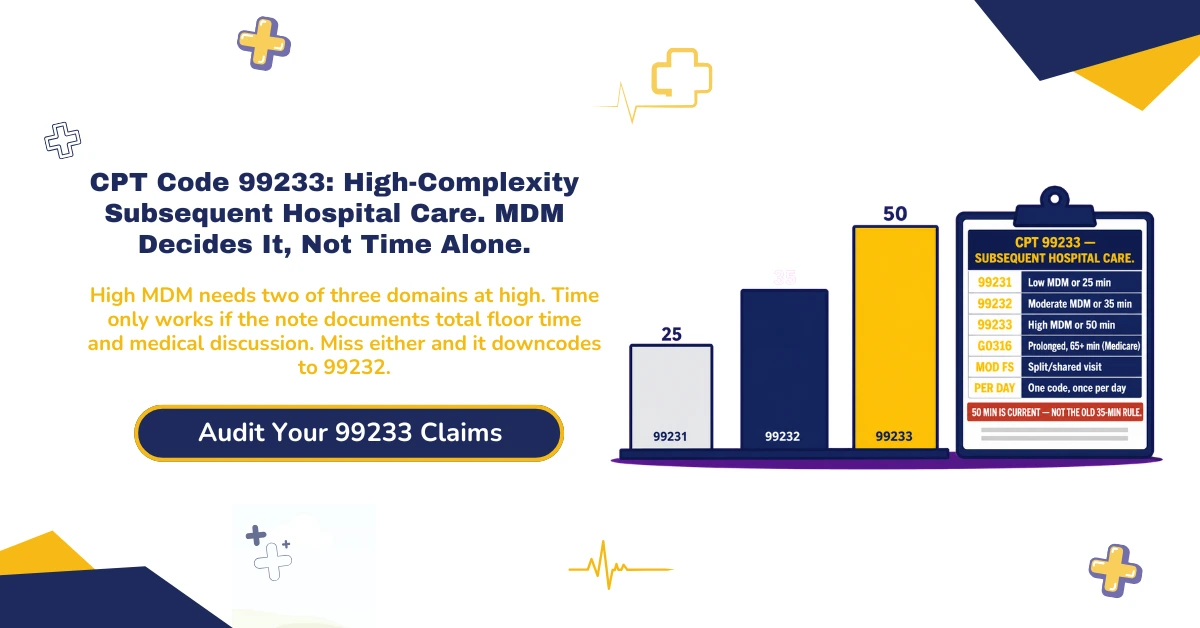
History and physical exam no longer drive E/M level selection under the current guidelines. That shift catches billing teams off guard more often than it should. Physicians who still document extensive review-of-systems to "justify" a higher level are spending time on elements that carry zero weight in the MDM calculation. The only levers that matter now are the three MDM elements and documented time. A note can be clinically thorough and still fail to support the required level if the MDM evidence is buried or absent.
3. Place of Service 21 (Inpatient) vs. 22 (Observation) - When Each Code Setting Applies

Post-2023 guideline changes unified inpatient and observation care under the same 99221-99223 code range, retiring the separate observation-only codes. The distinction between place of service codes matters at the claim level because POS mismatches between the admission order and the billed code remain a common denial trigger:
- Place of service 21 applies to confirmed inpatient admissions.
- Place of service 22 applies to observation status.
- Same-day admission and discharge uses codes 99234-99236 instead, a separate track that catches practices off guard on short-stay encounters.
Most billing teams handle the selection problem by training coders on the tier definitions and trusting that physician notes will carry the necessary evidence. The hidden cost is that notes written between a 14th patient and a midnight discharge rarely map clinical complexity to MDM criteria explicitly. That documentation gap is exactly what iScribe Health's automated scribing addresses by flagging MDM tier alignment in real time, before the note is finalized, closing the gap between what happened clinically and what the claim can actually defend.
Knowing which tier applies is only the first gate. Whether a high-complexity claim survives scrutiny depends on whether the note contains specific, element-by-element evidence that high-complexity MDM requires. That is where the next section picks up.
Documentation Requirements for High-Complexity Medical Decision Making in 99223

The 2 of 3 Rule and Why Ignoring Any Element Creates Audit Exposure
2 of 3
MDM elements needed at high-complexity
Meeting that threshold requires satisfying at least two of the three MDM elements, Problems, Data, and Risk, at the high-complexity level. Creating more defensible documentation and standardizing clinical documentation quality across the practice are the operational fix for a systematic revenue gap that only surfaces when a payer pulls records.
High-Complexity Problems That Qualify for 99223 and the Exact Language That Proves It
Specific examples of high-complexity problems that qualify for that same figure include a new diagnosis with uncertain prognosis, an acute illness or injury threatening life or bodily function, and a chronic illness with severe exacerbation or treatment side effects. The documentation must name the condition and explicitly connect it to one of those qualifying descriptors to withstand scrutiny.
What Actually Counts as High-Complexity Data
High-complexity data documentation requires one of three specific activities: independent interpretation of a test (not just noting that a report was reviewed), review and summarization of external records from another facility or provider, or discussion of the case with an independent historian when the patient cannot give a reliable history.
Documenting High Risk and the Three-Column Evidence Checklist
High risk under the Risk element is met by any of the following, as broader industry trends consistently reflect: drug therapy requiring intensive monitoring for toxicity, a decision for elective major surgery with identified patient or procedure risk factors, a decision for hospitalization, or any procedure carrying significant risk of complications, morbidity, or mortality. Each qualifying factor must be explicitly stated in the note rather than implied by the clinical context alone.
Most physicians write the Assessment and Plan as a narrative organized around the diagnosis, which means the column-specific proof sentences auditors require are often absent entirely. A hospitalist admitting a patient for CHF exacerbation with AKI would instead write: (1) "Patient presents with acute decompensated heart failure with new-onset AKI, representing an acute illness posing a threat to organ function requiring intensive management."
(2) "Independent review of outside echocardiogram from referring facility reveals new reduced EF of 25%, altering management plan." (3) "Decision for inpatient hospitalization with initiation of IV diuresis and daily creatinine monitoring for nephrotoxicity risk." That structure maps each sentence directly to a qualifying MDM element, leaving no gap for an auditor to exploit.
Defaulting to a diagnosis list produces a systematic revenue gap that only surfaces during an audit, when retroactive reconstruction of clinical reasoning is both incomplete and legally vulnerable. iScribe Health's ambient AI medical scribe is most beneficial in the environments where this problem is most acute: high patient volumes and significant after-hours documentation burden. Operating through ambient listening and conversational AI, it integrates directly with supported EHRs for a seamless documentation experience and, at the point of note completion, generates element-specific documentation for each MDM column, so the proof sentence auditors require is captured at the point of care, not pieced together afterward.
That same discipline around MDM applies equally to time-based billing.
Time-Based Billing for 99223 and What Activities Count Toward 75 Minutes

The 75-Minute Rule Counts All Physician Work on the Date of the Encounter
According to the AMA CPT Editorial Panel's 2022 guidance, qualifying activities include pre-visit chart review, ordering and reviewing tests, care coordination, and clinical documentation. A physician who logs only bedside time is measuring a fraction of the work and billing at a fraction of the rate that work justifies.
Reviewing Test Results and Imaging - Why Ordering Isn't Enough
A physician who orders a CT chest, then spends 12 minutes reviewing the radiology report and reconciling findings with the clinical picture, has generated 12 minutes of qualifying time beyond the order itself.
Documentation Time Itself Is Billable
The AMA's framework treats the note as physician work, not administrative burden -- meaning a physician who spends 15 minutes completing a thorough admission note is generating qualifying time, not losing it.
How to Document Total Time - Start/Stop vs. Total Minutes Statement
Two documentation formats satisfy the requirement: a start and stop time, or a statement of total minutes spent on qualifying activities on the date of the encounter.
Date of Service Rules and Inpatient vs Observation Billing Distinctions for 99223
The date of service on a claim must match the calendar date the physician physically evaluated the patient, not the date the admission order was written, not the date the patient arrived at the emergency department, and not the date the attending was notified.

Why the Claim Date Must Match the Evaluation Date Not the Admission Order
The hospitalist evaluates the patient Wednesday morning at 7 AM, so the claim date is Wednesday, not Tuesday. According to the AAPC Knowledge Center, 99223 is reported on the date the physician actually evaluates the patient, not the date of hospital admission, and conflating these two dates is a documented source of claim errors and denials.
This is precisely the struggle hospitalists and their billing teams face when physicians are regularly charting two or more hours outside of direct patient care time; the note is never anchored cleanly to the encounter moment. iScribe Health's Ambient Listening and Conversational AI captures the encounter in real time, and its EHR Integration surfaces that timestamped clinical record at the point of note completion, after the AI drafts the encounter summary, giving billing teams a reliable anchor for the correct date of service.
For high-volume practices and health systems where clinicians routinely carry that 2+ hour after-hours charting burden, the impact materializes across every patient encounter and every day of clinical practice as an ongoing structural correction.
How the 2023 Observation Consolidation Changed Code Selection and When 99234 Through 99236 Apply Instead
iScribe Health's E&M Coding Intelligence and Automated E&M Coding are designed to surface exactly this kind of rule-dependent code selection at the point of note completion, flagging same-day admit-and-discharge scenarios so the correct 99234-99236 code set is applied before the claim is ever filed.
The Once-Per-Admission Rule and When Modifier AI Enters the Picture
Subsequent visits during the same stay shift to 99231 through 99233.
When multiple physicians evaluate a patient on the same admission date, each physician from a different specialty may independently bill an initial hospital care code, provided the documentation supports a separate and distinct evaluation. When the admitting physician and a consulting physician from the same group evaluate the patient on the same date, modifier AI becomes the mechanism that distinguishes the two encounters and protects both claims.
It protects the admitting physician's claim and preserves the consulting physician's independent billing right at the same time. iScribe Health's E&M Coding Intelligence is built to surface modifier requirements like this as part of its AI Customization layer, so the admitting physician's claim carries the correct modifier and the consulting physician's independent evaluation is documented with enough specificity to stand on its own, both captured through Ambient Listening without adding charting time to either clinician's day.
Subsequent Hospital Care Codes and How Consulting Physicians Bill Alongside 99223

Days 2 and Beyond - Why 99231-99233 Replace 99223 After Admission
Improving coding consistency across providers on this exact boundary is where iScribe Health's E&M Coding Intelligence adds immediate value: at the point of note completion, after the AI drafts the encounter summary, the platform surfaces the appropriate code selection rather than leaving each clinician to rely on memory mid-chart.
Consulting Physicians Get Their Own 99223
Improving coding consistency across providers on the initial hospital care code range is precisely the kind of group-level gap iScribe Health's Automated E&M Coding and Real-Time Denial Alerts are built to close, flagging a likely downcode before the claim ever leaves the practice.
RVU Values That Make 99223 Worth Getting Right
Physicians and advanced practice providers in high-volume practices feel the documentation burden acutely, regularly charting two or more hours outside of patient care time, and note quality and coding precision both suffer under that load. iScribe Health's Ambient Listening and Conversational AI captures the encounter in real time, and when integrated with a supported EHR, the ambient documentation experience is seamless: after the AI drafts the encounter summary, E&M Coding Intelligence maps the documented MDM complexity to the appropriate code from the CMS Physician Fee Schedule before submission.
Related Reading
- Cpt Code 99244
- Cpt Code 99203
- Cpt Code 99232
- Cpt Code 99221
- Cpt Code 99205
- Cpt Code 99202
- Cpt Code 99222
- Cpt Code 99233
Common Billing Errors and Audit Risks That Turn 99223 Into a Liability
Federal audit enforcement data makes the exposure concrete: the HHS Office of Inspector General identifies improper inpatient E/M coding, including upcoding of admission levels such as that same figure, as a top Medicare Part A audit risk, with reviews consistently finding that billed complexity levels are not supported by the underlying medical record. A separate OIG audit found that a single hospital's systematic miscoding produced more than $1 billion in overbilled Medicare claims before anyone inside the organization detected it. That finding is a structural indictment of how clinical documentation gets written under time pressure.
1. MDM Documentation That Signals Complexity Without Proving It
The most common assumption among practice administrators and billing decision-makers is that if their coders understand the that same figure–99223 level criteria, they will select the right code and claims will go out clean. The most common that same figure billing error is writing a note that describes a complex patient without documenting the specific MDM elements an auditor needs to see.
A hospitalist note that reads "high-complexity decision-making given multiple comorbidities" tells a clinician everything and an auditor nothing. The 2-of-3 MDM threshold requires documented evidence across Number/Complexity of Problems, Amount/Complexity of Data, and Risk of Complications. Assertions of complexity are not evidence of it.
When post-payment reviewers downcode that same figure claims, MDM documentation deficiency is the primary trigger, and the repayment demand follows the same logic: the record did not prove what the code claimed.
iScribe Health's E&M Coding Intelligence surfaces missing MDM elements at the point of note completion, after the AI drafts the encounter summary, while the physician is still cognitively engaged with the encounter and clinical detail is still accessible. For practices running a supported EHR, this capability activates through seamless EHR Integration without disrupting the existing charting workflow. The physician can close the MDM gap in the moment it opens, before a post-payment reviewer ever sees the record.
2. Missing or Incomplete Time Statements on Time-Based 99223 Claims
Many physicians add a phrase like "extensive time spent coordinating care" without specifying a number. That phrase does not satisfy the threshold. Payers disallow it. The claim downcodes. The fix requires documentation discipline at the moment of the encounter, not a retrospective note added during billing review.
iScribe Health's Ambient AI Documentation captures the encounter in real time through Ambient Listening and Conversational AI, generating a draft that includes time-specific language before the note is finalized. Real-Time Denial Alerts flag incomplete time statements before submission, removing the dependency on a physician to self-audit a note at the end of a high-volume shift.
3. iScribe Trial Data: 33% Overcoding Rate Across 941 Ortho Encounters

According to iScribe's proprietary audit data from a trial at Center for Sports Medicine & Orthopaedics, Chattanooga, 941 encounters were analyzed, with 54.8% provider, AI agreement found alongside a 33% overcoding rate, and none of the coders or physicians in the practice were aware the pattern existed before the audit ran. That is a visibility failure. The gap is measurement.
4. The Two-Way Documentation Failure - Overcoding and Undercoding From the Same Root Cause

Practice administrators typically frame that same figure inpatient E/M audit risk as a one-directional overcoding problem. The actual data contradicts that framing. As iScribe's 2024 analysis documents, the same documentation failures that produce overcoding in one practice produce missed 99223 revenue in another, because underdocumentation cuts both ways.
A hospitalist group whose Assessment and Plan never explicitly documents the data elements reviewed is leaving defensible reimbursement on the table every admission. Conservative coding without measurement relocates the revenue problem without solving the compliance risk.
iScribe Health's Automated E&M Coding applies consistent code-level logic across every encounter rather than relying on individual coder judgment or physician self-reporting, reducing both the overcoding liability and the undercoding revenue loss simultaneously. Because the capability runs across every patient encounter and every day of clinical practice, the protection compounds in exactly the same way the risk does.
5. Industry Benchmark - Only 55% of E/M Visits Are Accurately Documented
The scale of the problem is not practice-specific. Industry benchmarking finds that approximately the same pattern holds.healthleadersmedia.com/finance/oig-audit-finds-hospital-upcodes-overbilled-medicare-1b), meaning nearly half of all evaluation and management claims carry documentation errors that create either overcoding liability or undercoding revenue loss. For a practice billing that same figure across a hospitalist group of ten physicians, that error rate compounds across hundreds of admissions per month. The HHS Office of Inspector General's findings confirm that [a single hospital's systematic miscoding can produce nine-figure repayment exposure before anyone inside the organization detects it.
Most billing teams respond to that risk by investing in coder training or post-submission audits. Both interventions arrive after the irreversible documentation failure has already occurred. The MDM capture failure happens at the moment of documentation, when the physician is still cognitively engaged with the encounter. iScribe Health's Ambient AI Documentation, most impactful in high-volume practices or health systems where clinicians regularly chart two or more hours outside of patient care time, surfaces missing MDM elements before the note is finalized, allowing the physician to complete the record while clinical detail is still accessible. That single workflow step closes both the overcoding liability and the undercoding revenue loss, and its Physician Burnout Reduction effect compounds across every subsequent encounter.
The errors catalogued here share a single structural origin: documentation that is written to describe care, not to defend a code level. The next section shows how Automated E&M Coding changes that equation, turning that same figure accuracy from a manual audit exercise into a measurable, repeatable workflow built into every encounter.
How Automated E/M Coding Closes the 99223 Documentation Gap Before It Becomes a Denial
They originate in a documentation process that evaluates complexity after the window to capture it has already closed.

Why Real-Time MDM Evaluation Catches What Post-Visit Coding Reviews Miss
As eBridge RCM LLC notes, if the note does not reflect clinical complexity at the time of signing, the code cannot be supported regardless of what actually occurred during the encounter. Addenda carry audit risk of their own, and the original note already tells the auditor a story you cannot fully rewrite.
A post-visit coding review cannot fix a process that broke six hours earlier at the bedside.
How Point-of-Care MDM Capture Can Justify 99223 Before the Note Is Signed
An AI medical scribe operating during the encounter evaluates the emerging note against MDM criteria in real time, surfacing prompts when a required element is absent before the physician signs. If the independent data review sentence is missing, the system flags it while the clinical details are still fresh, allowing the physician to address the gap before signing rather than attempting a defensible addendum afterward.
That mechanism matters most in high-census periods, when documentation quality degrades under time pressure precisely when the patient complexity justifying that same figure is highest. iScribe Health's Automated E/M Coding applies that same real-time evaluation to code selection itself, so the code assigned reflects what the note actually contains, not what the physician intended to document.
Revenue Integrity in Both Directions - Surfacing Undercoded 99223 Encounters Alongside Overcoded Ones
Overcoding draws auditor attention, but it represents only half the documentation accuracy problem. Undercoding quietly drains revenue every billing cycle. eBridge RCM LLC makes the mechanism explicit: the same documentation-accuracy process that prevents overcoding also surfaces encounters where high-complexity MDM was performed but not fully documented, recovering defensible revenue that practices are otherwise leaving on the table.
Fix only overcoding and you reduce audit risk while leaving money uncollected. Fix only undercoding and you recover revenue while increasing exposure. Automated E/M coding addresses both simultaneously because it operates on the same evidence layer: what the note actually says versus what the MDM criteria require. eBridge RCM LLC's published guidance on E/M coding changes confirms this bidirectional dynamic, making it a practical framework for practices seeking both compliance and revenue integrity at once.
Related Reading
- Cpt Code 99386
- Cpt Code 99395
- Cpt Code 99385
- Cpt Code 99284
- Cpt Code 99396
- Cpt Code 99283
- CPT Code 99024
- Cpt Code 99499
Next steps
If your admission notes are describing clinical complexity without proving it element by element, the path forward starts with capturing MDM evidence at the moment of the encounter, not reconstructing it during billing review. Start with our AI medical scribe.
The finding that a 33% overcoding rate can sit undetected across nearly a thousand encounters confirms that coder competence alone cannot close this gap. When the note fails to document a discrete proof sentence for each qualifying MDM element, even a perfectly trained coder is forced to either downcode or submit a claim the record cannot defend. That is a documentation capture failure, not a coding knowledge failure.
At the same time, the time-based pathway carries its own upstream vulnerability: pre-visit chart review, care coordination, and documentation time all count toward the 75-minute threshold, but only when the physician records them on the date of the encounter. Both pathways fail for the same reason, the clinical work happens, and the note does not capture it. Together, they point to one corrective action: surfacing missing MDM elements and unrecorded qualifying time before the note is signed, while the clinical detail is still accessible.
Start with iScribe Health. The ambient documentation and real-time E&M coding intelligence work together to flag incomplete MDM elements before the note is finalized, so every 99223 claim reflects what actually occurred clinically rather than what a physician could piece together hours later from memory.
Frequently Asked Questions
Do history and physical exam still factor into selecting 99223?
No. Under current E/M guidelines, history and physical exam no longer drive level selection. The only levers that matter are the three MDM elements and documented time, which means a note can be clinically thorough and still fail to support 99223 if the MDM evidence is buried or absent.
What does 'high-complexity medical decision making' actually mean for an initial hospital admission?
High-complexity MDM for 99223 means the documentation explicitly satisfies at least 2 of the 3 MDM elements at the high-complexity threshold: Number and Complexity of Problems Addressed, Amount and/or Complexity of Data Reviewed and Analyzed, and Risk of Complications and/or Morbidity or Mortality of Patient Management. Examples of qualifying problems include a new diagnosis with uncertain prognosis, an acute illness threatening life or bodily function, or a chronic illness with severe exacerbation.
Does the 75-minute threshold for 99223 only count time spent at the bedside?
No. All physician time on the date of the encounter counts, not just bedside minutes. Qualifying activities include pre-visit chart review, ordering and reviewing tests, care coordination, and clinical documentation, so a physician who logs only bedside time is measuring a fraction of the work the threshold is designed to capture.
What is the difference between CPT codes 99221, 99222, and 99223?
The three codes map to low, moderate, and high medical decision-making complexity respectively for initial hospital inpatient or observation care. 99221 requires low-complexity MDM or 40 minutes of physician time, 99222 requires moderate-complexity MDM or 55 minutes, and 99223 requires high-complexity MDM or 75 minutes on the date of the encounter.
Does it matter whether a patient is in inpatient status versus observation when billing 99223?
Both statuses now fall under the same 99221-99223 code range following the 2023 guideline changes that unified inpatient and observation care. The distinction shows up at the claim level: Place of Service 21 applies to confirmed inpatient admissions and POS 22 applies to observation status, and mismatches between the admission order and the billed code remain a common denial trigger.