CPT Code 99222 Explained: What It Means for Inpatient Care
CPT code 99222 costs billing teams real revenue. See how automated E&M coding closes the documentation gap and cleans your claims.


Most 99222 denials are not payer problems. They are documentation gaps that formed hours before the claim was ever submitted.
CPT code 99222 sits at the center of initial hospital care billing, yet it is consistently misunderstood by the people responsible for selecting it. The gap between that assumption and actual payer scrutiny is where revenue quietly disappears. Practices using real-time clinical documentation tools are beginning to see exactly how wide that gap is. See our AI medical scribe for how this works in practice.
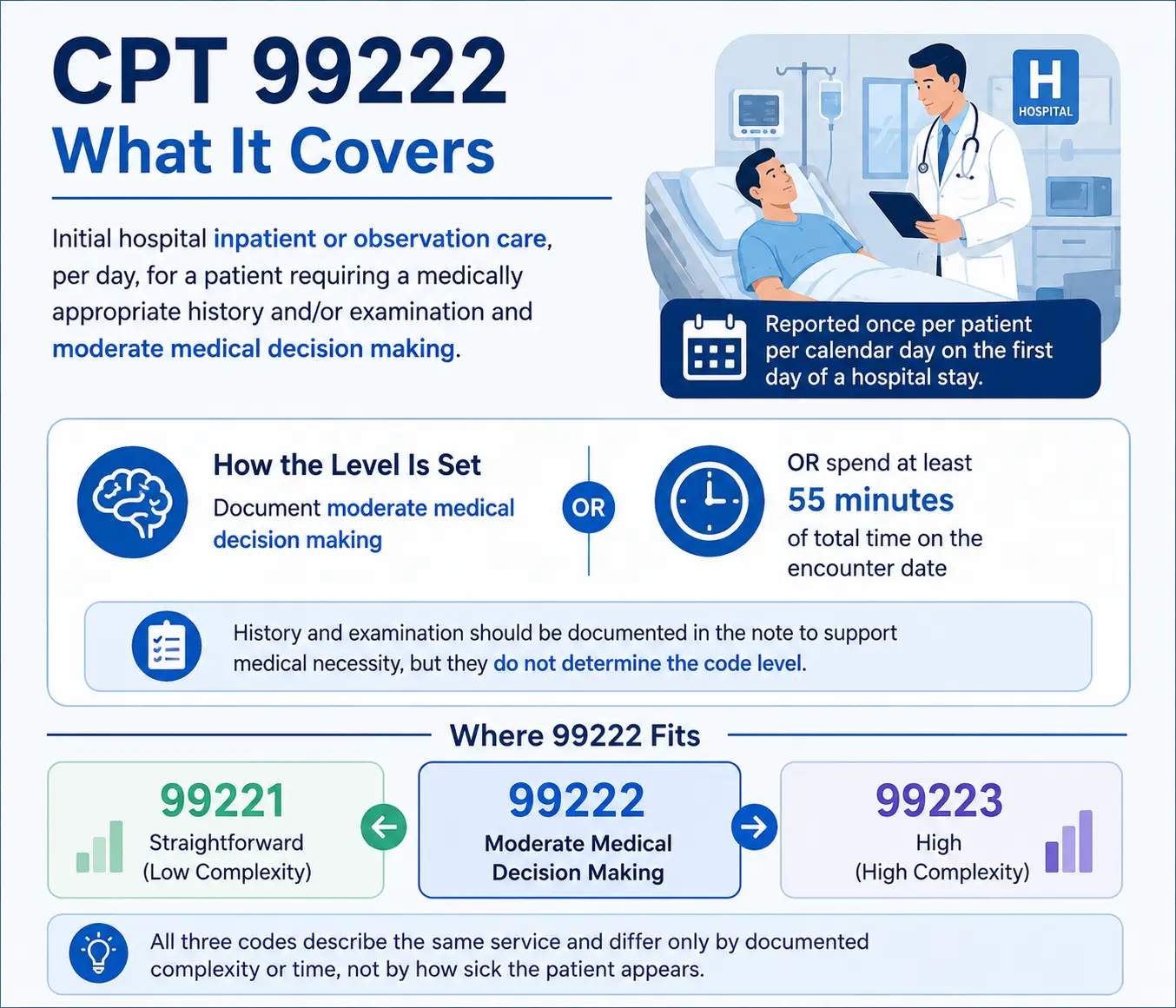
CPT code 99222 is defined by the American Medical Association as an Evaluation and Management code for initial hospital inpatient or observation care, per day, representing moderate medical decision-making complexity. That "per day" language matters. The code covers the first encounter with a patient in an inpatient or observation setting on a given calendar day, and it is reportable only once for that date, regardless of how many times a provider sees the patient.
The critical word is "threshold." That same figure does not describe an admission. It describes a clinical complexity level that the documentation must demonstrate.
A hospitalist who admits a patient with acute pneumonia complicated by a COPD history and spends 55 minutes coordinating care on day one is in exactly the scenario this code was built for. But if the note is finished three hours later from memory, the comorbidity reasoning, the differential, and the coordination complexity are often already gone. The code may be technically assigned.

It is not defensible.
55 minutes
Total time threshold for 99222
Providers have two routes to that same figure. The first is moderate Medical Decision Making (MDM); the second is a total time of 55 minutes spent on the encounter date on activities directly related to the patient.
The MDM pathway is more common but is also where most coding inconsistency lives. Without a systematic framework applied at the point of documentation, selection often defaults to habit rather than evidence. The time pathway demands that providers track and document total minutes with precision, which post-encounter note completion makes unreliable. Neither pathway is forgiving of documentation lag.
Effective January 1, 2023, the AMA and CMS merged previously separate observation care codes into a unified series, making CPT codes 99221 through 99223 applicable to both inpatient and observation encounters. The once-per-calendar-day, admitting-provider-only rule applies equally across both settings: other physicians seeing the same patient on admission day must use subsequent care codes, not that same figure, a common source of billing errors in teaching hospitals and group practices. Knowing what that same figure covers is only the first step. The harder question is what the code demands from the clinical record to survive scrutiny, and how many elements of Medical Decision Making your documentation must satisfy at the moderate level is where most practices quietly lose ground.
Key takeaways
- CPT code 99222 requires moderate medical decision-making, and two of the three MDM elements missing from the documentation is all it takes to lose the code, regardless of what the clinician actually did in the room.
- The highest concentration of billing error in the 99221-99223 series sits at 99222, not at the extremes, both undercoding and overcoding cluster in the middle because the boundaries are routinely misread.
- Sepsis workups, CHF exacerbations, and COPD flares qualify for 99222 every day; the bottleneck is never clinical rarity, it's whether the documentation captured at the time of the encounter surfaces the complexity the code requires.
- Roughly one in five inpatient claims fails Medicare criteria on audit, that failure rate reframes denials as a documentation problem, not a payer behavior problem.
- Post-encounter charting is the hidden overcoding risk: by the time the note is finalized, the real-time clinical reasoning that justifies moderate MDM exists only in the physician's memory, not in the record a payer auditor will read.
- iScribe Health's Automated E&M Coding closes that gap by generating E&M codes directly from the full clinical narrative as it unfolds, so the complexity that justifies 99222 is captured in the record before the note ever closes.
What Are the Three MDM Elements and How Many Must Be Met for Moderate Level
Three elements determine whether a that same figure claim reaches moderate MDM, and getting two of them wrong in the documentation is all it takes to lose the code.

The Three MDM Elements Every 99222 Claim Must Account For
Moderate MDM for CPT 99222 requires documentation across three distinct elements: Number and Complexity of Problems Addressed, Amount and/or Complexity of Data to be Reviewed and Analyzed, and Risk of Complications and/or Morbidity or Mortality of Patient Management. According to the AMA CPT 2021 E/M Guidelines, moderate-level examples within each element include one or more chronic illnesses with exacerbation or progression (Problems); independent interpretation of a test or review from an independent historian (Data); and prescription drug management or a procedure carrying risk of complications (Risk).
Each element must be supported by its own discrete, auditable documentation. But if the note compresses the differential reasoning into a single line and omits the medication adjustment rationale, the coder has nothing auditable to point to.
The 2-of-3 Rule and Which Combinations Hold Up Under Audit
2-of-3
MDM elements must reach moderate level
As CodeItRight.ai notes in its breakdown of MDM levels, the threshold for each element is assessed independently, which means template language that survives copy-paste across elements can satisfy none of them under audit.
Billing teams often over-index on Problems, documenting a dense problem list while leaving Data and Risk as template language, a pattern that routinely collapses under review.
Why Moderate MDM Is a Documentation Architecture Problem, Not a Clinical One
The AMA CPT 2021 E/M Guidelines evaluate only what is documented, not what occurred clinically, which means a well-managed admission can still fail the threshold if the note does not reflect the complexity of the decisions made. The hidden cost is not just audit exposure; it is systematic undercoding that compounds across payers and quarters without ever appearing on a denial report.
The documentation architecture that satisfies the 2-of-3 threshold is built as care is delivered, not reconstructed from memory afterward.
What Clinical Scenarios Commonly Qualify for 99222
Sepsis workups, CHF exacerbations, and COPD flares fill inpatient census sheets every day. The clinical scenarios that qualify for CPT that same figure are not rare corner cases reserved for unusually complex admissions. They are the bread-and-butter of inpatient medicine. The bottleneck is documentation: whether the note captured at the time of the encounter surfaces the complexity that was already there.
1. Acute Infection with Systemic Involvement - Sepsis, Pneumonia, and Severe UTI

Acute infections with systemic signs are prototypical that same figure territory. A patient admitted for community-acquired pneumonia with fever, hypoxia, and altered mental status requires respiratory assessment, hemodynamic monitoring, and antibiotic stewardship decisions on day one, a multi-system complexity pattern that satisfies moderate MDM without ambiguity. When comorbidities are present but the note omits the differential reasoning, the qualifying complexity disappears from the record even though it drove the clinical decisions.
The clinical burden of CAP admissions is well-documented. Rates of Hospitalization for Community-Acquired Pneumonia Among US Adults: A Systematic Review confirms that CAP remains one of the leading drivers of adult inpatient volume in the United States, while industry research underscores that managing CAP requires rapid, coordinated clinical decisions across multiple organ systems from the moment of admission. That clinical reality exists in the room. The documentation failure is that it rarely survives the note.
2. Chronic Disease Exacerbation - Decompensated CHF, COPD Flare, and Uncontrolled Diabetes

Chronic disease exacerbations represent the single largest share of inpatient volume, and each one is a credible that same figure scenario on clinical grounds. Decompensated CHF, a COPD flare with concurrent infection, or uncontrolled diabetes requiring IV insulin and monitoring all involve prescription drug management plus data review, two of three MDM elements at the moderate level. The documentation failure is systematic: the clinical reasoning that justifies the code is rarely templated, so it is the first detail to disappear in a post-encounter note.
This is the pattern clinicians we work with in high-volume practices describe most consistently, spending two or more hours outside of patient care time reconstructing notes from memory, producing documentation that strips out the very reasoning that supports moderate MDM. By capturing the clinical encounter in real time through Ambient Listening and Conversational AI, the system drafts the encounter summary at the point of note completion, before the reasoning has faded and before the systemic signs and data review rationale go missing. The result is documentation that reflects the encounter as it actually happened, not a compressed reconstruction assembled after hours.
3. Multi-System Conditions Requiring Coordinated Day-One Management
A patient admitted for pneumonia with comorbid COPD, heart failure, and diabetes is not an outlier. According to the Rates of Hospitalization for Community-Acquired Pneumonia Among US Adults: A Systematic Review, patients hospitalized for community-acquired pneumonia frequently present with multiple chronic conditions requiring coordinated management of both the acute infection and underlying disease on the first day of care. That multi-system pattern anchors moderate MDM clearly. What it does not do is document itself.
Standardizing how that complexity is captured across a practice, so that the attending, the NP covering overnight, and the hospitalist rotating in all produce notes of equivalent clinical depth, requires more than individual effort. It requires documentation architecture. iScribe Health's clinical informatics and IT/EHR administrator support layer is designed precisely for this: enabling IT and EHR administrators and clinical informatics teams to standardize clinical documentation quality across the practice, so that the same encounter surfaces the same complexity regardless of which clinician authored the note.
4. The Dual Coding Pathway - MDM vs. 55-Minute Time Threshold and Where Inconsistency Creeps In
Providers who cannot reconstruct MDM element-by-element from a finalized note have a second option: 55 minutes of total time on the encounter date qualifies for that same figure without MDM documentation. In practice, this pathway is underused because time is rarely captured in real time. The result is inconsistency across a group practice, where one provider codes by MDM and another codes by time, and neither approach is documented with enough specificity to survive a payer request. This is a documentation architecture problem, not a coder knowledge problem.
iScribe Health's E&M Coding Intelligence and Automated E&M Coding address both sides of this problem. At the point of note completion, after the AI drafts the encounter summary, the system applies coding logic to what was actually documented, flagging the applicable pathway and surfacing gaps before the note is finalized. Real-Time Denial Alerts extend that protection forward, catching payer-risk patterns before a claim is submitted rather than after a denial arrives. For practices already operating on a supported EHR, EHR Integration ensures this workflow is seamless rather than additive.
5. Undercoding Risk - When Complex Patients Are Defaulted to 99221 Due to Thin Documentation
The most documentable, clearly qualifying encounters, including high-comorbidity acute admissions, are the ones most frequently coded down to 99221. The gap is visibility. When notes are assembled after hours from memory or templated language, the systemic signs, data review rationale, and coordination decisions that satisfy two of three MDM elements are the first details to go missing.
Physicians, nurse practitioners, and clinical staff managing high patient volumes and spending significant time on after-hours documentation are most exposed to this pattern. The benefit is ongoing: realized across every patient encounter and every day of clinical practice, not as a one-time configuration but as a continuous correction to the documentation gap that costs revenue on every qualifying admission that gets coded down.
Knowing which scenarios qualify is only half the equation. The other half is understanding exactly where that same figure sits relative to its neighbors in the initial hospital care series, and why the middle code is where the most costly and systematic coding errors concentrate. That comparison is where the revenue integrity picture becomes actionable.
How 99222 Compares to 99221 and 99223 in the Initial Hospital Care Series
Billing teams treat the 99221-99223 series as a straightforward ladder: match the note to the complexity, pick the code, move on. The reality is that the middle code, 99222, is where the highest concentration of systemic error concentrates, with both undercoding and overcoding clustering here because the boundaries with 99221 and 99223 are routinely misread, and the clinical specificity needed to defend moderate MDM rarely survives the gap between encounter and finalized note.
Who Can Bill 99222 and What Modifiers Apply
Only the admitting provider or principal physician of record bills 99222 for a given patient on a given calendar day. In multi-provider settings, such as a teaching hospital where both a resident and an attending evaluate the patient on admission day, only the attending as principal physician of record submits the claim. Per the CMS Medicare Claims Processing Manual, that same figure, Modifier AI must be appended to that claim when multiple providers bill initial hospital care for the same patient on the same date, distinguishing the principal physician's claim from co-managing or consulting physicians. Missing Modifier AI in that scenario is a common source of claim denial that billers frequently attribute to payer behavior rather than a correctable documentation and billing workflow gap.
Why 99222 Is the Highest-Leverage Coding Target
The 2023 unified inpatient and observation framework made this problem structurally worse. The same patient presentation will support different code levels depending entirely on how explicitly the problems addressed, data reviewed, and risk managed are articulated in the record. That makes level selection a function of note architecture, not clinical reality. Providers who finalize notes hours after the encounter have already lost the MDM narrative that justifies that same figure over 99221.
Most teams handle this by relying on post-encounter documentation to reconstruct clinical complexity, a process that consistently strips out comorbidity detail, differential reasoning, and risk nuance before the coder ever sees the note. The hidden cost is systematic: per the OIG Work Plan, that same figure, undercoding and overcoding on initial hospital care codes compound across payers and quarters into material revenue and compliance exposure. iScribe Health's real-time clinical documentation closes that gap by capturing the full MDM narrative during the encounter, so every that same figure selection is built on documentation that can withstand payer scrutiny rather than retrofitted to meet it after the fact.
Knowing where that same figure sits in the spectrum, and who is authorized to bill it, is the foundation. The real financial question is what miscoding at this level actually costs across payers, quarters, and dispute outcomes. The next section quantifies exactly that.
1. The 99221-99223 Spectrum - Straightforward to High MDM with 40, 55, and 75 Minute Thresholds
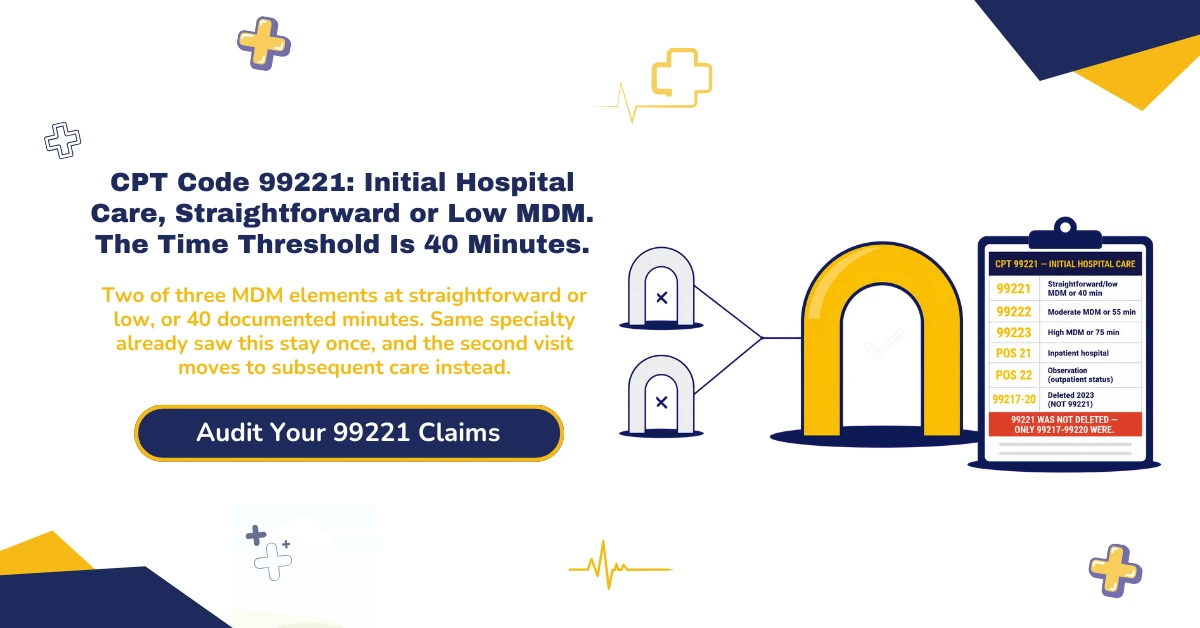
CPT 99221 requires straightforward or low MDM, or 40 minutes; 99222 requires moderate MDM, or 55 minutes; 99223 requires high MDM, or 75 minutes. Per the AMA CPT Code Set, 2023, level selection is driven by the highest MDM tier documented across three elements: problems addressed, data reviewed, and risk of complications. The critical point for billing teams is that meeting two of those three elements at the moderate threshold is what separates a defensible that same figure from a 99221 that forfeits revenue, and the documentation architecture of the note determines which threshold the record actually supports, regardless of what happened clinically.
2. Who Bills 99222 and When Modifier AI Applies for the Principal Physician of Record
Per the CMS Medicare Claims Processing Manual, that same figure, Modifier AI must be appended to that claim when multiple providers bill initial hospital care for the same patient on the same date, distinguishing the principal physician's claim from co-managing or consulting physicians who bill with standard E&M codes. In practice, missing Modifier AI in multi-provider admissions is a routine source of claim denial that billing teams consistently misread as payer aggression rather than a correctable workflow gap.
3. The Financial and Compliance Stakes of Miscoding - Undercoding to 99221 vs. Overcoding to 99223
Systematic undercoding from 99222 to 99221 compounds revenue loss across payers and quarters. Overcoding to 99223 when only moderate MDM is documented creates recoupment liability under Medicare's RAC and OIG oversight programs. Per the OIG Work Plan, that same figure, both errors are material and both trace to the same root cause: documentation captured after the encounter cannot reliably preserve the MDM specificity the code requires. For practice administrators managing E&M coding across multiple providers, that same figure is the highest-leverage correction target precisely because error concentrates here in both directions.
Related Reading
- Cpt Code 99233
- Cpt Code 99203
- Cpt Code 99232
- Cpt Code 99244
- Cpt Code 99221
- Cpt Code 99205
- Cpt Code 99223
- Cpt Code 99202
CPT 99222 Median IDR Award Benchmarks and What Payer Disputes Actually Cost
Over 300,000 surprise billing disputes were initiated through the federal IDR process from April 2022 through March 2023, far exceeding the volume CMS originally projected, a signal that underpayment disputes are a structural feature of the current reimbursement environment.

What the Median IDR Award for CPT 99222 Reveals About First-Submission Underpayment
Based on broader industry trends and medical group practice patterns we track, providers who pursue IDR disputes frequently receive awards above what payers offered on first submission, suggesting the qualifying payment amount payers use to anchor their initial offers is often below what arbitrators find defensible. That gap between first-submission offer and final award has direct implications for coding decisions made before a claim ever reaches a payer.
That figure compounds further when payer underpayment on correctly coded claims is layered on top of the coding variance itself.
Which Payers, States, and Quarters Generate the Most 99222 Disputes and Who Wins
The pattern that matters for a billing administrator is this: if your payer mix includes high-volume commercial contracts in states with elevated QPA benchmarks, and you are not tracking IDR outcomes by payer and quarter, you are missing the clearest signal available about where your first-submission rates are being systematically suppressed. iScribe Health's Real-Time Denial Alerts surface that signal at the claim level, flagging payer behavior as it happens rather than requiring manual reconciliation weeks later.
The Real Cost of Filing a CPT 99222 IDR Claim Including Batch Filing Math
Per CMS Federal IDR Process Update guidance, the No Surprises Act IDR administrative fee structure has changed over time, directly affecting the per-claim cost threshold for practices pursuing underpayment recovery. Batch filing rules allow practices to group substantially similar claims into a single IDR submission, which compresses the per-claim administrative cost and makes systematic dispute filing viable for mid-volume practices that would otherwise treat each underpayment as too small to pursue individually.
How Systematic 99222 Miscoding Compounds Into a Payer Arbitrage Problem Across Quarters
A single miscoded claim represents a recoverable variance; the same variance repeated across 200 claims per month, across four quarters, across three payers, is a revenue integrity failure with a precise dollar value attached to it.
iScribe Health's Automated E&M Coding and E&M Coding Intelligence address the upstream side of that problem: by generating the E&M code from the real-time clinical narrative through Ambient Listening rather than from the finalized note, every code selection is anchored to the documented complexity the encounter produced at the moment it occurred. For practices already running a supported EHR, iScribe Health's EHR Integration delivers this capability as a seamless ambient documentation experience with no disruption to existing workflows.
Why Post-Encounter Documentation Creates a Hidden Overcoding Risk on 99222 Claims
Roughly one in five inpatient claims fails Medicare criteria on audit, according to a review that found 71 of 333 sampled claims did not meet inpatient status criteria. The common assumption is that if the coder selected the right level based on the documented note, the claim is defensible, and denials are a payer behavior problem to fight case by case, not a documentation problem to fix upstream.

How Post-Encounter Note Completion Strips the MDM Evidence That Distinguishes 99222 from 99221
This is the struggle physicians we work with describe most consistently: the clinical complexity of the encounter was real, but the note written two or three hours later cannot reconstruct the reasoning that was present at the bedside. And it is exactly where iScribe Health's Ambient AI Documentation and Ambient Listening / Conversational AI are designed to intervene, capturing the clinical narrative in real time so the MDM complexity, comorbidity interactions, and differential reasoning are part of the note before the encounter ends, rather than approximated after the fact.
The Audit Exposure - What OIG Findings Reveal
The HHS Office of Inspector General has confirmed that improper Medicare payments on hospital claims are driven by provider-side documentation and coding failures, not by payer over-aggressiveness.
Why This Is a Documentation Architecture Problem, Not a Coder Knowledge Problem
iScribe Health's Ambient AI Documentation closes both gaps at once. At the point of note completion, iScribe Health's E&M Coding Intelligence then reviews the AI-drafted encounter summary and surfaces the appropriate coding level, reducing audit risk on the claim before it ever reaches a biller.
That is where iScribe Health is built to operate, and where the compounding exposure of retrospective documentation finally stops.
How Automated E&M Coding Captures the Clinical Complexity That Justifies 99222
That distinction matters enormously for practice administrators who have invested in E&M coding tools and still see denials climbing, because the root problem sits upstream of the coding engine: when decisions are made from the finalized note rather than the full real-time clinical narrative, MDM complexity elements are routinely omitted before the coder ever touches the claim.

Why the Code Suggestion Is Only as Defensible as the Narrative That Generates It
Compounding that vulnerability is the provider-to-provider inconsistency that post-encounter reconstruction tends to amplify.
One hospitalist captures comorbidity burden with precision; another compresses the same clinical picture into two sentences. iScribe Health's AI medical scribe is architected specifically to improve coding consistency across providers, so the standard of documentation that supports a defensible code is not contingent on which physician happened to chart that shift.
Pros and cons at a glance
✓ Pros
- Surfaces all three MDM elements simultaneously from the real-time narrative.
- Improves coding consistency across providers.
- Closes irreversible loss between the encounter and the finalized note.
- Ensures codes accurately reflect encounter complexity without downstream correction.
✗ Cons
- Only as defensible as the source narrative it reads.
- Accelerates the same deficiency if post-encounter reconstruction persists.
- Code suggestions built from post-encounter notes are structurally vulnerable under audit.
,
How Real-Time Narrative Capture Locks In the 2-of-3 MDM Elements Before the Note Is Finalized
iScribe Health's Ambient Listening and Conversational AI layer is where that intervention begins, capturing the clinical narrative as the encounter unfolds rather than relying on what a physician can reconstruct afterward. At the point of note completion, after the AI drafts the encounter summary, iScribe Health's E&M Coding Intelligence reads that full real-time narrative and surfaces a code suggestion with the evidence chain already intact. Because iScribe Health materializes seamlessly inside a supported EHR through its EHR Integration, that coded, narrative-rich output lands in the workflow physicians already use, no secondary system, no additional charting step.
This is the reframe billing teams most often miss: iScribe Health's Automated E&M Coding, architected around real-time narrative capture, does not merely speed up what coders already do. It changes what is available to code from, ensuring complexity that would otherwise disappear between the encounter and the finalized note is preserved and defensible.
The Operational Payoff - Surfacing Audit Candidates Before the Payer Does
iScribe Health's Real-Time Denial Alerts operationalize that upstream opportunity, flagging documentation gaps and coding mismatches at the point of care rather than weeks later when a remittance arrives.
Related Reading
- Cpt Code 99284
- Cpt Code 99396
- Cpt Code 99395
- Cpt Code 99385
- Cpt Code 99499
- Cpt Code 99386
- Cpt Code 99283
- Cpt Code 99024
Next steps
If your billing team keeps watching 99222 claims return as denials or downcodes despite confident code selection, the path forward starts with fixing where the clinical narrative is captured, not where the code is assigned. Post-encounter documentation does not fail because coders lack knowledge. It fails because the MDM reasoning that distinguishes a defensible 99222 from a 99221 exists only in the physician's memory by the time the note is finalized, and no coding engine recovers what was never written down.
Automated E&M coding that operates on the real-time clinical narrative, before note finalization, structurally closes the gap between what a physician's cognitive effort actually supported and what survives into the documented record. That matters because fighting those denials case by case through IDR arbitration is self-defeating: the same upstream documentation failures that generate denials also disqualify many of those claims from the federal arbitration pathway intended to recover them. These two realities point to the same corrective action, capturing the full clinical narrative during the encounter so every code selection is built on documentation that holds up, not documentation assembled after the reasoning has already faded.
Start with the AI medical scribe from iScribe Health, which captures the encounter in real time and applies E&M Coding Intelligence at the point of note completion, before the claim leaves the practice. Every code selection becomes defensible from the moment the encounter ends.
Frequently Asked Questions
Can a provider use CPT 99222 for both inpatient and observation patients?
Yes. Effective January 1, 2023, the AMA and CMS merged previously separate observation care codes into a unified series, making CPT codes 99221 through 99223 applicable to both inpatient and observation encounters. The once-per-calendar-day, admitting-provider-only rule applies equally across both settings.
What happens if my note doesn't clearly document all three MDM elements, can I still bill 99222 using time?
Yes, but only if you documented 55 minutes of total time spent on the encounter date on activities directly related to the patient. In practice this pathway is underused because time is rarely captured in real time, and without precise documentation it is just as difficult to defend as MDM.
Does satisfying only one MDM element, even a very complex one, support a 99222 claim?
No. The AMA CPT 2021 E/M Guidelines are explicit that no single element, regardless of how complex, can carry the code on its own. At least two of the three MDM elements must independently reach the moderate level to support a 99222 claim.
If my practice has multiple providers seeing the same admitted patient on day one, can they all bill 99222?
No. Only the admitting provider may report 99222 for that calendar day. Other physicians seeing the same patient on admission day must use subsequent care codes, not 99222, a common source of billing errors in teaching hospitals and group practices.
Why do so many complex admissions end up coded down to 99221 instead of 99222?
The post points to a documentation timing problem, not a clinical one. When notes are assembled after hours from memory or templated language, the systemic signs, data review rationale, and coordination decisions that satisfy two of three MDM elements are the first details to go missing, causing clearly qualifying encounters to default to the lower code.