CPT Code 99233 Explained: What It Covers and How to Bill
CPT code 99233 billing decisions cost practices real revenue. See how automated E&M coding closes the documentation gap for billing teams.


Billing 99233 correctly isn't a compliance problem. It's a revenue problem, and most teams are losing it not from overcoding, but from documentation that hides the complexity they already delivered.
2.06 work RVUs. That single number, drawn from the CMS Physician Fee Schedule, separates CPT code 99233 from every other code in the subsequent hospital visit family and makes it the highest-stakes billing decision a hospitalist or specialist makes on a non-admission day. The common assumption among practice administrators and billing decision-makers is that training coders on MDM criteria and documentation requirements is the primary lever for getting 99233 right. If the team knows the rules, the claims will be accurate. Getting it right is a direct revenue decision, repeated across every inpatient and observation follow-up visit your team documents.
2.06
Work RVUs, highest in subsequent visit family

CPT code 99233 represents subsequent hospital inpatient or observation care at the highest level of medical decision-making complexity within the subsequent visit family (99231 through 99233), used by the same physician or same-specialty group practice on follow-up days after the patient has already been admitted. It is never reported on the day of admission, which belongs exclusively to the initial care codes (99221 through 99223).
The official descriptor signals something specific: this code does not reward longer notes or more diagnoses listed. It recognizes the quality and complexity of clinical judgment exercised on that calendar day, which is precisely why documentation that compresses the actual reasoning into a templated paragraph fails to support it.
The subsequent visit family runs from 99231 at the lowest complexity tier through 99232 at moderate complexity to 99233 at the top. Because Medicare payment equals a code's total RVUs multiplied by the Conversion Factor (set at $33.29 for most of 2024), 99233's higher RVU weight generates materially greater reimbursement per encounter than either 99231 or 99232. The gap compounds quickly across a hospitalist's weekly census.
Only approximately 55% of E&M visits are correctly documented, meaning the remaining 45% are either overcoded, undercoded, or insufficiently supported. The gap is visibility into what was actually managed, reviewed, and decided in real time.
Knowing that figure, however, is only the starting line. The code can be reached by two entirely different documentation pathways, and choosing the wrong one for a given encounter is one of the most common sources of both undercoding and audit exposure. The next section maps both routes so you can select the one that best reflects the care actually delivered.
Key takeaways
- CPT code 99233 carries 2.06 work RVUs, the highest of any subsequent hospital visit code, making it the single most consequential billing decision a hospitalist or specialist makes on a non-admission day.
- Two selection methods exist: high-complexity MDM or 50 minutes of total time on the date of the encounter. Choosing the wrong one, or documenting the right one poorly, costs reimbursement either way.
- Industry data puts coding accuracy for E&M visits at roughly 55%, meaning nearly half of all 99233 claims are either overcoded or undercoded, often without the practice ever knowing.
- A payer auditor cannot reimburse clinical complexity the note fails to demonstrate. The documentation is not evidence that the visit happened; it is the claim.
- Habitual undercoding to 99232 is invisible on a per-claim basis, but across a hospitalist group it compounds into hundreds of forfeited dollars per provider in a single week.
- Overcoded claims that pay today become recoupment demands tomorrow, the exposure runs in both directions, and most practices have never measured their own coding accuracy.
- iScribe Health's Automated E&M Coding closes this gap by generating E&M codes directly from clinical documentation in real time, so the code the note actually supports is captured before the claim ever leaves the practice.
The Two Methods for Selecting 99233 - MDM or Time
The AMA's 2021 E/M framework made Medical Decision Making (MDM) and total time fully independent paths. A provider who defaults to one method out of habit may be undercoding without realizing it.

AMA 2021 Made MDM and Time Parallel Tracks Where Only One Must Be Met
99233 requires either high-complexity MDM or a minimum of 50 minutes of total time on the date of the encounter, not both. That independence is the structural change most hospitalists still underuse.
A physician who spends 55 minutes managing a complex patient with fragmented family communication and a multi-system chart can bill that same figure on time alone, even when the MDM narrative in the note is clinically thin.
Where this gets costly in practice: hospitalists managing high patient volumes routinely compress their MDM narratives because the documentation burden accumulates faster than the day allows.
Choosing the Right Track Based on Which Method Reflects the Work Actually Performed
The decision rule is straightforward: use whichever method is more defensible given what actually happened during the encounter. A hospitalist who spent the bulk of an encounter coordinating care across specialties, reviewing outside records, and counseling a family, but whose MDM narrative is compressed, selects time-based billing because time is the stronger evidentiary record that day.
In practice, many hospitalists never reach that decision point. That conservative reflex is a documentation visibility gap, and it suppresses real reimbursement on visits where total time would have fully supported the higher level.
This is where iScribe Health's E/M Coding Intelligence closes the loop. The system surfaces the stronger billing path at the point of documentation, before the encounter is finalized. Combined with real-time denial alerts integrated directly into the EHR workflow, the figure that time-based billing justifies is no longer left on the table because the documentation moment passed before anyone reviewed it.
Both tracks become viable because the underlying record supports them.
The next section breaks down exactly what "high-complexity" means across each of the three MDM elements, and why meeting "two of three" is far more precise a standard than it sounds.
High-Complexity MDM for 99233 - What the Three Elements Actually Require
Three clinical definitions stand between a that same figure claim and a payer's downcoding decision. Most clinicians document what they managed. Payers audit whether the note maps, word by word, to the AMA CPT E/M Guidelines. The gap between those two things is where reimbursement disappears, and in high-volume practices where clinicians regularly chart two or more hours outside of patient care time, that gap widens across hundreds of encounters before anyone catches it at audit.
High-complexity MDM for that same figure requires meeting 2 of 3 elements at the high level: Problems, Data, and Risk. The 2023 AMA CPT Editorial Panel revision matters here in a way most practices underestimate: although the shift to MDM-or-time as the sole basis for inpatient E&M level selection was designed to reduce documentation burden, it inadvertently raised the stakes for clinical reasoning specificity. Because history and physical exam elements no longer count, every 99233 claim now lives or dies on whether the note explicitly captures high-complexity problems, extensive data review, and high-risk management decisions, three elements that inter-provider documentation variability routinely fails to deliver consistently, even within the same practice and the same coding team.
Removing exam documentation didn't simplify the standard; it concentrated audit risk onto the clinical narrative, so provider-level documentation variability carries more consequence than before.
1. Problems Element - Chronic Illness With Severe Exacerbation or Life-Threatening Acute Condition
Per the AMA CPT E/M Guidelines, the Problems element reaches high complexity when the note documents ongoing management of a chronic illness with severe exacerbation, progression, or treatment side effects, or an acute or chronic condition that poses a direct threat to life or bodily function. A patient with COPD in acute respiratory failure, managed with escalating oxygen therapy and specialist consultation, qualifies. The critical documentation failure is describing clinical severity without using language that maps to those two specific triggers. "Patient doing poorly" doesn't satisfy the definition. "Acute exacerbation of COPD with hypoxic respiratory failure posing threat to bodily function" does.
This is precisely the gap that iScribe Health's Ambient AI Documentation and E&M Coding Intelligence are built to close. Because the AI captures the clinical encounter in real time through ambient listening, it surfaces the language a physician used at the bedside, the language that reflects genuine clinical complexity, and at the point of note completion, after the AI drafts the encounter summary, its automated E&M coding logic checks whether the Problems element is documented with the specificity payers require. Clinicians we work with in high-volume health systems tell us this single feedback loop, applied consistently across every patient encounter, is what finally brings documentation language in line with the complexity they are managing.
2. Data Element - Extensive Review Including Independent Interpretation and External Physician Discussion
The Data element is where well-intentioned notes most often fall short. The AMA CPT E/M Guidelines distinguish between reviewing a report and independently interpreting raw data from a test ordered by another physician. Reading a radiology report summary does not meet the threshold.
Personally reviewing the imaging and documenting your own clinical interpretation does. A nephrologist managing a CKD patient who reviews external lab values, orders additional studies, and consults with the referring team can meet this element, but only if the note explicitly states each of those activities. Omitting the word "independently" or skipping documentation of the external discussion leaves the element undefended.
Under time pressure, the clinicians we work with naturally narrate what they did, not every discrete data activity that the AMA grid requires. iScribe Health's ambient conversational AI captures those activities as they happen during the encounter, so the drafted note arrives at completion already reflecting the independent interpretation step and the external discussion, with real-time denial alerts flagging any Data sub-element still left undefended before the note is finalized. For practices running a supported EHR, this happens through iScribe Health's EHR integration, requiring no separate documentation workflow.
3. Risk Element - High Morbidity or Mortality From Management Options Including Drug Monitoring or Escalation Decisions
The Risk element requires that the management options chosen carry high risk of morbidity or mortality. The AMA CPT E/M Guidelines examples include drug therapy requiring intensive toxicity monitoring (anticoagulation, chemotherapy), decision to hospitalize or escalate level of care, and consideration of emergency major surgery. The documentation obligation is to name the management option and connect it explicitly to the risk it carries. A note that records warfarin dosing without stating that the decision requires intensive INR monitoring for toxicity risk leaves the Risk element exposed. The clinical action and its risk rationale must both appear in the note.
Clinicians working under time pressure naturally describe what they did, not why each decision carried the specific risk profile the AMA grid requires. That compression is where claims become vulnerable. iScribe Health's real-time documentation capture, delivered through ambient listening at the point of care, flags whether each MDM element is sufficiently documented before the note is finalized, closing the gap between the complexity a physician managed and what the record can defend at audit. The impact is realized across every patient encounter and every day of clinical practice, and is most pronounced in high-volume practices or health systems where accurate, compliant coding across a large patient population is the difference between consistent reimbursement and a pattern of preventable claim denials.
Meeting the high-complexity MDM threshold is one path to a defensible that same figure claim, but for encounters where the physician's total time investment tells the stronger story, the time-based billing method offers a separate route to the same code, and understanding exactly which activities count toward that threshold can unlock reimbursement that MDM-focused documentation alone would miss.
Related Reading
- Cpt Code 99232
- Cpt Code 99244
- Cpt Code 99203
- Cpt Code 99221
- Cpt Code 99205
- Cpt Code 99223
- Cpt Code 99202
- Cpt Code 99222
Time-Based Billing for 99233 - What Counts and What the Prolonged Service Threshold Unlocks

The 50-Minute Floor - What Activities Actually Count Toward 99233 Time
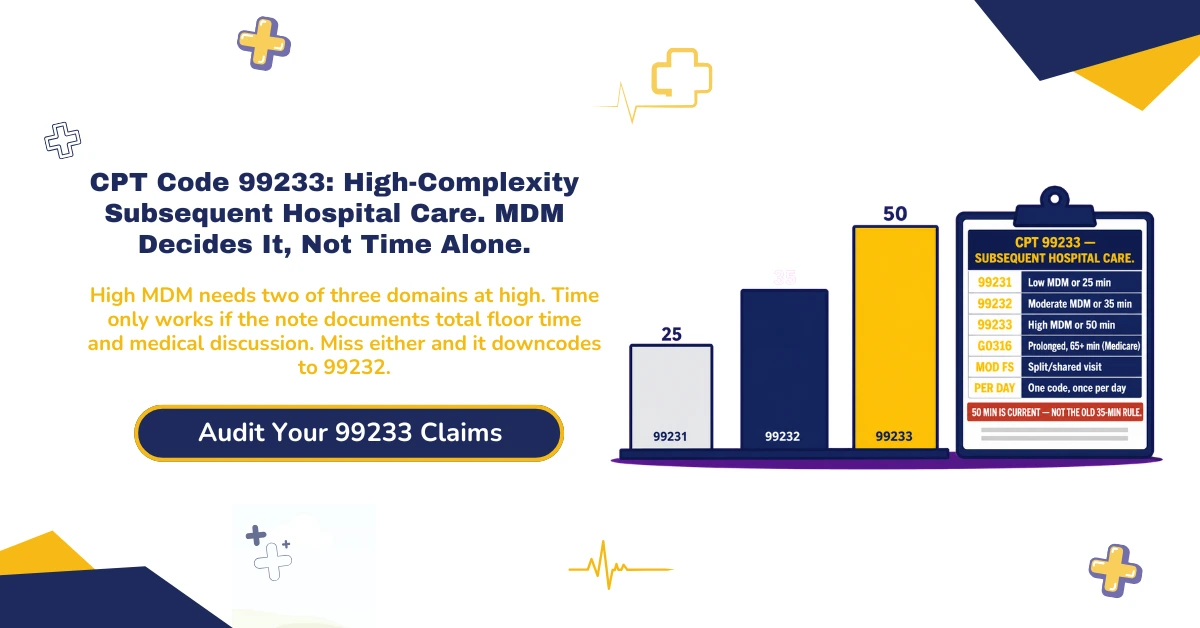
50 minutes of total time on the date of the encounter is the minimum threshold to select that same figure on a time basis. Crucially, that total includes both face-to-face and non-face-to-face activities performed on the same calendar day.
The documentation burden of capturing every qualifying activity compounds the problem.
This aligns with broader research showing that physicians spend nearly 2 hours on EHR documentation and administrative tasks for every 1 hour of direct patient care. iScribe Health's Ambient Listening and Conversational AI captures the full encounter in real time, including care coordination exchanges and chart review activities, so that when the AI drafts the encounter summary at the point of note completion, the supporting time record is already built into the note rather than reconstructed from memory.
Per Diem Rule - Why 99233 Can Only Appear Once Per Day
That same figure is subject to a per diem limitation: it may be reported only once per calendar day by the same physician or a physician of the same specialty within the same group practice, per the AMA CPT Assistant, May 2023. When multiple physicians in the same group see the same patient on the same day, the duplicate claim is typically caught only after submission, triggering a denial that requires manual intervention to resolve.
iScribe Health's Real-Time Denial Alerts surface per diem conflicts at the point of note completion, the moment the AI drafts the encounter summary, rather than weeks later when a remittance arrives. Because iScribe Health integrates directly with supported EHRs, the alert appears inside the existing clinical workflow without requiring a separate billing system login, giving the care team a window to resolve assignment before the claim is submitted.
The 65-Minute Threshold That Unlocks Prolonged Service Add-Ons
When total encounter-day time reaches 65 minutes or more, prolonged inpatient service add-on codes become billable alongside that same figure: CPT 99418 for commercial payers, or HCPCS G0316 for Medicare, per the AMA CPT Assistant, May 2023. Each additional 15-minute increment beyond that threshold supports an additional unit of the add-on code, as confirmed by Coding Clarified.
Most physicians who spend 60-plus minutes on a complex subsequent visit never capture it, leaving the add-on revenue unclaimed simply because the time was never systematically documented.
iScribe Health's E&M Coding Intelligence and Automated E&M Coding address this at the source by analyzing the full time record embedded in the AI-drafted note and automatically flagging when the prolonged service threshold has been met.
How 99233 Compares to 99231 and 99232 in Reimbursement and Documentation Requirements
The gap between 99231, 99232, and 99233 is not just a spectrum of clinical complexity. It is a measurable revenue decision made on every subsequent inpatient visit, and most billing teams never calculate what habitual undercoding actually costs across a week.
1. 99231 vs. 99232 vs. 99233 - MDM Complexity and Time Thresholds Side by Side
That same figure, 99232, and 99231 differ by a single tier of medical decision-making complexity or a defined time increment. Per the CMS CY that same figure Medicare Physician Fee Schedule Final Rule, 99231 requires straightforward or low MDM (or 25-plus minutes), 99232 requires moderate MDM (or 35-plus minutes), and 99233 requires high MDM (or 50-plus minutes). Medical necessity governs all three; documentation volume alone never justifies the higher level.
2. RVU and Reimbursement Differential - Why Choosing 99233 Over 99232 Is Directly Revenue-Impactful

The CMS Fee Schedule assigns meaningfully greater RVU weights to each step up in the subsequent visit family, making the 99232-to-that same figure selection directly revenue-impactful. A hospitalist carrying 15 to 20 subsequent visits daily who defaults to that same figure on visits that genuinely qualify for 99233 compounds that per-encounter gap into five- and six-figure annual shortfalls. The loss never triggers a compliance flag, so it is almost never measured, and because it is silent, reimbursement integrity erodes encounter by encounter without a single denial to prompt a review.
This is precisely where iScribe Health's E&M Coding Intelligence is designed to intervene. At the point of note completion, after the AI drafts the encounter summary, iScribe Health surfaces an automated E&M code assignment derived directly from the clinical narrative, not from a physician's rushed best guess at the end of a 20-patient day. That single step begins to close the gap between the complexity that was clinically real and the code that was actually submitted, supporting reimbursement integrity across every encounter.
3. Chronic Undercoding Pattern - Providers Defaulting to 99232 Despite High-Acuity Visits
The pattern is consistent and predictable: a provider manages a patient with a deteriorating chronic condition, orders additional labs, coordinates with a specialist, and then documents a note that reads like a that same figure because the clinical reasoning was compressed under time pressure before moving to the next room. The complexity was real. The documentation did not reflect it. Clinicians we work with in high-volume practices describe this compression as routine, not occasional, because charting 2-plus hours outside of patient care time every day makes thorough real-time documentation feel structurally impossible.
What makes this a bidirectional financial exposure is that overcoding and undercoding coexist within the same practice simultaneously. One physician's inflated that same figure claims draw a recoupment demand while a second physician's systematic 99232 defaults silently erode reimbursement on identical complexity. Neither problem surfaces until it is already financially damaging, and neither is easy to audit retrospectively at scale.
iScribe Health addresses both sides of that exposure. Its Ambient Listening and Conversational AI captures the encounter as it unfolds, including the specialist coordination, the clinical reasoning, and the escalating acuity that a compressed typed note routinely omits. The result is more defensible documentation: a note whose internal logic actually reflects the medical decision-making that occurred, not the abbreviated version a fatigued physician produced between rooms. Real-Time Denial Alerts add a downstream layer, flagging reimbursement problems before they compound. And because iScribe Health integrates directly with supported EHRs, the ambient documentation experience is seamless for practices and health systems already operating within those platforms, no parallel workflow, no additional charting burden.
Per the CMS CY that same figure Medicare Physician Fee Schedule Final Rule, medical necessity and documentation must substantiate the level of service selected. AI-powered scribing closes the gap between clinical reality and documented evidence by generating a complete encounter narrative and a level-of-service assignment in real time, before the note compresses the complexity that already justified the higher code. The benefit is ongoing, realized across every patient encounter and every day of clinical practice, making it most impactful precisely where the exposure is greatest: high-volume practices where the undercoding tax accumulates silently across thousands of visits per year.
Knowing the threshold that separates that same figure from 99232 is only half the equation. The other half is building a note that proves the complexity was real. The next section breaks down exactly what that note must contain to survive payer scrutiny.
Documentation Requirements That Make 99233 Defensible Against Payer Scrutiny
Industry research indicates the current CMS claims-review system catches those gaps reactively, after payment has already been made, converting documentation problems into recoupment demands rather than pre-submission corrections.

What a 99233 Note Must Explicitly Capture to Satisfy MDM-Based Review
Each element must be explicitly supported in the note rather than implied by clinical context.
For time-based billing, CMS guidelines require a clear attestation of total calendar-day time, including non-face-to-face work such as chart review, care coordination, and documentation itself. Without that attestation, the time basis for the level collapses regardless of how much time was actually spent.
One of the most persistent struggles clinicians in high-volume inpatient settings face is inconsistency across the same practice: one hospitalist's notes reliably capture all three MDM elements while another's compress the same clinical complexity into shorthand that strips the signals payers need to see. iScribe Health's ambient AI documentation addresses this directly by standardizing clinical documentation quality across the practice, ensuring that Problems, Data, and Risk are captured explicitly at the point of note completion, after the AI drafts the encounter summary, rather than reconstructed from memory after the clinical moment has passed.
Why Medical Necessity Is the Invisible Threshold Payers Test Before Reimbursing 99233
What most teams report, and what broader denial patterns consistently reflect, is that payer denials are driven significantly by documentation deficiencies rather than clinical inappropriateness. The note must connect clinical facts to decision complexity in language payers recognize.
For practices and health systems already running a supported EHR, iScribe Health's EHR integration delivers a seamless ambient documentation experience that embeds this language structurally, so the connection between clinical facts and decision complexity is present in the note when the claim is submitted, not argued for after a denial arrives.
The Documentation Failure Patterns That Trigger 99233 Denials
iScribe Health's Ambient Listening and Conversational AI captures the encounter as it unfolds, then applies E&M Coding Intelligence to generate structured documentation that reflects the actual complexity of the visit. The result is a note built to withstand MDM-based review rather than one that requires retrospective defense.
When iScribe Health's Automated E&M Coding is layered onto a supported EHR through its seamless integration model, the structured evidence that same claim requires is already present when the claim reaches the payer.
Why Most Practices Billing 99233 Have Never Measured Their Own Coding Accuracy
For practice administrators managing high-acuity inpatient visits, that distinction carries real financial weight, because the exposure accumulates quietly across every encounter, every provider, and every rushed note written at the end of a long shift.

Industry Benchmarks Reveal That Correct E&M Documentation Is the Exception Not the Rule
Only approximately the proportion cited above, meaning nearly half of all evaluation and management claims carry some form of coding inaccuracy, a scale of error that makes accurate coding the exception rather than the default.
Coding consistency is an every-encounter operational problem. CureCloudMD identifies improving coding consistency across providers as one of the highest-leverage interventions available to practice administrators, precisely because variation at the provider level compounds into material revenue and compliance divergence at scale.
iScribe's 941-Encounter Trial Showing What a Real-World Audit Reveals
Real-world audits bear this out. An audit of 941 encounters at the Center for Sports Medicine & Orthopaedics revealed a 33% overcoding rate, with provider-to-AI agreement at only 54.8%, findings that illustrate how far typical documentation practices can drift from defensible coding.
iScribe Health's E&M Coding Intelligence addresses this directly.
The Bidirectional Risk Overcoding and Undercoding Both Create
Overcoding draws the most regulatory attention, but undercoding is the quieter damage. CureCloudMD's analysis confirms that the same clinical complexity managed by different physicians within the same practice routinely produces different E&M levels, creating uneven revenue and uneven compliance exposure at scale. Inter-provider coding variance is a structural revenue leak that training alone cannot close, because the root cause is the absence of a real-time mechanism to apply that knowledge consistently at the point of documentation.
iScribe Health's Automated E&M Coding generates code suggestions from clinical documentation in real time, creating a continuous, encounter-level audit trail that makes the 33% overcoding exposure visible and correctable before a claim is ever submitted.
How Automated E&M Coding Closes the Documentation Gap That Manual Processes Miss
Roughly half of all E&M visits carry a coding inaccuracy, and the root cause is rarely a coder who doesn't know the rules. The gap lives upstream, in the exam room, where clinical complexity gets compressed into a finalized note before anyone in billing ever sees it.

Why the Clinical Complexity That Justifies 99233 Disappears Before the Note Is Finalized
Physicians document under real time pressure. Problems discussed get shortened to a diagnosis, data reviewed becomes "labs checked," and risk assessed disappears entirely, or survives as a generic phrase that no payer auditor can map to a high-complexity threshold.
Coder knowledge of MDM criteria becomes structurally irrelevant when the note they receive contains findings without the explicit reasoning that maps those findings to each MDM element.
How Real-Time Documentation Capture Locks In MDM Signals at the Point of Care
When clinical documentation is captured at the point of care through AI medical scribe technology, the full MDM narrative, including problems discussed, data reviewed, and risk assessed, is recorded as the encounter unfolds rather than reconstructed from memory afterward.
Inter-provider variability is the compliance risk that dedicated coding departments cannot solve on their own. The Journal of Spine Surgery's that same figure research found that even in large teaching institutions with full coding departments, inconsistent documentation practices produced variable coding outcomes. That is a documentation workflow problem.
Automated E&M coding enforces consistent documentation logic at the point of care, so the MDM elements that justify a that same figure are captured the same way regardless of which provider is documenting. The traceable code recommendation also creates a pre-submission audit trail, giving billing teams a defensible record to review before the claim goes out rather than after a payer denial arrives.
The documentation complexity that earns a that same figure is already happening in your exam rooms. Your current workflow either captures it before the note is compressed or it doesn't.
Next steps
If your billing team is catching 99233 documentation gaps after the payer has already pulled records, the path forward starts with fixing what the note captures at the point of care, not what coders review after the fact. Start with our AI medical scribe.
The finding that nearly half of all E&M visits carry a coding inaccuracy despite existing training programs confirms that coder knowledge alone cannot close the gap when the MDM reasoning was never captured in the first place. The parallel finding that overcoding and undercoding coexist simultaneously within the same practice means the financial exposure runs in both directions, invisibly, until a retrospective audit makes it visible in the worst possible way. Together, they point to one corrective action: capturing clinical complexity in real time, before the note compresses the reasoning that would have defended the 99233 at adjudication.
Start with an AI medical scribe that captures the encounter as it unfolds and surfaces an E&M code suggestion at the moment of note completion. From there, the documentation that defends your that same figure claims is already in the note before the claim goes out.
Frequently Asked Questions
What is the minimum number of minutes needed to bill 99233 on a time basis?
50 Minutes of total time on the date of the encounter is the minimum threshold to select 99233 on a time basis. That total is not limited to face-to-face bedside time, it includes every qualifying activity performed on that calendar day, such as reviewing records, ordering tests, care coordination, and completing clinical documentation.
Does drug therapy like anticoagulation count as high risk for the MDM Risk element?
Yes. The AMA CPT E/M Guidelines specifically cite drug therapy requiring intensive toxicity monitoring, including anticoagulation, as an example of a high-risk management option. However, the note must name the drug and explicitly connect the decision to the risk it carries, such as stating that warfarin dosing requires intensive INR monitoring for toxicity risk; recording the clinical action alone is not sufficient.
What kinds of problems qualify as high complexity under the MDM Problems element?
The Problems element reaches high complexity when the note documents ongoing management of a chronic illness with severe exacerbation, progression, or treatment side effects, or an acute or chronic condition that poses a direct threat to life or bodily function. The critical requirement is using language that maps to those specific triggers, for example, 'acute exacerbation of COPD with hypoxic respiratory failure posing threat to bodily function' rather than a vague phrase like 'patient doing poorly.'
What does 'reviewing a report' versus 'independently interpreting' data actually mean for the Data element?
Reading a radiology report summary does not meet the Data element threshold for high complexity. Personally reviewing the raw imaging and documenting your own clinical interpretation, independent of the ordering physician's report, does. The note must also explicitly state any external physician discussion that occurred; omitting those details leaves the element undefended at audit.
Can 99233 be used on the same day a patient is admitted?
No. CPT code 99233 is never reported on the day of admission, that day belongs exclusively to the initial care codes, 99221 through 99223. 99233 applies only to follow-up days after the patient has already been admitted, when the same physician or same-specialty group practice returns for a subsequent visit.