CPT Code 58150 Explained: Billing and Reference Guide 2026
CPT Code 58150 billing guide for 2026, helping practice administrators close documentation gaps and capture cleaner claims on every hysterectomy.


The word "total" in CPT 58150 misleads more billing teams than it guides. Here is what the descriptor actually controls, and where the real denial risk hides.
Billing staff who code hysterectomy claims daily know CPT 58150 by number. The common assumption among practice administrators and billing decision-makers is that if their billing team has the right CPT codes and modifier logic memorized, hysterectomy claims will be paid correctly, and that denials signal a coder knowledge gap, not a documentation gap. What trips up even experienced coders is the "with or without" language buried inside the official descriptor, language that quietly resolves one of the most common sources of unnecessary claim complexity in OB/GYN billing. Getting this definition exactly right matters because, as clinical documentation specialists know, the code's defensibility starts in the operative note, not the billing queue.
CPT 58150 is the AMA-designated code for total abdominal hysterectomy (corpus and cervix), with or without removal of tube(s), with or without removal of ovary(s). That is the verbatim descriptor from the American Medical Association CPT codebook, and every word in it carries billing weight.

The procedure it represents is a complete removal of the uterine corpus and the cervix through an open abdominal incision. "Total" in this context means both anatomical components of the uterus are removed. It does not mean "complete" in a broader surgical sense, and it does not describe the number of additional structures taken. Billing staff who read "total" as a signal to look for a more comprehensive code are misreading the descriptor.
The "with or without" language is the operative phrase most billing teams underestimate. Per the AMA CPT codebook, the inclusion or removal of fallopian tubes and/or ovaries does not alter the primary code selection. A practice billing CPT that same figure for a total abdominal hysterectomy with bilateral salpingo-oophorectomy is billing correctly. The BSO does not change the base code. Misreading this creates two problems simultaneously: unnecessary claim complexity and potential upcoding exposure if a different base code is selected without clinical justification.
The failure mode is rarely a coder knowledge gap. It is that the operative note arrives in the billing queue without clearly stating which structures were removed, forcing the coder to infer. When the note is ambiguous, code selection becomes a guess. That guess, when it lands on the wrong code, is an audit liability regardless of what the surgeon actually did.
Knowing what CPT that same figure covers is only half the equation. The code's reimbursement value and the rules that govern what is billable around it are controlled by the surgical approach and a 90-day global period that starts the moment the case closes. That is where the next section picks up.
Key takeaways
- CPT 58150 covers exactly one scenario: a total abdominal hysterectomy through an open incision, apply it to any other approach and the claim is a misrepresentation, not a rounding error.
- Most CPT 58150 denials don't originate in the billing queue, they originate in the operative note, when uterine weight, approach language, or concurrent procedure rationale never made it into the documentation.
- Modifier -59 does not make a concurrent procedure separately billable on its own; the operative note has to establish why the additional procedure was clinically distinct before the modifier means anything to a payer.
- Four distinct code families govern hysterectomy billing, vaginal, laparoscopic, abdominal, and radical, and payers audit the match between documented approach and submitted code before they look at anything else.
- Vague or missing ICD-10 pairing is the first thing commercial and government payers flag on CPT 58150 claims, because medical necessity lives in the diagnosis documentation, not the procedure line.
- In practices where surgeons self-document operative notes, a significant share of CPT 58150 claims carry documentation gaps serious enough to fail audit scrutiny, that's a documentation failure rate, not a coder failure rate.
- iScribe Health's E&M Coding Intelligence reads the complete clinical narrative in real time, not just the finalized note, and surfaces the documentation gaps that cause CPT 58150 claims to fail before they ever reach the clearinghouse.
The Surgical Approach and Global Period That Govern CPT 58150 Reimbursement

Open Abdominal Incision Is the Non-Negotiable Approach Requirement for CPT 58150
CPT that same figure covers a total abdominal hysterectomy performed through an open abdominal incision, commonly called a laparotomy, and that approach distinction is what separates 58150 from its laparoscopic and vaginal counterparts.
The practical implication: if the operative note does not explicitly state "open abdominal incision" or "laparotomy," the code has no documentary foundation, and that single omission can unravel the entire claim. iScribe Health's Ambient Listening and AI Documentation capture the surgeon's real-time intraoperative narrative and draft an encounter summary at the point of note completion, embedding approach specificity, including explicit laparotomy language, before the note is ever finalized.
What the 90-Day Global Period Actually Bundles and What It Does Not
CPT 58150 carries a 90-day global surgical period. According to global surgical package guidance, bundled services include the surgical incision, organ mobilization, closure, minor adhesiolysis, and hemostasis. Routine postoperative care is equally bundled; a wound check on day 14 or a follow-up visit on day 30 for expected recovery management cannot be billed separately. Exceptions are narrow: a new unrelated problem or an unrelated return to the OR may support a modifier 24 or modifier 79 claim, but only with documentation that explicitly establishes unrelatedness.
When coders are processing high patient volumes, the distinction between a bundled postoperative visit and a legitimately unbundled encounter can easily collapse without airtight documentation. iScribe Health's E&M Coding Intelligence and Real-Time Denial Alerts surface these distinctions at the moment they matter, flagging when a postoperative encounter requires modifier justification before a claim is submitted, so that reimbursement integrity is maintained across every encounter in the global window.
The 90-Day Global Period as a Live Documentation Clock
Practices that rely on manual, after-the-fact charting routinely discover this gap only when a denial arrives, at which point the window for clean appeal documentation is already narrow. iScribe Health's Ambient AI Documentation, integrated directly with supported EHRs, addresses this at the source: the AI drafts the encounter summary at the point of note completion, capturing the intraoperative and clinical detail in real time rather than from memory hours later.
Related Reading
Hysterectomy CPT Code Selection by Approach - When 58150 Is Wrong
Four distinct code families govern hysterectomy billing, and CPT 58150 is the correct choice in exactly one scenario: an open abdominal approach with complete removal of the uterine corpus and cervix. Apply it anywhere else and the claim is a misrepresentation of service.
The decision billing staff face is which three variables to confirm before any code is selected: surgical approach, cervical status, and uterine weight. Miss any one of them and the code becomes a guess, regardless of how experienced the coder is.
When Documentation Gaps Drive Downcoding Across All Approaches
Most billing teams handle this by reviewing the finalized note and filling in what they can infer. A claim built on an incomplete operative note survives until an auditor requests the record. iScribe Health's coding intelligence captures approach descriptors, cervical status, and specimen weight from the clinical narrative in real time, so the note arrives at the billing queue already containing the specificity that defends whichever hysterectomy code applies. Most beneficial when a practice has multiple surgeons whose dictation habits vary and coding consistency across providers is a known revenue leak.
A claim built on an incomplete operative note survives until an auditor requests the record.
Selecting the right code family is only half the equation. The claim still needs a diagnosis that convinces the payer the procedure was medically necessary. The next section maps the ICD-10 codes that do that work for CPT that same figure, and shows how mismatched diagnosis language is the silent driver behind medical necessity denials that correct code selection alone cannot prevent.
1. Supracervical Hysterectomy Requires CPT 58180, Not 58150
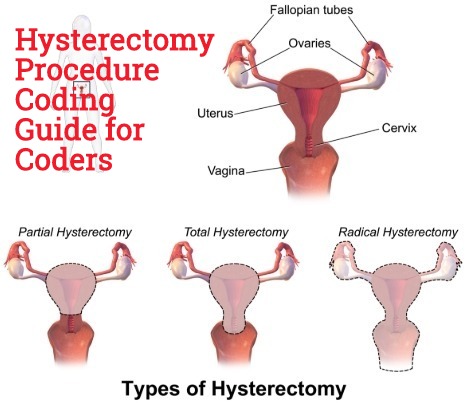
Industry coding guidance is explicit: CPT that same figure must not be applied to a supracervical (subtotal) hysterectomy, and confusing total versus subtotal hysterectomy is cited as one of the most frequent coding errors in this code family. Operative notes often describe the procedure without stating cervical disposition clearly. If the note does not confirm cervical removal, no coder can assign that same figure and remain defensible at audit.
2. Vaginal Hysterectomy Approach Mandates CPT 58260-58294, Never 58150
Do not use CPT 58150 for a vaginal approach. The correct code family is 58260 through 58294, with the specific code driven by uterine weight and whether concurrent repairs such as colporrhaphy or enterocele repair were performed, per industry coding guidance. This is where a documentation gap becomes a direct revenue gap: when the operative note omits specimen weight, the coder cannot distinguish between codes in this family, and the safest defensible choice is the lower-paying one.
3. Laparoscopic or Robotic Hysterectomy Belongs in CPT 58570-58573, Not 58150

CPT 58570 through 58573 govern laparoscopic and robotic-assisted hysterectomy, with code selection turning on a 250-gram uterine weight threshold and adnexal removal, according to industry coding guidance. Applying that same figure to a laparoscopic case is a misrepresentation of service that creates overpayment liability. The risk compounds when surgeons use templated dictations that omit the weight measurement entirely, leaving the coder to guess between codes that carry meaningfully different reimbursement rates.
4. Uterine Weight Documentation Protects Audit Defensibility Across All Hysterectomy Families
Uterine weight is the single clinical measurement that determines correct code selection across both vaginal and laparoscopic families, and it must appear in the operative note, as industry coding guidance makes clear. When surgeons omit it from dictation, the coder is forced to guess rather than code. iScribe Health's real-time documentation capture pulls this measurement from the clinical narrative before the note is finalized, so the billing queue receives the specificity the code requires. Most beneficial when multiple surgeons in the same practice have inconsistent dictation habits and coding variability is a known revenue leak.
5. Prophylactic Hysterectomy for BRCA Carriers Requires ICD-10 Specificity to Establish Medical Necessity

Prophylactic hysterectomy in BRCA carriers is a high-denial scenario precisely because the procedure has no symptomatic diagnosis to anchor it. Payers require a correctly paired Z-code (such as Z40.02 for prophylactic surgery) alongside the genetic susceptibility code (Z15.01 or Z15.02), and vague or mismatched diagnosis language is a consistent trigger for medical necessity denials on these claims. Industry data on denial rates for this pairing is not uniformly published, but the structural risk is well-documented: without ICD-10 specificity that mirrors the documented clinical rationale, the claim reads as elective rather than indicated, and no amount of correct CPT selection recovers it.
Clinical Indications and ICD-10 Codes That Establish Medical Necessity for CPT 58150
That structural risk extends across the full range of CPT that same figure indications, not just prophylactic cases. Five clinical scenarios account for nearly all claims submitted to commercial and government payers, each mapping to a specific ICD-10 family, and the pairing between the documented indication and the submitted code is exactly what payers audit first. As industry research has noted, vague or mismatched ICD-10 diagnoses are a top audit trigger for surgical claims, and the codes supporting medical necessity must align precisely with the documented clinical indication.
The five accepted indications, mapped to their ICD-10 families, are:
1. Uterine Fibroids Causing Pain or Heavy Bleeding - ICD-10 D25.x
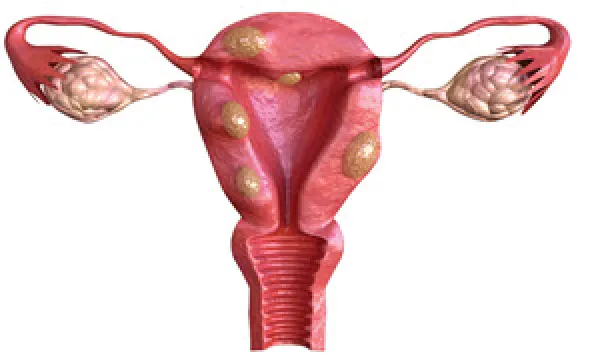
D25.x (leiomyoma of uterus) is the highest-volume indication for CPT that same figure. The subcategory matters: D25.0 specifies submucosal fibroids, D25.1 intramural, D25.2 subserosal, and D25.9 is unspecified. A claim submitted with D25.9 when the operative note documents a submucosal fibroid is not just imprecise; it signals to the payer that the code and the note were never reconciled, which is an audit trigger. Pair the D25.x subcategory with N92.0 or N92.1 when menorrhagia is the primary driver.
This is precisely where coding consistency across providers breaks down in high-volume gynecology practices. When clinicians are seeing full schedules and completing charts after hours, the anatomical specificity documented in the OR gets compressed into the broadest available subcategory by the time the note is finalized. iScribe Health's ambient AI documentation captures the clinical narrative in real time, including fibroid location as the surgeon describes it, and surfaces it at the point of note completion, so the D25.x subcategory the coder selects is already anchored to what was actually documented, not reconstructed from memory.
2. Abnormal Uterine Bleeding Unresponsive to Medical Management - ICD-10 N93.x

N93.x covers abnormal uterine bleeding not classified elsewhere. Medical necessity here depends on documented treatment failure, not just the diagnosis. A claim pairing N93.8 with CPT that same figure without prior treatment history in the record is a denial waiting to happen. The note must show what was tried, for how long, and why surgical intervention became the appropriate next step.
3. Chronic Pelvic Pain from Severe Endometriosis or Adenomyosis - ICD-10 N80.x and N85.0

N80.x and N85.0 carry heightened payer scrutiny compared to other CPT that same figure indications. N80.0 through N80.N85.
4. Uterine Prolapse Requiring Definitive Surgical Correction - ICD-10 N81.x
N81.x covers female genital prolapse by type and severity. Submitting N81.9 (unspecified) when POP-Q staging is documented in the pre-operative record is a reconciliation failure. Payers cross-reference staging documentation against the specificity of the submitted code. N81.2, N81.3, and N81.4 each carry distinct clinical meaning that should match the note exactly.
5. Prophylactic Hysterectomy for Genetic Risk - Z40.02 Paired with Family History or Mutation Code
Z40.02 governs prophylactic hysterectomy in carriers of BRCA1, BRCA2, or other documented high-risk mutations, but the code cannot stand alone. As industry research has identified, absence of the paired genetic susceptibility or family history code creates a medical necessity denial risk that no CPT or modifier expertise can resolve after submission. This pairing is a prerequisite, not an optional documentation enhancement.
---
The common thread across all five scenarios is that medical necessity is established by the clinical narrative, not by the code alone. A coder who selects the correct ICD-10 subcategory but works from a note that never documented exhausted conservative management, prolapse staging, or qualifying genetic history cannot rescue the claim at the coding stage. That documentation gap precedes the coding decision and makes the coding decision irrelevant.
This is the structural problem that high-volume gynecology practices face most acutely. When clinicians are regularly completing substantial charting outside patient care time, a pattern seen consistently in busy surgical practices, the clinical specificity that survives into the finalized note is inversely proportional to how exhausted the documenting physician is. The fibroid subtype gets generalized. The pain duration timeline gets omitted. The prior treatment sequence never makes it into the note in a form a payer will accept.
Practices that standardize clinical documentation quality across providers, rather than relying on coders to reconstruct it, are the ones that consistently clear payer scrutiny. iScribe Health's ambient listening and conversational AI capture the relevant clinical elements, fibroid location, prior treatment history, prolapse staging, genetic risk documentation, during the encounter itself. At the point of note completion, after the AI drafts the encounter summary, those specifics are already structured into the record.
For IT/EHR administrators and clinical informatics teams deploying iScribe Health across a supported EHR, the result is improved coding consistency across providers system-wide, not just for the physicians who happen to document thoroughly on their own. 02, the system flags it before the note is finalized, while correction is still possible.
Selecting the right ICD-10 code is only half the equation; the code is only as defensible as the note that generated it. The next section examines exactly which documentation elements must appear in the operative record for a CPT that same figure claim to survive payer scrutiny, and why the window to capture them closes the moment the surgeon finalizes the note.
Related Reading
Documentation Requirements That Make or Break a CPT 58150 Claim
As Infection Control and Hospital Epidemiology (Bucher et al.) confirmed, variability in hysterectomy coding accuracy traces back to inconsistencies in source clinical documentation rather than differences in coder skill.

Uterine Weight - The Single Most Audited Data Point in a 58150 Note
iScribe Health's ambient AI documentation is designed precisely for this moment. For practices already running a supported EHR, iScribe Health's EHR Integration materializes as a seamless layer on top of the existing workflow; surgeons do not change how they operate or dictate, and the ambient listening infrastructure surfaces the documentation that closes the gap.
Approach Language That Locks In or Loses the Code
As Infection Control and Hospital Epidemiology (Bucher et al.) found, operative notes lacking explicit detail about surgical approach resulted in codes that did not accurately reflect the clinical encounter, and that error could not be corrected at the coding stage alone.
In high-volume practices where surgeons are completing multiple operative notes in a single day, the likelihood of approach language being left vague increases with every hour spent catching up on documentation after the fact. iScribe Health's ambient listening captures explicit approach narrative in the surgeon's own words at the point of care, so the AI-drafted encounter summary already contains the language a coder and an auditor both need. Surgeons spend less time on documentation and more time on patient care.
The Pre-Finalization Checklist for a Defensible CPT 58150 Note
iScribe Health's E&M Coding Intelligence works at the point of note completion, after the AI drafts the encounter summary, to verify that these elements are present and defensible before the surgeon signs.
The value compounds across every patient encounter and every day of clinical practice: documentation quality is standardized across the practice rather than varying surgeon by surgeon, and the defensibility of each operative note reflects consistent clinical detail rather than whoever happened to dictate carefully that day. As Infection Control and Hospital Epidemiology (Bucher et al.) established, that standardization is exactly where the coding accuracy gap is won or lost.
Additional Procedures Bundling and Separate Billing With CPT 58150
Modifier -59 does not make a concurrent procedure separately billable. The operative note does.
That distinction costs practices real money when billing staff apply the modifier correctly but the surgeon's dictation never establishes why the additional procedure was clinically distinct. According to the CMS National Correct Coding Initiative, modifier -59 and its X-modifiers can bypass a column-two NCCI edit only when the operative report independently documents a separate indication, technique, and clinical complexity for that procedure. Without that narrative, the modifier converts a recoverable denial into a false modifier claim, which carries higher audit and recoupment exposure than the original edit violation.
Ensuring accurate, compliant medical coding across high patient volumes to maximize reimbursement and minimize claim denials is exactly where documentation quality becomes a revenue decision, not just an administrative one.
1. Minor Adhesiolysis and Routine Hemostasis - Bundled Into CPT Code 58150, Never Billed Separately
According to industry coding guidance, minor adhesiolysis and routine hemostasis are considered integral to CPT that same figure and are bundled by NCCI policy; billing them separately triggers an edit violation and claim denial. No modifier overrides this. The tradeoff is real: surgeons who dictate "lysis of adhesions performed" without specifying extent or clinical complexity give coders no path to separate reimbursement, even when the work was substantial. In high-volume practices where clinicians are already spending significant time charting outside of patient care, the pressure to consolidate dictation into a single flowing narrative is exactly what produces this documentation gap at scale.
2. Extensive Adhesiolysis, Appendectomy, and Cystoscopy - Separately Billable Concurrent Procedures With Independent Documentation
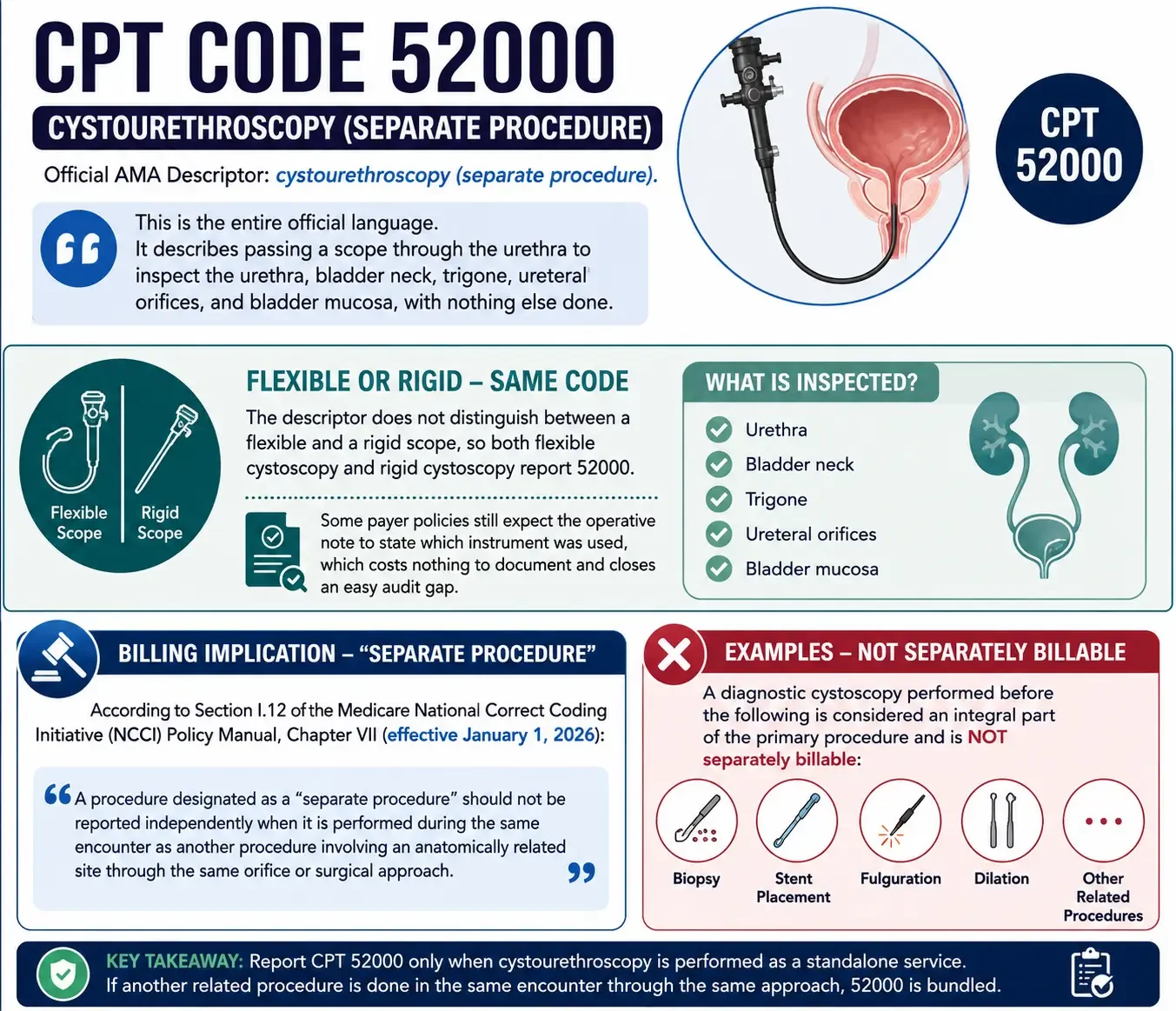
Extensive adhesiolysis (CPT 58740 or 44005 depending on site), incidental appendectomy, and cystoscopy can be billed separately alongside CPT 58150, but only when the operative note carries its own paragraph for each: the distinct indication, the technique used, and the clinical complexity encountered. A TAH performed in a patient with dense pelvic adhesions from prior endometriosis is the clearest example. Without that procedure-level narrative, the payer bundles it and the practice loses the RVUs entirely. The CMS National Correct Coding Initiative is explicit that correct coding requires accurate documentation, not merely correct code selection, making the operative report the primary instrument of reimbursement defense.
iScribe Health's Ambient AI Documentation captures each concurrent procedure's indication, technique, and clinical complexity in real time as the surgeon narrates, producing the procedure-level documentation granularity that transforms a single-paragraph note into a defensible, multi-line claim worth hundreds of dollars more per encounter. This is most impactful in high-volume practices or health systems where the volume of multi-procedure cases compounds the financial exposure of consolidated, non-specific dictation across every encounter, every day.
3. Bilateral Salpingo-Oophorectomy - Absorbed by CPT 58150's 'With or Without' Descriptor, Not Separately Billable
The CPT that same figure descriptor explicitly includes removal of tubes and ovaries as optional components of the same procedure. Billing a separate salpingo-oophorectomy code alongside 58150 creates a duplicate billing exposure that CMS National Correct Coding Initiative edits are designed to catch. The exception worth monitoring is risk-reduction salpingectomy billed for genetic indications, where payer-specific coverage policies vary and some commercial payers do permit separate billing with appropriate ICD-10 documentation. Even in these edge cases, the operative note must independently establish the distinct clinical indication, a requirement that ambient documentation captures at the point of dictation, before the note ever reaches the coder's queue.
4. Operative Report Documentation Standard - Each Additional Procedure Needs Its Own Indication, Technique, and Complexity Narrative
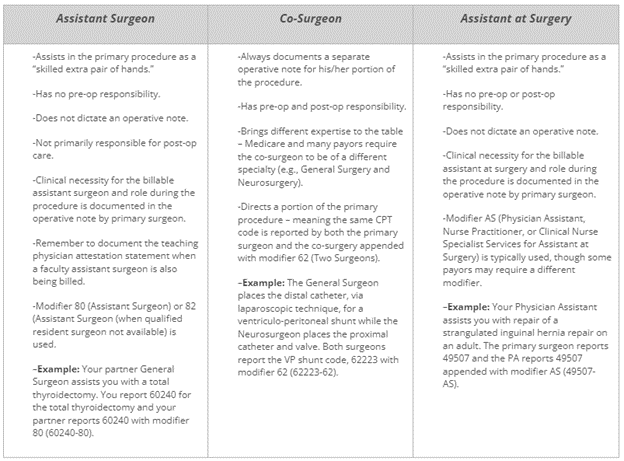
The single most common reason additional procedure claims fail alongside CPT code 58150 is inadequate operative documentation. Each separately billed procedure must have its own stated clinical indication, a discrete description of the surgical technique employed, and a narrative that conveys the complexity of that specific intervention. A single bundled paragraph covering the entire case does not meet payer or audit standards. Surgeons and coders must collaborate to ensure the operative report reflects each procedure as a standalone clinical event.
5. Combination Procedure Coding With CPT 58150 - Using Modifier 51 and Pelvic Floor Repair Add-On Codes Correctly
When CPT 58150 is reported alongside additional procedures such as pelvic floor repair, coders must apply modifier 51 (multiple procedures) to secondary codes and confirm whether any add-on codes are involved, as add-ons are modifier-51 exempt. Incorrect modifier application or failure to sequence the highest-value procedure first can result in reduced reimbursement or claim rejection. Understanding the interaction between primary and secondary codes in combination scenarios is essential for accurate payment and compliance when billing with CPT 58150.
Why Self-Documented CPT 58150 Claims Carry a Hidden Overcoding Risk
Self-documented operative notes create a documentation gap that most practices never detect because paid claims look identical to correctly supported ones.

The Overcoding Risk Hidden Inside Self-Documented Gynecologic Surgical Encounters
A significant share of CPT that same figure claims carry a documentation gap serious enough to fail audit scrutiny in practices where surgeons write their own operative notes, and that gap is a documentation failure rate. The distinction matters enormously for any practice administrator who has been directing remediation budget toward billing team education.
The absence of a denial reads as confirmation that the documentation was adequate, when in reality it only means the payer has not yet looked closely. OIG audit findings confirm that Medicare overpayment recovery is systematically incomplete, so improper payments are not reliably clawed back after submission, which leaves practices exposed long after those claims have cleared.
Why the Failure Mode Is a Documentation Gap, Not a Coding Gap
The overcoding risk in CPT that same figure claims almost never originates in the billing department. It originates in the operative note, where self-documenting surgeons routinely omit the clinical specifics that the submitted code actually requires: explicit uterine weight, approach confirmation language, and per-procedure narrative for any concurrent work. No downstream coding fix substitutes for what was never written.
The HHS Office of Inspector General's 2024 audit findings make the mechanism explicit: documentation deficiencies, not coder error, are the primary driver of improper surgical payments. Self-documenting practices are structurally self-undermining over time, because when denials are resolved by re-educating coders rather than correcting the operative note template, the same documentation deficiencies recur across multiple cases, and OIG and RAC auditors read that systematic recurrence not as honest error but as a pattern of overcoding. The practices carrying the highest audit exposure are those with the most confident coding teams working from the least documentationally complete operative notes.
How Real-Time AI Scribing Closes the Window Before the Note Is Finalized
Uterine weight, approach confirmation, and concurrent procedure detail are captured most accurately at the moment of the procedure, not reconstructed from memory an hour or a day later. iScribe Health's E&M Coding Intelligence builds coding recommendations from the complete clinical narrative captured in real time, so the specifics that define the correct code are locked into the record before the note is ever finalized.
Related Reading
Next steps
If your hysterectomy claims are being denied despite experienced coders selecting the correct code, the path forward starts with recognizing that the operative note, not the billing queue, is where claim defensibility is won or lost. Coder knowledge is necessary but not sufficient: the clinical documentation created at the time of service is the primary determinant of whether a CPT 58150 claim survives audit, gets paid at the correct level, or generates a compliance liability. Start with our AI medical scribe.
Uterine weight, approach confirmation, and concurrent procedure detail are captured most accurately at the moment of the procedure, not reconstructed from memory hours later. When surgeons omit these elements from templated dictations, the coder is forced to guess rather than code, and the branch point between a defensible claim and an audit-vulnerable one is set in the operating room. Systematic recurrence of the same documentation gaps across multiple cases signals a pattern of overcoding to OIG and RAC auditors, dramatically elevating the probability of a formal probe. Together, these realities point to one corrective action: capture the clinical specificity that defines the correct code before the note is finalized, not after the denial arrives.
Start with iScribe Health's AI medical scribe, which listens during the encounter itself and drafts a structured operative summary, complete with approach language, uterine weight, and per-procedure narrative, before the surgeon ever signs. The note that reaches your biller already contains what the claim requires.
Frequently Asked Questions
What exactly does CPT 58150 cover, and does it change if the surgeon also removes the ovaries or tubes?
CPT 58150 covers total abdominal hysterectomy (corpus and cervix) performed through an open abdominal incision, with or without removal of the fallopian tubes and/or ovaries. The inclusion or removal of those structures does not alter the base code, so a claim for a total abdominal hysterectomy with bilateral salpingo-oophorectomy is still correctly billed as CPT 58150.
Which CPT code do I use if the surgeon left the cervix in place during an open abdominal hysterectomy?
When the cervix is left intact, CPT 58180 is the required code, not 58150. Applying 58150 to a supracervical (subtotal) hysterectomy is one of the most frequently cited coding errors in this code family, and it cannot be defended at audit if the operative note does not confirm cervical removal.
What CPT codes apply to vaginal and laparoscopic hysterectomies, can I ever use 58150 for those approaches?
No. Vaginal hysterectomies belong in the 58260-58294 code family, with the specific code determined by uterine weight and whether concurrent repairs were performed. Laparoscopic and robotic-assisted hysterectomies belong in the 58570-58573 family, with code selection turning on a 250-gram uterine weight threshold and adnexal removal. Applying 58150 to either approach is a misrepresentation of the service rendered.
How long is the global period for CPT 58150, and what does it bundle?
CPT 58150 carries a 90-day global surgical period that begins the moment the operative note is finalized. Bundled services include the surgical incision, organ mobilization, closure, minor adhesiolysis, hemostasis, and routine postoperative care, meaning a wound check or standard follow-up visit within that window cannot be billed separately. Exceptions such as a new unrelated problem or an unrelated return to the OR may support a modifier 24 or modifier 79 claim, but only with documentation that explicitly establishes unrelatedness.
If the operative note doesn't mention the surgical approach or uterine weight, can the coder just infer those details?
No, inference is not documentation. A claim built on an incomplete operative note survives only until an auditor requests the record, and a note that omits approach language or specimen weight removes the documentary foundation not just for the primary claim but for the entire 90-day billing window. For vaginal and laparoscopic code families specifically, omitting uterine weight forces the coder to default to the lower-paying defensible code, creating a direct revenue gap.