CPT Code 57454: Complete Reference and Billing Guide
CPT code 57454 billing gaps cost real revenue. Billing teams, see how automated E&M coding turns cleaner claims into money recovered.


Knowing CPT 57454 requires three procedural components is not enough. If your documentation does not prove each one happened, the claim fails exactly like a wrong code would.
CPT code 57454 sits at the center of one of the most documentation-sensitive billing decisions in OB/GYN practice. The common assumption is that if the billing team knows CPT 57454 requires both cervical biopsy and endocervical curettage, the coding is correct and the claim is safe. The problem is that the official descriptor is a compressed compliance checklist, and every word in it carries payer weight. See our AI medical scribe for how this works in practice.
The Three-Part Descriptor That Defines the Code That single phrase bundles three distinct clinical services into one billable unit: (1) colposcopic visualization of the cervix and adjacent vaginal tissue, (2) endocervical curettage (ECC), and (3) cervical biopsy. All three must occur in the same session for the code to apply. That three-part requirement is where most coding errors originate.

Why Reimbursement Value Is Entirely at Risk Without Full Documentation The work relative value unit (RVU) for CPT 57454 reflects that bundled complexity. Under the Medicare Physician Fee Schedule, the code carries meaningful per-encounter reimbursement value that is entirely at risk when documentation fails to support each component individually. This is not a minor administrative concern.
The code is correct. The documentation collapses under audit. The financial outcome is identical to selecting the wrong code entirely.
Payers audit the clinical note behind the code and evaluate it against the descriptor's specific language. Each noun in the CPT 57454 phrase corresponds to a discrete documentation element the auditor expects to find: evidence of colposcopic examination, a documented ECC specimen, and a documented biopsy specimen.
"Procedure completed" does not satisfy any of those checkpoints. Where Documentation Gaps Actually Originate, and How to Close Them The structural problem is timing. The physician who performed the colposcopy, ECC, and biopsy is also the one expected to translate each of those clinical actions into audit-ready language, under time pressure, before the note reaches the biller. That is where documentation gaps originate. The failure is a workflow failure, not a knowledge failure.
iScribe Health's Automated E&M Coding is designed to address this by capturing and structuring the clinical narrative at the point of care, so each required component is documented as it happens rather than reconstructed afterward. In high-volume OB/GYN settings, real-time AI scribing has meaningfully reduced after-hours documentation time, capturing clinical detail at the point of care rather than requiring reconstruction at the end of a packed schedule.
Key takeaways
- CPT 57454 requires three distinct procedural components, colposcopy, cervical biopsy, and endocervical curettage, and payers audit at the component level, not the encounter level. A note that blurs all three into one narrative is a denial waiting to happen.
- Selecting the right code is only half the job. A correctly coded 57454 claim still fails at adjudication when billing mechanics, modifier placement, global period conflicts, and payer-specific rules, go unchecked before submission.
- Four colposcopy codes cover the same anatomical site with nearly identical language and meaningfully different reimbursement rates. That structural closeness drives systemic miscoding even in experienced billing teams.
- AI-assisted audits have surfaced overcoding rates as high as 33% in colposcopy encounters, a number that reflects a documentation systems failure, not individual coder error.
- E&M coding accuracy sits around 55% across independent practices. A correct code paired with a weak clinical note is still a revenue leak, the note is where 57454 claims are won or lost.
- iScribe Health's Automated E&M Coding closes that gap by generating E&M codes in real time from clinical documentation, giving OB/GYN providers a built-in check that every required component is captured before the encounter closes, not discovered missing after a denial.
What Are the Three Required Procedural Components of CPT 57454
Three procedural acts make CPT that same figure defensible. Miss any one of them in the clinical note, and payers treat the encounter as if that act never happened. That distinction matters because the code is audited at the component level, not the encounter level, and a note that blurs the three together into a single narrative creates the same financial exposure as a note that omits a component entirely.
1. Colposcopic Visualization, Cervical Biopsy, and Endocervical Curettage - All Three Must Occur in the Same Session

CPT Code 57454 is defined by the simultaneous performance of all three procedural components, colposcopic visualization, directed cervical biopsy, and endocervical curettage (ECC), within a single clinical encounter. Billing coders and OB/GYN providers must confirm that no component was deferred to a follow-up visit, as payers treat the code as an indivisible bundle. Splitting components across dates of service invalidates the 57454 claim entirely.
2. Explicit Documentation of Each Component - Implied or Bundled Language Triggers Payer Audit Denial
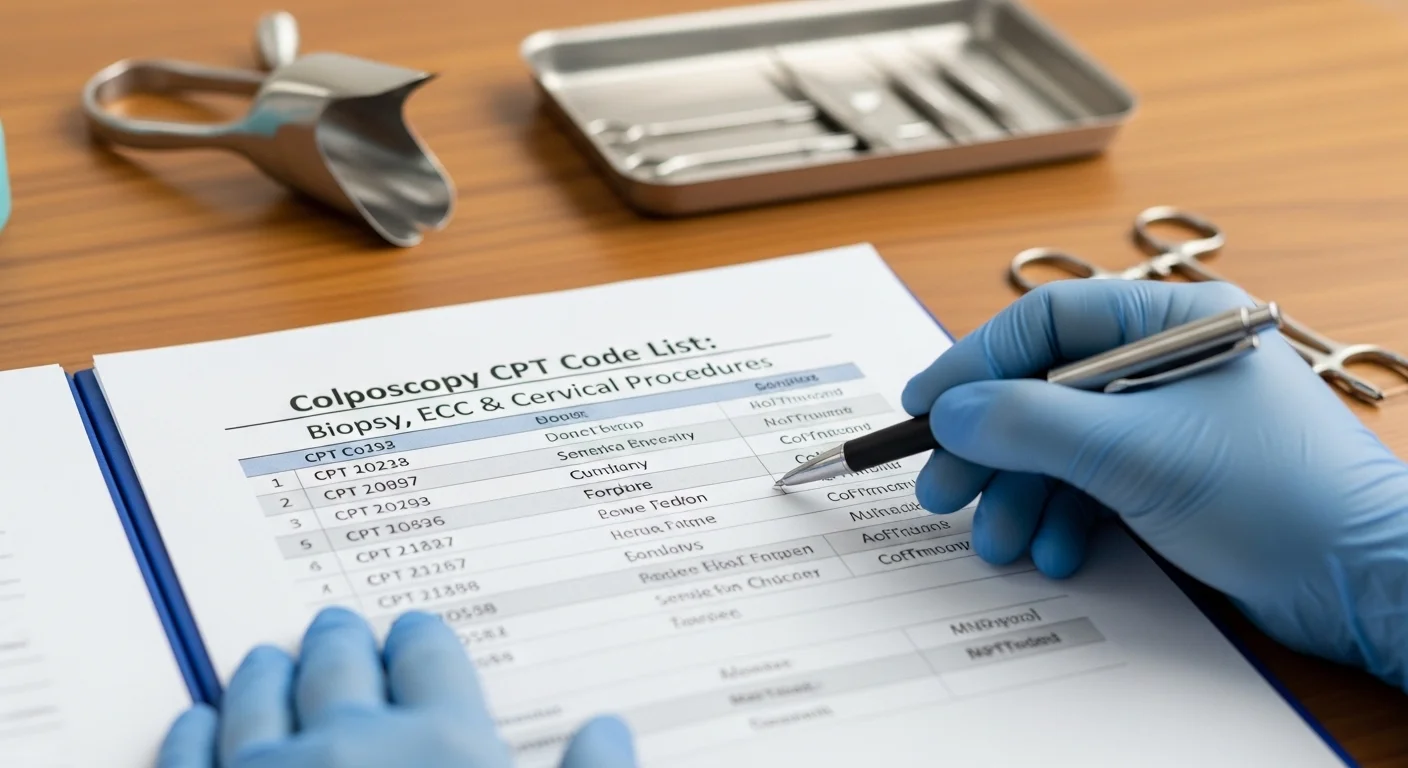
Payer audit logic is unambiguous on this point. The Centers for Medicare & Medicaid Services Documentation Guidelines state that generic bundled language such as "procedure completed" or "colposcopy performed" does not satisfy the requirement to explicitly name each of the three components in the operative or procedure note. The note must confirm colposcopic findings, biopsy site selection and technique, and ECC performance with specimen disposition, each as a named, independent entry.
In high-volume OB/GYN practices where clinicians routinely chart well outside of patient care time, this is precisely where component-level specificity breaks down. When notes are reconstructed from memory at the end of an afternoon packed with colposcopy, well-woman, and problem visits, the three discrete acts of CPT that same figure collapse into a single-sentence narrative that satisfies no one, least of all a payer reviewer. The American College of Obstetricians and Gynecologists Coding Resources confirm that billing teams who assume correct code knowledge translates to correct documentation frequently fail payer audits because the clinical note does not independently corroborate each element. That gap between what happened in the room and what the note proves happened is where recoverable revenue disappears.
iScribe Health's ambient AI documentation captures each procedural step as it occurs during the encounter through ambient listening and conversational AI, generating component-level clinical language in real time rather than after the fact. Because the AI drafts the encounter summary at the point of note completion, not hours later after clinical detail has faded, the colposcopic findings, biopsy site selection, and ECC specimen disposition each appear as discrete, named entries that satisfy payer audit requirements. For practices already running a supported EHR, this integrates directly through iScribe Health's EHR integration, making the workflow seamless rather than additive.
iScribe Health's Real-Time Denial Alerts further flag documentation gaps before the claim is submitted, giving the care team the opportunity to correct the note while the encounter is still fresh.
3. Abnormal Pap Smear (ASC-US, LSIL, HSIL) or Positive High-Risk HPV Test as the Clinical Indication Driving Full 57454 Utilization
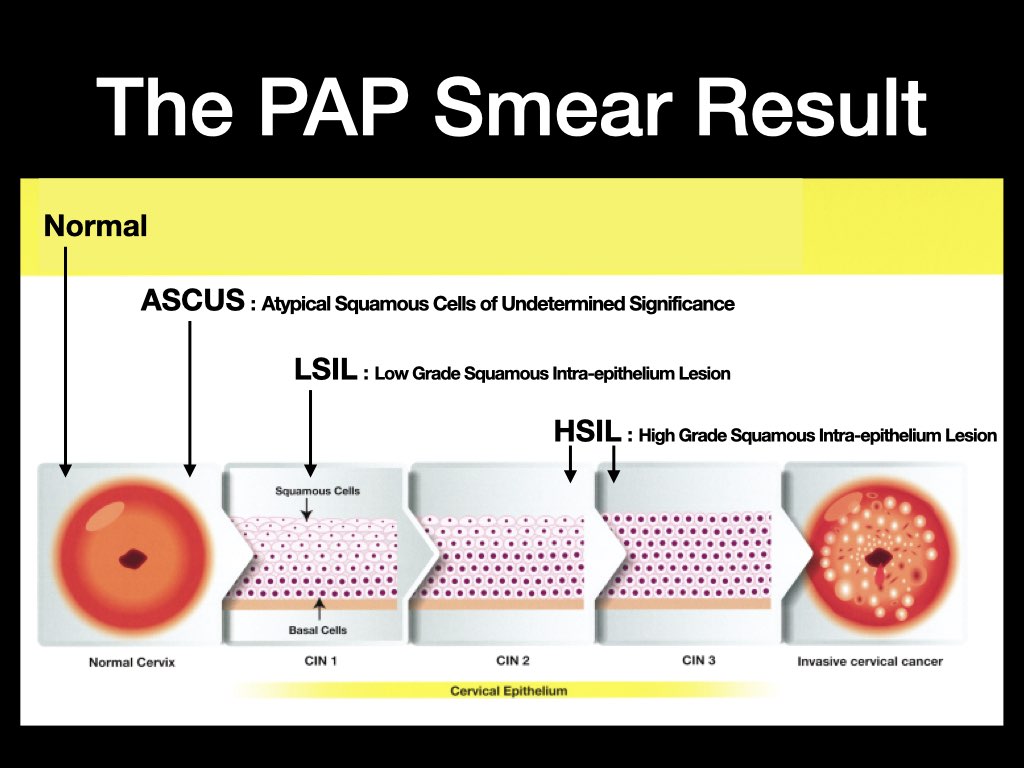
The most common ICD-10 diagnoses paired with CPT 57454 are abnormal cervical cytology results, ASC-US, LSIL, or HSIL, and a positive high-risk HPV co-test, which together constitute the clinical justification for proceeding with both biopsy and ECC in the same session. Coders must link the correct ICD-10 code to the claim; a mismatch between indication and procedure code is a leading cause of medical necessity denials for 57454.
Related Cervix Colposcopy CPT Codes That Billers Confuse with 57454
Four colposcopy codes cover the same anatomical site, use nearly identical procedural language, and reimburse at meaningfully different rates. That combination creates predictable, systemic coding errors. The codes are structurally close enough to invite judgment calls where none should exist. In high-volume practices and health systems, where clinicians are most likely to be charting well beyond their scheduled patient care time, these judgment calls compound across every encounter and every day, quietly eroding reimbursement and accumulating audit exposure before anyone notices.
The Novitas Solutions Medicare Part B LCD/Article Guidance is unambiguous: code selection among 57452, 57455, 57456, and 57454 is determined by two binary documentation facts. Biopsy performed? ECC performed? Those two yes/no answers resolve the code every time. Any deviation from that logic is either undercoding or an upcoding exposure, regardless of how thorough the encounter felt.
1. CPT 57455 - Colposcopy with Cervical Biopsy Only (No ECC Performed)
Use 57455 when a directed cervical biopsy is performed and documented, but ECC is explicitly deferred or not indicated. Across the market, this is the correct code when only one of that same figure's two required procedural components is present. The overcoding risk here is real: billing that same figure when the operative note documents "ECC deferred" creates direct audit exposure, because the payer reads the note, not the coder's intent. Improving coding consistency at this decision point, particularly across multiple providers who may document the same procedure differently, is one of the clearest ways to protect reimbursement without changing clinical workflow.
2. CPT 57456 - Colposcopy with ECC Only (No Cervical Biopsy Taken)

57456 applies when endocervical curettage is performed as a standalone sampling procedure without a directed cervical biopsy in the same session. This scenario is less common but clinically valid, and the code distinction matters: billing that same figure here overstates the procedure performed. The documentation test is the same as for 57455: one component confirmed, one absent, and the correct code drops accordingly. Inconsistent provider documentation habits make this distinction especially fragile across high patient volumes, where accurate, compliant coding cannot rely on a biller catching every variation.
3. CPT 57452 - Colposcopy Without Biopsy or ECC (Visualization Only)
57452 covers diagnostic colposcopy where the provider examines the cervix and adjacent vagina but takes no tissue and performs no curettage. It is the baseline visualization code. Critically, Novitas Solutions Medicare Part B LCD/Article Guidance confirms that colposcopic visualization is bundled into that same figure, 57455, and 57456. Billing 57452 alongside any of those higher-level codes is unbundling and is not permitted. Billing that same figure when only 57452 was supported is straightforward upcoding.
4. Biopsy-ECC Decision Matrix - How Y/N Documentation Drives Code Selection for CPT 57454
The matrix resolves every encounter in under 30 seconds. Biopsy: Yes / ECC: Yes = that same figure. Biopsy: Yes / ECC: No = that same figure. Biopsy: No / ECC: Yes = 57456. Biopsy: No / ECC: No = that same figure. Most billing teams treat mastery of this matrix as the finish line. The operative note, not the coder's knowledge of the matrix, is the legal record that determines which code is defensible, and that is where correctly selected claims collapse into denials.
When a provider documents procedural components without naming each one separately, the operative note cannot confirm which cell of the matrix applies. Absent documentation is treated as an absent procedure, as broader payer adjudication patterns confirm. A claim coded that same figure on accurate clinical grounds occupies the same audit risk position as a claim coded for the wrong level entirely: the payer reads generic bundled language as insufficient support and collapses the code to a lower-level reimbursement or denial, regardless of what actually happened in the room. The result is claim denial that erodes reimbursement at scale, and it is entirely preventable at the point of documentation.
8% provider, AI agreement, 33% overcoding rate found. iScribe Health's ambient listening and conversational AI captures discrete procedural components in real time during the encounter, so the biopsy-Y and ECC-Y answers are already present in the note before the claim is built. Because the system integrates directly with supported EHRs, that documentation is available at the point of note completion, after the AI drafts the encounter summary, with no additional charting burden placed on the provider.
For practices running high patient volumes, this is how accurate, compliant medical coding gets achieved consistently across every encounter, not just when a biller happens to catch a documentation gap.
Critically, iScribe Health's E&M Coding Intelligence and Real-Time Denial Alerts extend that protection beyond the note itself. Rather than discovering a documentation deficiency after a denial arrives, the system surfaces coding discrepancies before the claim leaves the practice, functioning as pre-submission checkpoints. Improving coding consistency across providers, one of the most persistent challenges in multi-clinician OB/GYN practices, depends on this kind of systematic support, not on any individual biller's ability to review every operative note for every encounter.
Selecting the right code from this matrix is only half the protection. The other half is making sure the claim itself is structured to survive payer scrutiny before it leaves the practice. The next section covers the specific billing guidelines for CPT that same figure that function as pre-submission checkpoints, not post-denial corrections.
Related Reading
- Cpt Code 76805
- Cpt Code 76817
- Cpt Code 58150
Billing Guidelines for CPT 57454 That Protect Claims Before They Leave the Practice
A correctly coded CPT that same figure claim can still fail at adjudication. Not because the wrong code was selected, but because the billing mechanics surrounding the code were never checked before submission. The four denial triggers below are each detectable before the claim leaves the practice.
Pre-Bill Review as a Confirmation Step, Not a Salvage Operation
Most billing teams treat these four triggers as post-denial problems, something to address after the claim returns rejected. The hidden cost of that approach is not just the appeal cycle time; it is the revenue that never comes back from encounters where the global period collision went unnoticed and the window to refile closed.
Practices that rely on manual end-of-day chart review to catch these issues are betting that a rushed note will contain the exact modifier justification, diagnostic chain reference, and biopsy site documentation that payers require. iScribe Health's real-time denial alerts are designed to surface these gaps at the point of care before submission. Practices using real-time AI documentation tools consistently find that the pre-bill checkpoint becomes a confirmation step rather than a last-minute search for language the note may never have contained.
Getting the billing rules right for CPT that same figure is a necessary condition for clean claims, but it is not sufficient if the note backing the code was written under time pressure and left the clinical justification incomplete. The next section examines why those documentation gaps are nearly invisible to in-house review, and what it takes to actually surface them before they become patterns.
1. 10-Day Global Period Rule - Why Routine Follow-Up Visits After CPT Code 57454 Get Denied
CPT 57454's 10-day global period means any follow-up visit, pathology result review, or post-procedure E&M billed within that window is automatically bundled by payers unless a modifier explicitly separates it. As STI Revenue Cycle Management's October 2024 eNews confirms, services rendered inside the postoperative window are denied without the correct modifier appended. The denial rarely surfaces at submission; it appears later, at adjudication of the surrounding encounter cluster, long after the billing team has moved on. That timing gap is exactly why global period collisions go undetected until revenue is already gone.
2. Modifier 25 on Same-Day E&M - When Separate Medical Decision-Making Must Be Documented Before You Append It
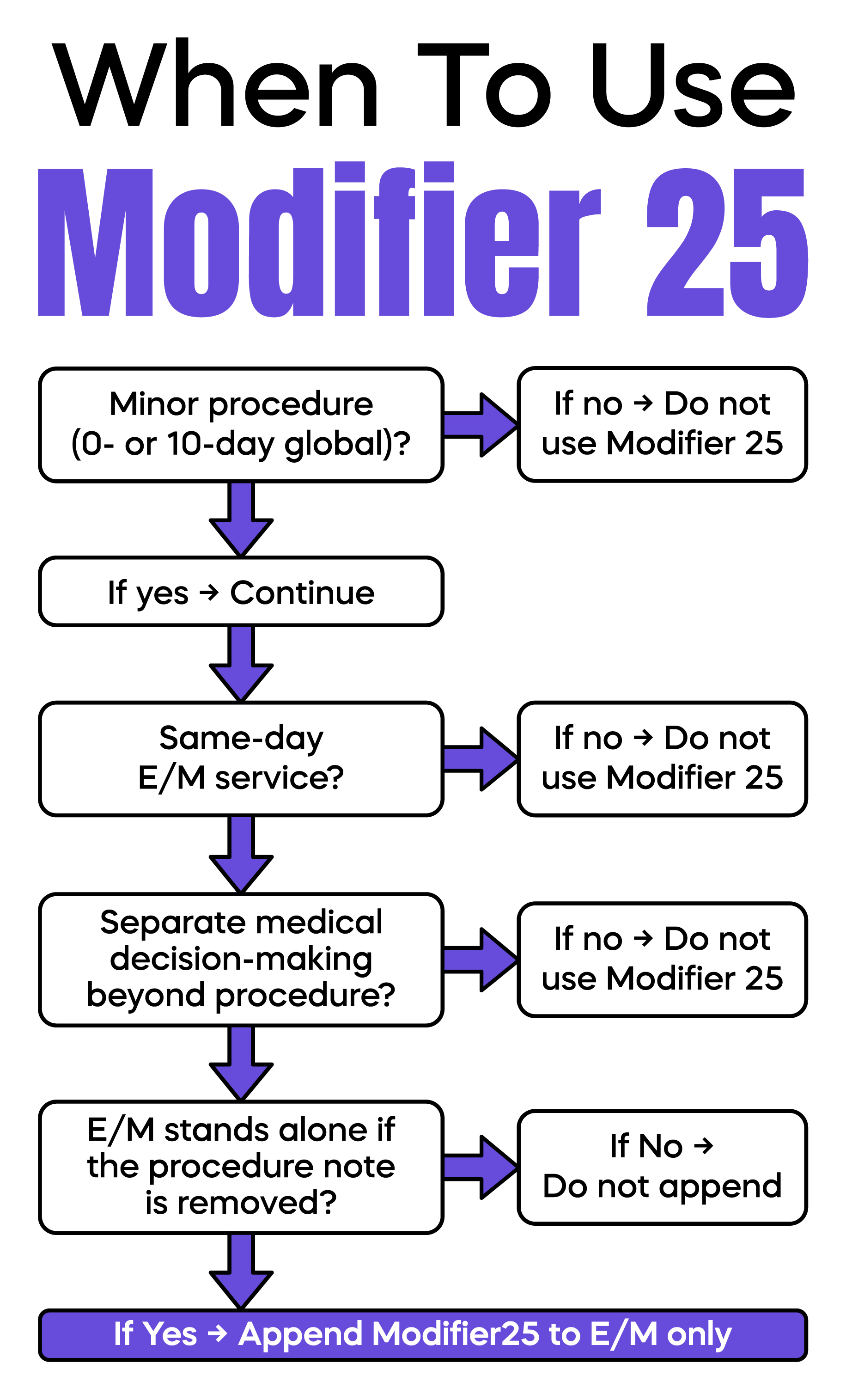
Modifier 25 is not a default add-on for same-day E&M visits billed alongside CPT 57454. It signals to the payer that the evaluation and management service was independently documented, separately medically necessary, and clinically distinct from the colposcopy procedure itself. CMS OIG post-payment reviews have consistently recovered overpayments tied to Modifier 25 misuse when the supporting note lacked a distinct clinical decision. The modifier must be earned by the documentation before it is appended, not applied reflexively because two services occurred on the same date. A thin note with a bolted-on Modifier 25 is audit exposure, not clean billing.
3. ICD-10 Linkage Accuracy - Matching Z12.4, R87.610, and R87.612 to the Clinical Indication in the Procedure Note

The ICD-10 code on the claim must trace directly back to the documented clinical indication in the procedure note. Z12.4 (screening for cervical cancer), R87.610 (ASC-US), and R87.612 (HSIL) each carry different medical necessity thresholds, and payers cross-reference the referral indication against the billed diagnosis code. The JLGTD consensus guidelines are explicit: the documented indication must align with the diagnostic codes used for billing to support medical necessity. A mismatch between what the note says prompted the procedure and what the claim reports as the diagnosis is one of the most common first-pass denial drivers in OB/GYN procedure billing.
4. CPT 87624 Diagnostic Chain Completion - Linking a Positive High-Risk HPV Result to the Colposcopy Encounter
When a positive high-risk HPV test (CPT 87624) is the clinical trigger for the colposcopy, that result must appear as an explicit link in the diagnostic chain connecting the prior encounter to the 57454 claim. The JLGTD guidelines specify that the referral indication, including positive HPV test results, must be documented and must align with the billing codes used to establish medical necessity. A procedure note that omits the HPV result reference leaves the payer without a documented clinical rationale for the colposcopy, turning a straightforward medical necessity argument into an avoidable denial. This gap is common, not an edge case, and it is entirely catchable before submission.
Why Colposcopy Coding Errors Go Undetected Until an AI Audit Surfaces Them
That avoidable denial pattern, multiplied across hundreds of encounters, is precisely what a 33% overcoding rate discovered only through AI-assisted review represents. When a billing team's confidence in its code knowledge becomes the primary control mechanism, that confidence actively conceals the gap between what providers document and what gets billed across hundreds of encounters.

Why Practice-Level Self-Audit Is Structurally Blind to Colposcopy Overcoding
Internal billing reviews are designed to catch obvious errors: wrong patient, wrong date, missing modifier. What they cannot catch is a subtler mismatch, the kind where a CPT code was selected correctly but the operative note never explicitly confirms that endocervical curettage was performed as a distinct procedural step, leaving the claim technically unsupported.
Research published in the Archives of Internal Medicine identifies operational systems failures, including inadequate handoffs and supervisory gaps, as the most common root cause of preventable errors in clinical settings. In a high-volume OB/GYN practice with multiple providers charting under time pressure, no internal reviewer is comparing the component-level language of each operative note against the billed code on a per-claim basis. Systematic overcoding stays invisible without automated tooling.
What a 33% Overcoding Rate Across 941 Encounters Reveals About Documentation at Scale
An AI-assisted coding audit of 941 colposcopy encounters at a single OB/GYN site revealed a 33% overcoding rate and a 54.8% provider, AI agreement rate, a systematic error that the practice's existing billing and coding processes had not identified before the audit.
Key takeaway: A 33% overcoding rate across that same figure encounters went entirely undetected by existing billing processes, the true error rate was structurally unknowable without automated tooling.
That is what happens when documentation specificity is left to individual provider habits across a large encounter volume, and it illustrates why the correct-code assumption is itself a liability.
The Correct-Code-Weak-Note Problem and Its Financial Consequences
Selecting the right CPT code is necessary, but it is not sufficient. A correct CPT code paired with a weak or non-specific operative note creates the same financial and compliance exposure as an outright wrong code. Payers audit the note, not just the code selection.
Most administrators discover this only after a payer audit reconstructs the documentation record and finds the clinical justification missing. iScribe Health's Automated E&M Coding works upstream of code selection, capturing every required component in the clinical note in real time so that when a payer or audit tool scrutinizes the claim, the documentation is already defensible rather than retroactively reconstructed.
Next steps
If your colposcopy encounters are losing recoverable revenue before anyone notices, the path forward starts with closing the gap between what providers perform and what the clinical note actually proves. Knowing the biopsy-ECC matrix that separates 57454 from 57455 and 57456 is necessary, but a correctly selected code tied to generic bundled language occupies the same audit risk position as a wrong code entirely. Start with our AI medical scribe.
The 33% overcoding rate surfaced only through AI-assisted audit of 941 encounters confirms that billing team confidence in code knowledge is not a reliable control mechanism at scale. When documentation specificity is left to individual provider habits under time pressure, the error rate is structurally unknowable without automated tooling. The 10-day global period bundling exposure compounds this: two independent revenue-leak vectors emerge from a single colposcopy encounter, and both are invisible to standard internal review. Together, they point to one corrective action: capturing component-level clinical language in real time, before the encounter closes and before the claim is built on a note that cannot survive audit.
Start with an AI medical scribe that drafts the encounter summary at the point of care, embedding colposcopic findings, biopsy site documentation, and ECC confirmation as discrete, named entries before the provider leaves the room. Real-Time Denial Alerts then flag remaining documentation gaps before submission, turning the pre-bill checkpoint from a salvage operation into a confirmation step.
Frequently Asked Questions
What happens if my operative note says 'procedure completed' instead of documenting each step separately?
Generic bundled language like 'procedure completed' or 'colposcopy performed' does not satisfy payer audit requirements. The Centers for Medicare & Medicaid Services Documentation Guidelines require that colposcopic findings, biopsy site selection and technique, and ECC performance with specimen disposition each appear as a named, independent entry in the note, and absent documentation is treated as an absent procedure.
Which colposcopy code do I use if the physician performed the cervical biopsy but skipped the ECC?
Use CPT 57455, not 57454. The biopsy-ECC decision comes down to two binary facts: biopsy performed and ECC performed. Biopsy Yes / ECC No resolves to 57455 every time, and billing 57454 when the operative note documents 'ECC deferred' creates direct audit exposure because the payer reads the note, not the coder's intent.
Can I bill CPT 57452 alongside CPT 57454 on the same claim?
No. Novitas Solutions Medicare Part B LCD/Article Guidance confirms that colposcopic visualization is already bundled into 57454, 57455, and 57456, so billing 57452 alongside any of those higher-level codes constitutes unbundling and is not permitted.
What ICD-10 diagnosis codes are typically paired with CPT 57454?
Common clinical indications include abnormal Pap smear results, ASC-US, LSIL, HSIL, and positive high-risk HPV test results, and the ICD-10 code on the claim must reflect the specific abnormality documented in the note. A mismatch between the diagnosis code and the clinical indication is an independent audit tripwire that can trigger recoupment even when all three procedural components are correctly documented.
Is colposcopy alone, without biopsy or ECC, ever a billable service?
Yes. CPT 57452 covers diagnostic colposcopy where the provider examines the cervix and adjacent vagina but takes no tissue and performs no curettage, making it the baseline visualization-only code. It reimburses at a lower rate than 57454 and cannot be billed together with the higher-level colposcopy codes.