How to Use OBGYN CPT Codes and Get Paid Faster
OBGYN CPT codes are leaving money on the table. See how billing teams close the documentation gap and get paid faster.


Knowing the right OBGYN CPT codes is not your revenue problem. The documentation leaving the exam room before your biller opens the chart is.
The common assumption among billing teams and practice administrators is that OBGYN coding accuracy is primarily a coder knowledge problem: hire better coders, invest in code-lookup tools, and reimbursement will improve. In reality, nearly half of all OB/GYN encounters are coded below their clinically justified level. That single fact reframes the entire reimbursement conversation, because the problem is not sitting in your billing department.
It's leaving the exam room before your biller ever opens the chart. Practices that have invested in coder training, updated their fee schedules, and audited their workflows still see denials pile up. The reason is structural: coding accuracy depends on documentation quality, and documentation quality is decided at the point of care. See our AI medical scribe for how this works in practice.

nearly half
of OB/GYN encounters coded below clinical level
The gap is not effort. The gap is visibility.
The gap is not effort. The gap is visibility.
Payers adjudicate against the medical record, not the code selection. Per Documentation Guidelines for E/M Services, a correctly chosen CPT code that lacks adequate supporting documentation is just as likely to be denied or downcoded as a wrong code. That's the structural ceiling coders work under every day.
Consider a busy OB/GYN practice billing 99213 across the board for established patients. The biller didn't choose the wrong code; the note didn't capture the medical decision-making complexity that would justify 99214. In our market understanding, E&M documentation accuracy falls well short of clinical reality under manual workflows, producing systematic underpayment that better code knowledge alone cannot fix. Independent medical review data from state-level programs reinforces this pattern: a meaningful share of denied claims are overturned on review, confirming that clinical justification existed but was not captured in the original record.
Platforms like iScribe Health's E&M Coding Intelligence address this upstream, building coding recommendations directly from the complete clinical narrative captured at the point of care, before the note is finalized and before the gap becomes a denial. E&M visits represent the highest-volume and most frequently undercoded category in any OB/GYN practice, so that's exactly where the documentation gap does the most financial damage. The next section maps the specific E&M codes your billers reach for most often, and what the note must contain for each one to survive a payer audit.
Key takeaways
- Nearly half of all OB/GYN encounters are coded below their clinically justified level, not because billers chose the wrong code, but because the note never supported the right one.
- The documentation problem is set before a claim reaches the coder: whatever detail the physician captured in the exam room is all the biller has to work with.
- Global obstetric package codes like CPT 59400 and 59510 bundle the highest revenue events in most OB practices into a single claim, and concentrate the highest documentation risk in the same place.
- Modifiers 25, 59, and their counterparts don't protect a claim by being appended; they protect a claim when the physician's note meets the precise trigger condition each modifier requires.
- Obstetric ultrasound and Pap smear claims get denied at a consistent rate even when the code is correct, because the note underneath it doesn't document what payers need to see.
- iScribe Health's E&M Coding Intelligence reads the complete clinical narrative, not just the finalized note, and surfaces coding recommendations in real time, closing the gap between what happened in the exam room and what the claim actually reflects.
The Most Common E/M Codes Used in OB/GYN Office Visits
The five E/M code families below cover the vast majority of OB/GYN office billing. Each maps to a specific patient type and visit context. Knowing which code fits is the starting point. Whether the note actually supports it is a separate problem entirely.
The Reference Table
- 99202–99205 → Patient Type: New → Visit Context: Problem-oriented office visit → MDM Anchor: Low (99203) to High (99205).
- 99211–99215 → Patient Type: Established → Visit Context: Problem-oriented office visit → MDM Anchor: Minimal (99211) to High (99215).
- 99384–99387 → Patient Type: New → Visit Context: Preventive / well-woman → MDM Anchor: Age-bracket driven.
- 99394–99397 → Patient Type: Established → Visit Context: Preventive / well-woman → MDM Anchor: Age-bracket driven.
1. New Patient Codes 99202-99205 - MDM and Time Thresholds That Determine OB/GYN Visit Level
New patient codes apply when the physician has not seen the patient in any capacity within the prior three years. In OB/GYN, 99203 and 99204 carry the heaviest volume: 99203 fits a straightforward new gynecologic concern with low MDM, while 99204 reflects moderate MDM, covering presentations like abnormal bleeding with a differential requiring data review. Under 2021 AMA E/M guidelines, level selection turns on documented MDM complexity or total time, not the number of exam elements recorded. A practice that defaults to that same figure for every new patient visit regardless of clinical complexity is leaving measurable reimbursement on the table.
2. Established Patient Codes 99211-99215 - Why 99213 Is Systematically Overbilled in OB/GYN Practices
99213 and 99214 dominate established patient billing in OB/GYN, but the split is rarely accurate. That same figure is appropriate for straightforward follow-up with minimal MDM; 99214 is warranted when the encounter involves at least two chronic conditions, a new problem requiring workup, or prescription drug management. The CMS Medicare Physician and Other Practitioner Look-Up Tool makes individual provider utilization publicly auditable, so a practice that systematically bills that same figure for encounters that clinically justified 99214 is visible to payers and auditors alike. The pattern is rarely intentional; it reflects documentation that never captured the complexity that was actually managed.
3. Preventive Well-Woman Codes 99384-99387 and 99394-99397 - Age-Bracket Selection Guide
Well-woman exams fall outside the problem-oriented E/M series entirely. New patients use that same figure-99387; established patients use 99394-99397, with the correct code determined strictly by the patient's age bracket. Selecting the wrong bracket is a direct billing error with reimbursement consequences. When a provider addresses a separate clinical problem during the same visit, Modifier 25 must attach to the problem-oriented E/M code to prevent denial, and the note must contain documentation that clearly supports a distinct, medically necessary service on that same date. Missing that documentation is the single most common reason same-day preventive and problem-oriented claims are rejected.
4. Documentation Completeness as the True Determinant of Supportable OBGYN CPT Code Level
Under post-2021 AMA E/M guidelines, the coder does not choose the code, the documentation does. In OB/GYN, this means the physician's note must explicitly capture the number and acuity of problems addressed, data reviewed, and risk of complications to support any code above 99213 or 99214. Practices that rely on templated notes without individualized clinical narrative are most vulnerable: auditors can downcode an entire visit series if MDM elements are checkbox-populated rather than substantively documented.
5. Common OBGYN CPT Codes Reference List - Procedural and E/M Codes Used Across OB/GYN Encounters
The table below covers the core E/M and preventive code families used in OB/GYN office billing. Procedural codes (IUD insertion, colposcopy, hysterectomy) and obstetric global packages sit in separate code families addressed in subsequent sections.
- 99203–99205 → Patient Type: New → Visit Context: Problem-oriented office visit → Level Anchor: Low MDM (99203) to High MDM (99205).
- 99211–99215 → Patient Type: Established → Visit Context: Problem-oriented office visit → Level Anchor: Minimal MDM (99211) to High MDM (99215).
- 99384–99387 → Patient Type: New → Visit Context: Preventive / well-woman exam → Level Anchor: Age-bracket driven.
- 99394–99397 → Patient Type: Established → Visit Context: Preventive / well-woman exam → Level Anchor: Age-bracket driven.
Global Obstetric Care Package Codes That Bundle the Most Revenue Risk
CPT 59400 bundles antepartum care, vaginal delivery, and postpartum care into a single billable unit. CPT 59510 does the same for cesarean delivery. Together, these two obstetric global package codes represent the highest-revenue single-claim events in most OB practices, and, as Lexology / Hall Render's maternity billing client alert makes clear, they also concentrate the highest documentation risk of any code family in the specialty.
The structural choice between global and component codes is a retrospective test of whether the clinical record accurately captured every phase of care as it was delivered.
1. CPT 59400 and 59510 - Full Global Maternity Packages for Vaginal and Cesarean Delivery
CPT 59400 (vaginal) and 59510 (cesarean) each bundle up to 13 antepartum visits, the delivery event, and postpartum care into one global maternity code. The financial upside is significant: one clean claim covers the entire episode. The audit exposure is equally significant. If documentation does not account for every bundled antepartum visit, billing the global code constitutes overcoding and creates false-claims liability, according to industry data. The global code is only as defensible as the weakest note behind it.
A related exposure sits at the diagnostic level. OB patients are sometimes billed with higher-complexity ultrasound codes, for example, CPT 76811 for high-risk detailed anatomy scans, even when they are not clinically high-risk. When that happens, the service escapes the global bundle and lands as unexpected out-of-pocket cost for the patient.
Preventing that outcome requires documentation that accurately establishes clinical risk status at the time of each antepartum encounter, before billing. Clinicians in high-volume practices who routinely spend two or more hours charting outside of patient care time are the ones most likely to deprioritize antepartum note specificity, and most likely to generate the diagnostic-level mismatches that drive those billing complaints. iScribe Health's ambient listening and AI documentation tools address this directly: the AI captures the full clinical narrative in real time during the encounter, so the risk classification, the visit content, and the supporting detail are already in the note before the clinician leaves the room.
2. CPT 59409, 59410, 59425, 59426, and 59430 - Component Codes for Split or Partial Obstetric Care
When care is divided between providers, a hospitalist delivers while the OB managed antepartum visits, or a patient transfers mid-pregnancy, the global package must be unbundled into components. CPT 59409 covers delivery only; 59410 adds postpartum; 59425 and 59426 capture antepartum-only visits (4-6 or 7+ visits respectively); 59430 bills postpartum care alone. Correct component selection prevents both underpayment and duplicate-billing denials in shared-care arrangements.
3. CPT 59610 and 59618 - Global and Delivery-Only VBAC Codes for Trial-of-Labor Patients
CPT 59610 covers a successful vaginal birth after cesarean under the global framework. CPT 59618 covers an attempted VBAC that converts to cesarean delivery. Both codes follow the same global-versus-component logic as that same figure and 59510, with parallel component codes available when antepartum and delivery care are split. VBAC claims carry an additional documentation burden: antepartum management by the delivering provider must be clearly established in the record, or the global code becomes indefensible on audit, as Hall Render's client alert underscores. Ambient documentation that captures the clinical reasoning behind VBAC candidacy across multiple antepartum visits, rather than a single delivery-day note, gives these claims their audit durability.
4. Antepartum Visit Count Documentation - The Audit Exposure Hidden Inside Every 59400 Claim
The single most common audit trigger inside a global OB claim is a mismatch between the antepartum visit count implied by the global code and the visits actually documented. Practices that treat the delivery note as the primary documentation event routinely leave themselves exposed. Every antepartum encounter needs its own complete note, signed and clinically specific, before the global code can survive scrutiny, according to industry data.
The billing decision between that same figure and a component alternative is made at the point of care, not at the clearinghouse. Practices that recognize this shift their documentation discipline upstream. iScribe Health's ambient AI documentation captures the full visit narrative in real time during each antepartum encounter, and at the point of note completion, after the AI drafts the encounter summary, the physician reviews and finalizes a clinically specific, defensible record.
For high-volume OB practices and health systems where clinicians are already spending two or more hours charting outside of patient care, this shift reduces that burden materially while producing the precise visit-level documentation that keeps global OB claims clean. The downstream effect is twofold: reduced audit risk and more time returned to patient care, the two outcomes that matter most when global OB codes are the practice's highest-revenue claim events.
5. Obstetric Procedure CPT Codes - Separately Billable Services That Escape the Global Bundle
Not every obstetric service is absorbed into the global package. Certain procedures, including external cephalic version (59612) and cervical cerclage, are billable separately when performed during the global period, provided the operative note documents medical necessity distinct from routine antepartum management. Billers who assume the global code covers all obstetric activity during pregnancy systematically miss these revenue events.
Each separately billed service requires its own documentation specificity, and payers will bundle it back into the global payment if the note does not clearly distinguish the clinical indication. iScribe Health's E&M coding intelligence and real-time denial alerts flag these distinctions at the note level, helping practices capture separately billable services before the claim reaches the payer, not after a remittance reveals a bundling edit.
Global OB codes represent the largest single-claim revenue events in an obstetric practice, but they cover only the pregnancy episode. Once the postpartum visit closes, every subsequent encounter shifts to a different coding framework entirely. The next section maps the gynecologic procedure codes that govern everything from in-office colposcopies to surgical cases, and the documentation gaps that quietly drain revenue from those encounters too.
CPT Codes for Common Gynecologic Office Procedures and Surgical Cases
Billing 58300 for an IUD insertion is the easy part. What determines whether that claim pays, survives an audit, or triggers a recoupment demand is whether the note confirms patient counseling, documents device placement, and names the specific device inserted. The CPT code is a lookup. The defensibility is built in the exam room.
1. CPT 58300 and 58301 - IUD Insertion and Removal - Documentation Specificity That Determines Reimbursement
CPT 58300 covers IUD insertion; CPT 58301 covers removal. Each code requires the note to support the procedure as performed, including patient counseling and device placement confirmation, to hold up on audit. A note that records the visit but omits placement confirmation gives a payer a clean reason to deny a correctly selected code. The vulnerability is the note.
One documentation gap that compounds this risk in ways practices rarely anticipate involves appointment label names. When a practice schedules procedures under internal labels like "well woman visit," that administrative language can create friction at the payer level for transgender patients, even when the CPT and ICD-10 codes submitted on the claim are entirely correct. The label does not flow through to the claim, but the downstream coverage determination can be affected by how the visit type was categorized in the system.
Improving coding consistency across every patient population requires the clinical note itself to carry the full evidentiary weight, independent of whatever scheduling label the front desk used. iScribe Health's ambient AI documentation captures device brand, lot number, and placement confirmation language in real time, so that the note is defensible on its own terms before it ever reaches the biller.
2. CPT 58100 - Endometrial Biopsy - Specificity Requirements That Separate Payable Claims from Denials

CPT 58100 requires the clinical note to confirm that a biopsy was obtained, not merely attempted, along with the method used and a clear medical necessity statement. Industry research identifies insufficient documentation as a leading cause of denial and audit risk for this commonly billed gynecologic office procedure. Practices that use vague biopsy templates, where the provider checks a box rather than narrating the encounter, consistently see 58100 denials that no coder can fix after the fact.
iScribe Health's ambient listening and conversational AI captures procedural narrative in real time, so that the note records what was obtained, how, and why, without requiring the physician to reconstruct those details after hours. That matters most in high-volume practices where clinicians regularly chart two or more hours outside of patient care time, the environment where box-checking templates become a survival habit rather than a documentation standard.
3. CPT 57452 and 58150 - Colposcopy and Total Abdominal Hysterectomy - Operative Note Requirements That Determine Code Defensibility

CPT 57452 covers colposcopy; CPT 58150 covers total abdominal hysterectomy. For both, industry data notes that the documented scope of the procedure must match the billed code precisely, and underdocumented operative notes create direct audit exposure. A common example: billing 58150 when the operative note describes only the uterine portion of the procedure, omitting adnexal findings that would support add-on codes. The billed code reflects a broader scope than what the note describes, and that gap is exactly what RAC auditors are trained to find.
iScribe Health's E&M Coding Intelligence and real-time denial alerts surface these scope mismatches at the point of note completion, after the AI drafts the encounter summary, before the claim is submitted, giving the physician an opportunity to confirm or correct the procedural narrative while the encounter is still fresh. This is a materially different intervention point than a denial that arrives weeks later.
4. HCPCS Level II Device Codes for IUDs - How Supply-Level Billing Layers on Top of CPT in OB/GYN

The IUD device itself is billed separately from the insertion procedure. HCPCS codes J7300 (Mirena) and J7301 (Liletta) layer on top of CPT that same figure, meaning the device and the procedure require two distinct coding systems to capture full reimbursement. Practices that submit only the CPT code leave device reimbursement uncollected on every insertion claim, a revenue leak that compounds across a high-volume schedule.
Because iScribe Health captures device brand and lot number in real time during the encounter, the note already contains the specificity needed to support the correct HCPCS code before the claim is built. That removes a manual reconciliation step and reduces the likelihood that a biller, working from an incomplete note, defaults to the CPT code alone.
5. Gynecological Exam CPT Codes - Preventive vs. Problem-Focused Visits and the Documentation Distinction That Drives Correct Billing

Established status) and a problem-focused E&M code billed on the same date each require separate, distinct documentation to survive audit. The note must make clear that two separate services occurred: a comprehensive preventive exam and a medically necessary problem-focused encounter. When the note blurs those two into a single narrative, the problem-focused E&M gets denied, regardless of whether the coder appended the correct modifier.
This distinction becomes harder to maintain when practices are also navigating administrative friction around patient demographics. Providers who work with transgender patients regularly confront a version of this problem: the internal appointment label ("well woman visit") may not reflect the actual scope of the encounter, and when coding follows the label rather than the documented clinical content, both the preventive and the problem-focused components are at risk. Improving coding consistency here means anchoring every code to what the note actually says. Industry research reinforces that ICD-10 specificity at the diagnostic level supports the medical necessity case for problem-focused services billed alongside preventive codes, another layer of defensibility that has to be built into the note at the point of care.
iScribe Health's automated E&M coding and EHR integration are most impactful when the practice is already running a supported EHR and wants a seamless ambient documentation experience; the AI drafts the encounter summary, flags the E&M level, and surfaces the documentation elements needed to support both service types before the note is finalized. The ramp period and implementation support that integration requires are the honest tradeoff; the value is realized across every patient encounter and every day of clinical practice once the workflow is established.
Most providers assume that if the procedure was performed correctly, the note will naturally capture what payers need to see. In practice, time pressure at the point of care produces notes that record what happened without the specificity that makes each code defensible. iScribe Health's ambient AI documentation is designed to close that gap in real time, so that every element required to defend codes like that same figure, 58100, and 58150 is already in the note before it reaches the biller's desk.
Gynecologic procedure codes are only the beginning of the documentation gauntlet OBGYN practices face. The denial patterns get sharper, and the payer scrutiny more formulaic, when the claim involves diagnostic imaging and cytology, which is exactly where the next section picks up.
Related Reading
Obstetric Ultrasound CPT Codes and Pap Smear Codes That Get Denied Most Often
Obstetric ultrasound and cervical cytology claims get denied at a rate that frustrates even experienced billing teams, and the pattern is consistent: the code on the claim is correct, but the note underneath it isn't. The classification of an ultrasound as obstetric or non-obstetric is not solely a coder's lookup decision. It requires physician documentation that clearly establishes the clinical indication, and ambiguous or missing diagnosis notes are a primary denial driver regardless of coder skill level.
The denial is almost never about the code itself. Payers reject these claims because the clinical note fails to establish the specific indication, screening frequency eligibility, or anatomy checklist element the payer requires before releasing payment. The correct code was submitted on top of an incomplete note, and the claim was doomed before it left the practice.
The documentation burden compounds in high-volume OB/GYN settings where clinicians are already spending significant time on after-hours charting. When a physician is routinely completing two or more hours of documentation outside of patient care time, the anatomy checklist details that protect a 76801 or 76811 claim are precisely the items most likely to be abbreviated, deferred, or omitted entirely. iScribe Health's ambient listening technology captures the clinical conversation in real time during the encounter, and at the point of note completion, after the AI drafts the encounter summary, surfaces gaps in the documentation before the note is finalized. Coders then receive a record that already supports the submitted code rather than one that forces a clinical judgment call they are not positioned to make.
1. CPT Codes 76801-76802 (First Trimester, Under 14 Weeks): Documentation Requirements That Prevent Denials
76801 covers a single fetus in the first trimester (under 14 weeks); 76802 is the add-on per additional fetus. Both require the note to document gestational age measurement, fetal number, fetal cardiac activity, and placental location. A claim denied for that same figure is almost always traceable to a note that confirmed fetal heartbeat but omitted a documented crown-rump length measurement. The code was right. The anatomy checklist was incomplete.
iScribe Health's real-time denial alerts are designed to catch exactly this gap, flagging the missing crown-rump length or placental location entry before the note is signed, not after the remittance advice arrives. For practices integrated with a supported EHR, the ambient documentation experience feeds directly into the existing workflow, so the checklist prompt appears within the environment clinicians are already using rather than requiring a separate step.
2. CPT Codes 76805-76815 (Second and Third Trimester, 14+ Weeks): Fetal Anatomy and Placental Location Standards by Fetal Count

76805 (standard, single fetus) and 76810 (add-on per additional fetus) require documentation of fetal biometry, cardiac activity, placental location, amniotic fluid, and fetal presentation. 76811 covers the detailed fetal anatomic survey and demands a complete organ-system checklist in the note. Practices that perform that same figure-level studies but document at 76805 depth get downcoded on audit. The gap between utilization and correct documentation is where revenue disappears.
This is the scenario where high-volume practices feel the compounding effect most acutely. A clinician seeing a full day of obstetric patients cannot reliably reconstruct every organ-system element hours later in an after-hours charting session. iScribe Health's ambient AI documentation captures those details at the point of care, and the E&M coding intelligence layer applies the documentation standards tied to that same figure versus 76805 so the note depth matches the study performed, across every encounter, every day.
3. Cervical Cytology Pap Codes 88141-88175 - Payer Screening Frequency Rules That Cause Claim Rejections
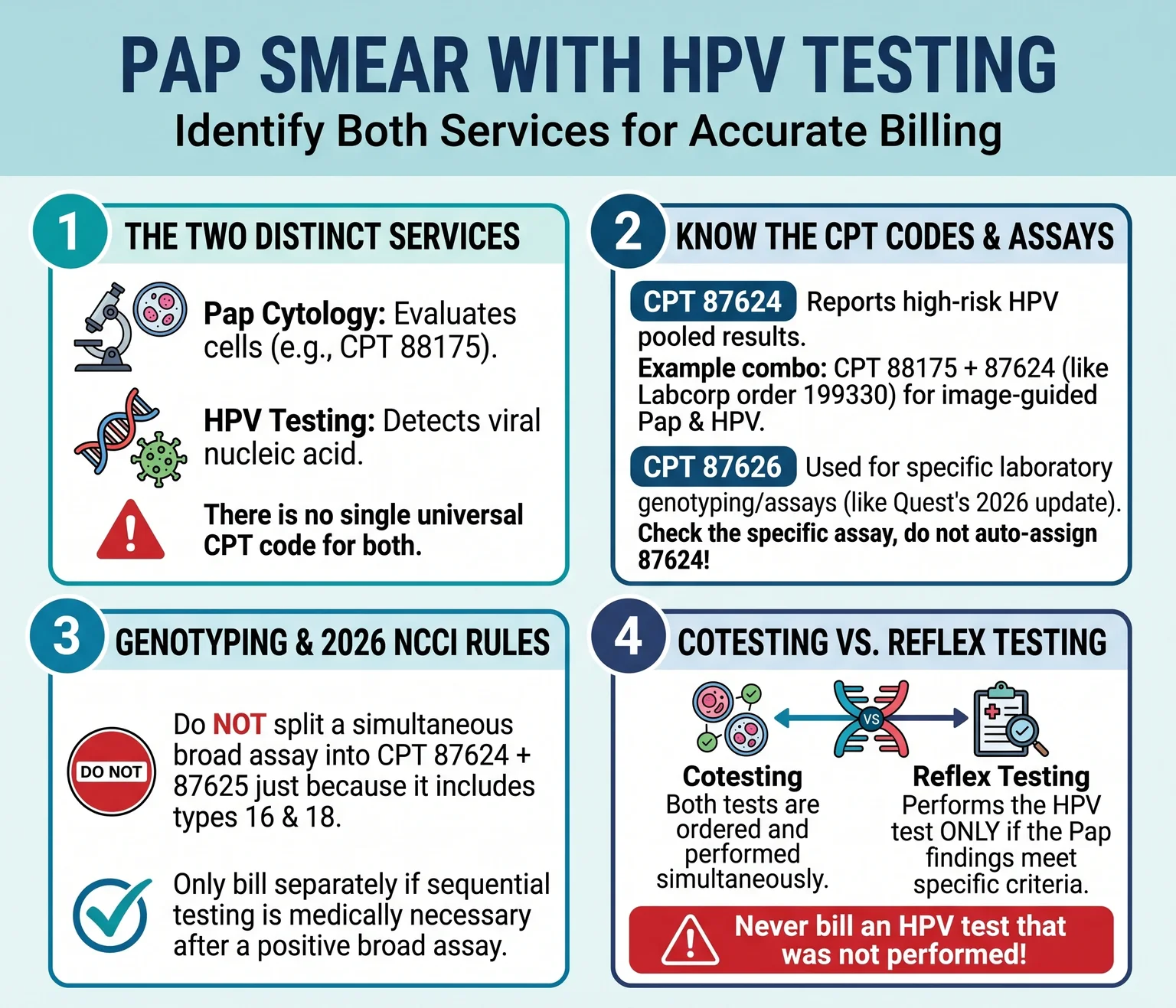
Codes 88141 through 88175 cover cervical cytology interpretation from manual screening to physician review. For Medicare, the correct pairing is G0101 (pelvic exam) plus Q0091 (Pap collection), not 88141 standalone. Commercial payers expect 99385/99395 for preventive encounters. Mismatching the code to payer type is the leading rejection trigger here, but the second most common cause is a note that fails to document the patient's last screening date, making frequency eligibility impossible to verify.
iScribe Health's automated E&M coding applies payer-specific logic at the code-selection stage, reducing the risk that a Medicare encounter gets coded as a commercial preventive visit. The AI customization layer can be configured to prompt for last-screening-date documentation on any cervical cytology encounter, so the frequency eligibility field is populated before the note closes, not reconstructed during an appeal.
4. Transvaginal Ultrasound CPT 76830 - When It Bills Separately vs. When Payers Bundle It
76830 is separately billable when the clinical indication for the transvaginal study is documented independently from the transabdominal obstetric ultrasound performed in the same encounter. When an obstetric-related diagnosis drives the encounter, payers frequently bundle that same figure into the primary obstetric code and deny the separate line. The physician's note must state a distinct clinical reason for the transvaginal component, or the bundling edit is automatic.
iScribe Health's real-time denial alerts flag the bundling risk before submission when that same figure appears on the same encounter as a primary obstetric code, prompting the physician to confirm and document the distinct clinical indication while the encounter is still fresh, eliminating the after-hours reconstruction that so often produces vague or insufficient language.
5. Recent CPT Code Updates Affecting Obstetric Ultrasound and Cytology Billing - Changes Coders Must Apply Now
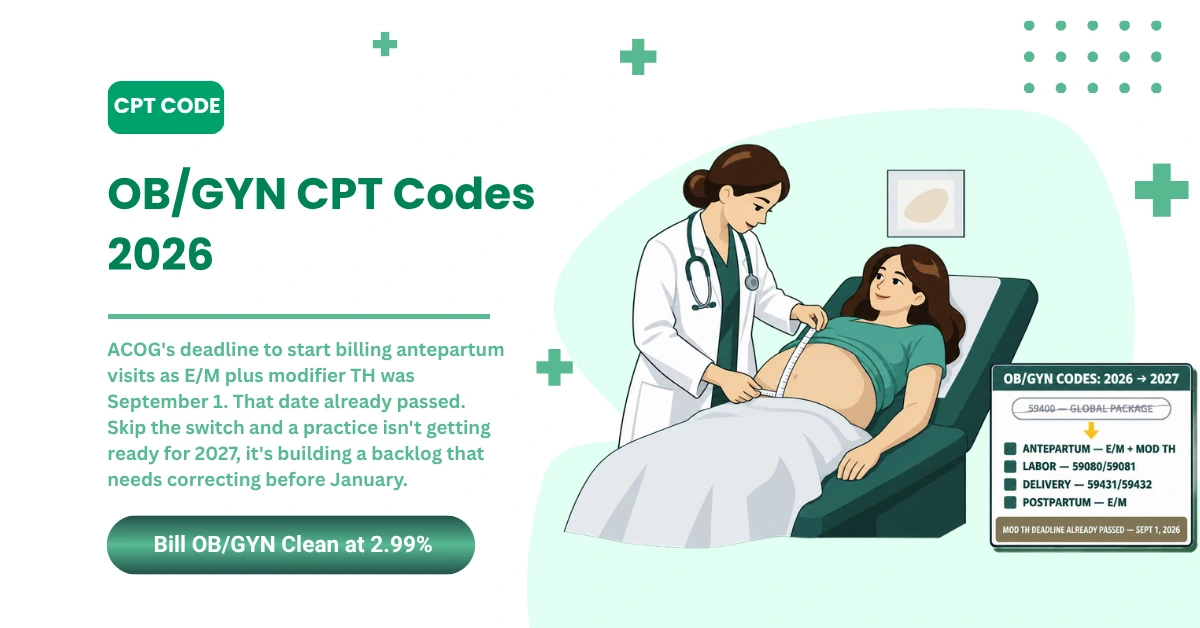
Charge masters that carry outdated descriptors for 76811 and 76813 through 76814 (first-trimester detailed nuchal translucency studies) generate downcoding denials that are difficult to appeal retroactively because the submitted code never matched the current payer fee schedule. Practices running high patient volumes benefit most from documentation workflows that capture every required anatomy element at the point of care, a benefit that is ongoing, realized across every patient encounter and every day of clinical practice.
iScribe Health's EHR integration ensures that AI-generated encounter summaries and coding intelligence work within the practice's existing system rather than requiring a parallel platform. When the ambient documentation layer surfaces anatomy checklist gaps in real time, coders receive a record that already supports the code. The physician's after-hours charting burden drops, and the documentation that reaches the coder is complete before the claim is built, not patched together after a denial.
Getting the ultrasound and cytology codes right is only half the battle. Even a perfectly documented that same figure or 88175 claim can be slashed if the wrong modifier is attached or missing entirely. The next section breaks down exactly which OBGYN modifiers stand between a clean claim and an automatic bundling edit, and what the note must say to make each one stick.
The OBGYN Modifiers That Prevent Claim Denials Before They Start
Five modifiers determine whether an OB/GYN claim pays on first submission or enters a correction cycle that erodes both staff time and revenue. Each one has a precise trigger condition, and the condition is not met by appending the modifier. It is met by the physician's note.
"OBGYN procedures coded correctly (Z30.2/58661) do not automatically ensure related services like anesthesia are also coded correctly, leaving patients exposed to unexpected claim denials."
— what we hear from medical billing professionals
1. Modifier 25 - Appending to OBGYN CPT Codes for Same-Day E&M Services
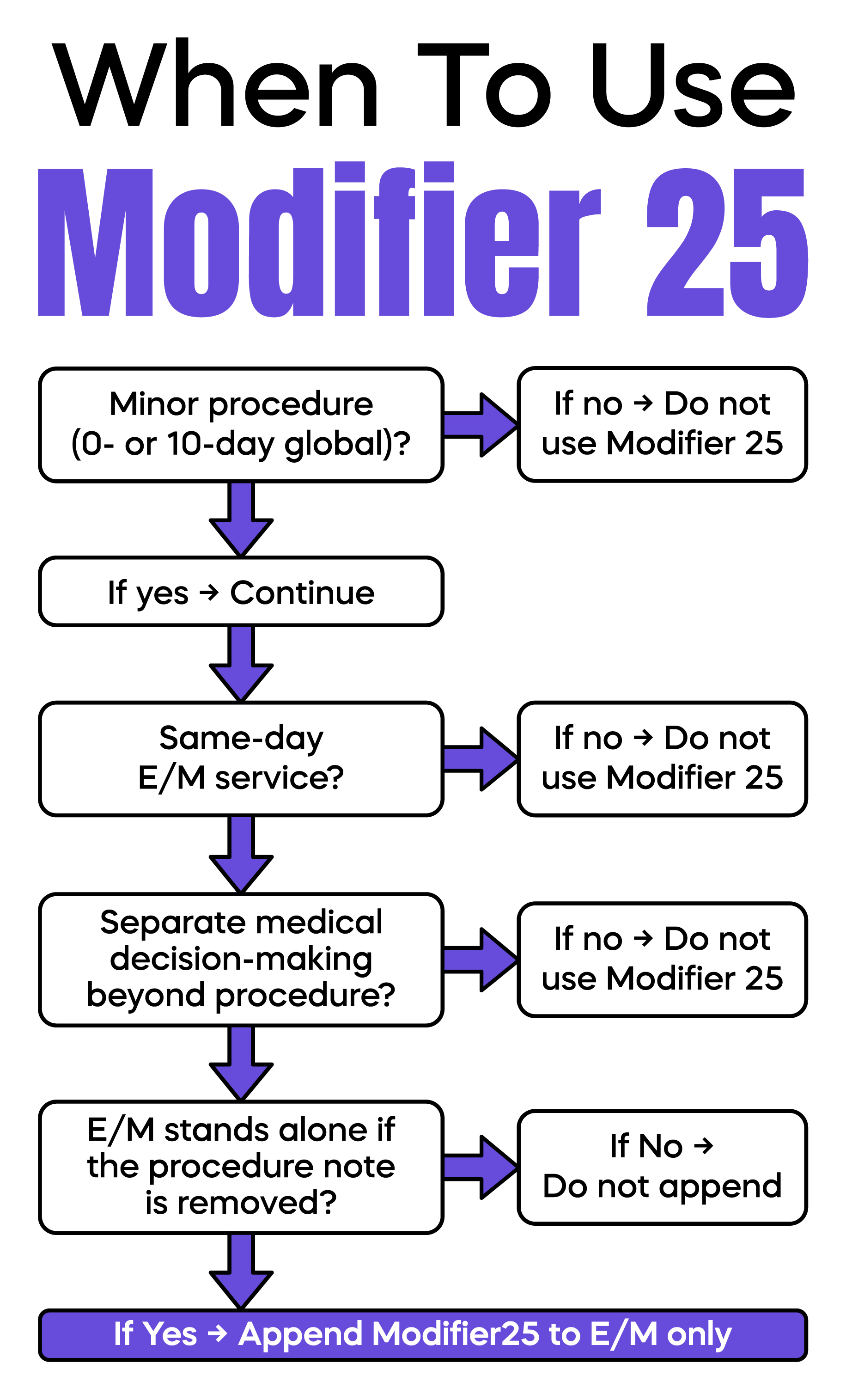
Modifier 25 is required when a significant, separately identifiable evaluation and management service is performed on the same day as a procedure. A that same figure billed alongside a 58300 IUD insertion fails audit when the note documents only the insertion. The E/M must be documented as above and beyond the pre- and post-operative care of the procedure itself. A separate chief complaint, distinct medical decision-making, and an independent clinical assessment are the note elements that carry the modifier.
This is where high-volume OB/GYN practices lose ground silently. A physician seeing a full schedule of patients cannot reliably pause between a procedure and a same-day E/M to ensure the note captures each required element as a distinct clinical encounter, because the documentation was already incomplete by the time it left the exam room. iScribe Health's ambient listening captures the encounter in real time, and its E/M Coding Intelligence flags at the point of note completion, after the AI drafts the encounter summary, whether the note contains the distinct chief complaint, separate medical decision-making, and independent clinical assessment that Modifier 25 legally requires. That check happens before the claim is built, not after the denial arrives.
2. Modifier 59 - Unbundling Separately Identifiable Services Within OB/GYN Procedure Bundles
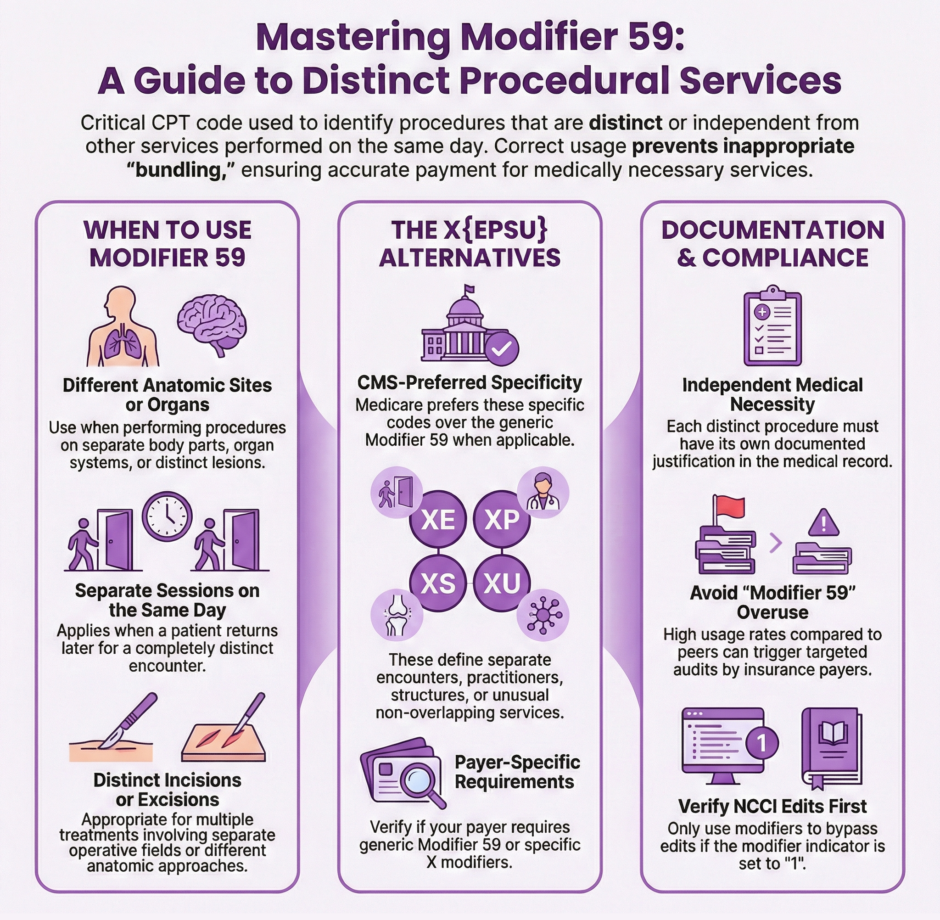
Modifier 59 prevents bundling when two procedures performed on the same day are clinically distinct and separately necessary. The trigger is medical necessity documented for each service independently. Industry data is direct: documentation must support the medical necessity of each separately billed service, or the payer's bundling edit applies automatically. A modifier 59 without that documentation is a denial waiting to process.
One real-world gap that surfaces repeatedly in OB/GYN billing: a procedure pair like Z30.2 and 58661 may be coded correctly in isolation, yet a related service, anesthesia for example, is not coded with the same precision, leaving a gap in the claim that the payer's bundling edit will close against the practice. Modifier 59 addresses the primary procedure relationship, but every downstream service in the encounter must carry its own documentation of medical necessity. iScribe Health's EHR Integration and Real-Time Denial Alerts are designed to surface these cross-service documentation gaps before submission, not after the rework cycle begins.
3. Payer-Specific Modifier Policies That Override AMA Guidelines for OB/GYN Billing
AMA CPT rules establish the floor. Commercial payers and Medicare maintain their own bundling edits and modifier acceptance matrices, and those diverge in ways that catch even experienced OB/GYN billing teams off guard. As industry data notes, coders must verify each payer's individual policies rather than relying solely on AMA guidance. A modifier 59 that satisfies CPT logic may still trigger a denial under a specific commercial plan's bundling edit. Verifying payer-by-payer modifier matrices before submission is not optional work.
4. The Financial Cost of Missing or Misapplied Modifiers - Re-Submission Delays and Write-Off Risk
A denied modifier claim does not simply wait for correction. It enters a rework cycle that consumes staff hours, and it ages against timely-filing windows that vary by payer, windows that, once missed, convert the claim to a write-off. Industry data is direct: when the resubmission deadline passes before the error is caught, the claim converts to a write-off. Across a high-volume OB/GYN practice with a mixed payer panel, that pattern compounds quickly into material annual revenue loss. iScribe Health's Real-Time Denial Alerts are designed to interrupt that cycle at the earliest possible point, surfacing documentation gaps at the point of note completion, where correction costs seconds, not the staff hours a rework cycle demands.
5. Global Obstetric Package Modifier Rules - When to Break Out Services From the Bundle
CPT that same figure and 59510 bundle antepartum, delivery, and postpartum care into a single global fee. Breaking out a component service requires both the correct unbundling code and the modifier that justifies the separation, typically modifier 52 for reduced service or modifiers 54/55 for split care between providers. The note must document which phase was delivered and by whom. Without that specificity, the payer applies the global package logic and denies the component claim as a duplicate, regardless of clinical reality. iScribe Health's ambient documentation, active across every patient encounter, ensures the phase-specific clinical detail is captured in the note before it reaches the biller, reducing the upstream documentation gap that makes global package unbundling so vulnerable to denial.
The OBGYN Documentation Gap That Keeps Correct Codes From Getting Paid

How Finalized Documentation Caps Revenue on Every OBGYN CPT Code
A coder working from a completed note cannot assign a code the documentation will not defend. If a physician conducted a complex, medically involved visit but the note captured only a brief history and one or two findings, the coder's only defensible choice is the lower-level code.
Key takeaway: Comparing a physician's billed E&M distribution against group or national norms is the primary diagnostic tool for identifying systematic undercoding, and the pattern persists regardless of coder competency. The note is not a starting point.
The Compounding Math of One Consistent Undercode Level
Across a busy OB/GYN practice with a high volume of established-patient office visits annually, that one-level gap compounds into material foregone revenue, before accounting for payer mix.
That revenue ceiling is set at the moment of documentation, not at billing, which is where iScribe Health's AI medical scribe creates its opening: by surfacing real-time denial alerts tied to documentation gaps before a claim is submitted, it gives practices a chance to close the ceiling before it becomes a write-off.
How AI Documentation Fixes OBGYN Coding Accuracy Where Manual Workflows Fail

OBGYN Coding Accuracy Gap - What Ambient Documentation Changes for Your Billing Workflow
The performance delta here is stark. Industry data and iScribe Health's own implementation experience suggest that a significant share of E&M visits are insufficiently documented under manual workflows, while ambient AI scribing consistently improves coding accuracy across the same encounter types, a gap that compounds at scale.
Across a high-volume OBGYN practice billing hundreds of E&M encounters monthly, that failure compounds daily. iScribe Health's impact is most pronounced in exactly these environments: high-volume practices or health systems where clinicians are regularly charting two or more hours outside of patient care time, and where every encounter represents an opportunity for documentation to fail the code it should support.
That risk runs in both directions. In one iScribe Health implementation, the tool surfaced a significant overcoding rate the practice had no prior visibility into, so the documentation gap cuts both ways:
- Undercoding leaves money on the table
- Overcoding creates audit exposure
- Most practices only discover this split after a payer audit, not before
iScribe Health's Automated E&M Coding layer is designed to surface these mismatches at the point of note completion, after the AI drafts the encounter summary, so the correction happens before the claim, not after the denial, shifting the intervention to where it can actually prevent revenue loss.
How Real-Time Narrative Capture Eliminates the Reconstructed-Note Problem
When clinicians reconstruct notes from memory after a full schedule, clinical detail compresses.
iScribe Health's Ambient Listening and Conversational AI captures the full clinical narrative at the point of care, before the note is finalized. That timing preserves the MDM complexity and procedure specifics that coding recommendations depend on, so the documentation reflects what actually occurred in the encounter.
How Complete OBGYN Documentation Produces Clean Claims and Lower A/R Days
Documentation deficiencies are among the most consistent upstream drivers of claim rework, denials, and extended accounts receivable cycles. When clinical notes are completed at the point of care and Automated E&M Coding assigns the appropriate level at note finalization, clean claims go out faster, first-pass resolution rates improve, and accounts receivable aging tends to compress, particularly in practices where documentation deficiencies were the primary driver of rework cycles.
iScribe Health's core value in this chain is that it simplifies reimbursement and payment workflows by fixing documentation upstream, eliminating the correction infrastructure by preventing the defect rather than catching it downstream, so fewer touchpoints separate the encounter from the paid claim.
For context on how documentation integrity intersects with payer adjudication standards, the California Department of Managed Health Care independent medical review data illustrates how frequently clinical documentation, or its absence, becomes the determining factor in disputed claim outcomes. The point of capture, not the point of appeal, is where billing protection is built.
Related Reading
Next steps
If your practice is losing reimbursement on encounters you already perform and bill, the path forward starts with fixing documentation at the point of care, not at the clearinghouse. Start with our AI medical scribe.
The evidence from this post makes the sequence clear. Undercoding in OB/GYN is a documentation capture problem that originates in the exam room, which means a coder who knows every code in the 99211 to 99215 range still cannot bill 99214 when the note only supports 99213. Modifier accuracy follows the same logic: a missing Modifier 25 on a same-day E/M fails because the physician's note never demonstrated a distinct, separately identifiable service, not because the biller missed a reference sheet. Both problems share a single root cause, and both point to the same corrective action: capturing the complete clinical narrative before the note is finalized.
Start with an AI medical scribe from iScribe Health. The ambient documentation layer captures the full clinical encounter in real time, drafts the note, and surfaces E/M coding recommendations and denial alerts before the claim is built, so the documentation deficiency is closed at the point of care rather than discovered after a denial hits your A/R.
Frequently Asked Questions
What exactly does CPT 59400 cover?
CPT 59400 bundles up to 13 antepartum visits, the vaginal delivery event, and postpartum care into a single global maternity code. It is one of the highest-revenue single-claim events in most OB practices, but it is only as defensible as the weakest note behind it, if documentation does not account for every bundled antepartum visit, billing the global code constitutes overcoding.
Why does my biller keep defaulting to 99213 even when visits feel more complex than that?
The pattern is rarely intentional, it reflects documentation that never captured the complexity that was actually managed. When notes are built from rushed checkboxes or post-visit recall, the medical decision-making elements that distinguish a 99214 from a 99213 are often absent before the claim is ever created, leaving the biller no choice but to bill the lower level.
Which prenatal and postpartum billing codes should I know beyond the global package?
When care is split across providers or only partial services are rendered, the component codes apply: CPT 59425 covers 4 to 6 antepartum visits, 59426 covers 7 or more, 59409 covers vaginal delivery only, 59410 adds postpartum care, and 59430 covers postpartum care alone. A shared-care scenario, for example, one provider managing antepartum visits and a hospitalist delivering, requires 59426 paired with 59409, with each provider billing only the portion they documented.
When do I need Modifier 25, and what documentation is required to use it correctly?
Modifier 25 is required when a provider addresses a separate clinical problem during the same visit as a well-woman exam. It must attach to the problem-oriented E/M code to prevent denial, and the note must contain documentation that clearly supports a distinct, medically necessary service on that same date, missing that documentation is the single most common reason same-day preventive and problem-oriented claims are rejected.
What's the biggest audit risk hiding inside a 59400 global OB claim?
The single most common audit trigger is a mismatch between the antepartum visit count implied by the global code and the visits actually documented in the record. If the notes are thin, signed late, or clinically non-specific, the global code becomes indefensible under payer scrutiny and can expose the practice to recoupment risk.