CPT Code 59515 Explained: Cesarean with Postpartum Care
CPT code 59515 is a three-part bundle, and billing teams lose reimbursement when documentation gaps go unseen.


CPT 59515 bundles three billable services into one code, and missing any of them is a documentation failure before it is ever a coding error. Here is exactly what belongs inside the package and what must be billed separately.
CPT 59515 is a global obstetric package that bundles three distinct, documentable clinical services into a single billable unit. For OB practices where the delivering physician also manages postpartum recovery, this distinction carries real financial weight. As documentation accuracy reviews across OB practices consistently reveal, the gap between what was clinically delivered and what gets captured in the chart is where reimbursement quietly disappears. See our AI medical scribe for how this works in practice.
CPT 59515 includes three specific services: the cesarean delivery itself (surgical delivery of the fetus and placenta via abdominal incision), inpatient hospital care in the immediate post-delivery period, and routine outpatient postpartum follow-up visits through the six-week recovery window. Under global obstetric package guidelines, all two components must be documented and attributable to the same provider or group for the global code to stand on a claim. The same-physician requirement is the structural condition that makes that same figure apply at all. When delivery and postpartum care are split across providers, the global package dissolves and separate codes govern each service instead.

This matters operationally because OB practices with rotating call schedules, locum coverage, or shared patient panels routinely expose themselves to this split without realizing it. The claim gets submitted under 59515, the postpartum documentation points to a different provider, and the mismatch creates either a denial or a silent underpayment. What most billing teams report is that insufficient documentation, not just incorrect codes, is a primary driver of claim denials and audit vulnerability. The provider attribution question is a documentation problem before it is ever a coding problem.
The provider attribution question is a documentation problem before it is ever a coding problem. With cesarean deliveries representing a substantial share of all U.S.
Births, the volume amplifies every per-claim gap. A postpartum visit note that is thin on clinical findings, or an inpatient progress note that omits care decisions made during the hospital stay, does not just weaken one claim. It establishes a documentation pattern that compounds across every billing cycle. Across the market, incomplete documentation for any component of a bundled code increases denial and audit risk.
Most OB practices handle postpartum documentation manually, across a six-week window, often completed after hours when clinical detail fades. That is where the three-component bundle quietly breaks down. iScribe Health's Automated E&M Coding addresses this at the source by generating structured, code-ready documentation at each encounter, specifically when the delivering physician is also managing inpatient and outpatient postpartum care within a single practice's workflow, so all two bundled service components are captured and defensible before the claim is ever submitted.
Understanding what belongs inside CPT that same figure is only half the equation. The other half, knowing precisely what falls outside the bundle and must be billed separately, is where most denial patterns actually originate, and that is where the next section begins. What CPT 59515 Does Not Include: Separately Billable Services and Where Practices Leave Money Behind The assumption that the global package absorbs everything that happens between delivery and the six-week postpartum visit is one of the most consistent sources of lost revenue in OB billing. CPT 59515 is bounded, not open-ended. The services it excludes are not edge cases.
They are clinical events that occur routinely in cesarean deliveries and carry their own CPT codes, their own documentation requirements, and their own reimbursement when billed correctly. Without a documentation workflow designed to flag them at the point of care, they get absorbed into the global claim and never billed at all. The clearest category of exclusions involves complications and additional procedures performed at the time of delivery. A cesarean hysterectomy, management of postpartum hemorrhage requiring surgical intervention, or repair of a bladder laceration encountered during the abdominal approach are not bundled into 59515. Each carries a distinct CPT code and requires its own operative documentation to support a separate charge.
The same logic applies to sterilization procedures performed at the time of cesarean delivery. CPT 58611 covers tubal ligation performed concurrently with a cesarean section and is explicitly carved out of the global package, but it requires a separate operative note entry or a clearly documented addendum that identifies the procedure, the indication, and the technique. When the operative report treats the sterilization as incidental rather than as a separately documented service, the charge either never gets generated or gets denied on audit. Neither outcome is a payer error. Both are documentation failures that occur before the claim is built.
The postpartum period introduces a second exclusion category that is less obvious but equally consequential. Visits within the six-week window that address a new condition unrelated to the delivery, a wound infection requiring incision and drainage, a separately evaluated comorbidity such as a hypertensive crisis or a new-onset postpartum thyroiditis, are not part of the global postpartum care that 59515 covers. These encounters can and should be billed under the appropriate E&M code with a modifier indicating that the visit addressed a condition distinct from the routine postpartum course.
The documentation burden here is specific: the note must clearly differentiate the new problem from routine recovery management, establish medical decision-making that stands on its own, and reflect that the visit was not simply a postpartum check conducted ahead of schedule. When notes are templated or brief, that differentiation disappears, the visit gets absorbed into the global package by default, and the separately reimbursable service is never recovered. Why Documentation Workflow Determines Whether Exclusions Get Captured The exclusions that exist outside CPT 59515 do not fail to get billed because physicians are unfamiliar with the rules.
They fail to get billed because the documentation infrastructure in most OB practices is not built to surface them in real time. An operative note completed hours after a cesarean delivery, reconstructed from memory or a brief dictation, is unlikely to contain the granular procedural language that distinguishes a separately billable complication repair from a routine intraoperative finding. A postpartum visit note generated from a pre-built template is unlikely to contain the clinical specificity that supports a separate E&M charge for a new problem. The gap between what was clinically delivered and what the documentation supports is a workflow gap, and it repeats on every claim where the note was not built to capture the distinction at the moment of care.
This is the operational reality that makes automated, structured documentation consequential rather than merely convenient. When documentation is generated at the point of encounter with the clinical specificity required to distinguish bundled from separately billable services, the coding decision does not depend on a biller reviewing a thin note days later and making a judgment call under time pressure. The note either supports the separate charge or it does not, and that determination happens before the claim is ever assembled.
iScribe Health's Automated E&M Coding is designed to function at exactly this point in the workflow, generating structured documentation that captures the clinical detail required to identify, support, and defend separately billable services alongside the global package, so that the revenue those services represent is not quietly absorbed into a bundled claim that undervalues what was actually delivered.
Key takeaways
- CPT 59515 is a global obstetric package, it bundles the cesarean delivery, admission, and postpartum care into one billable unit, and incomplete documentation of any component creates audit exposure even when the claim clears initial review.
- The most common CPT 59515 revenue problem is not a denial, it's undercoding that never surfaces, because thin operative notes push coders toward lower complexity before the claim is ever submitted.
- Split care invalidates CPT 59515 for both providers simultaneously, and most billing teams only find out after the denial lands, not before the claim goes out.
- E&M coding accuracy across OB practices sits around 55%, meaning nearly half of encounters are coded at the wrong complexity level, and the financial bleed is silent, not flagged.
- Payer clinical reviewers apply a stricter evidentiary standard than coders do, a claim that passes internal QA can still lose a post-payment audit if the documentation doesn't independently support the complexity billed.
- iScribe Health's Automated E&M Coding generates codes directly from clinical documentation in real time, closing the gap between what the physician documented at the encounter and what the coder can defensibly bill, before the claim is ever touched.
What Is Excluded from CPT 59515 Billing
Most practice administrators and billing decision-makers assume that if the CPT code is right, the billing is right, and that denials must be a payer issue or a modifier problem, not a documentation problem. That assumption is exactly what allows misclassification errors to persist. Misclassification errors, not wrong-code selections, are a leading driver of CPT that same figure claim denials, a pattern documented in payer audit findings and OB coding accuracy reviews. Billing teams that focus their audit energy on choosing between delivery codes often miss the more costly problem: services that are explicitly excluded from the global bundle are quietly absorbed into the claim, triggering denials, overpayment audits, and payer-initiated takebacks that compound across every billing cycle.
1. Antepartum Care Visits - Explicitly Excluded from CPT 59515 and the Most Misunderstood Boundary
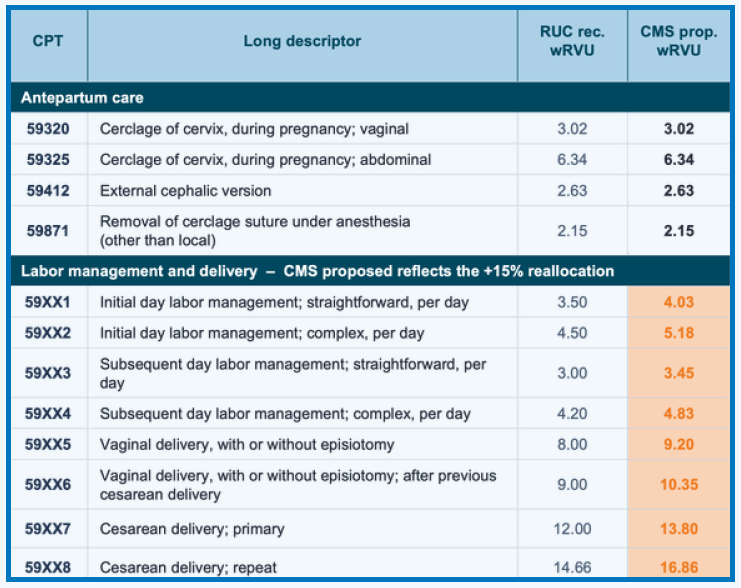
Antepartum care is not included in CPT 59515. According to the NAMAS global obstetrical package guide, the code covers cesarean delivery plus postpartum care only, and any antepartum visits must be coded separately if provided by the same physician. The UnisLink OB/GYN Medical Coding Guide confirms this is the most common source of miscoding, occurring when physicians assume the global code covers the full pregnancy episode.
The practical consequence is direct. When a billing team absorbs antepartum visits into a that same figure claim, the payer sees a bundling error, not a documentation gap. The denial arrives, the rework begins, and the root cause often goes unidentified because the coder never flagged the antepartum visits as a separate coding pathway in the first place. That pattern repeats, billing cycle after billing cycle, and in high-volume OB practices where clinicians are regularly charting two or more hours outside of patient care time, the documentation pressure that drives these errors is compounded by simple capacity constraints. Time spent reconstructing antepartum encounter details after the fact is time taken directly from patient care.
2. Unrelated Medical Complications and Separate Subsequent Hospitalizations - Billable Outside 59515
Consider a patient who develops a postpartum wound infection requiring a separate inpatient admission. That hospitalization is not covered under CPT that same figure. As NAMAS states, unrelated medical complications and subsequent separate hospitalizations occurring during the postpartum period fall outside the global obstetrical bundle and may be billed independently.
This is where revenue disappears silently. Practices that fail to bill these encounters separately leave legitimate reimbursement uncollected. Those that bill them incorrectly inside the global code face overpayment audit exposure. Neither outcome is acceptable, and both trace back to the same documentation failure: the clinical record does not clearly distinguish the complication from routine postpartum care. For physicians already stretched thin on documentation time, the moment a complication arises mid-encounter is precisely when documentation discipline is hardest to maintain, and when the billing consequences of a thin clinical narrative are most severe.
3. ICD-10 Diagnosis Code Selection for Postpartum Visits - A Distinct Documentation Step Not Covered by 59515
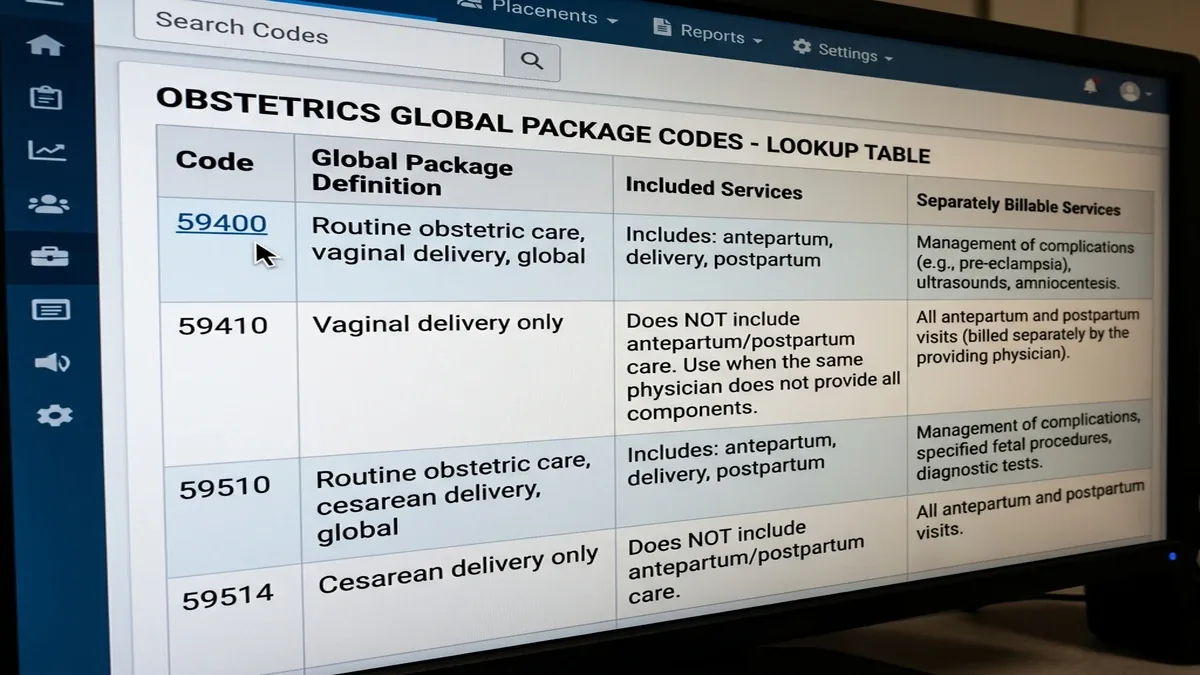
Linking the correct ICD-10 diagnosis code to a postpartum visit is a separate documentation requirement that CPT 59515 does not address or simplify. Coders must actively select the appropriate postpartum encounter or complication code, such as Z39.0 or Z39.2, rather than defaulting to the delivery diagnosis. Errors here cause claim mismatches even when the CPT code itself is correct, leading to avoidable denials.
4. Elective vs. Non-Elective Cesarean Distinctions - ICD-10 Impact Only, Not a Reason to Change CPT 59515

The elective versus non-elective cesarean distinction does not change the CPT code. CPT that same figure remains correct for cesarean delivery with postpartum care regardless of how the delivery was indicated. What changes is the ICD-10 diagnosis coding on the claim. As NAMAS explains, the delivery circumstances must be accurately documented as a separate step beyond selecting the correct CPT code.
This matters operationally. Billing teams that conflate the CPT and ICD-10 decisions sometimes assume that a non-elective delivery requires a different procedure code. It does not.
The clinical narrative in the operative report drives ICD-10 selection; the CPT code stays fixed. Thin or rushed documentation that fails to record delivery circumstances leaves the ICD-10 selection unsupported and the claim audit-exposed. iScribe Health's Ambient Listening and Conversational AI captures delivery circumstances during the encounter itself, reducing the documentation time physicians spend after the visit and ensuring that the clinical narrative supporting ICD-10 selection is captured at the moment it is clinically relevant, not reconstructed from memory later.
5. Related ICD-10 Diagnosis Codes Paired with CPT 59515 - Z39.0, O82, and Key Postpartum Complication Codes

CPT 59515 claims require precise ICD-10 pairing to pass payer edits. The primary encounter code is typically O82 (encounter for cesarean delivery) for the delivery itself, while Z39.0 covers immediate postpartum care and Z39.2 covers routine follow-up. Complication codes from the O85–O92 range apply when postpartum conditions arise. Mismatched or vague diagnosis codes are a leading cause of 59515 claim rejections and compliance flags.
What Is the Difference Between CPT 59515, 59510, and 59514

That proof lives in the clinical note, and for practices where physicians are charting two or more hours outside of patient care time, producing that proof consistently across every delivery encounter is exactly where documentation quality breaks down. iScribe Health's Ambient Listening and Conversational AI captures the encounter in real time, so the operative note that determines which cesarean code is defensible is drafted at the point of care, not reconstructed from memory hours later.
The Three-Question Decision Tree That Determines Which Cesarean Code Is Correct
- Did this provider manage antepartum care? If no, CPT 59510 is off the table immediately.
- Will this provider conduct the postpartum follow-up through the six-week period? If no, CPT that same figure is eliminated.
- Is delivery the only documented service this provider performed? If yes, CPT 59514 is the correct code, and the claim should reflect nothing more.
When a physician's note is thin on scope-of-service detail, the coder is left inferring rather than confirming, and inference introduces audit risk. iScribe Health's EHR Integration and Real-Time Denial Alerts work together here: the ambient documentation layer drafts the encounter summary at the point of note completion, after the AI has listened to the clinical conversation, and the denial alert layer flags claim-level risk before submission, giving the billing team a second checkpoint without adding a manual review step.
CPT 59514 When the Delivery Stands Alone Without Postpartum Care
Both overcoding and undercoding carry real consequences.
Primary vs. Repeat Cesarean and CPT that same figure - Why ICD-10, Not the CPT Code, Carries the Distinction
A common source of confusion is the assumption that primary and repeat cesarean deliveries require different procedure codes, but that is not how the coding system is structured.
Key takeaway: CPT that same figure, 59514, and 59515 apply to both primary and repeat cesarean deliveries without modification. The primary-vs-repeat distinction lives entirely in the ICD-10-CM diagnosis code, not the procedure code.
This is where iScribe Health's E&M Coding Intelligence and Automated E&M Coding create a concrete advantage. A physician who documents a prior uterine scar during the encounter generates a note that supports O34.21 without the coder having to chase the operative history separately, closing a gap that has historically been a quiet but consistent source of coding error.
Related Reading
How Split Care or Transfer of Care Affects CPT 59515 Billing
According to the AAPC Medical Billing and Coding Forum, when a patient's antepartum care is divided between two practices, the global obstetric package code no longer applies to either provider's claim.

Why CPT 59515 Becomes Invalid the Moment Postpartum Care Changes Hands
The code does not become partially valid. It becomes inapplicable, period.
The Correct Code Pair for Delivering and Postpartum Providers
In a split-care cesarean scenario, the delivering provider and the postpartum provider each bill a distinct code, reflecting only the services each actually performed.
Provider Role: Delivering provider
- Correct Code: CPT 59514
- Description: Cesarean delivery only
Provider Role: Postpartum provider
- Correct Code: CPT 59430
- Description: Postpartum care only
The regular practice bills 59430 for the postpartum care it provides.
The Handoff Gap as an Organizational Problem, Not a Coding Problem
The coding solution is straightforward, but the organizational challenge behind it often is not. When the delivering provider and the postpartum provider each document their encounter in isolation, without a shared handoff protocol, the billing team is left reconstructing scope of service from incomplete notes. Each component claim then stands alone before a payer reviewer, stripped of the protective bundling logic the global package provides.
What Documentation Is Required to Support Billing CPT 59515
A CPT that same figure claim can clear internal coding quality review, with the correct code, correct modifiers, and no obvious unbundling errors, and still be vulnerable to post-payment audit and takebacks. The reason is straightforward: payer clinical reviewers apply a different evidentiary standard than coders do. Where a coder asks whether the code fits the documented procedure, a clinical auditor asks whether every note in the record independently establishes medical necessity, service delivery, and provider attribution. Documentation that answers the coder's question but not the auditor's question produces a claim that is correct by internal standards and indefensible by external ones.
As retrospective documentation audits have consistently confirmed, incomplete documentation is a leading cause of obstetric claim downcoding and denial, with auditors consistently finding that comorbidities and postpartum care complexity are omitted when notes are completed after the fact. Correct CPT code selection is insufficient on its own to protect a claim from denial when the underlying record is thin.
Each of the five documentation elements below must stand independently in the record before the claim is submitted.
1. Operative Report Documenting Cesarean Procedure, Incision Type, and Intraoperative Findings

A templated or rushed operative note that omits a documented complication removes the clinical evidence a payer auditor needs to confirm encounter acuity. The audit consequence is direct: the claim gets reclassified to CPT that same figure, and reimbursement drops immediately.
2. Inpatient Progress Notes and Hospital Discharge Summary Covering Post-Delivery Stay
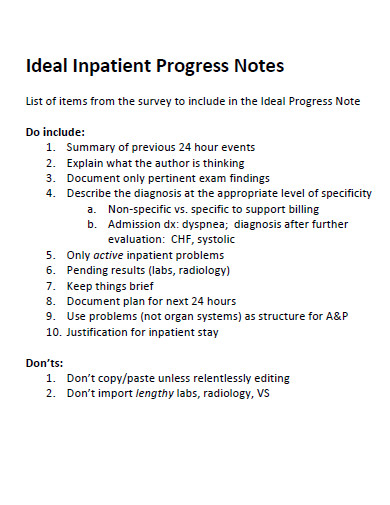
The discharge summary must independently document the patient's postpartum status, complications managed during the admission, and the clinical basis for discharge. Per the CMS Medicare Claims Processing Manual, Chapter 12, both elements are required components of the global period record. Generic or templated entries across either document give an auditor no evidence that inpatient postpartum care was medically necessary or that the billing provider delivered it.
3. Postpartum Follow-Up Visit Notes Spanning the Six-Week Global Period
Missing postpartum visit documentation is one of the most consistent triggers for global OB package claim flags, because payers treat the absence of a visit note as direct evidence the service was not provided, regardless of whether the correct CPT code appears on the claim.
4. Retrospective and After-Hours Charting Risk - Omitted Comorbidities and Audit Exposure

After-hours charting is where documentation quality collapses. Documentation audits have consistently confirmed that retrospective charting is a leading cause of obstetric claim downcoding, and correct code selection is insufficient on its own when the underlying record is thin. Most practices discover these gaps only when a payer pulls the record.
5. Comprehensive Documentation Checklist Specific to Cesarean Delivery Billing Under CPT 59515
A structured documentation checklist tailored to CPT 59515 ensures that every required element, operative report, inpatient notes, discharge summary, and postpartum visit records, is present before claim submission. Billing teams and coders use this as a pre-submission audit tool to catch gaps that payers would otherwise flag. The tradeoff: checklists only work if clinical staff complete them contemporaneously; retroactive completion defeats their compliance value.
CPT 59515 Documentation Checklist - Five Required Elements for a Defensible Cesarean Delivery Claim
Every defensible CPT that same figure claim rests on five independently documented elements:
# 1. Required Document: Operative Report
What It Must Capture: Incision type, fetal/placental delivery, intraoperative findings, comorbidities
Audit Risk if Missing: Claim reclassified to CPT 59514; immediate reimbursement drop
# 2. Required Document: Daily Inpatient Progress Notes
What It Must Capture: Active clinical decision-making each day of hospital stay
Audit Risk if Missing: Triggers retrospective recoupment across entire billing cycle
# 3. Required Document: Hospital Discharge Summary
What It Must Capture: Postpartum status, complications managed, clinical basis for discharge
Audit Risk if Missing: Cited in obstetric audits as evidence inpatient care component not rendered
# 4. Required Document: Six-Week Postpartum Visit Note
What It Must Capture: Physical assessment, clinical findings, postpartum care decisions
Audit Risk if Missing: Payer treats absence as direct evidence service was not provided
# 5. Required Document: Provider Attribution Across All Elements
What It Must Capture: Same provider/group NPI tied to all three bundle components
Audit Risk if Missing: Global package disqualified; split-care codes required
Most OB practices assume their records meet this standard until an audit proves otherwise. iScribe Health's real-time ambient documentation captures each element inside the practice's existing EHR workflow at the moment of the encounter, so operative findings and postpartum decisions are recorded as they happen rather than reconstructed from memory when the audit-critical specifics have already faded. At Center for Sports Medicine & Orthopaedics, Chattanooga, 941 encounters were analyzed, revealing 54.8% provider, AI agreement and a 33% overcoding rate that had been invisible to the practice's manual review process, demonstrating that point-of-encounter capture changes the evidentiary floor of every claim, not just flagged outliers.
How Coding Gaps on CPT 59515 Claims Quietly Drain OB Revenue
A significant share of revenue lost on CPT that same figure never shows up as a denial. It disappears quietly, claim by claim, because the documentation supporting the code was incomplete before the coder ever opened the chart. This is a structural throughput failure baked into how OB physicians complete notes under time pressure.

Why a 55% E&M Accuracy Rate Means Nearly Half of High-Complexity OB Encounters Are Miscoded
55%
of E&M visits are accurately documented (industry baseline
According to CureCloudMD's June 2025 analysis, ~55% of E&M visits are accurately documented (industry baseline), leaving nearly half of all coded encounters carrying the wrong level. On high-complexity encounters, the error almost always runs toward undercoding. For a global package like CPT that same figure, where reimbursement reflects bundled postpartum care, inpatient management, and the delivery itself, a single code-level drop translates directly into measurable revenue loss on every affected claim, compounding silently across the full volume of cesarean deliveries a practice bills each month.
The After-Hours Charting Problem - How Rushed OB Notes Produce Incomplete Billing Sheets Before the Coder Ever Sees Them
The failure originates at the point of care, not at the billing workstation. As CureCloudMD's 2025 review documents, after-hours charting and rushed note completion by OB physicians produce documentation that systematically omits comorbidities, intraoperative complexity, and postpartum care decisions. By the time the billing sheet reaches the coder, the clinical narrative that would justify the full global package is simply absent. Coders default to the safest, lowest defensible code. No downstream correction can retroactively supply what was never captured.
An AI medical scribe captures that complexity in real time, at the moment of the encounter, before the note degrades into a rushed summary.
What a Single-Practice AI Audit Revealed Across 941 OB-Adjacent Encounters
A real-world ambient AI audit of 941 encounters at the Center for Sports Medicine & Orthopaedics in Chattanooga uncovered a 54.8% provider-AI agreement rate and a 33% overcoding rate, entirely invisible to the practice until the AI-powered workflow analysis surfaced it. Overcoding at that rate creates audit exposure with payers, while the undercoding running alongside it erodes revenue just as steadily. Neither surfaces through manual chart review at scale.
The revenue damage from CPT that same figure miscoding is a documentation capture problem that begins the moment a physician opens a chart under time pressure. The next section details exactly how automated E&M coding rebuilds that capture layer at the source, turning the moment of the clinical encounter into the first line of defense for accurate cesarean delivery reimbursement.
Related Reading
Next steps
If your cesarean delivery claims are clearing internal coding review but still drawing post-payment audits and silent underpayments, the path forward starts with fixing the documentation before the note closes. A claim that answers the coder's question but not the auditor's question is correct by internal standards and indefensible by external ones, and no downstream correction can change that. Start with our AI medical scribe.
The 55% E&M accuracy baseline means nearly half of all high-complexity OB encounters reach the payer miscoded, almost always toward the lower value. Combined with the structural reality that after-hours charting systematically omits comorbidities, intraoperative findings, and postpartum care decisions before a coder ever opens the chart, the revenue loss on CPT 59515 is not occasional. It is compounding across every billing cycle. Those two facts point to the same corrective action: capture the complete clinical narrative at the encounter, in real time, before memory and time pressure degrade the record that determines which code is defensible.
Start with iScribe Health. After the ambient documentation layer drafts a complete encounter summary, the E&M Coding Intelligence surfaces the correct code level from a full clinical record, and Real-Time Denial Alerts flag gaps before the claim leaves the practice.
Frequently Asked Questions
Does elective vs. non-elective cesarean change which CPT code I use?
No. CPT 59515 remains the correct procedure code regardless of whether the cesarean was elective or non-elective. What changes is the ICD-10 diagnosis coding on the claim, the clinical narrative in the operative report drives ICD-10 selection, while the CPT code stays fixed.
If the delivering physician hands postpartum care off to a partner, can the practice still bill CPT 59515?
No. CPT 59515 requires that the same provider or group perform the delivery and manage postpartum follow-up through the six-week recovery window. When postpartum care transfers to a different provider, the global package dissolves and CPT 59514, covering delivery only, is the correct code for the delivering physician.
Are antepartum visits included in CPT 59515?
No. CPT 59515 covers cesarean delivery plus postpartum care only; antepartum visits are explicitly excluded and must be coded separately. Absorbing antepartum visits into a 59515 claim creates a bundling error that triggers denials, not just a documentation gap.
What happens if a patient develops a postpartum wound infection that requires a separate hospitalization, is that covered under CPT 59515?
No. Unrelated medical complications and subsequent separate hospitalizations occurring during the postpartum period fall outside the global obstetrical bundle and may be billed independently. Practices that fail to bill these encounters separately leave legitimate reimbursement uncollected, while incorrectly absorbing them into the global code creates overpayment audit exposure.
What is the difference between using Z39.0 and Z39.2 on a CPT 59515 claim?
Z39.0 covers the encounter for care and examination of the mother immediately after delivery, while Z39.2 applies to routine outpatient follow-up visits within the six-week postpartum window. Confusing these two codes, or pairing either with an active delivery diagnosis code, is a common rejection trigger even when the CPT code is correctly selected.