CPT Code 59510 Explained: What It Covers and How to Bill It
CPT code 59510 billing gaps cost practices revenue. See what documentation failures put your global maternity claims at risk.


Billing CPT 59510 correctly starts with picking the right code. Keeping the claim defensible requires something harder: documentation that proves all three bundled care phases actually happened.
The common assumption is that CPT 59510 errors are code-selection errors: know when to use 59510 vs. 59514 vs. 59515, and revenue is protected. That assumption is exactly where billing risk begins. See our AI medical scribe for how this works in practice.
According to the AMA CPT Editorial Panel and the 2024 CMS Medicare Physician Fee Schedule, it is a global maternity package that bundles antepartum care, cesarean delivery, and postpartum care into a single billable unit, with all three phases reimbursed together rather than as separate line items. A surgical code answers one question: was the procedure performed?

A global package code answers three: was antepartum care rendered, was the delivery performed, and was postpartum care completed? If any phase is incomplete, undocumented, or split across providers outside the billing group, the global package claim is no longer defensible. The code number on the claim may be correct.
The claim itself may still be wrong. Phase 1: Antepartum Care The exposure is a documentation origin problem, and no code-selection training closes it. CMS distinguishes 59510 from 59514 and 59515, but selecting the right code still fails if documentation doesn't confirm which provider rendered which phase.
Phase 2: Cesarean Delivery The 2024 CMS Medicare Physician Fee Schedule Final Rule identifies this directly: the breadth of the global package creates inherent billing exposure because providers may inadvertently overclaim or underclaim without recognizing the error. The code number on the claim may be correct while the claim itself remains indefensible if the delivery phase is not properly attributed to the billing provider. Phase 3: Postpartum Care If postpartum care is incomplete, undocumented, or split across providers outside the billing group, the global package claim is no longer defensible. The next section breaks down exactly what each care phase requires to hold up under payer scrutiny.
Key takeaways
- CPT 59510 is a global package code, it bundles antepartum visits, the cesarean delivery, and postpartum care into one billable unit, and every phase has to be documented to hold up under audit.
- The most common CPT 59510 billing failure isn't selecting the wrong code, it's submitting a global code when the care delivered was never actually global.
- Antepartum visit counts matter: fewer than four visits before delivery can disqualify the global package and require component coding instead.
- Split-care and transferred-care scenarios demand component codes (CPT 59514 or 59515), not CPT 59510, billing the global code when another provider handled any phase is the structural mismatch payers flag first.
- Modifier 22 on a cesarean claim is a documented assertion of exceptional complexity, not a billing convenience, without a detailed operative note to back it, it invites a payer review that rarely ends well.
- When iScribe Health analyzed 941 obstetric and surgical encounters, 33% showed overcoding errors that had gone undetected internally, not from wrong code selection, but from clinical records that couldn't substantiate the code billed.
- iScribe Health's AI-powered documentation captures the clinical detail at the point of care that makes CPT 59510 defensible, prenatal visit counts, complexity notes, and care continuity, before the claim is ever submitted.
What Three Components Are Included in CPT 59510
The common assumption among practice administrators and billing decision-makers is that CPT that same figure errors are coder-selection errors. If the team knows when to use that same figure vs. 59514 vs. 59515, the billing system works and revenue is protected.
In reality, three documentation failures can collapse a CPT that same figure claim, and none of them involve the surgery itself. According to industry data, each of the three bundled components carries its own discrete documentation standard, and a deficiency in any single phase exposes the entire global package to denial or downcoding. That asymmetry is where most billing problems quietly begin.
1. Antepartum Care - Scheduled Prenatal Visits with Vital Sign and Lab Monitoring
CPT Code 59510 bundles a defined set of antepartum visits, typically 4 or more, into its global package. Each visit must document vital signs, weight, blood pressure, fetal heart tones, and relevant lab results. Billers and coders must verify visit counts meet payer thresholds; falling short triggers unbundling requirements and partial-service codes, undermining the global claim's reimbursement integrity.
2. Cesarean Delivery - Surgical Procedure Including Placental Delivery
The delivery component covers the surgical procedure itself and the delivery of the placenta, and MD Clarity confirms that both elements must be present in the operative documentation for the global package to hold. An operative note that describes the incision and closure but omits placental delivery documentation, or fails to capture intraoperative findings that justify the procedure's complexity, gives a payer grounds to challenge the claim.
Operative note audits in obstetric billing surface this problem consistently. When notes are templated or auto-populated without provider-specific intraoperative detail, the documentation looks complete on the surface but lacks the clinical narrative that distinguishes a defensible record from a form-filled one. That distinction matters most when a payer requests records. iScribe Health's ambient documentation drafts an encounter summary at the point of note completion, after the AI captures the clinical detail, so intraoperative specifics are recorded as they happen rather than assembled later from a generic template. Where the practice is already running a supported EHR, the integration is seamless, so the operative record lands directly in the workflow clinicians already use.
3. Postpartum Care - Hospital and Office Follow-Up Through Six Weeks After Delivery
Postpartum care under CPT that same figure includes both hospital-based follow-up immediately after delivery and office-based visits extending approximately six weeks post-delivery. Both visit types must be documented to support the bundled postpartum component, as MD Clarity makes clear. A practice that performs the hospital rounds but has no office visit record in the postpartum window has an incomplete global package claim, even if the patient simply did not return.
This is where a structural compliance problem intersects with a documentation problem. If the postpartum visit was rendered but the note is missing or incomplete, the global package is exposed. If the visit was never rendered because the patient did not return, billing that same figure overstates the services delivered and creates audit liability. High-volume OB practices face this risk acutely: when clinicians are already spending significant time on after-hours documentation, the postpartum visit note is often the one that gets deprioritized or completed incompletely at the end of a long day.
Real-time, ambient documentation, captured through iScribe Health's Ambient Listening and drafted by AI at the close of each encounter, ensures postpartum visit notes carry the specificity the global package requires rather than relying on reconstructed summaries. iScribe Health's E&M Coding Intelligence and Real-Time Denial Alerts provide an additional layer of protection: coding logic is applied at the point of note completion, surfacing documentation gaps before the claim is submitted rather than after a payer has already flagged the record. The result is that the practice gains visibility into what the clinical record actually contains, across antepartum, delivery, and postpartum phases, at the moment it matters most.
Each of these three components must also be documented by the right provider to count toward the global package. That is where the billing picture gets significantly more complicated, and the next section examines the same-provider requirement that determines whether CPT that same figure is even the correct code to submit.
When to Use CPT 59510 and When the Same Provider Requirement Actually Applies
They start with the clinical record, and they work backward through every prenatal visit looking for one thing: proof that the same physician or group owned the care from first encounter to postpartum discharge. When that thread breaks anywhere in the record, the global package unravels.

The Continuity Rule - Same Physician or Same Group Must Own All Three Phases
If care is split across providers outside the same group, the global package code is no longer appropriate and individual component codes must be used.
Why Provider Identity at Every Prenatal Visit Is a Claim-Defense Requirement
iScribe Health addresses this at the source, capturing provider identity and visit ownership within the clinical note itself rather than leaving that reconstruction for billing staff.
The coding consistency benefit compounds across the group. iScribe Health's E&M Coding Intelligence applies automated E&M coding at note completion, creating a consistent coding signal across every provider in the rotation, individual physicians and advanced practice providers alike, so the record speaks clearly when a payer audits the sequence.
When the Global Package Breaks - Split-Care and Transferred-Care Scenarios That Force Component Coding
The only defense is a prenatal record in which provider identity, role, and visit ownership are unambiguous at every encounter, with nothing left to reconstruct at the time of claim submission.
iScribe Health's Real-Time Denial Alerts are designed to surface these fracture points before they become denial events.
When Not to Use CPT 59510 and Which Split or Transferred Care Scenarios Demand Component Codes

Four Scenarios Where CPT 59510 Is the Wrong Code From the Start
MedsIT Nexus documents all four in its 2025 billing guidance, noting that postpartum tubal sterilization falls entirely outside the global obstetric package and must be coded separately, even when performed in the same admission as the delivery.
How Mid-Pregnancy Transfers and Late OB Entry Force a Component-Code Split
When a patient transfers from one provider or group to another mid-pregnancy, the receiving provider can bill only for the phases they personally rendered. MedsIT Nexus's 2025 guidance is explicit: a provider who receives a transferred obstetric patient mid-pregnancy can bill only for the delivery and postpartum phases they covered, not the full global package.
The late-entry scenario is identical in structure: a provider who first sees a patient after the antepartum visit window has closed cannot bill that same figure, because they never furnished the antepartum component the global code requires. Coding consistency across these scenarios depends entirely on whether the documentation system can distinguish one provider's contribution from another's at the individual-visit level, and most EHR workflows, without ambient support, cannot.
Why the Billing Error Starts in the Chart, Not at the Coding Desk
As Invensis noted in its 2023 analysis of AI medical scribe, when antepartum and delivery care are provided by different physicians or groups, each provider must bill only the component code reflecting the specific phase they personally rendered.
The documentation gap compounds in high-volume practices where clinicians regularly complete notes well after the encounter ends; notes completed at end-of-evening rather than end-of-clinic are frequently stripped of the visit-level specificity the billing team needs to confirm component eligibility. iScribe Health's Ambient AI Documentation captures structured, provider-attributed notes at every prenatal encounter in real time, integrating directly with the practice's existing EHR so no parallel workflow is introduced.
Practices running iScribe Health across supported EHR environments close that documentation gap across every patient encounter and every day of clinical practice, as an ongoing structural improvement to coding consistency and coding precision that directly impacts revenue.
Related Reading
- Cpt Code 76817
- Cpt Code 58150
- Cpt Code 57454
- Cpt Code 76805
Alternative Codes to CPT 59510 When the Global Package Does Not Apply
CPT that same figure and CPT 59515 are the two component codes that replace CPT 59510 when the billing provider did not furnish all three phases of the global cesarean package. Selecting between them is a revenue-integrity checkpoint that depends entirely on what the clinical record can prove.
1. CPT 59514 - Cesarean Delivery Only, No Antepartum or Postpartum Care
CPT that same figure covers the surgical delivery alone, with no antepartum or postpartum care included. It applies when a provider performs only the operative delivery and furnished neither prenatal visits nor follow-up care. The clearest example: a hospitalist OB covering a single delivery for a patient whose entire prenatal course was managed at a community health clinic.
The reimbursement is narrower than that same figure, and the operative note must explicitly confirm no other care phases were rendered by that provider. This is precisely where ambient AI documentation closes a gap that time pressure routinely opens: iScribe Health's ambient listening captures provider role and care scope in the moment of the encounter, before the coder ever touches the chart, so the record behind CPT that same figure is defensible on its own terms.
2. CPT 59515 - Cesarean Delivery Plus Postpartum Care, Antepartum Excluded
CPT that same figure applies when the delivering provider assumes postpartum management but did not furnish antepartum care, which was rendered by a separate provider or group. It captures more of the care continuum than that same figure but still falls short of the global package value. The record must show that the billing provider actively assumed postpartum responsibility, not simply that antepartum care happened elsewhere.
Without that affirmative documentation, payers have grounds to downcode or deny. iScribe Health's E&M Coding Intelligence, which engages at the point of note completion after the AI drafts the encounter summary, flags exactly this type of care-phase ambiguity before a claim is submitted, ensuring accurate, compliant medical coding across high patient volumes to maximize reimbursement and minimize claim denials.
3. Three-Way Decision Logic - Choosing Between CPT 59510, 59514, and 59515
The selection among these three codes turns on one question: which care phases did the billing provider actually document and deliver? CPT that same figure requires all three phases from the same provider or group. CPT that same figure requires delivery plus documented postpartum assumption.
CPT that same figure requires delivery alone. Coders who know this logic but are working from an incomplete operative note are still filing on indefensible documentation, because the code is only as accurate as the record behind it. iScribe Health is most impactful in high-volume practices or health systems where clinicians regularly chart outside of patient care time, environments where the care-phase details that distinguish that same figure from 59515 are exactly what gets omitted under that pressure.
4. ICD-10 Diagnosis Code Alignment Required for Every Cesarean CPT Selection
ICD-10-CM diagnosis codes must align with the selected CPT package. A claim pairing CPT that same figure with a diagnosis code that implies a full global care episode creates a payer-edit mismatch that triggers denial without any coder error in the CPT selection itself. The compliance failure originates upstream, in documentation that never clearly established the scope of the billing provider's involvement.
iScribe Health's Real-Time Denial Alerts surface these mismatches before submission, while EHR Integration ensures that the ambient documentation feeding diagnosis-code selection flows directly into the supported EHR, materializing most powerfully when the practice or health system is already running a supported EHR and wants a seamless ambient documentation experience. Accurate code selection and accurate diagnosis coding both depend on the same source: a complete, provider-specific clinical record.
5. Delivery-Only vs. Global Package Codes - Understanding the Reimbursement Spectrum
The reimbursement gap between CPT that same figure and CPT 59510 reflects the care gap between delivery-only and the full global package. CPT that same figure sits between them, capturing delivery plus postpartum but excluding the antepartum value. Practices that default to that same figure when 59515 is actually supported leave postpartum reimbursement on the table. Practices that bill that same figure when split care applies overbill and expose themselves to audit. Documentation precision is therefore a revenue issue as much as a compliance one.
When covering providers generate operative notes under time pressure at shift change or post-call, the care-phase boundaries that determine whether that same figure or 59515 applies are exactly what gets omitted. iScribe Health's ambient AI documentation, built to accurately capture clinical notes during or after patient encounters using conversational AI, records provider role and care scope in the moment, so the record that drives code selection is complete before any coder touches the claim. The benefit is ongoing, realized across every patient encounter and every day of clinical practice. Center for Sports Medicine & Orthopaedics, Chattanooga: 941 encounters analyzed, 54.8% provider, AI agreement, 33% overcoding rate found. Until they ran the trial, no one in the building knew the split.
Selecting the right code from the that same figure family gets the claim to the payer's door. The modifiers attached to that claim determine whether it walks through or gets flagged for review. The next section maps exactly which modifiers apply to CPT that same figure, when each one is appropriate, and which combinations are most likely to draw payer scrutiny.
Which Modifiers Apply to CPT 59510 and How to Use Them Without Triggering an Audit
Modifier 22 on a cesarean delivery claim is not a billing convenience. It is a documented assertion that the procedure exceeded typical complexity, and payers treat it exactly that way.
1. Modifier 22 (Increased Procedural Services) - When Complexity Justifies Additional Reimbursement for CPT Code 59510
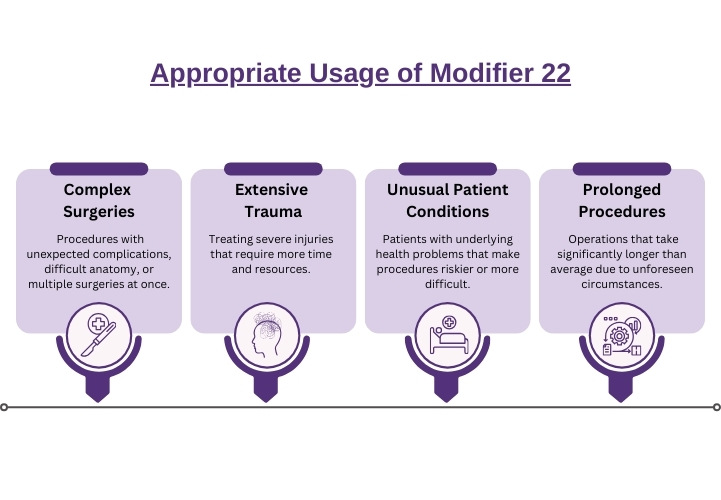
Modifier 22 applies to CPT that same figure when the cesarean involved substantially greater work than usual, such as extensive lysis of adhesions from prior abdominal surgery. Per the MGMA 2022 Medical Coding, Billing and Auditing Toolkit, the modifier requires a detailed operative note that names the specific circumstances driving the added complexity. Without that note written at the time of surgery, the modifier is indefensible on audit.
This is one of the most consistent pain points for busy obstetric practices: the complexity is real, the surgeon lived it, but the operative note, drafted hours later under the weight of a full schedule, does not capture the granular clinical detail that payers require. iScribe Health's ambient listening and conversational AI address this directly. Because iScribe Health integrates with supported EHRs and generates an AI-drafted encounter summary at the point of note completion, the operative detail that defends Modifier 22 exists in the record before the claim is ever filed, not reconstructed after a records request arrives.
2. Modifier 52 (Reduced Services) - Rarely Appropriate for CPT 59510 and When to Avoid It

Modifier 52 signals a service was reduced or eliminated. It is rarely appropriate for CPT that same figure because the global package is already a bundled unit; a partially rendered global package typically requires a component code (59514 or 59515) rather than a modifier. Appending Modifier 52 to that same figure instead of selecting the correct component code is a common mismatch that triggers payer review and often results in denial.
Practices running high patient volumes, where clinicians regularly chart two or more hours outside of direct patient care, are especially vulnerable here. When documentation is rushed, code selection defaults to habit rather than precision, and Modifier 52 ends up on claims where it does not belong. iScribe Health's E&M Coding Intelligence surfaces these mismatches upstream, before submission, so the practice can correct the code-selection problem rather than absorb the denial.
3. Split-Care Scenarios - Why Modifiers Cannot Substitute for the Correct Component Code
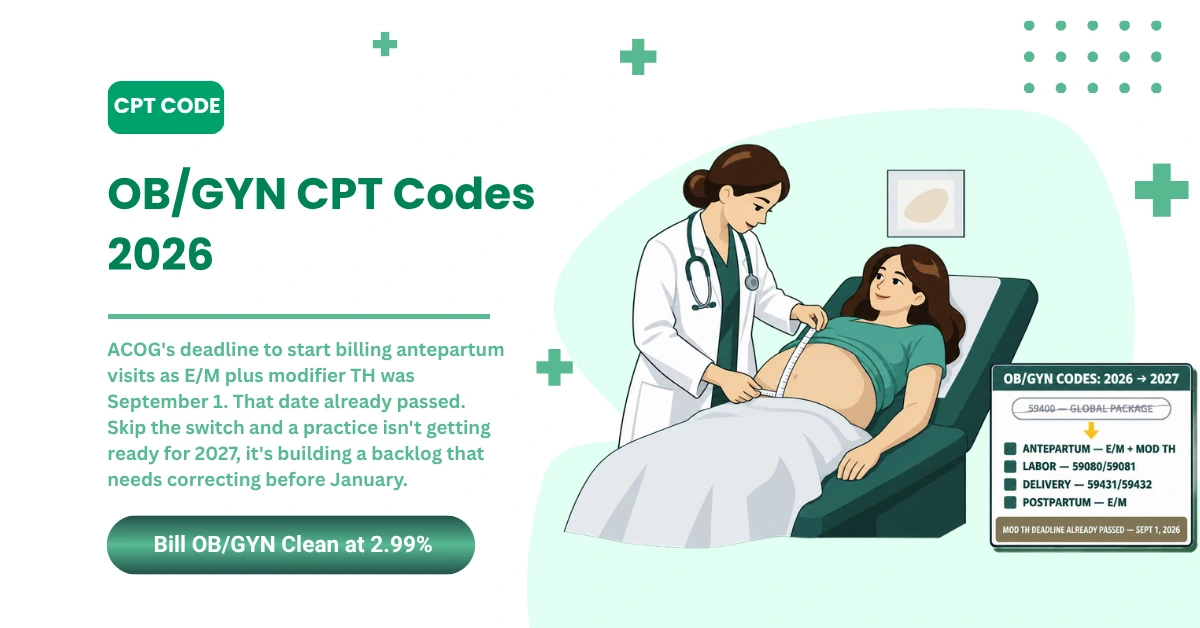
Modifiers do not fix a code-selection problem. When antepartum care was rendered by a separate provider group, no modifier on that same figure corrects the claim; the delivering provider must bill 59514 or 59515 to reflect only the phases they rendered. Using a modifier to signal partial care on a global code is among the most frequently flagged patterns in obstetric claim audits, because it misrepresents the scope of service billed.
iScribe Health's real-time denial alerts surface these audit candidates upstream, before they become denied claims that consume staff time to work, reducing administrative overhead and protecting revenue without adding headcount. That matters acutely in split-care arrangements, where the handoff between provider groups creates documentation gaps that are easy to miss and expensive to fix after the fact.
4. Documentation Requirements - How Missing Operative or Visit Records Turn Modifier Use Into an Audit Trigger
Any modifier appended to CPT code 59510 without corresponding supporting documentation is one of the highest-risk audit triggers in obstetric billing. For Modifier 22, payers expect a detailed operative report; for any modifier affecting the global package, visit notes must confirm which services were and were not rendered. Practices that append modifiers as a reimbursement strategy without contemporaneous records face recoupment demands, compliance penalties, and potential False Claims Act exposure.
5. Payer-Specific Modifier Policies - Verifying Acceptance Before Submitting CPT 59510 With Any Modifier
Commercial payers and Medicare do not apply identical modifier acceptance rules to global obstetric codes. Some commercial plans require pre-authorization or a written narrative attachment before they will process Modifier 22 on that same figure; others apply automatic downcoding. Verifying each payer's modifier policy before submission, not after denial, is the only way to avoid the resubmission cycle that delays reimbursement and inflates administrative overhead.
iScribe Health's real-time denial alerts are designed to surface exactly these payer-specific mismatches before a claim goes out the door, reducing the resubmission cycle that consumes staff capacity and delays cash flow. For practices already running a supported EHR that want a seamless ambient documentation experience, this layer of pre-submission intelligence integrates without adding headcount or disrupting clinical workflow.
Getting modifier use right closes one audit door. It does not reveal how many claims with no modifiers at all are quietly overbilled or underbilled across an entire billing cycle. That is the problem the next section confronts: why systematic overcoding in CPT that same figure stays invisible to the practices it is costing the most.
Why Systematic Overcoding in CPT 59510 Stays Hidden Until an AI Audit Finds It
When iScribe Health analyzed 941 obstetric and surgical encounters, 33% showed overcoding errors that no one inside the practice had flagged. As obstetric audit research published in Acta Obstetricia et Gynecologica Scandinavica confirms, practice deviations are only surfaced through structured external review against objective criteria, not through clinician self-assessment. That finding applies directly to billing: a practice's internal belief that its claims are clean is not evidence that they are.

The 33% Overcoding Rate No OB Practice Saw Coming Until the Audit Did
OB practices with experienced coders, low denial rates, and clean-looking dashboards still carry hidden audit risk because their internal review processes evaluate code selection, not documentation completeness. A coder who correctly identifies that a patient qualifies for the global package still has no mechanism to verify, at claim submission, whether the underlying antepartum visit notes actually document the number of visits included in the billed code.
Routine internal review confirms that the right code was chosen, but it cannot confirm that the documentation behind that code will survive external scrutiny.
Why Overcoding and Undercoding in 59510 Are Both Documentation-Origin Problems
Code selection happens at the billing desk. Documentation failures happen weeks earlier, during the encounter. By the time a coder sees the claim, the note is already written, the visit count is already fixed, and the provider attribution is already either present or absent. Selecting CPT codes correctly does nothing to repair a prenatal note that omits visit-specific findings, fails to attribute care to the billing provider, or counts a visit that the record does not support.
This matters for undercoding too.
How Real-Time Documentation Closes the Gap That Retroactive Note-Writing Leaves Open
Both overcoding and undercoding share one root cause. Notes completed hours or days after the encounter rely on memory, not observation. Provider presence, visit content, and clinical narrative degrade in retroactive documentation in ways that are invisible to the coder but immediately visible to a Recovery Audit Contractor reviewer.
An AI medical scribe captures clinical narrative in real time at the point of care, before the encounter ends. Real-time ambient documentation closes that gap before a billing decision is ever made and before an auditor ever asks for the record.
Related Reading
- Cpt Code 59409
- Cpt Code 59515
Next steps
If your antepartum notes are leaving provider identity unverified visit by visit, the path forward starts with documentation captured at the point of care, not reconstructed after the encounter ends. Start with our AI medical scribe.
Provider identity at every prenatal visit is not an administrative formality; it is the structural prerequisite that determines whether CPT 59510 survives a payer audit at all. That means the claim defense is built during the encounter, not at the billing desk. And the 33% overcoding rate found in iScribe Health's 941-encounter analysis confirms that internal review processes cannot surface what the clinical record quietly omits. Together, those two realities point to one corrective action: closing the gap between what care was delivered and what the note can actually prove, before any claim reaches the payer.
Start with AI medical scribe technology from iScribe Health. Provider attribution, visit-specific clinical detail, and care-phase documentation are captured in real time at every encounter, so the record that reaches your coder is already built to defend the code selected.
Frequently Asked Questions
Does CPT 59510 cover postpartum care, and what does that actually include?
Yes. CPT 59510 bundles postpartum care into the global package, covering both hospital-based follow-up immediately after delivery and office-based visits extending approximately six weeks post-delivery. Both visit types must be documented to support the bundled postpartum component, a practice that performs hospital rounds but has no office visit record in the postpartum window has an incomplete global package claim, even if the patient simply did not return.
What happens to the 59510 claim if a locum tenens or outside hospitalist performs the delivery?
Billing CPT 59510 is no longer appropriate. If a provider outside the billing group performs any phase of care, the continuity requirement is broken and individual component codes must replace the global package code. The same-provider or same-group standard must hold across all three phases, antepartum, delivery, and postpartum, for 59510 to be defensible.
If a patient transfers to our practice mid-pregnancy, can we still bill the global 59510?
No. A provider who receives a transferred obstetric patient mid-pregnancy can bill only for the phases they personally rendered, typically the delivery and postpartum phases, not the full global package. The revenue consequence is structural, not recoverable through a modifier.
What's the minimum number of antepartum visits needed before we can bill CPT 59510 instead of the antepartum-only codes?
AAPC confirms a minimum threshold of four or more prenatal visits is required before the bundled antepartum component is billable under the global package rather than unbundled into separate codes such as 59425 or 59426. If that visit floor isn't met, the entire global package claim becomes indefensible regardless of how complete the operative note is.
Is postpartum tubal sterilization included in the CPT 59510 global package if it's done at the same admission as the cesarean?
No. Postpartum tubal sterilization falls entirely outside the global obstetric package and must be coded separately, even when performed in the same admission as the delivery. It carries its own CPT code and its own reimbursement pathway, and bundling it into 59510 is an overclaim regardless of timing.