CPT Code 59400 Explained: What's Included in Global OB Care
CPT Code 59400 bundles months of OB care into one claim. Billing teams, see where documentation gaps quietly drain reimbursement.


Billing CPT 59400 correctly is not your revenue problem. Missing documentation behind that single bundled code is, and most practices only find out after the denial lands.
CPT 59400 sits at the center of every global OB billing workflow, and the common assumption among practice administrators and billing decision-makers is this: if our billing team knows the components of CPT 59400, antepartum visits, delivery, postpartum care, and applies the code correctly, our claims should be paid in full; any shortfall must be a payer problem or a coding edge case. That instinct is understandable. It is also where revenue quietly disappears.
"Patients are confused about when CPT 59400 is actually billed, whether it's charged early in pregnancy, at delivery, or after postpartum care ends."
— what we hear from obstetric billing professionals
See our AI medical scribe for how this works in practice.
The real exposure is code selection. According to the AMA CPT Code Set, 59400 bundles antepartum care, vaginal delivery, and postpartum care into a single billable episode, so one line item is expected to represent months of clinical contact. When a payer audits that single line item, they are not checking whether you picked the right code.
They are checking whether every component of that episode is documented well enough to defend the claim. Most practices discover the gap only after the denial arrives. Global in OB billing is a structural designation with direct reimbursement consequences.
The CMS Medicare Claims Processing Manual is explicit: a payer reimburses a single bundled fee for the entire maternity episode, and unbundling individual components during the global period is treated as improper billing, triggering denial or audit. That means the moment you submit that same figure, you are representing that one provider or group managed the full continuum of care, and that every component is documented in the record.

The ACOG Committee on Coding and Nomenclature makes this explicit: inadequate visit documentation, missing delivery notes, and incomplete postpartum records are the primary drivers of claim denial and revenue leakage, not coding errors alone. A practice that consistently bills that same figure but receives partial payment because postpartum documentation is missing is facing a documentation problem that looks like a coding problem until someone pulls the chart.
A practice that consistently bills that same figure but receives partial payment because postpartum documentation is missing is not facing a coding problem.
The AMA CPT Assistant identifies a compounding risk: when a patient transfers care mid-pregnancy or delivers prematurely, the global code must be split into component codes, and failure to make that adjustment is a leading cause of under-reimbursement. That adjustment requires the coder to know what the physician documented, what the delivery note captured, and whether postpartum care was completed by the same group. When a payer pulls records and the documentation trail is incomplete, the practice absorbs the clawback, the write-off, or the compliance exposure. Knowing that same figure is a global code is the starting point. The next section breaks down exactly which services the AMA bundles inside that single code description, so your team can cross-check whether every component is actually being documented at your practice.
Key takeaways
- CPT 59400 bundles antepartum care, vaginal delivery, and postpartum follow-up into one fee, but every component must be independently charted to survive a payer records request, not just correctly coded.
- Industry data shows only ~55% of E&M visits are accurately documented, and inside a global maternity package, that error rate compounds across an entire episode of care.
- Six service categories sit entirely outside CPT 59400, including fetal non-stress tests (CPT 59025), and practices that don't bill them separately leave recoverable revenue on the table with every claim.
- When delivery is handled by an on-call partner rather than the managing provider, CPT 59400 is no longer valid for either clinician, the global package requires one provider or group to own the full, uninterrupted episode.
- January 1, 2027 OB coding changes are close enough that practices treating them as a future problem are already behind on preparation.
- The most expensive billing errors in global OB care never generate a denial, the claim clears, payment posts, and the documentation gap becomes a permanent, invisible revenue loss until a post-payment audit surfaces it.
- iScribe Health's AI-powered ambient scribing captures visit-level documentation in real time, inside your EHR, so every antepartum note, delivery record, and postpartum encounter meets the evidentiary standard CPT 59400 requires, before a payer ever asks for the records.
What Services Are Included in CPT Code 59400
Three services sit inside CPT that same figure, and every one of them must be independently charted to survive a payer records request. The global maternity package bundles antepartum care, the vaginal delivery itself, and postpartum follow-up into a single code billed by a single provider or physician group managing the full continuum of care. Knowing that definition is the easy part. The harder part is proving, visit by visit, that each component actually happened, a burden that lands hardest on high-volume OB practices where clinicians are already spending significant time on after-hours documentation long after the last patient has left.
1. Antepartum Care - Initial Visit Through Full Prenatal Schedule
The antepartum component follows a standard prenatal visit schedule: the initial prenatal visit, followed by visits that increase in frequency as pregnancy progresses through the second and third trimesters until delivery. Every one of those encounters must be individually charted with gestational age, clinical findings, and a documented plan. A patient seen less frequently than the standard schedule, or a chart where every prenatal note looks identical, creates a documentation gap that auditors can identify without much effort.
This is where the manual, post-visit charting model breaks down in practice. When a clinician is seeing a full OB panel and reconstructing notes hours later, encounter-specific detail, gestational age at that visit, the specific clinical finding discussed, the individualized plan, tends to compress into templated language that reads the same at 24 weeks as it does at 34 weeks. iScribe Health's ambient AI documentation captures that visit-specific detail in real time through ambient listening and conversational AI, so each antepartum note carries the granularity the schedule actually demands, without adding documentation time to an already full day.
2. Vaginal Delivery Component - Delivery With or Without Episiotomy and Forceps

The delivery component covers the actual delivery service, with or without episiotomy and with or without forceps use. The delivery note or operative record must specify which of those elements applied. A generic delivery note that omits whether an episiotomy was performed or whether forceps were used gives a payer grounds to question whether the billed delivery component is fully substantiated, even when the code itself is correct.
3. Postpartum Care Component - Routine Follow-Up and 6-Week Examination
Postpartum care includes routine follow-up through the standard 6-week postpartum examination. This is consistently the most under-documented leg of the global package. A brief, templated postpartum note that lacks physical exam findings or fails to tie the visit back to the global episode gives a payer exactly the opening it needs to recoup payment on an otherwise valid claim.
Practices managing high patient volumes know this firsthand: the postpartum visit often gets the least documentation attention precisely because it comes at the end of a long episode, when documentation fatigue is highest. iScribe Health's ambient documentation is most beneficial at exactly this point, when clinicians are seeing high patient volumes and spending significant time on after-hours charting, so the postpartum encounter is captured with the same specificity as the initial prenatal visit rather than condensed into a perfunctory note.
4. Single-Provider Continuity Requirement - One Physician or Group for All Care

CPT that same figure applies only when a single provider or physician group handles the complete, uninterrupted continuum of care from antepartum through delivery and postpartum. If a covering physician delivers the baby while a different provider managed all prenatal visits, the global code no longer applies. Component codes must be used instead, and billing the global package in that scenario is a compliance exposure, not just a technicality.
5. ICD-10 Pairing - Z34.xx and Z37.0 for Normal Pregnancy Global OB Claims
Correct ICD-10 pairing is non-negotiable. CPT that same figure pairs with Z34.xx codes (supervision of normal pregnancy) for the antepartum period and Z37.0 (single liveborn infant, delivered in hospital) to indicate delivery outcome. High-risk pregnancy diagnoses without supporting documentation create a mismatch that triggers rejection, because payers expect normal-pregnancy codes to align with a chart that reflects routine, uncomplicated care throughout.
A related pressure point worth naming: OB practices increasingly see patients billed for additional CPT codes alongside primary codes without clear medical necessity or proper diagnosis codes attached, creating claim mismatches that trigger unexpected denials and patient out-of-pocket exposure. Correct, complete documentation at every encounter is the first line of defense against that outcome. iScribe Health's real-time denial alerts surface these mismatches at the point of note completion, after the AI drafts the encounter summary, so the issue is caught before the claim leaves the practice rather than weeks later in a remittance.
6. Clinical Scenario Overview - When CPT 59400 Applies vs. When It Does Not

The clearest signal that CPT that same figure does not apply is a split-care scenario: the antepartum provider differs from the delivering physician, or postpartum care is handed off to a separate clinician. In those cases, component codes (59425 or 59426 for antepartum only, 59409 for delivery only, 59430 for postpartum only) replace the global package. Billing that same figure when care was genuinely split is one of the most common audit triggers in OB billing, and it surfaces most often in group practices where coverage arrangements are informal.
7. Global OB Package Definition - What the All-Inclusive Bundle Actually Covers
CPT Code 59400 represents a global maternity package that consolidates antepartum, delivery, and postpartum services into a single billable unit, reimbursed at one negotiated rate. Payers expect no additional E/M or procedure codes for routine services within this bundle. The critical tradeoff is that any service falling outside the routine scope, such as a complication visit or non-routine procedure, must be separately documented and billed with a modifier to avoid bundling denials.
Modifier Usage Requirements - When 22, 52, and 53 Apply to Global OB Claims
Modifiers are not optional adjustments in global OB billing; they are documentation obligations with direct claim consequences. Modifier 22 applies when a service is substantially more complex than the standard descriptor covers, but it requires a supporting narrative in the chart that explains specifically what made the encounter unusual, not a generic statement that the case was complicated. Modifier 52 signals a reduced service when the global package was not completed as billed, such as when postpartum care was not rendered by the delivering provider.
Modifier 53 covers discontinued procedures. Each of these carries its own documentation threshold, and applying any of them without a corresponding chart entry that substantiates the modifier is an audit exposure that payers identify through pattern analysis across a practice's claim history, not just on individual claims.
The documentation burden for modifier use falls disproportionately on practices where clinicians are reconstructing notes after a full clinical day. When the chart is built in real time through ambient AI documentation, the clinical detail that justifies a modifier, the specific complication, the deviation from standard care, the reason a service was reduced or discontinued, is captured at the point of care rather than reconstructed from memory hours later, which is precisely when that detail is most likely to be omitted or compressed into language too vague to support the modifier on audit.
Related Reading
- Obgyn Cpt Codes
- Cpt Code 59025
- Cpt Code 59510
What Services Are Excluded from CPT Code 59400 and Billed Separately
Bundling assumptions are where global OB revenue quietly erodes, and CPT 59400 carries more exclusions than most billing teams account for. Fetal non-stress tests, obstetric ultrasounds, and complication-driven antepartum visits each follow their own billing rules, and missing any one of them means leaving reimbursement uncaptured across every affected encounter. Understanding exactly where the global package ends is the first step toward closing those gaps consistently.
Six categories of services sit entirely outside CPT that same figure, and billing teams that assume otherwise leave real, recoverable revenue on the table with every claim they submit.
How to Bill Postpartum Visits Separately When a Different Provider Renders Care (Code 0502F)
When a provider other than the delivering physician renders postpartum care, that care falls outside the global package entirely. The correct billing path requires procedure code 0502F paired with the appropriate postpartum ICD-10 diagnosis codes. P3 Healthcare Solutions notes that failing to use this code combination results in unbilled, unrecovered revenue. This scenario is common in group practices where coverage rotations mean the postpartum visit provider routinely differs from the delivering provider, making this a recurring gap rather than an occasional edge case.
1. Cerclage, External Cephalic Version, and High-Risk Antepartum Visits Billed Outside CPT Code 59400
CPT Code 59400 bundles only routine antepartum visits into its global package. Procedures like cervical cerclage (CPT 57700), external cephalic version (CPT 59412), and medically necessary high-risk visits fall outside that bundle and must be billed separately. Practices managing complex pregnancies need to document medical necessity carefully, as payers frequently audit these add-on claims and may deny them without thorough clinical documentation.
2. Fetal Non-Stress Tests and Biophysical Profiles Require Separate CPT Codes Outside 59400

Fetal surveillance tests are explicitly excluded from the CPT that same figure global package. Each fetal non-stress test must be billed under CPT that same figure, and biophysical profiles carry their own separate codes for every encounter. P3 Healthcare Solutions confirms that diagnostic services like fetal non-stress tests require their own CPT codes to capture reimbursement that would otherwise be left on the table. In high-risk pregnancies requiring weekly surveillance across multiple trimesters, the unbilled total per patient compounds into a material revenue gap that never triggers a denial because the claim was never submitted.
3. Ultrasounds and Amniocentesis Are Diagnostic Services Excluded from the CPT 59400 Global Bundle

Diagnostic imaging sits entirely outside the that same figure bundle. Obstetric ultrasounds billed under CPT 76805 or 76811, amniocentesis, and other imaging studies each require a separate claim with their own CPT code. P3 Healthcare Solutions identifies this category as one of the most consistent undercoding patterns in global OB billing. For practices managing complex pregnancies with multiple imaging encounters per trimester, the revenue gap accumulates quietly across hundreds of claims and rarely surfaces until a retrospective audit forces the count.
4. Postpartum Visits Billed Separately Using Procedure Code 0502F and Corresponding ICD-10 Codes
When postpartum care is not delivered by the same provider who performed the delivery under CPT Code 59400, the postpartum visit must be billed separately using procedure code 0502F alongside appropriate ICD-10 codes such as Z39.1 or Z39.2. This scenario commonly arises in group practices or when care transitions occur. Billers must confirm payer-specific rules, as some insurers still expect the global code regardless of provider continuity.
5. CPT 59425 and 59426 for Antepartum-Only Care When the Delivering Provider Differs
Split-care scenarios break the 59400 global code entirely. When the prenatal provider is not the delivering provider, the prenatal practice must bill CPT that same figure for four to six antepartum visits or CPT 59426 for seven or more, rather than defaulting to the global package. P3 Healthcare Solutions confirms that defaulting to that same figure in these split-care scenarios causes systematic undercoding and revenue loss for the prenatal practice.
6. Medically Indicated Inpatient Antepartum Management Billed Separately from the CPT 59400 Global Fee
Inpatient admissions for antepartum complications generate E/M services that are separately billable from the global package, but only when modifier 24 is appended to prevent automatic payer bundling. Without it, payers treat the inpatient claim as a duplicate of the global fee and deny it outright. The clinical documentation typically exists; the modifier is missing. That makes this one of the most preventable revenue losses in OB billing, and one of the most auditable, because the gap shows up as a pattern across every admission claim submitted without the modifier rather than as an isolated denial.
What Component Codes Apply When OB Care Is Split Between Providers
Modifier 24 closes one gap in OB billing, but a separate structural problem dismantles the global package entirely before a modifier ever becomes relevant. When a group practice's on-call physician delivers a patient whose prenatal care was managed entirely by a partner, CPT that same figure is no longer valid for either provider. The global package requires one provider or group to manage the full, uninterrupted continuum of care. The moment that continuity breaks, the claim must be rebuilt from component codes. Industry data confirms that four codes carry the weight that same figure previously held: 59409, 59430, 59425, and 59426.
1. CPT 59409 - Vaginal Delivery Only, No Antepartum or Postpartum Care
CPT 59409 covers the delivery service alone, with no antepartum or postpartum care attached. It applies when a covering or on-call physician performs only the delivery for a patient whose prenatal care belonged to a different provider. Reimbursement is lower than the global package rate, so practices that default to this code without verifying payer fee schedules accept a preventable revenue reduction on every split-delivery claim. Coding consistency across individual physicians and advanced practice providers matters here; in high-volume group practices, a single provider's habit of reaching for the wrong component code at the wrong handoff compounds into a systematic revenue leak that a practice-wide audit rarely catches until the damage is already done.
2. CPT 59430 - Postpartum Care Only for a Non-Delivering Provider
CPT 59430 reimburses postpartum follow-up when the provider managing that care did not perform the delivery. It is the correct code when a patient's primary OB resumes care after a covering physician delivered the baby, or when postpartum management shifts to a different clinician entirely. The limitation billing teams frequently miss: the postpartum note must stand on its own clinical merits, because the payer cannot assume continuity with the delivery record. When the resuming provider is one of several in a busy group, the encounter note is often the only artifact that establishes that provider's independent role, making the quality and specificity of that note a billing document, not just a clinical one.
3. CPT 59425 and 59426 - Antepartum-Only Codes for 4-6 or 7+ Visits
CPT that same figure applies when a provider manages a lower range of antepartum visits without performing the delivery or postpartum care; CPT 59426 applies when the visit count is higher, in the same scenario. A mid-pregnancy transfer to a maternal-fetal medicine specialist is the most common trigger. The visit count is the deciding factor between the two codes, which makes real-time antepartum visit tracking a billing requirement, not just a clinical convenience. Practices where individual physicians and advanced practice providers document independently, without a shared, encounter-level record of who saw the patient and when, routinely discover the visit count discrepancy only at claim submission, when reconstructing it is both time-consuming and audit-vulnerable.
4. Clinical Scenarios That Trigger Split OB Billing - Covering Physicians, Group Practices, and Mid-Pregnancy Transfers
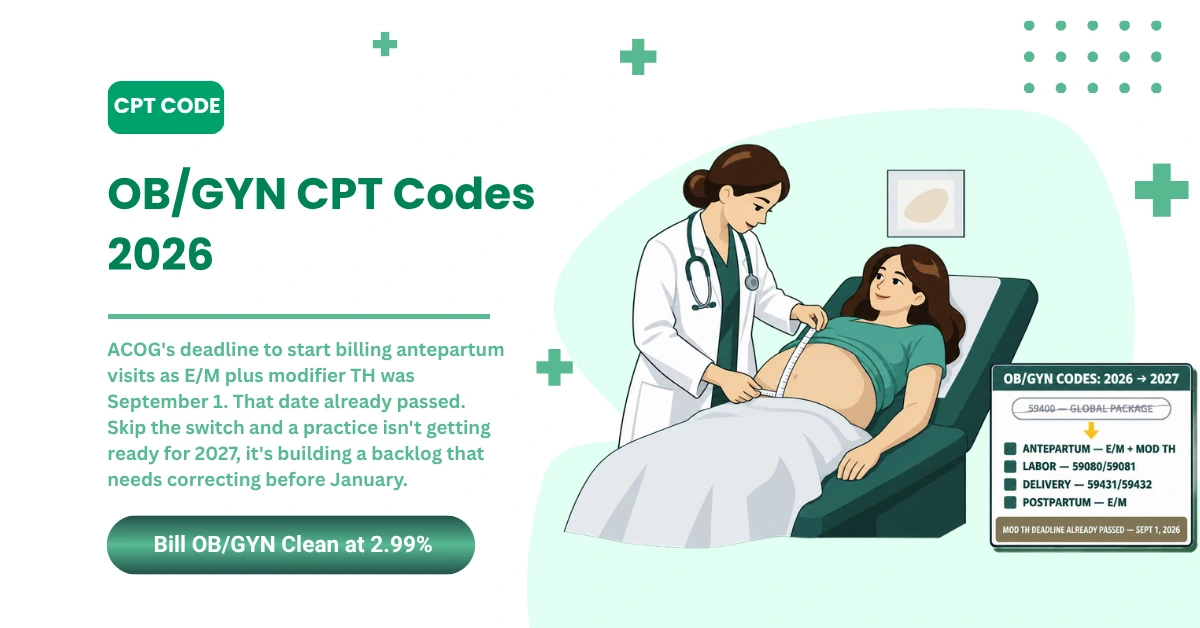
The three most common triggers are a covering physician delivering a partner's patient, a patient transferring to a specialist mid-pregnancy, and postpartum care shifting to a different clinician after discharge. Each scenario produces a different combination of component codes. The critical insight most billing teams learn too late: the decision to split the codes is not made at claim submission. It is made at every handoff, and the documentation either supports it or it does not.
5. Documentation Requirements When Component Codes Replace the Global Package
The code selection is the easy part; the documentation coordination is where claims collapse. When two providers each assume the other has captured the handoff in the chart, the component codes can be technically correct while the underlying records fail a payer audit entirely. Each provider must independently support only the specific service segment they performed, with no reliance on the other's notes. Practices that have not tracked antepartum visit counts in real time and documented each provider's specific role cannot reconstruct that record after the fact. The consequence is a claim that is wrong as a global and indefensible as a split, so the practice loses either way.
This is where the familiar approach breaks down. Billing teams know the codes. The failure point is that two providers, documenting independently after a rushed handoff, rarely capture the care delineation that component codes legally require. The OB practices we work with face a compounding version of this problem: physicians are already charting two or more hours outside of patient care time, and adding a precise, provider-attributed split-care note to that burden means the documentation is either delayed, incomplete, or both by the time a claim is submitted.
iScribe Health's Ambient Listening and Conversational AI is built for exactly this environment. Because it delivers the greatest value when physicians want a completely hands-free documentation experience during the visit, it captures physician dialogue and patient context during the visit to generate clinical notes in under 30 seconds, at the moment of care, before the handoff fades. That means when a covering physician completes the delivery, the chart reflects that provider's specific role in that specific encounter without a manual reconstruction effort afterward.
The same logic applies when the primary OB resumes postpartum care: the ambient session produces a note that stands on its own clinical merits, which is precisely what CPT 59430 requires. For practices already running a supported EHR, the integration is seamless, so the workflow change is the AI doing more, not the physician doing anything differently at the desk.
iScribe Health's E&M Coding Intelligence layer works to improve coding consistency across individual physicians and advanced practice providers, the exact population where split-care coding diverges most unpredictably in a group OB practice. Each provider independently selecting the correct component code introduces variation; the system supports consistent code assignment across encounters, reducing the provider-to-provider variation that quietly erodes revenue on every split-delivery claim.
Getting the component codes right solves today's split-care billing problem. But a larger disruption is coming that will affect every OB practice billing the global package, regardless of how care is divided. The AMA's scheduled deletion of CPT that same figure in 2027 will make the component-code logic explored here the new default for all obstetric billing, and practices that are not already building the documentation infrastructure to support it are running out of runway.
Related Reading
- Cpt Code 58150
- Cpt Code 57454
- Cpt Code 76805
- Cpt Code 76817
The Upcoming CPT 59400 Coding Changes Every OB Practice Needs to Prepare For
This is not a minor procedural update. It is a structural reset that will expose whether every antepartum and postpartum encounter in your practice can independently justify its own billing level, starting with visits happening right now.

What the AMA Is Actually Deleting on January 1, 2027 and What Replaces It
Post-that same figure, antepartum and postpartum care will transition to standard Evaluation and Management (E/M) codes billed per encounter, with delivery services reported separately. That means a typical pregnancy, which involves many individual prenatal visits under standard obstetric care guidelines, will require each of those encounters to be individually documented and independently defensible as a separate E/M claim instead of one global submission. That shift fundamentally changes the documentation standard every provider in the practice must meet at every visit.
Why Unbundling Every Antepartum and Postpartum Visit Into E/M Codes Multiplies Documentation Exposure
If the note does not independently support the code billed, the claim is vulnerable, regardless of how well the overall episode of care was managed. Multiply that exposure across 13 to 15 visits per patient and across a full year of volume, and the financial risk compounds quickly.
Key takeaway: Global OB claims already carry above-average audit rates. The that same figure transition doesn't raise the audit threat from zero; it raises it from already-elevated.
iScribe Health's Automated E&M Coding and E&M Coding Intelligence are designed precisely to close this gap, improving coding precision to directly impact revenue and standardizing clinical documentation quality across the practice. Both capabilities become more valuable the earlier a practice deploys them, since documentation habits formed now will carry directly into the unbundled environment.
Poor Global Package Documentation Habits That Hurt Unbundled Billing
- A missing gestational age notation in week 24
- A postpartum note that records vitals but skips examination findings
- A delivery record that omits episiotomy detail
Under per-encounter E/M billing, however, each gap becomes a standalone audit exposure point that can trigger a downcode or denial on its own.
iScribe Health's Ambient AI Documentation, powered by Ambient Listening / Conversational AI, captures clinical detail in real time, at the point of care, so every antepartum and postpartum encounter is built into a note designed to independently support the code billed. Realizing that outcome across the full episode requires consistent provider adoption during the ramp period, and iScribe Health's AI Customization capability allows the ambient layer to be configured to the specific documentation patterns of an OB practice, reducing the adoption friction that has historically undermined AI documentation rollouts before they reach full clinical coverage.
Documentation Requirements That Make CPT 59400 Audit-Proof Across the Full Episode
Documentation Compliance for CPT 59400 - Why the Claim Is Only as Defensible as Its Weakest Visit
Knowing every line of CPT that same figure's bundle definition does not protect a practice from audit-driven recoupment, because the real exposure is whether every antepartum visit, the delivery note, and the postpartum encounter each carry independently defensible documentation. A payer auditing the global package evaluates the record component by component; a single thin chart entry, a missing gestational age, an absent forceps notation, or a postpartum note never tied back to the global episode can unravel the entire bundled fee.
A payer auditing CPT that same figure reconstructs the entire episode from individual chart entries, and the global reimbursement is only as defensible as its weakest documented visit. The exposure most OB billing teams underestimate is the per-encounter paper trail behind the code selection. The documentation strategy has to be encounter-level, because audit risk exists at every visit in the episode, not just at delivery.
1. Antepartum Visit Notes - Individual Charting of Date, Gestational Age, Findings, and Plan
Each antepartum encounter must stand on its own as a discrete chart entry. Professionals for Women's obstetrics financial policies specify that a single summarized prenatal note does not satisfy audit requirements; payers expect individual entries with date, gestational age, clinical findings, and a documented plan for every visit in the series. A missing gestational age on even one note gives an auditor grounds to question whether the visit occurred as billed.
The execution problem in high-volume OB practices is volume compression. When a clinician is regularly charting two or more hours outside of patient care time, the granular detail that makes each antepartum visit audit-proof is exactly what gets abbreviated. iScribe Health's ambient AI documentation is designed to address this directly: the system listens during the encounter and, at the point of note completion, after the AI drafts the encounter summary, the structured fields, date, gestational age, clinical findings, documented plan, are already populated.
2. Delivery Documentation - Operative or Delivery Note Specifying Episiotomy and Forceps Use
The delivery note must explicitly state whether an episiotomy and forceps were used, beyond confirming a vaginal delivery occurred. Industry data confirms these procedural details are required to justify the delivery component during a records review. A vague delivery narrative that omits instrument use creates an audit gap that cannot be patched after the fact, because the clinical moment has passed and the record is what it is.
This is the category of documentation deficiency that surfaces upstream, before a payer requests records, when a structured review protocol is in place. iScribe Health's E&M Coding Intelligence and ambient listening capabilities are designed to surface audit candidates upstream, flagging encounter notes that lack the procedural specificity payers require, so the gap can be identified at note completion rather than at recoupment.
3. Postpartum Visit Note - Physical Exam Findings Tied to Global Episode Discharge
The six-week postpartum visit is the formal close of the global episode. Professionals for Women's obstetrics financial policies require that the postpartum note include physical exam findings and discharge language explicitly connecting the encounter back to the global episode of care. Without that linkage, a payer can treat the visit as undocumented within the bundle and recoup accordingly.
Creating more defensible documentation at this closing visit means the note must do two things simultaneously: record physical exam findings with clinical specificity and include explicit episode-discharge language. iScribe Health's AI-generated encounter summary, produced at the point of note completion, is structured to carry both, reducing the likelihood that a provider closes the global episode with a note that is clinically complete but documentarily incomplete.
4. Cross-Provider Continuity - Avoiding Audit Exposure from Inconsistent Group Documentation
When two physicians in the same practice share OB patients but chart in different formats, the continuity of care record breaks down. Professionals for Women's financial policy documentation notes that payers review for continuity across the full global episode, and a handoff without proper documentation can trigger denial or recoupment even when the clinical care itself was complete. The gap is visibility across providers who never standardized how they close a shared patient's chart.
iScribe Health's EHR integration is designed to close this visibility gap at the system level. Because the ambient documentation layer operates within the practice's existing supported EHR, rather than alongside it, every provider in a group charts through the same structured output. The result is a consistent documentation format across the full global episode regardless of which clinician saw the patient at which visit, which is the continuity payers are auditing for.
5. Pre-Audit Chart Review - Proactively Identifying Documentation Gaps Before Payer Requests
Running a retrospective review across the last 90 days of CPT that same figure claims is the lowest-cost way to surface documentation deficiencies before a payer does. The tradeoff is real: internal audits require staff time and a structured protocol, and smaller practices often lack both. The cost of a proactive review is fixed and bounded. A post-recoupment remediation, by contrast, includes the repayment itself, the administrative burden of appeals, and the reputational signal to the payer that the practice's records are inconsistent.
iScribe Health's Real-Time Denial Alerts extend this logic from retrospective to prospective. Rather than waiting for a 90-day lookback to surface a pattern of thin documentation, the system is designed to surface audit candidates upstream, flagging documentation gaps at the encounter level before the claim is submitted. For practices where the administrative team does not have capacity to run structured internal audits, this shifts the detection point from post-submission to pre-submission, where the cost of remediation is lowest.
6. Documentation Compliance Checklist - A Structured Tool for CPT 59400 Episode Completeness
A checklist tied to each CPT that same figure episode should confirm: individual antepartum entries with gestational age, a delivery note specifying instrument use, and a postpartum note with explicit episode-discharge language. The execution problem is volume. When a provider sees 20 or more patients a day, the charting granularity that makes each encounter audit-proof is exactly what gets compressed, and physician burnout from documentation load is a recognized driver of that compression.
Because the system captures structured, encounter-level detail in real time through ambient listening and conversational AI, every antepartum visit can produce the date, findings, and plan a payer auditor needs without requiring post-visit documentation work from the provider. The limitation worth naming: the system materializes when the practice or health system is already running a supported EHR and wants a seamless ambient documentation experience, and consistent provider adoption across the full episode is required before it reliably closes the documentation gap.
Getting the documentation right on every CPT that same figure episode is the floor. But even practices with solid charting habits are often surprised to discover where the global package is quietly bleeding revenue in ways no individual chart gap would reveal. The next section maps exactly where those silent losses occur inside the global maternity bundle.
Where OB Practices Are Silently Losing Revenue Inside the Global Maternity Package
A substantial share of OB/GYN claims contain a billing inaccuracy, according to industry billing data, and the most expensive errors are the ones that never generate a denial. They generate silence. A CPT that same figure claim clears, payment posts, and the revenue gap becomes permanent.
1. The 33% Overcoding Pattern Hidden Inside Your CPT Code 59400 Encounter Volume
Overcoding draws as much audit attention as undercoding, and it compounds silently across high-volume OB schedules. Billing inaccuracy reviews across high-volume clinical settings have consistently surfaced meaningful overcoding rates, cases where documented E&M levels do not independently support the complexity billed. In shared antepartum care, that drift accelerates: visit notes vary by provider, complexity indicators go uncaptured, and the coded level floats above what the record can actually defend.
The pattern is a structural byproduct of high-volume, multi-provider documentation without real-time standardization. iScribe Health's Automated E&M Coding and AI Customization work together to anchor each coded level to the documented encounter, reducing the drift that makes overcoding invisible until a payer requests records.
2. Antepartum and Postpartum Visits Documented Too Briefly to Defend the Global Package
A note that satisfies the schedule fails a records request. Industry data confirms that payers auditing a global OB claim examine whether visit count and complexity indicators in the record actually support the package billed, and documentation gaps that were never caught internally become the direct basis for post-payment recoupment. The postpartum visit carries the same risk: without physical exam findings and a clear discharge narrative tied to the global episode, the entire claim becomes vulnerable, not just that single encounter.
iScribe Health's Ambient Listening captures the clinical conversation as it happens, so the note reflects the actual complexity of the encounter at the point of note completion, not a summary assembled from memory at the end of a full clinic day.
3. Separately Billable Diagnostic Tests and Complication Visits Left Unbilled Due to Bundling Assumptions
Fetal non-stress tests, diagnostic ultrasounds, and high-risk antepartum encounters sit entirely outside the CPT that same figure definition, but coders routinely absorb them through assumption rather than verified payer policy. Providers Care Billing LLC identifies this pattern as systematic undercoding that remains invisible until an internal billing review or payer audit surfaces it. A practice that audits 12 months of claims frequently discovers significant unbilled diagnostic revenue, not from deliberate choices, but because no one confirmed what the global package definition actually excludes. iScribe Health's E&M Coding Intelligence flags procedure specifics at the encounter level, giving the coding team a documented signal to identify separately billable services before the claim is submitted.
4. Provider Documentation Variability in Group OB Practices That Masquerades as a Coding Problem
When different physicians chart the same clinical events at different levels of specificity, the practice cannot apply uniform coding standards across encounters, and separately billable services get absorbed into the global package by default. That pattern shows up on the explanation of benefits as a payer problem. It originates inside the practice's own documentation coordination. No coding engine corrects a revenue floor built on inconsistent source notes, because the ceiling on coding accuracy is always the quality of the underlying documentation. Improving coding precision to directly impact revenue starts at the note, and that is where iScribe Health's Ambient AI Documentation intervenes, standardizing the documentation input across every provider before the coding step begins.
5. AI-Powered Clinical Documentation That Captures the Full CPT Code 59400 Narrative Before the Note Closes
AI-powered clinical documentation tools embedded in the encounter workflow capture visit frequency, complexity indicators, and procedure specifics in real time, before the note is finalized, ensuring every antepartum and postpartum visit is independently defensible at the point of care rather than reconstructed at billing. For OB practices anticipating post-2027 unbundling requirements under CPT Code 59400, this shifts documentation accuracy from a retrospective audit function to a prospective clinical habit, closing the revenue leak at its source.
Related Reading
- Cpt Code 59409
- Cpt Code 59515
Next steps
If your global maternity claims keep coming in below expectations despite consistent use of CPT 59400, the path forward starts with documentation that can defend every bundled component independently, not just the code on the claim. Start with our AI medical scribe.
The insight that a single thin chart entry can unravel the entire bundled fee means that correct code selection offers no protection when the record behind it cannot stand up to a component-by-component payer review. The pattern where inconsistent documentation across providers creates a revenue floor that no amount of correct coding can raise means the problem is structural, not incidental, and it compounds silently across every shared episode. Together, they point to one concrete action: closing the documentation gap at the point of care, before a payer request forces a retroactive reconstruction that rarely holds up.
Start with an AI medical scribe that captures visit-specific clinical detail in real time during each antepartum, delivery, and postpartum encounter. Each note posts to the chart with the gestational age, clinical findings, procedural specifics, and episode-discharge language payers audit for, without adding documentation time after the visit ends. For practices already running a supported EHR, the workflow change is the ambient layer doing more, not the physician doing anything differently at the desk.
Frequently Asked Questions
Can I bill antepartum care separately if my provider didn't do the delivery?
Yes, when the prenatal provider differs from the delivering physician, CPT 59400 cannot be used by either party. The prenatal provider must bill CPT 59425 (four to six antepartum visits) or CPT 59426 (seven or more visits) instead of the global code, and defaulting to the global code in these split-care scenarios causes systematic undercoding for the prenatal practice.
Is postpartum care always bundled into 59400, or can it be billed on its own?
Postpartum care is bundled into 59400 only when a single provider or group manages the full continuum from antepartum through delivery and postpartum. If postpartum care is handed off to a separate clinician, the global code no longer applies and postpartum must be billed separately under CPT 59430.
What services are NOT covered by CPT 59400 that I should be billing separately?
Six categories fall outside the global package: fetal non-stress tests (CPT 59025), obstetric ultrasounds and diagnostic imaging (e.g., CPT 76805 or 76811), complication-driven antepartum visits billed as E/M services, cerclage placement and external cephalic version, inpatient antepartum management (requiring modifier 24), and antepartum-only codes in split-care scenarios. Assuming any of these are bundled into 59400 leaves recoverable revenue on the table.
How does Medicare treat unbundling individual components during the global period?
The CMS Medicare Claims Processing Manual is explicit: a payer reimburses a single bundled fee for the entire maternity episode, and unbundling individual components during the global period is treated as improper billing, triggering denial or audit.
Why do 59400 claims get denied even when the code itself is correct?
According to ACOG's Committee on Coding and Nomenclature, the primary drivers of claim denial and revenue leakage are inadequate visit documentation, missing delivery notes, and incomplete postpartum records, not coding errors alone. A payer auditing a 59400 claim is checking whether every component of the bundled episode is documented well enough to defend the claim, so a documentation gap can sink an otherwise correctly coded submission.