Orthopedic CPT Codes: Ultimate Guide and Billing Cheat Sheet
Orthopedic CPT codes span three code families. Billing teams, close every gap and collect every dollar you have earned.


Orthopedic billing spans three code families in a single visit. Miss one, and you are either leaving money uncollected or building a compliance problem no cheat sheet can fix.
Orthopedic CPT coding spans far more territory than most billing teams expect. A single orthopedic encounter can pull from three distinct code families simultaneously, and missing one means either leaving reimbursement uncollected or building a compliance exposure that surfaces months later in a payer audit. See our AI medical scribe for how this works in practice.
Consider a straightforward scenario: a patient presents for a pre-operative office visit before a total knee replacement (27447). The surgical code lives in the musculoskeletal block. The office visit bills under 99214.

If the practice ordered a pre-op knee MRI, that imaging code sits in a third range entirely. Three code families, one encounter, one patient.
Practices that treat the 20000-29999 block as the complete universe of orthopedic billing are working with an incomplete map.
Orthopedic procedures primarily fall within CPT codes 20000-29999, the musculoskeletal system surgery range designated by the American Medical Association. According to the American Medical Association's CPT structure, this block covers surgical interventions on bones, joints, muscles, tendons, and ligaments. Within that range, Find-A-Code's 2024 reference confirms that common orthopedic CPT codes include arthroscopy codes (29870-29999), fracture care codes, joint injection codes, and soft-tissue repair codes. The range is large enough that mastery requires structure, not memorization.
Orthopedic billing routinely draws from at least two additional code families beyond the musculoskeletal block: E&M codes 99202-99215 for office visits and consultations, and separate ancillary ranges for radiology, physical medicine, and supporting services. These appear on nearly every orthopedic schedule, every day. iScribe Health's real-time AI scribing captures the encounter as it happens, so documentation supporting codes across every family is built at the source, not reconstructed at the billing desk. A 33% overcoding rate illustrates how much coding accuracy depends on the completeness of documentation captured during the encounter, before a coder ever opens the chart. Until they ran the trial, no one in the building knew the split.
33%
Overcoding rate found before anyone knew
54.8%
Provider-AI agreement rate in orthopedic coding trial
Key takeaways
- Orthopedic CPT coding spans at least three code ranges in a single encounter, the 20000-29999 musculoskeletal block is the anchor, but E&M and injection codes routinely pull from outside it.
- A one-week audit of 941 real orthopedic encounters found a 33% overcoding rate and only 54.8% provider, AI agreement, and the practice had no idea until the audit ran.
- The most common orthopedic billing failures aren't wrong codes, they're correct codes attached to notes that don't document the clinical detail the code requires.
- Modifiers and global period rules aren't clerical shortcuts; every modifier submitted tells the payer that the documentation explicitly supports a specific condition, and CMS audits confirm that.
- ICD-10 mismatches kill claims that had the right CPT code, laterality errors, unspecified codes, and missing sequencing are the most common culprits.
- The documentation failure that causes a denial starts in the exam room, not at the billing desk, fixing it at the note level is the only durable fix.
- iScribe Health's AI-powered ambient scribing captures clinical detail in real time during the encounter, so the documentation behind each CPT code is complete before the note ever reaches a coder.
What Are the Most Common Orthopedic E&M and Injection Codes?
The most frequently billed orthopedic evaluation and management codes are 99202-99215, and the highest-volume injection code is CPT 20610. Selecting the right one is a documentation event that happens inside the exam room, before the note is ever finalized.
1. 99202-99215 E&M Codes - Mapping Office Visit Complexity to Orthopedic Encounters

Orthopedic E&M codes split into new patient visits (that same figure-99205) and established patient visits (99212-99215), with complexity determined by medical decision-making (MDM) or total time. The established-patient range is where most orthopedic volume lives, and where undercoding is most common. A follow-up knee injection visit with minimal documentation will support 99213 at best. That same visit, with MDM capturing imaging review, surgical candidacy discussion, and plan adjustment, supports 99214.
The downstream revenue impact of that single-level gap is real. Improving coding precision directly impacts revenue at the practice and health system level, and consistency across providers compounds the effect. A high-volume orthopedic group where every clinician consistently captures MDM at the correct level captures meaningfully more reimbursement than one where documentation quality varies by physician or by how far past 6 p.m. the note was finished.
2. MDM-Driven E&M Level Selection - Why the Note Must Justify the Code, Not the Coder

The 2021 AMA E&M overhaul eliminated history and physical exam bullet counts as the primary drivers of code level, replacing them with MDM complexity or total time. That shift placed the entire weight of code selection on what the physician documents about clinical reasoning, not what the coder reconstructs afterward. E&M level selection must be driven by the complexity of MDM documented in the clinical note at the time of the visit, not determined retroactively.
Most orthopedic physicians dictate or type notes hours after the encounter, when clinical detail has already faded. The note arrives at the billing desk underselling the visit, and the coder has no path to manufacture defensible MDM from thin documentation. That structural gap is where real-time ambient AI documentation captures MDM complexity as it unfolds, so the note reflects what actually happened in the room, not a compressed recollection of it.
iScribe Health's ambient listening and conversational AI layer operates at the point of care, passively capturing the clinical conversation and drafting the encounter summary before the physician ever touches a keyboard. Its E&M Coding Intelligence then surfaces the supported code level at the point of note completion, after the AI drafts the encounter summary, giving the physician a defensible, MDM-grounded code selection tied directly to what was documented. For practices already running a supported EHR, this surfaces inside the existing workflow through EHR Integration, with no parallel system to manage.
The impact is most pronounced in high-volume practices or health systems where clinicians regularly chart two or more hours outside of patient care time, a pattern that reliably produces the faded-detail, undercoded notes that leave reimbursement on the table.
Improving coding consistency across providers is where the compounding effect becomes visible. When E&M level selection is anchored to AI-assisted documentation rather than individual recall and typing speed, the variance between a thorough documenter and an efficient one narrows, and coding precision improves across the entire panel.
3. CPT 20610 - Aspiration and Injection of a Major Joint with Laterality and Documentation Requirements
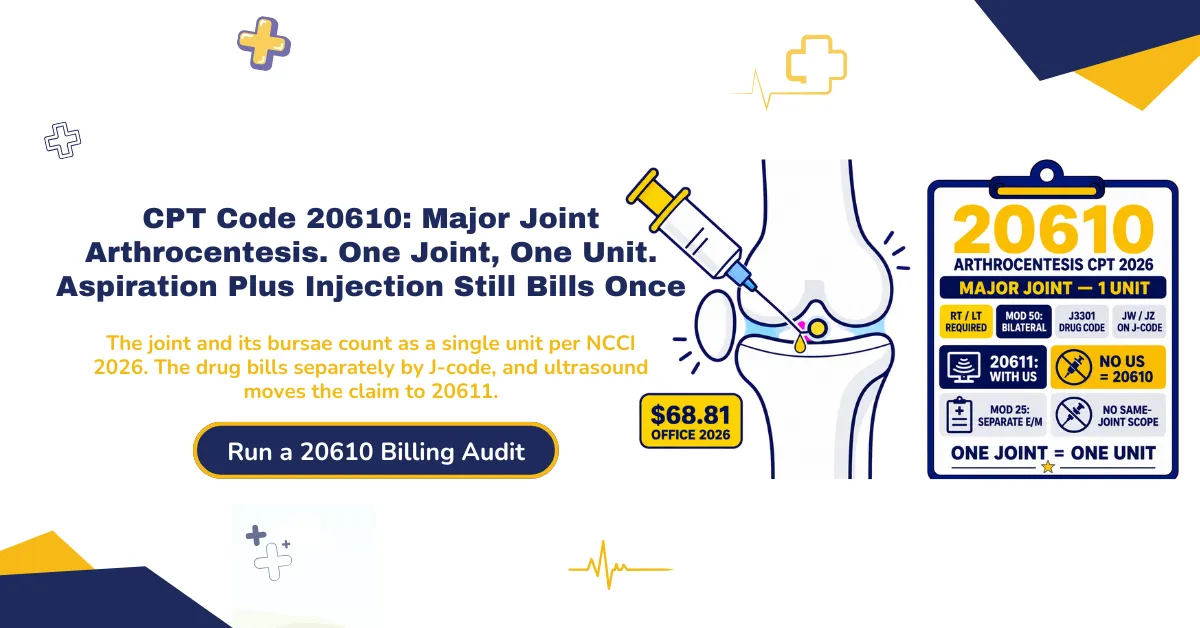
CPT 20610 covers aspiration and injection of major joints including the knee, shoulder, hip, and ankle, making it the highest-volume injection code in orthopedic billing. The code requires explicit documentation of laterality (left vs. right) and the specific joint treated to establish medical necessity. Claims submitted without laterality consistently draw modifier 59 denials on same-day bilateral injections. The treating physician is the only person who can capture that specificity in real time; a coder cannot supply it afterward.
There is a related eligibility problem that compounds the billing exposure: providers routinely struggle to determine patient responsibility at the CPT code level for common procedures like knee injections, because eligibility tools typically return only service-type level benefits rather than clean CPT-level data. A front desk that cannot tell a patient what a 20610 injection will cost at the time of scheduling generates surprise balances, delayed collections, and patient friction, none of which a modifier corrects after the fact. Accurate, CPT-level documentation is the upstream input that makes downstream eligibility and collections decisions possible.
iScribe Health's Real-Time Denial Alerts flag laterality and specificity gaps before a claim leaves the practice, so the that same figure documentation problem surfaces at note completion rather than at remittance.
4. 73721 vs. 73718 - MRI Knee vs. MRI Lower Extremity, a Frequently Confused Imaging Code Pair

These two codes are among the most commonly confused in orthopedic imaging orders. CPT 73721 applies when the MRI study is focused specifically on a joint such as the knee; CPT 73718 applies to non-joint soft tissue or bone studies of the lower extremity. Billing 73718 when the study is a knee MRI is a misrepresentation that payers flag on audit. The distinction lives in the imaging order and the clinical note, not in the radiology report alone. Consistent MDM documentation, capturing why the specific study was ordered and what anatomy was implicated, gives the ordering note the specificity that distinguishes that same figure from 73718 at the point of audit, not after.
5. Fracture Care and Injection/Aspiration Code Families - Global Period Traps and Bundling Rules
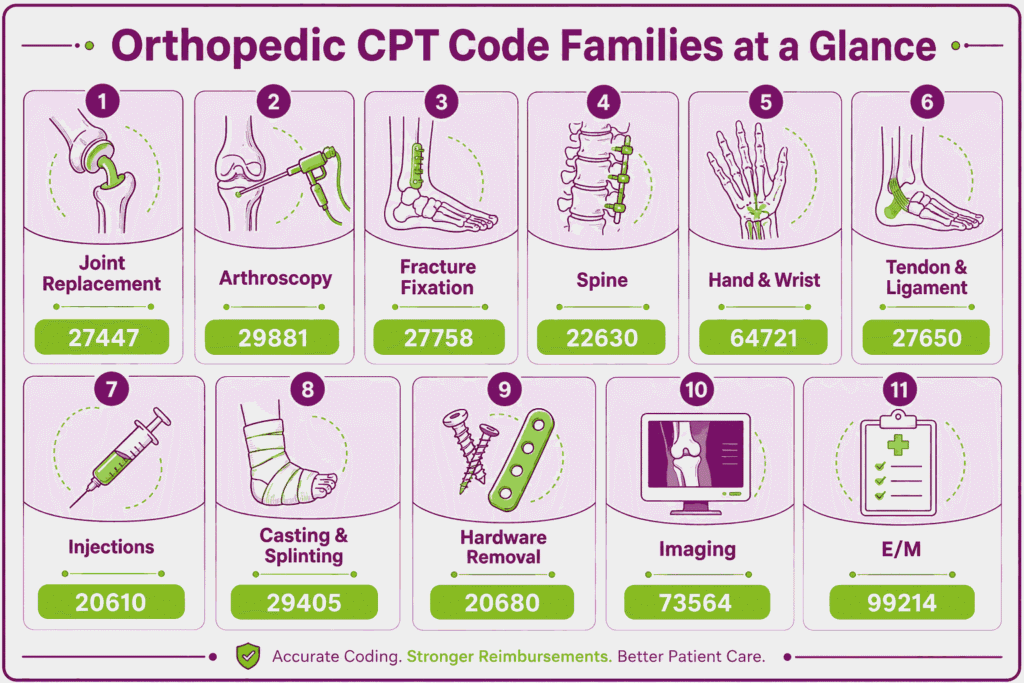
Fracture care codes carry 90-day global periods, meaning routine E&M visits and injection codes billed within that window without the correct modifier trigger automatic bundling denials. The knowledge problem here is upstream of the coding desk: if the clinical note does not document that the service was separately identifiable, no modifier will make the claim defensible on appeal. Code-level accuracy depends on documentation specificity established at the time of the visit, a standard that retroactive note completion makes structurally difficult to meet.
iScribe Health's ambient AI documentation captures the clinical rationale for each service as the visit unfolds, embedding that specificity into the encounter record before the note is finalized. Real-Time Denial Alerts flag global period conflicts against the claim before submission, so the modifier decision happens with full clinical context rather than as a defensive guess at the billing desk. Documented clinical specificity, captured in real time, is the sufficient condition for clean reimbursement.
---
E&M and injection codes represent the front door of orthopedic revenue, but the deeper exposure sits in surgical codes, where anatomical specificity and laterality distinctions can zero out a claim before it ever reaches adjudication. The next section maps the highest-volume orthopedic surgical CPT codes by body region so you have the right code before the note is finalized.
Related Reading
- Orthopedic CPT Codes
- Cpt Code 20610
- Cpt Code 20552
Orthopedic Surgery CPT Codes by Body Region
Surgical codes don't fail at the code level. They fail at the operative note level, one undocumented detail at a time.
Surgical codes don't fail at the code level. They fail at the operative note level, one undocumented detail at a time.
A billing team that knows CPT 27695 covers single ankle ligament repair and CPT 27698 covers multiple or secondary ligament repairs still can't bill 27698 correctly if the surgeon's dictated note doesn't explicitly state how many ligaments were repaired and whether the procedure was a revision. The code exists. The reimbursement doesn't, because the documentation behind it doesn't hold up. That gap, replicated across every body region below, is where orthopedic revenue quietly drains. Ensuring accurate, compliant medical coding across high patient volumes to maximize reimbursement and minimize claim denials is exactly the problem iScribe Health's ambient AI documentation is built to solve, capturing procedure-level detail in real time so the operative note already contains the specifics a coder needs before a claim is ever built.
The table below maps high-volume surgical CPT codes by anatomical region. Use it as a reference, then read the compliance note under each heading, because the note is where the money actually lives.
Region: Knee
- CPT Code: 27447
- Procedure: Total knee arthroplasty
- Key Documentation Requirement: Implant type, fixation method, laterality
- CPT Code: 29881
- Procedure: Arthroscopy with meniscectomy
- Key Documentation Requirement: Compartment (medial/lateral), side
CPT Code: 29888
- Procedure: ACL reconstruction
- Key Documentation Requirement: Graft source, fixation detail
- CPT Code: 29877
- Procedure: Chondroplasty
- Key Documentation Requirement: Cannot be billed with other knee scopes without distinct documentation and modifier
Region: Hip
- CPT Code: 27130
- Procedure: Total hip arthroplasty
- Key Documentation Requirement: Approach, implant, laterality
- CPT Code: 27236
- Procedure: Femoral neck fracture ORIF
- Key Documentation Requirement: Fracture classification, fixation method
Region: Shoulder
- CPT Code: 29827
- Procedure: Arthroscopic rotator cuff repair
- Key Documentation Requirement: Tendon(s) repaired, instrumentation used
- CPT Code: 23472
- Procedure: Total shoulder arthroplasty
- Key Documentation Requirement: End-stage arthritis diagnosis, implant type
- CPT Code: 29826
- Procedure: Subacromial decompression
- Key Documentation Requirement: Partial vs. complete resection must be specified; separate from 29827 without modifier 59 and supporting operative note language confirming a distinct, independently indicated procedure.
Region: Spine
- CPT Code: 22551
- Procedure: Anterior cervical discectomy and fusion
- Key Documentation Requirement: Level(s) treated; add-on 22552 for each additional level
- CPT Code: 22633
- Procedure: Posterior lumbar interbody fusion
- Key Documentation Requirement: Level, approach confirmation
- CPT Code: 22513
- Procedure: Vertebroplasty/kyphoplasty
- Key Documentation Requirement: Vertebral level, cement volume
Region: Hand/Wrist
- CPT Code: 64721
- Procedure: Carpal tunnel release
- Key Documentation Requirement: Diagnosis confirmation, laterality
- CPT Code: 25607
- Procedure: Distal radius fracture ORIF
- Key Documentation Requirement: Open treatment confirmation, fixation detail
1. Knee Orthopedic CPT Codes - 27447, 29881, 29888, and the 27695/27698 Distinction
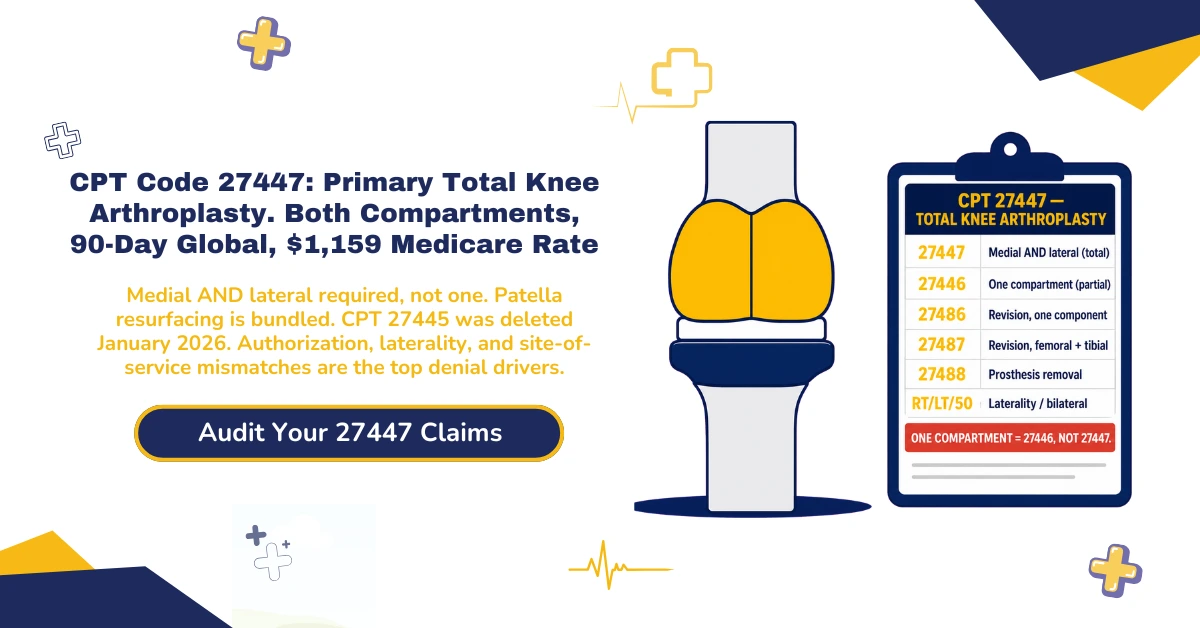
CPT 27447 (total knee arthroplasty) is among the highest-volume orthopedic billing codes nationally. 7 million hip and knee arthroplasties across 1,447 institutions, making accurate knee coding the single highest audit-exposure category in orthopedic surgery. At that scale, documentation gaps compound into significant revenue exposure across a full billing cycle.
CPT 29881 requires the operative note to specify the compartment (medial or lateral) and side; missing either detail triggers automatic bundling questions. The 27695/27698 distinction is the most frequently misassigned ankle code in the knee/lower extremity group: 27695 covers single ligament repair, 27698 covers multiple or secondary repairs, and billing 27698 without an explicit ligament count in the note is a documented audit trigger.
2. Hip Orthopedic CPT Codes - 27130 Total Hip Arthroplasty and 27236 Femoral Neck Fracture ORIF
CPT 27130 (total hip arthroplasty) and CPT 27236 (open treatment of femoral neck fracture) represent opposite ends of the hip coding spectrum: elective joint replacement versus acute fracture care. Both share the same documentation vulnerability. Payers require that the ICD-10 diagnosis code medically support the CPT billed, and laterality errors or missing episode-of-care characters cause automatic denial regardless of CPT accuracy. For 27236, the fixation method must appear explicitly in the operative note; a note that omits fixation detail is insufficient.
The AJRR that same figure Annual Report documents the scale at which hip procedures are performed across the registry's 1,447 participating institutions. At that volume, laterality errors and missing fixation language are systematic revenue leaks. AAHKS further underscores the payer scrutiny on hip replacement outcomes data flowing to CMS, which means documentation quality at the operative note level carries direct reimbursement consequences.
3. Shoulder Orthopedic CPT Codes - 29827, 23472, and 29826 for Arthroscopic and Arthroplasty Procedures
CPT 29827 (arthroscopic rotator cuff repair) requires the operative note to identify which tendon(s) were repaired and what instrumentation was used; a generic "rotator cuff repaired" entry will not support the code under audit. The highest compliance risk in shoulder coding is the 29826/29827 pairing. Payers routinely bundle CPT 29826 (subacromial decompression) into 29827 unless modifier 59 is applied with clear documentation that the decompression was a distinct, separately indicated procedure. Without that operative note language, the that same figure payment disappears entirely. CPT 23472 (total shoulder arthroplasty) is appropriate for end-stage arthritis and requires implant type and diagnosis specificity to survive a medical necessity review.
This is the documentation pattern that collapses under post-case time pressure. Surgeons completing notes after a full OR day regularly omit the tendon-by-tendon specificity and the distinct-procedure language that distinguishes that same figure from 29827. iScribe Health's ambient AI documentation captures these distinctions in real time during the case, and the EHR integration surfaces them in the drafted note at the point of completion, so the physician confirms rather than reconstructs.
4. Spine Orthopedic CPT Codes - 22551, 22633, and 22513 for Fusion and Vertebral Augmentation
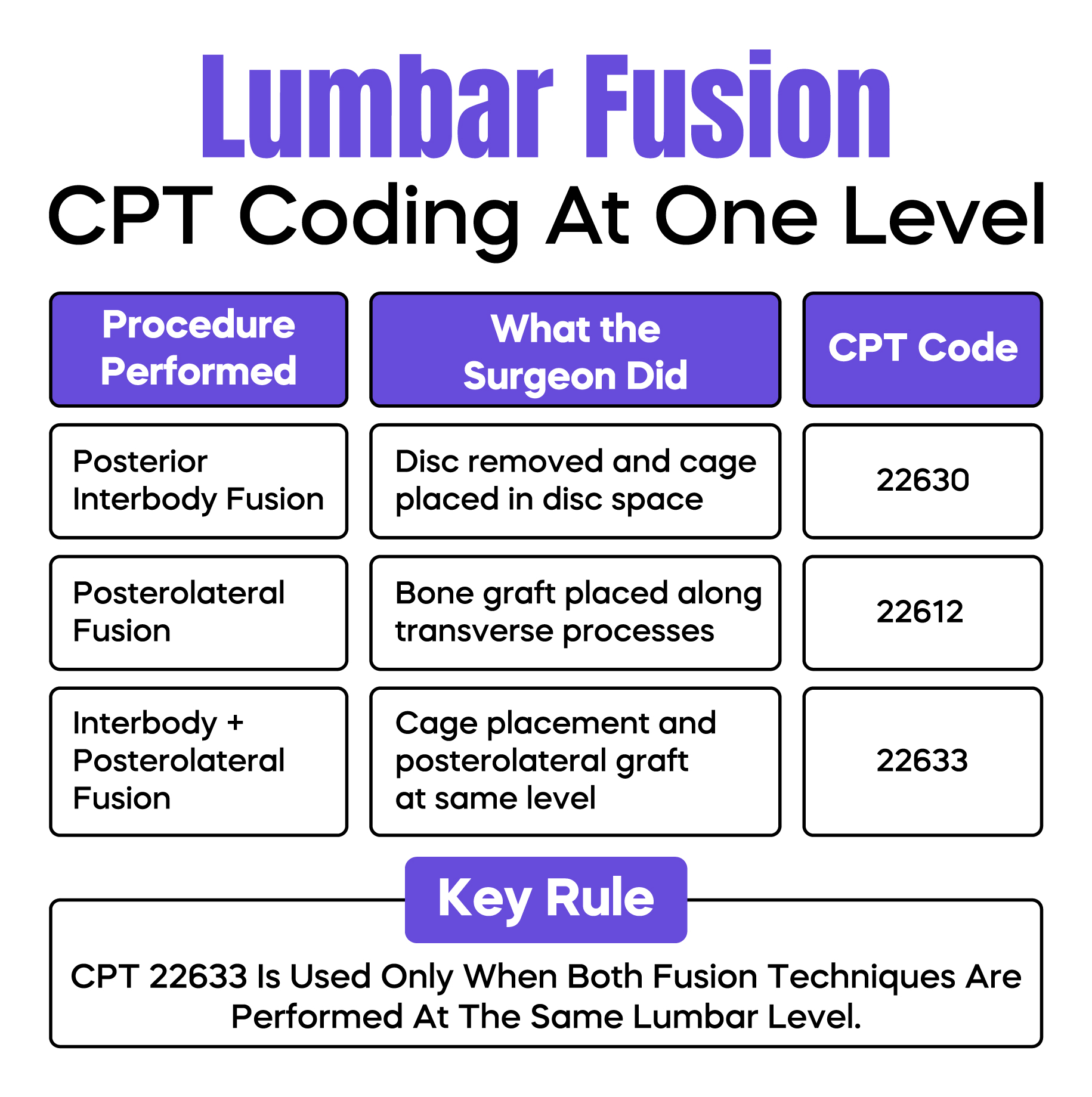
CPT 22551 (anterior cervical discectomy and fusion, ACDF) is the primary spine fusion code, and undercoding here follows a predictable pattern: the add-on code 22552, required for each additional level treated, is frequently omitted when operative notes don't clearly enumerate every level addressed. A two-level ACDF billed as a single-level procedure is a direct revenue loss that no code update corrects. CPT 22633 covers posterior lumbar interbody fusion and requires explicit approach confirmation in the note. CPT 22513 covers vertebroplasty and kyphoplasty; the vertebral level and cement volume must be documented to distinguish it from observation-only intervention.
For high-volume spine practices, where clinicians are routinely charting two or more hours outside of patient care time, the risk of level omissions compounds across every case. iScribe Health's ambient AI documentation is most impactful in exactly these environments: every level addressed is captured conversationally during the procedure, and the AI-drafted note enumerates each one before the claim is built, so the add-on code opportunity is never silently left on the table.
5. Hand and Wrist Orthopedic CPT Codes - 64721 Carpal Tunnel Release and 25607 Distal Radius Fracture ORIF
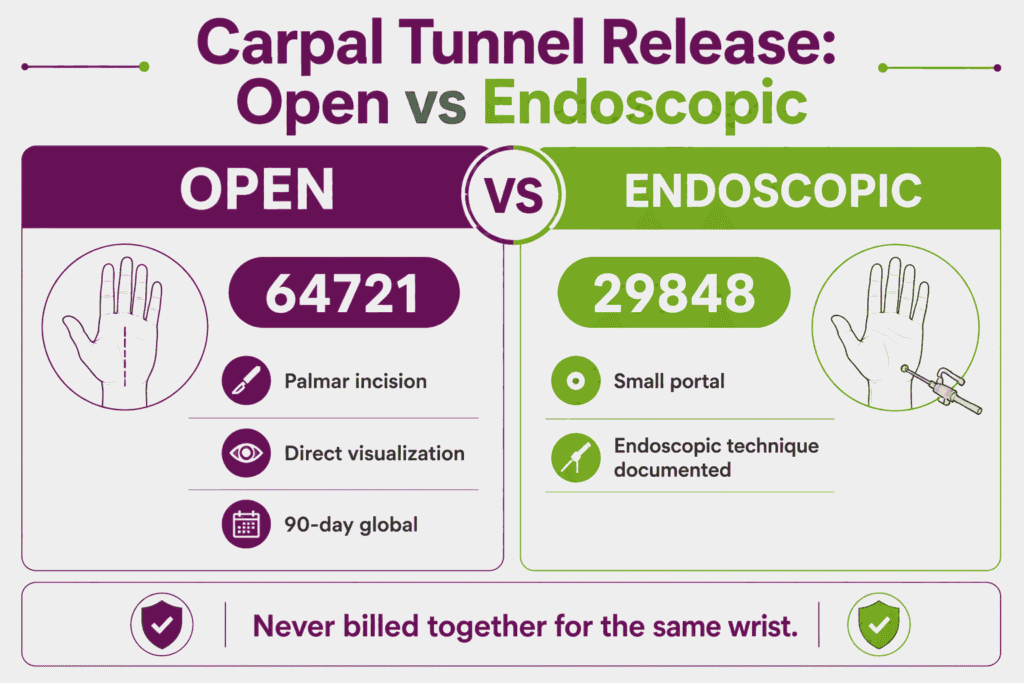
CPT 64721 (carpal tunnel release) is one of the highest-volume orthopedic surgical codes, making hand and wrist billing a frequent elective-procedure audit target. Laterality is the most common deficiency: billing 64721 without specifying left or right in the operative note creates a clean denial. CPT 25607 (open treatment of distal radius fracture with internal fixation) requires the note to confirm open treatment explicitly; a note that describes the fracture but defaults to vague language about "fixation" without confirming open approach can be downcoded to a closed treatment code, which reimburses significantly less.
These are high-frequency, lower-complexity cases where documentation shortcuts are most tempting and most costly.
6. Orthopedic Surgery CPT Codes - Overview of Cross-Regional Coding Principles and Compliance Risks

The single greatest risk factor across all orthopedic surgical codes is documentation capture. Most practices assume their surgeons' dictated notes contain the operative specifics that distinguish that same figure from 27698, or confirm that 29826 was a truly separate procedure from 29827. Under post-case time pressure, those critical distinctions are exactly what gets omitted.
The AJRR that same figure Annual Report tracks over 3.7 million hip and knee arthroplasties across 1,447 institutions, a scale at which documentation deficiencies across a billing cycle represent substantial revenue exposure. Ensuring accurate, compliant medical coding across high patient volumes to maximize reimbursement and minimize claim denials requires that the documentation infrastructure matches the procedure volume.
The AI drafts the encounter summary at the point of note completion, so the ligament count, approach confirmation, fixation method, and tendon-by-tendon repair detail are already present when the physician reviews the note. Real-time denial alerts surface documentation gaps before claims go out, not after they come back rejected. This is most valuable in high-volume practices or health systems where clinicians regularly chart two or more hours outside of patient care time, because that is when the gap between what happened in the OR and what appears in the note is widest, and where revenue quietly drains one undocumented detail at a time.
Having the right surgical code for each body region is table stakes. Every code in this section lives inside a global period and may require a modifier before the payer will process it at all. The next section breaks down exactly which modifiers apply to these surgical codes, what global period rules mean for post-op billing, and what happens to revenue when either is applied incorrectly.
Billing Modifiers and Global Periods Every Orthopedic Coder Must Know
Attaching a modifier to an orthopedic claim is not a clerical shortcut. Under Centers for Medicare & Medicaid Services program integrity rules, every modifier submitted on a claim represents to the payer that the clinical documentation explicitly supports a specific condition, a standard CMS has enforced through its Supplemental Medical Review Contractor program and routine post-payment audit cycles. Payers audit modifier-flagged claims at elevated rates precisely because the documentation often does not back the claim up. For orthopedic coders, that gap between what the modifier asserts and what the note actually says is where denials are born, and where the revenue cycle begins to erode quietly, one remittance line at a time.
"Medical billing and coding students struggle to understand when and why Modifier 25 applies, particularly in orthopedic clinic scenarios involving same-day, multi-service visits."
— what we hear from medical billing and coding students
1. Modifier 59 - Distinct Procedural Service That Overrides Bundling Edits
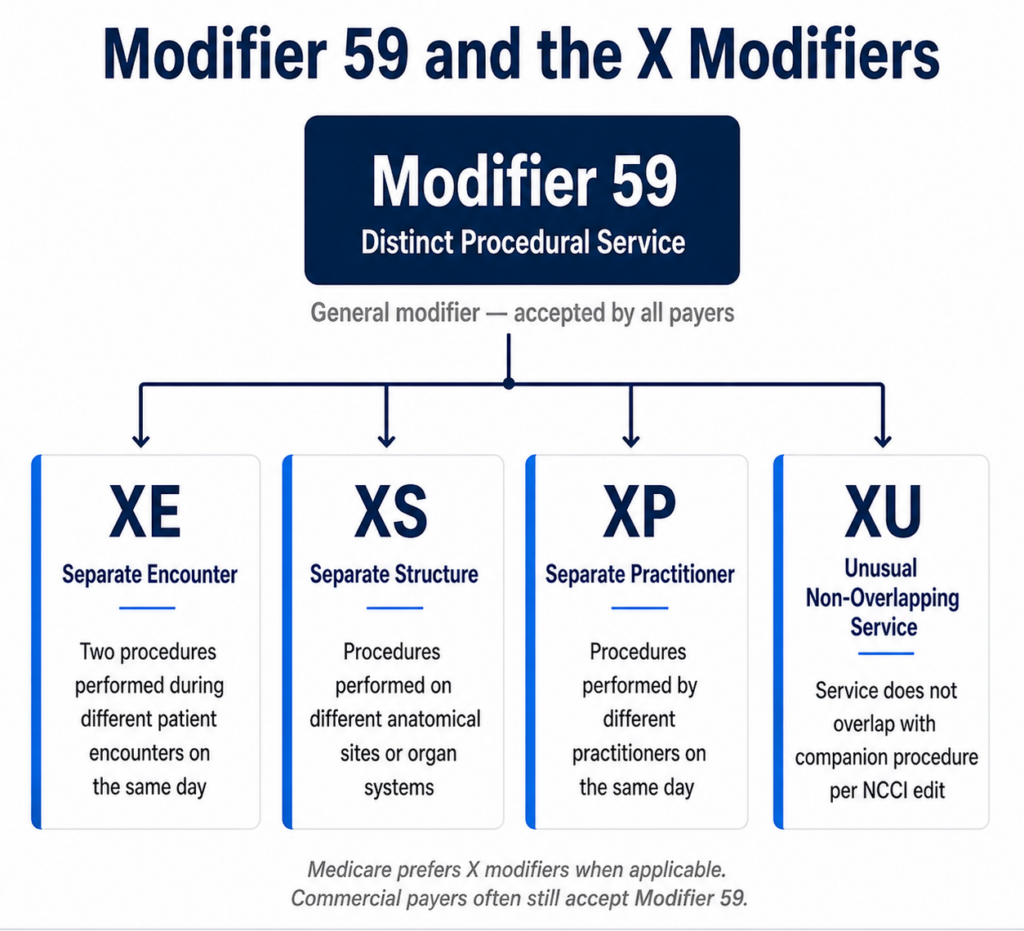
Modifier 59 tells the payer that two procedures performed on the same date were genuinely distinct and not subject to NCCI bundling edits. The documentation must identify a separate anatomical site, a separate session, or a clinically independent service. Without that explicit language in the note, the modifier is a liability. Billers who append it routinely to override edits, without corresponding note specificity, are flagging their own claims for review.
The core difficulty is that the granular clinical detail needed to defend modifier 59, the distinct site, the separate clinical rationale, must first exist in the encounter or operative note before it can be carried into the claim. When documentation is captured under pressure during peak census periods, that specificity is what gets compressed or omitted. iScribe Health's ambient AI documentation is designed precisely for that environment: it captures the clinical narrative in real time during the encounter, so the note already contains the modifier-supporting language before the claim is ever built, without adding charting burden to the care team.
2. LT/RT Laterality Modifiers - Preventing Automatic Denials on Bilateral Orthopedic Claims
Extremity codes require laterality. Omitting LT or RT on a unilateral procedure such as a knee arthroscopy or shoulder injection is one of the fastest paths to an automatic denial, because the payer cannot determine which side was treated. The fix is straightforward in theory, but in practice the omission rate stays high because laterality is documented in the operative note and not always transferred cleanly into the claim build. The note is the source of truth; the modifier only reflects it.
iScribe Health's EHR integration closes that transfer gap. Because the ambient documentation flows directly into the supported EHR at the point of note completion, after the AI drafts the encounter summary, the laterality language documented by the provider is already structured within the clinical record before the billing team touches the claim. That removes one of the most common points at which side-specific detail gets lost in translation between the clinical and revenue cycle teams.
3. Modifier 51 and 22 - Multiple Procedures and Increased Complexity Require Airtight Documentation
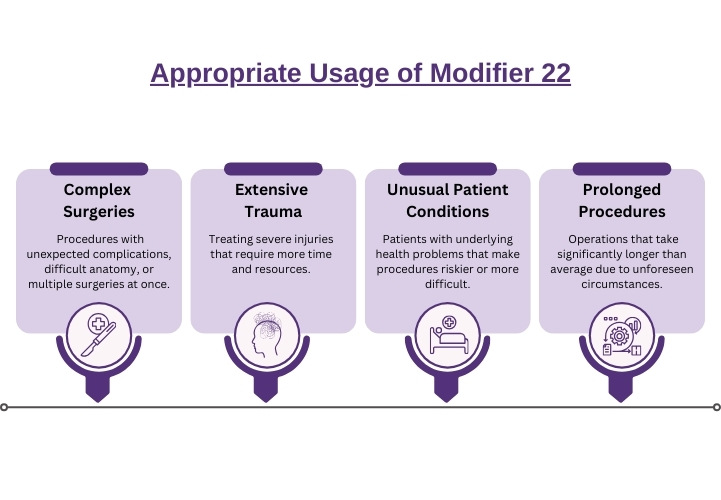
Modifier 51 signals multiple procedures performed in the same operative session, triggering payer-applied reductions on secondary codes. Modifier 22 is reserved for cases where the work substantially exceeded what the base CPT code describes, unusual complexity, extended operative time, or significant additional effort. The critical limitation for modifier 22 is that attaching it without operative note language explicitly describing the additional work performed is a direct audit flag and a common orthopedic billing error.
4. Modifier 25 - Billing a Significant Separate E&M on the Same Day as an Orthopedic Procedure
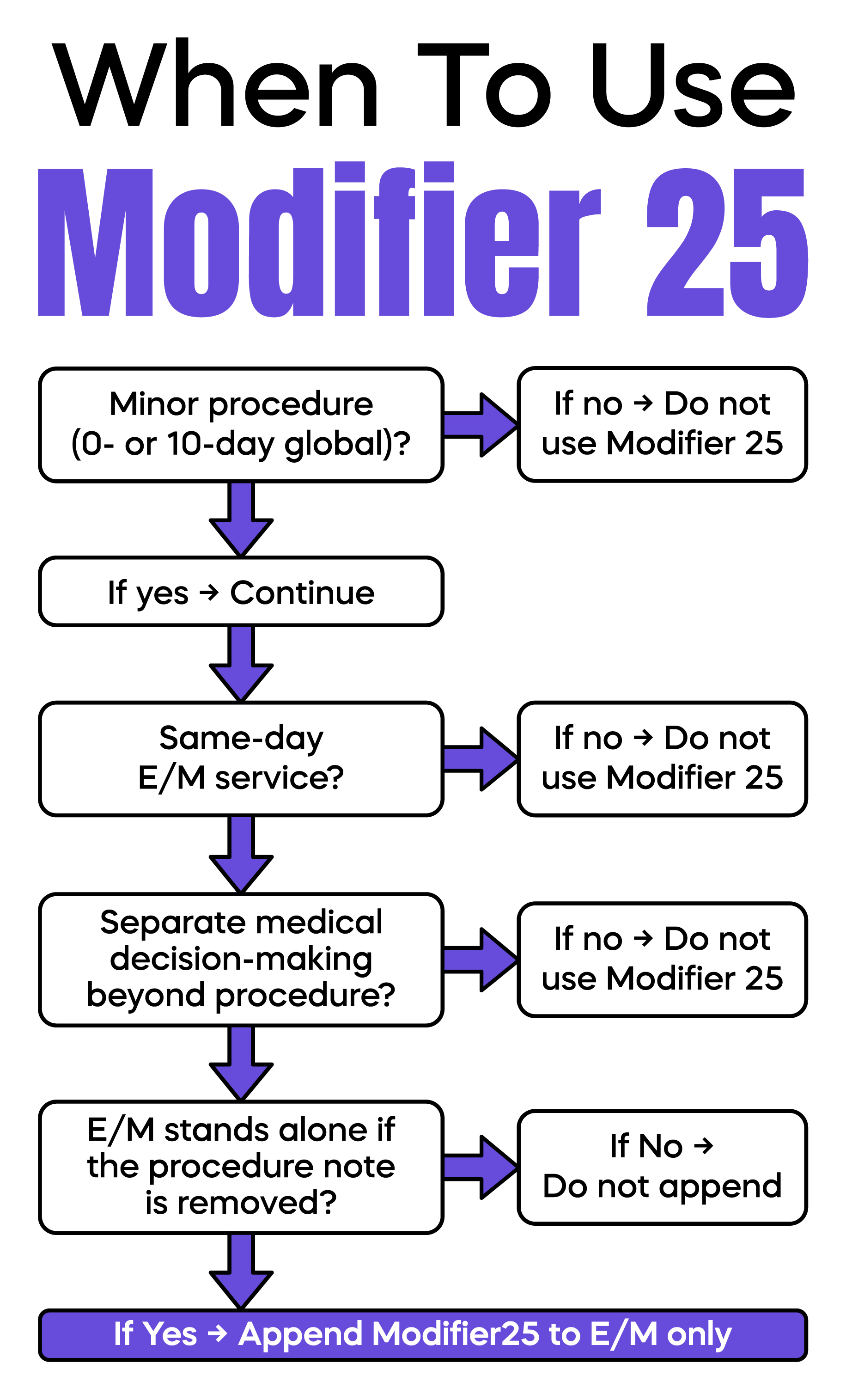
Billing 99213-25 alongside a 20610 injection requires the E&M to document a separately identifiable, significant service, one that stands apart from the pre-service work bundled into the procedure itself. The documentation must make that separation explicit. A note that flows from history directly into the injection without a distinct clinical decision-making section gives the payer grounds to bundle and deny the E&M. A missing or unsupported modifier 25 turns a payable E&M into a bundled zero.
This is one of the most consistently misunderstood modifier scenarios for coders newer to orthopedic billing. Same-day, multi-service orthopedic visits, a follow-up evaluation followed immediately by a joint injection, routinely produce notes that blend the E&M and procedural elements together, leaving no visible documentation boundary for the payer to recognize. Optimize by The Provider Partner identifies this documentation blending as a primary driver of modifier errors across orthopedic practices.
iScribe Health's E&M Coding Intelligence and Automated E&M Coding address this at the source. At the point of note completion, the system identifies whether the clinical content captured supports a separately identifiable E&M service and surfaces that distinction, so the separation modifier 25 requires is reflected in the note structure before the claim is coded, not identified for the first time during a post-payment audit. For practices where same-day injection visits are high-volume, this is a structural change in how documentation quality is maintained across every encounter.
5. Global Periods and Injection Codes - The Highest-Risk Zone for Modifier Misuse in Orthopedic Billing
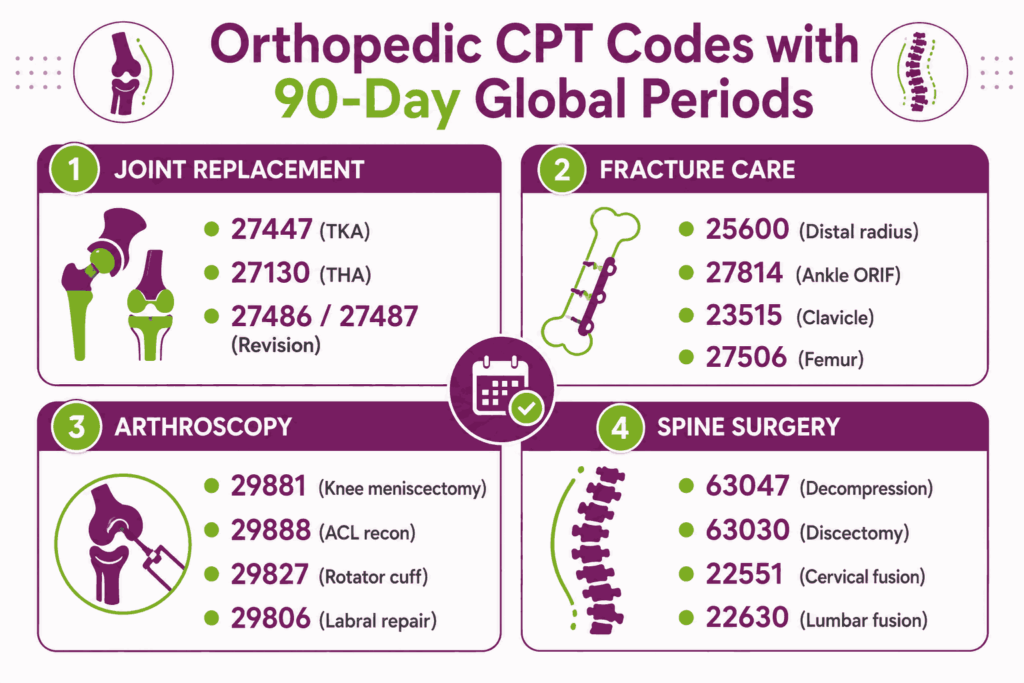
A 90-day global period bundles all related services into the surgical payment. Centers for Medicare & Medicaid Services payment policy is clear: billing a joint injection or aspiration inside an active global window without modifier 24 (unrelated E&M) or modifier 79 (unrelated procedure) triggers automatic denial. The confusion is real and persistent. A patient in the global period of a right knee ORIF who presents with a left knee effusion still needs the correct modifier combination (79-LT) applied accurately, and the note must document that the service was unrelated to the original surgical site.
What makes this zone particularly difficult is that payer-specific modifier logic is inconsistent. Orthopedic coders regularly encounter N822 and N823 denial codes on claims where they applied what they believed was the correct modifier, only to discover that payer-level edits interpret global period relationships differently than the CMS baseline policy. Applying 79-LT correctly at the claim level is insufficient if the underlying note does not clearly establish that the service involved a distinct anatomical site and an independent clinical rationale. The documentation must do the work the modifier can only signal.
iScribe Health's Real-Time Denial Alerts surface global period conflicts as they emerge, flagging encounters where the documented service intersects with an active global period so the care team and billing staff can verify modifier accuracy and note sufficiency before submission, not after a denial has already been issued. When integrated with a supported EHR, these alerts operate across every patient encounter, making global period oversight a continuous workflow function rather than a periodic audit event.
---
The pattern across all five of these modifiers is the same: the modifier is only as defensible as the note written at the time of the encounter. Most practices address this by training coders on modifier rules, which is necessary but incomplete. Modifier misuse is a documentation timing problem. The surgeon's operative note, the provider's encounter note, the specificity of the clinical narrative captured in real time, those are what determine whether any modifier survives audit.
A practice that trains coders while leaving intraoperative and encounter documentation habits unchanged has fixed the symptom and left the cause intact. iScribe Health's ambient AI documentation captures the granular clinical detail during the encounter itself, so the note already contains the modifier-supporting language before the claim is ever built. And because the system is designed to streamline clinical workflows, maintaining documentation quality even during peak census periods, the care team does not have to choose between seeing the next patient and charting the last one with the specificity that revenue integrity requires.
Getting the modifier right protects the claim. But the modifier only works if the diagnosis code underneath it is equally precise. The next layer of orthopedic billing risk lives in ICD-10 selection, where a single missing laterality character or the wrong episode qualifier can unravel a correctly coded CPT claim entirely.
Related Reading
- Cpt Code 29881
- Cpt Code 29827
- Cpt Code 20550
ICD-5 Codes Orthopedic Practices Get Wrong Most Often
The common assumption among practice administrators and billing decision-makers is that arming coders with the correct CPT code list and keeping up with annual code updates is sufficient to protect revenue; the cheat sheet is the solution. But a substantial share of orthopedic claims that reach payer edits fail not because the CPT code is wrong, but because the ICD-10 code attached to it is missing a single character. According to the SPRY Orthopedic Billing Guide 2026, errors in laterality, anatomical specificity, and episode-of-care designators are among the most common causes of claim denials in orthopedic practices, and every one of those errors traces back to a clinical fact that was never documented during the encounter.
In high-volume orthopedic practices, the environments where clinicians are routinely seeing packed schedules and spending two or more hours on after-hours documentation, this problem compounds daily. Every encounter that closes with a vague note is another denial waiting to arrive. iScribe Health's Ambient AI Documentation and Ambient Listening / Conversational AI are designed for that context: capturing clinical specificity in real time, at the only moment it exists, so the downstream coding chain has something accurate to work from.
1. M17.x Knee Osteoarthritis - Laterality Errors That Trigger Instant Denials
The M17.x family is the highest-volume knee diagnosis category in orthopedic billing, and it is also one of the most reliably denied when specificity is missing. Billing M17.9 (osteoarthritis of knee, unspecified) against a CPT code for a unilateral procedure, say a 29881 meniscectomy, creates an immediate crosswalk failure. Payers read that pairing as a diagnosis that does not medically justify a side-specific procedure. The correct code, M17.11 (primary osteoarthritis, right knee) or M17.12 (left knee), requires the provider to have documented laterality in the clinical note. If the note omits a specific side, the coder cannot manufacture one.
That is the structural problem. Coders working from finalized notes are not making a knowledge error when they default to unspecified codes. They are making the only honest choice available given what the documentation contains. In practices where clinicians are charting two or more hours outside of patient care time, often reconstructing encounters from memory at the end of a long day, laterality is precisely the kind of detail that erodes. iScribe Health's Ambient Listening captures it conversationally, in the room, before the encounter ends.
2. S72.x Femoral Fracture - Seventh-Character Episode-of-Care Mismatches
Femoral fracture codes carry a mandatory seventh character: A for initial encounter, D for subsequent encounter, S for sequela. The SPRY Orthopedic Billing Guide 2026 identifies a mismatch between the CPT code's implied episode and the ICD-10 seventh character as a top denial trigger in orthopedic fracture billing. A claim for an open reduction internal fixation (CPT 27236) paired with S72.001D, the subsequent-encounter suffix, signals to the payer that active surgical intervention is being billed for a follow-up visit. That contradiction triggers automatic rejection regardless of whether the procedure itself was performed correctly.
The seventh character is a clinical fact. It reflects where the patient is in their care episode, and that context exists only in the provider's real-time understanding of the case. When that understanding is documented live, through iScribe Health's ambient documentation rather than reconstructed hours later, the episode character embedded in the AI-drafted encounter summary reflects what the provider actually observed, not a best-guess fill-in made under end-of-day charting pressure.
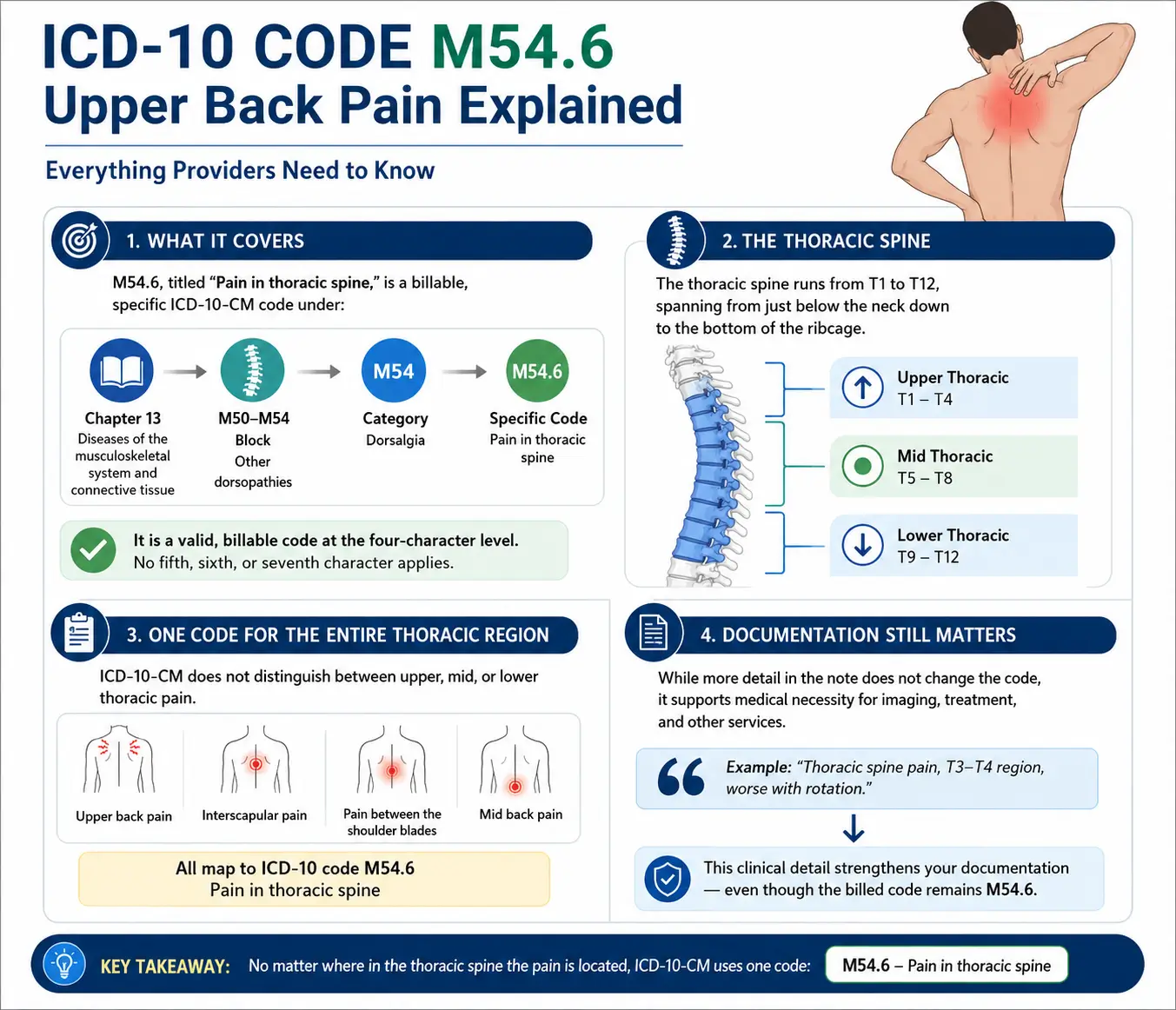
3. M54.x Back Pain - Unacceptable Vagueness in the CPT-to-ICD-10 Crosswalk

M54.5, low back pain, is one of the most overused codes in orthopedic billing. It is also one of the most dangerous to pair with surgical CPT codes. Payers treat nonspecific back pain diagnoses as insufficient medical necessity justification for procedures like lumbar fusion (CPT 22633) or vertebral augmentation (CPT 22513). RCM Experts identifies M54.x as a high-denial code family precisely because its subcategories are routinely under-specified in orthopedic claims. The more defensible codes, M51.16 (intervertebral disc degeneration, lumbar region) or M47.816 (spondylosis with radiculopathy, lumbar region), require documented clinical findings that a vague "back pain" note does not support.
The crosswalk between a surgical CPT and a nonspecific M54.x code is not a coder's mistake. It is a documentation gap, and it grows wider in proportion to how rushed or after-hours the charting process becomes. High-volume practices where clinicians are already stretched thin on documentation time are the settings where M54.x over-reliance is most entrenched, and where iScribe Health's Ambient AI Documentation is most impactful: it surfaces clinical specificity during the encounter, not after it.
4. M75.x Shoulder Lesions - Laterality and Completeness Errors on Rotator Cuff Claims
Billing CPT that same figure (arthroscopic rotator cuff repair) with M75.100 (unspecified rotator cuff syndrome, shoulder unspecified) is a textbook payer crosswalk failure. The correct code, M75.111 (complete rotator cuff tear, right shoulder) or M75.121 (left shoulder), requires the provider to have documented both the side and the tear completeness during the encounter. Completeness matters because partial and complete tears carry different surgical justifications. Without that distinction in the note, the coder faces an impossible choice: guess, or bill unspecified and accept the denial.
When a provider dictates laterality and tear characteristics in real time during the encounter, that clinical detail is locked into the AI-drafted note before anyone touches a claim. The specificity that determines M75.111 versus M75.100 is captured at the only moment it can be captured accurately, inside the room, during the visit. For practices running iScribe Health on a supported EHR, that drafted note flows directly into the existing workflow through EHR Integration, so the specificity exists where the coder and the billing team can act on it. The downstream result is faster claim adjudication and cleaner first-pass submission that supports the goal of getting paid faster.
5. A/D/S Episode Characters Across All Fracture Families - The Systemic Mismatch Denial
The A/D/S seventh-character problem runs across every fracture family in ICD-10, including S52.x (radius and ulna), S82.x (tibia and fibula), and S92.x (foot). The SPRY Orthopedic Billing Guide that same figure confirms that fracture care CPT codes must be paired with the ICD-10 seventh character that reflects the correct episode of care, and that a mismatch is a top denial trigger across the category. Practices that apply episode characters inconsistently, sometimes based on the visit type rather than the documented clinical stage, generate a pattern of denials that looks random but is entirely predictable once the root cause is identified.
That root cause is upstream. In high-volume practices where clinicians regularly chart two or more hours outside of patient care time, the clinical stage of a fracture patient is exactly the kind of contextual detail that does not survive the gap between the encounter and the late-night charting session. iScribe Health's Real-Time Denial Alerts surface the mismatch at the point of note completion, after the AI drafts the encounter summary, giving the provider a moment to correct the record before the claim is ever built, not weeks later when a denial lands in the queue.
Every error pattern in this section, the wrong laterality character, the mismatched episode suffix, the nonspecific back pain code propped against a surgical CPT, traces back to the same upstream failure point. The next section reveals why that failure keeps recurring even in practices where coders know exactly which codes to use.
Why Orthopedic Coding Mistakes Keep Happening Even When Coders Know the Codes
According to Practolytics' billing analysis, the Center for Sports Medicine & Orthopaedics in Chattanooga analyzed those 941 encounters and found provider-AI coding agreement reached only 54.8%, and nobody inside the building knew the split existed until they ran the trial. That gap points not to what coders know, but to what the documentation never gave them to work with.

Why Documentation Gaps Persist Even When Coders Know the Rules
As Practolytics noted in their analysis, coders work from finalized notes that have already lost the complexity of the original encounter: medical decision-making rationale, time spent, and procedure-specific detail are frequently absent by the time the coder opens the chart.
This is the structural problem orthopedic practices face and rarely name directly: the note is finalized, the provider has moved to the next room, and the clinical story is already fixed. iScribe Health's ambient AI documentation is designed to intervene at exactly that moment, capturing the encounter in real time through conversational AI, so that the AI-drafted note reflects the full complexity of what actually happened before the provider ever touches a keyboard.
At a glance
Coding Failure Type: Undercoded E&M visits
- Root Cause: Documentation ceiling, clinical complexity was real but not captured in the note
- Example in Orthopedic Billing: Complex polytrauma patient billed as that same figure instead of 99214/99215 because MDM detail absent from finalized note
- Who/What Can Catch It: Cannot be caught by denial reports, claims paid at wrong level without protest
- Revenue Impact: Silent revenue drain, encounter by encounter
Coding Failure Type: Modifier support failures
- Root Cause: Provider did not capture intraoperative complexity before signing the note
- Example in Orthopedic Billing: Rotator cuff repair note lacks documented unusual procedural difficulty, making modifier 22 unsupportable
- Who/What Can Catch It: Coder knows modifier 22 exists but cannot attach it without audit exposure
- Revenue Impact: Missed reimbursement and audit exposure if modifier attached without documentation
Coding Failure Type: ICD-10 specificity failures
- Root Cause: Clinical facts (laterality, episode of care, anatomical specificity) never recorded at point of encounter
- Example in Orthopedic Billing: Note documents only 'shoulder pain' rather than fully specified diagnosis with laterality and clinical context
- Who/What Can Catch It: Cannot be reconstructed by coder after the fact
- Revenue Impact: Persistent and systemic revenue drain in orthopedic billing
It simply was not documented, so the coder had no defensible basis to select 99214 or 99215. iScribe Health's E&M Coding Intelligence layer operates at the point of note completion, after the AI drafts the encounter summary, applying automated E&M coding logic to the captured documentation before the claim is ever assembled.
As Practolytics' analysis confirms, billing staff and providers operate from fundamentally different reference points, creating a systematic ceiling that no coder training can overcome.
As MaxRemind has documented, ICD-10 specificity failures represent a persistent and systemic revenue drain in orthopedic billing, one that originates not in the coding team but in the moment the encounter ends without the right details captured.
All three failure types share a single point of origin: the moment the encounter ends and the clinical story stops being recorded. iScribe Health's ambient AI documentation, built for physicians who want a completely hands-free documentation experience during the visit, integrated with EHR systems already in place, and active across every patient encounter and every day of clinical practice, changes what is available to the coder before they ever open the chart.
How Real-Time Documentation Capture Closes the Orthopedic Coding Gap

The Three Revenue Leaks That Start Before the Note Is Finalized
Revenue Leak: E&M level selection
- What Gets Lost: MDM complexity tier
- Downstream Impact: Downcoded claims that are not recoverable after the note is finalized
Revenue Leak: Modifier defensibility
- What Gets Lost: Intraoperative decisions supporting modifier 22
- Downstream Impact: Denied or stripped modifiers with no easy appeal path
Revenue Leak: ICD-10 laterality
- What Gets Lost: Left-versus-right anatomical specificity
- Downstream Impact: Payer rejections on laterality grounds
How Ambient AI Scribing Produces Code-Ready Documentation for Orthopedic CPT Claims
The hidden cost is real: every detail that doesn't make it into the note, whether it is the medical necessity rationale for a same-day injection or the specific anatomical site of a fracture, becomes a denial or a downcode that surfaces weeks later with no easy appeal path.
iScribe Health's AI medical scribe addresses this as an infrastructure problem rather than a physician behavior problem, capturing the full clinical narrative in real time so that code-ready detail is embedded in the note before it is ever signed.
From Fewer Denials to Higher First-Pass Resolution
That upstream leverage translates directly into measurable financial outcomes. First-pass resolution rate is a direct downstream output of documentation quality: errors captured upstream propagate into coding errors, rejections, and revenue loss that compounds across every payer.
Key takeaway: A 2% reduction in denial rate recovers $800K to $1.5M annually, and that recovery starts with what gets captured in the exam room, not what a coder can reconstruct afterward.
Related Reading
- Cpt Code 27130
- Cpt Code 27447
Next steps
If your orthopedic practice is still absorbing unexpected denials and take-backs despite trained coders and current CPT references, the path forward starts with recognizing that documentation captured during the encounter sets the ceiling on every code that follows. Start with our AI medical scribe.
The 33% overcoding rate found across 941 real orthopedic encounters was invisible to the practice until an AI-assisted audit surfaced it, which means the problem was never about coder knowledge. And the structural pattern across E&M undercoding, modifier 22 failures, and ICD-10 laterality rejections is consistent: the clinical detail needed to defend each code either exists in the note at the time of encounter or it is gone. Together, these two realities point to a single corrective action, capturing the full clinical narrative in real time, before the physician leaves the room, so the billing team has something defensible to work from.
Start with iScribe Health. The system listens during the encounter, drafts the note before the physician touches a keyboard, and runs E&M coding logic and pre-submission denial alerts against what was actually documented. Notes finish by end of clinic, not end of evening, and the clinical specificity that separates a payable 99214 from an undercoded 99213 is already in the chart when the coder opens it.
Frequently Asked Questions
Which CPT codes cover arthroscopy in orthopedic billing?
Arthroscopy codes fall within the 29870-29999 range of the musculoskeletal surgery block. Common examples from the post include CPT 29881 (arthroscopy with meniscectomy), CPT 29888 (ACL reconstruction), CPT 29827 (arthroscopic rotator cuff repair), and CPT 29826 (subacromial decompression), each with its own operative note documentation requirements to avoid bundling denials.
What is the difference between new patient and established patient office visit codes in orthopedics?
New patient orthopedic office visits bill under CPT 99202-99205, while established patient visits bill under CPT 99212-99215. The post notes that the established-patient range is where most orthopedic volume lives and where undercoding is most common, often because documentation doesn't fully capture the complexity of medical decision-making at the time of the visit.
How do I choose between MDM and time-based E&M coding for an orthopedic visit?
Since the 2021 AMA E&M overhaul, code level is driven by either the complexity of medical decision-making (MDM) documented in the clinical note or total time spent, the old history and physical exam bullet counts no longer apply. The post emphasizes that MDM must be documented at the time of the visit, not reconstructed afterward, because notes completed hours later tend to undersell the encounter and produce undercoded claims.
Why does a knee injection claim get denied when billed on the same day as an office visit?
Same-day bilateral injections billed under CPT 20610 without a modifier 59 consistently draw denials, particularly when laterality, left versus right, is not explicitly documented. The post also notes that claims billed within a fracture care code's 90-day global period without the correct modifier trigger automatic bundling denials, and no modifier makes a claim defensible on appeal if the clinical note doesn't document that the service was separately identifiable.
What documentation does CPT 20610 actually require?
CPT 20610 requires explicit documentation of laterality (left vs. right) and the specific joint treated, knee, shoulder, hip, or ankle, to establish medical necessity. The post makes clear that a coder cannot supply this specificity after the fact; only the treating physician can capture it in real time.