ENT CPT Codes: Mistakes to Avoid and Key Resources 2026
ENT CPT codes expose billing teams to wider denial risk. Spot the mistakes costing your practice revenue before they compound.


ENT practices touch four CPT code families in a single visit. Every documentation gap puts all of them at risk at once.
ENT billing sits at a crossroads that most specialties never encounter. A single clinic day can move from a straightforward office visit to a diagnostic nasal endoscopy, an audiology evaluation, and a surgical consult, each governed by different code families, different payer policies, and different documentation thresholds. That breadth is a structural revenue risk that compounds every time the clinical note falls short of what the code requires.
The common assumption is that this is a training problem. Hire sharper coders, run quarterly audits, and denial rates will fall. The data contradicts that assumption.

Most specialties operate within one or two CPT code families per encounter. ENT practices routinely touch four or more in a single session: office E/M, diagnostic endoscopies, audiology codes, and surgical procedure codes. Each family carries its own documentation requirements, modifier logic, and medical necessity standards. When a coder works from a note that captured the visit but not the complexity, every one of those code families becomes a potential undercoding event simultaneously.
A3 Medical Billing's benchmarking analysis makes the structural point clearly: denial root causes are embedded in each specialty's service model, not correctable by coder training alone. ENT faces eligibility and coding-conflict denials, plus procedure-specific bundling denials, bilateral modifier disputes, and prior authorization rejections on surgical codes. The surface area is wider, and wider means more exposure.
ENT's anatomy is bilateral by design. A practice that applies modifier 50 without verifying the specific payer's bilateral payment rule for that exact CPT code can face a partial or full denial even when the procedure was performed correctly and documented adequately. Bundling rules compound the exposure further: endoscopic sinus surgery codes carry NCCI edits that restrict which procedure combinations can be billed together, and when documentation does not clearly distinguish the medical necessity of each component, the claim becomes an unbundling audit target. According to The Medicator's (2026), certain major payers, including Molina Healthcare, UnitedHealthcare, Oscar Health, and Ambetter, reach denial rates that can exceed 30% for in-network claims, driven by systemic payer behavior rather than coding errors alone.
30%
Denial rates some major payers exceed on in-network claims
When documentation is captured manually under clinical pressure, the detail that justifies complex codes, laterality, method, findings, time spent, is exactly what gets dropped. That missing detail does not affect one claim; it degrades the defensibility of every code family the encounter touched. AI-powered scribing closes that capture gap at the point of care, before a missing detail becomes a denied claim.
The next section maps the specific E/M code families where that surface area translates into the most frequent and most costly billing errors ENT practices face every week.
Key takeaways
- ENT billing spans more code families in a single clinic day than most specialties see in a week, office visits, diagnostic endoscopy, audiology, and surgical consults each carry different payer rules and documentation thresholds.
- The revenue gap between a 99213 and a 99215 can exceed $80 per visit; the difference is almost never the coder's choice, it's what the clinical note captured before it ever reached the billing queue.
- Modifier errors don't surface during the encounter. They surface weeks later when a payer flags the claim and the note can no longer be amended without a formal addendum.
- ENT's highest-volume diagnostic codes are denied not because the CPT code is wrong, but because the note says a procedure was performed without documenting what was visualized, where, and by what method.
- Surgical write-offs in ENT trace back to notes that omit patient age, the specific sinuses addressed, or independent medical necessity, details the surgeon had to capture, not details the coder can reconstruct.
- When payers redesign code sets annually, as they did with auditory osseointegrated device codes in 2024, coder training alone can't prevent claim failures if the documentation doesn't reflect the new specificity requirements.
- Industry baseline data puts accurate E&M documentation at roughly 55%, meaning nearly half of visits are already undercoded before a coder touches the chart.
- iScribe Health's AI-powered ambient scribing captures the clinical detail, findings, laterality, medical necessity, procedure specifics, at the point of care, so the note that reaches the coder is already defensible.
ENT CPT Codes for Office Visits and E/M Services Most Practices Misapply
New patient office visits in ENT fall under CPT codes 99202-99205; established patient visits use 99212-99215. The code within each range is determined by medical decision-making (MDM) complexity or total time, not by how long the physician felt the visit lasted.

New vs. Established Patient ENT Visit Codes: 99202-99205 and 99212-99215
New patient visits (99202-99205) require that the provider has not seen the patient in the same specialty within three years. Established patient visits (99212-99215) apply to all return encounters. As For The Record Magazine has documented, code selection within each family is driven by MDM complexity across three elements:
- Number and nature of diagnoses or management options
- Amount and complexity of data reviewed
- Risk associated with the management plan
A follow-up for chronic sinusitis that involves reviewing prior imaging, weighing a prescription change, and considering surgical referral carries moderate MDM complexity. That is a 99214. Billing it as a 99213 because the note did not capture those elements is lost revenue tied directly to a documentation gap.
Why ENT Practices Systematically Land on 99213 When the Encounter Qualifies for 99214
The pattern is a documentation problem. When a physician finishes a busy clinic session and the clinical record does not reflect the number of diagnoses considered, the data reviewed, or the risk of the management plan, the coder has no path to 99214, leaving the practice to bill at a lower level for complexity that was genuinely delivered.
Key takeaway: E/M undercoding in ENT is a documentation capture failure. The gap is clinical effort that was never written down as a decision.
E/M undercoding in ENT is a documentation capture failure. The gap is not clinical effort; it is whether what the physician actually decided during the encounter was ever written down.
This is where iScribe Health's Ambient AI Documentation changes the math. iScribe Health uses Ambient Listening and Conversational AI to capture physician dialogue and patient context during the visit to generate clinical notes in under 30 seconds, so the complexity of the encounter is reflected in the record before the visit ends.
Critically, iScribe Health's E&M Coding Intelligence and Automated E&M Coding work from that ambient-captured note to improve coding consistency across providers and improve coding precision in a way that directly impacts revenue, by ensuring that complexity the physician already delivered is legible to the coder. Because iScribe Health integrates with the practice's existing EHR, this workflow materializes without disrupting the systems already in place.
How ICD-10 Diagnosis Specificity Either Defends or Destroys Your E/M Code Selection
A claim pairing a 99214 with an unspecified diagnosis code signals a mismatch to payers: the billed complexity implies multiple diagnoses or significant management risk, but the diagnosis code tells a simpler story, creating an inconsistency that invites denial or recoupment.
Without that alignment, the higher-level code is exposed, and iScribe Health's Real-Time Denial Alerts are designed to surface that exposure before the claim leaves the practice, giving coders and billers the opportunity to correct mismatches at the point of submission rather than after a denial.
Essential ENT Modifiers and When Each Should Be Used
Modifier errors surface at the worst possible moment: not during the encounter, not when the note is finalized, but weeks later when a payer flags a claim and the documentation can no longer be amended without a formal addendum. ENT coders often understand modifiers well enough; the clinical note simply never captured the evidence the modifier requires. That documentation gap hits hardest in high-volume ENT practices where clinicians routinely spend significant time charting outside of patient care hours, and where reconstructing granular clinical detail hours after a packed schedule is unreliable.
As Part B News (DecisionHealth) reports, OIG has launched a targeted review of same-day E/M services billed alongside minor procedures, because documentation routinely fails to demonstrate that the E/M was a distinct, separately identifiable service. Think of each modifier below as a documentation test. If the note cannot pass the test, the modifier cannot save the claim.
1. Modifier 25 - Billing a Separate E/M Service on the Same Day as a Minor ENT Procedure
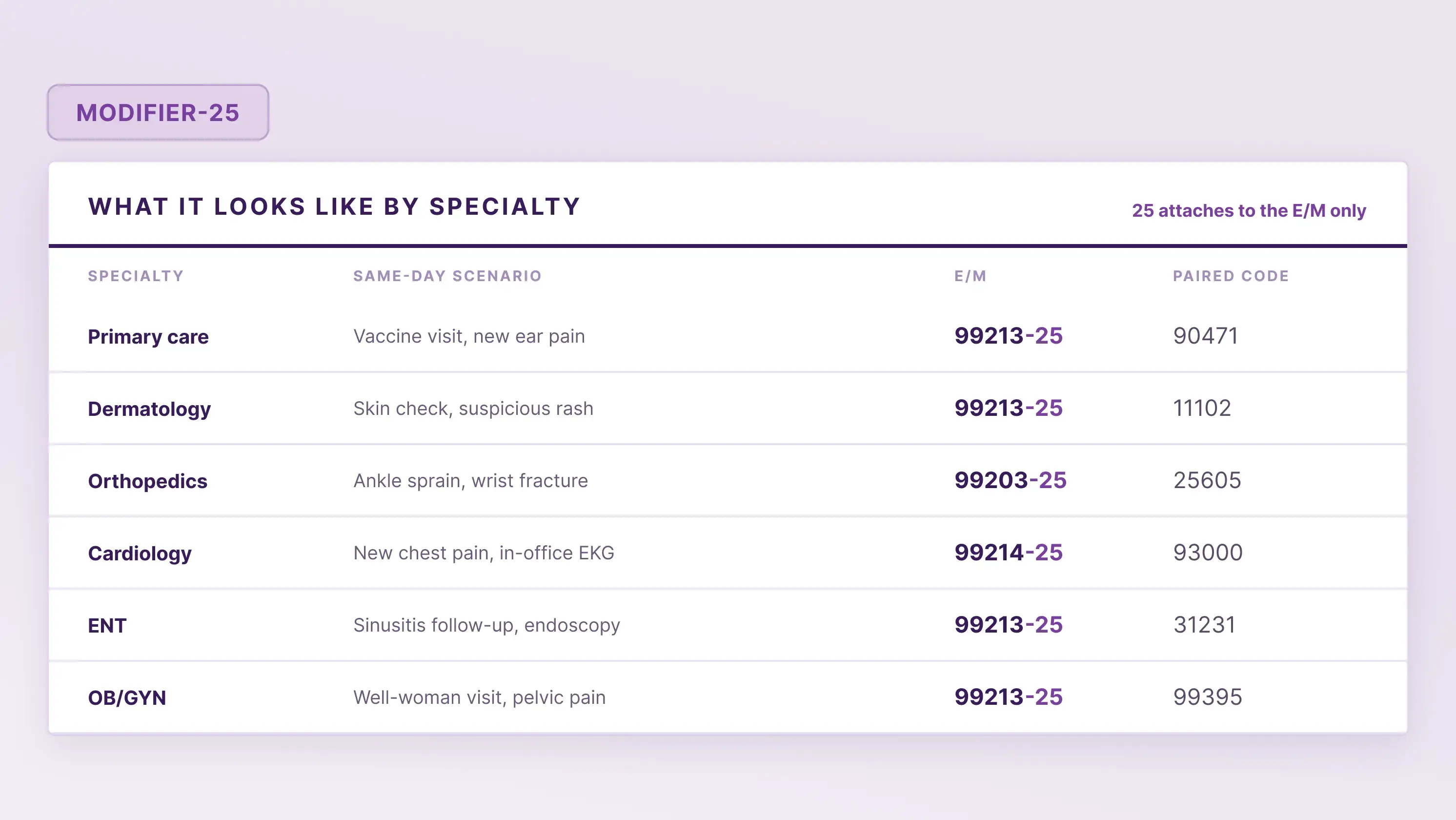
Modifier 25 permits billing a separate, significant E/M service on the same day as a minor procedure, but only when the note proves the visit was distinct from pre- and post-procedure care inherent to that procedure. The clinical trigger is a separately documented medical decision-making rationale, not a brief mention that the provider "also evaluated" the patient. ENT practices that dictate a single combined note for the visit and the procedure create an audit liability that no modifier choice can resolve retroactively.
This is precisely where ambient AI documentation changes the equation. iScribe Health's ambient listening captures the full physician-patient conversation in real time, including the distinct medical decision-making rationale that Modifier 25 demands, without requiring the physician to pause, dictate, or reconstruct detail after the encounter. For practices already running a supported EHR, iScribe integrates directly into that workflow, so the separately identifiable E/M reasoning lands in the note automatically, in the moment it is spoken, rather than being compressed into a post-visit summary that blurs the procedural and evaluative elements together.
OIG-compliant Modifier 25 documentation in 2026 requires that distinction to be explicit and contemporaneous, exactly what real-time capture is built to produce.
2. Modifier 50 - Reporting Bilateral ENT Procedures Performed in a Single Surgical Session

Modifier 50 signals that the same procedure was performed on paired structures, such as both ears or both maxillary sinuses, in a single surgical session. Medicare's standard bilateral reimbursement rate is 150% of the single-procedure allowable, but commercial payers vary: some pay 100% plus 50%, others require separate line items by RT and LT modifiers, and some apply their own bilateral reduction schedules. Appending Modifier 50 without first verifying the payer's bilateral policy for that specific CPT code is one of the most common and preventable ENT billing errors.
iScribe Health's real-time denial alerts flag payer-specific bilateral policy conflicts at the point of note completion, after the AI drafts the encounter summary but before the claim is submitted, giving the care team an opportunity to resolve the discrepancy while the clinical context is still fresh. This is most impactful in high-volume practices where a single provider may perform bilateral procedures across dozens of encounters in a day and cannot manually cross-reference each payer's bilateral reduction schedule for every CPT code.
3. RT and LT Modifiers - Specifying Right or Left Side for Unilateral ENT Procedures

RT (right) and LT (left) modifiers are required for unilateral procedures on anatomically paired ENT structures: ears, sinuses, nasal passages, and tonsils when applicable. Omitting laterality on codes that demand it triggers automatic claim rejection at many payers, not a request for additional documentation. The clinical note must specify the operative side before the claim is built. A note that reads "nasal endoscopy performed" without naming the side gives the coder nothing defensible to work with.
When a physician describes work on the right maxillary sinus, that specificity is documented in the AI-drafted note in real time, rather than reconstructed from memory at end of day. Practices where clinicians deliver a completely hands-free documentation experience see the greatest benefit here: the physician focuses entirely on the procedure and the patient, while the ambient AI records the clinical specifics that RT and LT modifiers legally require.
4. Modifier 59 and X-Modifiers (XS, XE, XP, XU) - Defending Distinct Procedural Services Against Bundling Edits
Modifier 59 establishes that two same-day procedures are clinically distinct and not subject to bundling under CCI edits. CMS now prefers the more specific X-modifier subsets, XS (separate structure), XE (separate encounter), XP (separate practitioner), and XU (unusual non-overlapping service), because each one narrows the justification to a specific clinical reason rather than a generic "distinct service" claim. In ENT, where same-day diagnostic and therapeutic procedures are routine, using the correct X-modifier variant materially reduces audit exposure compared to bare Modifier 59, a point reinforced by Skillacquire in its 2026 OIG-compliant modifier guidance.
iScribe Health's E&M Coding Intelligence evaluates the AI-drafted note at the point of completion and surfaces the appropriate X-modifier variant based on what was actually documented, separate structure, separate encounter, or otherwise, so the coding decision is grounded in the clinical record rather than applied generically by a fatigued coder working from an incomplete note.
5. Strategic Modifier Stacking in ENT Billing - Combining Modifiers Correctly to Maximize Clean Claims
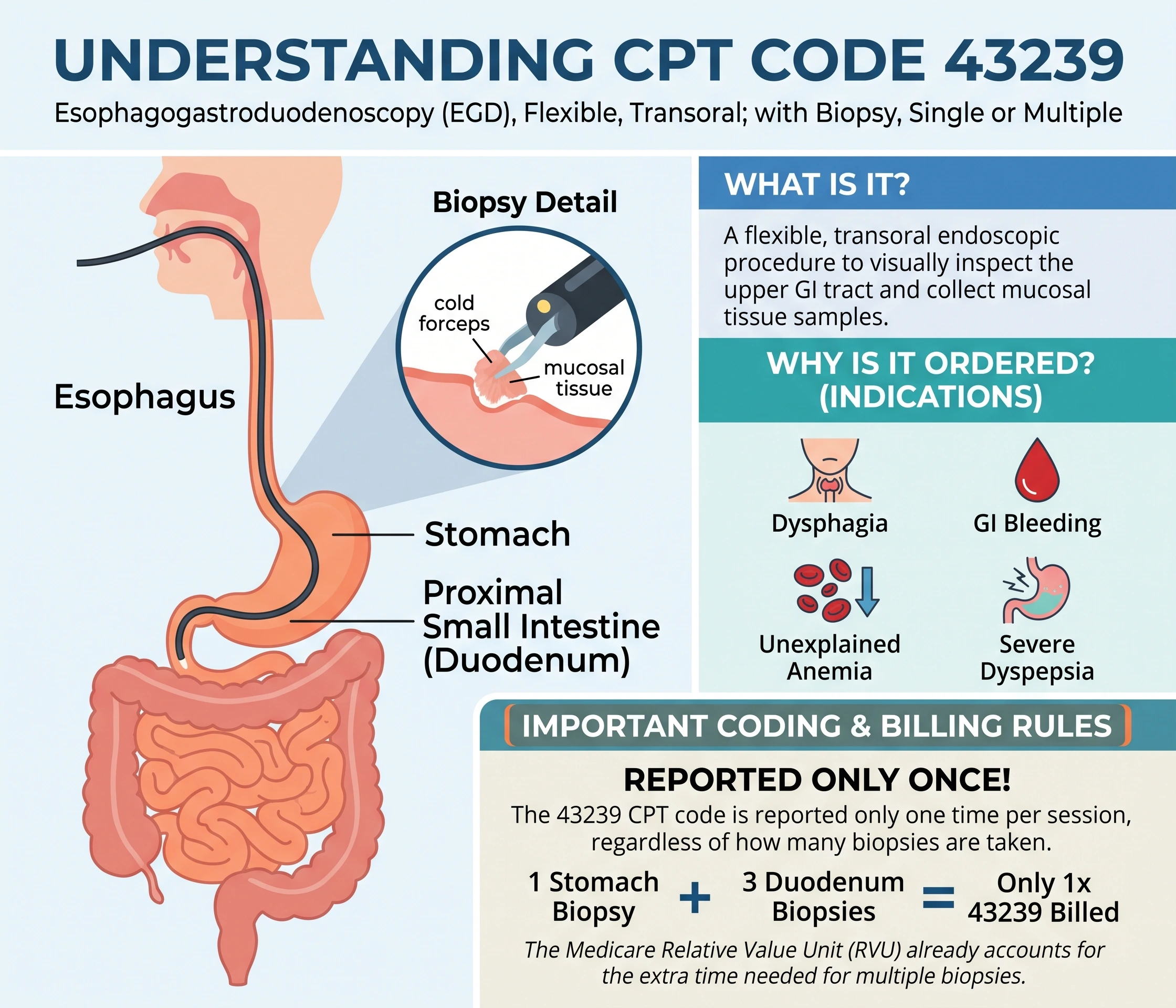
ENT billing frequently requires applying multiple modifiers to a single claim line, for example, pairing Modifier 50 with Modifier 59 when a bilateral procedure is also distinct from another same-day service. Incorrect modifier sequencing or conflicting modifier combinations are a primary driver of ENT claim denials. Coders must understand payer-specific modifier hierarchy rules and validate combinations against current CCI edits before submission.
Key Diagnostic and In-Office ENT Procedure Codes That Trigger Denials
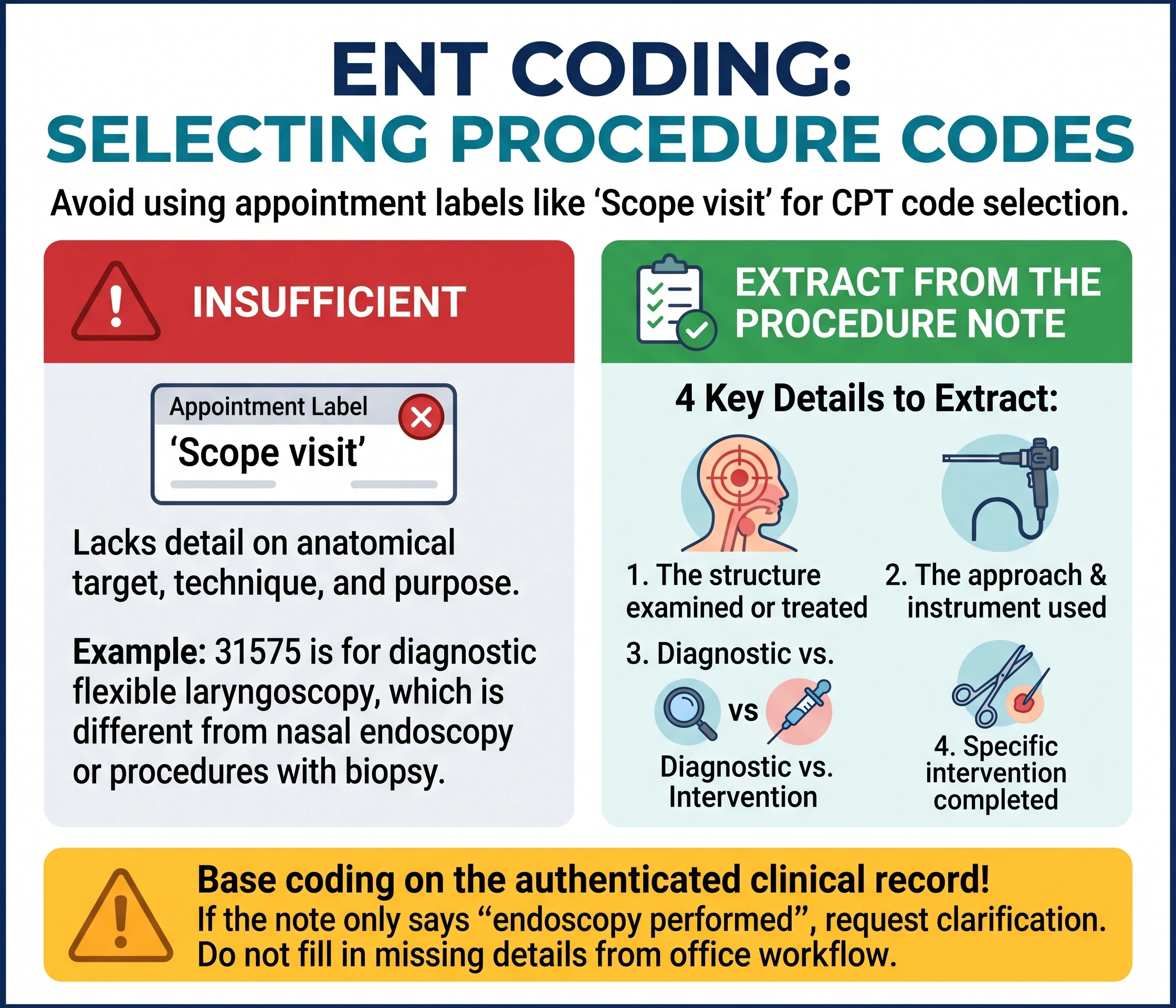
The denial trigger for ENT's highest-volume diagnostic codes is almost never the CPT code itself. Per ENT public record filing via GovWell (2024), payers reject these claims when the clinical note states only that a procedure was performed rather than what was visualized, where, and by what method. The code is correct. The note is indefensible. The denial originates in the exam room, not the billing department.
Each of the five codes below functions as a documentation specificity test. Pass it with the right clinical detail, and the claim holds. Miss a single required element, and even a correctly selected ENT CPT code becomes audit-vulnerable across every encounter where that gap repeats. Ensuring accurate, compliant medical coding across high patient volumes to maximize reimbursement and minimize claim denials is precisely where documentation capture breaks down in busy ENT practices, and where the cost of that breakdown compounds.
1. Nasal Endoscopy (CPT 31231) and Flexible Laryngoscopy (CPT 31575) - Documentation Must Name Anatomy and Findings

These two ENT CPT codes represent the highest claim volume in outpatient ENT billing, making them prime targets for payer audits. Documentation must explicitly name each anatomical structure examined, turbinates, nasopharynx, vocal cords, and record actual findings, not just confirm the procedure occurred. Vague operative notes stating only 'endoscopy performed' are the most common denial trigger for both codes.
2. Cerumen Removal CPT 69210 vs. CPT 69209 - Instrumentation vs. Irrigation Is Not Interchangeable

CPT 69210 applies only when cerumen is impacted and removed via instrumentation such as curettes or forceps; CPT 69209 covers lavage or irrigation. Conflating these two ENT CPT codes is one of the most frequently audited errors in ENT billing. The note must document impaction, the specific removal method, and that the procedure required physician skill, a Q-tip or simple irrigation cannot support 69210 and will trigger recoupment.
3. Epistaxis Control Codes 30901, 30903, and 30930 - Site and Method Must Match the Code Selected
Epistaxis ENT CPT codes are differentiated by anatomical location and technique: CPT 30901 covers anterior simple control, CPT 30903 covers posterior or complex control, and CPT 30930 covers cauterization. Payers deny claims when the documented method does not align with the billed code, for example, billing 30903 when only anterior packing was placed. The operative note must state the bleeding site and the exact intervention performed to withstand a medical necessity review.
4. Nasopharyngoscopy (CPT 92511) - Laterality and Indication Required to Defend Billing and Prior Auth
For nasopharyngoscopy (CPT 92511), laterality and a clearly stated clinical indication must appear in the record to satisfy both billing and prior authorization requirements. The GovWell Public Record (Eustis ENT Coding Documentation) identifies missing laterality and inadequate indication language as recurring elements in payer rejection patterns for this code.
5. Myringotomy and Tympanostomy Tube Codes (CPT 69433 / CPT 69436) - Laterality and Anesthesia Type Drive Code Selection
CPT 69433 applies to tympanostomy tube insertion requiring general anesthesia, while CPT 69436 covers the procedure under local or no anesthesia, a distinction that directly affects reimbursement and prior authorization pathways. Both ENT CPT codes require explicit laterality documentation; billing bilateral procedures without appending modifier 50 or using separate line items is a consistent audit finding. Missing indication language, such as recurrent otitis media criteria, further undermines medical necessity on appeal.
Related Reading
- Cpt Code 31575
- Cpt Code 30520
Common ENT Surgical Procedure Codes and the Documentation Gaps That Cost Practices
Surgical claims are where documentation gaps convert to the largest single-claim write-offs in an ENT practice. The correct CPT code for a tonsillectomy, an endoscopic sinus surgery, or a septoplasty is not chosen by the coder. It is determined by what the surgeon wrote before and during the procedure. When that documentation omits patient age, the specific sinuses addressed, or independent medical necessity for each concurrent procedure, the revenue is already gone before the coder opens the chart.
1. Tonsillectomy and Adenoidectomy Codes (CPT 42820-42826) - Age and Scope Determine the Right Code
Tonsillectomy and adenoidectomy codes split by two variables: patient age (under 12 versus 12 and older) and whether adenoids were removed alongside tonsils. CPT 42820 covers tonsillectomy with adenoidectomy in patients under 12; CPT 42821 applies to patients 12 and older. Billing the wrong age bracket is one of the most frequently flagged errors in T&A audits, and the operative note must state the patient's age explicitly, not leave it to the coder to calculate from a date of birth buried in the demographic record.
2. Endoscopic Sinus Surgery Codes (CPT 31253-31288) - Sinus-by-Sinus Documentation to Avoid Unbundling Audits

Endoscopic sinus surgery codes are additive: each sinus group addressed carries its own CPT code, and the operative note must name each sinus specifically. A note that reads "sinus surgery performed" leaves the coder unable to distinguish between applicable code ranges without reconstructing the procedure from memory or requesting a provider addendum. Payers and Recovery Audit Contractors treat vague ESS documentation as an unbundling flag, and recoupment demands on ESS claims are among the highest-dollar audit findings in outpatient ENT billing.
3. Septoplasty (CPT 30520) Paired with Turbinate Reduction (CPT 30140) - Proving Medical Necessity for Both

Proving medical necessity for both procedures is essential. CPT 30520 (septoplasty) and CPT 30140 (turbinate reduction) are frequently performed together, but many payers apply bundling edits that deny 30140 unless the operative note documents independent medical necessity for the turbinate pathology, separate from the septal deviation. The clinical rationale for each procedure must appear in the pre-operative assessment and the operative report. When it does not, the turbinate reduction claim is denied on the first pass, and the appeal requires a provider addendum that could have been avoided entirely with complete initial documentation.
4. Prior Authorization Friction on ESS and T&A Surgical Codes - Incomplete Documentation Causes Denials Even for Appropriate Cases

Prior authorization denials for endoscopic sinus surgery and tonsillectomy are rarely about clinical appropriateness. They are almost always about missing documentation at the time of submission: no formal allergy testing results, no documented conservative treatment trial, or symptom burden described in the office note without the specificity payers require. The scheduling delay that follows an incomplete prior auth request can stretch for weeks in busy ENT practices, compressing the revenue cycle and creating a backlog that compounds across high-volume surgical schedules.
5. Modifier Use on Bilateral and Staged ENT Procedures - Preventing Automatic Claim Reductions
Bilateral ENT procedures billed with Modifier 50 are subject to payer-specific payment rules that vary by code and by contract. The documentation error is rarely choosing the wrong modifier; it is failing to verify whether a specific payer reimburses the bilateral code at 150% or 100% of the fee schedule, and whether the operative note supports the bilateral designation with explicit anatomical language. Without that documentation, automatic claim reductions go uncontested because there is no operative language to cite in the appeal.
The familiar workaround is to flag these gaps post-denial and request provider addenda. That approach recovers some claims, but it costs appeals staff time and delays cash flow significantly on the practice's highest-value procedures. An AI medical scribe captures the granular clinical detail during the pre-operative workflow and operative encounter in real time, so patient age, sinus-by-sinus scope, turbinate pathology rationale, and bilateral designation are present in the note before the coder ever opens the chart. This is most beneficial when surgeons are running high-volume operative days and dictating post-procedure from memory, which is exactly when critical specifics get compressed or dropped.
Surgical codes represent the highest per-claim revenue in an ENT practice, but they are not the only documentation-sensitive billing domain. Audiology and hearing testing codes carry their own specificity requirements that are changing, and the practices that get them right share the same documentation discipline that protects surgical claims.
Audiology and Hearing Testing CPT Codes ENT Practices Must Get Right in 2026

Core Audiology CPT Codes in ENT and What Each Note Must Capture
CPT 92557 (comprehensive audiometry threshold evaluation) is the highest-volume audiology code in most ENT practices, covering air conduction, bone conduction, and speech testing in a single encounter. The note must document all three test components, the ear tested, and the clinical indication. CPT 92567 (tympanometry) requires documentation of the specific ear tested and the tympanogram result; submitting without laterality is one of the most common reasons this code is rejected during payer review. CPT 69420 and CPT 69421 (myringotomy with and without tube insertion) are surgical, but they frequently appear on the same claim as audiometric codes, and bundling edits fire when the supporting diagnosis does not align across both code sets.
The 2026 Hearing Aid Code Overhaul and What 92628-92641 Demand
Legacy hearing aid evaluation codes CPT 92590 through 92595 are retired as of January 1, 2026. A practice submitting CPT 92590 after that date receives a hard claim rejection, not a soft denial or a downcode. The replacement set, CPT 92628 through 92641, is time-based, meaning the minutes spent in each service category must be recorded in the note before the claim is submitted.
ICD-10 Laterality for Hearing Loss and Its Effect on Audiology Claim Approval
Unspecified hearing loss coded as H90.9 is one of the quietest denial drivers in ENT audiology billing. Laterality-specific codes, H90.0 for conductive hearing loss in the right ear, H90.3 for bilateral sensorineural loss, and H90.6 for mixed hearing loss, are what payers increasingly require to approve audiometric CPT codes.
The ENT Coding Mistakes That Survive Coder Training and How to Stop Them
ENT Coding Mistakes That Survive Coder Training
Most practice administrators and billing decision-makers believe that coding errors are a training and knowledge problem: hire better coders, run more audits, and denial rates will fall. Certified coders are not the weak link. The real failure point sits upstream, in the finalized clinical note that reaches the coder's queue already missing the detail that would justify the code the provider actually earned. Understanding where these errors originate, and why they persist despite training investments, is the first step toward building a workflow that stops them at the source.
1. Upcoding and Undercoding as a Visibility Problem - The 33% Overcoding Rate Most ENT Practices Never See Coming

At the Center for Sports Medicine & Orthopaedics in Chattanooga, 941 encounters were analyzed, provider-AI agreement came in at only 54.8%, and a 33% overcoding rate was found, so practices are billing at levels the documentation cannot support. Until they ran the trial, no one in the building knew the split. That pattern is invisible until an external auditor surfaces it.
The same audit infrastructure that would catch overcoding would also catch systematic undercoding, where a provider delivers a high-complexity encounter but the note only documents enough for a 99213. Both errors cost the practice money. Neither is caused by a coder who doesn't know the code set.
The gap is visibility, and it is precisely the visibility gap that iScribe Health's E&M Coding Intelligence and Real-Time Denial Alerts are designed to close. At the point of note completion, after the AI drafts the encounter summary, the system surfaces coding signals before the chart ever reaches the coder's queue. That means overcoding and undercoding errors are identified while the clinical reasoning is still fresh and correctable, not weeks later when a denial arrives.
2. Incorrect Modifier 50 Application - Billing Bilateral Without Knowing Payer-Specific Payment Rules for That Exact ENT CPT Code
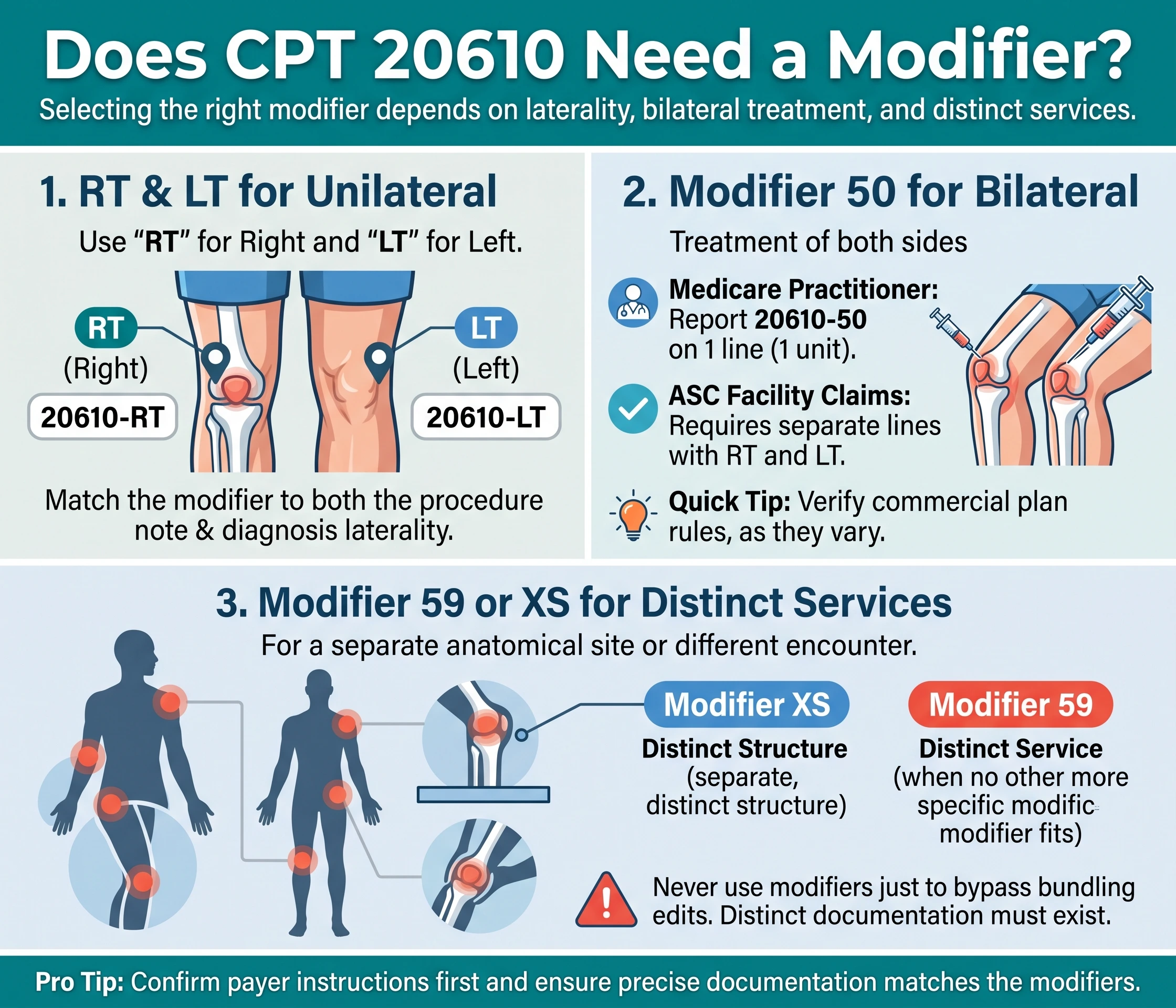
Billing bilateral without knowing payer-specific payment rules for that exact ENT CPT code is where this error originates. Industry billing analysis consistently shows that incorrect Modifier 50 application in ENT billing stems from not knowing the payer-specific bilateral payment rules for that modifier on that specific procedure code. Training on modifier definitions does not close that gap. A coder can recite the textbook definition of Modifier 50 and still apply it incorrectly to a procedure where a specific commercial payer reimburses bilateral work differently than Medicare does.
The documentation layer compounds the problem. When the clinical note does not clearly specify that both sides were treated in the same session, the coder is left inferring laterality from context rather than reading it from the record. That inference is where denial risk lives. Because iScribe integrates directly with supported EHRs through its EHR Integration layer, that captured detail flows into the chart without a separate documentation step.
3. Misunderstanding Primary and Secondary Procedures in ENT Surgical Encounters - How Bundling Errors Compound Before Anyone Notices

ENT surgical encounters frequently involve multiple procedures where bundling rules determine which ENT CPT codes can be billed separately and which are included in the primary procedure's reimbursement. When rejection monitoring is not performed daily, a single systematic bundling misunderstanding can propagate across hundreds of claims before the pattern surfaces. By then, correcting denied claims requires retroactive appeals that consume far more resources than daily queue review would have.
4. The Structural Documentation Ceiling - When Finalized ENT Notes Cannot Support the Complexity That Was Actually Delivered
When finalized ENT notes cannot support the complexity that was actually delivered, training cannot fix the underlying mechanism. Billing research states it directly: when documentation fails to capture medical decision-making complexity, procedure specifics, or laterality, the error cannot be corrected retroactively without a provider addendum, making the root cause a documentation problem rather than a coder knowledge problem. Addenda are time-consuming, often incomplete, and carry their own audit risk when they appear to reconstruct clinical reasoning after the fact.
Most practices handle this by investing in coder training. The familiar approach is reasonable: better-trained coders catch more errors before submission. The hidden cost is that a credentialed coder working from an incomplete note hits a hard ceiling set by the note itself, not by their knowledge.
iScribe Health's Ambient AI Documentation removes that ceiling by capturing the clinical detail coders need before the note is finalized: complexity indicators, medical necessity language, laterality, and procedure specifics recorded at the point of care through Ambient Listening. The AI drafts the encounter summary immediately after note completion, and iScribe's Automated E&M Coding layer assigns the appropriate level while the encounter context is complete and intact. That upstream capture is why the documentation gap never forms in the first place.
For high-volume ENT practices where clinicians regularly spend significant time charting outside of patient care hours, this workflow also directly addresses physician burnout, a compounding cost that denial rates alone do not capture.
5. Common ENT Coding Mistakes to Avoid - The Errors That Survive Formal Coder Training and Repeat Across Every Audit Cycle
Certain ENT CPT codes errors persist not because coders lack training but because training addresses rules in isolation rather than the real-world conditions where those rules break down, payer variation, documentation gaps, and high-volume surgical days where laterality and bundling decisions get made under time pressure. Practices that identify their own recurring error patterns through internal audit data and build targeted correction workflows stop these mistakes from surviving into the next audit cycle.
Key Resources and the Documentation Workflow That Makes ENT CPT Codes Defensible
That gap between knowing the correct code and having the documentation to defend it is where ENT revenue quietly disappears, and where audit exposure quietly builds. The AAO-HNS Bulletin's 2025 Otolaryngology Workforce Report identifies coding and documentation workflows as core practice sustainability issues alongside patient care itself, which means the stakes here are structural.
"Patients struggle to identify the correct CPT codes for ENT in-office procedures (e.g. laryngoscopy for LPR diagnosis) on their own, highlighting a lack of accessible, reliable documentation of ENT-specific billing codes."
— what we hear from ENT medical billing teams

The Reference Stack Every ENT Practice Needs
- AMA CPT codebook
- AAO-HNS specialty coding guides
- NCCI edit tables
- Payer-specific Local Coverage Determinations
Each of these resources only delivers value when the underlying documentation supports it. NCCI edits allow modifier overrides for procedures performed on separate anatomical sites, but the modifier holds up only if the note explicitly documents the distinct site.
The LCD for a high-volume ENT procedure like balloon sinuplasty requires documented failure of medical management before the service qualifies for coverage. That requirement lives entirely in the clinical note. The note either contains it or it does not.
Prior Authorization as a Documentation Deadline, Not a Paperwork Step
Prior auth denials for ESS, tonsillectomy, and balloon sinuplasty are rarely caused by missing paperwork. The more common pattern: the office visit note never recorded the specific criteria the payer requires, so the auth submission lacks clinical support no matter how thoroughly the administrative team assembles it. Solving that problem means working upstream, before the auth request is ever assembled. The physician completes the clinical picture during the visit. The auth submission becomes a transfer of existing documentation, not a reconstruction.
The Documentation-First Workflow
Laterality, MDM elements, and procedure specifics must be recorded during the encounter, not recalled afterward. Most ENT practices handle this by relying on providers to complete documentation after the visit, which creates the familiar problem: the clinical complexity that justified a higher-complexity code was present in the room and absent from the record. An AI medical scribe captures laterality, MDM complexity, and procedure specifics in real time, so the note the coder opens already contains what the reference resources require.
The improvement in code selection is a documentation timing outcome. The codes are knowable. What determines whether a claim holds up under audit or prior auth review is whether the documentation captured the right clinical detail at the right moment, during the encounter, not after it.
Related Reading
- Cpt Code 69436
- Cpt Code 42820
Next steps
If your ENT practice keeps seeing denials after investing in coder training, the path forward starts with closing the documentation capture gap at the point of care, before the note is finalized and the revenue is already gone. Start with our AI medical scribe.
The structural documentation ceiling described throughout this post means a credentialed coder working from an incomplete note hits a hard limit set by the source record, not by their knowledge. Meanwhile, the documentation-first workflow principle established in the key resources section confirms that laterality, MDM complexity, and procedure specifics must be recorded during the encounter, not reconstructed afterward. Together, those two realities point to one logical intervention: capturing the clinical detail coders need before the note closes, not training coders to work around a note that never contained it.
Start with iScribe Health. The ambient documentation layer records clinical specifics in real time during the encounter, drafts the note immediately after, and surfaces coding signals before the chart reaches your billing team, so the code the provider earned is the code the note can actually defend.
Frequently Asked Questions
How do I know whether to use Modifier 50 or the RT/LT modifiers for a bilateral ENT procedure?
Use Modifier 50 when the same procedure was performed on paired structures in a single surgical session, but verify the specific payer's bilateral policy for that exact CPT code first, Medicare pays 150% of the single-procedure allowable, but commercial payers vary widely, with some requiring separate line items with RT and LT instead. RT and LT modifiers are used for unilateral procedures on anatomically paired structures when only one side was treated. Applying Modifier 50 without checking payer-specific bilateral rules is one of the most common and preventable ENT billing errors the post identifies.
What's the real difference between undercoding and upcoding in ENT, and which is the bigger problem in practice?
Undercoding, billing a lower-level code than the encounter actually supports, is the dominant problem the post identifies in ENT, not upcoding. Practices systematically cluster around 99213 for established patients even when chronic disease management, multi-diagnosis encounters, and prescription risk routinely qualify for 99214, because the clinical complexity was delivered but never documented in a way the coder can use. Upcoding risk arises separately when modifiers or code combinations are applied without adequate documentation to support them, which is why documentation capture at the point of care matters for both directions.
Why does an E/M claim get denied even when the visit itself was clearly complex?
Payers and auditors evaluate the written record, not the clinical reality of the visit, if the note does not capture the number of diagnoses considered, the data reviewed, and the risk of the management plan, there is no path to a higher-level E/M code regardless of what actually happened. A vague ICD-10 diagnosis code paired with a high-level E/M code compounds the problem, because the mismatch signals a documentation integrity issue to payers. The post frames this as a documentation capture failure that occurs before the coder ever sees the note, not a coding error.
When can I bill a separate E/M on the same day as a minor ENT procedure using Modifier 25?
Modifier 25 is appropriate when the E/M service was a distinct, separately identifiable service with its own medical decision-making rationale, not just a brief mention that the provider also evaluated the patient. The OIG has launched targeted reviews of same-day E/M services billed alongside minor procedures specifically because documentation routinely fails to demonstrate that distinction, so the note must explicitly show the evaluative reasoning was separate from the pre- and post-procedure care inherent to the procedure itself.
What happens if I use Modifier 59 instead of an X-modifier for a bundled ENT procedure, does it matter?
It matters for audit exposure. CMS now prefers the more specific X-modifier subsets, XS (separate structure), XE (separate encounter), XP (separate practitioner), and XU (unusual non-overlapping service), because each one narrows the justification to a specific clinical reason rather than a generic "distinct service" claim. Using bare Modifier 59 instead of the correct X-modifier variant materially increases audit risk in ENT, where same-day diagnostic and therapeutic procedures are routine.