What Is Medical Coding Documentation and Why It Matters
Medical coding documentation gaps cost practices thousands monthly. Billing decision-makers, see exactly where revenue disappears and recover it.


Your claims are clearing. Your revenue is quietly vanishing. Here is what medical coding documentation actually is, and why the gap between those two facts is costing your practice every single day.
Most practice administrators and billing decision-makers operate under a widespread assumption: if claims are going out the door without obvious rejections, the documentation must be adequate. The physician sees the patient, the note gets written, the billing team takes it from there. That sequence feels logical.
It is also quietly costing practices tens of thousands of dollars every month in revenue they never see leave. Medical coding documentation is the process of recording a clinical encounter in enough detail that every service, diagnosis, and decision can be translated into standardized codes and submitted for reimbursement. It is not a summary.

See our AI medical scribe for how this works in practice.
It is a legal and financial record, and every number on a remittance advice traces back to the specific words a clinician chose, or skipped, in the original note. A clinical note becomes a billable claim through a direct chain of translation. The physician documents what happened; a coder converts that narrative into standardized codes; a payer adjudicates the claim based on those codes.
Break the chain at the first link and every step downstream inherits the error. As published in PLOS Medicine (2022), services that are not properly documented cannot be accurately coded or billed, making the note itself the legal record of what was performed. The gap between what a physician clinically did and what the note actually captures is wider than most administrators realize.
Three coding systems govern virtually every claim a practice submits: ICD-10-CM assigns diagnosis codes, CPT captures procedures and services rendered, and HCPCS Level II covers supplies, equipment, and services not described by CPT. A physician who documents "diabetes" instead of "Type 2 diabetes mellitus with diabetic chronic kidney disease, stage 3" forces a less-specific ICD-10-CM code, reduces reimbursement, and may fail a medical necessity audit without a single claim ever being rejected outright.
Key takeaways
- Medical coding documentation is not a billing function, it is a clinical function. By the time a note reaches your billing team, the revenue decision has already been made.
- Only roughly 55% of E&M visits are accurately documented at baseline, which means no clearinghouse, no coding software, and no billing team can recover what was never captured in the note.
- The 5 C's of medical documentation, Clarity, Completeness, Consistency, Contemporaneousness, and Compliance, each map to a specific denial category or audit trigger, not just a quality standard.
- After-hours charting is not a minor inconvenience, it is where clinical complexity gets stripped out of notes written from memory, quietly reducing the MDM score before a single code is assigned.
- Common documentation errors like missing medical necessity, unsigned notes, and section inconsistencies create risk in both directions: undercoding leaves revenue on the table; overcoding invites OIG scrutiny.
- Clinical documentation improvement is not a retrospective audit function, practices that treat it as proactive governance protect both reimbursement and quality scores before a payer ever reviews the record.
- iScribe Health's E&M Coding Intelligence closes the gap by generating coding recommendations from the complete clinical narrative in real time, not from the finalized note after the encounter is over.
Key Principles of Medical Documentation - The 5 C's and the Rules That Protect Revenue
Medical documentation fails in predictable ways, and each failure maps to a specific denial category, audit trigger, or overpayment risk that a clean claim submission rate will never surface. The 5 C's of Documentation covered here are the structural framework that separates defensible notes from documentation that looks compliant today but builds audit exposure quietly inside payer algorithms. Understanding where each principle breaks down in practice is the starting point for protecting revenue at the point of care, before a RAC audit makes the cost visible.
1. Clarity - Write So a Stranger Coder Can Assign the Right ICD-10 Without Calling You

Write so a stranger coder can assign the right ICD-10 without calling you.
a clean claim submission rate is a lagging vanity metric, not a compliance signal.
Only ~55% of E&M visits accurately documented at baseline
Vague language is the single most common source of avoidable E&M claim denials. When a physician documents "patient doing okay" or lists an unspecified pain code instead of a lateralized, etiology-specific diagnosis, the coder cannot assign the correct ICD-10-CM without a callback, and the claim either downcodes or stalls. Coders consistently report that notes where the assessment section contradicts the problem list force judgment calls that create audit exposure before the claim even leaves the practice.
As AAPC's analysis of CMS error rate data confirms, E&M codes are among CMS's highest-error-rate targets precisely because note language is too imprecise to support the level billed. This is where iScribe Health's Ambient AI Documentation directly addresses the problem. iScribe Health is most beneficial when clinicians are seeing high patient volumes and spending significant time on after-hours documentation, the precise environment where clarity degrades fastest. The result is documentation that standardizes clinical documentation quality across the practice, so a stranger coder can assign the right ICD-10 without calling anyone.
A study of tertiary care encounters found that missing comorbidities and underdocumented medical decision-making complexity were responsible for the majority of revenue loss. A physician who manages hypertension, diabetes, and chronic kidney disease in a single visit but documents only the presenting complaint may bill a level-3 when the clinical complexity clearly supports a level-4 or level-5. That gap compounds silently across every provider and every day.
The consequences are not hypothetical. Poor documentation is a direct driver of claim denials and compliance violations, and the losses are fully preventable when every billable element is captured at the point of care. iScribe Health's E&M Coding Intelligence and Automated E&M Coding capabilities work at exactly that moment, at the point of note completion, after the AI drafts the encounter summary, to improve coding precision in a way that directly impacts revenue.
For Chief Medical Officers, practice administrators, and individual physicians, this means the complexity a physician manages in the room is the complexity the record reflects, rather than whatever the physician could remember to type after a 30-patient day.
2. Completeness - Capture Every Diagnosis, Comorbidity, and Complexity That Justifies the Level of Service
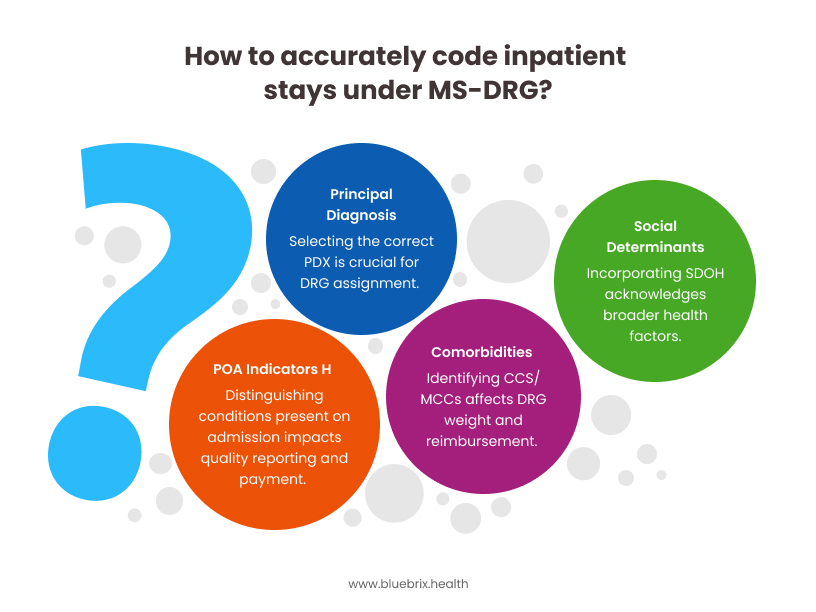
Incomplete medical coding documentation is the leading driver of revenue leakage, not fraud, but omission. Completeness requires documenting all active diagnoses, relevant comorbidities, and the medical decision-making complexity that supports the billed E/M level. A tertiary care pilot study found that undercoding due to incomplete records was far more prevalent than overcoding. The real limitation: completeness audits are time-intensive and require ongoing CDI specialist involvement to sustain gains.
3. Consistency - Ensure Every Entry in the Record Tells the Same Clinical Story
Ensure every entry in the record tells the same clinical story.
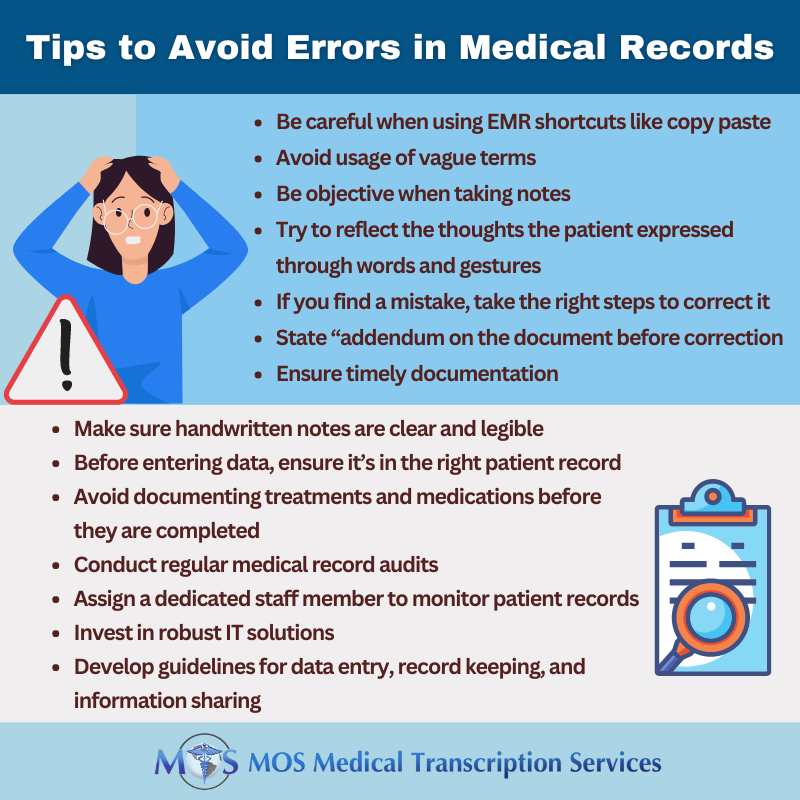
If the physician documents "hypertension, well-controlled" in the HPI but the problem list, medication reconciliation, and assessment section tell three different stories, the record fails consistency, and payers and auditors treat internal contradictions as evidence that the note was not generated from genuine clinical observation. This is a downstream consequence of the fragmented, after-hours charting workflow that high-volume practices rely on by default. When notes are drafted from memory rather than from a real-time ambient capture of the encounter, internal inconsistency is structurally inevitable.
iScribe Health's EHR Integration and Real-Time Denial Alerts surface these inconsistencies before a claim is submitted, an ongoing safeguard realized across every patient encounter and every day of clinical practice, so the record that reaches the payer tells one coherent clinical story from HPI to assessment to plan.
4. Contemporaneousness - Document at the Point of Care, Not Days After the Encounter
Defensible medical coding documentation depends heavily on timing. Notes completed days after an encounter are routinely challenged during audits because they raise questions about accuracy and recall. CMS and most payers require documentation to be completed within 24–48 hours of service. Late entries must be clearly marked as addenda with a timestamp. The practical tradeoff: real-time documentation pressures clinicians during already-compressed appointment schedules, making structured templates and ambient AI tools increasingly necessary.
5. Compliance - Align Every Note With Medical Necessity Standards to Survive a RAC Audit
Compliance in medical coding documentation means every service billed must be supported by documented medical necessity, not just clinical habit. CMS's Simplifying Documentation Requirements initiative underscores that providers must demonstrate why a service was medically necessary, not merely that it was performed. Recovery Audit Contractors specifically target records where the documentation doesn't justify the code submitted. The key limitation: compliance requirements shift annually with payer policy updates, requiring continuous staff education and internal audit cycles.
Related Reading
- Common Medical Coding Errors
- Medical Coding Ai Tools
- What Is Evaluation And Management Coding
- Time-based E&m Coding
Documentation Requirements for E/M Services - What Every Note Must Capture
E/M documentation failures rarely come from ignorance of the rules. The more expensive failure is quieter: a physician who knows every CMS guideline still writes "history of hypertension" for a patient whose blood pressure is actively managed, and in that single phrase, a legitimate comorbidity disappears from the MDM complexity calculation. Poor documentation language errors of this kind drive claim denials and compliance violations that compound silently across every note, every provider, every day, a pattern documented in compliance analyses of outpatient billing.
The deeper problem is structural: documentation pressure builds fastest in high-volume practices where clinicians routinely chart two or more hours outside of patient care time, leaving less cognitive bandwidth for the precise language that determines E/M level. That is the gap iScribe Health's ambient AI documentation is designed to close, accurately capturing clinical notes during or after patient encounters so the language that reaches the chart reflects clinical reality, not documentation fatigue.
1. Chief Complaint and History of Present Illness - The Narrative Foundation Every Auditor Checks First
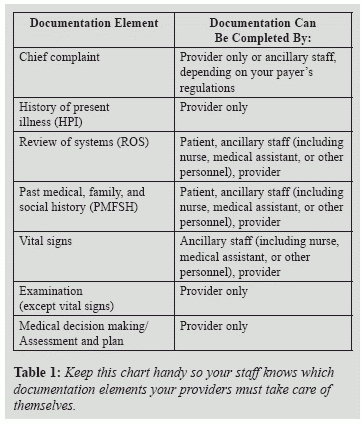
Every defensible E/M note begins with a chief complaint that captures the specific reason for the visit in the patient's own terms, followed by a History of Present Illness that details onset, location, duration, severity, and modifying factors. Vague HPI entries like "patient presents for follow-up" give auditors nothing to anchor the visit's medical necessity. MLN compliance guidance, this narrative section is the first element reviewers assess when a claim is pulled for audit.
When a physician is dictating under time pressure or reconstructing notes hours after the encounter, the specificity of the HPI degrades first, onset becomes approximate, modifying factors disappear, the patient's own words get flattened into a generic phrase. iScribe Health's ambient listening and conversational AI captures the encounter as it unfolds, so the HPI reflects what the patient actually said and when, rather than what the physician could reconstruct at end of day.
2. Medical Decision Making - Documenting Problems, Data, and Risk to Justify the E/M Level

Medical decision making is now the highest-stakes component of most outpatient E/M encounters since the 2021 AMA guideline revisions shifted the primary framework toward MDM complexity rather than history and exam elements. Three dimensions must be explicit: the complexity of problems addressed, the amount and nature of data reviewed, and the risk of complications. Writing "reviewed records" without specifying what was reviewed and what clinical conclusion it supported leaves the data element unsupported and the MDM level indefensible, a documentation gap the CMS MLN identifies as a leading source of improper payments.
iScribe Health addresses this through E&M Coding Intelligence and Automated E&M Coding that activate at the point of note completion, after the AI drafts the encounter summary. Rather than asking physicians to re-read a note and self-assess its MDM weight, the system surfaces the coding logic against the documented content, flagging, for example, when a comorbidity is mentioned in the subjective but absent from the MDM problem list, or when data review is asserted without a documented clinical conclusion. The result is that the revenue destruction caused by under-coded MDM is caught before the claim leaves the practice rather than after a denial or audit.
3. Provider Identity and Authentication - Signature, Credentials, and Date Requirements That Trigger Denials

Every E/M note must be authenticated by the rendering provider with a legible signature or electronic attestation, credentials, and the date of service. Missing or illegible signatures remain one of the most common reasons Medicare contractors deny or recoup E/M claims during post-payment audits. For practices using scribes or residents, the supervising physician's countersignature and a clear statement of their involvement are non-negotiable documentation requirements that directly affect medical coding defensibility.
4. Time-Based Billing Documentation - Total Encounter Time and Activities That Count Toward the Threshold
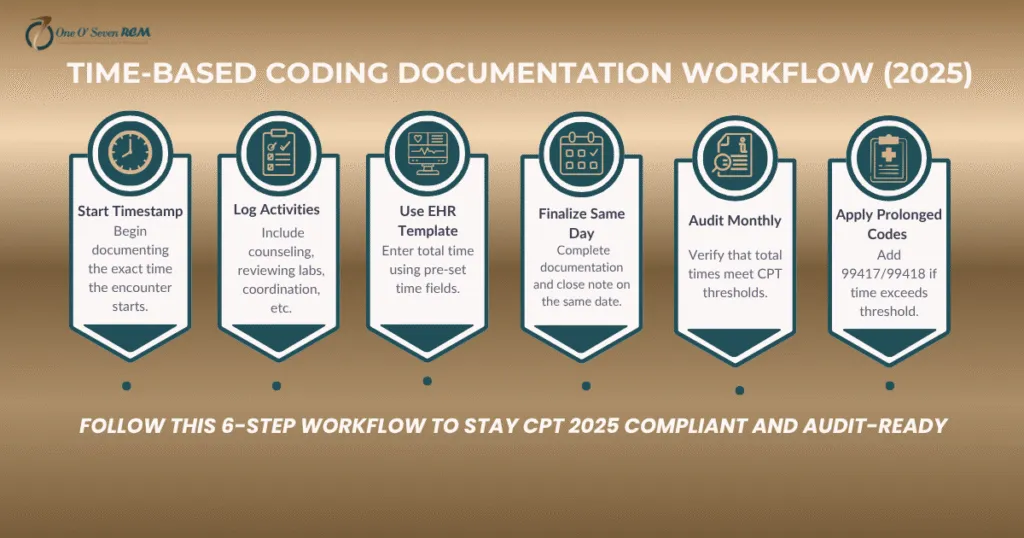
For time-based billing, CMS requires that the medical record state the total time spent on the date of the encounter and describe the specific activities performed during that time. Providers who select a code based on time but omit the total minute count from the note have no defensible basis for that code selection. Staff time generally does not count toward the threshold, and conflating it with physician time is one of the most common errors in time-based E/M documentation.
Because iScribe Health's ambient AI documentation captures activities as they occur during the encounter, the note can reflect discrete, time-stamped clinical activities rather than a retroactive estimate, removing the guesswork that turns a correctly coded encounter into an indefensible one. For high-volume practices where clinicians are already charting two or more hours outside of patient care time, reducing that documentation burden also reduces the likelihood that time documentation is skipped or approximated under pressure.
5. Assessment and Plan Specificity - Diagnosis Linkage and Treatment Rationale That Support ICD-10 Code Selection
Image: Medical Coding Documentation - assessment plan specificity diagnosis
The assessment must link each diagnosis to the treatment plan with enough specificity to support ICD-10 code selection at the highest available level of detail. Phrases like "probable" or unanchored problem descriptors cost practices recoverable revenue on every encounter where a more specific code was clinically supported but not documented. iScribe Health's EHR Integration means the AI-drafted encounter summary lands directly in the physician's existing workflow, no copy-paste, no separate platform, so the friction between what was said in the room and what appears in the assessment is minimized.
Real-Time Denial Alerts extend this further: when documented language is insufficient to support the selected diagnosis code or E/M level, the alert surfaces before submission rather than after, converting a silent revenue leak into a correctable documentation step. Across every patient encounter and every day of clinical practice, that combination, ambient capture, automated coding intelligence, and pre-submission alerts, is how iScribe Health reduces the operational costs associated with downstream scribing, transcription, and claim rework while giving physicians more time for patient care instead of documentation correction.
Documentation Requirements by Setting - Outpatient, Inpatient, and Home Health
Documentation requirements differ sharply by care setting, and the rules governing what can be coded vary enough that a note written correctly for one context becomes a liability in another. The gap is not effort. The gap is visibility into which framework applies and what it demands, and the capacity to meet that demand consistently across every encounter, every day, even during peak census periods.
1. Outpatient Settings - Medical Decision Making Drives E/M Level Selection
Image: Medical Coding Documentation - outpatient settings decision making
Under ICD-10-CM outpatient guidelines, "probable," "suspected," or "rule out" conditions cannot be coded as established diagnoses. A clinician who documents "probable pneumonia" for a same-day discharge visit has created an uncodeable primary diagnosis; the claim must be resubmitted using the documented symptom instead (cough, fever, dyspnea). Beyond diagnosis specificity, the 2021 AMA E/M revisions shifted level selection toward medical decision making complexity.
Under the updated MDM guidelines, vague clinical language directly suppresses the E/M level a coder can defensibly assign, and downcoding ripples across every affected encounter. The problem compounds in high-volume practices where clinicians regularly chart two or more hours outside of patient care time; under that cognitive load, MDM documentation is where specificity erodes first. This is precisely where iScribe Health's Ambient AI Documentation and E&M Coding Intelligence address a structural gap.
iScribe Health's ambient listening captures the full clinical conversation hands-free during the visit, then delivers an AI-drafted encounter summary at the point of note completion. At that moment, Automated E&M Coding evaluates the MDM content against the established framework so the level assigned reflects the complexity actually documented, not a conservative estimate made under time pressure. For practices already running a supported EHR, EHR Integration means this workflow runs inside the existing system, with no parallel charting environment to manage.
2. Inpatient Settings - Principal Diagnosis and CC/MCC Capture Define MS-DRG Assignment
Inpatient coding operates under a different ruleset. Providers may document and code "probable," "suspected," or "likely" conditions at discharge, reflecting the broader diagnostic workup typical of a hospital stay. The higher-stakes documentation challenge is capturing every applicable complication or comorbidity (CC) and major complication or comorbidity (MCC), because these directly determine the MS-DRG weight assigned to the encounter.
Incomplete CC/MCC documentation compresses a hospital's Case Mix Index, reducing reimbursement on every affected admission and showing up as weights that drift lower rather than as obvious claim rejections. Health systems that want a completely hands-free documentation experience during the visit benefit most from iScribe Health's ambient conversational AI, which captures the clinical detail, including comorbidity discussions that occur organically during rounding, that manual post-visit charting tends to compress or omit. The ability to simplify clinical workflows so care teams can maintain documentation quality even during peak census periods is especially material in inpatient environments, where census volatility is the norm and the cost of a missed MCC is immediate and compounding.
Real-Time Denial Alerts surface coding gaps before claims leave the system, giving coders a concrete signal rather than a retrospective write-off.
3. Home Health Settings - OASIS Assessment Accuracy Anchors PDGM Payment Classification
Medicare coverage depends on explicit documentation of homebound status, a face-to-face encounter narrative that connects the clinical findings to the skilled service need, and OASIS item accuracy that drives the Primary Diagnosis Grouping and clinical grouping under PDGM. Each element must be present and internally consistent; a face-to-face note that describes functional limitations in general terms rather than tying them to a specific skilled need creates a coverage vulnerability that survives initial submission and surfaces only on audit. For home health agencies operating on a supported EHR, iScribe Health's EHR Integration and ambient documentation capability allow clinicians to capture the granular functional and clinical detail OASIS accuracy requires, during the visit, hands-free, rather than reconstructing it from memory during after-hours charting.
The ongoing nature of that benefit matters: it is realized across every patient encounter and every day of clinical practice, not as a one-time remediation effort.
How Documentation Accuracy Impacts the Revenue Cycle and Reimbursement
Most revenue cycle conversations start at the claim. The documentation decisions that determine what that claim can legitimately contain have already been made, and in many practices, they are quietly costing far more than anyone has measured. This section examines where that value is actually lost, starting with why the clinical note is the true ceiling on reimbursement and what the compounding math of routine undercoding looks like across a real practice.

Documentation Is the Revenue Cycle's Starting Line, Not a Downstream Input
The common assumption among practice administrators and billing decision-makers is: "If our claims are going out the door without obvious rejections, our documentation must be adequate." This belief is understandable, but it is precisely wrong. Accurate documentation is the foundation of the healthcare revenue cycle.
Every reimbursement decision a payer makes traces back to a single source: the clinical note. The moment a physician finalizes a note without capturing the full complexity of the encounter, the ceiling on legitimate reimbursement drops. No billing software, no clearinghouse scrub, and no coder review can raise that ceiling after the fact.
As CMS guidance makes clear, the medical record must establish medical necessity and contain sufficient detail to justify the code selected before a claim can withstand scrutiny. Ensuring reimbursement integrity, then, is not a billing department function, it begins the moment the clinician opens their mouth in the exam room.
The Compounding Math of Undercoding - What Baseline E&M Documentation Inaccuracy Actually Costs
The scale of the problem is not abstract. According to a 2022 study published in PMC (National Library of Medicine), approximately the same pattern holds. Consider a 10-physician orthopedic practice where each provider undercodes three E&M visits per day by a single level.
The per-visit reimbursement gap from a single downcoded E&M level compounds into hundreds of dollars per provider daily, and potentially more than a million dollars annually across a multi-physician group. The claims all went out. Most got paid.
The loss was invisible. This is precisely where iScribe Health's Automated E&M Coding capability closes the gap. At the point of note completion, after iScribe Health's Ambient AI Documentation drafts the encounter summary, the platform's E&M Coding Intelligence evaluates the documented complexity and surfaces the appropriate code before the note is ever finalized.
In high-volume practices where clinicians are regularly charting two or more hours outside of patient care, that per-encounter accuracy check compounds across every patient encounter and every day of clinical practice, translating invisible undercoding losses into captured, compliant reimbursement at scale.
Missed Comorbidities and Thin MDM Narratives - How Incomplete Notes Translate Directly Into Claim Denials
Medical decision-making (MDM) complexity is one of the most underdocumented dimensions of an E&M encounter. When a note fails to name active comorbidities, omits what was considered and ruled out, or reduces a nuanced clinical judgment to a single line, the documented complexity drops regardless of what actually happened in the room. The result is either a downgraded code or a denial tied to insufficient medical necessity.
Practices that only track rejection rates miss this entirely, because a downcoded claim is not rejected, it is paid at the wrong level, silently. The same PMC research that puts accurate E&M documentation at roughly 55% identifies thin MDM narratives as a primary driver of that gap. iScribe Health's Ambient Listening and Conversational AI captures the full clinical conversation in real time, giving the AI-drafted note the raw material, active comorbidities, differential reasoning, plan complexity, that coders and payers need to validate the level of service actually provided.
Because the platform integrates directly with a practice's supported EHR, this richer documentation flows into existing workflows without disruption, enabling practices to ensure accurate, compliant medical coding across high patient volumes to maximize reimbursement and minimize claim denials. Real-Time Denial Alerts add a downstream safeguard: when a note's documentation is insufficient to support the selected code, the practice is notified before the claim departs, not weeks later in an explanation of benefits. Together, these capabilities simplify reimbursement and payment workflows by resolving documentation deficiencies at their source rather than forcing costly rework downstream.
Related Reading
- Orthopedic Coding Guidelines
- Medical Coding Automation
- E&m Coding Cheat Sheet
- Orthopedic Medical Coding
- Urology Coding Guidelines
Common Medical Coding Documentation Errors and the Compliance Exposure Most Practices Don't See Coming
Common documentation errors that lead to claim denials share a pattern: missing or incomplete provider signatures, absent medical necessity documentation, coding from "rule out" diagnoses in outpatient settings, and inconsistencies between sections of the same record. Each one is a known OIG audit trigger. What most practices don't model is that these same errors create risk in both directions at once, and in high-volume environments where clinicians are regularly charting two or more hours outside of patient care time, the conditions that produce these errors multiply with every encounter.
1. Upcoding Without Supporting Documentation - The Error That Triggers Federal Scrutiny
Billing a higher E/M level than the medical record actually supports, such as submitting a 99215 when documentation only justifies a 99213, is one of the most audited patterns in medical coding documentation. Payers and OIG target this systematically. The compliance exposure is severe: recoupment demands, False Claims Act liability, and exclusion from Medicare. The tradeoff practices miss is that EHR auto-population makes this error nearly invisible until an audit surfaces it.
2. Copy-Paste Documentation in EHRs - When Efficiency Becomes a Compliance Liability
Copy-paste or 'cloning' of clinical notes across encounters creates documentation that appears thorough but fails to reflect the patient's actual condition on the date of service. CMS and RAC auditors specifically flag identical note language across visits as a red flag in medical coding documentation reviews. Practices relying on this shortcut face claim denials, overpayment allegations, and potential fraud exposure, with the core tradeoff being speed gained versus audit defensibility lost.
3. Missing or Invalid Physician Signatures - The Authentication Gap CMS Won't Overlook
CMS requires that every medical record entry be authenticated by the treating provider through a legible signature, credentials, and date. Unsigned or improperly signed notes render the entire encounter non-billable under Medicare rules, exposing practices to full claim recoupment. This medical coding documentation error is especially common in group practices using shared EHR logins or delayed attestation workflows. The tradeoff: shortcut documentation processes that skip signature validation create systemic audit vulnerability.
4. Unbundling Procedures Without Modifier Justification - A Quiet Revenue Integrity Failure
Billing an E/M visit alongside a same-day procedure without appending modifier -25, or using it without documentation proving the visit was significant and separately identifiable, is a persistent medical coding documentation error that generates CO-97 denials and payer audits. Practices that routinely append modifiers without corresponding documentation support face both denial volume and compliance risk. The real tradeoff is that modifier use feels like a billing fix but demands a documentation foundation to be defensible.
5. Vague or Unspecified ICD-10 Diagnosis Codes - The Medical Necessity Documentation Breakdown
Submitting claims with nonspecific or placeholder ICD-10 codes, such as Z00.00 for a general exam when a more precise diagnosis is documented in the chart, undermines medical necessity and triggers CO-50 denials across payers. This medical coding documentation failure is especially damaging because it signals to auditors that clinical documentation and coding workflows are misaligned. The tradeoff practices face is that coders defaulting to unspecified codes for speed create a denial and audit pattern that compounds over time.
Clinical Documentation Improvement (CDI) Programs - How They Protect Reimbursement and Quality Scores
Clinical documentation improvement sits at a structural intersection most outpatient practices never examine: the point where a physician's words become a payer's decision. The gap between what a clinician observed and what the record can defend is where reimbursement quietly erodes, quality scores drift downward, and audit exposure accumulates. Understanding CDI as a proactive governance function, not a hospital-only compliance reaction, is the first step toward closing it.

Clinical documentation improvement (CDI) is the systematic process of identifying and resolving documentation gaps before a claim is filed, connecting physician language to compliant medical coding and creating a record that accurately reflects patient severity of illness. Across the broader market, CDI has evolved well beyond its inpatient origins into a strategic, data-driven function that protects reimbursement integrity across care settings. CDI intervenes upstream, before the claim assembles, not after a denial lands or an audit letter arrives.
That upstream position is what makes it a governance layer rather than a correction mechanism. Organizations with active CDI programs systematically capture comorbidities, complications, and medical decision-making complexity that ad-hoc documentation misses. In risk adjustment models such as HCC coding for Medicare Advantage, payers reimburse based on documented patient complexity.
A patient with undocumented HFrEF coded simply as "heart failure" generates a materially lower risk score and lower payment, regardless of how sick that patient actually is. Incomplete severity-of-illness capture similarly distorts quality metrics, suppressing scores that drive value-based contract performance. The OIG's 2024 and 2025 Work Plans explicitly prioritize outpatient E/M coding accuracy and medical necessity documentation, signaling that ambulatory practices face the same audit scrutiny hospitals have navigated for years.
CDI programs protect revenue less by catching coding errors than by closing a structural timing gap. Because payer Local Coverage Determinations and algorithmic audit criteria can be updated silently and applied retroactively, CDI's real function is continuous, forward-looking defensibility management, not retrospective error correction. Hospitals have CDI specialists embedded in their workflows. Most outpatient practices do not, and that gap is precisely where physician burnout and documentation debt compound the problem.
Physicians, nurse practitioners, and clinical staff in high-volume outpatient settings routinely carry 2+ hours of post-visit charting outside of patient care time. That documentation burden is not a personal productivity failure; it is a structural exposure. Every note completed under time pressure is a note where a comorbidity goes uncaptured, an E/M level goes under-supported, or a medical necessity linkage goes unstated.
What most teams report, consistently, is that documentation quality directly shapes the integrity of the coded record, and by extension, the defensibility of every claim that flows from it. iScribe Health addresses this structural gap by embedding CDI-layer intelligence directly into the clinical workflow, at the point where the documentation actually originates. Its Ambient Listening / Conversational AI captures the clinical encounter in real time, so the physician speaks naturally to the patient rather than typing into a template.
The AI then drafts the encounter summary, and at the point of note completion, before the claim is ever assembled, E&M Coding Intelligence and Automated E&M Coding evaluate the documented medical decision-making complexity against payer criteria and flag gaps while the encounter context is still fresh. Real-Time Denial Alerts surface payer-side risk before submission, converting what was previously a retrospective correction cycle into the upstream defensibility function that HFMA identifies as the strategic hallmark of mature CDI programs. This workflow is designed for physicians, nurse practitioners, and clinical staff as the primary users, with IT and EHR administrators handling the integration layer.
iScribe Health's EHR Integration is built to run inside a practice or health system's existing supported EHR, meaning the CDI function does not require a parallel system or a separate login; it lives inside the documentation workflow clinicians already use. For IT and clinical informatics teams, that integration architecture reduces the adoption friction that typically causes point solutions to sit unused. The downstream effect compounds across every encounter.
Reducing the time physicians spend on post-visit documentation means clinicians can see more patients per day without burning out, a benefit that is most impactful in high-volume practices or health systems where after-hours charting has become the norm. But beyond capacity, every encounter where ambient documentation captures clinical complexity accurately is an encounter where the CDI function has already done its job: the record reflects what the physician observed, the code reflects what the record supports, and the claim is defensible before it is filed. That is CDI operating as a governance layer, continuous, forward-looking, and realized across every patient encounter and every day of clinical practice.
How AI-Powered Documentation Closes the Gap Between What Clinicians Capture and What They're Owed
Every note a physician writes under time pressure is a revenue decision in disguise, and most practices never see it that way until a payer audit makes the math unavoidable. The documentation gap is not a billing problem. It is a point-of-care problem, and where it starts is exactly where it has to be fixed.
AI-assisted documentation at the point of care is among the few interventions that can address both the revenue gap and the compliance gap, because both failures originate at the same moment of capture, when a fatigued provider documents from memory after the encounter. Physicians spend a substantial share of their working hours on EHR tasks outside of direct patient care, compounding a memory-driven documentation loss that no downstream billing tool, CDI program, or coding staff can reconstruct once the source record is written.

Why the Revenue Leak Starts at the Keyboard, Not the Clearinghouse
"Clinicians feel burdened by documentation as 'rote work that needs to get done,' suggesting it consumes time that could be spent on clinical care, directly implying a gap between effort spent documenting and reimbursable output quality."
Billing software can only work with what the note contains, and the note reflects a compressed version of the encounter: active comorbidities omitted, MDM complexity understated, specificity sacrificed for speed. That sobering reality underscores why no clearinghouse flag or coder review can reconstruct clinical detail that was never written down.
The gap opens at the keyboard, not the claim. This is a pattern clinicians in high-volume practices know intimately: documentation becomes rote work that has to get done rather than a clinical activity that earns its place in the chart, and the result is a persistent gap between the effort spent documenting and the reimbursable output that documentation actually produces. iScribe Health addresses that gap at its source.
Its Ambient Listening and Conversational AI captures the encounter as it happens, so the note is drafted from the live clinical conversation rather than reconstructed from a fatigued provider's memory hours later. The output is an AI-drafted encounter summary that arrives at the point of note completion, before the physician ever touches a keyboard, integrated directly into the practice's supported EHR for a seamless ambient documentation experience.
Post-Visit Charting Is a Memory Problem, and Memory Downcodes Your Claims
Physicians spend a substantial portion of their working hours on EHR tasks outside of direct patient care, with after-hours charting representing a significant share of that burden. That fatigue is not just a burnout metric; it is a coding accuracy metric. Fatigued notes suppress codeable comorbidities, flatten MDM complexity, and create the audit exposure that a practice will not discover until records are pulled.
The problem is most acute in high-volume practices and health systems where clinicians routinely chart two or more hours outside of patient care time, precisely the environment where iScribe Health's Physician Burnout Reduction impact is most pronounced, and where it compounds across every patient encounter and every day of clinical practice. Critically, the platform is also designed to avoid a failure mode that negates those time savings: AI documentation tools that produce excessive filler make notes longer and harder to parse, which is especially damaging for follow-up visits where brevity is essential to capturing only billable, reimbursable activity. iScribe Health's AI Customization is built to produce notes that are clinically precise rather than padded, because a bloated note is not a defensible note.
What "Complete Clinical Narrative" Actually Means for E/M Code Selection
A complete clinical narrative captures not just what was treated but what was considered, ruled out, and weighed against active background conditions. For E/M code selection, MDM complexity depends on that full picture being present in the record at the time of signing, not inferred later by a coder who was not in the room. iScribe Health's E&M Coding Intelligence and Automated E&M Coding work from the ambient capture to surface the appropriate code at the point of note completion, and Real-Time Denial Alerts flag documentation gaps before the claim ever leaves the practice.
The combined effect is documentation that is more defensible, structured to withstand payer scrutiny because it reflects the actual clinical complexity of the encounter, not a compressed memory of it. Incomplete documentation at the point of care is a primary driver of E/M undercoding and audit vulnerability, and no amount of downstream review restores specificity that was never written down.
Related Reading
- Best Medical Coding Software
- Urology Medical Coding
- Ai Medical Coding Companies
- Medical Coding Outsourcing Companies
- Medical Coding Optimization
Next steps
If your revenue dashboard shows clean submissions while the underlying notes were finished from memory after a full patient day, the path forward starts with fixing documentation at the moment of capture, not downstream in the billing queue. Start with our AI medical scribe.
The finding that only roughly 55% of E/M visits are accurately documented at baseline, with the inaccuracies most skewing toward undercoding, means every note a fatigued provider saves after hours is already a revenue decision made against the practice. The asymmetric risk profile documented in the compliance section makes this more urgent: the same vague language that silently suppresses comorbidity codes and MDM complexity scores can simultaneously generate overcoding exposure on visits where a provider inconsistently upgrades levels, meaning a practice can be losing reimbursement and accumulating audit liability from the same note-quality failure at the same time. Together, those two realities point to one corrective action: capturing clinical complexity accurately at the point of care, before the note is finalized and before the ceiling on legitimate reimbursement is quietly lowered.
Start with an AI medical scribe that captures the encounter as it unfolds and surfaces E/M coding gaps at note completion. The clinical detail that drives defensible reimbursement is already happening in the room. The question is whether it makes it into the record.
Frequently Asked Questions
What exactly is medical coding documentation?
Medical coding documentation is the process of recording a clinical encounter in enough detail that every service, diagnosis, and decision can be translated into standardized codes and submitted for reimbursement. It is not a summary, it is a legal and financial record, and every number on a remittance advice traces back to the specific words a clinician chose, or skipped, in the original note.
What's the difference between CPT codes and HCPCS codes?
CPT codes capture procedures and services rendered, while HCPCS Level II covers supplies, equipment, and services not described by CPT. Together with ICD-10-CM diagnosis codes, these three systems govern virtually every claim a practice submits.
How does E&M level selection actually work after the 2021 AMA guideline changes?
Since the 2021 AMA guideline revisions, medical decision making complexity is the primary framework for most outpatient E/M level selection, replacing the older history-and-exam element approach. Three dimensions of MDM must be explicitly documented: the complexity of problems addressed, the amount and nature of data reviewed, and the risk of complications, and vague language in any of those three areas directly suppresses the E/M level a coder can defensibly assign.
If my practice has a low claim rejection rate, does that mean our documentation is fine?
Not necessarily, a clean claim submission rate is a lagging vanity metric, not a compliance signal. Because CMS pays first and audits later, a practice with zero current rejections may simultaneously be sitting on a statistically flagged overpayment demand building inside payer algorithms, and only approximately 55% of E&M visits are accurately documented at baseline.
What documentation is required when billing based on time rather than medical decision making?
For time-based billing, CMS requires that the medical record state the total time spent on the date of the encounter and describe the specific activities performed during that time. Staff time generally does not count toward the threshold, and conflating it with physician time is one of the most common errors in time-based E/M documentation.