Urology CPT Codes: Complete 2026 Reference List
2026 urology CPT codes reference for billing decision-makers, plus the documentation visibility gap quietly costing your practice reimbursement.


Knowing every urology CPT code won't save your revenue if the clinical note can't support it. The real billing problem starts in the exam room, not the billing queue.
Urology practices that consistently lose revenue rarely have a coding knowledge problem, yet the common assumption among practice administrators and billing decision-makers is that the fix is a better coding reference: if the team knows every urology CPT code and its correct application, accurate reimbursement will follow. The billers know the difference between 99213 and 99214. The coders understand modifier rules. The real failure happens earlier, in the exam room, before the note is ever finalized, and no CPT reference list fixes a problem that originates at the point of care. See our AI medical scribe for how this works in practice.

Documentation Deficiency, The Real Driver of Urology Claim Denials
Documentation deficiency drives the majority of urology claim denials. The clinical documentation layer is where reimbursement is actually won or lost, and most practices never audit it until a denial pattern forces the question. Two distinct failure points explain why:
- The note, not the code. A biller who selects 99214 correctly but works from a physician note that documents only one or two elements of medical decision-making will see that claim downcode to 99213 on review.
- The code was right; the note was not.
- Undercoding driven by incomplete documentation. Coders working from incomplete finalized notes cannot bill what the note does not support, regardless of what actually happened in the room.
- Practices that run even a basic audit of their E&M documentation accuracy routinely find that a significant share of encounters are billed below the level the clinical complexity warranted, because the note never captured it.
That gap is expensive. Undercoding, often driven by incomplete documentation rather than deliberate caution, quietly drains practice revenue visit by visit.
Real-Time Denial Alerts, Closing the Loop at the Point of Care
That is where iScribe Health's AI medical scribe closes the loop. Governed by the American Medical Association (AMA) CPT Process and Guidelines, real-time denial alerts surface documentation gaps at the point of care, before the note is finalized, so the detail that supports a higher-complexity code or a distinct procedural service is captured in the visit, not reconstructed after a denial arrives. The codes themselves are the starting point.
Key takeaways
- Urology coders who know every CPT code cold still generate denials, because the clinical note arriving at billing is incomplete before it ever touches a code.
- The 2026 prostate biopsy restructuring deletes 55700 and replaces it with four new codes, each requiring clinical documentation specificity that was never necessary under the old code, making this a documentation problem, not a lookup problem.
- Catheterization codes 51701, 51702, and 51703 are not interchangeable; the distinction between them lives in the clinical note, and a missing detail at documentation is a missed reimbursement at billing.
- Modifier 59 is only as defensible as the note language behind it, and that language has to exist before the note is finalized, not reconstructed by a biller after the fact.
- NCCI bundling edits fire at the claim level, but the failure that triggers them originates inside the clinical note, one step earlier than any code reference can reach.
- Mismatched ICD-10 pairings on surgical urology claims drive denials even when the procedure code is selected correctly, which means the fix belongs in the operative note, not the billing queue.
- iScribe Health's AI-powered ambient scribing captures the clinical specificity, procedure intent, diagnosis detail, modifier-supporting language, at the point of care, so the documentation that makes urology codes stick is built into the note before it ever reaches billing.
What Are the Most Common Office-Based Urology CPT Codes for Catheterization and Ultrasound
The three catheterization codes covering office-based urology are not interchangeable, and treating them as such is one of the most common sources of quiet revenue loss in a urology practice. The clinical and financial distinctions between 51701, 51702, and 51703 are real, and the documentation standard each requires is specific enough that a generic procedure note will fail at least one of them on audit.
1. CPT 51701 - Simple Catheterization for Routine Bladder Drainage
CPT 51701 covers insertion of a non-indwelling catheter for straightforward bladder drainage with no complicating factors. This is the correct code for a routine straight-cath performed on a cooperative patient with normal anatomy. It carries the lowest relative value units (RVUs) of the three catheterization codes, per the CMS Physician Fee Schedule Relative Value Files RVU24A, and is appropriate because no additional skill or instrumentation was required.
2. CPT 51702 - Temporary Indwelling Catheter Placement in the Office Setting
CPT 51702 describes insertion of a temporary indwelling (Foley) catheter under simple conditions. Industry utilization data consistently identifies this as the highest-frequency catheterization code billed in outpatient urology offices, which also makes it the most scrutinized. The clinical note must confirm that the catheter was left in place and that no complicating anatomy or technique was involved. Billing 51702 when the encounter actually involved a complication leaves revenue on the table; billing it when 51701 was the correct service creates audit exposure.
High-volume urology practices compound this risk: when clinicians are seeing full schedules and spending significant time on after-hours documentation, the precision required to distinguish a clean 51702 encounter from a borderline one erodes. iScribe Health's Ambient Listening and Conversational AI captures procedure-level detail in real time, while the encounter is still happening, so the note arrives at billing with the specificity needed to defend whichever code is correct, rather than defaulting to the safest-sounding phrase written hours later.
3. CPT 51703 - Complicated Catheterization Requiring Additional Skill or Instrumentation
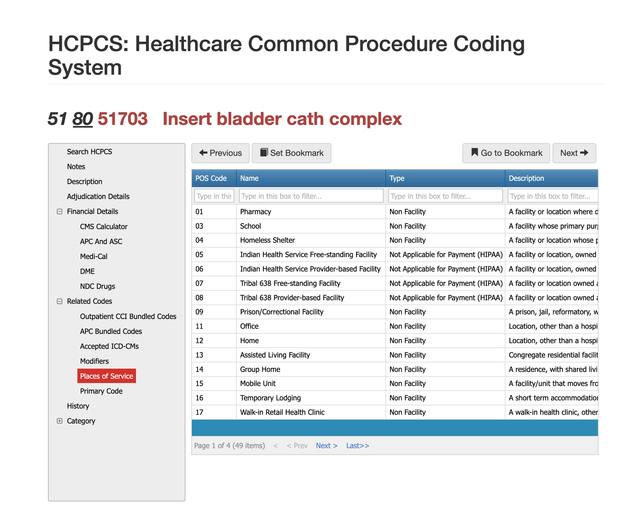
CPT 51703 applies when catheterization is complicated by urethral stricture, false passages, altered anatomy, or a condition requiring instrument change or additional passes. Per the CMS Physician Fee Schedule Relative Value Files RVU24A, 51703 carries materially higher RVUs than 51701, making the documentation requirement the deciding financial variable. The note must explicitly name the complicating condition and describe the additional technique used. A phrase like "catheterization performed without difficulty" written hours after a genuinely complicated encounter collapses a defensible that same figure into an indefensible one.
This is precisely where coding consistency across providers breaks down in busy practices. When one provider habitually captures complication language and another does not, the same clinical event produces different codes and different reimbursement, because the notes differed rather than the procedures. iScribe Health's Automated E&M Coding and E&M Coding Intelligence work at the point of note completion, after the AI drafts the encounter summary, applying consistent coding logic across every provider on the platform. That consistency directly impacts revenue by reducing the same figure-to-51701 downcoding that occurs when documentation is thin.
4. CPT 51798 - Post-Void Residual Ultrasound - Separate Billing vs. Bundling Rules
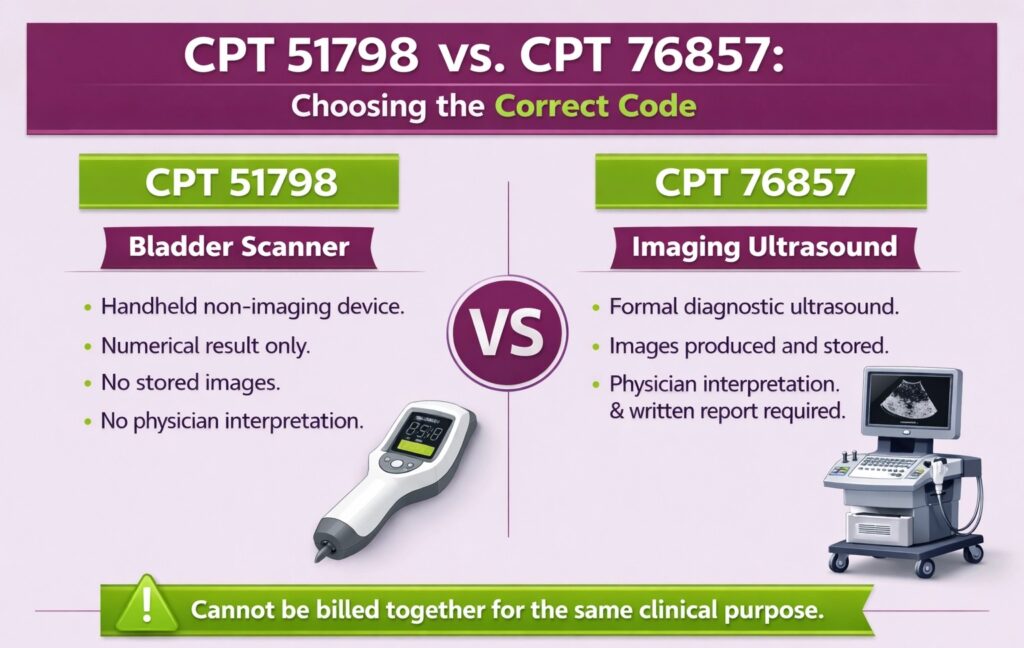
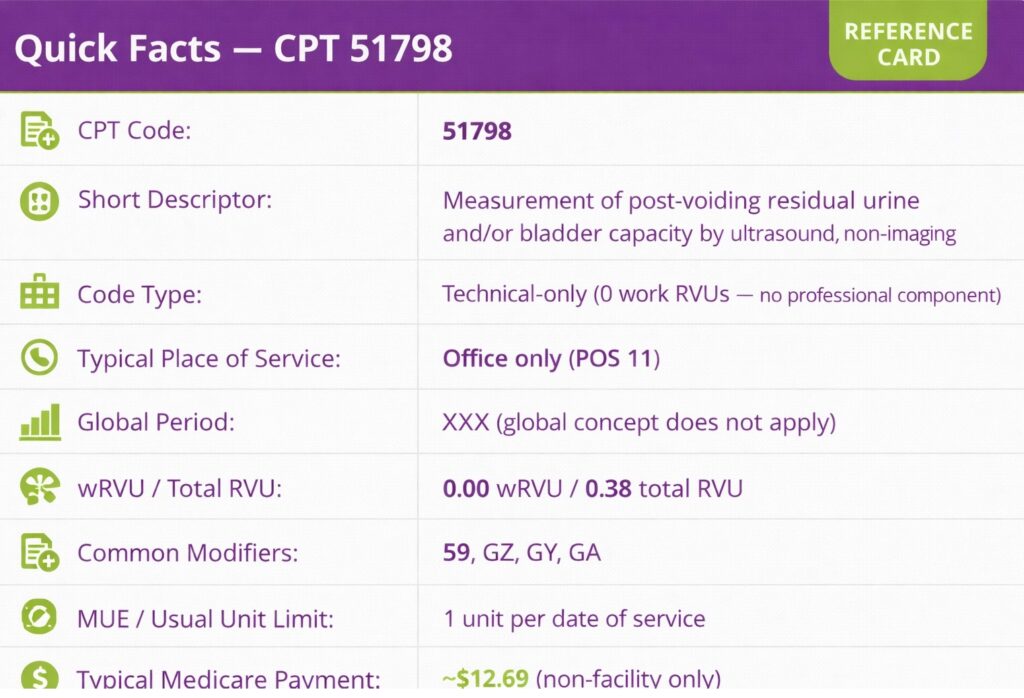
CPT 51798 covers bladder ultrasound to measure post-void residual (PVR) urine volume. It is separately billable when performed and documented as a distinct service with its own clinical indication, most commonly to evaluate urinary retention, lower urinary tract symptoms, or neurogenic bladder. The bundling risk is real: payers routinely deny that same figure when it is submitted alongside urodynamic studies or certain E&M visits without a modifier establishing medical necessity for the separate service. Documentation must reflect why PVR measurement was independently indicated, not simply that it was performed in the same visit.
iScribe Health's Real-Time Denial Alerts surface bundling conflicts at the point of note completion, before the claim leaves the practice, so a missing modifier or an absent medical-necessity statement can be corrected in the same workflow that produced the note, rather than discovered on a remittance weeks later.
5. Office-Based Urology CPT Codes by Category - A Practical Billing Overview
- CPT Code 51701 → Description: Simple, non-indwelling catheter insertion → Key Billing Condition: Normal anatomy; no complicating factors.
- CPT Code 51702 → Description: Temporary indwelling (Foley) catheter, simple → Key Billing Condition: Catheter left in place; straightforward placement.
- CPT Code 51703 → Description: Temporary indwelling catheter, complicated → Key Billing Condition: Note must name the complication and describe the technique.
- CPT Code 51798 → Description: Post-void residual ultrasound (bladder scan) → Key Billing Condition: Separately billable; distinct clinical indication required.
The Medicare Physician Fee Schedule assigns non-facility and facility RVUs separately for each of these codes, meaning the same catheterization service yields different payment depending on where it is performed. A perfectly selected code can still produce a lower-than-expected payment if the annual conversion factor or RVU values shift between the proposed and final MPFS rule, a dynamic the Medicare Physician Fee Schedule analysis published by the American Academy of Ophthalmology illustrates clearly for procedure-heavy specialties, where RVU reallocation and conversion-factor adjustments cascade directly into practice revenue. That risk is entirely outside a practice's control. The real revenue risk lives upstream, in the clinical note, before the code is ever chosen.
6. Documentation Requirements That Distinguish CPT 51701 from 51703 in the Clinical Note
Most urology providers know in the room which catheterization code applies. The problem surfaces hours later, when the note is dictated or typed and the specific detail that made the encounter complicated, the stricture encountered, the instrument swapped, the additional passes required, has been compressed into a phrase that won't survive an audit. This pattern is most acute in high-volume practices or health systems where clinicians regularly face substantial after-hours charting demands: by the time documentation happens, clinical memory has already smoothed over the procedural specifics that make that same figure defensible.
iScribe Health is most beneficial exactly in this scenario. EHR Integration delivers that note directly into the practice's supported EHR, eliminating the re-entry step that further degrades documentation quality in post-encounter dictation workflows. At the point of note completion, Automated E&M Coding reviews the drafted summary and applies coding logic consistently, so the code selection and the clinical note align from the start rather than diverging when a tired provider compresses a complicated encounter into a single generic phrase.
Practices running iScribe Health in high-volume urology settings benefit from this improvement across every patient encounter and every day of clinical practice, because the ambient documentation layer is active for every procedure, not just the ones a provider flags for review.
Office-based catheterization and bladder ultrasound represent the highest-volume, lowest-complexity end of the urology CPT spectrum. The bundling stakes rise sharply once the scope enters the picture. Endoscopic and cystoscopy codes introduce a layered hierarchy where a single documentation gap can collapse reimbursement across an entire procedure family.
What Are the Key Endoscopic and Cystoscopy CPT Codes Used in Urology
Cystoscopy accounts for the largest share of endoscopic volume in outpatient urology, which means the bundling rules governing its code family have an outsized effect on practice revenue. Getting the code right is only half the job. The more common failure point is that the clinical documentation doesn't establish whether the procedure was diagnostic or therapeutic, and that distinction determines whether CPT 52000 is separately reportable or silently absorbed by an NCCI edit before the claim ever pays. In high-volume urology practices, where clinicians routinely face significant after-hours documentation burdens, that documentation gap compounds across every encounter, every day, quietly eroding recoverable revenue at scale.
1. CPT 52000 - Diagnostic Cystoscopy as the Endoscopic Baseline Code
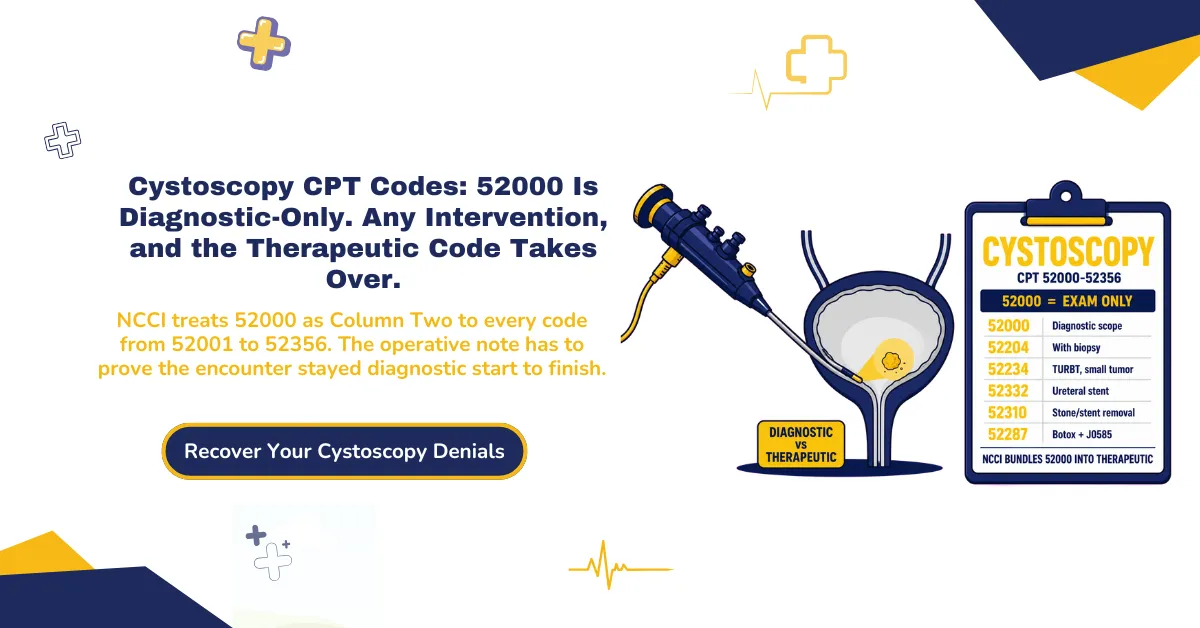
CPT 52000 is the foundation of urology endoscopic billing, covering diagnostic cystoscopy without any therapeutic intervention. The critical decision rule: when a therapeutic cystoscopy code is billed in the same session, industry data confirms that same figure bundles into the higher-level code and cannot be reported separately under NCCI rules. The practical limitation: most operative notes don't document the diagnostic cystoscopy as a distinct, independently performed service, so the modifier that would save the charge has no documentation to stand on. For practices managing high patient volumes, that omission repeats silently across hundreds of encounters before anyone recognizes the pattern.
2. NCCI Bundling Principles Governing the Cystoscopy and Bladder Endoscopy Code Family
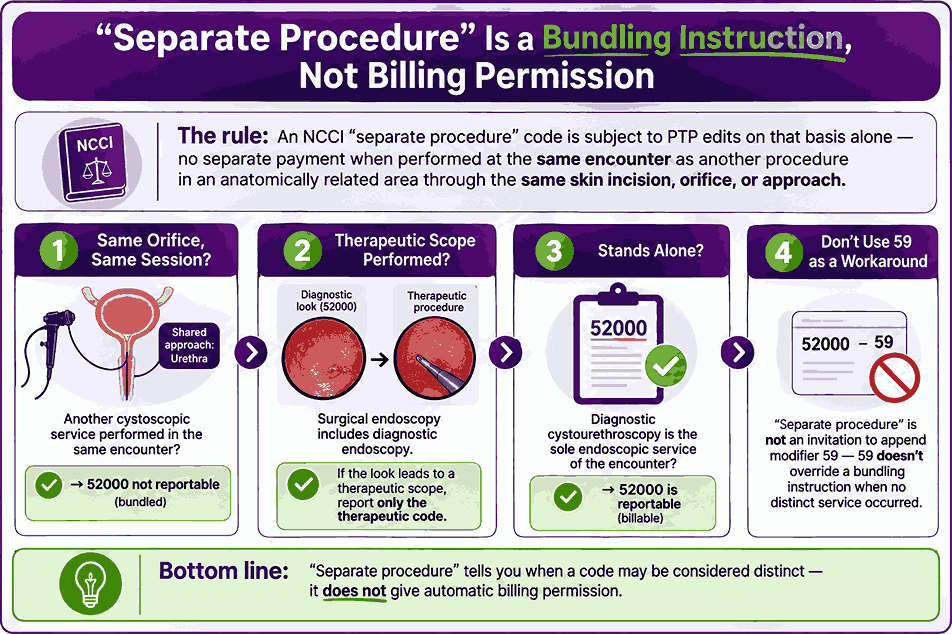
Same-session therapeutic codes including CPT 52204 (biopsy), 52224 (fulguration), 52332 (ureteral stent placement), and 52356 (laser lithotripsy) each trigger NCCI edits that bundle 52000 as a component, a pattern consistent with what most billing teams encounter across the market. Billing them together without a valid modifier and supporting note language results in denial of the lower-level code. The modifier alone is insufficient; Volari AI is explicit that the distinct-procedure modifier must be supported by documentation establishing each service as separately performed. This is where most practices lose recoverable revenue: the denial is preventable, but only when the operative note maps each billed code to a distinct clinical event before the claim is submitted, not after the denial arrives.
Accurate, compliant medical coding across high patient volumes demands that the note arrive complete, not reconstructed under denial pressure. Most billing teams handle this by flagging the denial and appealing with a modifier. That approach recovers some revenue, but it costs time and leaves the underlying documentation gap intact for the next encounter. The deeper fix is building the intent-specific language into the operative note at the point of care.
When a urologist's note explicitly documents that the diagnostic cystoscopy was performed as a separate, distinct service with its own clinical purpose, the NCCI edit has no foothold. Because iScribe Health integrates directly with supported EHRs, the AI drafts the encounter summary at the point of note completion, embedding the procedure-specific language physicians need without adding charting time. Real-time denial alerts surface bundling conflicts before the claim is submitted, giving the billing team an actionable signal while the encounter is still fresh rather than weeks later during a denial work queue review. The result is accurate, compliant coding at the volume urology practices actually run, without requiring clinicians to add a second documentation pass to every operative note.
Broader experience with cystoscopy bundling reinforces why that upstream specificity matters: practices that allow the documentation gap to persist don't just lose individual claims, they train payers to expect underdocumented notes, which increases audit exposure across the entire cystoscopy code family.
3. CPT 54150 - Male Circumcision as a Commonly Queried Office-Surgical Urology Code
CPT 54150 covers circumcision using a clamp or other device in patients older than 28 days, and it surfaces frequently in urology billing because commercial payer coverage varies sharply by medical necessity criteria. Without explicit documentation of the clinical indication, such as phimosis or recurrent balanitis, commercial payers routinely deny the claim as cosmetic or elective. The operative note must connect the diagnosis code to a documented condition, not just list the procedure. This is a medical necessity documentation problem, not a coding selection problem.
The cystoscopy code family represents the high-volume, lower-dollar layer of urology endoscopy. The highest-dollar documentation disruption sits one category over. The prostate biopsy code restructuring didn't just reassign numbers; it rewrote what the clinical note must contain for any of the new codes to survive a payer audit.
What Changed in Prostate Biopsy CPT Coding for 2026
Each replacement code requires clinical documentation that was never necessary under 55700, making this the most documentation-intensive coding change in urology this cycle.

CPT 55700 Is Gone - What the January 1, 2026 Deletion Actually Means for Claims
A practice that continues billing that same figure after January 1 faces denial, and this is precisely where coding consistency breaks down in high-volume urology settings. Coders may know the new codes, but the underlying clinical notes don't contain the discrete data points each code demands.
Prostate Biopsy CPT Codes 55707-55715 by Approach and Imaging
Broader industry trends map the breakdown precisely: 55707 covers transrectal systematic biopsy, 55708 covers transrectal MRI-fusion targeted biopsy, 55709 covers transperineal systematic biopsy, and add-on code 55715 captures each additional targeted lesion beyond the first.
Practices performing MRI-fusion biopsies on multi-focal lesions that fail to bill 55715 for each additional targeted core are leaving reimbursement on the table with every case.
iScribe Health's Ambient AI Documentation captures approach, imaging modality, and lesion count during the encounter itself, at the point of note completion after the AI drafts the encounter summary, so the discrete data points each new code demands are present before the claim is submitted.
CPT 55711 vs. 55708 - The Clinical Distinction That Determines Which Code Survives an Audit
The single distinguishing factor is anatomical approach: 55708 is transrectal, and 55711 is transperineal. A note that omits the approach renders the code selection indefensible under audit.
What Are the Main Surgical and Lithotripsy CPT Codes in Urology
The CPT code is only the address on the envelope; the ICD-10 diagnosis pairing is the postage. Mismatched ICD-10 diagnosis codes linked to surgical urology CPT codes are a primary driver of claim denials, even when the procedure code itself is selected correctly. That distinction matters because it shifts the problem upstream, into the operative note, before the claim is ever built, and it is exactly the gap that breaks coding consistency at scale.
1. CPT 50590 (ESWL) - Non-Invasive Kidney Stone Fragmentation via Shock Wave
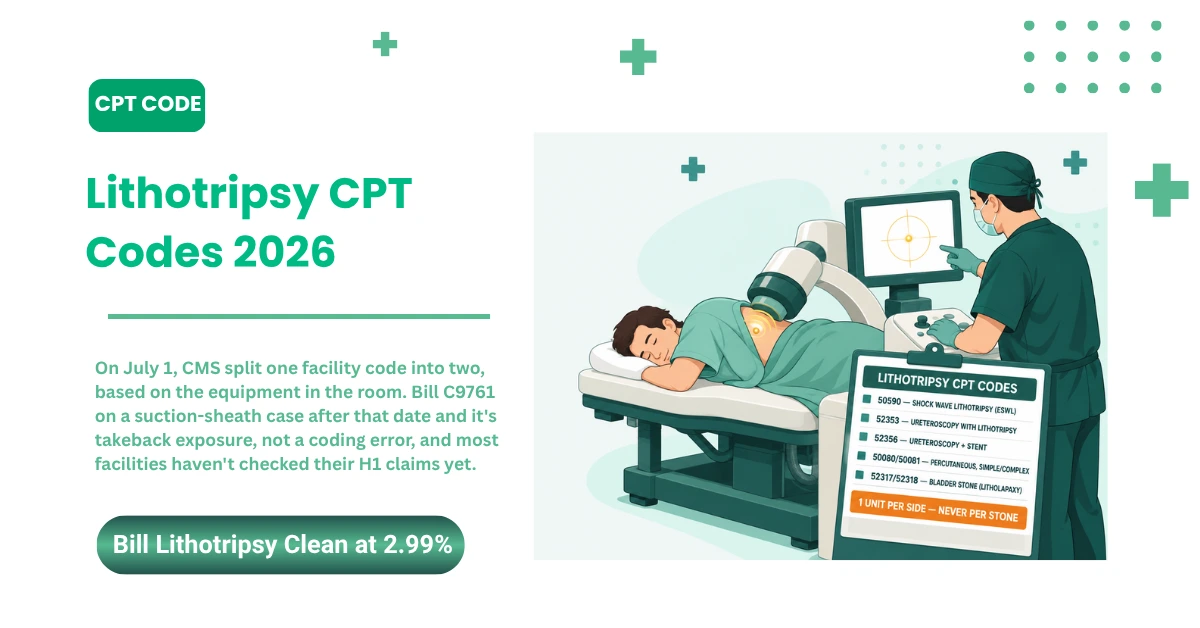
CPT 50590 covers extracorporeal shock wave lithotripsy for kidney stone fragmentation. Its required ICD-10 companion is a confirmed urolithiasis code, most commonly N20.0 (calculus of kidney). Submitting 50590 without a laterality-specific stone diagnosis triggers automatic medical-necessity rejection. The financial exposure is real: a denied ESWL claim eliminates the full Medicare reimbursement for that session, with no partial payment fallback on a non-covered denial.
The root cause is almost never a billing error; it is a documentation gap. In high-volume urology practices, where clinicians routinely face heavy after-hours documentation loads, a quickly dictated operative note that omits stone laterality gives billing staff nothing clean to attach. iScribe Health's ambient listening and conversational AI captures those diagnosis-specific details, laterality, stone confirmation, clinical context, at the point of care, before the note is finalized and the denial clock starts. Because iScribe Health integrates directly with supported EHRs, that laterality-specific detail lands in the structured note without requiring a separate documentation step from the physician.
2. CPT 52601 (TURP) - Transurethral Resection of the Prostate for BPH

CPT 52601 is the standard code for transurethral resection of the prostate and requires a BPH diagnosis, specifically N40.1 (benign prostatic hyperplasia with lower urinary tract symptoms). Billing 52601 against a prostate cancer ICD-10 is one of the most documented denial patterns in urology billing: payers treat it as a medical-necessity mismatch and reject the claim outright, regardless of how cleanly the procedure code was selected. Industry research identifies this pairing failure as a consistent upstream documentation problem, not a downstream billing one.
iScribe Health's E&M Coding Intelligence and Automated E&M Coding surface the correct diagnosis pairing in the draft encounter summary the AI generates at the point of note completion. Practices we work with that run high surgical volumes, where resection completeness language is often left ambiguous in a rushed dictation, use iScribe Health's real-time denial alerts to catch these mismatches before the claim is submitted rather than after the denial arrives.
3. CPT 52597 (Aquablation) - Category III to Category I Transition in 2026
Aquablation transitioned from Category III code 0421T to Category I code 52597 effective 2026, a shift that directly affects Medicare reimbursement eligibility and RVU assignment under the CMS physician fee schedule. Practices that have not updated their charge masters are billing a retired code, which means denials on every Aquablation claim until the fee schedule is corrected. The Category I transition is not automatic inside most EHRs; it requires a manual charge master update.
iScribe Health's EHR integration is designed to surface exactly this kind of structural code transition risk. Rather than relying on billing staff to audit charge master currency, practices using iScribe Health within a supported EHR environment can identify retired-code exposure through real-time denial alerts before claims leave the practice, improving coding consistency across every Aquablation encounter from the point the transition takes effect.
4. CPT 55250 (Vasectomy) - Male Sterilization Procedure With Bilateral Coding Nuance
CPT 55250 covers vasectomy as a unilateral procedure by definition. A bilateral vasectomy, which is the clinical standard, requires specific modifier application to avoid underpayment or denial. Misapplication of modifier 50 on 55250 is a documented billing error pattern in urology practices, often producing either a duplicate-service denial or a single-unit payment when two units were performed. The operative note must confirm bilateral resection explicitly to support the correct submission.
This is a coding consistency problem that begins in the operative note. When the note does not explicitly confirm bilateral resection, the modifier cannot be defended on audit. iScribe Health's ambient AI documentation captures the bilateral confirmation at the moment the procedure is described, giving billing staff the note language they need to apply the modifier correctly, and giving the practice the audit trail to support it.
5. Surgical Urology CPT Codes by Subcategory - Kidney, Ureter, Prostate, and Male Reproductive
As industry data documents, surgical urology CPT codes organize by anatomical subcategory: kidney and ureter procedures (anchored by that same figure), prostate procedures (52601 and 52597), and male reproductive procedures (55250). Each subcategory carries distinct documentation thresholds and payer coverage requirements. Treating them as interchangeable within the broader surgical urology bucket is a reliable path to denials that look like coding errors but originate in documentation gaps.
Improving coding consistency across all three subcategories requires meeting each one's documentation threshold at the point of care, not reconstructing detail after the fact. That is where ambient listening, applied inside a supported EHR through iScribe Health, changes the structural dynamic: the AI drafts the encounter summary with subcategory-specific detail while the physician is still in the room, so the note that reaches billing already supports the claim.
6. ICD-10 Diagnosis Pairings and Denial Risk for Surgical Urology CPT Codes

The CPT code identifies the procedure; the ICD-10 code justifies it. Pairing a correct CPT code with an unsupported or non-covered diagnosis results in automatic denial. For surgical urology, the highest-risk pairings are that same figure without a confirmed calculus code, 52601 without N40.1, and 52597 submitted under the retired Category III code. Industry research confirms that most of these mismatches originate in the operative note, not the billing queue.
Billing staff working from a quickly dictated note that omits stone laterality or leaves resection completeness ambiguous have no clean ICD-10 to attach. For practices already running a supported EHR, the integration is seamless: the AI listens during the encounter, drafts the summary at the point of note completion, and feeds accurate, pairing-ready documentation directly into the workflow that feeds billing.
Getting the surgical code and its ICD-10 companion right is necessary, but it is not sufficient on its own. How these codes behave alongside companion procedures on the same claim is governed by a separate layer of rules: the modifier system, where a single missing or misapplied modifier can unravel an otherwise clean surgical claim.
What Modifiers Are Commonly Used With Urology CPT Codes
Modifier selection in urology billing is not a knowledge problem. Most experienced coders know what modifier 59 means. The real problem is that a modifier appended to a claim is only as defensible as the clinical note language behind it, and that language has to exist before the note is finalized, not reconstructed by a biller hours later.
1. Modifier 59 - The Broad Distinct Procedural Service Modifier and Its Audit Exposure
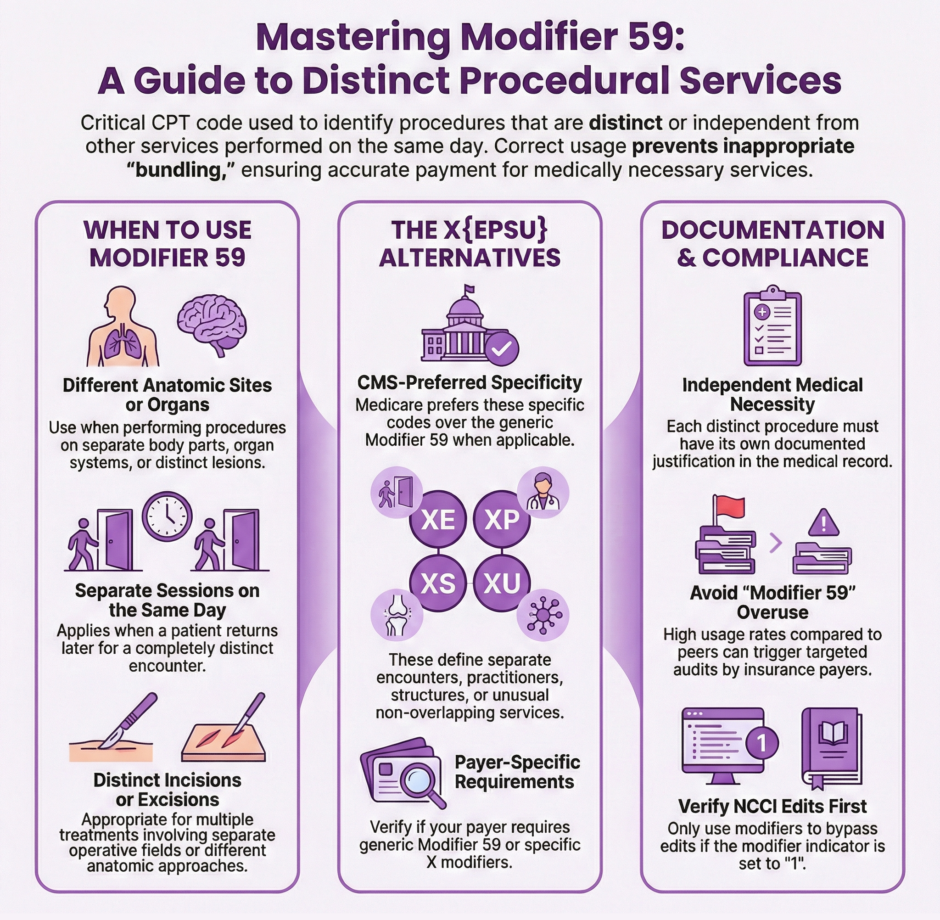
Modifier 59 signals a distinct procedural service not normally reported together with another code. In urology, it appears frequently when billing a post-void residual ultrasound alongside an E&M visit, or a urethral dilation alongside cystoscopy. The audit exposure is real: CMS has explicitly flagged modifier 59 as one of the most misused modifiers across specialties, and RAC auditors routinely target urology claims where 59 is appended without note language explicitly stating why the service was distinct. Defaulting to 59 when a more specific X-modifier applies is the single fastest way to invite a recoupment review.
2. X-Modifiers (XE, XP, XS, XU) - Choosing the Right Descendant Over Modifier 59
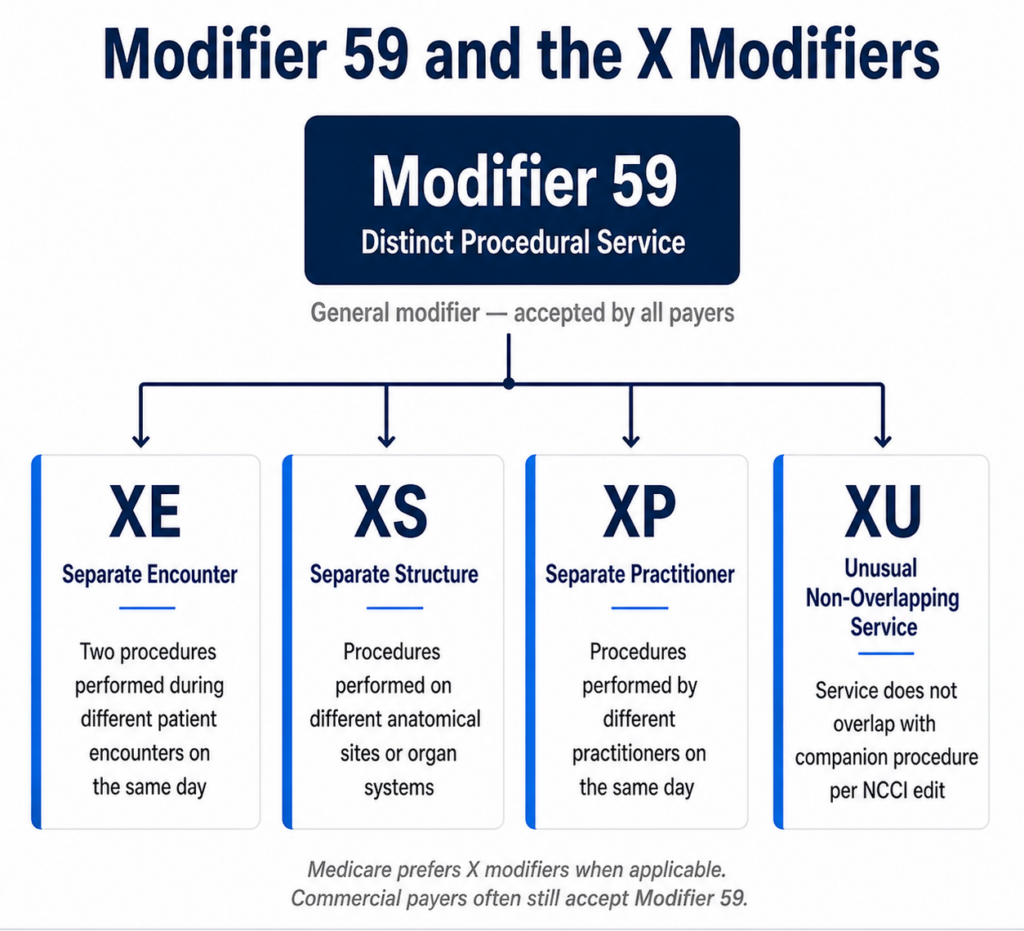
CMS introduced XE (separate encounter), XP (separate practitioner), XS (separate structure), and XU (unusual non-overlapping service) to replace imprecise use of modifier 59 on urology CPT codes. XS is most common in urology when procedures are performed on anatomically distinct structures, such as a ureteroscopy and a cystoscopy billed together. The tradeoff is that payers vary in acceptance, and selecting the wrong X-modifier can trigger the same denials as an unsupported 59.
3. Modifier 50 - Bilateral Procedure Reporting for Paired Urologic Structures

Modifier 50 applies when the same procedure is performed on both sides of a paired structure, such as bilateral ureteral stent placement or bilateral orchiectomy. Medicare reimburses bilateral procedures at 150% of the single-procedure allowed amount, paid on one line with modifier 50 appended. The documentation requirement is precise: the operative note must name both sides explicitly. A note that says "stent placed" without specifying laterality will not support modifier 50 on audit, regardless of what the claim says.
150%
of the single-procedure allowed amount
4. Modifier 58 and Modifier 79 - Staged and Unrelated Procedures Within the Global Period

Modifier 58 covers a staged or related procedure performed during the global period of a prior procedure, when the second procedure was planned or anticipated at the time of the first. Modifier 79 covers an unrelated procedure during the same global period. Misapplying these is a consistent audit trigger in urology: using 79 for a clearly staged TURP follow-up, for example, signals to payers that the second procedure was unplanned when the clinical record shows otherwise. The distinction lives entirely in the original operative note, which must indicate whether a staged approach was anticipated.
5. Clinical Note Documentation Language That Substantiates Any Modifier Claim
Every modifier above fails audit scrutiny without explicit supporting language in the clinical record. Phrases like "distinct procedural service performed at a separate anatomical site" or "procedure performed bilaterally, both sides documented" are not optional; they are the evidentiary basis for the modifier. The structural challenge for most urology practices is that this language must be composed in real time by the treating physician. Billers reconstructing it after the fact are producing a note that looks unsupported to an auditor. AI-powered scribing captures and structures that clinical specificity at the point of care, so the note arriving in billing already carries the language that makes every modifier defensible before the claim is filed.
Getting the modifier right is a necessary condition for reimbursement, but it is not sufficient on its own. Even a perfectly documented, correctly modified urology claim can be denied if the procedure pair runs into a bundling rule the billing team never saw coming, which is exactly where NCCI edits enter the picture.
Related Reading
- Cpt Code 55700
- Cpt Code 51700
How NCCI Edits Affect Urology CPT Code Bundling and Reimbursement
Part B News (DecisionHealth) reported in April 2025 that a single quarterly NCCI update introduced nearly 40,000 new edit pairs, a volume that makes manual reference tracking functionally impossible for any urology billing team managing a full procedure mix. Coding errors including NCCI bundling violations account for approximately 30% of all claim denials, the single largest denial category, yet correcting coding knowledge alone does not close the gap because documentation failures and payer-specific edit logic operate independently of what the coder knows.

When NCCI Column 1/Column 2 Edits Trigger Urology Claim Denials
NCCI column 1/column 2 edit pairs designate one code as the comprehensive service and a second as the component; when both appear on the same claim for the same patient on the same date, the column 2 code is automatically denied. That outcome is rarely a coding oversight in isolation; more often, the modifier was omitted because the underlying note contained nothing to support it.
This is the documentation gap that practice administrators and billing decision-makers in high-volume urology settings consistently encounter: the clinical note was never built to carry the modifier-supporting content the payer's edit logic requires. iScribe Health's Ambient Listening and Conversational AI captures procedure-specific language in real time, distinct anatomical site, separate clinical indication, and independent medical necessity, so the note already contains that content before a coder ever touches the claim. Because iScribe Health integrates directly with supported EHRs, the AI-drafted encounter summary materializes at the point of note completion, inside the workflow the practice is already running, with no separate charting step required.
The Three NCCI Denial Patterns That Drain Urology Revenue
The three most common patterns, as identified by Part B News (DecisionHealth) in April 2025, are:
- Billing a bundled pair without a modifier
- Appending a modifier without documentation that establishes the service as distinct
- A place-of-service mismatch where the edit applies in one setting but the claim reflects another
The rework loop of appealing denials costs time and rarely recovers the full denial volume, because the appeal still has to produce documentation that was never written during the encounter. iScribe Health's Real-Time Denial Alerts add a downstream check: when a note pattern associated with a common bundling failure is detected, the alert surfaces before the claim leaves the practice, giving the billing team an opportunity to correct the record rather than manage a denial. That pre-submission intervention works in concert with note-level accuracy to address all three patterns across the claim.
iScribe Health's E&M Coding Intelligence and Automated E&M Coding complement the note-level work by applying coding logic after the AI drafts the encounter summary, reinforcing reimbursement integrity across the full claim, not just at the procedure-code level.
Why Modifier Appended Without Supporting Documentation Is the Costliest of the Three Patterns
Of the three denial patterns, the second, appending a modifier without documentation that establishes the service as distinct, produces the most compounding financial damage because it creates both an immediate denial and a compliance exposure that survives the rework cycle.
But the note was never written to carry that distinction in terms the payer's edit logic can evaluate, and the result is that a defensible claim becomes an indefensible one the moment it is reviewed. iScribe Health's Ambient Listening and Conversational AI resolves this at the source: because the AI captures the encounter in real time, procedure-specific language, separate anatomical site, independent clinical indication, and the sequencing of distinct services are embedded in the note as the encounter unfolds, not reconstructed afterward when the detail that would have supported the modifier is no longer recoverable. The modifier and its supporting documentation are aligned from the start, closing the compliance exposure before it opens.
Why Incomplete Documentation Makes Every Urology CPT Code a Revenue Risk
Audited encounter data exposes a structural problem that no CPT reference list can fix: when the clinical note arriving at billing is incomplete, the coder's knowledge becomes irrelevant. The Journal of Medicine, Health Sciences Research confirms that inpatient medical record documentation is routinely subject to formal audit evaluation for both quality and completeness, treating documentation deficiency as a measurable, structural failure rather than an isolated coder misstep. That framing matters for urology practices, because the ceiling on reimbursement is set the moment a clinician finalizes a note.
The 55% Accuracy Floor - What Audited Urology Encounter Data Actually Shows
Audit benchmarks consistently show that a significant share of encounters arrive at billing with notes that cannot fully support the code submitted, so real revenue is left on the table across nearly every clinic day. Overcoded encounters, flagged at meaningful rates in audited ambulatory sites, create compliance exposure that no modifier can retroactively resolve. Coders working from an incomplete note are making the best defensible decision from insufficient raw material.
Why the CPT Code List Is Necessary but Not Sufficient Without a Documentation Foundation
Knowing every correct CPT code, modifier, and bundling rule does not change the outcome when the clinical note fails to supply the specificity each code requires. Documentation gaps operate as independent denial triggers, and correcting coder knowledge alone cannot eliminate them. The coder's reference list becomes executable only when the physician's record already contains the language needed to justify a modifier, distinguish a separate procedure, and establish medical necessity. Without that foundation, the reference is aspirational rather than operational.
How Real-Time Ambient Documentation Closes the Gap
iScribe Health's AI medical scribe addresses that gap directly: ambient documentation captures MDM complexity, procedure-specific detail, and ICD-10-relevant clinical context in real time, so the note reaching billing is already built to support the code rather than forcing coders to defend one that was never complete enough to begin with.
The CPT codes, modifiers, and bundling rules in this reference are only as valuable as the clinical notes that activate them. The next section shows you exactly what a documentation workflow built to make those codes stick actually looks like in practice.
iScribe Health is purpose-built for independent and specialty urology practices that want active implementation support and a documentation layer integrated into their clinical workflow.
Related Reading
- Cpt Code 52356
Next steps
If your urology practice keeps seeing claim denials despite experienced coders and updated code references, the path forward starts with fixing what arrives at billing before anyone selects a code. As this guide established, coding errors including NCCI bundling violations account for approximately 30% of all claim denials, yet correcting coder knowledge alone cannot close the gap when documentation gaps operate as independent denial triggers. The code list is necessary. It is not sufficient. Start with our AI medical scribe.
The 2026 prostate biopsy restructuring makes this concrete: codes 55707, 55708, 55709, and 55711 differentiate on anatomical approach and imaging guidance method simultaneously, meaning only a note that captures both elements at the point of care can defensibly support the correct code. No coder can reconstruct approach from imaging type alone. That same principle applies across the cystoscopy family, where NCCI edits fire automatically when the operative note fails to establish each billed service as distinct and independently performed. Together, these two dynamics point to the same corrective action: building the clinical specificity into the note during the encounter, not after a denial arrives.
Start with an AI medical scribe built for the documentation precision urology billing actually requires. iScribe Health's ambient capture records approach details, imaging methodology, MDM complexity, and procedure-level specificity in real time, so the note reaching your billing queue already contains the language that makes every modifier, every new prostate biopsy code, and every bundling distinction defensible before the claim is submitted.
Frequently Asked Questions
When I bill CPT 52000 alongside a therapeutic cystoscopy code in the same session, why does it keep getting denied?
CPT 52000 bundles into higher-level therapeutic cystoscopy codes under NCCI rules, so same-session codes like 52204, 52224, 52332, and 52356 trigger edits that absorb 52000 as a component. A modifier can protect the charge, but only when the operative note explicitly documents the diagnostic cystoscopy as a separately performed service with its own clinical purpose, without that language, the modifier has nothing to stand on.
What's actually changing with prostate biopsy CPT codes in 2026?
The post notes that four new prostate biopsy CPT codes are replacing the previous codes and that the restructuring rewrote what the clinical note must contain for any of the new codes to survive a payer audit. The post begins to address this topic but does not provide further detail in the section shown.
What's the difference between CPT 51701, 51702, and 51703, and does it actually matter for revenue?
Yes, the financial difference is material. CPT 51701 covers simple non-indwelling catheter insertion with no complicating factors and carries the lowest RVUs of the three; 51702 covers temporary indwelling (Foley) catheter placement under straightforward conditions; and 51703 applies when catheterization is complicated by factors like urethral stricture or altered anatomy and carries materially higher RVUs than 51701. The deciding variable in each case is whether the clinical note names the specific conditions and techniques that distinguish one code from another.
Can CPT 51798 for a post-void residual bladder scan be billed separately, or does it always bundle with other services?
CPT 51798 is separately billable when it is performed and documented as a distinct service with its own clinical indication, most commonly to evaluate urinary retention, lower urinary tract symptoms, or neurogenic bladder. Payers routinely deny it when submitted alongside urodynamic studies or certain E&M visits without a modifier establishing medical necessity for the separate service, so the documentation must explain why PVR measurement was independently indicated, not just that it was performed in the same visit.
If my coders are selecting the right urology CPT codes, why are claims still being downgraded or denied?
Code selection and clinical documentation are two separate failure points, and most revenue loss originates in the note, not the billing queue. A biller who correctly selects 99214, for example, but works from a physician note that documents only one or two elements of medical decision-making will see that claim downcode to 99213 on review, the code was right, but the note didn't support it. The post identifies documentation deficiency, not code selection error, as the driver of the majority of urology claim denials.