8 Urology Coding Cheat Sheet Tips for Faster Claims 2026
Billing teams, close the revenue gap with a urology coding cheat sheet built on documentation that actually supports the level you bill.


Your cheat sheet can't fix what the note never captured. The revenue leak in urology billing starts at documentation, and by the time coding touches the chart, the damage is already done.
Yet billing teams at urology practices often carry the weight of a system that was never designed to catch errors at their actual source. The cheat sheet is on the wall, the modifier training is done, and the denial-tracking workflow is running.
Yet claims still come back, E/M levels still get questioned, and revenue still quietly disappears. Looking upstream at the clinical encounter where the documentation was created explains why. Practices that have invested in AI-powered clinical documentation are discovering that the coding step is only as strong as the note that feeds it, a pattern reflected in iScribe Health's encounter audit data, where a meaningful share of finalized notes diverged from the complexity the provider intended to bill.

A coding reference tells you what to bill. It cannot tell you what the note actually says. Based on our market understanding, a significant portion of E/M visits carry documentation that does not fully support the level billed, meaning a meaningful share of evaluation and management encounters across physician practices contain gaps that would not survive a payer review.
That is a documentation failure that presents as a coding failure. Urology is a procedurally dense specialty. A single clinic day routinely includes diagnostic cystoscopies, post-void residual checks, catheter placements, and back-to-back established patient visits. That pace creates real pressure on documentation.
A common pattern: the physician completes the clinical reasoning in the room, moves to the next patient, and reconstructs the note from memory later. Details that support medical decision-making complexity get compressed or omitted entirely, not from carelessness, but from time.
The gap is visibility.
By the time a coder touches the chart, the opportunity to capture the full clinical picture has already passed. A stricter pre-submission audit or tighter modifier training cannot close this gap because those tools act on the claim after the documentation deficiency has already been created and the window to capture the full clinical picture has already closed. The fix must happen at the point of care, not the point of coding. Most urology practices do not discover this documentation gap until they audit a denial pattern, by which point weeks of revenue have already quietly slipped through. The next section puts a number on exactly how much, and why it is almost always invisible until it is not.
Key takeaways
- Only ~55% of E&M visits are accurately documented, meaning the cheat sheet on your wall is working from incomplete raw material before a single code gets selected.
- Billing errors in urology almost always originate in the exam room, not the billing queue; chasing denials downstream is the costliest place to fix a documentation problem.
- iScribe's internal encounter audits found a 33% overcoding rate across a sample of urology visits, nearly one in three encounters carrying repayment exposure the practice hadn't yet identified.
- Claim denial rates run at 7-10% of submitted claims industry-wide, and coding and documentation errors are consistently among the primary drivers, not modifier confusion, not fee schedule gaps.
- A urology coding cheat sheet accelerates clean claims only when the clinical note already contains the specificity that supports the code level chosen; without that, the reference guide is decorative.
- iScribe Health's E&M Coding Intelligence closes the gap by generating AI-powered coding recommendations from the complete clinical narrative, not just the finalized note, so the right code is supported before the claim is ever built.
The Hidden Revenue Leakage Most Urology Practices Discover Too Late
An internal iScribe encounter audit found a 33% overcoding rate across a sample of urology visits reviewed against documented clinical complexity. In that audit set, nearly one in three encounters carried repayment exposure the practice had not yet discovered. The common assumption among practice administrators and billing decision-makers is that a better coding reference, a sharper cheat sheet, more modifier training, or a stricter pre-submission audit will close the revenue gap.

That assumption misreads where the problem originates. When a physician is documenting late into the evening, fatigued, working from memory, racing to clear the queue, the conditions for MDM mismatches and specificity gaps are structural, not accidental. No reference sheet resolves a structural problem at the point of documentation.
What iScribe Encounter Audits Reveal About Miscoded Urology Visits
Center for Sports Medicine & Orthopaedics, Chattanooga: 941 encounters analyzed, 54.8% provider-AI agreement, 33% overcoding rate found. Until they ran the trial, no one in the building knew the split. A3 Medical Billing denial-rate benchmarks by specialty confirm that urology's procedural mix generates above-average claim vulnerability, a pattern consistent with the direction of iScribe's internal findings, and one that makes the downstream financial stakes of each miscoded visit considerably higher than in lower-acuity specialties.
Overcoding creates retroactive repayment liability that grows silently across every billing cycle until a payer flags it. According to the Revenue Synergy 2026 RCM Benchmark Report, this exposure is most acute in high-volume practices and health systems where the sheer number of daily encounters means even a modest per-visit miscoding rate accumulates into material financial risk across a billing period.
iScribe Health's E&M Coding Intelligence is designed to interrupt that accumulation before it begins. Operating through Ambient Listening and Conversational AI, it reads the complete clinical narrative as the encounter unfolds, before the note is locked, and surfaces coding-level recommendations at the point of note completion, after the AI drafts the encounter summary, giving clinicians an opportunity to reconcile documentation gaps while the clinical context is still immediate.
The Three Compounding Denial Drivers Inside Every Miscoded Urology Claim
Modifier misuse, ICD-10/CPT specificity gaps, and Medical Decision-Making documentation mismatches do not operate independently. Each one amplifies the others when they appear together in the same claim. The financial consequence of stacking them is what most practices underestimate, and what A3 Medical Billing denial benchmarks show accumulates disproportionately in specialty practices with high procedural volumes.
Why Payer Audits Are the Most Expensive Place to Catch Urology Coding Errors
The cost of a coding error rises sharply depending on where in the revenue cycle it is caught. When overcoding is discovered at a payer audit rather than at the point of documentation, repayment demands, penalties, and retroactive denials routinely compound across multiple billing periods; industry compliance guidance consistently notes that lookback windows can extend well beyond a single billing cycle. iScribe Health's E&M Coding Intelligence reads the complete clinical narrative as it is generated, surfacing Automated E&M Coding recommendations before the note is locked, so overcoding exposure and MDM documentation gaps are caught at the source, not on a payer's audit report six months later.
8 Urology Coding Cheat Sheet Tips That Speed Up Clean Claims in 2026
Your cheat sheet is only as powerful as the clinical note behind it. That sentence is not a cliché; it is the structural reality that explains why urology practices with trained billing staff and printed CPT reference guides still face denial rates that erode monthly revenue. Clean claims depend on documentation that supports the specific code level chosen, a principle the Docsity / Emory University Medical Coding and Billing Standards guide makes explicit, not merely selecting a code from a reference sheet.
Each of the eight tips below is actionable today. Each one also has a hard ceiling: the clinical note. Keep that ceiling in mind as you work through the list.
Apply Modifier 25 Only When the Note Stands Alone
Modifier 25 allows billing a significant, separately identifiable E/M service on the same day as a minor procedure, but payers expect the E/M documentation to stand entirely on its own if audited. The gomedicalbilling.com urology cheat sheet is direct: documentation must clearly separate the assessment and plan from the procedure note. Coders who have worked through modifier 25 denials consistently report the same pattern: the note existed, but it read like a pre-procedure checklist rather than an independent evaluation. That distinction is what auditors look for, and it cannot be reconstructed after the fact.
iScribe Health's real-time denial alerts surface exactly this risk, flagging encounters where the E/M narrative has not established its independence from the procedure note before the claim is built, while the clinical detail is still accessible rather than locked inside a finalized document.
Choose the Correct Stone and Ureteroscopy Code by Approach
Code 52356 covers cystourethroscopy with ureteroscopy and stone fragmentation with or without stent placement, the most common endoscopic stone approach in outpatient urology. Codes 50080 and 50081 cover percutaneous nephrostolithotomy, differentiated by stone burden. The approach documented in the operative note determines the correct code; a note that describes ureteroscopic access but is vague about whether fragmentation or stent placement occurred leaves the coder choosing between codes with meaningfully different reimbursement profiles.
Code 52332, cystoscopy with indwelling ureteral stent insertion, carries a substantially higher non-facility reimbursement than the diagnostic cystoscopy code, making precise code selection critical to realizing earned revenue. Getting the approach and the intervention right requires a note that captures both explicitly.
In high-volume practices where operative notes are reconstructed hours after the procedure, the specificity of approach and intervention is exactly what erodes. iScribe Health's ambient AI documentation captures that procedural detail in real time, giving the coder the explicit language needed to select between 52332 and 52356 with confidence rather than querying the surgeon the following day.
1. E/M Office Visit Codes 99202-99215 - Level Selection by MDM Complexity
The essential E/M codes for urology office visits are 99202 through 99205 for new patients and 99212 through 99215 for established patients, with level determined by medical decision-making complexity across three documented elements: number and complexity of problems, amount and complexity of data reviewed, and risk of complications or morbidity. Billing 99215 requires all three elements to reach high complexity. When the clinical note captures only the diagnosis and a brief plan, the MDM collapses to a 99213 on audit.
Per the Docsity / Emory University Medical Coding and Billing Standards review, clean claims depend on documentation supporting the specific code level chosen, not merely selecting a code from a reference sheet. The reimbursement gap between that same figure and a 99215 is real and recurring across every day of clinical practice in a high-volume urology setting. iScribe Health's E&M Coding Intelligence evaluates the complete ambient-captured narrative at note completion and surfaces the MDM elements needed to defend the level billed, before the claim is submitted. The fix starts in the exam room.
2. Bladder Catheterization Codes 51701/51702/51703 and Post-Void Residual 51798 - Indication-Driven Selection
The main bladder catheterization CPT codes are 51701 for insertion of a non-indwelling catheter, 51702 for insertion of a temporary indwelling catheter in a straightforward anatomy, and 51703 for a complicated insertion where altered anatomy or clinical complexity is documented. The distinction between 51702 and 51703 is entirely note-dependent: if the physician encountered resistance, used a coude tip, or managed a stricture, the note must say so explicitly or 51703 will not survive a payer review. Code 51798 covers post-void residual urine volume measurement by ultrasound and is separately billable when performed as a distinct diagnostic service with a documented clinical indication. Billing 51703 on every catheterization regardless of complexity is a pattern auditors flag quickly.
iScribe Health's ambient AI documentation captures the clinical specificity, resistance encountered, instrument used, anatomical complexity, as it is spoken during the encounter, giving the coder the note language needed to defend 51703 without a retrospective query that may arrive too late or never arrive at all.
3. Cystoscopy Code Family 52000/52204/52224 - Bill the Most Comprehensive Service and Avoid Unbundling
The main cystoscopy CPT codes and their differences come down to what was performed during the scope. com. 39 non-facility; 52224 covers cystoscopy with fulguration or treatment of a minor lesion.
Diagnostic cystoscopy (that same figure) is bundled into more extensive operative cystoscopies performed during the same session unless separate distinct pathology is documented and the operative note explicitly supports it. Billing that same figure alongside 52204 in the same session without that documentation triggers a CCI edit denial. Bill the most comprehensive service performed, and let the operative note justify it.
As the Docsity / Emory University Medical Coding and Billing Standards guide affirms, accurate and compliant coding across high patient volumes requires documentation that supports the specific service billed. iScribe Health's real-time denial alerts surface bundling conflicts before the claim is built, so the coder resolves the issue with the complete narrative in hand rather than after an automatic CCI edit rejection.
4. 2026 Prostate Biopsy Code Overhaul - CPT 55700 Deleted, New 55707-55715 Family Effective January 1 2026
CPT code 55700 is deleted effective January 1, that same figure, and any claim submitted with it after that date receives an automatic invalid-code rejection with no grace period. The replacement family differentiates by approach and imaging guidance. Code 55707 covers transrectal, ultrasound-guided biopsy; 55705 covers nonimaging-guided biopsy of any approach, with its descriptor revised from the 2025 version to reflect the expanded code set. Urology coding update, imaging guidance codes 76872 and 76942 are now bundled into the new family and cannot be billed separately.
New prostate biopsy codes also differentiate transrectal versus transperineal approach, and MRI-fusion guidance combines pre-biopsy MRI images with real-time ultrasound. Practices that have not updated their superbills will face a wave of rejections that looks like a payer system error but is a reference-sheet problem. iScribe Health's EHR integration routes the approach and guidance method captured in the ambient narrative directly to the correct replacement code, eliminating the superbill gap before it generates a January rejection wave.
5. Critical Urology Modifiers -25, -50, -59/-X{EPSU}, and -LT/-RT - Apply Only When Documentation Explicitly Supports Each
Which modifiers are critical for urology billing comes down to four that drive the majority of preventable denials. Modifier 25 allows a separately identifiable E/M on the same day as a minor procedure, but only when the note stands independently of the procedure documentation. Modifier 50 applies to bilateral procedures not inherently bilateral by code description, such as bilateral ureteral stent placement; omitting it cuts the allowable in half.
Per gomedicalbilling.com's urology reference, some payers prefer modifiers LT and RT over modifier 50, so confirming payer-specific requirements before submission prevents a correctable denial. Modifier 59 or its X-variant signals a distinct procedural service at a separate site; without explicit documentation of that separate site and indication, the modifier creates audit exposure rather than resolving a bundling conflict. iScribe Health's real-time denial alerts evaluate the ambient-captured narrative against modifier requirements before the claim is submitted, surfacing the specific documentation gaps, missing site descriptions, procedure-note conflation, absent bilateral language, that make each modifier indefensible on audit.
6. Same-Day E/M and Procedure Billing With Modifier -25 - Separate Evaluation Beyond Pre-Service Work Required
You can bill an E/M and a procedure on the same day when the evaluation represents a significant, separately identifiable service that goes beyond the pre-service work already included in the procedure's global package. The documentation must make that separation visible: the assessment and plan in the note must read as an independent clinical decision, not as a setup paragraph for the procedure that follows. The gomedicalbilling.com urology cheat sheet states directly that payers expect E/M documentation to clearly stand on its own if billed separately. Coders who have worked through modifier 25 denials consistently encounter the same pattern: the note existed, but it read like a pre-procedure checklist. That distinction cannot be reconstructed after the encounter closes.
iScribe Health's ambient AI documentation captures the full evaluation narrative, the independent clinical reasoning, the assessment, and the plan, as it unfolds during the encounter, before the procedure begins, giving the E/M note its own documentary foundation that does not depend on the procedure note to be coherent. The E&M Coding Intelligence then flags at note completion whether the captured narrative is sufficient to stand alone under a modifier 25 audit.
7. Ureteroscopy and Stone Codes 52332/52356 Plus Ureteral Access Codes 50080-50548 - Scope and Approach Define the Code
Code 52356 covers cystourethroscopy with ureteroscopy and stone fragmentation with or without stent placement, the standard endoscopic stone approach in outpatient urology. Codes 50080 and 50081 cover percutaneous nephrostolithotomy, differentiated by stone burden. The approach and the specific intervention documented in the operative note determine the correct code; a note that describes ureteroscopic access but is vague about whether fragmentation or stent placement occurred leaves the coder choosing between codes with meaningfully different reimbursement profiles.
Code 52332, cystoscopy with indwelling ureteral stent insertion, carries a substantially higher non-facility reimbursement than the diagnostic cystoscopy code, making it critical that the operative note explicitly supports the service billed. Getting the approach and the intervention right requires a note that captures both explicitly, not a procedure checkbox that leaves the specifics implied.
iScribe Health's ambient AI documentation captures the procedural specificity, approach, fragmentation, stent placement, in real time during the operative encounter, eliminating the reconstruction gap that forces coders to choose between that same figure and 52356 based on inference rather than explicit note language.
8. ICD-10 Specificity Rules for Urology - Laterality, Histology, and Stage Must Drive Diagnosis Code Selection
Unspecified ICD-10 diagnosis codes are the fastest route to a medical necessity denial in urology billing. In urology, that means coding to laterality (left ureter, right kidney), to confirmed pathology rather than symptom codes when the diagnosis is established, and to the specific condition rather than a catch-all unspecified code.
The problem is that the specificity sits in the physician's narrative and never reaches the coding field, because it was never transcribed with the precision the ICD-10 system requires, or because the note was reconstructed after the encounter and the laterality was not recorded explicitly. That is a documentation workflow failure, and it is the same ceiling that limits every other tip on this list. iScribe Health's ambient listening captures laterality, histology, and clinical stage as spoken during the encounter, and the EHR integration carries that specificity directly into the diagnosis code field, closing the gap between what the physician knew and what the claim ultimately says.
Related Reading
- Hipaa Compliant Ai Scribe
- Top Medical Scribe Companies
- How Does An Ai Scribe Work
- Medical Scribe Cost
- Ai Scribe Cost
Common Urology Coding Mistakes That Keep Triggering Preventable Denials
Fixing that documentation workflow failure matters more urgently than most urology practices recognize. Claim denial rates for physician practices run at roughly 7-10% of submitted claims according to MGMA and AAFP benchmarking data, and coding and documentation errors remain among the primary drivers of preventable rejections. Most of these errors are not random. They repeat. The same mistake archetypes show up claim after claim because the root cause was never addressed.
10%
of submitted claims
Here is what those archetypes actually look like in urology billing, and what breaks each cycle.
1. Undercoding E/M Levels Because the Note Doesn't Reflect Actual MDM Complexity

Undercoding when the encounter warranted 99214 is a documentation failure that was already locked in before the claim was touched. As industry benchmarking analysis confirms, the note does not reflect the medical decision-making complexity the provider actually performed, so the correct code has no evidence to stand on. The cycle repeats because the documentation deficiency repeats, visit after visit, across every provider on the schedule. iScribe Health's Automated E/M Coding applies coding intelligence at the point of note completion, after the Ambient Listening AI drafts the encounter summary, giving the MDM complexity a contemporaneous evidentiary foundation rather than a reconstructed one.
2. Applying Modifier -25 Without a Separately Documented Significant Evaluation
Modifier -25 is valid only when the physician documented an evaluation that went meaningfully beyond the procedure's pre-service work. Billing teams that append it to every same-day E/M without checking the note create a pattern payers flag quickly, and audits can reach back across multiple prior billing cycles. The fix is a note that captures the separate clinical reasoning at the moment of the encounter, before the opportunity to document it has passed. iScribe Health's Ambient Listening captures that reasoning conversationally in real time, and EHR Integration delivers it into the existing workflow without requiring the physician to chart separately after the visit.
3. Using Modifier -59 Without Distinct Procedure Documentation to Override Bundling Edits

Modifier -59 identifies a genuinely distinct procedural service. Applying it to cystoscopy billed alongside a biopsy code in the same session, without documented distinct pathology, is a recognized false-claims exposure area, as industry analysis identifies modifier misuse among the primary drivers of rising preventable denials. Coders who apply the modifier without supporting operative documentation are escalating the compliance risk attached to it.
4. Omitting Laterality Modifiers -LT and -RT When the Procedure Site Is Clearly Documented
Skipping laterality modifiers on unilateral or bilateral procedures reads to payers as an incomplete claim, triggering a denial that requires resubmission of the exact same note that already contained the answer. The clinical documentation almost always specifies the site; the problem is that the coding workflow never surfaces it systematically. This is a preventable urology denial that repeats precisely because no process step forces the laterality detail out of the note and onto the claim before submission. iScribe Health's E/M Coding Intelligence is built to improve coding consistency by extracting exactly these procedural specifics, laterality included, from the complete clinical narrative at the point of note completion.
5. Using ICD-10 Unspecified Codes When the Note Contains the Specificity to Support a Precise Diagnosis

Defaulting to an unspecified diagnosis code is often a coder habit, but industry benchmarking identifies defaulting to unspecified diagnosis codes as a direct revenue and audit risk when the clinical note already contains the laterality, stage, or histology needed for a precise code. High unspecified-code rates draw MAC and RAC scrutiny. The note had the answer; the coder never found it because mining dense documentation is slower than picking the default. iScribe Health's E/M Coding Intelligence works from the complete clinical narrative captured during the encounter, surfacing diagnosis specificity before the note is finalized, so the precise ICD-10 detail is already organized and accessible rather than buried in prose.
6. Bundling Violation - Billing CPT 52000 Alongside 52204 or 52224 in the Same Operative Session
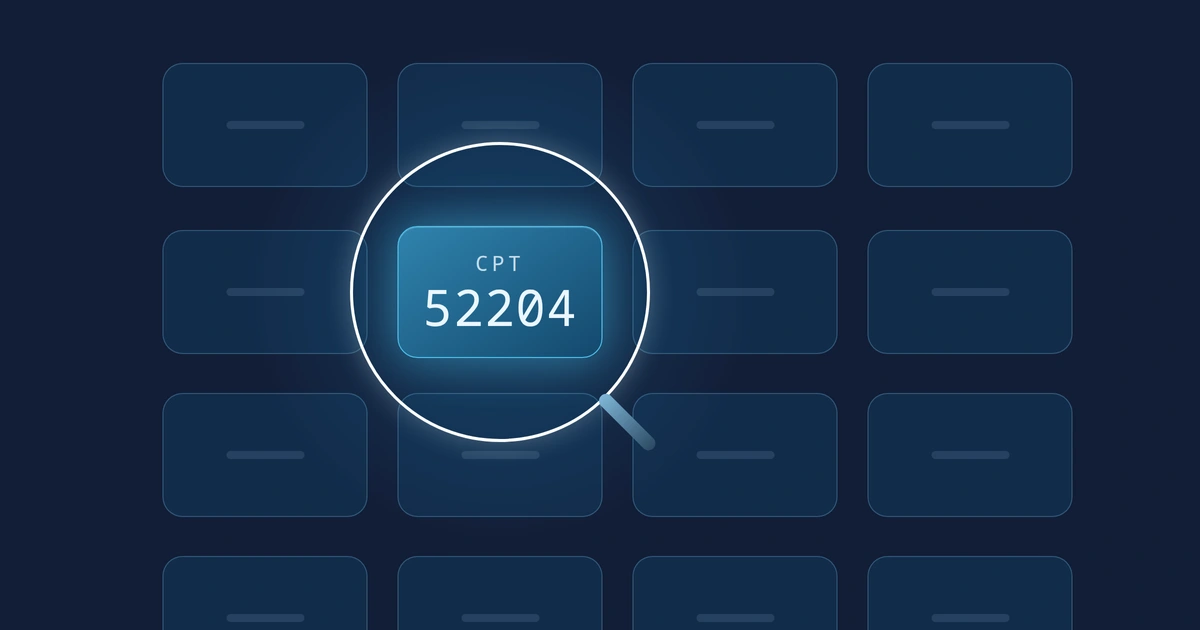
Cystoscopy (52000) is a component of more complex endoscopic procedures like biopsy (52204) or fulguration (52224) and is bundled under NCCI edits. Billing both on the same date without documented distinct pathology or a separate, independent indication is a bundling violation that guarantees denial and flags the account for post-payment audit. The urology coding cheat sheet fix: confirm NCCI edits before submitting any cystoscopy-plus-intervention claim.
7. Failing to Query the Physician When Documentation Gaps Create Avoidable Unspecified or Lower-Level Codes

When a note is ambiguous about diagnoses considered or data reviewed, coders either undercode to stay safe or overcode and invite scrutiny. A structured query process improves accuracy, but it is a workaround for documentation that should have captured the MDM detail in real time. By the time the query goes out, the physician is three patients ahead, and the addendum reflects a best guess rather than contemporaneous clinical reasoning, which weakens the claim's defensibility under audit. iScribe Health's Ambient Listening removes this gap by capturing clinical reasoning during the encounter itself, so the detail coders would otherwise have to query for is already in the note when it reaches the billing team.
8. Ignoring Global Period Rules When Billing E/M Visits After Urology Procedures

Billing a standard E/M visit during the global period of a urology procedure without a modifier, or without documentation showing a problem unrelated to the original procedure, produces a denial that coders often attribute to a system error rather than a documentation gap. The payer's logic is correct: the note does not demonstrate that the visit fell outside the procedure's included follow-up care. The fix requires the physician to document the distinct, unrelated clinical problem at the time of the visit, not as an afterthought on resubmission. iScribe Health's Real-Time Denial Alerts and EHR Integration surface these coding distinctions within the existing workflow, so the documentation gap is visible before the claim leaves the practice rather than weeks later in a remittance report.
How AI-Powered E/M Coding Intelligence Closes the Documentation Gap the Cheat Sheet Can't
A well-built urology coding cheat sheet is a genuine asset, but billing teams that rely on one often hit the same ceiling: denials that trace back not to coding errors but to documentation that never captured what the physician actually did.

Why Your Urology Coding Cheat Sheet Stalls When the Clinical Note Is Incomplete
The cheat sheet defines what a compliant claim requires, but it cannot supply clinical detail the note never recorded.
How Real-Time Documentation Turns Cheat Sheet Tips Into Defensible Claims
A coding tool that reads the finalized note works with whatever survived the documentation process. iScribe Health's E/M Coding Intelligence captures the complete clinical narrative in real time at the point of care, then surfaces coding recommendations from that full context before anything is lost to memory or time pressure. Ambient AI scribing captures all threads of a complex encounter as the visit unfolds. In iScribe Health's internal encounter audits, a striking share of finalized notes diverged from the complexity the provider intended to bill, a gap the real-time capture workflow is designed to close by surfacing documentation completeness signals before the note is locked rather than after.
Turning Each Cheat Sheet Tip Into an Enforceable Billing Workflow
AI documentation intelligence structurally relocates the quality-control checkpoint from the billing department back to the exam room, which is the only stage of the revenue cycle where a documentation deficiency can be corrected rather than compensated for. When a coding gap surfaces at claim submission, the physician's clinical intent during that encounter was never fully transferred into the medical record, a loss that no post-submission process can recover. Broader market data on AI-powered claim scrubbing tools has attributed clean-claim rate improvements of up to 30% to these workflows, a figure that reflects upstream documentation quality as much as billing-side accuracy, since scrubbing tools can only work with the clinical detail the note actually contains.
That foundation is what real-time documentation intelligence is built to provide.
Related Reading
- Best Ai Scribe For Athenahealth
- Ai Medical Scribes With E&m Coding Built In
- Ai Scribe Accuracy
- Do Ai Scribes Reduce Claim Denials?
Next steps
If your billing team is still chasing urology denials with modifier training and a tighter pre-submission audit, the path forward starts with fixing documentation at the encounter, before the note is ever finalized.
The insight that modifier misuse and ICD-10 specificity errors are documentation retrieval failures, not coder knowledge gaps, means no reference tool can close a gap that formed in the exam room. The finding that AI documentation intelligence structurally relocates the quality-control checkpoint from the billing department back to the encounter means the 30% clean-claim rate improvement attributed to upstream documentation capture is not a billing-side gain at all. Together, they point to one action: capturing complete clinical detail in real time, so every MDM element, laterality marker, and procedural distinction exists in the note before a coder or scrubbing tool ever sees the claim.
Start with Best AI medical scribe for orthopedic practices to see how iScribe Health's ambient listening and E&M Coding Intelligence work inside your existing EHR workflow. From there, the coding recommendations your billing team needs are grounded in what was actually documented during the encounter, not reconstructed from memory after it.
Frequently Asked Questions
Why does my urology practice still get claim denials even after modifier training and pre-submission audits?
Because the root cause is documentation, not coding. By the time a coder opens a finalized note, the window to capture the full clinical picture has already closed, and no amount of modifier training or pre-submission auditing can fix a documentation deficiency that was created earlier in the encounter.
What CPT codes replaced 55700 for prostate biopsies in 2026?
CPT 55700 was deleted effective January 1, 2026, with no grace period. The replacement family runs from 55705 through 55715, sorting claims by approach and imaging guidance, for example, 55707 covers transrectal, ultrasound-guided biopsy, while 55705 covers nonimaging-guided biopsy of any approach. Imaging guidance codes 76872 and 76942 are now bundled into the new code set and cannot be billed separately.
When is it appropriate to bill a diagnostic cystoscopy (52000) versus a cystoscopy with biopsy (52204)?
The code selection must follow what was actually performed and documented. Diagnostic cystoscopy (52000) is bundled into more extensive operative cystoscopies performed during the same session unless separate distinct pathology is documented, and billing 52204 when only a diagnostic scope was performed is an overbilling risk, but billing 52000 when a biopsy was taken leaves meaningful reimbursement on the table.
How do I correctly use Modifier 25 on a day when a procedure is also billed?
Modifier 25 allows billing a significant, separately identifiable E/M service on the same day as a minor procedure, but the E/M documentation must stand entirely on its own if audited, it cannot read like a pre-procedure checklist. Payers look specifically for whether the assessment and plan are clearly separated from the procedure note.
What are the three main denial drivers in urology claims, and why do they compound each other?
Modifier misuse, ICD-10/CPT specificity gaps, and Medical Decision-Making documentation mismatches are the three compounding denial drivers. A visit billed with an unsupported MDM level is already vulnerable; attach a modifier that does not survive scrutiny and the claim fails on two vectors simultaneously, and adding a non-specific diagnosis code makes the denial nearly impossible to overturn on appeal.