Urology Billing Codes Reference Guide for Faster Claims
Urology billing codes mean little when the note fails. Billing decision-makers gain cleaner claims and real reimbursement with E&M Coding Intelligence.


Your coders aren't the problem. The revenue you're losing is locked inside the clinical note before billing ever opens the chart, and no amount of coding expertise can recover complexity that was never documented.
Urology practices invest heavily in billing staff, credentialing, and denial workflows, then watch revenue shortfalls repeat quarter after quarter with no clear explanation. But the problem rarely shows up in the clearinghouse queue. It is locked into the clinical note long before a coder ever opens the chart.
Only approximately 55% of urology E&M visits are accurately documented, creating a structural revenue ceiling before billing even begins. That number is a documentation metric. Nearly half of every encounter a urologist sees contains a note that fails to fully reflect what clinically occurred, and that gap is permanent by the time billing opens the chart.
55%
of urology E&M visits accurately documented
The ceiling this creates is concrete. If a provider sees 20 complex patients daily but the note only supports a 99214 complexity level when the encounter genuinely warranted a 99215, the per-encounter revenue loss compounds across every provider, every day, every quarter.

As Infohub Consultancy Services states directly: "Coders can only code what is documented." A certified coder reviewing a note that omits medical decision-making complexity, skips the number of diagnoses addressed, or fails to document the data reviewed has no raw material to work with. Expertise does not manufacture evidence that was never captured. Even billing teams following correct CPT and ICD-10 rules experience revenue leakage when the underlying clinical documentation fails to reflect encounter complexity.
Coders can only code what is documented.
The most preventable urology revenue loss occurs at the point of documentation, not at the clearinghouse. Denial management addresses errors that survived into the claim. It cannot address complexity that never made it into the note. Platforms like iScribe Health's E&M Coding Intelligence work at the point of documentation to surface billable complexity in real time, before the note closes and the coding opportunity is gone. This approach is supported by the industry finding that only 55% of urology E&M visits are accurately documented at the note level. The documentation gap is the structural problem.
Key takeaways
- Only ~55% of urology E&M visits are accurately documented, meaning the bigger revenue leak isn't denied claims, it's charges that never get coded correctly in the first place.
- CPT 55700 becomes a hard rejection on January 1, 2026; the replacement family (55707-55715) raises documentation thresholds that coders can't meet if the clinical note didn't capture them.
- Cystoscopy, stone management, and prostate surgical billing each fail at the same point: the operative note, not the fee schedule, by the time a denial arrives, the dictation window is closed.
- Unspecified ICD-10 codes trigger automated medical necessity edits before a human reviewer ever sees the claim, specificity at the diagnosis level carries the same weight as modifier accuracy.
- Seven modifiers drive the majority of preventable urology denials, and in every case the modifier was appended but the clinical note never delivered the proof the payer required.
- Denial rate, A/R days, and First-Pass Resolution Rate are lagging indicators of what happened in the exam room, tightening denial management downstream doesn't fix a documentation gap upstream.
- iScribe Health's E&M Coding Intelligence reads the complete clinical narrative in real time, not just the finalized note, and surfaces coding recommendations before the encounter closes, closing the gap where urology revenue actually disappears.
CPT Codes for Diagnostic and Therapeutic Cystoscopy Procedures in Urology
The operative report header reads "cystoscopy." The correct CPT code lives three paragraphs deeper, buried in a sentence about tumor size. That gap, repeated across dozens of encounters each month, is where urology revenue quietly disappears.
1. CPT 52000 - Diagnostic Cystourethroscopy (Baseline Surveillance Code)

CPT 52000 is the foundational cystourethroscopy code billed when a physician performs visual inspection of the urethra and bladder with no therapeutic intervention. It is appropriate for surveillance scopes and initial diagnostic evaluations, but it is also the most commonly miscoded default. Coders who rely on the operative note title rather than the procedure body routinely submit 52000 when a biopsy, fulguration, or stent placement was actually performed, systematically undercoding every therapeutic encounter. At high patient volumes, the exact environment where accurate, compliant coding matters most, this pattern compounds quickly into measurable revenue loss and elevated denial rates (Cadence Collaborative).
2. Selecting Diagnostic vs. Therapeutic Cystoscopy Codes Based on Encounter Documentation
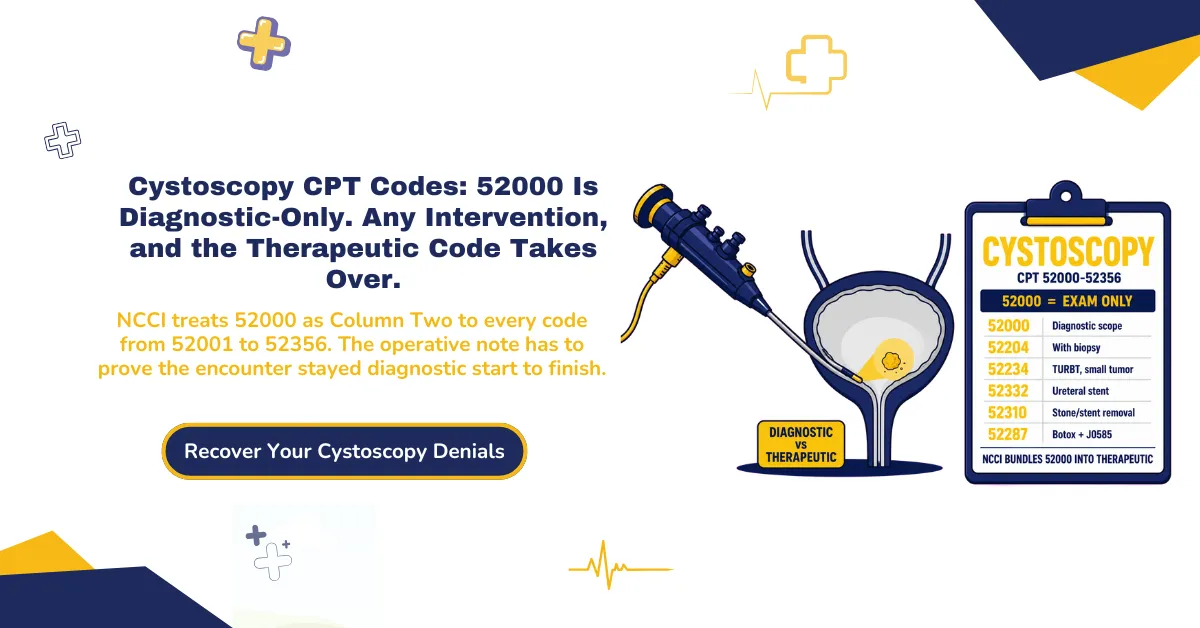
The correct cystoscopy CPT code is determined entirely by what was performed, not what the note is titled. When a therapeutic intervention occurs, the therapeutic code subsumes the diagnostic component: CPT 52204 (biopsy, pathology billed separately), CPT 52001 (evacuation of blood clots), and CPT 52005 (ureteral catheterization with separate imaging billing) each replace 52000 entirely when the corresponding intervention is documented. Billing that same figure alongside any of these codes is a bundling error (Cadence Collaborative). The decision tree starts with one question: did the scope stay diagnostic, or did the surgeon do something?
In high-volume urology practices, where clinicians regularly chart two or more hours outside of patient care time, answering that question correctly at scale requires that the documentation capturing the answer be complete before it reaches the billing team. That is the workflow problem iScribe Health's Ambient AI Documentation is built to solve.
3. Upcoding/Downcoding Error Between CPT 52224 and 52234 Due to Tumor Size Documentation Gaps
This is where urology billing accuracy stops being a coding problem and becomes a documentation problem. 0 cm) (Express MBS). Selecting the correct code requires precise tumor size documentation in centimeters within the operative report.
When a surgeon dictates "small lesion treated" without specifying dimensions or distinguishing fulguration from excision, the coder cannot legally select between that same figure and 52234 without guessing. That is a documentation capture failure, and it happens before the chart ever reaches the billing team (Cadence Collaborative).
Most practices assume their coders read every operative note carefully enough to catch these distinctions. The real constraint is that coders can only code what the note actually says. When lesion size is absent, intervention type is ambiguous, or the note header contradicts the procedure body, even an experienced biller is forced to downcode or flag the claim for physician query, adding days to the reimbursement cycle (Cadence Collaborative).
iScribe Health's Ambient Listening and Conversational AI captures the complete clinical narrative at the point of care, procedure intent, concurrent findings, and lesion dimensions, so the detail that determines the correct cystoscopy CPT code exists in the AI-drafted encounter summary before the coder opens the chart. Because iScribe integrates directly with supported EHRs, that note lands where coders already work, without a separate handoff step. The Real-Time Denial Alerts layer adds a downstream check: when documentation gaps do slip through, the system surfaces them at the point of note completion rather than after a claim has already been rejected, keeping the reimbursement cycle intact across every encounter.
The limitation worth naming: this approach requires provider adoption during the encounter itself, not after. Practices with physicians who dictate retrospectively will need a workflow change alongside any documentation tool. iScribe Health is most impactful where clinicians are already motivated to reclaim the hours lost to after-hours charting, a condition that high-volume urology groups consistently meet.
Cystoscopy codes are only the entry point into urology's most documentation-sensitive billing territory. The next category, prostate biopsy, has undergone a structural CPT overhaul for 2026 that renders the previously ubiquitous code 55700 obsolete, and the replacement codes carry documentation requirements that most existing note templates were never built to satisfy.
2026 Prostate Biopsy CPT Code Updates That Replace 55700
The replacement family, 55707-55715, does not simply rename the procedure; it restructures how the work is defined and documented.

The American Medical Association CPT that same figure code set replaced it with the 55707-55715 family, which maps each code to a specific combination of approach type (systematic vs. targeted) and imaging modality. A practice that migrated to 55707 on paper but whose provider note still reads "prostate biopsy performed" has not completed the transition, because the documentation itself no longer supports the code being billed.
A provider note that previously supported a that same figure claim will now support no valid claim at all, because the new codes require explicit capture of biopsy approach type and imaging modality that most existing templates were never built to record.
The that same figure-55715 codes bundle imaging guidance directly into the procedure code, which means separately billing an imaging guidance code alongside them constitutes unbundling. Systematic unbundling across a high-volume urology practice creates a pattern that payers flag during retrospective audits, and the recovery demands that follow can exceed the original billing gains many times over. Research indexed in PubMed (National Library of Medicine) continues to reinforce that documentation precision at the point of care is the single most controllable variable in downstream claim integrity.
To support any code in the that same figure-55715 family, the provider note must explicitly state the biopsy approach (systematic or targeted) and the imaging modality used, and that language must be present before the claim is submitted, not reconstructed after a denial.
iScribe Health's ambient AI documentation captures the full clinical narrative in real time, approach type, imaging modality, and procedural specifics, through ambient listening and conversational AI during the encounter itself. At the point of note completion, after the AI drafts the encounter summary, the practice already holds the documentation required to support a legitimate code assignment across the entire that same figure-55715 family.
Captured approach and modality versus a generic procedure entry determines whether a completed procedure generates a clean claim or no billable claim at all. iScribe Health's E&M Coding Intelligence and Real-Time Denial Alerts are designed to ensure accurate, compliant medical coding across high patient volumes, maximizing reimbursement and minimizing claim denials at the only moment it can be controlled: when the encounter is still live.
CPT Codes for Endourology and Kidney Stone Management Procedures
Kidney stone procedure coding lives or dies in the operative note, not the fee schedule. By the time a denial arrives, that dictation window has closed.
1. CPT 50590 (ESWL) - Indications, Medicare Coverage Nuances, and Bundling Rules
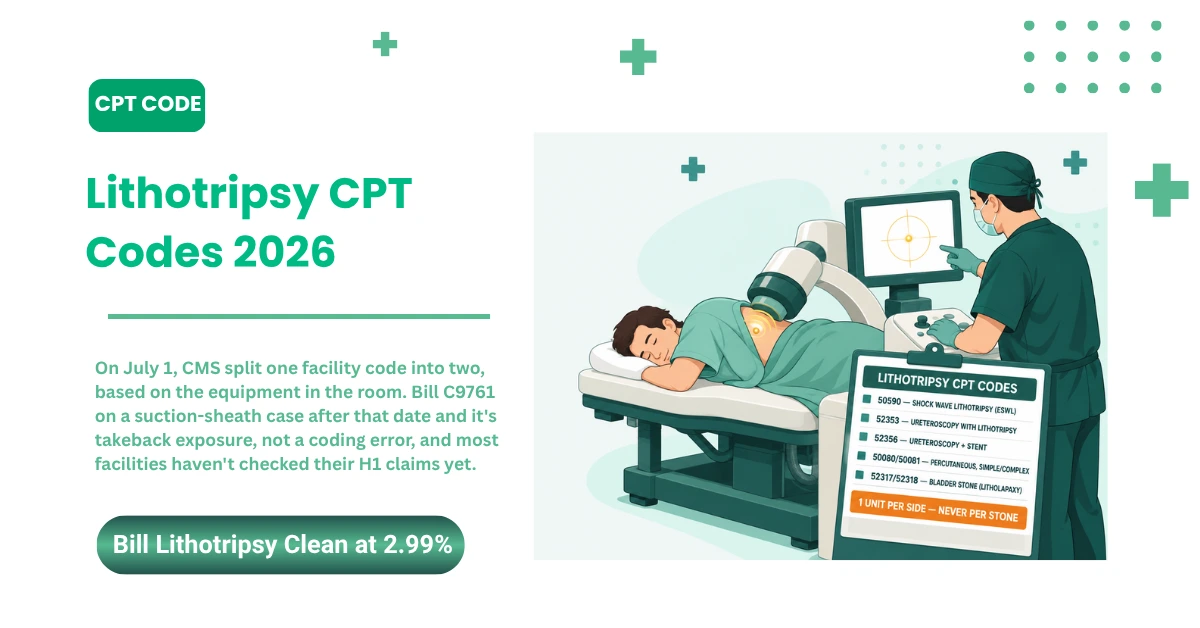
CPT 50590 covers extracorporeal shock wave lithotripsy for renal and ureteral calculi. Medicare covers it when medical necessity is documented with a specific ICD-10 (N20.0 or N20.1), but same-day stent insertion creates a bundling exposure: payers frequently deny separately billed CPT 52332 when performed on the same date as 50590 without a distinct clinical justification and supporting modifier. The site-of-service distinction also matters, since facility and non-facility RVU rates differ materially for this code.
2. CPT 52332 (Ureteral Stent Insertion) - Add-On Billing Errors and Global Period Traps

CPT 52332 (cystourethroscopy with insertion of an indwelling ureteral stent) is frequently miscoded as CPT 52282, a urethral stent code. That single-character transposition is a measurable, recurring billing error in urology practices. When that same figure falls within the global period of a prior stone procedure, it requires modifier 78 (return to OR for related procedure) or the claim will deny as bundled. Documentation must confirm the clinical reason for the return encounter.
3. CPT 52353 vs. 52352 - Distinguishing Lithotripsy Performed from Lithotripsy Attempted
This is the highest-stakes distinction in endourology billing. CPT 52353 (ureteroscopy with lithotripsy) requires operative documentation confirming the lithotripsy device was activated and stone fragmentation occurred. CPT 52352 (ureteroscopy with removal of foreign body or calculus) applies when the procedure was attempted but fragmentation was not achieved or confirmed. Billing that same figure when the note does not confirm fragmentation is a medical necessity mismatch that payers flag on pre-payment review. Most teams working from real-time clinical documentation capture this distinction at the point of care, before the chart is finalized.
4. ICD-10 Pairing - N20.0 (Calculus of Kidney) and N20.1 (Calculus of Ureter) - Specificity Requirements

N20.0 (calculus of kidney) and N20.1 (calculus of ureter) are not interchangeable, and payers treat N20.9 (unspecified) as a flag for pre-payment scrutiny. The imaging report and operative note must confirm stone location before the coder selects the diagnosis code. Pairing that same figure (ureteroscopic lithotripsy) with N20.0 when the stone was in the ureter creates a procedure-diagnosis mismatch that delays payment and can trigger a medical necessity request. Specificity at the ICD-10 level is the payer's primary signal for approval.
5. Endourology Surgical Procedure Billing by Body Area - Kidney vs. Ureter vs. Bladder Site Specificity
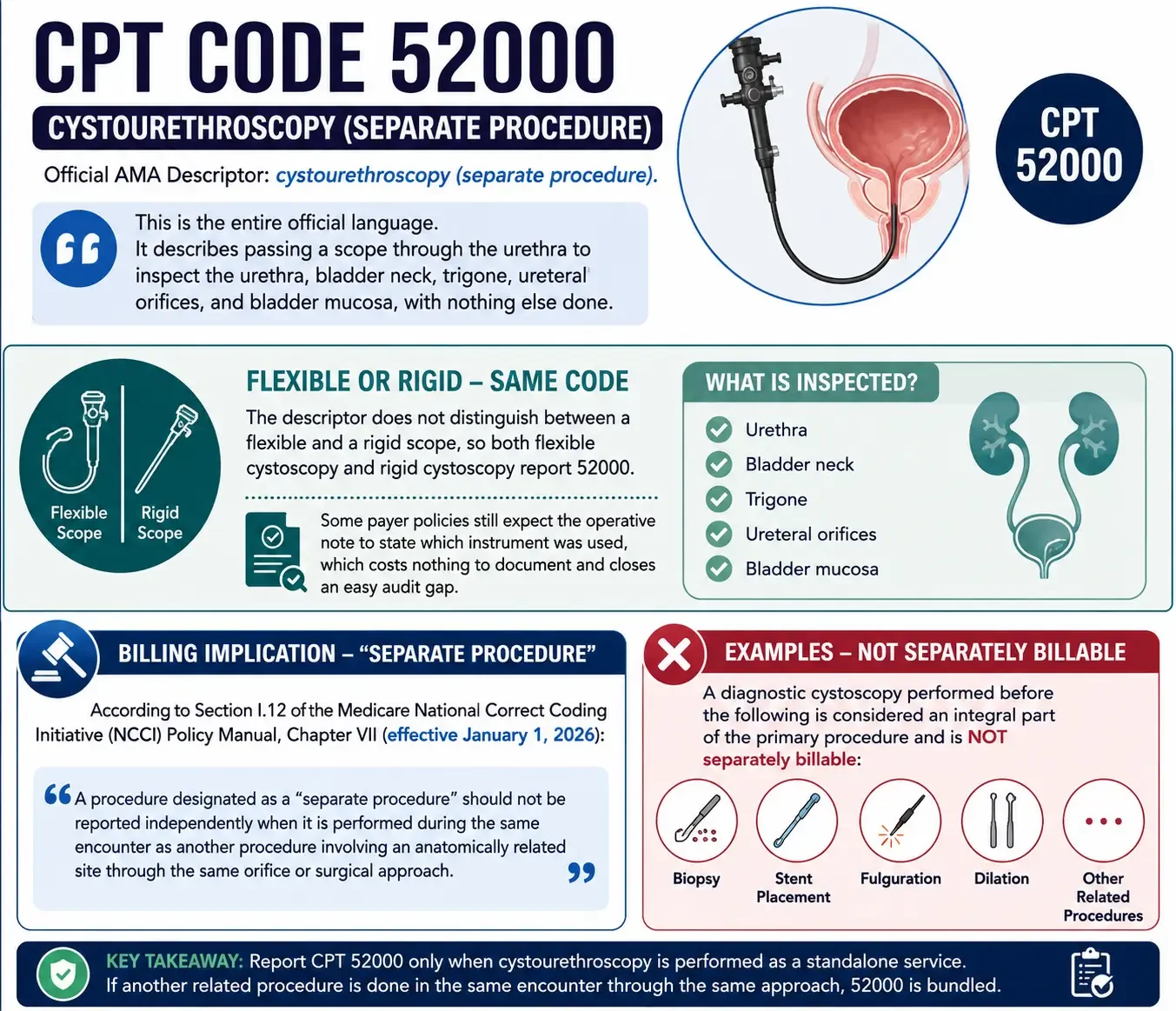
Percutaneous nephrolithotomy (PCNL) bills under CPT 50080 (calculus up to 2 cm) or CPT 50081 (calculus greater than 2 cm), with stone size documented in the operative report as the determining factor. Ureteroscopic procedures use the 52320-series for stone removal without lithotripsy and 52353 when lithotripsy is performed. Site specificity, confirmed by imaging and operative documentation, determines which code family applies. Misidentifying the anatomical site in the note is the upstream error that produces a downstream denial.
6. Medicare Payment and Reimbursement Details for Kidney Stone CPT Codes - RVUs, Facility vs. Non-Facility Rates
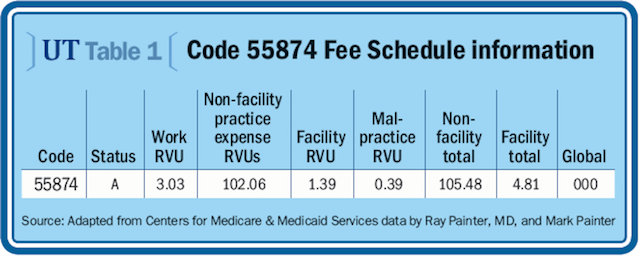
Medicare reimbursement for kidney stone procedures varies significantly by site of service. CPT that same figure and CPT 50590 both carry higher non-facility RVU rates than facility rates, meaning a procedure performed in an ASC or hospital generates a different payment than the same procedure in an office setting. Practices billing PCNL codes (50080, 50081) in facility settings should confirm the correct place-of-service code, since a mismatch between the reported site and the payer's records is a common source of reimbursement delay on high-value stone cases.
Kidney stone procedures represent some of the highest-volume, highest-variability coding scenarios in urology, but they share one structural trait with the next category: the ICD-10 diagnosis code is the payer's primary signal for medical necessity approval. That dynamic becomes even more consequential when the procedure in question is prostate surgery, where the distinction between N40.0 and N40.1 can determine whether a BPH claim clears review before it ever reaches adjudication.
CPT Codes for Prostate Surgery and BPH Treatment Billing
Prostate surgical billing fails before the coder ever opens the fee schedule. The three structural failure points that code lookup alone cannot fix are:
- The operative note's failure to name the specific energy modality
- The clinical record's silence on LUTS severity
- A 90-day global period that locks reimbursement decisions to what happened in the operating room, not the billing department
The core synthesis claim underlying all three failure points is this: accurate CPT code selection is a necessary but entirely insufficient condition for full reimbursement in prostate and BPH surgery, because the revenue outcome is decided in the operating room and the clinical note, not in the billing department.
TURP vs. Laser Vaporization - Why Code Confusion Triggers Denials
CPT 52601 (Transurethral resection of prostate, including control of postoperative bleeding, complete) covers transurethral resection of the prostate using an electrosurgical loop. CPT 52648 covers laser vaporization or enucleation. A note that reads "laser prostatectomy" without specifying enucleation sends coders to the wrong code, because 52601 and 52648 pay differently and payers audit the distinction. Billing 52601 for a HoLEP procedure because the operative note omits the energy modality is one of the most common, and most preventable, prostate surgery CPT code denials in urology billing.
Aquablation (CPT 52597): Strict Coverage Criteria
CPT 52597 covers Aquablation, a robotic waterjet ablation approach for BPH. Medicare local coverage determinations require documentation of prostate volume thresholds and prior treatment failure before approving 52597 claims. Practices billing this code without those clinical specifics in the encounter note face near-certain denial on first submission. The code exists; the coverage criteria are strict; and the documentation has to prove both conditions before the claim reaches adjudication.
1. CPT 52601 (TURP) vs. 52648 (Laser Vaporization) - Why Using 52601 for Laser Procedures Triggers Denials
CPT 52601 covers electrosurgical TURP using a resectoscope, while 52648 applies to laser vaporization or enucleation of the prostate. Billers frequently misapply 52601 to laser-based procedures because both address BPH obstruction, but payers treat them as distinct technologies. This misuse triggers claim denials and potential upcoding audits. Operative notes must explicitly document the energy modality used, electrosurgical loop versus laser fiber, to support the correct urology billing code selection.
2. CPT 52597 (Aquablation/Waterjet Ablation) - Emerging BPH Code With Strict Coverage Criteria

CPT 52597 describes transurethral waterjet ablation of the prostate (Aquablation), a robotic image-guided procedure distinct from both TURP and laser techniques. Medicare contractors require specific coverage criteria documentation, including prostate volume thresholds and prior conservative treatment failure. Billers must confirm the payer's LCD before submitting, as non-covered indications result in automatic denial. Confusing 52597 with 52601 or 52648 is a common and costly urology billing codes error in practices newly adopting this technology.
3. CPT 55866 (Laparoscopic Radical Prostatectomy) - Documentation Requirements That Determine Reimbursement
CPT 55866 covers laparoscopic surgical radical prostatectomy with retropubic approach, including nerve-sparing when performed. Payers require operative documentation to explicitly confirm the laparoscopic approach, nerve bundle identification and preservation technique, and lymph node dissection status. Submitting 55866 without these elements risks downcoding to an open approach code. Nerve-sparing is bundled into 55866 and cannot be billed separately, a frequent billing error that generates recoupment demands during post-payment audits.
4. ICD-10 N40.1 vs. N40.0 - How BPH Specificity Determines Medical Necessity for Surgical Intervention
N40.1 (BPH with lower urinary tract symptoms) and N40.0 (BPH without LUTS) are not interchangeable in urology billing. Payers use this distinction to adjudicate medical necessity for surgical procedures like TURP or laser ablation, N40.1 signals symptomatic obstruction justifying intervention, while N40.0 alone may trigger medical necessity denials for the same procedures. Coders must review AUA symptom score documentation and physician notes to assign the correct code rather than defaulting to the less-specific N40.0.
5. ICD-10 C61 (Malignant Neoplasm of the Prostate) - Pairing With Surgical CPT Codes for Oncologic Procedures
C61 is the required primary diagnosis when billing radical prostatectomy (CPT 55866 or open equivalent) for prostate cancer. Unlike BPH codes, C61 must be supported by pathology-confirmed malignancy in the medical record before claim submission. Pairing C61 with BPH surgical codes like 52601 creates a clinical mismatch that payers flag for audit. Secondary codes for Gleason grade, clinical stage, and PSA findings strengthen the claim and align with oncology-specific LCD requirements for surgical authorization.
6. Medicare 90-Day Global Period for Prostate Surgery - What Cannot Be Billed Separately After the Procedure
CPT 52601 carries a 90-day global surgical period. Routine follow-up visits, catheter management, and standard postoperative care rendered within that window are bundled into the surgical payment and cannot be billed separately, a distinction that catches many practices off guard when payers deny claims for services the global period already covers.
Related Reading
- Hipaa Compliant Ai Scribe
- Top Medical Scribe Companies
- Ai Scribe Cost
- Medical Scribe Cost
- How Does An Ai Scribe Work
Commonly Used ICD-10 Diagnosis Codes for Urology Conditions
Diagnosis code specificity carries the same downstream weight as modifier accuracy, and the pattern is consistent: a significant share of urology claim denials trace back to diagnosis code issues, and the most common trigger is an unspecified code that a payer's automated medical necessity edit flags before a human reviewer ever sees the claim. Codes like N39.0, R32, and R31.9 routinely prompt additional documentation requests or outright denials because they signal that the clinical record did not support a more precise selection. That signal is a documentation fidelity gap.
When a urologist documents "UTI" or "hematuria" without capturing the clinical detail that would justify a specific ICD-10 code, the coder is legally constrained to submit the unspecified code. The revenue loss that follows is traceable to the moment the physician's note was finalized without adequate specificity. Directing ICD-10 training at coders addresses the wrong professional at the wrong point in the workflow.
This is where the documentation gap becomes a workflow problem iScribe Health is designed to close. iScribe Health's Ambient Listening and Conversational AI captures the clinical conversation in real time, stress versus urge, gross versus microscopic, site-specific versus systemic, and at the point of note completion, after the AI drafts the encounter summary, the specificity signals needed to support a precise ICD-10 selection are already embedded in the record. The coder never has to chase a corrective query because the documentation gap was eliminated before the note was finalized. The result is improved coding consistency without adding documentation burden to the physician.
The seven entries below cover the highest-frequency urology diagnosis codes, their specificity requirements, and the CPT pairing logic that keeps claims clean.
1. N39.0 - Urinary Tract Infection, Site Not Specified - When 'Unspecified' Triggers Payer Scrutiny
N39.0 is among the most submitted urology diagnosis codes and among the most frequently flagged. Payers accept it only when documentation genuinely cannot support a site-specific code such as N30.00 (acute cystitis) or N10 (acute pyelonephritis). When paired with an office visit CPT (99213-99215), the medical necessity edit checks whether the documented complexity matches the unspecified diagnosis. If the note names the site, the coder must use the site-specific code, or the claim becomes indefensible on audit. iScribe Health's ambient documentation captures site-specific language as the physician speaks, so the note arrives at coding with the detail that supports N30.00 or N10 rather than defaulting to N39.0.
2. R32 - Unspecified Urinary Incontinence - Choosing Specificity to Avoid Medical Necessity Denials
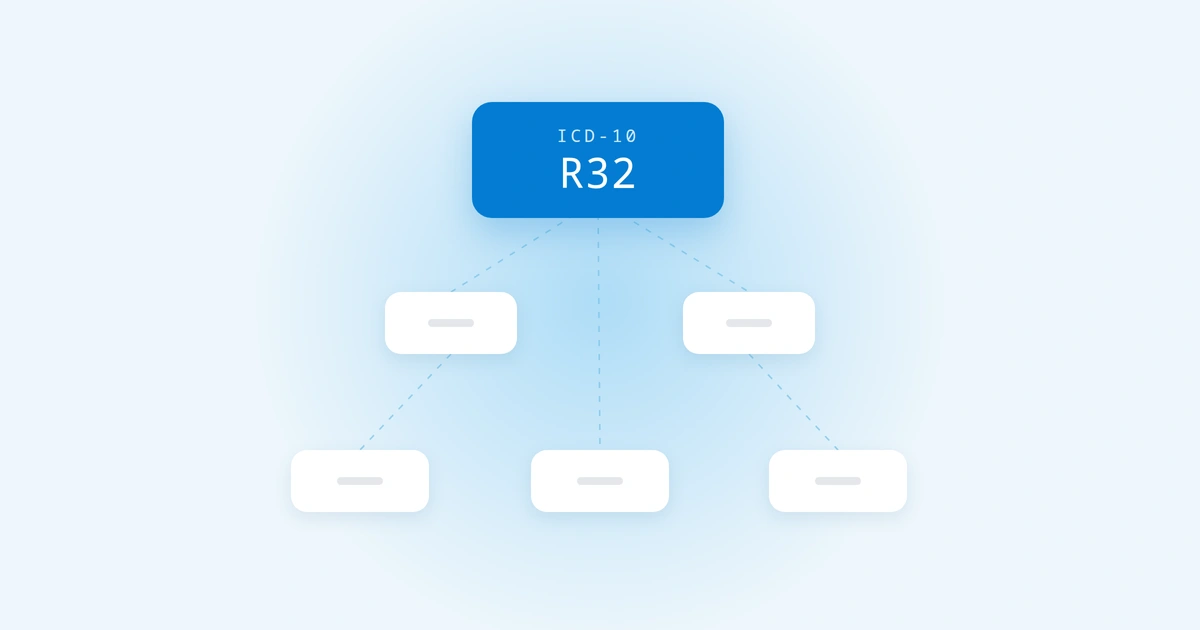
R32 is a documentation failure indicator. 498. Submitting R32 when subtype is documented creates a mismatch between the record and the claim that payers flag as a medical necessity concern.
MedCare MSO's 2024 guidance confirms that unspecified incontinence codes trigger additional documentation requests before reimbursement is approved. Practices we work with tell us that subtype is almost always discussed during the encounter; the problem is that it does not reliably make it into the note. iScribe Health's conversational AI listens for and surfaces that subtype language at note completion, so the distinction between stress and urge is locked in documentation before the claim is built.
3. R31.9 - Hematuria, Unspecified - Specificity Ladder from Gross to Microscopic

Billing R31.9 when the provider documented gross hematuria is a preventable error. R31.0 (gross hematuria) and R31.21 (asymptomatic microscopic hematuria) are both available and both reduce additional documentation request risk. The specificity ladder matters because payers pair hematuria codes against cystoscopy CPTs (that same figure, 52204) and expect the diagnosis to reflect what the note actually describes. Submitting R31.9 against a therapeutic cystoscopy code invites a medical necessity denial that a more specific code would have cleared automatically. Because iScribe Health's ambient layer captures the clinical characterization, gross versus microscopic, symptomatic versus asymptomatic, in real time, the note exits the encounter with the specificity the claim requires rather than requiring a retrospective query to the physician.
4. Diagnosis-to-Procedure Code Pairing - Mismatched ICD-10 and CPT Codes as the Leading Cause of Preventable Urology Denials

According to industry data, mismatched ICD-10 and CPT pairings are a leading cause of preventable claim denials because payers require the diagnosis code to directly support the medical necessity of the procedure billed. 1 (BPH with LUTS) to satisfy medical necessity criteria. The fix is upstream: the note must capture the clinical detail that justifies the specific code before the coder ever opens the claim.
iScribe Health's E&M Coding Intelligence and Real-Time Denial Alerts surface pairing inconsistencies at the point of note completion, giving the physician an opportunity to correct the record before it reaches billing, not after a denial is already in queue.
5. T83.192A - Ureteral Stent Complications and Device Implant ICD-10 Specificity in Urology Billing
T83.192A covers mechanical complications of other urinary devices and implants, initial encounter, and it is the code required when a ureteral stent complication drives the visit. MedCare MSO's that same figure compliance review identifies non-specific implant coding as a common cause of claim rejection when a more precise code exists. The encounter qualifier (A for initial, D for subsequent, S for sequela) must match the visit type documented in the record. Submitting T83.192A on a follow-up encounter without updating the qualifier to D is a recurring audit finding that triggers both denial and compliance exposure. iScribe Health's EHR Integration pulls encounter context, including visit sequence, into the ambient summary, giving coders the qualifier signal they need without a separate chart review.
6. Sling Procedure ICD-10 Coding - Matching N39.3 or N39.41 to CPT 57288 for Clean Claim Submission
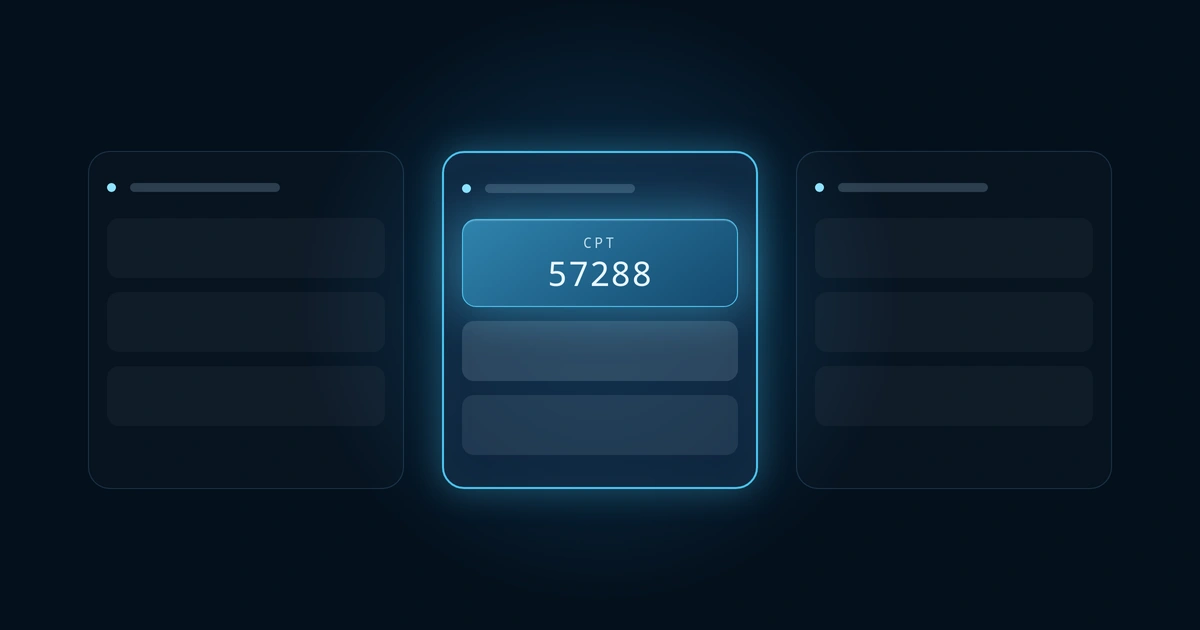
CPT 57288 (sling operation for stress incontinence) requires a diagnosis code that confirms stress incontinence. N39.3 (stress incontinence, female) is the primary pairing; N39.41 (coexistent stress and urge incontinence) applies when mixed incontinence is documented. Submitting R32 against 57288 creates an immediate medical necessity mismatch because the unspecified code does not confirm the indication the procedure requires. MedCare MSO's that same figure analysis is direct: the ICD-10 code must reflect the exact condition treated, not a broader category. iScribe Health's ambient documentation captures the subtype distinction during the pre-operative or office visit encounter, so by the time that same figure is billed, the supporting diagnosis is already specific in the record.
7. Structuring a Clean Urology Claim - Diagnosis Code Specificity, Sequencing, and the ICD-10 Coding Reference Workflow

A clean urology claim requires that the primary diagnosis code reflects the condition that drove the encounter, sequenced first, with supporting codes listed in clinical priority order. Cureintent's coding error review identifies wrong code selection and missing documentation as the primary drivers of coding-related denials. The practical constraint is that coders can only sequence what the note supports. When a provider documents "incontinence" or "hematuria" without characterization, the coder's only defensible option is an unspecified code, and the claim enters payer review at a disadvantage.
iScribe Health removes that constraint at its root. The Ambient Listening and Conversational AI captures specificity signals, stress versus urge, gross versus microscopic, site-specific versus systemic, during the encounter itself. At the point of note completion, after the AI drafts the encounter summary, those signals are already embedded in the record. The coder sequences a specific code because the note supports a specific code. For practices running a supported EHR, iScribe Health's EHR Integration delivers this experience within the existing clinical workflow, and the improvement in coding consistency is realized across every patient encounter as an ongoing operational shift.
Getting the diagnosis code right is only half the claim integrity equation. Once ICD-10 specificity is locked, the next variable that determines whether a urology claim pays or denies is how modifiers are applied when multiple procedures appear on the same claim.
Urology Billing Modifiers That Prevent Claim Denials When Applied Correctly
Seven modifiers account for the majority of preventable urology claim denials, and the denial risk in every case is identical: the modifier was appended, but the clinical note never delivered the proof the payer expected. For urologists running high-volume schedules, where charting routinely spills two or more hours past the last patient of the day, that documentation gap is a matter of time. The note gets finished, but the specific language each modifier legally requires gets lost in the rush.
1. Modifier 50 - Bilateral Urology Procedures on Paired Organs Like Kidneys and Ureters

Append Modifier 50 when a procedure is performed on both sides of a paired organ system, such as bilateral ureteral stent placement, in a single operative session. The critical check: confirm the CPT code is not already inherently bilateral before adding it. According to the TransMedex Urology Billing Guide, applying Modifier 50 to an inherently bilateral code produces a duplicate billing error and a near-certain denial. The operative note must explicitly state that both sides were treated, naming the bilateral medical necessity in unambiguous terms rather than implying it through procedure description alone.
2. Modifier 24 - Unrelated E&M Services Billed During a Urological Global Period
Use Modifier 24 when a patient presents during the postoperative global period for a problem that has no clinical connection to the original procedure. The documentation must name a separate, distinct diagnosis, not a variation of the surgical indication. Without that language in the note, the payer's automated system treats the visit as a routine postoperative check and denies it as included in the global package. The visit passes initially, then fails on post-payment audit. Physicians seeing back-to-back patients and relying on templated notes are especially exposed here: the templated structure captures the visit, but the distinguishing sentence, the one that names the new, unrelated diagnosis, is precisely what gets omitted when documentation is rushed.
3. Modifier 78 - Return to the OR for a Related Complication Within the Urology Global Period
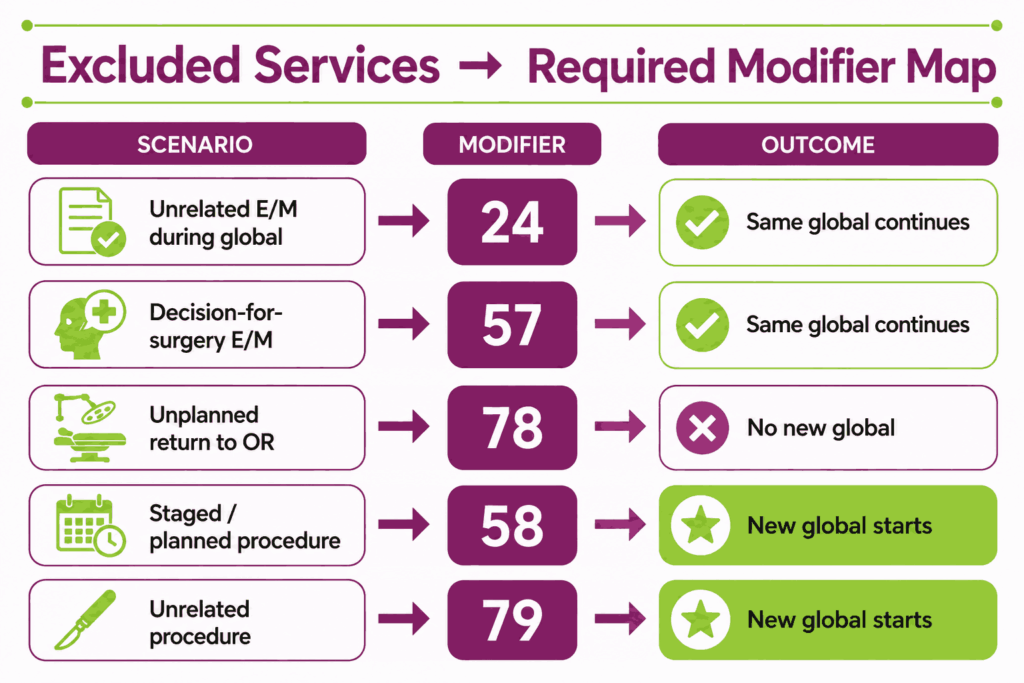
Modifier 78 applies when a complication of the original surgery requires the patient to return to the operating room during the global period. The operative report for the return procedure must explicitly link the complication to the prior surgery. A note that describes the return procedure without connecting it to the original case leaves the claim undefended and triggers a bundling denial. According to the TransMedex Urology Billing Guide, that causal connection must appear in the record as written language, not as an inference a reviewer is expected to draw.
4. Modifier 79 - Unrelated Urology Procedures Performed During an Active Postoperative Period

Modifier 79 covers a procedure performed during an active global period that is clinically unrelated to the original surgery. Per the TransMedex Urology Billing Guide, the medical record must document that the new procedure addresses a different diagnosis, and that diagnosis code must differ from the one tied to the original surgery. A mismatched or recycled diagnosis code collapses the modifier's protection entirely. This is one of the most common documentation failures in high-volume urology practices: the physician knows the two procedures are clinically unrelated, but the note does not say so, and the coder has no language to work with.
5. Modifier 59 and NCCI Selective Modifiers XS, XE, XP, XU - Unbundling Distinct Urology Procedures
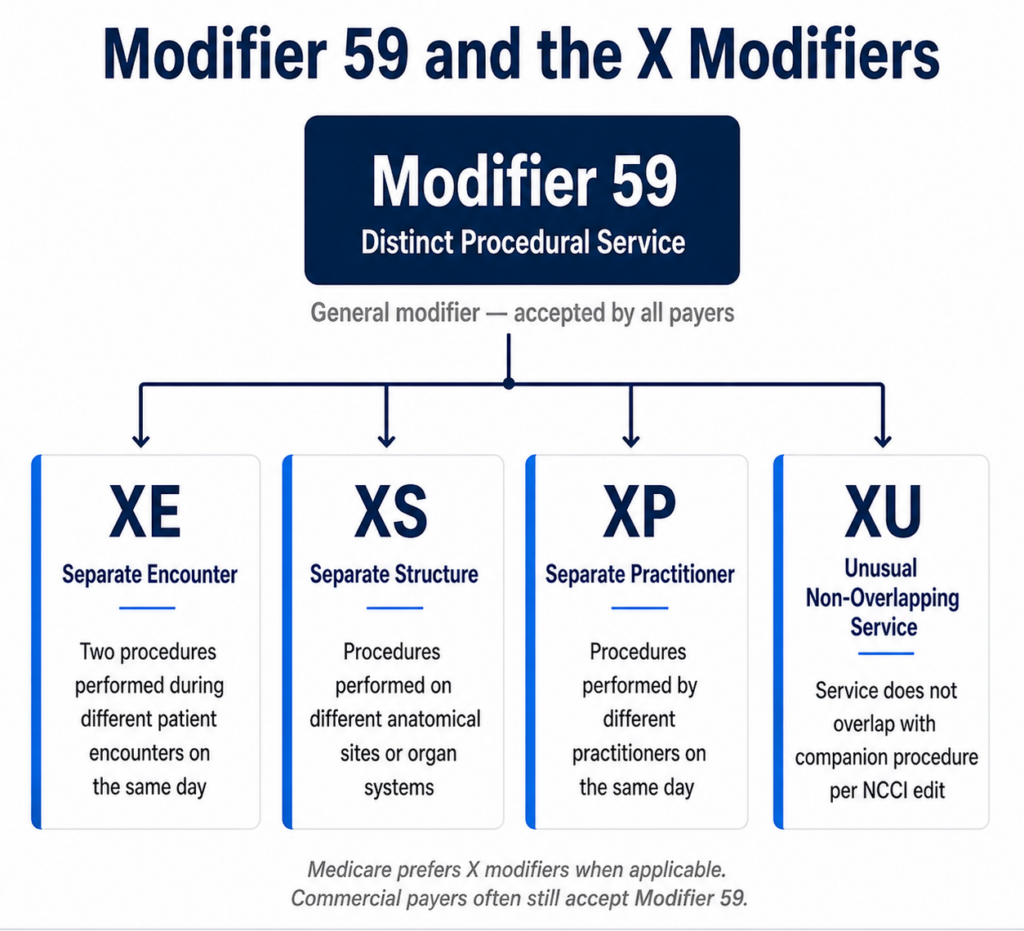
When two urology billing codes trigger an NCCI bundling edit, Modifier 59 or its more specific successors, XS (separate structure), XE (separate encounter), XP (separate practitioner), XU (unusual non-overlapping service), justify separate reimbursement. CMS prefers the granular X-modifiers because they communicate exactly why unbundling is appropriate. Audit defense requires operative documentation that explicitly identifies the distinct anatomic site, session, or service rationale corresponding to the modifier selected.
The Urology Coding Gap That Survives Every Code Update
They attend urology coding seminars, earn their CPC credentials, and stay current on every CPT revision cycle, yet a persistent gap remains.

What 941 Encounters Revealed About the Limits of Coder Expertise
In charts that had already cleared billing review, iScribe Health found a 54.8% provider, AI agreement rate across 941 encounters.
Why Finalized Notes Are Already Too Late for Accurate E&M Capture
Coders working from finalized notes face a structural ceiling: the contextual evidence needed to justify a more complex code has already been lost. The platform's Ambient Listening and Conversational AI captures the clinical conversation in real time, and its E&M Coding Intelligence surfaces coding guidance at the point of note completion, after the AI drafts the encounter summary (iScribe Health), preserving that evidence before it disappears.
How 2026 CPT Specificity Requirements Widen the Gap
Each revision cycle raises the documentation bar. The 55715 prostate biopsy family now requires approach, guidance modality, and specimen detail to be explicitly documented (iScribe Health).
Urology coding accuracy degrades with each update, because every revision adds documentation obligations that ambient clinical workflow was never redesigned to meet. iScribe Health's AI Customization and EHR Integration mean that as CPT requirements evolve, the platform's documentation prompts can be updated to capture the newly required specificity fields, approach, modality, specimen detail, inside the workflow the physician already uses, without requiring a template redesign project or retraining the billing team.
Real-Time Denial Alerts then flag downstream when a note's captured detail falls short of what a submitted code requires, closing the feedback loop before a claim is filed (iScribe Health).
The gap is structural, not a training problem. Closing it requires an intervention that happens before the coder ever opens the chart, and that intervention is most seamlessly realized when iScribe Health runs alongside a supported EHR, embedding directly into the clinical workflow rather than adding a parallel documentation step.
How Accurate Urology Billing Starts at the Point of Documentation
Accurate Urology Billing Starts at Documentation
Denial rate, First-Pass Resolution Rate, A/R days: these look like billing team scorecards, but they are actually lagging indicators of what happened in the exam room thirty minutes before anyone opened a charge sheet. What most billing teams lack is visibility into what the clinical note actually captured before it was finalized.

"Urology billing departments are sending payment requests with zero documentation, no date of service, no description, no invoice, leaving patients unable to verify what they owe before paying."
— what we hear from urology billing departments
Why the Revenue Leak Happens Before the Coder Opens the Chart
Most urology practice administrators treat billing accuracy as a downstream quality-control function, something coders catch after the chart is closed. As the coding-gap analysis in §7 established, coders can only bill what the note supports.
What Complete Clinical Narrative Means for Billing
For urology, that specificity is unforgiving. A targeted versus systematic biopsy approach, documented during the encounter, is the difference between a supportable claim and one that stalls on audit.
If the clinical narrative is incomplete before the note is finalized, coders cannot code what was never captured. That is the reimbursement ceiling, and it is set upstream.
How Real-Time Ambient Capture Closes the Gap Between What Was Said and What Gets Coded
The familiar approach is dictation or post-visit EHR entry, both of which reconstruct the encounter from memory after the clinical moment has passed, introducing gaps between what was said and what ultimately appears in the note.
Real-time ambient capture fixes the reimbursement problem at its source rather than downstream in the billing department. iScribe Health's E&M Coding Intelligence builds on that captured narrative to surface coding recommendations before the encounter closes, so the correct complexity level is built into the note from the start, not retrofitted after the fact. That upstream accuracy is the foundation every other billing optimization in this guide depends on.
Related Reading
- Best Ai Scribe For Athenahealth
- Ai Medical Scribes With E&m Coding Built In
- Ai Scribe Accuracy
- Do Ai Scribes Reduce Claim Denials?
Next steps
If your high-complexity urology encounters keep underperforming on reimbursement despite experienced billing staff, the path forward starts with recognizing that coders can only code what the note supports, and incomplete notes structurally cap revenue before a single claim is ever submitted.
The 2026 prostate biopsy code overhaul makes this concrete: each CPT update cycle widens the gap between what codes require and what finalized notes contain, meaning billing team re-education alone cannot close the revenue shortfall the transition creates. Revenue cycle KPIs like denial rate and First-Pass Resolution Rate are almost universally treated as billing team scorecards, but they are actually lagging indicators of documentation quality at the point of care. Together, these two realities point to one action: capturing the full clinical narrative in real time, before the note closes, so the detail that determines correct code assignment exists in the record before the coder ever opens the chart.
Start with Best AI medical scribe for orthopedic practices to see how iScribe Health's ambient documentation and E&M Coding Intelligence surface billing-relevant clinical detail at the point of note completion, keeping reimbursement decisions where they belong: in the exam room, not the appeals queue.
Frequently Asked Questions
If my coder knows all the right urology CPT codes, why are we still losing revenue?
Knowing the correct codes is not enough if the clinical note doesn't capture the complexity needed to support them. Coders can only code what is documented, so when a note omits medical decision-making complexity, lesion dimensions, or procedure specifics, even an expert coder has no raw material to work with, and the revenue loss is locked in before the chart ever reaches billing.
What actually changes about prostate biopsy billing when CPT 55700 is deleted in 2026?
After January 1, 2026, any claim submitted with CPT 55700 is automatically rejected. The replacement codes (55707-55715) each require the provider note to explicitly state the biopsy approach (systematic or targeted) and the imaging modality used, details that most existing note templates built around 55700 were never designed to capture.
Can I bill separately for ultrasound or MRI guidance when I use one of the new 55707-55715 prostate biopsy codes?
No. The 2026 CPT structure bundles imaging guidance directly into the procedure code, so billing ultrasound or MRI guidance as a separate line item alongside any code in the 55707-55715 family will generate an unbundling denial. Systematic unbundling across a high-volume practice can also trigger retrospective payer audits with recovery demands that exceed the original billing gains.
What's the difference between CPT 52353 and 52352, and why does it matter for kidney stone claims?
CPT 52353 (ureteroscopy with lithotripsy) requires operative documentation confirming the lithotripsy device was activated and stone fragmentation actually occurred, while CPT 52352 applies when fragmentation was not achieved or confirmed. Billing 52353 when the note does not confirm fragmentation is a medical necessity mismatch that payers flag on pre-payment review.
When do I need modifier 78 on a ureteral stent insertion claim?
Modifier 78 (return to OR for related procedure) is required when CPT 52332 falls within the global period of a prior stone procedure; without it, the claim will deny as bundled. The documentation must also confirm the clinical reason for the return encounter.