Urgent Care CPT Codes: Complete Reference Guide 2026
Urgent care CPT codes mapped for billing decision-makers, with automated E&M coding to close revenue gaps and put money back in your clinic.


Knowing the codes is not the problem. The real revenue risk lives in prohibited codes, a single POS field, and documentation gaps the 2021 MDM overhaul turned into automatic downcodes.
Thousands of freestanding urgent care centers operate across the United States, and every one of them bills under the same code set as a primary care office down the street. The common assumption among practice administrators and billing decision-makers is that mastering every CPT code, modifier rule, and MDM criterion is the primary lever for closing revenue leaks, that if coders simply know the codes well enough, the billing problems will resolve themselves. That belief is understandable, but it misses the more consequential layer of complexity: the strict rules governing which codes are prohibited, which place-of-service value the claim must carry, and how a 2021 framework overhaul changed the documentation standard every urgent care note must now meet. See our AI medical scribe for how this works in practice.
Urgent care facilities bill using standard outpatient Evaluation and Management codes 99202 through 99215, the same range any office-based physician uses. The codes map to new patients (99202-99205) and established patients (99211-99215), and the selection logic governing both groups was fundamentally restructured by the 2021 AMA E/M guideline overhaul, which replaced the legacy history-exam-MDM three-key-component method with a dual-pathway framework: providers now select the level of service based on either total time or medical decision-making, whichever best supports the visit. Pre-2021 habits built around documenting a physical exam to justify a code level are now a liability. The note has to support time or MDM, not a checklist of body systems reviewed.

These codes are reserved for hospital-based emergency departments. The prohibition is a structural rule tied to facility type. A freestanding clinic is not a hospital ED regardless of visit acuity or the complexity of care delivered.
Freestanding urgent care clinics must submit claims under Place of Service code 20 (Urgent Care Facility). Submitting POS 11 (Office) instead triggers automatic denials because payers use the POS value to validate whether the billed E/M code is appropriate for the setting. A perfectly selected 99214 with airtight documentation will still be rejected if the POS field is wrong.
Understanding what the code set covers, and what it explicitly excludes, is the prerequisite every other coding decision in urgent care depends on.
Key takeaways
- Urgent care centers bill under the same CPT code set as primary care offices, the codes aren't the problem; the documentation that has to justify them is.
- The 2021 AMA E/M guidelines replaced the old three-component method with a dual-axis framework (time or MDM), which created real upcoding opportunity for urgent care, but only when the note actually captures the clinical complexity that happened in the room.
- The difference between 99213 and 99214 is one MDM level. Billed incorrectly across a week of established patient visits, that single-digit gap costs a practice four figures.
- Procedure codes for wound repair, injections, joint procedures, and splinting each require specific documented variables, wound layer depth, joint size, abscess complexity, to survive an audit. The correct code without those details is a liability, not a revenue asset.
- Diagnostic billing risk isn't which code to select; it's whether the note documents medical necessity clearly enough to survive a same-day bundling review.
- Place-of-service code 20, Modifier 25, and ED code prohibitions operate at the claim-structure level, get any one wrong and the denial hits before a reviewer reads a single line of the note.
- Roughly 55% of E/M visits industry-wide are inaccurately coded, and the root cause isn't coder competence, it's that clinical complexity captured in the exam room never makes it into the finalized note the coder actually sees.
- iScribe Health's Automated E/M Coding closes that gap by generating E/M codes directly from clinical documentation in real time, so the code the visit earned is supported by the note before the claim ever goes out.
Complete New Patient E/M Codes 99202-99205 with Time Ranges and MDM Levels
The AMA E/M guidelines changed something fundamental about how new patient visits get coded: they replaced the old three-component history/exam/MDM method with a cleaner dual-axis framework.

The Dual-Axis Rule Why New Patient Codes Have Two Valid Pathways to the Same Level
Per the AMA CPT E/M Guidelines, coders select whichever basis, total time or Medical Decision Making (MDM) complexity, best supports the visit level; satisfying both criteria simultaneously is not required.
Key takeaway: MDM often supports a higher code level than the clock does, a new patient with a laceration requiring sutures plus a new prescription carries moderate MDM complexity, which supports 99204 even if the visit ran well under the time threshold for that level.
Without explicit MDM elements captured in the note, that 99204 becomes a 99203 by default, and the revenue difference between those two codes compounds quickly across a high-volume urgent care schedule.
This is the documentation trap the dual-pathway framework quietly created. When a provider is mentally cycling through the next waiting patient, the data reviewed, problems addressed, and management options considered in the room just completed rarely make it into the note with the granularity MDM coding demands.
iScribe Health's Ambient Listening and Conversational AI changes that dynamic at the source. iScribe Health's EHR Integration makes the ambient documentation experience seamless, and Real-Time Denial Alerts flag coding vulnerabilities before a claim goes out rather than after a denial comes back.
New Patient Code Reference Table 99202 Through 99205 Time Ranges MDM Levels and What Each Threshold Means in Urgent Care
CPT Code
Total Time (new patient)
MDM Complexity
Urgent Care Context
99202
15-29 minutes
Straightforward
Minor acute complaint, single self-limited problem, minimal data review
99203
30-44 minutes
Low
One stable chronic condition or acute uncomplicated illness; limited data reviewed
99204
45-59 minutes
Moderate
New problem with uncertain prognosis, prescription drug management, moderate data review
99205
60-74 minutes
High
Severe acute illness, drug therapy requiring intensive monitoring, extensive data review
The challenge iScribe Health addresses is ensuring that documentation exists in the first place, surfaced automatically during the encounter rather than reconstructed from memory afterward.
Complete Established Patient E/M Codes 99212-99215 with Time Ranges and MDM Levels
Established patient coding looks deceptively simple until you watch a practice lose four figures a week to a single digit: the difference between 99213 and 99214.

The Established Patient Code Table - Time Ranges and MDM Levels for 99212 Through 99215
Code
Total Time (date of encounter)
MDM Complexity
Typical Urgent Care Scenario
99212
10-19 minutes
Straightforward
Minor acute complaint, single self-limited problem, no prescription decision
99213
20-29 minutes
Low
Stable chronic condition follow-up, minor acute illness, minimal data review
99214
30-39 minutes
Moderate
New problem requiring additional workup, prescription drug management, chronic condition exacerbation
99215
40-54 minutes
High
Multiple complex conditions, high-risk prescription decisions, extensive data review
The reverse is equally true: a 22-minute visit with moderate MDM supports that same figure regardless of the clock.
How to Pattern-Match a Real Urgent Care Visit to the Right Established Patient Code
The most reliable starting point is MDM, since clinical complexity is usually easier to reconstruct from the encounter than total time.
- Number and complexity of problems
- Amount and complexity of data reviewed
- Risk of complications
A visit for a sinus infection in a patient with hypertension and a prescription for an antibiotic commonly meets two of those elements, yet it is routinely billed as 99213.
99213 vs. that same figure - How to Choose the Right Established Patient Code Every Time
Key takeaway: According to the Urgent Care Billing and Coding Guidelines 2023, internal coding audits found that up to 30% of established-patient visits billed at 99213 contained documentation sufficient to support 99214, even in practices with trained coders.
This is the gap iScribe Health's ambient documentation and automated E&M coding intelligence are built to close. iScribe Health's ambient listening and conversational AI captures the full clinical picture in real time, during the encounter itself, so that note completion happens by end of clinic, not end of evening. At the point of note completion, after the AI drafts the encounter summary, iScribe Health's E&M Coding Intelligence maps the documented complexity to the correct code automatically.
For practices already operating a supported EHR, iScribe Health integrates directly into that environment, so the ambient documentation experience runs inside the existing workflow rather than alongside it, and accurate code selection becomes a consistent outcome rather than a provider-by-provider variable.
Common Urgent Care Procedures with CPT Codes for Wound Repair, Injections, Joint Procedures and Splinting
Selecting the right urgent care procedure CPT code is only half the billing equation. The other half is whether the clinical note captures the specific variables that make that code defensible: wound layer depth, joint size, abscess complexity, route of administration. Without those documented details, the correct code becomes an audit liability rather than a revenue asset. One layer of confusion that compounds this problem at the practice level is that patients often arrive believing their visit severity determines how their claim is coded, confusing urgent care CPT logic with emergency department billing. In reality, CPT codes are tied to place of service and documented clinical complexity, and that distinction lives entirely inside the note the provider generates.
"Patients are confused about the difference between ER visit codes and urgent care visit codes, not understanding that CPT codes are tied to the place of service and clinical complexity, not patient-perceived severity."
— what we hear from medical billing professionals
1. Wound Repair CPT Codes 12001-12057 - Simple vs. Intermediate vs. Complex Selection
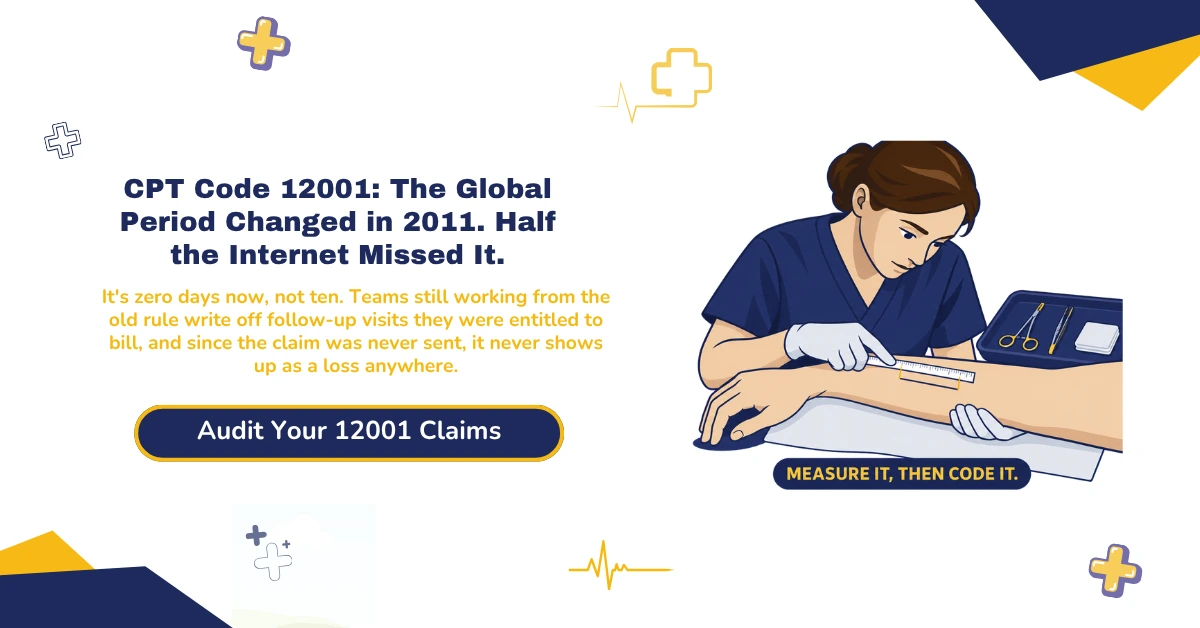
Wound layer depth is the single variable that determines which repair family applies. According to the CMS Physician Fee Schedule, simple repairs (that same figure-12021) cover epidermis and dermis closure only; intermediate codes (12031-12057) apply the moment a deeper layer is involved, such as subcutaneous tissue or fascia. A forearm laceration requiring only superficial closure maps to that same figure; the same wound with subcutaneous involvement maps to 12031 or higher. Billers who default to simple codes when intermediate work was performed leave reimbursement unclaimed on nearly every laceration visit, and the note is the only thing that can prove which code is correct.
For care teams managing high patient volumes, the risk is straightforward: when charting happens after the visit rather than during it, wound layer depth is among the first specifics lost.
2. Injection Administration Codes 96372 and 96374 - Subcutaneous/IM vs. IV Push Pairing

CPT 96372 covers subcutaneous or intramuscular injections; 96374 covers intravenous push administration. Both must be paired with the corresponding drug HCPCS or NDC code, because billing the administration code alone triggers bundling edits under NCCI rules, per the CMS National Correct Coding Initiative Policy Manual. In mid-level-only urgent care settings, the direct physician supervision requirement for 96372 also creates a compliance exposure that payers audit specifically.
3. Joint and Abscess Procedure Codes 20610, 10060-10180 - Arthrocentesis and Incision & Drainage
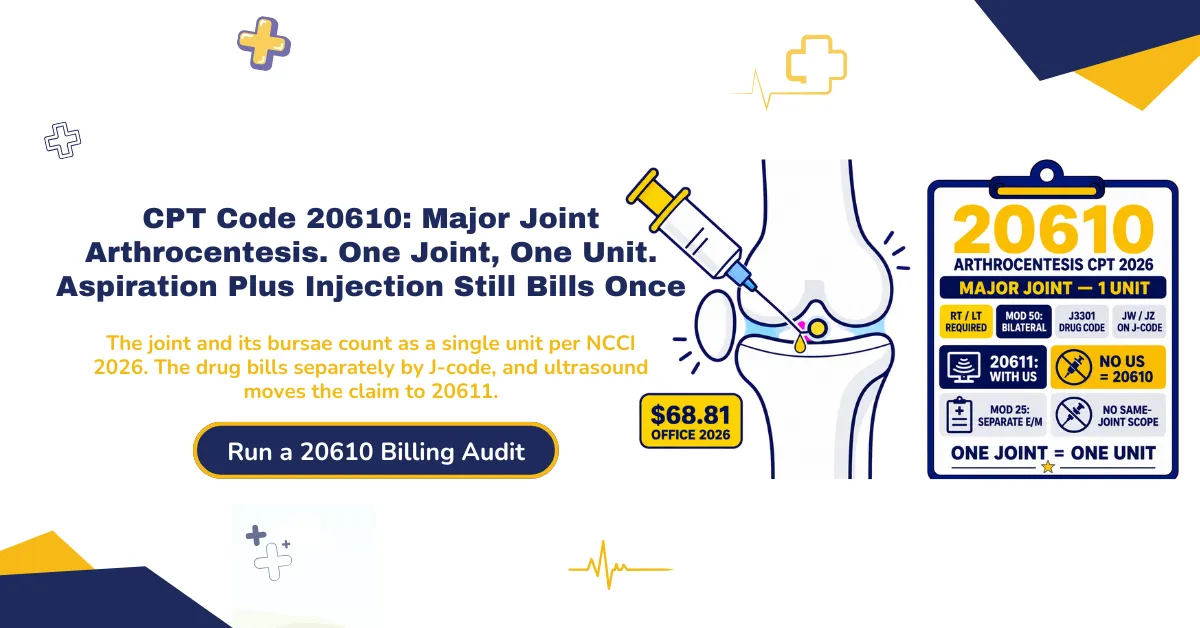
CPT that same figure (arthrocentesis or injection of a large joint such as the knee or shoulder) and I&D codes 10060-10180 rank among the most frequently billed urgent care procedure codes, per the CMS National Correct Coding Initiative Policy Manual. For I&D, the split between that same figure (simple) and 10061 (complicated) hinges on documented abscess complexity and whether loculations were present. Billers routinely default to that same figure regardless of complexity, forfeiting the higher reimbursement 10061 supports when the note captures the clinical picture. Both procedure families require Modifier 25 on the same-day E/M and, where applicable, Modifier 59 on the procedure to clear NCCI bundling edits.
4. Splinting Codes 29515 and 29000-29799 Range, Plus Foreign Body Removal 20525-20553
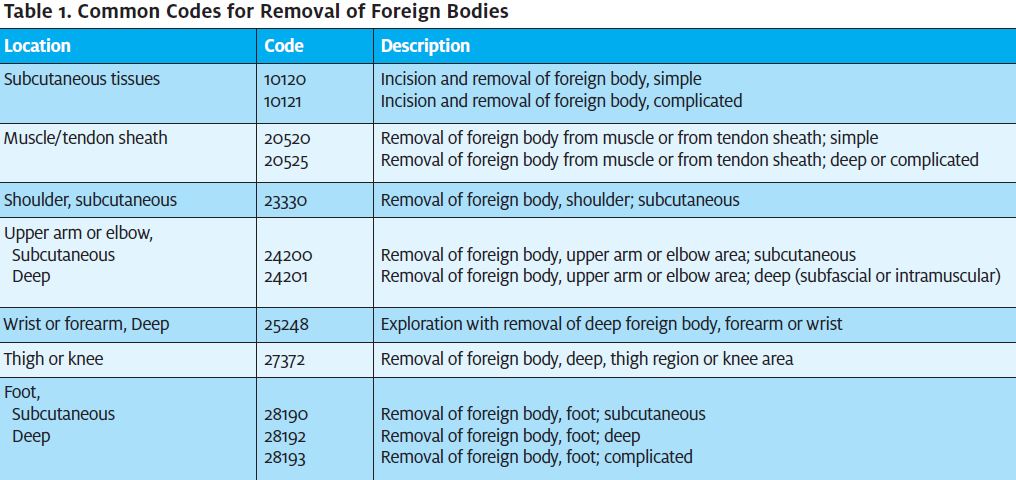
CPT 29515 (short leg splint) anchors the broader 29000-29799 splinting and casting range, while foreign body removal codes 20525-20553 cover subcutaneous and muscular retrieval. Splinting is among the most consistently under-billed urgent care procedure categories: the procedure is performed, but the claim is omitted when the provider note lacks specifics on anatomical site and splint type. Foreign body removal carries the same documentation dependency, with code selection driven by depth of retrieval.
Both categories require Modifier 25 on a same-day E/M to keep both charges payable, and both are precisely the type of visit-level detail that disappears when clinical workflow outpaces documentation, a pattern most acute in high-volume practices where documentation consistently falls behind the pace of care. iScribe Health's ambient documentation platform is built to streamline that workflow so care teams maintain documentation quality even during peak census periods, capturing the anatomical and procedural specifics that make these codes billable before the encounter ends.
5. Modifier 25 - Required When Any Procedure Is Billed Alongside a Same-Day E/M Code
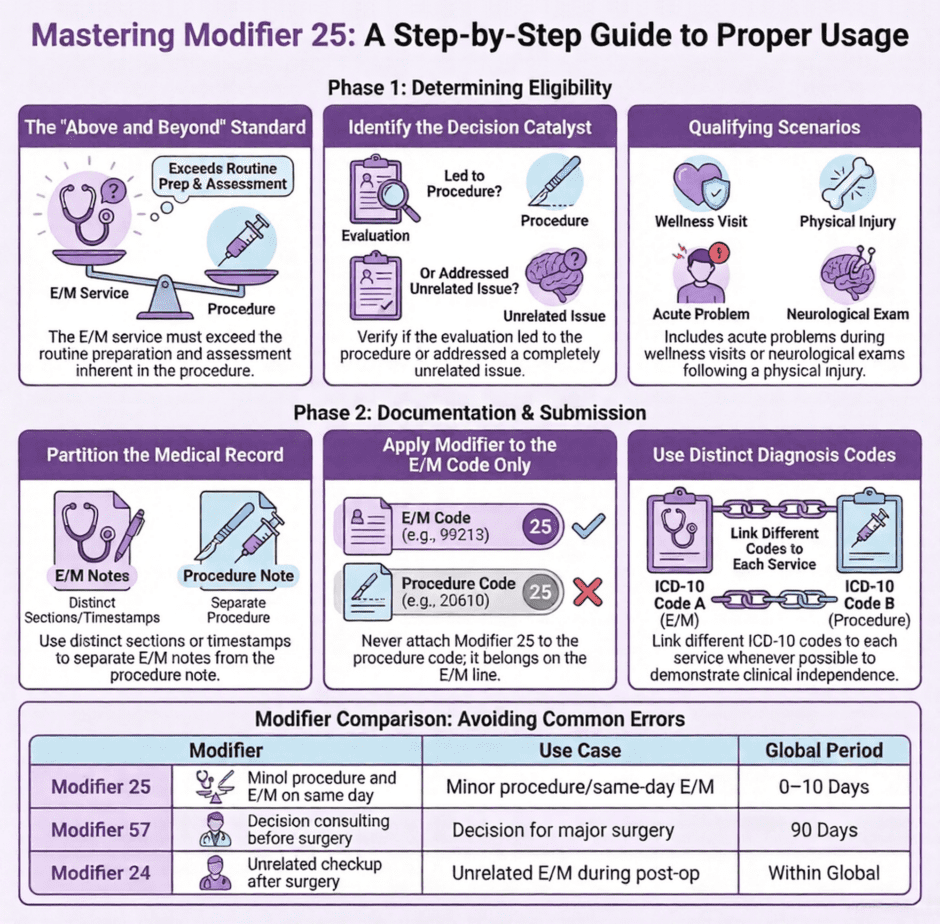
Modifier 25 is the single most consequential billing variable in urgent care procedure coding. Per the CMS Claims Processing Manual, it must be appended to the E/M code whenever a separately identifiable evaluation and management service is performed on the same date as a procedure, and its absence is among the most common causes of claim denial in urgent care settings. A patient receiving a cortisone injection into the knee (that same figure) during the same visit as an E/M encounter requires Modifier 25 on the E/M; without it, the payer bundles the procedure into the visit fee and denies the procedure charge.
The modifier itself is not the hard part. Generating a note that documents a genuinely separate, significant E/M service is where incomplete real-time documentation creates the exposure. Providers working with iScribe Health benefit from ambient AI scribing that captures the clinical reasoning behind both the E/M and the procedure within the same encounter, giving the coder the documented separation Modifier 25 requires before the claim is ever submitted. For practices already running a supported EHR, the platform integrates into that existing workflow so the documentation quality needed to sustain Modifier 25 on audit is produced consistently, across every encounter, every day of clinical practice, without adding to the charting burden that drives physician burnout in high-volume settings.
Procedure codes account for a significant share of urgent care revenue, but they represent only one layer of the billable encounter. The next section maps the in-house diagnostic and lab codes, including rapid strep, urinalysis, venipuncture, chest X-ray, and ECG, that frequently accompany these same visits and carry their own bundling rules and S-code pairing requirements.
Related Reading
- Cpt Code 10060
- Cpt Code 11200
- Cpt Code 12001
Common In-House Diagnostics and Lab CPT Codes for Rapid Strep, Urinalysis, Venipuncture, Chest X-Ray and ECG
The compliance risk in diagnostic billing sits one step before code selection: whether the test was performed under your clinic's own CLIA certificate, and whether the clinical note documents a clear medical necessity that survives a same-day bundling audit. Get the code right but the context wrong, and the denial lands the same way.
The diagnostic services billed most frequently in urgent care each carry distinct rules that extend well beyond code selection. Improving coding consistency starts with understanding those rules at the point of care, not at the point of claim.
1. Rapid Strep Test CPT Codes 87880 vs. 87804 - Choosing the Right Code for Your Testing Method
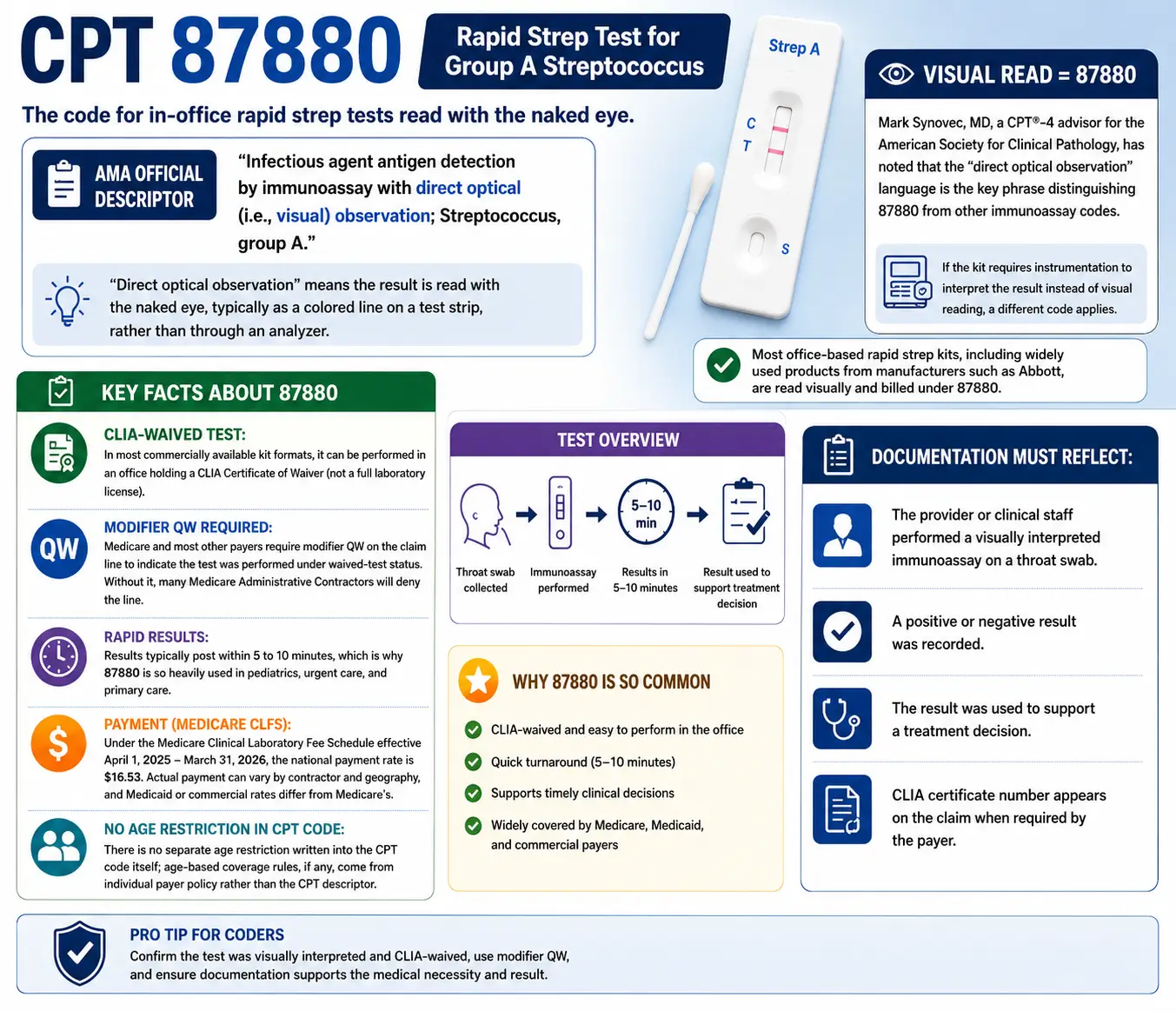
Urgent care billers must distinguish between 87880 (immunoassay, qualitative, multiple-step method) and 87804 (immunoassay, qualitative, single-step method) based on the specific CLIA-waived test kit used. Misassigning these codes is a common audit trigger. Both are billable under a CLIA waiver, but the kit's FDA-cleared methodology, not the result turnaround time, determines which code applies. Payers increasingly cross-reference the kit's package insert during audits.
2. Urinalysis 81002/81003, Venipuncture 36415, and Chest X-Ray 71045 - Core Diagnostic Codes for Urgent Care In-House Services
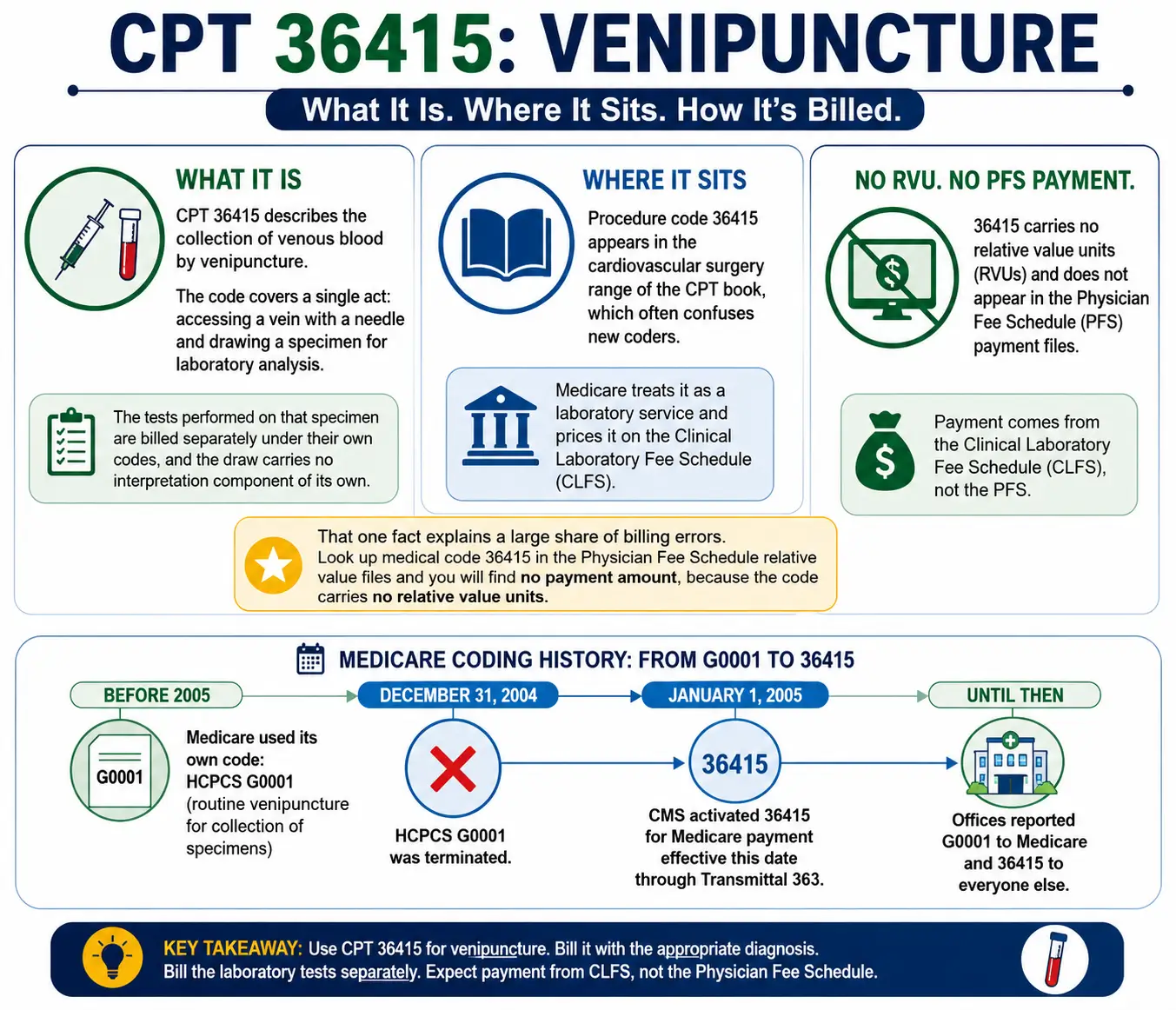
CPT 81002 covers non-automated urinalysis without microscopy; 81003 adds automation. CPT 36415 captures routine venipuncture for blood draws. CPT 71045 covers a single-view chest X-ray, the most common imaging ordered in urgent care. Medicare bundles 81002 with E/M visits under certain conditions, making modifier and medical necessity documentation critical. Each code requires the service to be performed and interpreted on-site to avoid reference-lab compliance issues.
3. ECG 93000, Lipid Panel 80061, and Vaccine Administration 90471/90472 - High-Frequency Ancillary Service Codes in Urgent Care
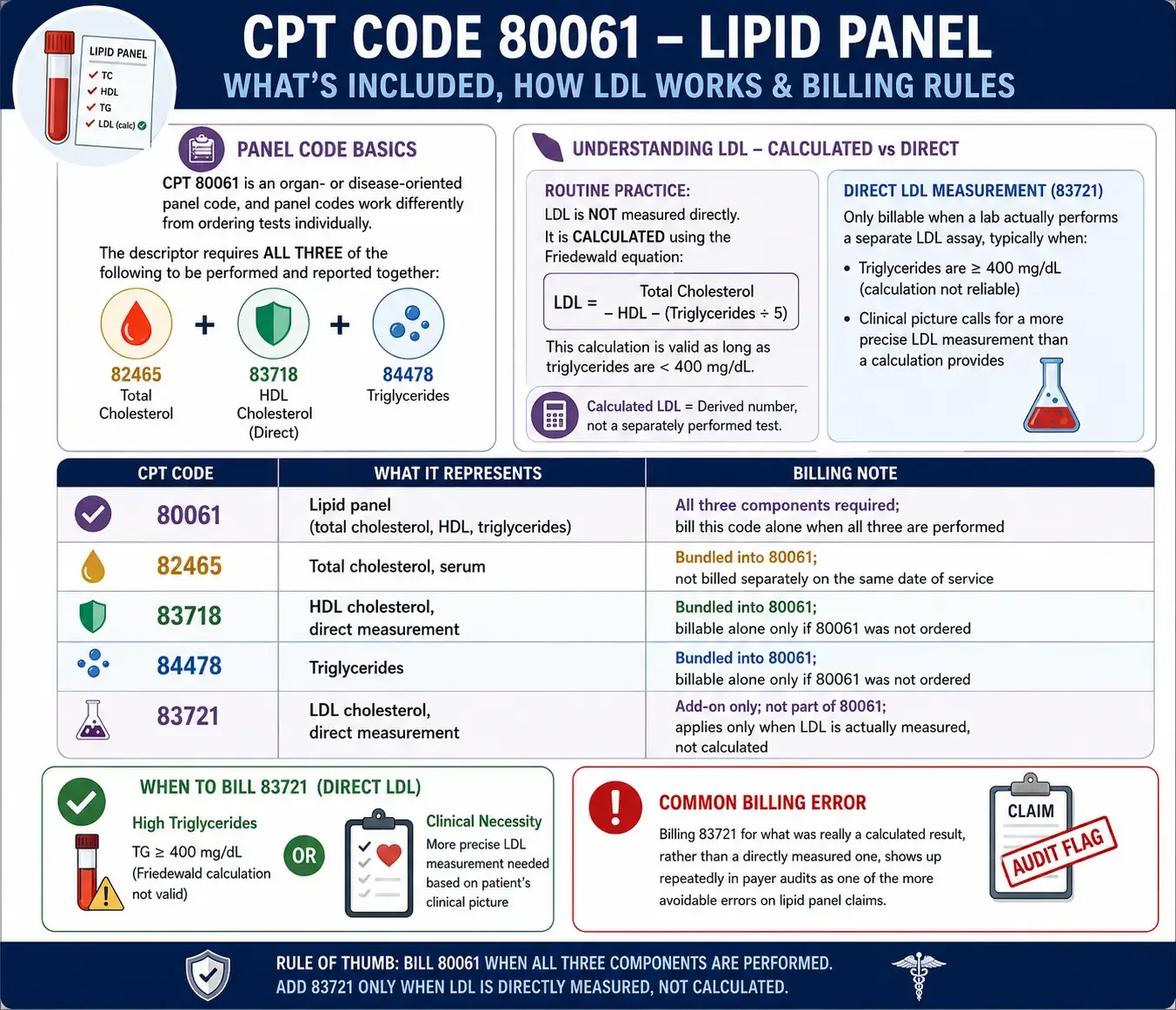
CPT 93000 covers a complete 12-lead ECG with interpretation and report, all three components must be performed by the billing provider to use the global code. CPT 80061 captures a lipid panel when ordered in-house. Vaccine administration uses 90471 for the first vaccine and 90472 for each additional, always paired with the corresponding vaccine product code (e.g., 90686 for flu). Omitting the product code or mispairing it with the administration code is a top denial reason.
4. S-Codes S9083 and S9088 - Urgent Care-Specific HCPCS Codes for Medicaid and Commercial Payer Billing

S9083 (global urgent care visit fee) and S9088 (services rendered in an urgent care center) are non-standard HCPCS codes accepted by many commercial payers and select Medicaid programs, but Medicare does not recognize them at all. Billing S9083 alongside a standard E/M code without first confirming payer-specific contract terms produces rejections that billers frequently misread as coding errors. The correct approach is to verify acceptance at the payer level before submission, because "some payers require it" and "some payers reject it" can both be true across a single practice's payer mix. Nucleus Align provides a searchable code reference that supports payer-level verification for codes including S9083 and S9088.
5. In-House vs. Reference Lab Billing Compliance - When You Can and Cannot Bill the Lab CPT Code
The technical component of any lab CPT code belongs exclusively to the entity that performed the test under its own CLIA certificate. When a specimen is processed in-house, the clinic bills the full code. When it is sent to a reference laboratory, the clinic may bill the venipuncture but cannot bill the lab panel itself, and doing so constitutes a compliance violation, not a coding error.
That determination is made at the point of care and at registration, before the claim is ever built. A coder who correctly selects a code for a rapid strep test cannot retroactively fix a violation created when the intake workflow failed to flag a send-out specimen. The documentation needed to justify standalone billing of codes like 93000 or 87880 must be embedded in the note before the coder opens the chart, closing a compliance gap that no amount of coder training alone reaches. See Section 7 for accuracy outcome data underlying this approach.
Knowing the right diagnostic CPT code is necessary, but it only protects revenue if the claim is built correctly around it. The next section maps the billing rules that determine whether a correctly coded diagnostic claim actually gets paid: POS 20 designation, Modifier 25 on same-day procedure visits, and the ED code prohibitions that trip up urgent care centers billing at the wrong facility type.
Urgent Care Billing Best Practices Covering POS 20, Modifier 25 and ED Code Prohibitions
The intake and documentation failures that create compliance violations upstream feed directly into a second layer of claim risk that operates at the structural level. Three claim-level fields determine whether an urgent care visit pays correctly or triggers a denial before a single reviewer reads the note. Getting the E/M level right matters, but if the place-of-service code is wrong, the modifier is missing, or the visit code belongs to a hospital ED, the claim fails regardless of how precisely the underlying visit was coded.
1. POS 20 vs. POS 11 - The Place-of-Service Error That Triggers Systematic Claim Denials
Freestanding urgent care centers must bill with Place of Service code 20, not POS 11 (Office). Per the Eustis Public Records / GovWell Urgent Care Billing Guidelines, submitting POS 11 on a freestanding claim causes payers to adjudicate under the office-visit fee schedule and flag the site-of-service mismatch, producing automatic downcoding or outright denial. The error is structural: it recurs every time the practice management system defaults to POS 11, which means one misconfigured template generates hundreds of underpaid claims before anyone notices the pattern.
This structural risk extends beyond your billing team's workflow. Patients themselves are increasingly caught off-guard when urgent care facilities reclassify their billing status mid-year, a real scenario that plays out when a clinic transitions its billing classification and patients suddenly face ER-level cost-sharing under their insurance plans instead of the urgent care co-pay they expected. That kind of reclassification confusion makes the POS code more than a back-office technicality; it is the field that determines what a patient owes and whether your practice is paid correctly. iScribe Health's Real-Time Denial Alerts surface POS mismatches at the point of submission, before the claim reaches the payer, so a single misconfigured template does not silently underpay hundreds of encounters.
2. Modifier 25 - When It Is Required, When It Is Not, and the Documentation Standard That Survives Audit
Modifier 25 is required whenever a separately identifiable E/M service is billed on the same date as a procedure. What survives audit is not the modifier itself but the note behind it. According to the Eustis Public Records / GovWell Urgent Care Billing Guidelines, the medical record must contain a distinct, separately documented E/M with its own history, exam, and medical decision-making, not a restatement of the procedure note. This is where most Modifier 25 claims fail: the modifier is appended correctly, but the clinical reasoning that justifies a separate service was never fully captured during the encounter.
This failure pattern reveals a synthesis principle that applies equally to Modifier 25 denials and preventive-visit bundling errors: both share a common root cause that coder training cannot fix, because the documentation deficit precedes and controls the billing outcome, and the modifier is merely the trigger that exposes the gap at adjudication. No amount of modifier knowledge produces a defensible claim when the clinical reasoning behind a separate service was never fully captured in the medical record to begin with.
When providers are racing through charts after a full shift, the E/M rationale and the procedure rationale blur together, not because the clinician lacks knowledge, but because there is simply no time to write each thread out separately. iScribe Health's Ambient AI Documentation addresses this upstream. By listening to the encounter in real time and drafting a structured note at the point of note completion, after the AI generates the encounter summary, it explicitly separates E/M rationale from procedure rationale before the chart is ever signed. The modifier is defensible before the claim is submitted, and the provider spends less time on documentation and more time on patient care.
That separation is not left to chance. iScribe Health's E&M Coding Intelligence and Automated E&M Coding layer apply coding logic against the completed note before it reaches the billing queue, so the documented reasoning and the selected modifier are aligned from the start.
3. ED Code Prohibition - Why 99281-99285 Are Off-Limits for Freestanding Urgent Care Centers
Emergency department codes 99281 through 99285 are categorically prohibited for freestanding urgent care centers. The Eustis Public Records / GovWell Urgent Care Billing Guidelines are unambiguous: these codes are reserved exclusively for hospital-based emergency departments, and billing them from a freestanding clinic constitutes an improper claim that payers will deny or recoup, with potential fraud flags attached. The confusion is most common among clinics co-located near hospital campuses, where providers sometimes assume their acuity level justifies ED-range codes. It does not. Acuity does not determine code eligibility; facility type does.
This distinction matters more as facility reclassification events become a real patient-facing issue. When a clinic near a hospital campus transitions its billing classification, patients who believed they were visiting an urgent care center may find themselves billed at ER cost-sharing rates, the exact confusion that arises when facility type and billing codes fall out of alignment. The QualityNet (CMS) framework governing facility designations and the Eustis Public Records / GovWell Urgent Care Billing Guidelines both reinforce that the facility classification, not the clinical acuity of the visit, is the controlling factor for code eligibility. iScribe Health's Real-Time Denial Alerts flag ED-code submissions from freestanding facility types before they reach adjudication, stopping the improper claim at the source.
Applying these three rules correctly eliminates the most preventable denial categories in urgent care billing. But correct rule application still depends entirely on what the clinical note says. The next section reveals why the coding mistakes that cost urgent care centers the most revenue are ones no billing team can fix after the encounter is closed.
Urgent Care Coding Mistakes That Billing Teams Cannot Fix Without Better Documentation
The common assumption among practice administrators and billing decision-makers is that the fix is better coder training: if coders know every CPT code, modifier rule, and MDM criterion, the revenue leak will close. In reality, billing accuracy in urgent care rarely fails because coders don't know the rules. It fails because the note that reaches the coder's desk is missing the clinical detail that would justify a higher code. That gap, between what happened in the exam room and what the provider documented, is where revenue quietly disappears.
1. The ~55% E/M Accuracy Rate Is a Documentation Problem, Not a Coder Knowledge Problem
Billing teams and practice administrators often invest in coder training when accuracy rates stagnate, but the root cause is upstream: physicians are not documenting what they actually did. When only 55% of urgent care CPT codes are assigned correctly industry-wide, the ceiling on coder performance is set by note quality, not coding expertise. Reframing the problem shifts accountability to the point of care, where documentation decisions are actually made.
2. High-Volume Urgent Care Environments Produce Incomplete Notes That Constrain Every Code a Biller Can Select
In fast-paced urgent care settings, providers see dozens of patients per shift and routinely address clinical complexity, multiple comorbidities, prescription decisions, risk stratification, that never makes it into the note. Coders working with urgent care CPT codes can only bill what the documentation supports, not what occurred in the room. The result is a systematic compression of code levels that billing teams are structurally unable to reverse after the fact.
3. Undercoding - Billing 99213 When 99214 Was Supported - Accumulates as Silent Revenue Loss Until an Audit Reveals It
Undercoding is invisible in real time. Industry coding trends data confirms it surfaces only during an audit, by which point the revenue loss has compounded across hundreds of visits. The 99213-to-99214 reimbursement gap varies by payer and geography, but even a modest per-visit shortfall multiplied across a busy clinic's monthly volume produces five-figure annual losses that no reference guide retroactively recovers.
The system surfaces the supported E/M level based on what was actually documented in that draft, creating more defensible documentation that reflects the clinical complexity of the visit rather than the time pressure the provider was under. The code the biller selects is then constrained by what actually happened in the room, not by what a rushed provider had time to type.
This is the pattern billing administrators recognize once they run the numbers: "The gap is not effort. The gap is visibility."
4. A ~33% Overcoding Rate Alongside Undercoding Means Urgent Care Billing Errors Run Simultaneously in Both Directions
The instinct to frame urgent care coding mistakes as either a revenue problem or a compliance problem misses the reality: both are happening at once. An average overcoding rate near 33% means a significant share of urgent care CPT codes are billed at levels the documentation cannot defend, creating active compliance exposure and repayment liability. Simultaneously, undercoding drains revenue on other visits. Billing teams facing audits must account for risk in both directions, not just one.
5. Urgent Care Coding Mistakes and Challenges - The Compounding Effect Across Common Documentation Failure Points
Urgent care CPT code errors do not stem from a single failure, they emerge from a cluster of recurring documentation gaps: missing medical decision-making rationale, absent time documentation, incomplete HPI, and unrecorded prescription risk assessments. Each gap individually might shift one code level; together they systematically distort the entire coding distribution across a practice. Billing teams cannot patch these gaps retroactively, making prospective documentation improvement the only viable correction strategy.
How Automated E/M Coding Closes the Documentation Gap That Reference Guides Cannot
Coding accuracy in urgent care is a capture problem. When clinical complexity disappears between the exam room and the finalized note, the coder inherits a record that cannot support the code the visit actually earned, regardless of how well that coder knows the MDM criteria.

Why the Note Arrives Incomplete Before the Coder Ever Sees It
By the time a clinician sits down to document, the visit is already receding. The specific reasoning behind a prescription decision, the number of diagnoses considered, or the data reviewed has faded. What gets recorded is a summary, not a reconstruction of clinical complexity, and that gap follows the note all the way to the coder.
A common pattern in busy practices: coders flag incomplete notes, request addenda, and still end up selecting a lower E/M level because the supporting detail was never captured in the first place. No training program fixes a note that was already thin when it arrived.
How Ambient AI Documentation Captures MDM Elements in Real Time
The clinical reasoning present in the room, the differential considered, the risk level of the management decision, gets embedded in the record while it still exists in full, rather than being reconstructed from memory after the fact.
Automated E/M Code Generation Closing the Gap to Audited Accuracy
Automated E/M coding built on complete ambient documentation closes accuracy from the industry-average near 55% to 95% audited accuracy, a gain that coder training cannot reproduce because it addresses the wrong constraint. The note is what changed.
An AI medical scribe like iScribe Health captures the complete clinical record in real time; iScribe's Automated E/M Coding feature then generates validated codes from that record, removing the manual selection step that introduces inconsistency across high-volume providers. The accuracy gain is a documentation completeness achievement, not a coding intelligence achievement.
One honest limitation worth naming: the documentation and coding accuracy gains described here materialize only when providers engage with the ambient capture process consistently across their shifts. Practices with fragmented or irregular provider adoption, common in multi-site urgent care groups with high clinician turnover, will see uneven results until documentation habits stabilize across the team. If your organization is not prepared to support a structured rollout and provider onboarding process, a more self-contained tool or a traditional scribing model may be a better near-term fit.
Next steps
If your urgent care practice is losing revenue on visits where the clinical complexity was real but the note never captured it, the path forward starts with fixing documentation at the source. As the 99213-versus-99214 analysis in this guide shows, moderate MDM clears the billing threshold on a large share of typical urgent care visits, yet up to 30% of those visits are still billed at the lower level. The gap is not threshold knowledge. It is documentation capture. Start with our AI medical scribe.
Two findings from this guide make the next step clear. First, automated E/M coding that closes accuracy from an industry average near 55% to 95% audited accuracy is a documentation completeness achievement, not a coding intelligence achievement: the same coding logic applied to a thin note reproduces the same undercoding. Second, Modifier 25 denials and preventive-visit bundling errors share a root cause that coder training cannot fix, because the documentation deficit precedes and controls the billing outcome. Both findings point to the same action: capture the clinical encounter completely, in real time, before the note is ever finalized.
Start with an AI medical scribe built for high-volume clinical workflows. When the note reflects what actually happened in the room, every code downstream, from E/M level to modifier selection to diagnostic billing, is anchored to documentation that supports it.
Frequently Asked Questions
Can urgent care centers bill using emergency department E/M codes like 99281-99285?
No. Emergency department E/M codes 99281-99285 are reserved for hospital-based emergency departments. Freestanding urgent care clinics are prohibited from using them regardless of visit acuity or the complexity of care delivered, it is a structural rule tied to facility type, not a payer preference.
What place of service code does an urgent care clinic need to use on claims?
Freestanding urgent care clinics must submit claims under Place of Service code 20 (Urgent Care Facility). Using POS 11 (Office) instead triggers automatic denials, because payers use the POS value to validate whether the billed E/M code is appropriate for the setting, even a perfectly documented 99214 will be rejected if the POS field is wrong.
Can I bill an urgent care visit based on time alone, or do I always need to document medical decision-making?
Either pathway is sufficient on its own, you select whichever basis, total time or medical decision-making (MDM), best supports the visit level. However, in a high-throughput urgent care setting, total time is frequently underdocumented or absent, making MDM the more revenue-protective selection path when the documentation exists to defend it.
Why do so many urgent care visits end up billed at 99213 when they should be 99214?
The post points to documentation capture failure rather than coder error: when providers complete notes after the clinic day ends rather than in real time, details like the rationale for a prescription change or chronic condition complexity addressed mid-visit often fade and never make it into the written record. Internal coding audits cited in the post found that up to 30% of established-patient visits billed at 99213 contained documentation sufficient to support 99214, even in practices with trained coders.
When does a new patient urgent care visit qualify for 99204 instead of 99203?
99204 Requires either 45-59 minutes of total time or moderate MDM complexity. Under the MDM pathway, moderate complexity applies to visits involving a new problem with uncertain prognosis, prescription drug management, or moderate data review, for example, a new patient with a laceration requiring sutures plus a new prescription already carries moderate MDM and supports 99204 even if the visit ran well under the time threshold.