13 Top Medical Scribe Companies to Consider in 2026
Top medical scribe companies ranked for 2026, so practice administrators can avoid EHR integration pitfalls that silently kill physician adoption.


Most scribe comparisons measure vendor capability, not physician behavior. That gap is where adoption collapses, costs compound, and the wrong framework quietly fails your practice before a single scorecard flags it.
Practice administrators spend weeks building evaluation matrices, scoring vendors on transcription accuracy percentages, HIPAA certifications, and EHR compatibility checklists. Most healthcare practice administrators and operations leaders believe that a thorough feature-by-feature comparison is the right framework for vendor selection: if the spec sheet checks out, the implementation will succeed. The logic feels sound: rigorous inputs should produce reliable outputs.
But the framework itself is the problem, because it measures what a platform can do in a controlled demo, not whether physicians will actually use it under real clinical conditions. For practices where clinicians are already seeing high patient volumes and finishing visits exhausted, the gap between a vendor's promised capability and a provider's daily behavior is where programs quietly die. Understanding that gap, especially for specialty-specific implementations, is what separates a successful deployment from expensive shelfware.
Image: Why Most Medical Scribe Comparisons Set Practices Up to Fail
Vendor capability and physician behavior are two different variables. A 98% transcription accuracy rate tells you how a model performed on a curated test set. It tells you nothing about whether a physician will correct the remaining 2% themselves, trust the output enough to stop reviewing every line, or simply revert to self-charting because the correction loop feels faster. Administrators conducting scribe comparisons often treat "EHR integration" as a binary checkbox, when in practice the distinction between a true ambient workflow and a PDF pushed into a chart is the difference between adoption and abandonment. That misconception is structural, baked into the evaluation framework before a single vendor is contacted.
According to the AMA's 2024 analysis, physician "pajama time" averaging 2 to 3 hours of after-hours EHR documentation per day has remained essentially unchanged even as headline burnout rates declined. That persistence is the clearest evidence that selecting a technically capable tool is not sufficient to solve the underlying workflow problem. A scribe platform a physician doesn't trust, or finds friction-filled to use, produces the same outcome as no platform at all.
A common pattern among practices that stall post-go-live is that frontline providers were never consulted during evaluation, so the criteria used to score vendors reflect administrator priorities, not the actual friction points physicians encounter at the point of care.
The moment a physician has to manually move a note from a scribe tool into the patient chart is often the moment they quietly stop using it. That single step, invisible on any feature checklist, is where adoption collapses.
The evaluation framework is the first failure point. When scribe adoption quietly stalls, the financial and operational damage compounds in ways that don't show up on a vendor scorecard until it's too late to reverse them. For practices already running a supported EHR, Epic, Oracle Health, or another natively integrated system, this distinction matters most immediately: ambient documentation that pushes structured notes directly into the correct patient chart is only possible when the EHR integration is native, not bolted on. Every workflow claim in the sections that follow assumes that EHR condition is met.
Key takeaways
- Feature-by-feature scorecards feel thorough, but they measure the wrong thing, a platform that passes every checklist and gets quietly routed around by physicians is still a failed implementation.
- Human scribe programs carry three compounding failure modes, scheduling gaps, scope ceilings, and turnover costs, that most administrators don't recognize as a unified cost stack until revenue has already absorbed the damage.
- Two delivery models share the label 'medical scribe' but operate on fundamentally different architectures; treating them as quality tiers of the same service leads to evaluating the wrong variables entirely.
- Physician adoption on day one is the only post-go-live metric that separates a real documentation solution from shelfware, 94% of providers accept iScribe-generated notes from the first session.
- EHR order time for primary care physicians rose 58.9% per scheduled clinic day since 2019, which makes vendor selection consequential, not academic.
- Practice size, EHR environment, and specialty complexity, worked through in that order, collapse a thirteen-vendor field to two or three serious candidates before a single demo is scheduled.
- iScribe Health closes the copy-paste gap directly: AI-generated notes push into the correct patient chart inside your existing EHR, with no duplicate entry, across the major EHR platforms used by health systems and specialty practices.
The Operational Costs That Stack Up When Scribe Programs Don't Scale
Human scribe programs carry three compounding failure modes that most practice administrators don't recognize as a unified cost stack until physician retention is already slipping and quarterly revenue has already absorbed the damage.

"Small independent practices face enterprise-oriented pricing structures that don't reflect their scale, making it difficult to assess ROI when only two providers are involved."
— what we hear from small independent medical practices
Why Human Scribe Capacity Creates a Scheduling Ceiling That Limits Patient Volume
According to DoctorsVA Solutions, a full-time in-person scribe costs between $48,000 and $90,000 per year once benefits, workspace, credentialing, and turnover are factored in, compared to roughly $24,960 annually for a virtual scribe. Every additional encounter without a reliable documentation infrastructure widens the gap between scheduled capacity and actual revenue capture. And because iScribe Health integrates directly with your existing supported EHR, practices already running a supported system don't absorb an implementation overhaul on top of a documentation crisis.
After-Hours Charting Is a Physician Retention Risk, Not a Documentation Quirk
The 2-3 hours per day physicians lose to documentation represents a direct and recurring operational time cost that compounds across a clinic or hospital as patient volume grows, and as Human Medical Billing notes, reducing after-hours charting has a direct impact on EHR time and physician sustainability.
iScribe Health delivers its greatest value when physicians want a completely hands-free documentation experience during the visit. For practices where clinicians regularly chart two or more hours outside of patient care time, that impact is realized across every patient encounter and every day of clinical practice.
How Documentation Inconsistency Creates a Hidden Revenue Leak for Your Practice
The revenue leak rarely appears as a single line item; it accumulates quietly in undercoded visits, overcoded claims flagged on audit, and E&M levels that drift from one physician to the next based on documentation habit rather than clinical reality. DoctorsVA Solutions estimates that freeing a provider to see just two additional patients per day at $150 per visit generates $78,000 in annual revenue, yet human scribe programs introduce variability because documentation quality depends on individual scribe skill, training recency, and specialty familiarity, creating audit exposure that stays invisible until a payer pulls records.
Independent practices with only two providers face the same coding drift risk as large health systems, but without the revenue base to absorb denial cycles or the compliance infrastructure to catch them early. IScribe for orthopedic practices addresses this directly through Automated E&M Coding and E&M Coding Intelligence built into the documentation workflow, targeting all three failure modes at once:
- Capacity ceilings
- After-hours overflow
- Coding drift
The structural fix is removing the human scribe dependency from the documentation loop entirely, replacing variable coverage and variable quality with an ambient AI layer that delivers a completely hands-free documentation experience, integrates with the EHR the practice already runs, and applies intelligent, consistent coding on every note it produces.
What Is the Difference Between Human Scribe Services and AI Ambient Scribe Platforms

Human Scribes Document and Their Scope Boundary Has Real Operational Consequences
Across the field, it is well established that scribes "document the encounter but do not diagnose, preserving the physician's scope of practice while offloading administrative documentation work."
Coverage gaps during illness, no-shows, or turnover fall directly on the physician's documentation queue, a queue that already consumes approximately half of a physician's working time, making the human model's reliability ceiling a structural concern rather than an occasional inconvenience.
Why Human Scribe Programs Break Down as Your Practice Grows
Human scribe programs scale through headcount, which means every new provider or location adds recruitment cycles, onboarding lag, and turnover exposure. For practices running a natively supported EHR, a direct EHR push, the architecture iScribe Health uses, routes structured notes into the correct patient chart without a copy-paste step, removing the handoff that most hybrid or bolted-on integrations reintroduce.
Measuring Scribe ROI by Clinical Capacity, Not Contract Price
A lower-cost AI platform only delivers on that metric if physicians trust and use it consistently enough to see more patients. iScribe's 94% provider acceptance rate on AI-generated notes matters precisely because unaccepted notes mean unrecovered time, and the $78,000 in additional annual revenue modeled from just two extra daily patient visits evaporates entirely if the physician spends recovered time correcting notes instead of seeing patients.
iScribe Health's Ambient Listening and Conversational AI delivers the greatest value when physicians want a completely hands-free documentation experience during the visit, no keyboard, no template navigation, no mid-encounter interruption, allowing clinical attention to remain on the patient throughout.
How NLP and LLM Engines Convert Conversation to Structured Notes
- Chief complaint
- History of present illness
- Assessment
- Plan
At the point of note completion, after the AI drafts the encounter summary, iScribe Health's E&M Coding Intelligence and Automated E&M Coding layer applies coding logic to the structured output, reducing the manual review burden that contributes to both revenue leakage and denial exposure. That distinction matters operationally: a model trained on general primary care encounters will underperform in orthopedics or cardiology, where procedure language and anatomical specificity are dense. iScribe Health's AI Customization capability addresses this directly, allowing the platform to be tuned for specialty-specific encounter language rather than relying on aggregate accuracy benchmarks that mask performance variance across clinical contexts.
Key Features to Evaluate Before Choosing a Medical Scribe Company
Physicians in primary care now spend measurably more time on EHR orders than before 2019, with EHR order time alone rising 58.9% per scheduled clinic day according to a January 2024 study, a trend that has pushed many practices to evaluate AI scribe solutions as a direct intervention.
Research published in JAMA Internal Medicine reinforces how wide the gap between promised and realized EHR efficiency can be, and independent analysis of the AI scribe market confirms that evaluating these tools rigorously remains genuinely difficult for most practice administrators.

Physician Adoption Rate - The One Post-Go-Live Metric That Exposes Shelfware
iScribe Health reports a strong day-one note acceptance rate, where providers accept the AI-generated note without significant revision from the first encounter, which serves as a useful reference point when asking any vendor to share comparable figures from a specialty-matched deployment. That figure matters because it signals that the underlying model was trained on specialty-specific language before the practice ever signed a contract, so calibration does not stretch across months of painful feedback loops. iScribe Health's AI Customization capability is what makes this possible: the ambient listening and conversational AI layer is trained to the clinical language of a given specialty before go-live, so the note that surfaces at the point of encounter summary reflects the physician's actual documentation style rather than a generic template, and sustained adoption is far more likely than with tools that require prolonged post-launch correction cycles.
EHR Push vs. Copy-Paste - Why Chart Destination Determines Real ROI
Where a note lands after it is generated is as consequential as how accurately it was drafted. Copy-paste documentation is a documented source of clinical error propagation, with JAMA Internal Medicine research flagging it as a contributor to inaccurate, redundant, and unverifiable chart entries that compound across encounters. Direct EHR push is a baseline requirement.
iScribe Health's EHR Integration routes AI-generated notes directly into the correct patient chart field automatically, and it materializes most cleanly when the practice or health system is already running a supported EHR and wants a seamless ambient documentation experience, no parallel interface, no copy-paste step, no manual reconciliation. Beyond note delivery, iScribe Health's Automated E&M Coding and Real-Time Denial Alerts work at the point of note completion, after the AI drafts the encounter summary, to ensure accurate, compliant medical coding across high patient volumes, maximizing reimbursement and minimizing claim denials before a charge ever reaches the payer.
The Compliance and Customization Floor Every Vendor Must Clear
Every vendor in this space will present a signed Business Associate Agreement as evidence of HIPAA compliance, but a BAA alone does not constitute a compliance posture. Verification should extend to data residency controls, audit log accessibility, and role-based access controls that separate physician, administrator, and scribe permissions. Those are the criteria that surface in a payer audit or breach investigation.
Specialty-specific model training deserves the same scrutiny. Asking vendors for accuracy data from a specialty-matched deployment, rather than aggregate benchmarks, is the only way to assess whether the model was trained on your clinical language. iScribe Health's E&M Coding Intelligence addresses this directly: rather than applying a one-size-fits-all coding logic, it applies specialty-aware coding that surfaces the documentation elements needed to support the correct level of service, reducing undercoding that leaves revenue on the table and overcoding that creates audit exposure.
- 1. Day-one note acceptance rate ≥ 94% in a specialty-matched deployment → Verification: Request data from a comparable specialty trial.
- 2. Direct EHR push (no copy-paste step) into your specific EHR instance → Verification: Live same-day demo in your EHR environment.
- 3. BAA in place plus data residency controls, audit logs, and role-based access → Verification: Review contract and security documentation.
- 4. Specialty-specific templates validated on real encounter data → Verification: Ask for specialty-matched accuracy benchmarks, not aggregate stats.
- 5. Coding accuracy data from a real-volume trial (not a marketing claim) → Verification: Request a validated trial report (e.g., encounter count, overcoding/undercoding surfaced).
- 6. Physician adoption monitoring post-go-live (time-in-EHR, note-correction rate) → Verification: Confirm the vendor provides an ongoing analytics dashboard.
- 7. Scalability path: per-encounter cost structure as providers are added → Verification: Model costs at 2×, 5×, and 10× the current provider count.
Related Reading
- Hipaa Compliant Ai Scribe
- How Does An Ai Scribe Work
- Medical Scribe Cost
- Ai Scribe Cost
13 Top Medical Scribe Companies to Consider in 2026
Physician adoption is the only post-go-live metric that separates a scribe investment from shelfware with a HIPAA badge. Feature lists are table stakes across every vendor on this list. What actually determines whether a platform delivers documentation ROI is whether clinicians accept the generated note on day one, whether that note lands directly in the EHR without a manual copy-paste step, and whether the coding that flows from it holds up when a payer pulls records. With that lens applied, here are the 13 vendors worth serious evaluation.
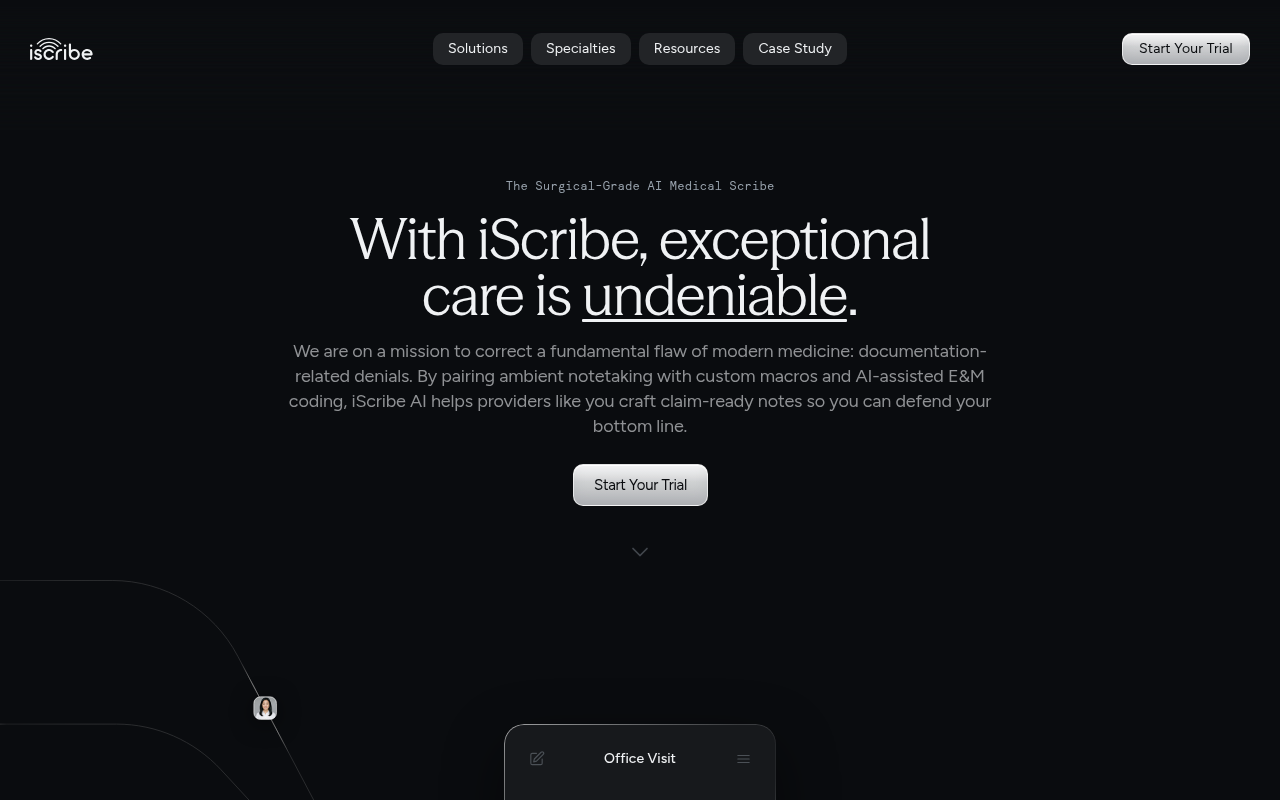
1. iScribe Health - Best AI Scribe for Revenue Integrity and Coding Accuracy
Most administrators assume documentation accuracy and coding accuracy are the same problem. They are not, and the gap between them is where audit risk quietly accumulates.
There is a broader trust problem that Chief Medical Officers and practice administrators encounter when evaluating AI scribe platforms: deep, often justified skepticism toward large technology vendors about how patient and clinical data is actually being used. When physicians do not trust the platform handling their encounter audio, they build workarounds that defeat the entire investment. That concern is not abstract, and it shapes every conversation about AI documentation in serious clinical settings.
iScribe Health is built around the workflows that make or break trust at the point of care: ambient listening that captures the encounter conversationally, automated E&M coding intelligence that runs at the point of note completion after the AI drafts the encounter summary, and a direct EHR integration that eliminates the copy-paste step physicians resent most. Real-time denial alerts surface coding problems before a claim leaves the practice, and AI customization allows the platform to be fitted to the documentation patterns a specific physician or specialty actually uses, reducing the friction that kills adoption in the first weeks after go-live.
The evidence behind those workflow claims is specific. iScribe Health's orthopedic coding trial, validated across 941 encounters, achieved 95% coding accuracy and surfaced a 33% overcoding rate that had been entirely invisible to the practice before deployment. That overcoding exposure is real audit risk, the kind that does not appear in a feature comparison matrix and does not show up until a payer pulls records. The 94% day-one note acceptance rate is a structural outcome of the direct EHR push: when a note lands in the chart without friction, physicians do not build the workarounds that eventually turn a platform into shelfware.
The best AI medical scribe for orthopedic practices' benefit materializes most clearly in high-volume practices and health systems where clinicians are regularly charting two or more hours outside of patient care time, a pattern that compounds into retention pressure that practice administrators feel long before it shows up in turnover data. Because iScribe Health's ambient documentation and E&M coding intelligence operate across every patient encounter on an ongoing basis, the efficiency gain does not arrive as a one-time implementation win; it accumulates daily across the full encounter volume of the practice.
Most beneficial when the practice is already running a supported EHR and wants ambient documentation tied directly to revenue integrity, not just time savings.
2. ScribeAmerica - Best for Large Health Systems and Emergency Departments
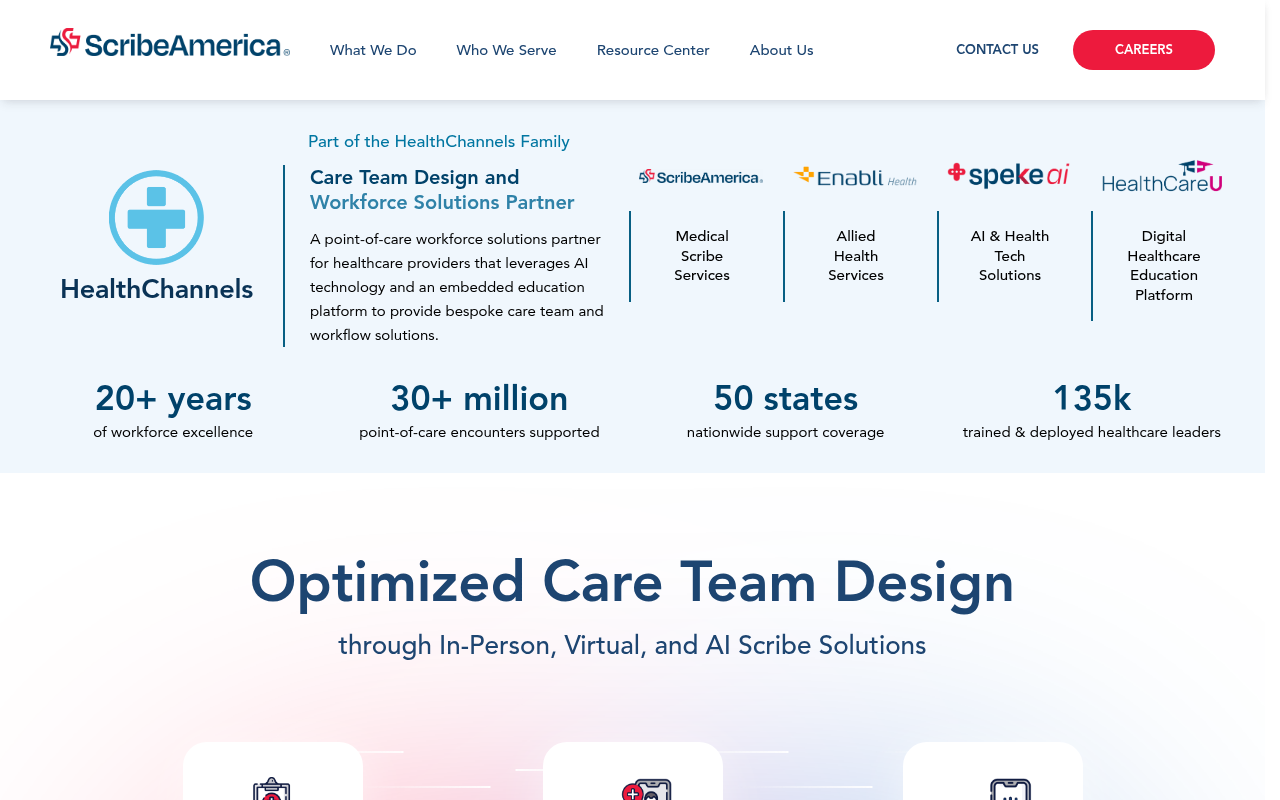
ScribeAmerica is the largest traditional medical scribe company in the United States, employing tens of thousands of scribes across on-site and virtual programs in health systems, academic medical centers, and high-volume emergency departments. Its institutional scale means credentialing, scheduling, and compliance infrastructure are mature. The honest tradeoff: per-encounter cost runs significantly higher than AI-native alternatives, and scheduling gaps during peak demand periods are a known operational friction point. Best suited to health systems where physician preference for a human presence in the room outweighs cost-per-encounter considerations.
3. Augmedix - Best Hybrid Ambient Scribe Combining Live Scribes with AI
Augmedix pioneered natural, conversational medical documentation by pairing remote live scribes with ambient technology platforms, giving practices a human quality layer on top of AI-assisted capture. The hybrid model is particularly strong in complex, unstructured encounters where pure AI models still struggle with clinical ambiguity. The tradeoff is cost: hybrid delivery carries more overhead than AI-only platforms. Augmedix explicitly markets customizable levels of AI automation and human support as a defining feature across its product suite, positioning the human review layer not as a transitional limitation but as a deliberate, flexible option available at all stages of adoption.
4. DeepScribe - Best AI Scribe for Complex Specialties Like Cardiology and Oncology
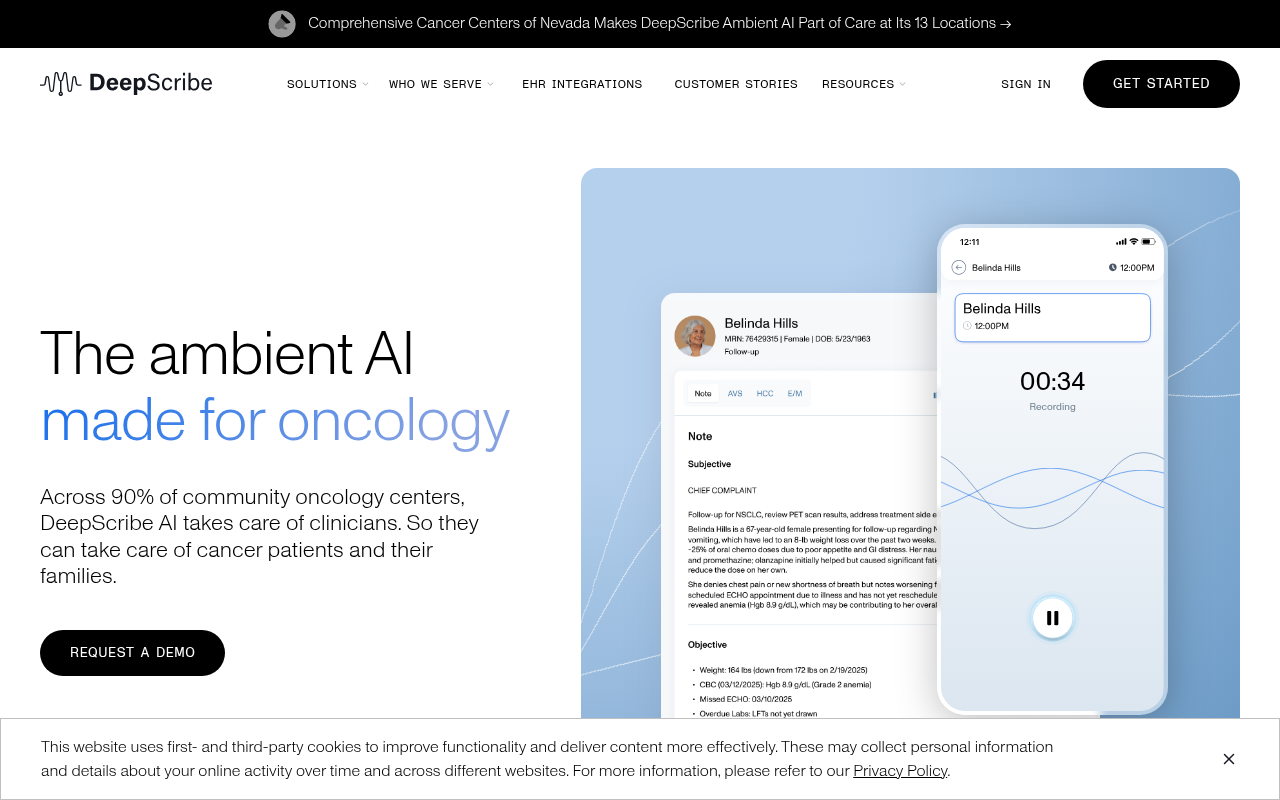
For specialty practices where a general-purpose NLP model produces notes that need heavy physician editing, DeepScribe's specialty-trained models for cardiology, oncology, and other complex disciplines are a meaningful differentiator. Specialty NLP trained on actual encounter data from those disciplines produces structurally different output than a general model fine-tuned on generic clinical text. The limitation to weigh: practices outside DeepScribe's core specialty verticals may find the platform's configuration overhead exceeds what a lighter AI-native tool requires. Best evaluated by practices where documentation complexity, not volume, is the primary constraint.
5. Microsoft Dragon Copilot (Nuance) - Best Enterprise Ambient AI with Robust EHR Interoperability
Dragon Copilot, built on Nuance's clinical AI infrastructure and integrated into the Microsoft Cloud for Healthcare, carries the broadest EHR interoperability footprint of any enterprise ambient platform. For large health systems already operating in the Microsoft ecosystem, the integration path is substantially shorter than with independent vendors. The practical limitation is that enterprise licensing, implementation timelines, and IT governance requirements make Dragon Copilot a poor fit for independent physician groups or practices with fewer than 20 providers. Its strength is depth of interoperability; its cost is complexity of deployment.
6. Abridge - Best for Clinical Depth and Rapid Health IT Integration
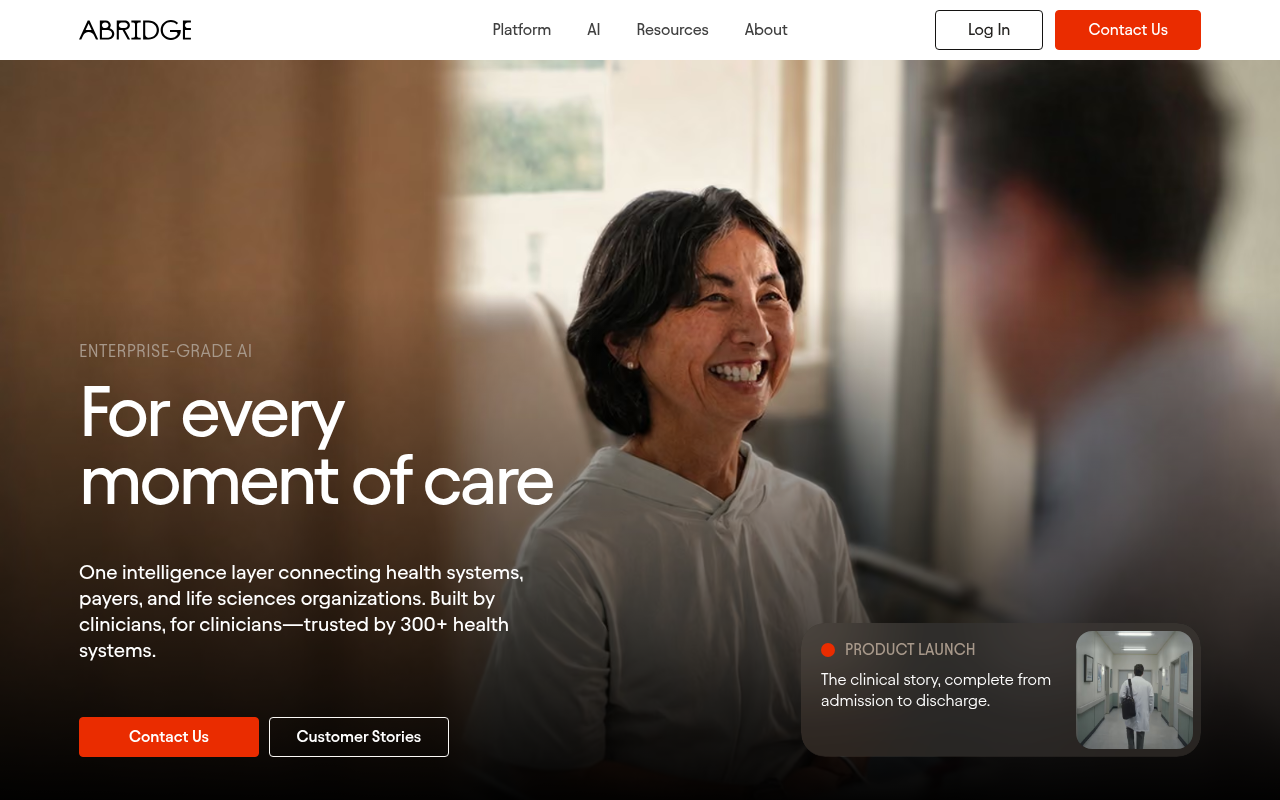
Abridge has earned recognition across health IT circles for clinical depth in note generation and a faster-than-average integration timeline with major EHR environments. Its summarization quality in complex, multi-problem encounters is consistently cited by clinicians as a differentiator over lighter ambient tools. The tradeoff worth naming: Abridge is oriented toward health system buyers and academic medical centers, and its configuration support for independent or single-specialty ambulatory practices is less mature than its enterprise offering. Evaluate it seriously if your EHR environment is Epic and your clinical complexity is high.
7. Suki - Best Enterprise Ambient Clinical Intelligence from Pre-Charting to Clinical Reasoning
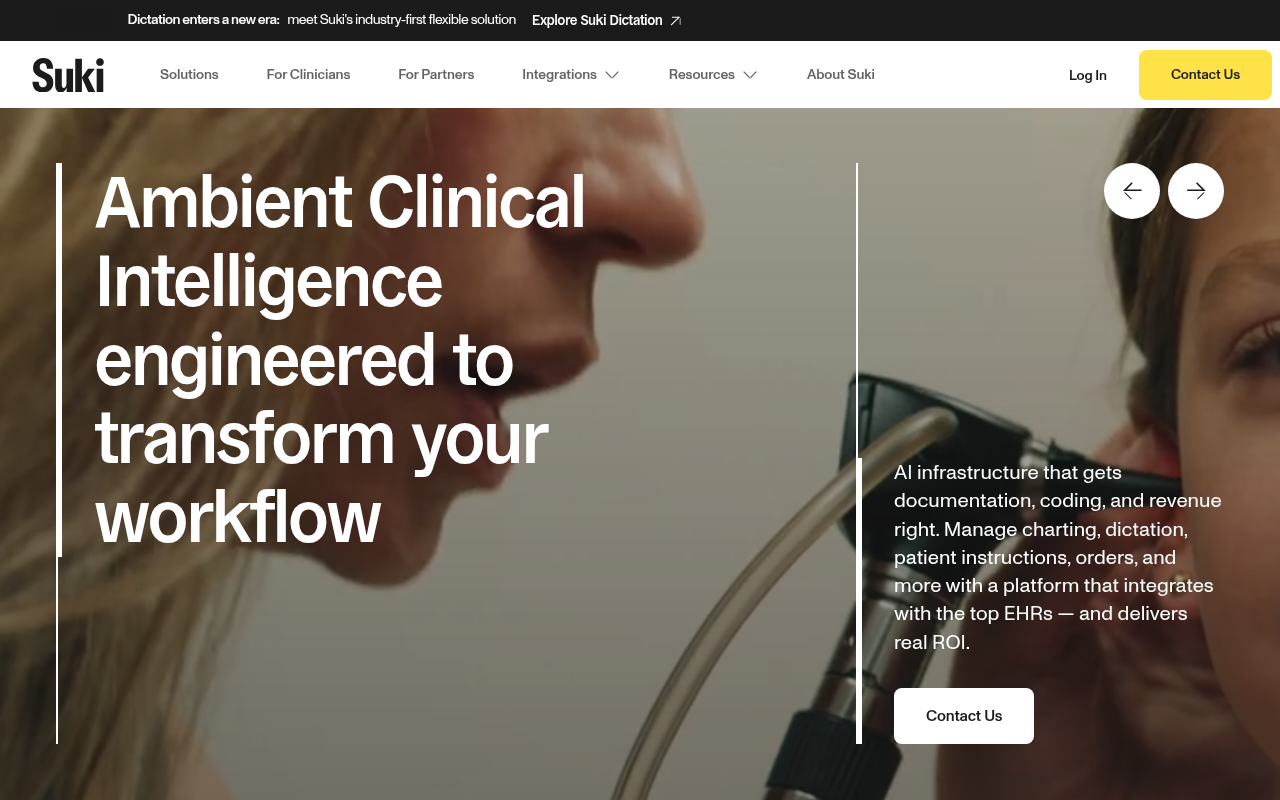
Suki spans the full clinical workflow from pre-charting through documentation and into clinical reasoning support, and its ambient voice layer has earned strong clinician satisfaction ratings in enterprise deployments. For enterprise buyers who want a single platform across multiple workflow stages, that breadth is genuinely valuable. The limitation is proportional: independent physician groups and ambulatory practices with 20 or fewer providers will find Suki's scope and pricing structure exceed their actual documentation need.
It is an enterprise tool solving enterprise problems, and fitting it to a smaller practice environment creates configuration overhead that erodes the efficiency gains.
8. Freed - Best AI Scribe for Reducing After-Hours Charting in Small and Midsized Clinics
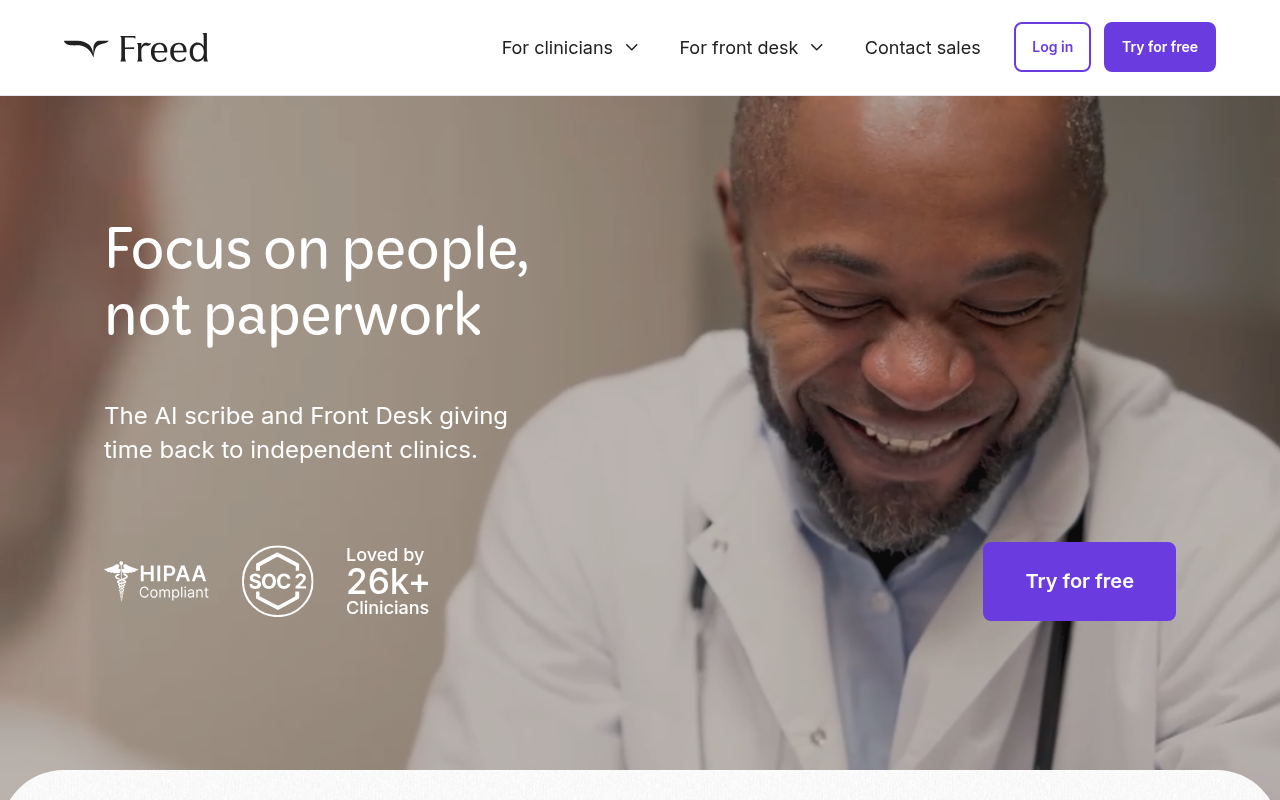
Physicians in small and midsized practices are spending meaningful hours after clinic completing charts, a documentation burden that compounds into burnout and retention pressure that lands squarely on the practice administrator. Freed is purpose-built to reduce after-hours charting for outpatient clinicians, with a setup path and mobile experience consistently cited by users as lower-friction than enterprise-tier alternatives. The honest tradeoff: Freed explicitly offers a Coding Assistant feature focused on revenue recapture, ICD-10, CPT, and E/M coding optimized at the highest justified level, making it more than a pure documentation tool and directly contradicting the claim that it is not a revenue integrity platform.
Practices that need deep audit defensibility or direct coding intelligence fully integrated into EHR workflows should confirm the depth of those capabilities directly with the vendor before signing.
9. Heidi Health - Best Free-Tier AI Scribe for Solo Practitioners and Budget-Conscious Practices

Heidi Health offers a functional free tier that has driven meaningful adoption among solo practitioners and small practices evaluating AI scribing without a capital commitment. For a single-provider practice testing whether ambient documentation actually changes clinical workflow, the free tier is a low-risk entry point. The limitation is scalability: as practice volume grows or EHR integration requirements become more specific, Heidi's free configuration becomes a ceiling rather than a foundation. For a solo practitioner whose primary need is low-friction ambient documentation without implementation support or coding integration, Heidi's free tier is a logical starting point; practices with more than one or two providers, EHR push requirements, or revenue integrity goals will find Heidi's configuration ceiling arrives quickly.
10. Nabla - Best Conversational AI Scribe with Multilingual Patient Support

Nabla's primary differentiator is multilingual patient encounter support, which matters in practices serving linguistically diverse patient populations where documentation accuracy across languages is a compliance and quality concern. Its conversational AI layer handles code-switching and mixed-language encounters better than most English-optimized ambient platforms. The tradeoff worth naming: Nabla's primary design emphasis is conversational and multilingual documentation capture; practices with revenue optimization or deep EHR integration as their first priority should confirm coding intelligence depth and native push support directly with the vendor before signing.
Evaluate it when patient population language diversity is the primary documentation challenge, and pair it with a billing workflow that compensates for lighter coding support.
11. Twofold Health - Best AI Scribe Built Specifically for Mental Health and Therapy Documentation
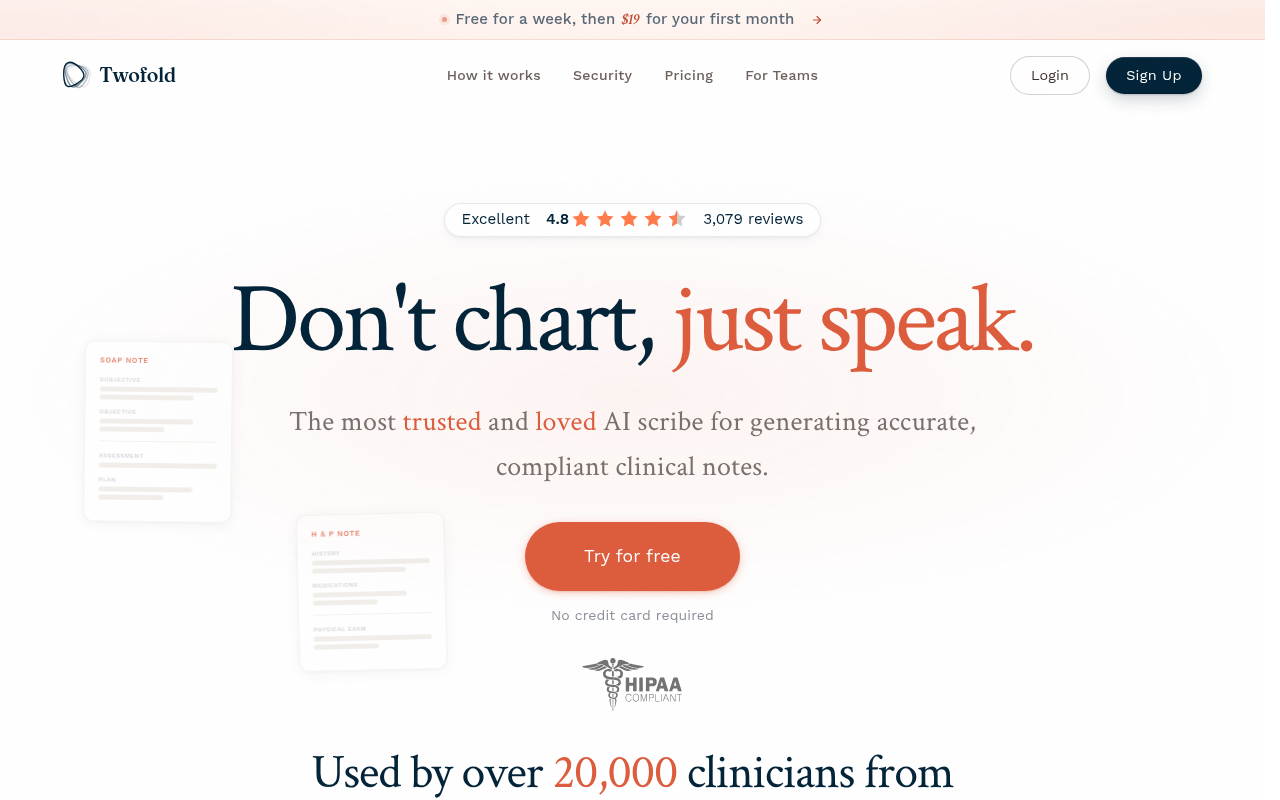
Mental health and therapy documentation follows structural patterns, regulatory requirements, and session note formats that differ substantially from medical encounter documentation. Twofold Health is a general-purpose AI scribe used broadly across primary care, hospital medicine, pediatrics, and behavioral health, not purpose-built exclusively for behavioral health workflows or billing formats. The limitation is intentional: Twofold does not serve medical specialties outside behavioral health, so practices with mixed clinical populations will need a separate documentation solution for their non-behavioral encounters. It is the right fit when the entire practice operates within mental health and therapy workflows.
12. ScribeEMR - Best HIPAA-Compliant Virtual Medical Scribe Service for Outpatient Practices
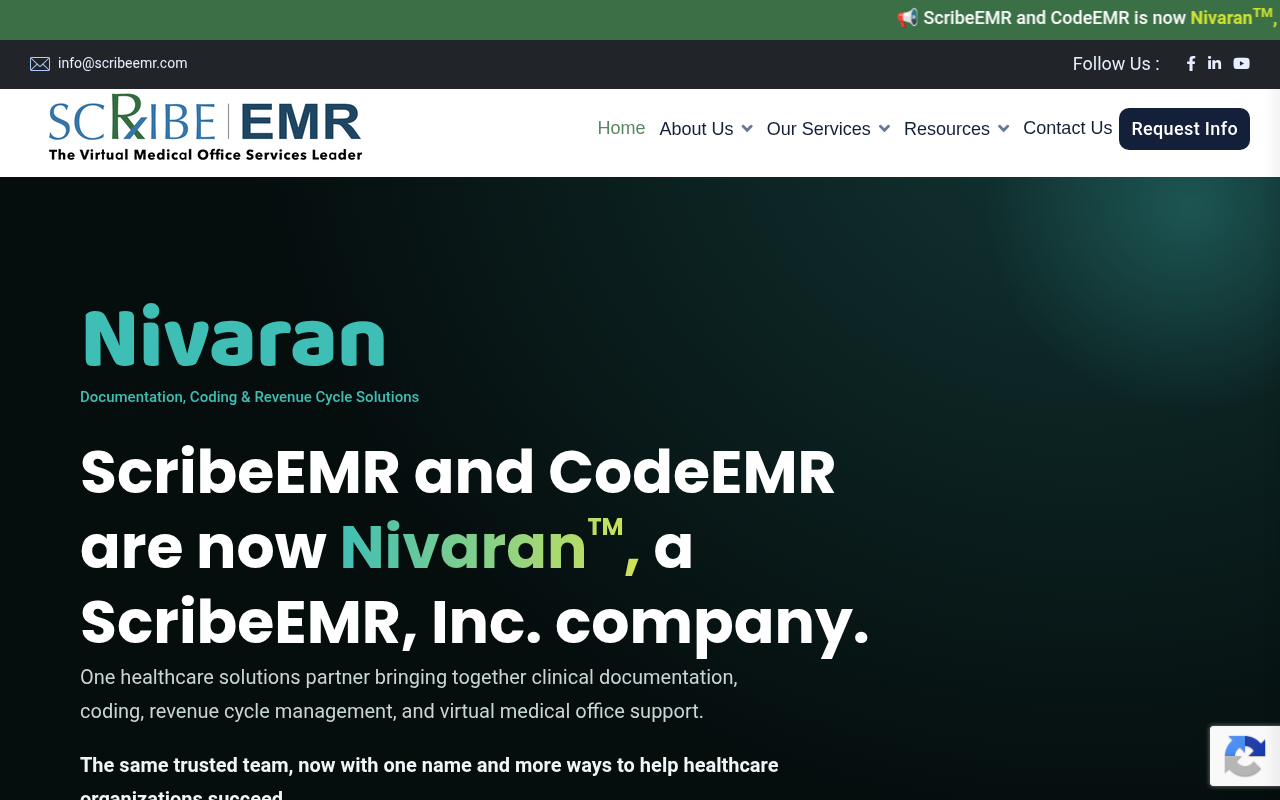
ScribeEMR (now rebranding as Nivaran) serves a broad range of healthcare settings including FQHCs, CHCs, rural and critical access hospitals, and hospital networks, not just outpatient practices, and offers a full suite of services including AI scribing, medical coding, revenue cycle management, and virtual medical office support, not only human virtual scribe coverage. For practices where physicians prefer real-time human documentation support but cannot justify a full-time on-site scribe, ScribeEMR's virtual model reduces scheduling and facilities overhead while maintaining a human quality layer. The tradeoff is scalability: virtual human scribes carry per-hour cost structures that do not compress with volume the way AI-native platforms do, making ScribeEMR a better fit for stable, predictable patient volumes than for practices with significant growth ambitions.
13. Medical Billers and Coders (MBC) - Best for Combining Scribing with Billing and Coding Audit Readiness
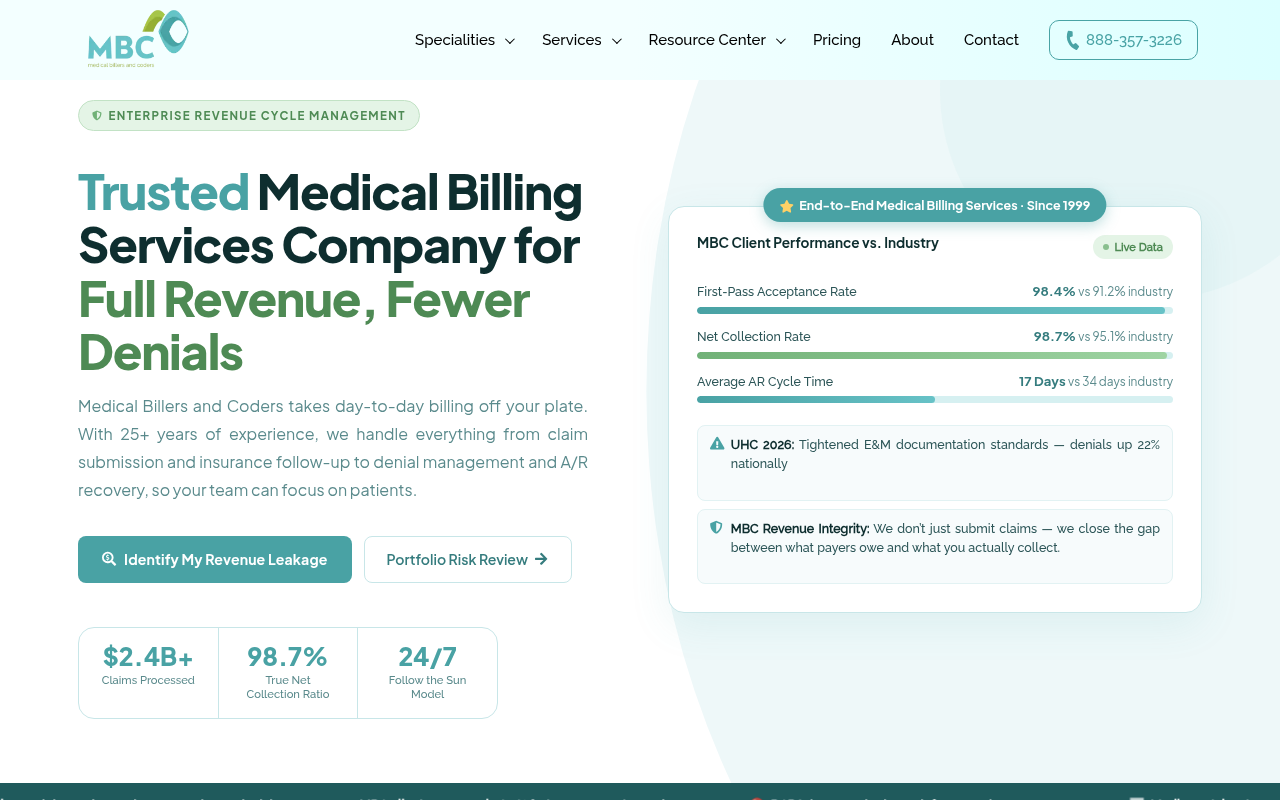
Medical Billers and Coders integrates scribing with billing and coding workflows, giving practices a single-vendor path from clinical documentation through claim submission and audit preparation. For small practices that currently manage documentation and billing through separate vendors with no shared data layer, consolidating those functions reduces the handoff errors that create coding variability and claim denials. The honest limitation: MBC's documentation technology is less advanced than AI-native ambient platforms, and practices prioritizing documentation speed and physician experience over billing consolidation will find the tradeoff does not favor MBC as a primary scribe solution.
Thirteen vendors, three fundamentally different delivery models, and a wide range of price points and specialty fits: the list above gives you the full field, but knowing who made the cut is only half the decision. The next section runs each of these options through a three-stage filter, practice size, EHR environment, and specialty complexity, so you can eliminate the wrong fits in minutes rather than after a six-week demo cycle.
How to Match the Right Scribe Model to Your Practice Type and Growth Stage
The three filters that actually determine whether a vendor survives contact with your practice are practice size, EHR environment, and specialty complexity, and working through them in that order collapses a thirteen-vendor field to two or three serious candidates before a single demo is scheduled.

Filter One - Practice Size Determines Which Tier of the Market You Actually Belong In
Mid-market ambient platforms serve groups of 3-15 providers who need consistent documentation across multiple clinicians without enterprise procurement cycles.
Filter Two - Your EHR Is a Hard Gate, Not a Preference
Check native push support first, before evaluating any other feature. A platform that requires copy-paste transfer between the scribe interface and your EHR is not an integration; it is a workaround that reintroduces the documentation burden you were trying to eliminate. When a platform like iScribe Health pushes AI-generated notes directly into the correct patient chart without copy-paste or duplicate entry, EHR compatibility becomes the first filter that cuts the vendor list in half before a single demo is booked.
Filter Three - Specialty Complexity and Audit Risk Break the Tie
When two vendors clear the size and EHR gates, specialty documentation depth determines the final call. Orthopedic, cardiology, and oncology practices carry materially higher coding audit exposure than primary care, because procedure-heavy encounters require precise E&M level justification and laterality documentation that generic templates miss.
Why Vendor Evaluation Cannot Stop at Go-Live
Running all three filters should leave most administrators with one or two vendors worth a serious conversation, but the selection decision does not end at contract signing. Research on team-based documentation support suggests that practices reaching full adoption see meaningful gains in visit volume and reductions in documentation time emerge most clearly after an extended post-adoption learning period, with early-window metrics often understating the platform's actual impact on clinical throughput. This means a practice that benchmarks vendor performance at 60 days and sees mediocre numbers may be abandoning a solution just before the compounding gains materialize, or may be correctly identifying a tool that never fits their workflow.
The difference is only detectable if the practice measures physician time-in-EHR and note-correction rates, not user satisfaction scores.
Related Reading
- Best Ai Scribe For Athenahealth
- Ai Medical Scribes With E&m Coding Built In
- Ai Scribe Accuracy
- Do Ai Scribes Reduce Claim Denials?
Next steps
If your practice is absorbing weeks of vendor evaluation only to watch physician adoption quietly collapse after go-live, the path forward starts with measuring the right variable before signing anything. Day-one note acceptance rate, not transcription accuracy percentages, is what predicts whether a scribe platform becomes a clinical workflow asset or expensive shelfware.
A 94% day-one note acceptance rate means physicians are not spending recovered time correcting notes instead of seeing patients, which is precisely where the modeled $78,000 in additional annual revenue from two extra daily visits evaporates in practices that chose the wrong platform. A 95% coding accuracy rate validated across 941 real orthopedic encounters means the 33% overcoding exposure that most practices carry invisibly does not surface for the first time during a payer audit. Together, they point to a single evaluation decision: verify those figures from a specialty-matched deployment before any contract is signed.
Start with Best AI medical scribe for orthopedic practices to see how iScribe Health's ambient documentation and E&M coding intelligence perform inside a real orthopedic encounter volume. Name your EHR and specialty, and the demo runs in a configuration that mirrors your actual clinical environment.
Frequently Asked Questions
What's the real difference between an AI ambient scribe and a human scribe?
Human scribes listen to an encounter and transcribe a draft note, that's the full scope of what they do, and every coverage gap from illness, turnover, or no-shows lands back on the physician's documentation queue. AI ambient scribe platforms capture the full encounter in real time and push a structured, EHR-ready note directly into the patient chart, so the physician reviews a completed note rather than building one from scratch after clinic ends.
Why does after-hours charting keep happening even when a practice already has scribes?
Scribe programs that don't fully close the documentation loop don't eliminate after-hours charting, they redistribute it. When physicians must still review, correct, and manually push notes into the EHR, the correction loop consumes the time the scribe was supposed to save, which is why the AMA's 2024 analysis found physician pajama time averaging 2 to 3 hours per day has remained essentially unchanged even as headline burnout rates declined.
How does inconsistent documentation actually hurt practice revenue?
Coding variability across providers accumulates quietly in undercoded visits, overcoded claims flagged on audit, and E&M levels that drift from one physician to the next based on documentation habit rather than clinical reality. Documentation gaps that suppress billable throughput or trigger claim denials carry a significant dollar magnitude, DoctorsVA Solutions estimates that freeing a provider to see just two additional patients per day at $150 per visit generates $78,000 in annual revenue, and the inverse is equally true.
Does it matter whether an AI scribe has a native EHR integration or just pushes a PDF into the chart?
Yes, the distinction between a true ambient workflow and a PDF pushed into a chart is the difference between adoption and abandonment. Ambient documentation that pushes structured notes directly into the correct patient chart is only possible when the EHR integration is native, not bolted on, and the moment a physician has to manually move a note from a scribe tool into the patient chart is often the moment they quietly stop using it.
Why doesn't a high transcription accuracy rate guarantee that physicians will actually use the platform?
A 98% transcription accuracy rate tells you how a model performed on a curated test set, but it tells you nothing about whether a physician will correct the remaining 2% themselves, trust the output enough to stop reviewing every line, or simply revert to self-charting because the correction loop feels faster. A scribe platform a physician doesn't trust, or finds friction-filled to use, produces the same outcome as no platform at all.