Orthopedic Surgery Billing Guidelines and Cheat Sheet 2026
Orthopedic surgery billing gaps cost practices daily. Get the 2026 guidelines billing decision-makers use to recover real reimbursement.


Orthopedic billing fails before a coder ever opens a chart. Here is where the revenue actually disappears, and what it takes to stop the compounding loss.
Orthopedic surgery billing sits at a structural disadvantage that most other specialties never face. The CPT code range alone spans hundreds of procedure codes, each with its own documentation requirements, modifier logic, and payer-specific rules. For practice administrators and billing decision-makers, the financial cost of getting this wrong is not theoretical.
It compounds daily, across every provider, at every encounter. The common assumption is that the root cause is a billing execution problem: coders need better tools, more training, or more precise modifier guidance to get claims right the first time. That assumption shapes how most practices respond to revenue leakage, and it is why the deeper structural problem keeps compounding.
Most billing teams treat errors as isolated events. A wrong modifier here. A missed laterality code there.
The assumption is that claim scrubbing catches the problems before submission. Orthopedic billing is modifier-intensive by nature, with global periods, fracture care nuances, and anatomical specificity requirements that create layered failure points, making it structurally more complex than most other specialties. That layering means a single upstream documentation gap can cascade into multiple denied or underpaid claims simultaneously.
No scrubber recovers revenue that was never documented.
No scrubber recovers revenue that was never documented.: Orthopedic billing's foundation is the CPT code range 20000 to 29999, the musculoskeletal system procedures block, which spans everything from simple joint injections to complex multi-stage reconstructive surgery. No other surgical specialty covers that breadth within a single CPT block.

The problem is not just volume. It is variance. A coder handling a knee arthroscopy, a trigger finger release, and a distal radius fracture on the same afternoon is working across three entirely different rule sets simultaneously. Each has its own global period logic, its own modifier requirements, its own ICD-10 specificity demands. Every orthopedic encounter carries at least three independent variables requiring separate documentation and justification: anatomy, timing, and procedure complexity. Miss any one of them and the claim is either denied or underpaid.
Bristol Healthcare Services' 2024 analysis of orthopedic coding modifiers confirms that payers have increased scrutiny on modifier usage precisely because the rules are complex enough to produce systematic errors, not just occasional ones. That scrutiny means modifier mistakes now trigger audits, not just single-claim denials. The real problem is that the clinical complexity justifying higher-acuity codes often never makes it into the physician's note when charting happens under time pressure or after hours.
When documentation does not capture what the surgeon actually evaluated and decided, every downstream tool is working from an incomplete record that structurally caps reimbursement. Even a modest undercoding rate, applied across a high-volume orthopedic practice, produces losses that compound across every provider and every encounter, quietly, without triggering any denial alert. Industry billing analysts consistently flag undercoding as one of the largest silent revenue drains in orthopedic revenue cycles.
The complexity runs deepest in two places that trip up even experienced billing teams: global surgical period rules and fracture care coding, where the rules governing what can and cannot be billed are strict, time-sensitive, and almost entirely dependent on what the physician documented at the time of the encounter. That is where the next section picks up.
Key takeaways
- Orthopedic surgery billing fails at a structural level, hundreds of CPT codes, modifier logic, and payer-specific rules mean the margin for documentation error is smaller than in almost any other specialty.
- The 90-day global surgical package bundles more than most billers account for, and fracture care coding adds a second compliance layer on top, both fail when the operative note doesn't capture what actually happened.
- Six modifiers protect the majority of orthopedic revenue, and every one of them fails the same way: the clinical note never contained the evidence the modifier was meant to prove.
- A 941-encounter orthopedic billing audit detected a 33% overcoding rate, not from intentional upcoding, but from documentation that didn't match what was billed.
- Denial queues in orthopedic practices run the same error types week after week, even in practices with experienced coders and updated scrubbing tools, because the root cause is upstream of the claim.
- Most physician notes are completed after hours, written from recall, long after the patient left, and no billing tool can recover clinical complexity that was never documented in the first place.
- iScribe Health's E&M Coding Intelligence reads the complete clinical narrative in real time, not just the finalized note, and surfaces coding recommendations before the encounter closes, at the only moment the revenue can still be saved.
Global Surgical Period Rules and Fracture Care Coding Every Orthopedic Biller Must Know
The 90-day global surgical package bundles far more than most billers realize, and fracture care coding, which requires distinguishing between open treatment, closed treatment, and percutaneous fixation, adds a second layer of precision that compounds the compliance risk. One of the most persistent struggles orthopedic billing teams face is correctly identifying whether a procedure falls under a 000, 010, or 090 global period, and that misidentification cascades immediately into incorrect billing of pre-op and post-op visits as separately payable office visits, triggering denials that are preventable but rarely recoverable after the fact.
"CMS's proposed 50% reimbursement reduction for same-day E/M visits paired with 0-, 10-, or 90-day global procedures directly threatens revenue for orthopedic and surgical billers who routinely bundle these services."
— what we hear from orthopedic and surgical medical billers

What the 90-Day Global Package Includes
Medicare's global surgery policy, the global surgical package for major procedures, covers the following services under a single bundled payment:
- The operation itself
- Local infiltration and topical anesthesia
- Immediate postoperative care
- All normal additional medical or surgical services the surgeon provides during the postoperative period
- Complications that don't require a return to the operating room
The bundling is automatic once the global period indicator "090" is assigned.
- Complications requiring a return to the OR
- Clearly unrelated surgical procedures
- Postoperative visits for conditions unrelated to the original surgery
Modifiers 54 and 55 apply when surgical and postoperative care are split between providers, and correct application depends on the global period being identified accurately from the outset.
There is also a compounding regulatory threat that orthopedic and surgical billing leaders cannot afford to ignore: CMS has proposed a 50% reimbursement reduction for same-day E/M visits paired with 0-, 10-, or 90-day global procedures, a change that would directly erode revenue on some of the most common encounter patterns in orthopedic practice.
50%
CMS proposed cut for same-day E/M with global procedures
Post-Op Visits - The Most Preventable Denial
The 90-day global package creates a hidden documentation debt: the only path to recovering additional revenue inside the global period runs through modifiers 58, 78, or 79, each of which requires the operative report and clinical record to have pre-established the qualifying conditions before the follow-up visit ever occurs. Without that foundation already in the record, the modifier cannot be supported and the additional visit cannot be billed separately.
Improving coding consistency across providers is where high-volume orthopedic practices have the most to gain and the most to lose. iScribe Health's Ambient AI Documentation captures the intraoperative and clinical narrative in real time, at the point of care, so the language that supports modifier 58, 78, or 79 is present in the record before a coder ever opens the chart, eliminating the retroactive reconstruction that most denials trace back to.
Open Treatment, Closed Treatment, and Percutaneous Fixation
- Closed treatment involves no surgical exposure of the fracture
- Open treatment involves surgical exposure and direct visualization
- Percutaneous skeletal fixation places fixation hardware across the fracture site under imaging guidance
When the operative note lacks the specificity to distinguish among these categories, coders default to the least specific code available, and the resulting undercoding is rarely caught until a retrospective audit surfaces the pattern. This is a category of loss that billers we work with describe as especially frustrating precisely because the clinical work was done correctly; the documentation simply didn't reflect it. iScribe Health's E&M Coding Intelligence and Real-Time Denial Alerts are designed to surface exactly this type of coding drift at the point of note completion, before the claim is submitted, so the specificity that separates a correctly coded percutaneous fixation from a generic closed-treatment code is captured and validated in the workflow rather than discovered during a post-payment audit.
How One Operative Note Sets Both the Global Clock and the Fracture Care Category
The operative note carries a dual burden that makes its accuracy uniquely consequential. It establishes the procedure date that starts the 90-day global period clock, and it contains the clinical language that determines which fracture care CPT category applies. A single documentation gap can simultaneously misalign the global period and miscategorize the procedure.
A surgeon dictating at the end of a packed OR day may compress the intraoperative narrative, omitting whether fixation was placed percutaneously or through an open incision, or failing to note a staged plan that would later justify modifier 58. The clinical documentation challenge is that peak census periods create conditions where maintaining documentation quality competes directly with the pace of care. iScribe Health's Ambient Listening and Conversational AI is built for exactly that environment: the platform streamlines clinical workflows so care teams can maintain documentation quality even during peak census periods, capturing the intraoperative narrative in real time so the specifics that set both the correct fracture care CPT category and the global period start date are recorded at the moment of care, not reconstructed hours later when critical detail is already gone.
At the point of note completion, after the AI drafts the encounter summary, iScribe Health's coding intelligence layer validates that the documentation supports the procedure category being billed, improving coding consistency across the full provider group, not just among the surgeons who happen to be the most thorough documenters.
Essential Modifiers in Orthopedic Billing and What Each One Actually Protects
Six modifiers protect the majority of orthopedic revenue. Each one fails the same way: not because the coder picked the wrong code, but because the clinical note never captured what the modifier was meant to prove.
1. Modifier 25 - Separately Identifiable E/M on the Same Day as a Procedure

Modifier 25 signals that a significant, separately identifiable evaluation and management service was performed by the same physician on the same day as a procedure. Without it, payers bundle the E/M fee into the procedure payment and deny the visit charge entirely. The documentation must show an independent history, exam, and medical decision-making process unrelated to the procedure itself. An orthopedic surgeon who injects a knee and separately evaluates a new shoulder complaint in the same visit has a defensible Modifier 25 claim, but only if the note treats those two encounters as clinically distinct events. As 360 Clinical Solutions explains, the E/M documentation must support a distinct medical decision-making process for the modifier to hold on review; the note is the evidence, and without it the modifier is indefensible.
In high-volume orthopedic practices, the environments where iScribe Health's ambient documentation is most impactful, clinicians routinely chart two or more hours outside of patient care time. That documentation burden is exactly where Modifier 25 support erodes: a physician juggling back-to-back same-day procedure and E/M visits cannot reliably reconstruct the distinct clinical narrative after the fact. iScribe Health's Ambient Listening / Conversational AI captures the full encounter in real time, and its E&M Coding Intelligence flags when the documented MDM is insufficient to support a separate E/M charge, at the point of note completion, after the AI drafts the encounter summary, before the claim ever leaves the practice.
2. Modifier 57 - Decision for Surgery Appended to E/M the Day Before or Day of Major Surgery
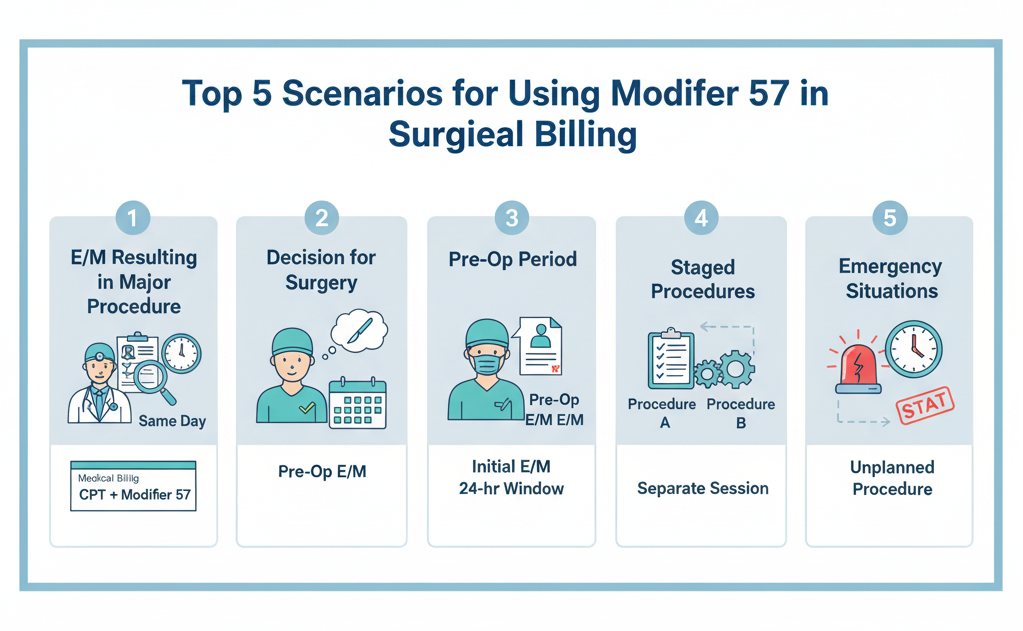
Modifier 57 applies when an E/M service on the day before or the day of a major surgery represents the decision to operate. Confusing it with Modifier 25 is one of the most consistent denial triggers in orthopedic billing, because the two modifiers govern different global period lengths: Modifier 25 covers minor procedures with zero- or ten-day global periods, while Modifier 57 applies to major surgeries carrying a 90-day global period. Wave HCA identifies this mix-up as a leading source of orthopedic modifier denials; appending the wrong one does not just reduce payment, it flags the claim for audit. Improving coding precision here directly impacts revenue, because the audit exposure compounds across every misclassified surgical decision visit.
iScribe Health's EHR Integration surfaces the correct modifier distinction at the point of note completion, so the physician's documentation explicitly captures the decision-to-operate narrative required by Modifier 57 rather than a generic pre-operative note that could be misread as a Modifier 25 scenario.
3. Modifier 22 - Increased Procedural Services for Substantially Greater Surgical Work
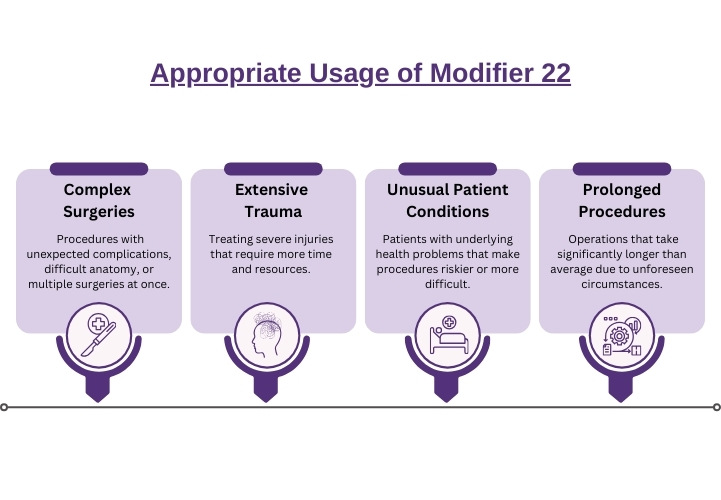
Modifier 22 tells a payer that the work performed was substantially greater than typical for the billed procedure code. Most payers require a cover letter and the operative report before approving any additional reimbursement, and without that documentation the request is denied outright. Reimbursement outcomes for Modifier 22 are genuinely payer-discretionary, which means documentation quality is the deciding variable, not the modifier itself. A thorough operative report that describes the specific anatomical complexity, unexpected findings, or extended operative time is the only evidence that survives payer review.
Wave HCA notes that Modifier 22 claims are denied outright when supporting documentation is absent or generic. iScribe Health's Ambient Listening captures operative complexity in real time during the procedure narrative dictation, so the specific language payers require, anatomical variance, unexpected intraoperative findings, time extensions, is built into the note before the claim is submitted rather than assembled retroactively when a denial arrives.
4. Anatomical Modifiers RT/LT, Modifier 50, and Digit Modifiers for Bilateral and Site-Specific Procedures

Orthopedic surgery billing demands precise anatomical specificity. RT and LT identify right and left sides, while Modifier 50 reports true bilateral procedures on a single line at 150% reimbursement, though many payers instead require two separate lines with RT and LT. Digit modifiers E1–E4 (fingers), FA/F9 (thumbs), TA/T5 (toes) are mandatory for hand and foot procedures. The tradeoff: payer rules on Modifier 50 versus RT/LT vary widely and must be verified claim by claim.
5. Modifier 58, 78, and 79 - The Three Modifiers Governing Work Inside a Global Period
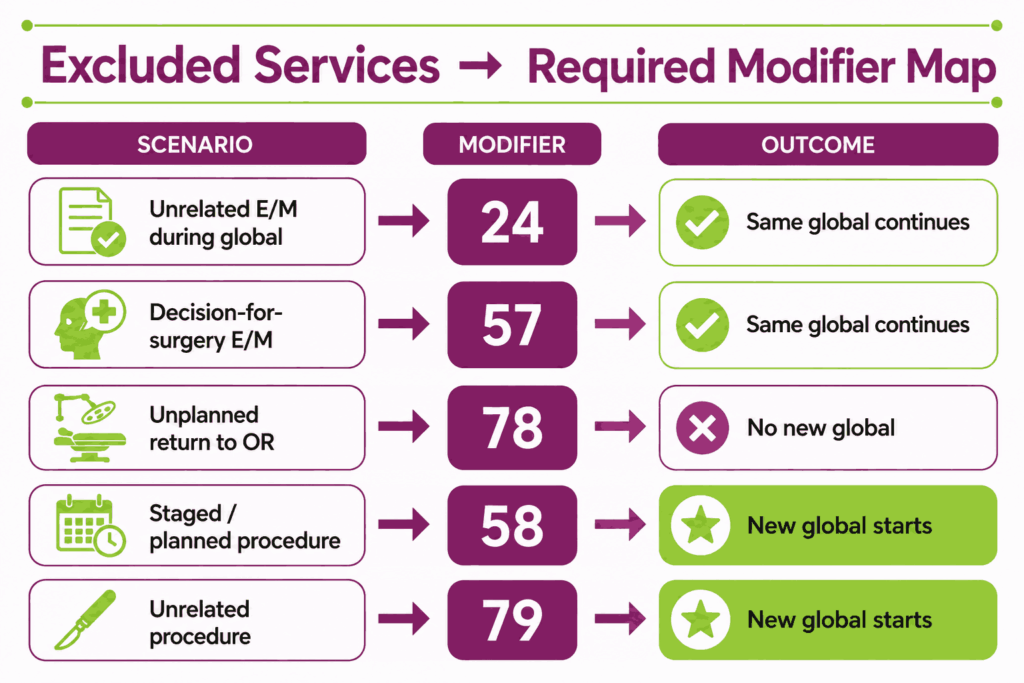
Three distinct modifiers govern return visits during an orthopedic global period. Modifier 58 covers a staged or related procedure planned at the time of the original surgery. Modifier 78 applies to an unplanned return to the operating room for a complication related to the original procedure. Modifier 79 covers a completely unrelated procedure performed during the global period. Misapplying any of these three results in automatic bundling and zero reimbursement for the return surgery.
6. Modifier Strategy in Orthopedic Billing - How Correct Stacking Prevents Denials Across the Revenue Cycle
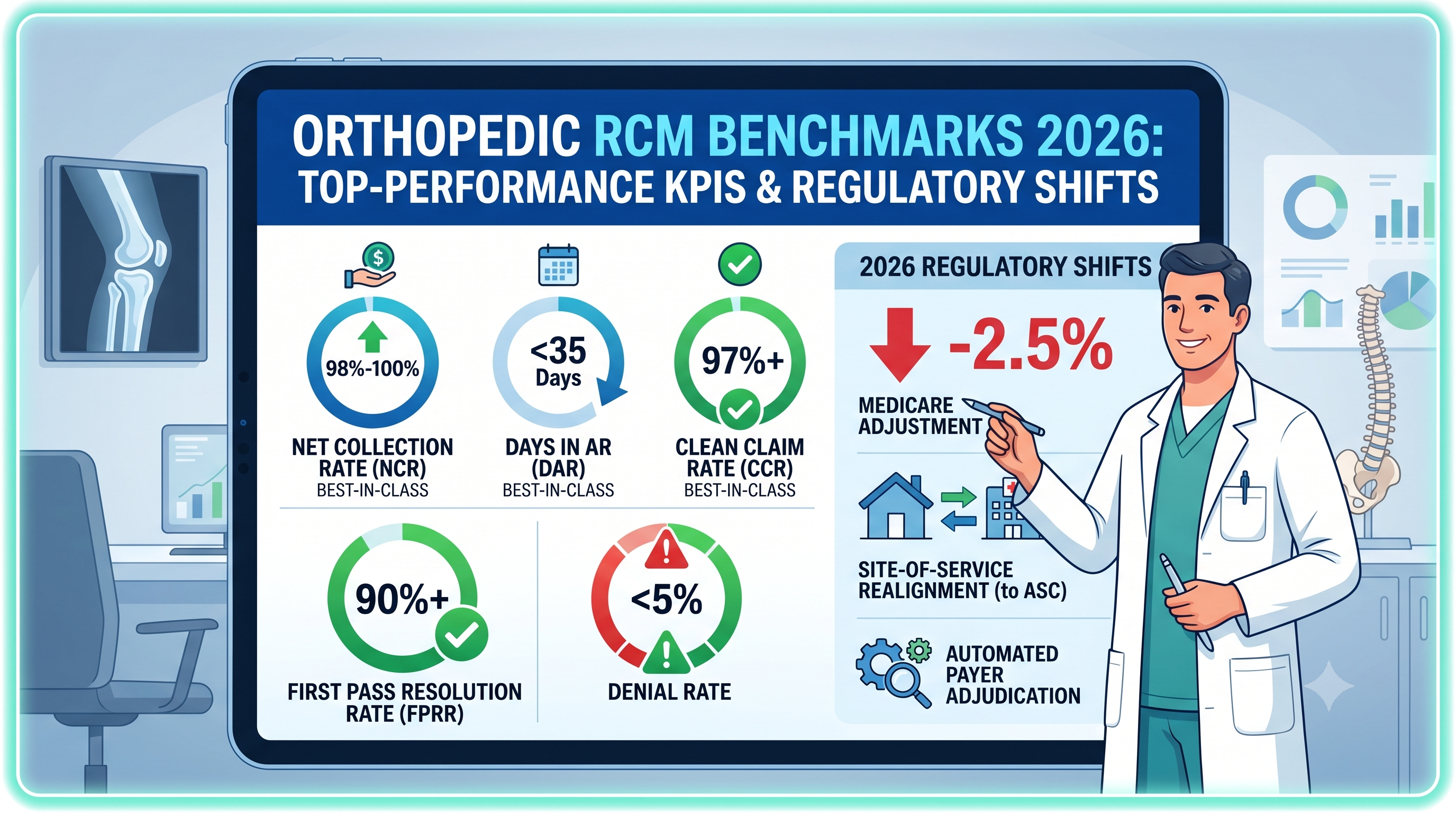
Across every modifier covered here, the pattern is consistent: payers deny these claims not because coders selected the wrong modifier, but because the clinical note never captured the distinct medical decision-making event, the prospective plan, or the site-specific detail that would justify the modifier in the first place. The coding error is the visible symptom; the missing documentation is the actual wound.
Practices seeing high patient volumes face this at scale, where the gap compounds across hundreds of encounters before a denial report surfaces it.
Orthopedic Modifier Quick-Reference Checklist
Use this checklist before submitting any orthopedic claim involving a modifier:
- Modifier 25 → When to Apply: Same-day E/M + procedure → Documentation Required: Separate H&P and MDM distinct from procedure → Common Denial Risk: E/M bundled into procedure payment.
- Modifier 57 → When to Apply: E/M on the day of or day before major surgery = decision to operate → Documentation Required: Note must document the decision to perform major surgery → Common Denial Risk: Confused with Mod 25; triggers audit.
- Modifier 22 → When to Apply: Substantially increased procedural complexity → Documentation Required: Operative report + payer cover letter detailing specific complexity → Common Denial Risk: Denied outright without supporting documentation.
- Modifiers RT / LT → When to Apply: Any unilateral procedure → Documentation Required: Laterality stated in operative/clinical note → Common Denial Risk: Claim rejected for missing site specificity.
- Modifier 50 → When to Apply: Bilateral procedure, same session → Documentation Required: Operative note confirms both sides treated → Common Denial Risk: Wrong line-billing format per payer contract.
- Modifier 58 → When to Apply: Staged/related procedure during global period → Documentation Required: Staged plan documented in original operative note BEFORE second procedure → Common Denial Risk: Modifier loses evidentiary basis if plan is undocumented.
- Modifier 78 → When to Apply: Unplanned return to OR, related complication → Documentation Required: Complication clearly distinguished from expected post-op course → Common Denial Risk: Confused with Mod 79; triggers overpayment audit.
- Modifier 79 → When to Apply: Unrelated procedure during global period → Documentation Required: Clinical record confirms no relationship to original procedure → Common Denial Risk: Confused with Mod 78; leaves revenue on the table.
Before submitting: Confirm the clinical note contains the specific language each modifier above requires, not just the modifier selection itself. In high-volume practices, iScribe Health's EHR Integration and Real-Time Denial Alerts make that confirmation a system-enforced checkpoint rather than a manual one.
Related Reading
- Orthopedic Billing And Coding
The Most Common Orthopedic Billing Mistakes That Quietly Drain Practice Revenue
That wound compounds differently in orthopedic billing, where denial queues are not random. The same error types surface week after week, in practices with experienced coders, updated scrubbing tools, and documented modifier policies. The persistence of these errors is the signal worth reading. The common assumption among practice administrators and billing decision-makers is that the root cause is a billing execution problem: coders need better tools, more training, or more precise modifier guidance to get claims right the first time. Billing errors and inefficiencies rank among the top three business challenges for orthopedic practices, with documentation gaps identified as the root cause of most claim denials, not coder error.
1. E/M Undercoding from Incomplete Documentation of Clinical Complexity
Orthopedic practices routinely undercode evaluation and management visits because physicians fail to document the full complexity of medical decision-making, comorbidities, data reviewed, and risk level. The result is a systematic downgrade from level 4 or 5 visits to level 3, costing practices thousands monthly. The tradeoff: correcting this requires physician-level documentation training, not just coder audits, making it a slower fix than most billing teams expect.
2. Unbundling Imaging Services Triggering NCCI Edit Denials - CPT 77002 and 76942
Unbundling imaging services is one of the most flagged NCCI edits in orthopedic billing, yet it appears in denial queues weekly at practices that have trained billing staff. CPT codes 77002 (fluoroscopic guidance) and 76942 (ultrasonic guidance) trigger automatic denials when billed separately alongside the parent procedure, because payer rules treat the imaging as already included in the primary code's reimbursement. Everest AR Management Group confirms this as a common orthopedic billing pitfall where NCCI edits fire automatically.
The coder is not guessing. The payer rule is clear. The problem is that operative notes frequently fail to specify whether imaging guidance was integral to the procedure or genuinely separate, leaving coders to make judgment calls that payers will not honor. iScribe Health's Real-Time Denial Alerts flag these bundling conflicts at the point of note completion, before the claim is submitted, so the physician or care team can clarify the clinical record while the encounter is still fresh, rather than discovering the denial weeks later in the AR queue.
3. ICD-10 Specificity Gaps - Missing Laterality, Displacement, and Encounter Type
ICD-10 specificity gaps are a primary denial trigger in orthopedic fracture coding. Missing laterality (left versus right), fracture displacement status, and encounter type (initial, subsequent, sequela) each generate automatic rejections from most commercial payers and Medicare. The AAPC Coders Specialty Guide for Orthopedics identifies these omissions as among the most common documentation deficiencies that billers inherit from clinical records, reinforcing that the gap is structural, not incidental.
Coders cannot assign laterality the clinical record never specified. That is a documentation capture failure, structurally impossible to correct at the billing stage.
Individual physicians and advanced practice providers who see high fracture volumes are particularly exposed to this gap; the details are clinically obvious in the room and easily omitted in a rushed note. iScribe Health's Ambient Documentation captures those details conversationally during the encounter, so laterality, displacement status, and encounter context are embedded in the AI-drafted summary before the physician ever reviews and signs the note. For practices already operating on a supported EHR, this capability materializes seamlessly through iScribe Health's EHR Integration, requiring no parallel documentation workflow.
4. Prior Authorization Failures and HCPCS Coding Gaps for DME and Orthopedic Supplies
Prior authorization failures combined with HCPCS coding gaps for DME and orthopedic supplies represent a consistently overlooked revenue leak. Braces, splints, and orthopedic supply items require both accurate HCPCS codes and documented medical necessity to survive payer scrutiny. When the clinical note does not clearly establish why a specific device was medically required, prior authorization denials follow, and the write-off is rarely recovered. Everest AR Management Group flags prior authorization failures and HCPCS gaps as overlooked revenue leakage points that experienced billing teams routinely miss.
The documentation of medical necessity for a brace or splint happens in the clinical encounter, in the conversation between physician and patient about function, pain, and treatment rationale. That is exactly where iScribe Health's Ambient Listening operates, capturing the clinical reasoning that justifies the supply order at the moment it is expressed, not reconstructed afterward from memory.
5. The Root Cause Pattern - Every Orthopedic Billing Error Traces Back to a Documentation Capture Failure
Every orthopedic billing error traces back to a documentation capture failure. Investing in coder training or billing software without first redesigning how physicians capture clinical complexity during the encounter is the equivalent of hiring a better transcriptionist to fix a conversation that never happened. 24/7 Medical Billing Services reinforces this directly: coders cannot upcode what the physician's note does not support, making undercoding a documentation capture failure rather than a coding execution failure. The gap is visibility.
For Chief Medical Officers and practice administrators, the implication is organizational: the fix cannot live in the billing department alone. It requires standardizing clinical documentation quality across the practice, across individual physicians and advanced practice providers, across service lines, and across every patient encounter. iScribe Health's combination of Ambient Documentation, E&M Coding Intelligence, and Automated E&M Coding is designed to make that standardization an ongoing operational reality, realized across every patient encounter and every day of clinical practice, not a one-time training intervention.
6. Global Surgery Period Billing Errors - Unbillable Services Submitted During the 90-Day Window
Routine postoperative visits submitted during the 90-day global period are among the most reliably denied claims in orthopedic billing, and payers detect these automatically. The error persists not because billers are unaware of the global period rule, but because the operative note and the post-op visit note are often disconnected in ways that make the relationship between the two unclear, forcing coders to make assumptions that payers will deny.
Each of these errors has a different CPT code, a different payer rule, and a different denial reason code. But they share the same origin.
Why Your Orthopedic Billing Problems Start Before the Claim Reaches a Coder
That origin point is the note itself, specifically when it gets written and under what conditions. A significant share of physician notes are completed after hours or outside the clinical encounter, a pattern documented across ambulatory EHR audit analyses. The note a coder receives the following morning may have been written well after the patient left, by a surgeon working from recall rather than real-time observation. The cognitive shortcuts taken at 9 p.m. left out the comorbidity management, the atypical anatomy, and the extended decision-making that justified a higher E/M level.

The Gap Between What the Surgeon Did and What the Note Actually Says
In orthopedic surgery, documentation pressure compounds across a ten-hour OR day where charting happens between cases or after the last patient is wheeled out. (2025) confirmed that documentation burden in orthopedic practice is a source-level problem: when clinical complexity is not captured in real time, the resulting incomplete note constrains downstream coding accuracy regardless of coder skill or tool sophistication.
Why Coder Guesswork Always Defaults to Lower Orthopedic Revenue
Industry billing audits consistently identify E/M downcoding as a significant and recurring revenue leak in orthopedic practices where notes do not fully capture encounter complexity, a finding reinforced by the 941-encounter audit at Center for Sports Medicine & Orthopaedics, which detected systematic coding drift that existing billing review processes had not surfaced.
Key takeaway: The same documentation gap that drives undercoding also creates overcoding exposure. Practices simultaneously lose revenue to undercoded clinical complexity and accumulate compliance risk through overcoded procedure levels, and neither problem is visible to the billing team.
Where Orthopedic Billing Errors Actually Begin - Point-of-Care Documentation Gaps
That investment addresses a constraint created hours earlier, when the clinical narrative was finalized under pressure.
Every encounter where complexity goes undocumented is revenue that exits the system before any billing tool ever sees the chart. iScribe Health's E&M Coding Intelligence captures the full clinical narrative at the point of care and surfaces coding recommendations from the complete encounter rather than from whatever abbreviated note a fatigued surgeon managed to finalize after hours, which is precisely when orthopedic practices lose the most ground.
Improving coding accuracy in orthopedic billing requires changing what the note contains before it reaches the coder's queue, not refining what happens after it arrives.
Best Practices for Orthopedic Billing Success Built Around Documentation That Coders Can Actually Use
Coding tools can only work with what the note contains. When the clinical narrative is thin, rushed, or templated into generic language, the revenue gap is created at the keyboard, not the claims scrubber. The resources and workflows below are ranked by how close they operate to that source problem.
1. The 941-Encounter Audit at Center for Sports Medicine & Orthopaedics That Exposed a 33% Overcoding Rate
When AI-assisted documentation analysis was applied to 941 encounters at Center for Sports Medicine & Orthopaedics, it surfaced a 33% overcoding rate that no existing billing review process had flagged. For high-volume orthopedic practices, this case demonstrates that coding drift is not an edge case, it is a systemic, measurable problem. The tradeoff: correcting overcoding in real time requires upfront investment in audit infrastructure that many practices defer until a payer audit forces the issue.
2. AI-Ambient Documentation with Integrated E&M Coding Intelligence Built Into the Point-of-Care Workflow
AI-ambient documentation with integrated E&M coding intelligence surfaces coding recommendations from the complete clinical narrative before the note is finalized, so the level of service the physician actually delivered is captured in the record rather than reconstructed during a retroactive chart review. This is the only intervention that operates at the documentation source. iScribe Health's Ambient Listening and Conversational AI captures the spoken clinical encounter in full; at the point of note completion, after the AI drafts the encounter summary, Automated E&M Coding surfaces the appropriate level-of-service recommendation directly within the workflow, with no added step for the physician.
This matters most in high-volume orthopedic practices where physicians routinely verbalize clinical complexity that a rushed typed note would omit entirely, and where clinicians regularly chart two or more hours outside of patient care time. Reducing that post-visit documentation burden means physicians can see more patients per day without burning out, a compounding benefit realized across every encounter, every day of clinical practice. Where the practice or health system is already running a supported EHR, iScribe Health's EHR Integration delivers this upstream capture layer as a seamless ambient experience inside the existing system, with no workflow disruption at go-live. The result is documentation that is more defensible under audit and built without adding time at the keyboard.
3. Same-Day Documentation Protocols, Structured Orthopedic Note Templates, and Modifier Checklists Coders Can Trust
Same-day documentation closes the gap between clinical encounter and billable record, while structured note templates for high-complexity orthopedic encounters, fracture management, multi-level spine, revision arthroplasty, ensure that modifier justification is embedded in the narrative before it reaches the coder. Modifier checklists only hold up under payer scrutiny when the underlying clinical note supports them. The tradeoff is physician adoption: templates that feel rigid reduce compliance and produce the generic documentation they were designed to prevent.
4. HCPCS Coding for DME and Orthopedic Supplies as a Recoverable Revenue Stream Requiring Clean Medical Necessity Documentation
HCPCS claims for braces, orthotics, and orthopedic supplies are routinely denied not because the codes are wrong but because the underlying clinical note lacks specific medical necessity language. This is a recoverable revenue stream, but only when the documentation explicitly connects the diagnosis, the functional limitation, and the prescribed item. Coders cannot manufacture that language after the fact. The note has to contain it before the claim is ever built. Because iScribe Health's ambient layer captures the full spoken encounter, including the physician's explanation of why a brace or orthotic is medically necessary, that connective language enters the draft note at the point of dictation rather than being chased during a coding review.
5. AAPC Coders Specialty Guide for Orthopedics and Payer-Specific LCD Policies as the Billing Team's Baseline Reference Layer
The AAPC Coders Specialty Guide for Orthopedics and payer LCD policies are the billing team's baseline reference standard, but they are static resources applied to a dynamic documentation problem. LCD criteria change frequently, and a team operating on last quarter's policy is building claims on outdated ground. These guides are necessary but not sufficient. Their value materializes only when the clinical note they are applied to already contains the specificity those criteria require, the exact gap that richer ambient documentation is designed to close upstream.
Every best practice in this section, same-day documentation, structured templates, HCPCS medical necessity language, LCD policy currency, depends on one thing: a clinical note that captures what actually happened in the room. The next section shows exactly how iScribe's E&M Coding Intelligence makes that the default, not the exception.
Related Reading
- Surgery Center Emr
- Medical Scribe Cost
Next steps
If your billing team keeps absorbing modifier denials and E/M undercoding losses despite experienced coders and updated scrubbing rules, the path forward starts with fixing what the note contains before it ever reaches the coding queue.
The 90-day global surgical package creates a documentation debt that is set permanently at the moment the operative report is signed, not at billing. When a staged plan or complication distinction is absent from that note, no modifier strategy recovers the revenue. At the same time, E/M undercoding and ICD-10 specificity gaps are structurally impossible to correct at the billing stage, because coders cannot assign a level the physician's note does not support and cannot code laterality the clinical record never specified. Together, these two realities point to one action: redesign how clinical complexity is captured during the encounter, not after it.
Start with Best AI medical scribe for urology practices at iScribe Health. The ambient documentation and E&M Coding Intelligence layer captures the spoken clinical narrative in real time and surfaces coding recommendations at the point of note completion, before the claim is built, so the specificity that supports Modifier 58, justifies a higher E/M level, and confirms fracture laterality is in the record from the start, not reconstructed from memory hours later.
Frequently Asked Questions
Why does orthopedic billing have so many claim denials compared to other specialties?
Orthopedic billing is structurally more complex than most specialties because a single coder can be working across three entirely different rule sets, each with its own global period logic, modifier requirements, and ICD-10 specificity demands, in the same afternoon. A single upstream documentation gap can cascade into multiple denied or underpaid claims simultaneously, and payers have increased scrutiny on modifier usage precisely because the rules are complex enough to produce systematic errors, not just occasional ones.
What exactly is included in the 90-day global surgical package, and what can still be billed separately?
The 90-day global surgical package covers the operation itself, local infiltration and topical anesthesia, immediate postoperative care, all normal additional medical or surgical services the surgeon provides during the postoperative period, and complications that don't require a return to the operating room. Three things can still be billed separately: complications requiring a return to the OR, clearly unrelated surgical procedures, and postoperative visits for conditions unrelated to the original surgery, but each exception requires the clinical record to already contain documentation proving the exception applies.
What's the difference between Modifier 25 and Modifier 57, and why does mixing them up matter?
Modifier 25 applies when a significant, separately identifiable E/M service is performed on the same day as a procedure, and it covers minor procedures with zero- or ten-day global periods. Modifier 57 applies when the E/M visit represents the decision to operate for a major surgery carrying a 90-day global period. Appending the wrong one doesn't just reduce payment, it flags the claim for audit, and that audit exposure compounds across every misclassified surgical decision visit.
How does poor documentation at the time of surgery lead to lost revenue that can't be recovered later?
The operative note simultaneously sets the global period clock and determines which fracture care CPT category applies, so any specificity omitted at the moment of signing, such as whether fixation was placed percutaneously or through an open incision, cannot be recovered through appeals. Similarly, the only path to additional revenue inside the global period runs through modifiers 58, 78, or 79, each of which requires the qualifying conditions to have been pre-established in the operative report before the follow-up visit occurs. No downstream billing tool or scrubber can recover revenue that was never documented in the first place.
Is undercoding really a significant revenue problem for orthopedic practices, or is it less of a concern than outright denials?
Industry billing analysts consistently flag undercoding as one of the largest silent revenue drains in orthopedic revenue cycles. Even a modest undercoding rate, applied across a high-volume orthopedic practice, produces losses that compound across every provider and every encounter, quietly, without triggering any denial alert, which is precisely what makes it more insidious than a standard claim denial.