13 Best Orthopedic EMR Systems for Practices in 2026
Orthopedic EMR systems built for high-volume practices cut documentation burden and protect reimbursement in 2026.


Generic EHRs cost orthopedic practices more than denied claims. They cost time, revenue, and accuracy at every layer of care that a general platform was never built to handle.
Most high-volume healthcare providers think that if they just pick the EMR with the best orthopedic templates and imaging integration, documentation will get faster and billing accuracy will improve on its own. But orthopedic practices see some of the highest per-physician patient volumes in outpatient medicine, and that volume creates a documentation pressure that generic EHR systems were not designed to absorb. The structural mismatch between what general platforms offer and what musculoskeletal care demands is an architectural problem, and the gap costs practices more than most administrators realize until the revenue data forces the conversation.
Orthopedic clinical workflows carry a specificity burden that most EHR platforms were never architected to handle. Every encounter involves anatomical precision: laterality, implant details, fracture classification, surgical modifier logic, and imaging that must live inside the chart, not in a separate PACS silo. A busy orthopedic group using a generic EHR is often forced to manually attach DICOM files to each patient chart because the system lacks native imaging integration. That single workaround, repeated across 30 or 40 encounters a day, compounds into a daily tax on physician time.

30 or 40
Daily encounters compounding friction
General EHRs were built around primary care visit structures. Orthopedic care runs on a fundamentally different clinical logic, one where post-operative tracking, rehabilitation milestones, and implant documentation are core to every encounter, not edge cases.
Practices that try to configure a general platform into a specialized orthopedic EHR through add-ons and custom templates often end up with a system that is expensive, brittle, and still incomplete. Research has consistently found that physicians spend a disproportionate share of their working hours on EHR documentation relative to direct patient care, a ratio that worsens in high-volume specialties. Orthopedic physicians report some of the steepest after-hours charting loads in medicine. That is a structural consequence of running specialty-level clinical complexity through a general-purpose system.
Documentation gaps in general EMRs do not stay inside the chart. They travel directly into the billing workflow. Orthopedic coding is among the most complex in outpatient medicine: fracture care codes, surgical modifiers, implant documentation requirements, and laterality specificity all create failure points that generic charge-capture modules are not built to catch. The hidden cost includes the undercoding that never generates a denial at all, where a physician documented less than the clinical complexity warranted because the template did not prompt the right elements. That revenue disappears silently.
Documentation gaps in general EMRs do not stay inside the chart. They travel directly into the billing workflow.
Even the most carefully selected orthopedic EHR closes the structural gap at the point of care. What it cannot fully close is the layer between what happened in the room and what the physician documented under time pressure. That is where iScribe Health's ambient AI documentation works as a complementary layer, capturing the clinical narrative in real time so the chart reflects the full encounter, not a compressed version written at 9 p.m.
Key takeaways
- Orthopedic practices carry some of the highest per-physician patient volumes in outpatient medicine, and that volume creates a documentation pressure no EMR template alone can absorb.
- The real throughput problem isn't which EMR you pick; it's the after-hours charting that piles up regardless of which system is on the screen.
- One ortho group audited 941 encounters and found a 33% overcoding rate, not because their EMR was misconfigured, but because their documentation workflow had a visibility gap the software couldn't fix on its own.
- Modifier-level billing accuracy (think -RT versus -LT on a knee arthroscopy) depends on documentation precision at the point of care, not on charge-capture modules reviewed after the fact.
- A feature checklist tells you what an EMR can do; it tells you almost nothing about how fast physicians move through documentation when the afternoon schedule is running twenty minutes behind.
- EMR implementation in orthopedic settings has been shown to reduce face-to-face patient interaction time, meaning go-live can make the documentation burden worse before it gets better.
- iScribe Health's AI-powered scribing layer works inside your EHR to capture documentation in real time, closing the workflow gap that orthopedic EMR systems leave open, and cutting after-hours charting by up to 90%.
Core Features That Distinguish Orthopedic EMR Systems from General-Practice EHRs
The common assumption among high-volume orthopedic practices is that if they just pick the EMR with the best orthopedic templates and imaging integration, documentation will get faster and billing accuracy will improve on its own. That assumption misses a structural reality: the difference between billing a knee arthroscopy with modifier -RT versus -LT is a clean claim versus a denial. That gap widens when documentation workflows are not built to enforce the specificity orthopedic coding demands.

"General-purpose spa/scheduling platforms lack the clinical documentation capabilities required for medical treatments, highlighting a core gap that orthopedic and other specialty EMRs are designed to address."
— what we hear from medical spa and orthopedic practice managers
Imaging Inside the Chart, Not Beside It
Integrated PACS and DICOM support is the single capability that separates a genuine orthopedic EMR from a general system with orthopedic cosmetics. As Questns' 2024 orthopedic EMR analysis documents, orthopedic providers need to view X-rays, MRIs, and CT scans directly inside the patient chart without manual file downloads, and any workflow that forces a provider to leave the encounter to retrieve images introduces both friction and documentation risk.
True imaging interoperability means two-way communication with existing MRI and X-ray hardware, real-time DICOM rendering inside the encounter note, and the ability to annotate findings without switching applications. General-practice EHRs rarely build to that standard because their patient populations rarely need it, a distinction Questns' 2024 orthopedic EMR analysis explicitly flags as the functional dividing line between specialty and general platforms, and one that becomes immediately apparent when evaluating how each system handles template design and coding automation.
Specialty Templates and Coding Automation That Reduce Denials
Orthopedic documentation is procedure-dense in ways that expose the limits of general-purpose templates. EZ Settle Solutions' October coding guide notes that procedures involving fracture care, joint replacements, and ligament repairs each require condition-specific templates and coding pathways that general-practice EHRs typically lack. A fracture-care template that auto-populates ICD-10 codes based on the selected injury site removes a decision point where laterality errors and modifier mismatches enter the claim.
The downstream billing impact of those errors is significant. EZ Settle Solutions documents that claim denials in orthopedic practices are frequently driven by incorrect modifier use and mismatched diagnosis-to-procedure pairings. Specialty-specific charge capture that automatically aligns CPT codes with the correct modifiers, including -LT, -RT, and -59, reduces that exposure at the source rather than catching it in a denial queue weeks later.
Rather than relying on a physician to manually select modifiers after the fact, iScribe's ambient AI listens during the encounter and drafts a complete, modifier-ready encounter summary at the point of note completion, before the encounter closes. Coding consistency improves when the source note is already complete and correctly structured; real-time denial alerts then surface any remaining mismatches before the claim is submitted, closing the loop between documentation and clean-claim submission.
Post-Op Tracking and Telehealth - Why Orthopedic EMRs Outperform General EHRs
Orthopedic care does not end when the patient leaves the operating room. Recovery spans weeks or months and requires follow-up visits that many patients, especially those with limited mobility after joint replacement, cannot easily attend in person. General-practice EHRs are built around episodic encounters with no native mechanism for tracking surgical recovery trajectories, logging PT progress against expected milestones, or flagging patients falling behind a post-operative protocol, leaving orthopedic practices to manage those gaps through workarounds.
Orthopedic-specific EMRs address this with dedicated rehabilitation tracking modules and telehealth workflows designed around post-operative checks. A remote follow-up module built for orthopedics can surface the right outcome measures, range-of-motion benchmarks, and pain scales for the specific procedure performed rather than presenting a blank visit note, keeping documentation quality consistent when time is shortest. iScribe Health's ambient listening capability extends into these follow-up encounters as well: the conversational AI captures the post-operative discussion in real time, so the note is drafted before the provider reaches for the keyboard.
The next section evaluates all 13 leading platforms on exactly that standard.
13 Best Orthopedic EMR Systems for Practices in 2026
At the end of a full clinic day, the average orthopedic physician still faces substantial post-visit documentation before they can leave the building. That number does not change much regardless of which EMR is on the screen, and it is precisely the kind of compounding burden that iScribe Health is built to address, most powerfully in high-volume practices and health systems where clinicians regularly chart two or more hours outside of patient care time. The platforms below vary enormously in template depth, imaging integration, and billing sophistication, but none of them ships by default with a workflow layer that closes the chart before the patient reaches the parking lot. Keep that in mind as you read each entry: feature completeness is the floor.
1. Modernizing Medicine (ModMed) - Best Orthopedic-Native EMR for Mid-Size Practices
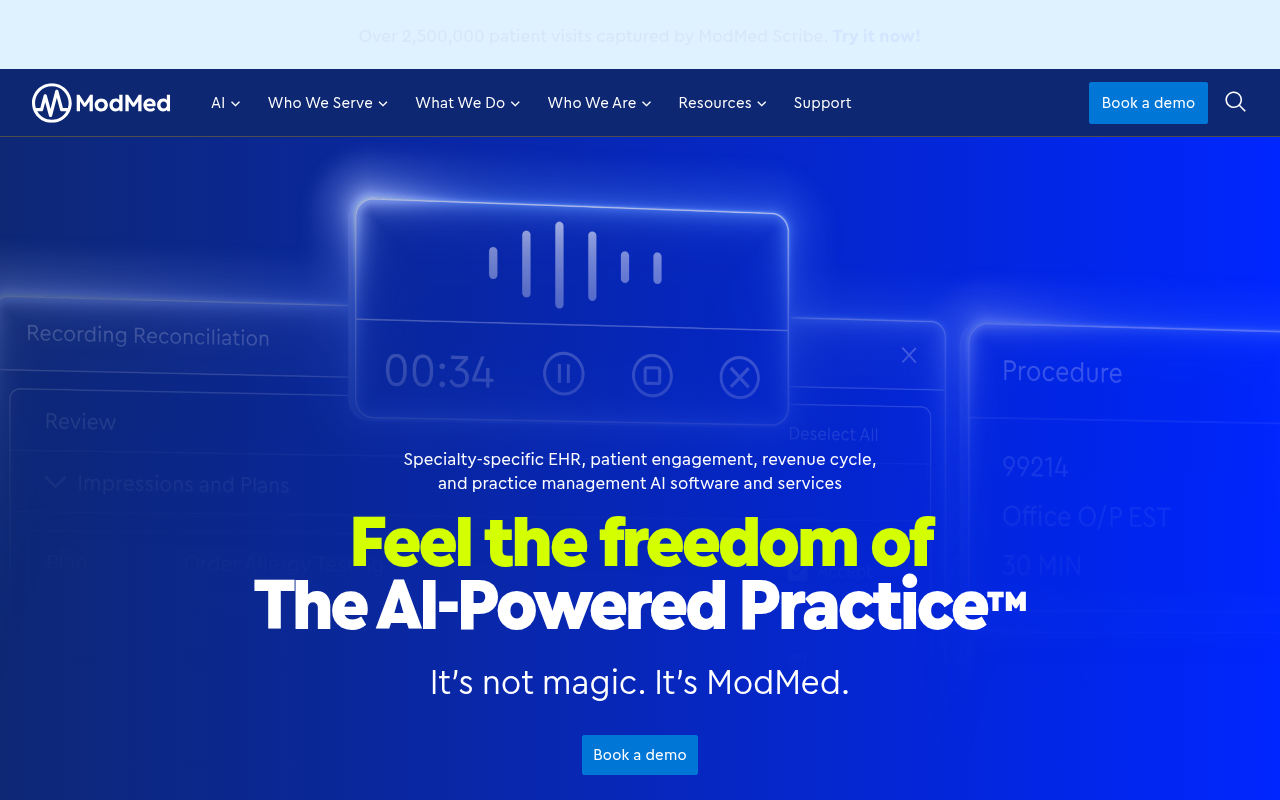
Modernizing Medicine is purpose-built for specialty practices, meaning its orthopedic templates, charge capture logic, and patient engagement tools are native rather than bolted on. The adaptive learning engine observes physician documentation patterns and progressively reduces per-encounter input over time. ModMed Orthopedics' own published outcomes data and independent health IT reviews consistently cite this adaptive engine as its primary throughput differentiator for practices running 25 or more encounters per day. The real limitation: practices with heavy surgical volume will find the system's OR documentation module less mature than its outpatient counterpart, so surgical-dominant groups should pressure-test that workflow before signing.
One pain point that surfaces repeatedly in high-volume orthopedic settings is that practice staff, clinical and administrative alike, receive little to no formal training on EMR systems during onboarding, often being expected to learn on the fly after only brief shadowing periods. That gap does not disappear once the EMR goes live; it compounds every time a physician closes the day with a full queue of incomplete charts. iScribe Health materializes as an ambient documentation layer on top of a supported EHR like ModMed, capturing the encounter conversation in real time so that an AI-drafted encounter summary is ready at the point of note completion, before the patient has reached the front desk.
Because the integration sits above the EMR rather than replacing it, staff do not need to relearn a new system; the familiar ModMed interface remains unchanged while the documentation burden shrinks encounter by encounter.
2. DocVilla - Best Cloud-Based Orthopedic EMR for Small Independent Practices
Orthopedic practices of any size, solo, small, medium, and large, that want a cloud-native platform without the overhead of an enterprise implementation will find DocVilla worth evaluating. Its cloud-native architecture keeps implementation timelines short and subscription costs predictable, which matters when a two-physician practice cannot dedicate six months to onboarding. Orthopedic template depth is solid for common MSK presentations, though practices with complex spine or trauma subspecialties will hit the ceiling of its customization options faster than a larger, more configurable system would allow.
3. Epic Orthopaedics - Best Configurable Enterprise EMR for Large Orthopedic Health Systems
Epic's orthopedic SmartForms and order sets are genuinely powerful at scale, and its interoperability with hospital systems, labs, and imaging networks is the strongest on this list. The honest tradeoff is cost and time: Epic implementations for large health systems routinely run into the millions of dollars and take 12 to 18 months before the system is fully operational, according to industry benchmarks that surface consistently in health IT planning discussions. That investment makes sense for a 20-provider academic orthopedic program; it is difficult to justify for a regional group of six surgeons.
4. Athenahealth - Best Orthopedic EMR for Billing Performance and Revenue Cycle Optimization
Athenahealth's revenue cycle management infrastructure is its primary differentiator. The platform's rules engine applies payer-specific claim edits before submission; Athenahealth references its Rules Engine Data (noted as a 2025 source) but does not publish any specific first-pass claim acceptance rate benchmark. For practices where denial management and reimbursement velocity matter more than specialty-template depth, Athenahealth is a defensible first choice. The tradeoff is that its orthopedic-specific documentation templates are less granular than those in purpose-built platforms, so practices with complex modifier and laterality requirements will need to invest time in custom template configuration to close that gap.
5. Greenway Health - Best Orthopedic EMR for Ambulatory Surgery Center Integration
Practices that operate both an outpatient clinic and an ambulatory surgery center face a coordination problem that most EMRs treat as an afterthought. Greenway Health's architecture connects clinic-side scheduling, pre-operative documentation, and ASC workflow into a single record, reducing the manual handoff friction that creates documentation gaps between settings. The limitation worth naming: Greenway's orthopedic template library is narrower than ModMed's or Nextech's, so subspecialty-heavy practices may find themselves building custom content where a native orthopedic platform would have shipped it out of the box.
6. DrChrono - Best Orthopedic EMR for iPad-First and Mobile Documentation Workflows
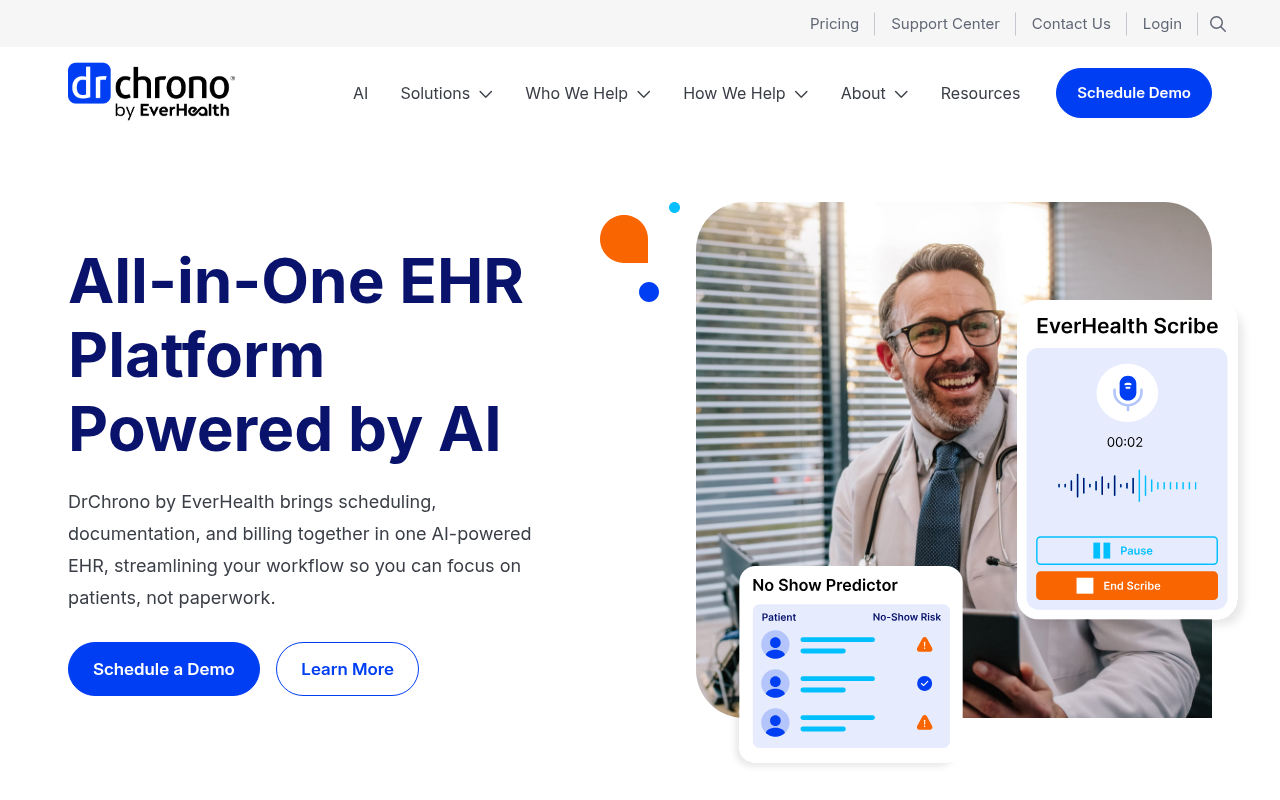
Orthopedic providers who document at the point of care on a tablet rather than a desktop workstation have a short list of genuinely mobile-optimized options. DrChrono is among the most-cited platforms in this category; its iPad-native architecture has been recognised in multiple health IT review outlets, including Software Advice's mobile EMR rankings, as a leading option for tablet-first clinical documentation. Its iPad-native interface supports real-time note entry during the encounter, which reduces the post-visit charting queue for providers disciplined enough to document in the room. DrChrono explicitly markets itself as serving multi-location clinics and multi-specialty practices with scalable, flexible workflows, directly contradicting the claim that its administrative infrastructure is insufficient for such groups.
7. AdvancedMD - Best Orthopedic EMR for Multi-Location Practice Management
Multi-location orthopedic groups spend a disproportionate amount of administrative time reconciling scheduling, billing, and provider credentialing across sites that run on disconnected systems. AdvancedMD centralizes those functions in a single platform, giving practice administrators a consolidated view of AR, appointment density, and provider productivity across locations. Its orthopedic template library is adequate rather than deep, so the value proposition is operational consolidation, not specialty documentation sophistication. Practices that prioritize clinical template granularity over administrative unification should look at Nextech or ModMed instead.
8. Nextech - Best Orthopedic-Specific EMR for Procedure-Heavy Subspecialty Practices

Nextech is one of the few platforms on this list built with procedure-heavy orthopedic subspecialties in mind from the ground up, a positioning its vendor documentation and independent KLAS specialty EMR reviews both confirm, citing its CPT/modifier logic and implant workflow depth as defining differentiators. Its CPT and modifier logic, implant documentation workflows, and operative note templates reflect the billing complexity of practices doing high volumes of joint replacement, fracture care, and spine surgery. That specificity is its strength and its boundary: practices with a significant primary care or general medicine component alongside orthopedics will find Nextech's scope too narrow. It is the right call when the practice is orthopedics-only and billing accuracy on complex procedural claims is the primary performance lever.
9. Kareo (Tebra) - Best Orthopedic EMR for Solo and Micro-Practice Affordability
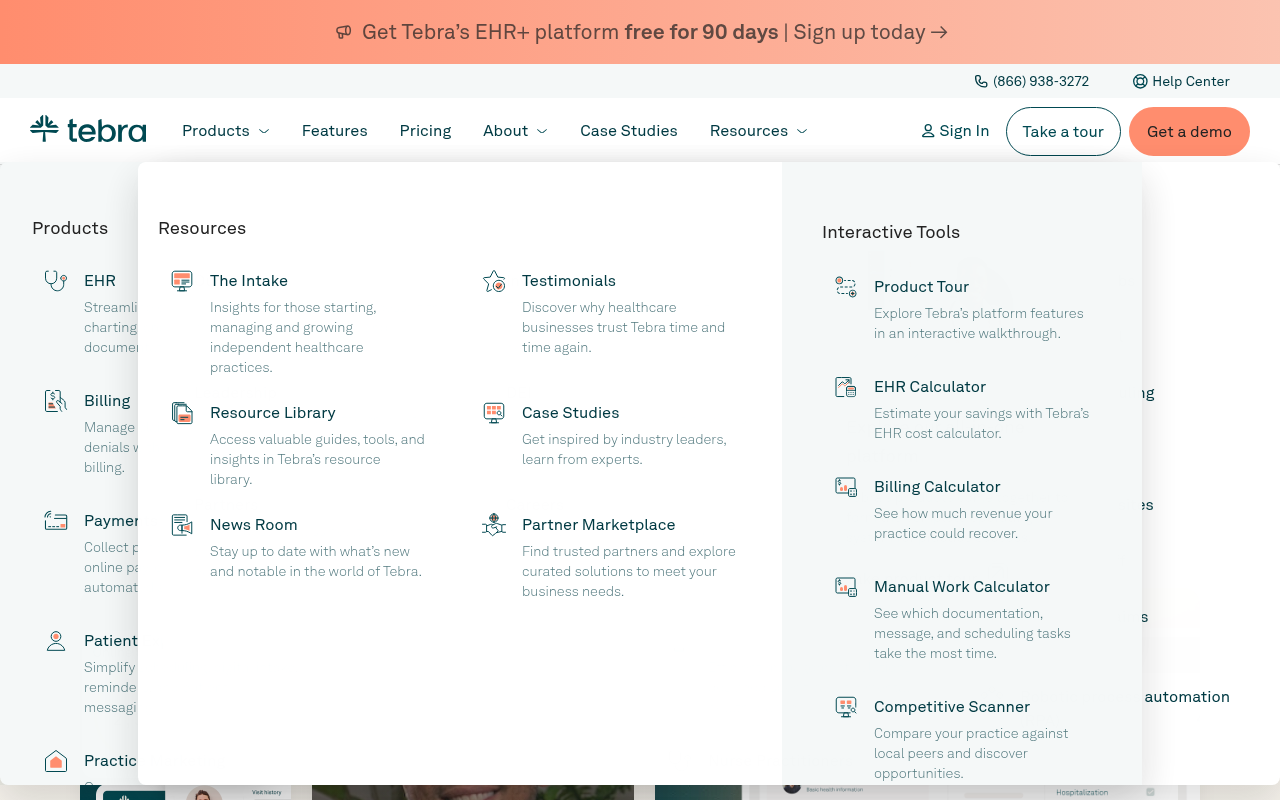
Solo orthopedic practitioners and micro-practices with one to three providers face a pricing reality that eliminates most enterprise and mid-market platforms before the demo is scheduled. Kareo, now operating under the Tebra brand, is designed for this segment: affordable monthly pricing, a manageable onboarding curve, and integrated billing that covers the basics without requiring a dedicated RCM staff. The ceiling is real: Kareo's orthopedic template depth and imaging integration are limited compared to specialty-native platforms, making it a starting point for new or small practices rather than a long-term platform for a growing surgical group.
10. Oracle Health (Cerner) Orthopedics - Best Enterprise EMR for Orthopedic Registries and Outcomes Reporting
Oracle Health's orthopedic configuration excels at connecting clinical documentation to national registries such as AJRR and NSQIP, enabling outcomes benchmarking that supports value-based care contracts. Its PACS integration is enterprise-grade, supporting high-volume imaging workflows across radiology and orthopedic departments. Best for academic medical centers and large orthopedic programs with registry reporting obligations. The limitation is high total cost of ownership and long implementation cycles.
11. CureMD - Best Orthopedic EMR for Integrated Telehealth and Remote Patient Monitoring
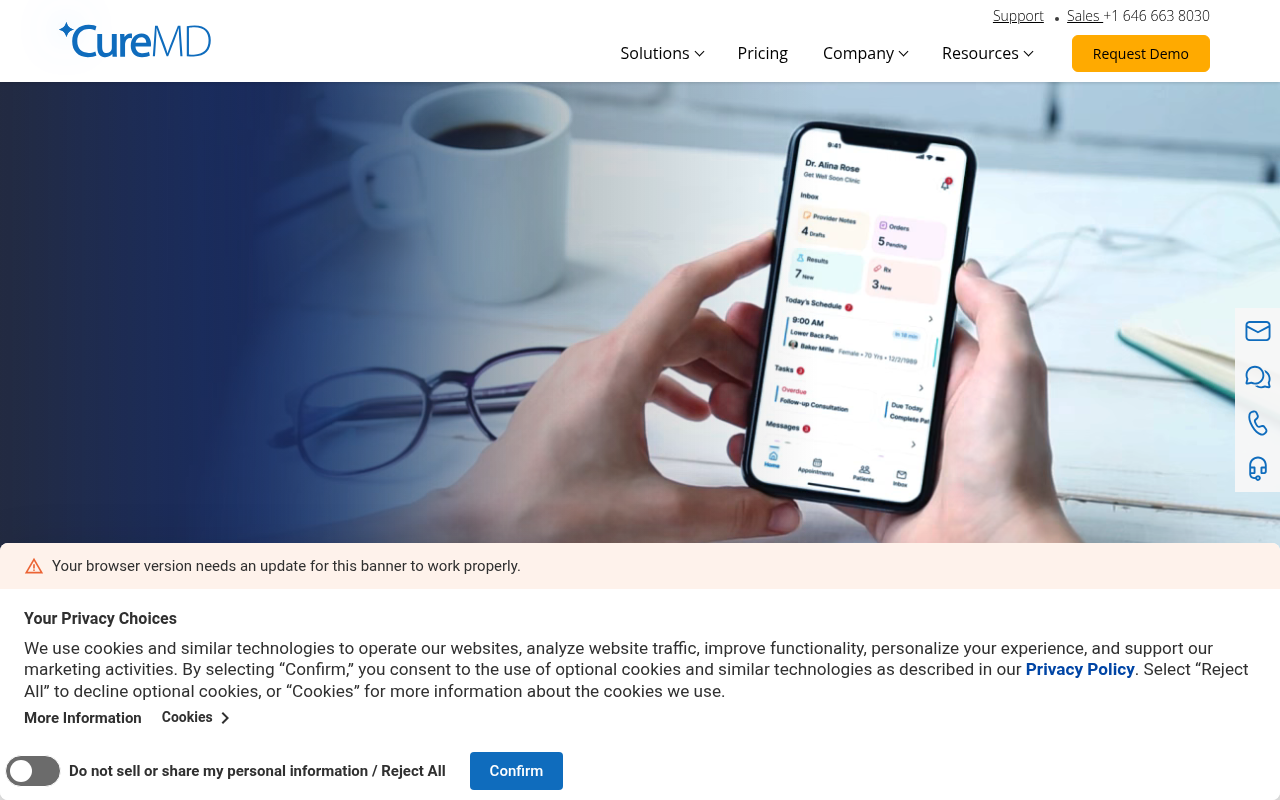
Post-operative orthopedic care increasingly happens outside the clinic, and practices that have built telehealth-based follow-up protocols need an EMR that treats virtual encounters as first-class documentation events rather than workarounds. CureMD integrates telehealth scheduling, video visits, and remote patient monitoring into a single record without requiring third-party middleware. Its orthopedic-specific template depth is moderate, and practices with high surgical volume will want to evaluate whether the platform's operative documentation meets their complexity requirements before committing. The platform earns its designation for practices where post-op patient access and chronic MSK management are central to the care model.
12. Praxis EMR - Best Orthopedic EMR for AI-Driven Concept-Based Note Generation
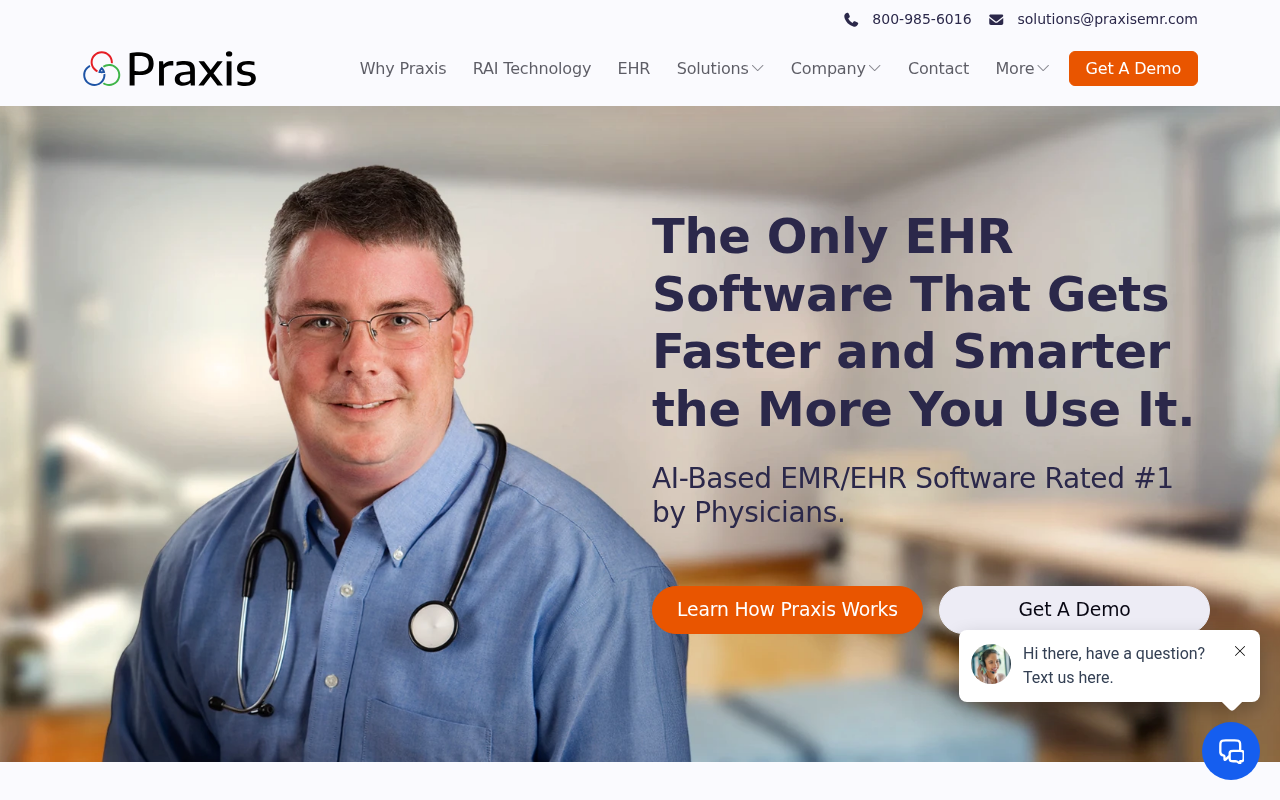
Praxis EMR uses a concept-based documentation model rather than a template library, meaning the system learns from the physician's own note patterns and generates increasingly accurate drafts over time. For orthopedic providers with consistent documentation habits, this produces notes that reflect actual clinical reasoning rather than template-driven language. The limitation is the training period: providers should expect several weeks before the system's output reaches a level of accuracy that meaningfully reduces editing time, and practices with high physician turnover will face repeated ramp-up cycles that erode the efficiency gains the platform promises.
13. WebPT (with Orthopedic Physician Module) - Best EMR for Combined Orthopedic Physician and Physical Therapy Practices
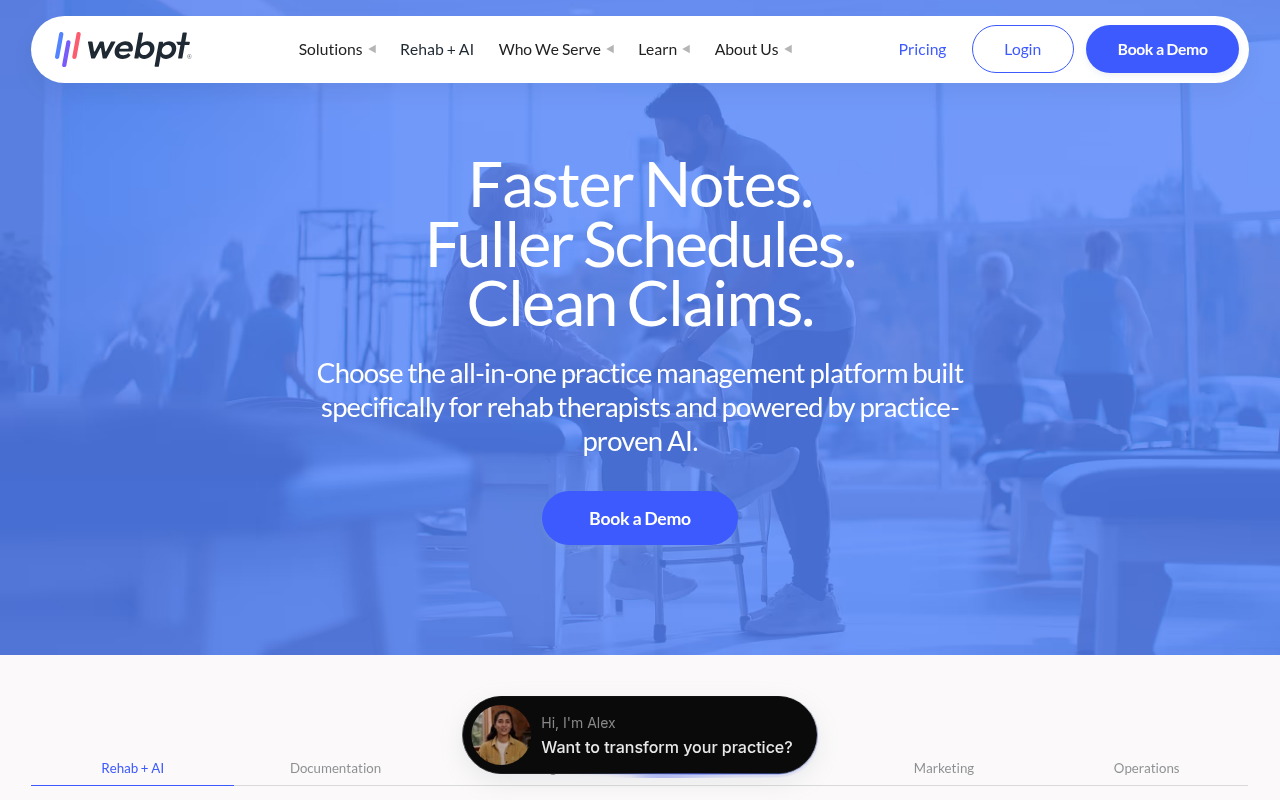
Practices that employ both orthopedic physicians and physical therapists under one roof face a documentation fragmentation problem that general EMRs solve poorly. WebPT was built for physical therapy documentation and has extended its platform to support the orthopedic physician side of the same patient record. The result is a shared clinical record that follows the patient from surgical consultation through rehabilitation without manual handoffs or duplicate data entry. The tradeoff is that the physician-side module is less mature than the PT documentation engine, so surgical-dominant practices should evaluate it alongside a purpose-built orthopedic EMR before deciding.
Related Reading
- Orthopedic Surgery Billing
- Orthopedic Billing And Coding
Key Selection Criteria When Evaluating Orthopedic EMR Systems
The standard EMR selection scorecard, which evaluates imaging integration, template depth, and billing module quality as separate checkboxes, structurally obscures the most consequential question: whether the system's documentation workflow architecture genuinely reduces per-encounter charting time or simply digitizes existing burden.

How to Evaluate Orthopedic EMR Systems for Real Documentation Speed, Not Just Feature Presence
The right evaluation question is "does this system's imaging integration eliminate the manual steps that slow documentation mid-encounter?" As oipub.com's orthopedic EMR analysis makes clear, systems that lack native two-way DICOM/PACS communication force manual workarounds that negate the efficiency gains from digital documentation altogether.
Medical Economics noted that documentation is one of the most time-consuming parts of a physician's day and is "an area ripe for improvement." The practices iScribe Health works with confirm this acutely: clinicians seeing high patient volumes and spending two or more hours on after-hours charting are the ones for whom the gap between feature presence and real throughput is most damaging.
The Five Criteria That Actually Predict Documentation Throughput
Five criteria, scored independently, predict whether an orthopedic EMR will accelerate or replicate your current documentation burden.
As the oipub.com analysis establishes, templates must be tailorable to a practice's specific case mix, including fracture care, sports medicine, spine, and joint replacement, rather than relying on generic documentation structures. Tight coupling between charge capture, coding validation, and claim submission is a distinct scoring dimension, which is precisely why iScribe Health's E&M Coding Intelligence and Real-Time Denial Alerts operate as independent capabilities layered on top of documentation.
The central question remains whether the system genuinely reduces per-encounter charting time or simply digitizes existing burden. iScribe Health delivers the greatest value when physicians want a completely hands-free documentation experience during the visit, which is the clearest possible answer to the workflow architecture criterion.
Practice-size fit matters because implementation overhead and feature complexity scale non-linearly with provider count. A configuration that works cleanly for a four-provider group can create administrative drag at twenty providers that no training program fully resolves. iScribe Health's value compounds most in high-volume practices or health systems where the after-hours charting burden is a daily reality, realized across every patient encounter and every day of clinical practice.
How Click Fatigue Silently Slows Orthopedic Documentation Throughput
The physicians iScribe Health works with most often fit a specific profile: they are seeing high patient volumes, they want a completely hands-free experience during the visit itself, and they are spending significant time on after-hours documentation that is eroding both personal time and cognitive reserves.
The workflow is straightforward: the physician speaks naturally with the patient, iScribe Health's ambient layer captures the encounter, and the AI drafts the note.
The Documentation Workflow Gap Every Orthopedic EMR Evaluation Misses
The common assumption among high-volume orthopedic practices is that if you just pick the EMR with the best orthopedic templates and imaging integration, documentation will get faster and billing accuracy will improve on its own. Audit data reveals what feature checklists cannot: a fully functional orthopedic EMR, running exactly as designed, can still produce a 33% overcoding rate across hundreds of real patient encounters, a finding that surfaces only when someone looks past the feature set and into actual claim-level outcomes.

What a 941-Encounter Audit Revealed About Orthopedic Coding Accuracy That No EMR Flagged
The Center for Sports Medicine & Orthopaedics / ScribeEMR case study analyzed 941 patient encounters at a Chattanooga orthopedic practice and found that 33% of encounters were overcoded, a billing accuracy gap the practice's own EMR never surfaced. Provider-to-AI coding agreement came in at just 54.8%, meaning that until they ran the trial, no one in the building knew the split. That blind spot is not unique to this practice. According to Tebra (2023), only 10% of healthcare providers use AI in their practice in any form, and of those planning to adopt it, most intend to apply it to scheduling and data entry rather than coding accuracy or documentation quality control, so the layer where errors accumulate goes largely unaddressed.
Fracture Care, Surgical Modifiers, and Implant Documentation Beyond Generic Templates
The result is a documentation workflow where the gap between what the EMR captures and what the claim actually requires is wide enough to produce systematic overcoding and undercoding simultaneously, across different encounter types, without a single alert firing. That gap has a direct downstream cost: it undermines defensible documentation, complicates reimbursement and payment workflows, and leaves the practice exposed at audit, exactly the failure modes that practices working with iScribe Health are working to close.
Where Orthopedic EMR Systems Fall Short - The Space Between Capture and Clinical Reality
Industry data shows most providers who are beginning to adopt AI are directing it toward administrative tasks rather than the coding and documentation quality control layer where errors actually accumulate, which means the gap identified in the Center for Sports Medicine & Orthopaedics / ScribeEMR case study remains open in the vast majority of practices today.
iScribe Health's ambient AI documentation layer is designed to operate precisely in this space, closing the distance between what is said in the encounter and what the claim ultimately reflects.
How AI Scribing Closes the Documentation Gap Your Orthopedic EMR Leaves Open
Most orthopedic practices that invest in a best-fit EMR, complete with specialty templates and charge-capture modules, still watch their physicians fall behind on charts after hours. According to Pacific Companies' December 2023 analysis, physicians routinely work 51 to 60 hours per week, with documentation tasks pushing well into evenings and weekends. That burden persists regardless of how well the EMR is configured.

Why Ambient AI Scribing Operates as a Layer on Top of Your Orthopedic EMR
The persistent after-hours documentation burden that high-volume orthopedic surgeons carry is a structural feature of high-volume practice that scales with patient volume, not with template quality. When that burden compounds the documented post-EMR-implementation finding that surgeons experience a lasting reduction in time spent with patients, the real cost is clinical intent that goes uncaptured or inaccurately captured under time pressure, creating a measurable gap between what was delivered in the room and what the medical record reflects.
The EMR captures what the physician enters. It has no mechanism to capture what the physician intended to enter but never got to, because the next patient was already in the room.
iScribe Health sits on top of any existing orthopedic EMR as an ambient scribing layer, capturing the encounter in real time so the structured note is ready before the physician opens the chart, eliminating the gap between what happened in the room and what the record reflects.
The Coding Visibility Problem AI Scribing Solves That Templates Cannot
Templates wait for input. Ambient scribing generates structure from the encounter itself, surfacing the specificity that modifier justification and implant documentation require without relying on the physician to remember and re-enter it under time pressure.
That distinction matters most in orthopedics, where coding complexity around fracture care and surgical modifiers means a rushed or incomplete note does not just create a clerical gap. It creates a compliance exposure. An orthopedic practice running a system like Phoenix Ortho can add an ambient scribing layer and realistically reduce post-visit charting time significantly. iScribe Health's published case study data reports substantial reductions in post-visit charting time in comparable high-volume orthopedic settings, because the documentation capture mechanism moved to the point of care.
Related Reading
- Surgery Center Emr
- Medical Scribe Cost
Next steps
If your physicians are still closing charts two hours after the last patient leaves, the path forward starts with recognizing that no EMR on this list ships a workflow layer that captures clinical intent at the point of care. Template quality and PACS integration reduce friction mid-encounter, but the 941-encounter audit finding, where a fully functional orthopedic EMR quietly produced a 33% overcoding rate without triggering a single alert, confirms that the documentation accuracy gap lives somewhere the feature checklist never reaches.
The persistent after-hours charting burden is a structural feature of high-volume orthopedic practice, not a configuration problem any EMR solves on its own. That means modifier errors, laterality mismatches, and CPT-to-ICD-10 pairing issues accumulate silently inside systems administrators believe are performing correctly. Together, these two realities point to the same action: adding an ambient documentation layer that operates at the point of care, drafts the encounter summary before the physician opens the chart, and surfaces coding gaps before the claim leaves the practice.
Start with Best AI medical scribe for urology practices to see how ambient capture, automated E&M coding, and real-time denial alerts work as a layer on top of whichever orthopedic EMR your practice already runs. No system switch. No staff retraining. The documentation burden shrinks across every patient encounter, every day.
Frequently Asked Questions
Do orthopedic EMRs actually connect to PACS and display imaging inside the chart, or is it still a separate viewer?
A true orthopedic EMR renders DICOM images, X-rays, MRIs, and CT scans, directly inside the patient chart with real-time rendering and the ability to annotate findings without switching applications. General-practice EHRs typically lack this native integration, forcing physicians to manually attach files or toggle between a separate PACS viewer and the chart, which adds compounding friction across every encounter in a full clinic day.
Why do so many orthopedic claims get denied, and can the right EMR actually reduce that?
Orthopedic denials are frequently driven by incorrect modifier use, such as -LT versus -RT, and mismatched diagnosis-to-procedure pairings, which are failure points that generic charge-capture modules are not built to catch. Specialty-specific EMRs address this with templates that auto-populate ICD-10 codes based on injury site and automatically align CPT codes with the correct modifiers, reducing the exposure at the source rather than catching errors in a denial queue weeks later. The post also notes that undercoding, where a physician documents less than the clinical complexity warranted because the template didn't prompt the right elements, represents revenue that disappears silently without ever generating a denial.
Is a cloud-based orthopedic EMR a realistic option for a small independent practice?
Yes, the post specifically highlights cloud-native architecture as a fit for smaller practices because it keeps implementation timelines short and subscription costs predictable, which matters when a two-physician practice cannot dedicate six months to onboarding. The tradeoff noted is that smaller cloud-based platforms may hit a ceiling on customization for complex subspecialties like spine or trauma.
How does an orthopedic EMR handle post-operative follow-up, and does it work for telehealth visits?
Orthopedic-specific EMRs include dedicated rehabilitation tracking modules that surface outcome measures, range-of-motion benchmarks, and pain scales specific to the procedure performed, rather than presenting a blank visit note, and telehealth workflows designed around post-operative checks for patients with limited mobility. General-practice EHRs have no native mechanism for tracking surgical recovery trajectories or logging PT progress against expected milestones, making every undocumented milestone both a billing gap and a quality gap.
If my practice already has an EMR, does switching to a specialized orthopedic system mean rebuilding everything from scratch?
Not necessarily, the post describes iScribe Health's ambient AI documentation as a complementary layer that integrates with supported EHRs rather than replacing them, so the familiar EMR interface remains unchanged while the documentation burden shrinks encounter by encounter. The structural gap that specialty templates alone cannot close, what happened in the room versus what a physician documented under time pressure, is addressed at the point of care without requiring practices to rebuild their existing infrastructure.