Orthopedic Billing and Coding: A Practical Guide for 2026
Orthopedic billing and coding gaps cost practices real revenue. See where claims fail before submission.


Orthopedic billing doesn't fail at the billing desk. It fails in the clinical note, and every incomplete chart is revenue already gone before a single claim is submitted.
Orthopedic billing sits at a structural crossroads unlike almost any other specialty in medicine. A single total knee arthroplasty encounter may require CPT 27447, a laterality-specific ICD-10 code, modifier RT or LT, prior authorization documentation, implant device logs, and global period tracking, all generated from one clinical note. That is a systems problem, and understanding this is what separates practices that consistently collect what they earn from those that quietly leave revenue on the table.
Orthopedic billing spans a uniquely wide range of service types, including office visits, injections, arthroscopic procedures, joint replacements, fracture care, and durable medical equipment, each governed by distinct coding rules and payer requirements. The musculoskeletal section of CPT alone runs from code 20005 through 29999, covering hundreds of distinct procedures across bones, joints, tendons, and soft tissue.

A single orthopedic practice may generate claims for an E&M visit, a joint injection with ultrasound guidance, a post-operative follow-up, and a DME order on the same day, each following a different coding logic, documentation standard, and payer policy. Orthopedic claims are subject to layered compliance requirements including modifier stacking, global surgical period rules, NCCI edits, implant cost tracking, and prior authorization, all of which must be managed simultaneously. These compliance layers do not operate independently: a global surgical period violation compounds a modifier error, a missing prior authorization compounds a documentation gap, and the failure modes stack. That exposure scales with volume; a high-throughput practice running 30 to 40 encounters per day generates it repeatedly, across every claim, every day.
The common assumption is that orthopedic billing complexity is a coder knowledge problem. In practice, the failure point sits earlier. When a clinical note omits the full complexity of medical decision-making, even a credentialed coder working from perfect CPT knowledge will produce the wrong code, because the source documentation was already deficient before the chart was opened. iScribe Health's Automated E&M Coding addresses this upstream by generating codes directly from complete, AI-captured clinical documentation. In the Center for Sports Medicine and Orthopaedics audit of 941 encounters, provider-AI agreement reached only 54.8%, with a 33% overcoding rate, evidence that AI-anchored documentation surfaced systematic gaps a manual coding review had not detected.
54.8%
Provider-AI agreement across 941 encounters
Understanding why orthopedic billing is structurally complex is only half the diagnosis. The harder question is exactly where in the workflow revenue is already walking out the door before a single claim is submitted.
Key takeaways
- Orthopedic billing fails at the documentation layer, not the coding layer, by the time a coder touches a claim, the missing laterality, episode-of-care designator, or medical necessity detail is already gone.
- A single total knee arthroplasty encounter can require six or more distinct documentation elements to produce a defensible claim; any one gap is enough to trigger a denial or a post-payment audit.
- One orthopedic group audited 941 encounters and found a 33% overcoding rate with only 54.8% agreement between providers and AI, a split no one in the practice knew existed until that moment.
- Revenue leaks before a claim is ever submitted: underdocumented office visits, missed modifier justifications, and incomplete fracture descriptors are billing problems that start in the exam room.
- Five modifiers drive the majority of orthopedic claim denials when misapplied, and appending the right modifier to a note that never captured the clinical justification creates a defensible-looking claim that will not survive a payer audit.
- iScribe Health's Automated E&M Coding generates E&M codes directly from clinical documentation in real time, closing the gap between what happened in the exam room and what the claim actually reflects.
Where Orthopedic Revenue Actually Leaks Before a Claim Is Ever Submitted
In reality, across a typical orthopedic practice, revenue walks out the door before a single claim reaches the clearinghouse.
Key takeaway: According to Practolytics (2024), up to 80% of medical bills contain errors, with undercoding and missing documentation among the most common causes of revenue loss in specialty practices, meaning the problem originates in the clinical documentation workflow, not solely in the billing department's coding knowledge.

80%
of medical bills contain errors
E/M Undercoding Starts in the Note, Not at the Billing Desk
The reimbursement gap between a 99213 and a 99214 is not a rounding error. What most physicians demonstrate in practice is a tendency to document the clinical plan while omitting the complexity of medical decision-making, causing encounters that qualify as 99214 to be billed as 99213 before any billing team involvement.
If the note does not reflect the number of diagnoses considered, the data reviewed, or the risk of complications weighed, the documentation can only support the lower level. That pressure compounds across a full clinic day, and research found that 25% of physicians reported frequent EHR use on days off, which means documentation demands routinely spill outside any scheduled work time.
iScribe Health's Ambient AI Documentation addresses this at the source: by listening to the encounter as it unfolds and drafting the note in real time, it captures the full clinical story, comorbidities discussed, surgical history referenced, Evaluation and Management (E/M) complexity articulated, so the E/M level the documentation actually supports is preserved before the claim is built.
How Modifier Misuse and Missing ICD-10 Specificity Turn Correct Codes Into Denied Claims
Both Modifier 25 and Modifier 57 require the note to explicitly support that a distinct, medically necessary service occurred, and when the note is thin, the modifier cannot be defended and the claim is denied.
Modifier
What It Signals
What the Note Must Support
25
A significant, separately identifiable E/M service performed on the same day as a minor procedure
That a distinct, medically necessary E/M service occurred beyond the procedure itself
57
The decision for surgery was made during an E/M service the day before or the day of a major surgery
That the surgical decision was explicitly made and documented during that E/M encounter
Broader industry trends consistently identify missing laterality and incorrect fracture episode-of-care designators as leading drivers of claim denials in orthopedic billing.
iScribe Health's E&M Coding Intelligence works at the point of note completion, after the AI drafts the encounter summary, to surface the code level the documentation supports and flag specificity gaps before the claim is submitted.
The Documentation Drift No One Measures Until a Claim Is Already Lost
As the audit finding from Center for Sports Medicine and Orthopaedics shows, a 33% overcoding rate and only 54.8% provider-AI agreement across 941 encounters went undetected until a structured measurement was applied.
iScribe Health's Real-Time Denial Alerts bring that visibility forward, surfacing documentation and coding gaps at the point of note completion, not after a denial has already been processed.
What Are the Most Common Orthopedic CPT Codes for Office Visits, Injections, Arthroscopy, and Joint Replacement?
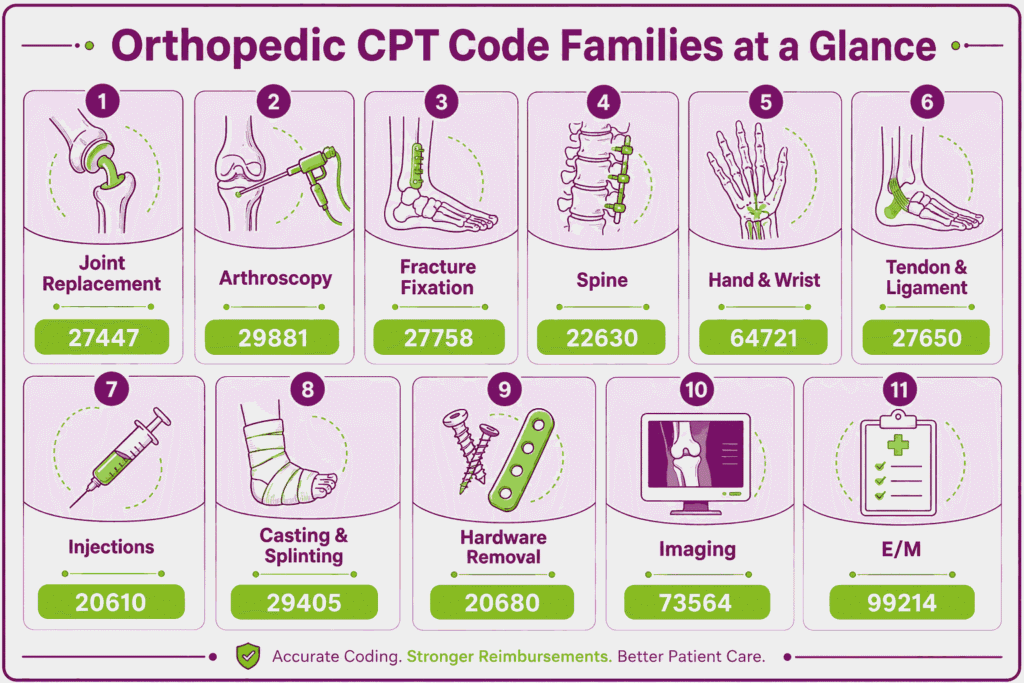
The most common orthopedic CPT codes span four service categories: office evaluation and management (E/M), joint injections, arthroscopy, and joint replacement. Knowing which codes drive the majority of orthopedic revenue is table stakes. A defensible claim depends on whether the clinical note documents the specific elements each code requires, and this is where many practices lose ground. The documentation layer fails them before a claim is ever built.
1. Office E/M CPT Codes 99202-99215 - New and Established Patient Visit Levels
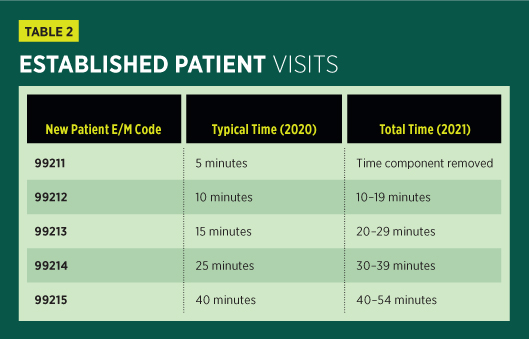
CPT 99202-99205 cover new patient visits; CPT 99211-99215 cover established patients. In orthopedic practices, that same figure and 99214 carry the highest volume, yet systematic undercoding pushes 99214-level encounters onto that same figure claims when the note captures the treatment plan but omits the medical decision-making complexity behind it. The clinical record fails to document the encounter complexity that would justify the higher level.
iScribe Health's Automated E/M Coding and E/M Coding Intelligence structures the clinical note in real time, most beneficial when clinicians are seeing high patient volumes and spending significant time on after-hours documentation, so the MDM elements needed to defend a that same figure or 99215 are present before the claim is ever submitted. This approach is consistent with findings from the CSMO 941-encounter audit, where systematic MDM documentation drift was only detected through AI-assisted code comparison.
2. Injection and Aspiration CPT 20610 with Ultrasound Guidance CPT 76942 - Major Joint Arthrocentesis
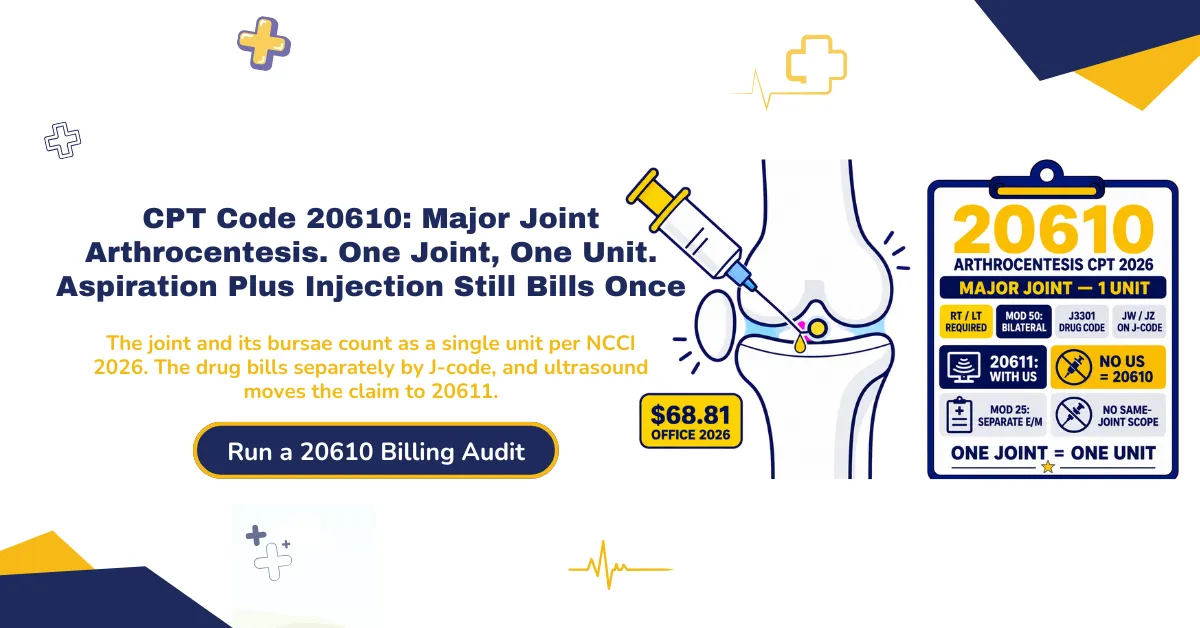
CPT 20610 covers arthrocentesis, aspiration, and injection of major joints including the shoulder, hip, and knee, making it one of the highest-volume procedure codes in outpatient orthopedics. When ultrasound guidance is used, CPT that same figure is billed alongside it, but this pairing is a consistent source of recoupment. Payers treat missing image records as evidence the guidance was never performed.
Permanent image storage in PACS or the EHR, plus a formal interpretation report, are mandatory documentation requirements. iScribe Health's Real-Time Denial Alerts surface these gaps at note completion, before submission, so the practice can correct the record rather than fight a denial.
3. Arthroscopy CPT Codes 29881, 29827, and 29888 - Knee, Shoulder, and ACL Procedures
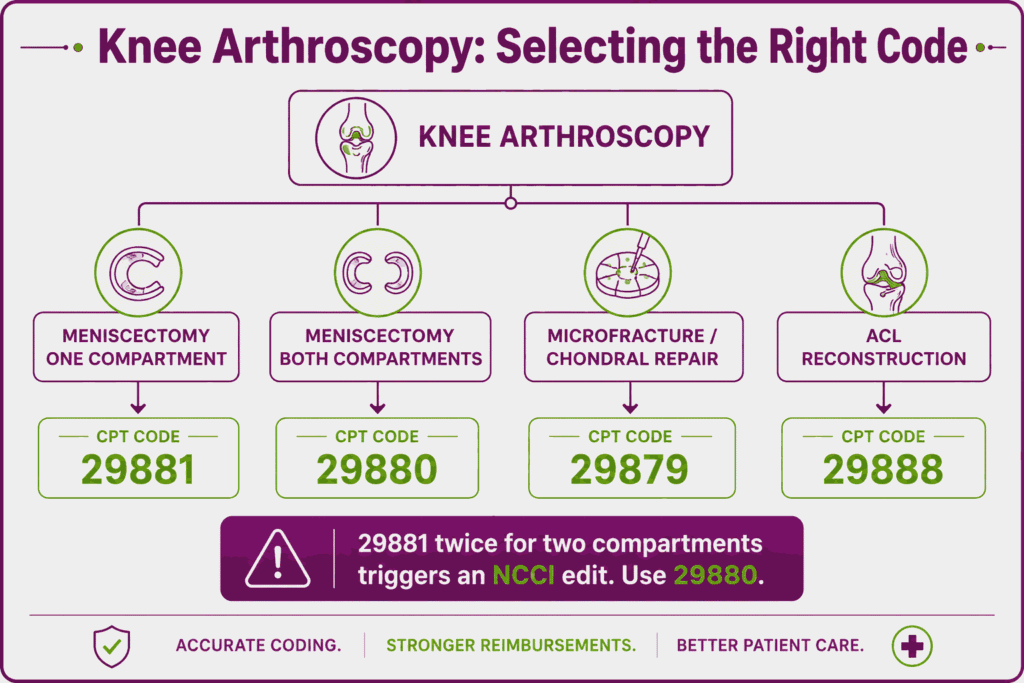
Three codes account for the majority of orthopedic arthroscopy volume. CPT 29881 covers knee arthroscopy with meniscectomy; CPT 29827 covers shoulder arthroscopy with rotator cuff repair; CPT 29888 covers arthroscopic ACL repair or augmentation. Billing CPT that same figure without a note that identifies the specific compartment involved and the meniscal tear type is a leading denial trigger for knee arthroscopy claims. The operative report must document structures visualized, pathology confirmed, and technique used. Bundling rules apply across all three codes, so each billed service must appear in the note as a distinct, separately documented procedure rather than a general description of the operative session.
iScribe Health's Ambient Listening and Conversational AI delivers the greatest value here when physicians want a completely hands-free documentation experience during the visit, capturing operative detail in real time so the structured note is ready at the point of note completion rather than reconstructed from memory after a full surgical day.
4. Joint Replacement and Spinal CPT Codes 27447, 27130, 22633, and 64721 - High-Value Surgical Billing
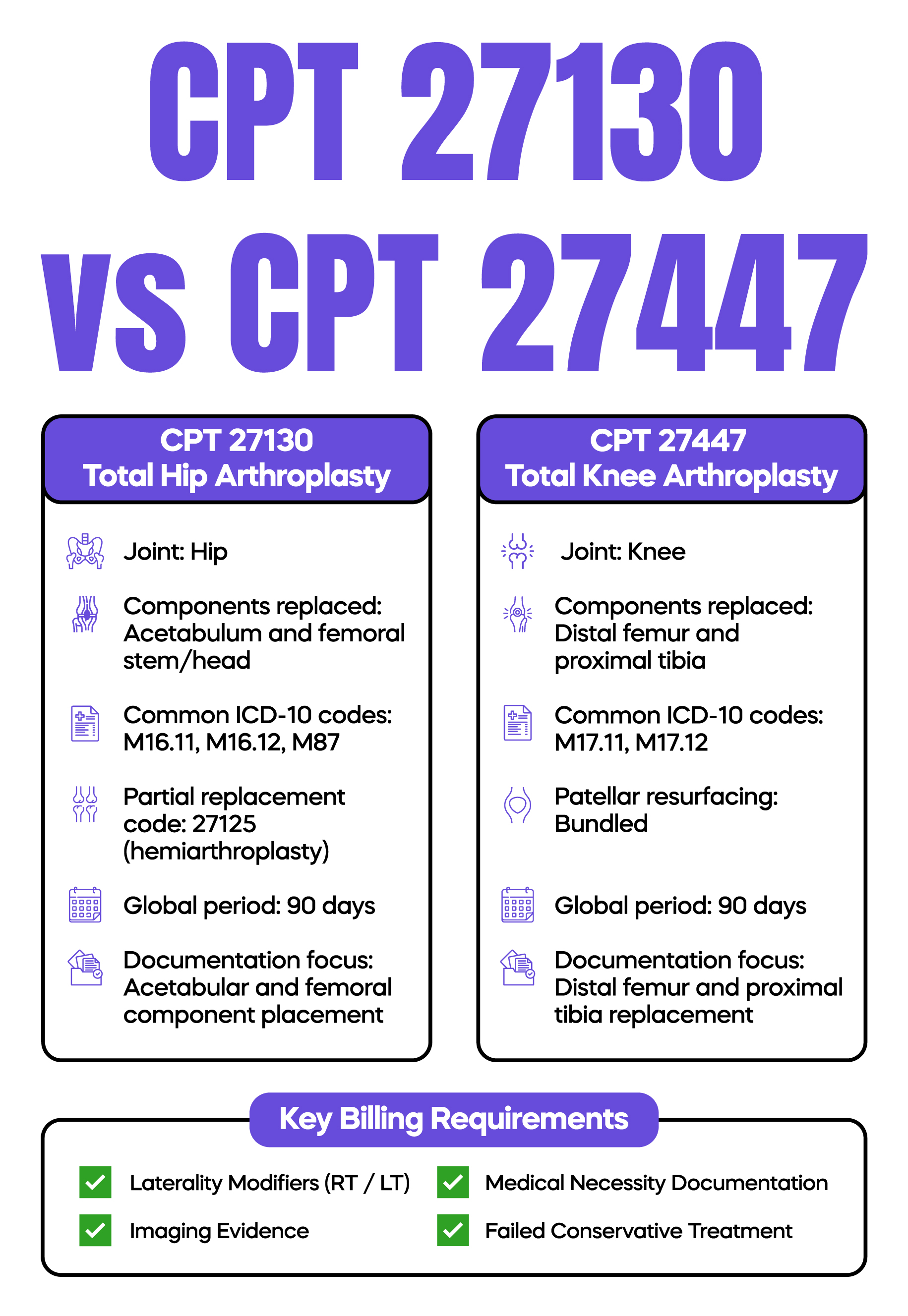
CPT 27447 codes total knee arthroplasty; CPT 27130 codes total hip arthroplasty; CPT 22633 codes lumbar interbody fusion; CPT 64721 codes carpal tunnel release. The arthroplasty codes carry the highest reimbursement in the orthopedic fee schedule, which also makes them the most scrutinized at audit. Operative notes must document implant details including manufacturer name and serial number, the surgical approach, and any intraoperative findings that changed the procedure. A 90-day global period attaches to both arthroplasty codes, so separately billed postoperative services require specific modifiers and supporting documentation to avoid automatic denial.
Evidence published in the Journal of Taibah University Medical Sciences supports the value of AI-assisted documentation in improving clinical record completeness, a finding that applies directly to the implant detail and intraoperative narrative requirements that make or break an arthroplasty audit.
Orthopedic CPT Code Quick-Reference Checklist
Before submitting any orthopedic claim, verify the following documentation elements are present for each service category:
- Office E/M (New Patient) → CPT Codes: 99205 → Required Documentation: MDM elements (number of diagnoses, data reviewed, and risk level) or documented total time.
- Office E/M (Established) → CPT Codes: 99211–99215 → Required Documentation: MDM complexity narrative, comorbidities considered, and plan rationale.
- Major Joint Injection → CPT Codes: 20610 → Required Documentation: Joint name, laterality, medication injected, and dose.
- Injection with Ultrasound Guidance → CPT Codes: 76942 → Required Documentation: Permanent image stored in PACS/EHR and a formal interpretation report.
- Knee Arthroscopy with Meniscectomy → CPT Codes: 29881 → Required Documentation: Compartment identified, meniscal tear type, structures visualized, and technique.
- Shoulder Arthroscopy with Rotator Cuff Repair → CPT Codes: 29827 → Required Documentation: Tear size and location, repair technique, and anchors used.
- Arthroscopic ACL Repair → CPT Codes: 29888 → Required Documentation: Graft type, fixation method, and separate documentation from any concurrent procedure.
- Total Knee Arthroplasty → CPT Codes: 27447 → Required Documentation: Implant name, serial number, lot number, surgical approach, and intraoperative findings.
- Total Hip Arthroplasty → CPT Codes: 27130 → Required Documentation: Implant name, serial number, lot number, surgical approach, and global-period modifier plan.
- Lumbar Interbody Fusion → CPT Codes: 22633 → Required Documentation: Levels fused, approach, implant details, and supporting imaging reference.
- Carpal Tunnel Release → CPT Codes: 64721 → Required Documentation: Laterality, open versus endoscopic technique, and confirmation of nerve decompression in the note.
Which Modifiers Are Essential in Orthopedic Billing and What Do They Indicate?
Five modifiers account for the majority of orthopedic claim denials when misapplied, and each one functions as a documentation checkpoint before it functions as a billing instruction. A coder who appends the right modifier to a note that never captured the clinical justification has not solved the problem; they have created a defensible-looking claim that will not survive a payer audit.
1. Laterality Modifiers RT and LT - Mandatory Identifiers for Paired Limb Procedures
RT (right side) and LT (left side) are not optional refinements; they are required identifiers for any paired-limb procedure, and a missing laterality modifier triggers automatic denial at most payers. The operative note must state the treated side explicitly, not just in the procedure title or a pre-printed template header. Dictation that reads "knee arthroscopy performed without complication" and omits side documentation leaves the billing team with no defensible basis for appending LT or RT. That denial originates in the exam room, not the billing queue. iScribe's ambient AI captures and confirms laterality at the moment of documentation, so the structured note that reaches the billing team already contains the explicit side language the modifier requires.
2. Modifier 59 and X-Modifier Variants (XE, XP, XS, XU) - Bypassing NCCI Edits for Distinct Services
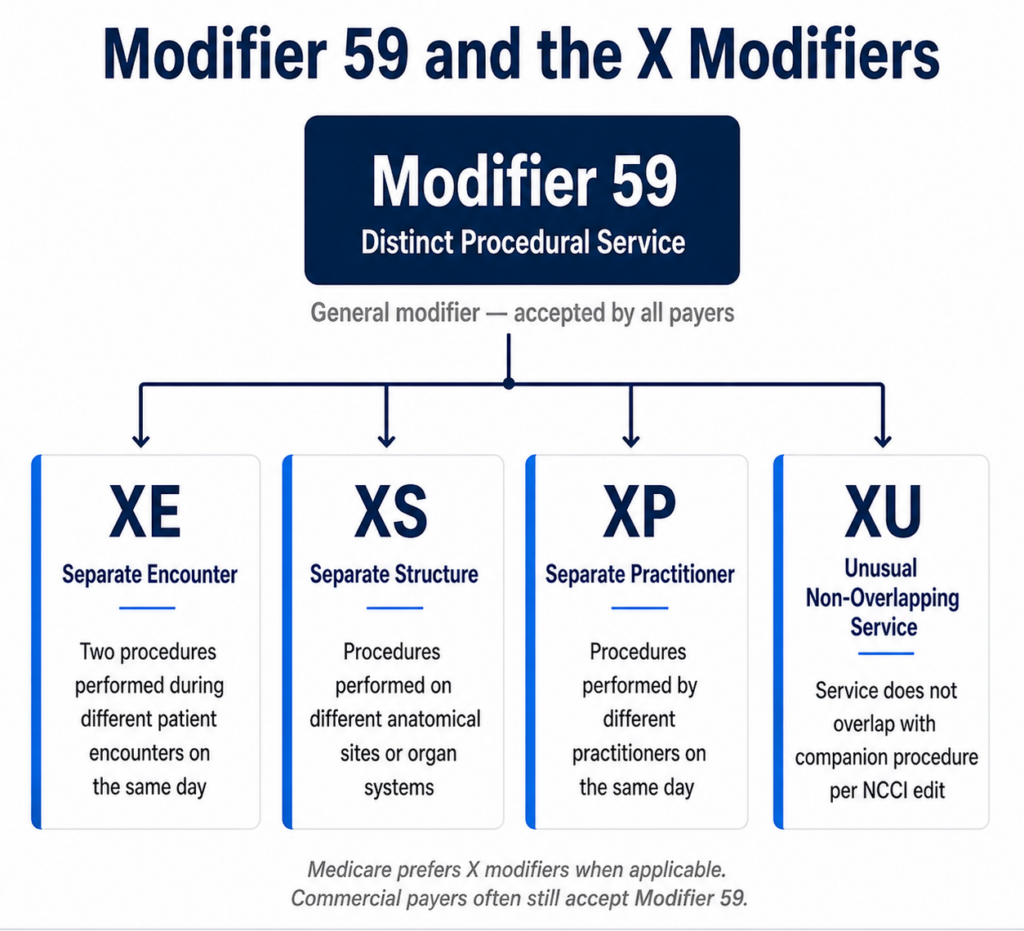
Modifier 59 tells the payer that two same-day procedures are genuinely separate services rather than bundled components of a single CPT code. It is the most scrutinized modifier in orthopedic billing, and Recovery Audit Contractors consistently target reflexive modifier 59 use as evidence of unbundling. The X-modifier subset adds required specificity: XE for a separate encounter, XP for a separate practitioner, XS for a separate structure, and XU for an unusual non-overlapping service.
Payers increasingly expect the narrower variant rather than a blanket modifier 59 with no supporting note language describing the distinct indication, separate anatomical site, or separate session. In high-volume practices where surgeons are completing multiple cases per operative day, the pressure to dictate quickly is real, and the distinct-service language is exactly what gets dropped. iScribe's structured documentation workflow prompts that language at the point of note completion, so the record supports the narrower X-modifier before the claim is built.
3. Modifier 58 for Staged Procedures During the Global Period - Planned Return-to-OR Reporting

Modifier 58 signals that a procedure performed during an active global period was planned at the time of the original surgery, is therapeutically related to it, or represents a more extensive service than initially performed. The critical documentation requirement is staged-procedure intent: the original operative note or pre-operative plan must record that a return to the operating room was anticipated. Without that language, payers reclassify the second procedure as a global-period service and deny it.
Billing teams regularly encounter this gap when surgeons dictate the first case without noting planned staged steps, leaving no record to support the modifier weeks later. Because iScribe structures the note at the point of the first encounter, staged-procedure intent is captured when it is clinically present, not reconstructed from memory at the time of the second case.
4. Modifier 50 for Bilateral Procedures and Modifiers JW/JZ for Joint Injection Drug Waste Reporting
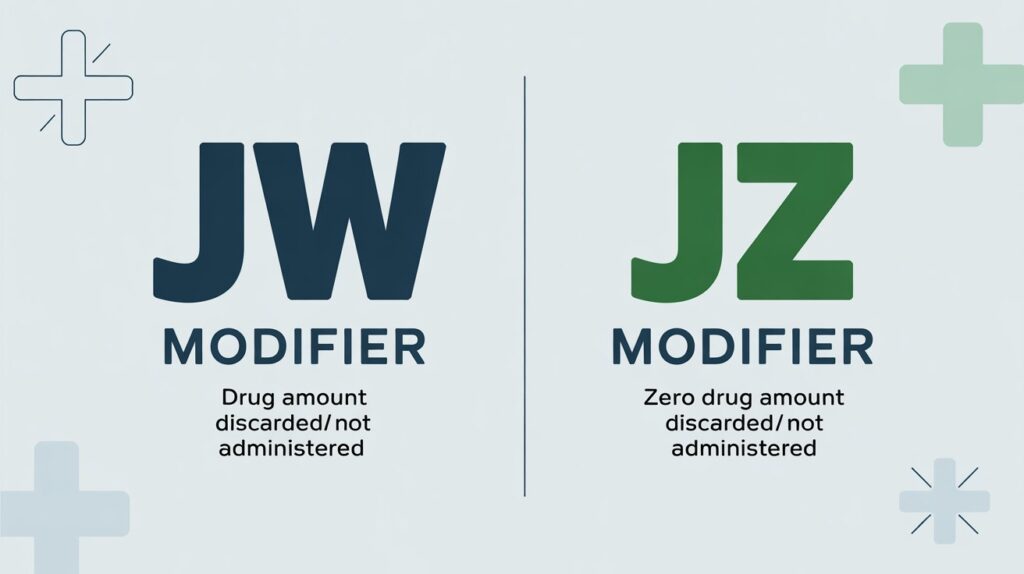
Modifier 50 signals that the same procedure was performed on both sides during the same operative session. Medicare reimburses bilateral procedures at a reduced combined rate rather than twice the single-procedure fee, so incorrect bilateral billing directly distorts revenue in both directions. Billing modifier 50 for bilateral knee injections requires the note to document bilateral examination findings, separate indications, and the procedure performed on both sides. A note that describes only one knee, then adds "bilateral" in a single line, will not support the modifier under audit.
5. NCCI Edit Cross-Referencing and Modifier Misuse - The Compliance and Unbundling Risk Framework
The National Correct Coding Initiative publishes bundled code pairs across the musculoskeletal range, and orthopedic practices face significant NCCI edit exposure given the volume of multi-component procedures billed in a single session. Coding individual components already included in a comprehensive CPT code is unbundling, and payers treat it as a fraudulent billing pattern regardless of intent. Pre-submission cross-referencing against current NCCI tables is non-negotiable.
The compliance risk compounds when modifier 59 or an X-variant is appended without documentation that genuinely supports a distinct service: the modifier does not override the edit, it invites audit scrutiny of whether the note can defend the separation. Practices that skip this step are not just risking denials; they are accumulating post-payment audit exposure that surfaces months after the original claim was paid. iScribe's Real-Time Denial Alerts surface these gaps at the encounter level, before submission, so the exposure is resolved at the note, not discovered in an audit response months later.
Related Reading
- Orthopedic Surgery Billing
ICD-10 Diagnosis Coding and Fracture Care Documentation Requirements in Orthopedics
Four dimensions must align simultaneously for a valid orthopedic fracture claim: laterality, open-vs-closed status, anatomical site, and episode-of-care designator.
"We face workflow friction that makes an AI-assisted ICD-10-CM coding tool appealing enough to generate immediate interest, suggesting our existing coding processes are cumbersome or inefficient."
— what we hear from medical coders

Why ICD-10-CM Specificity Is a Documentation Quality Metric, Not a Coding Skill Test
Under that kind of cognitive load, rushed or pre-populated notes are not a failure of diligence; they are a predictable outcome of an unsustainable workflow. iScribe Health's ambient AI documentation is designed precisely for that environment: it listens to the encounter in real time, drafts the encounter summary at the point of note completion, and captures the clinical specifics, site, laterality, fracture status, treatment phase, that coders need without requiring the physician to reconstruct details post-visit.
Laterality Requirements - How Right vs. Left Determines Whether a Claim Pays or Denies
iScribe Health's ambient listening captures the surgeon's own words during the encounter, including the side being treated, and weaves that language into the AI-drafted note at the point of completion. For practices already operating a supported EHR, this is a seamless addition to the existing documentation workflow, not a replacement of it. iScribe Health's real-time denial alerts add a downstream safeguard: if a laterality field is absent at the coding stage, the system flags it before the claim is submitted rather than after a denial has already occurred.
Fracture Episode of Care Designators - Initial, Subsequent, and Sequela Explained
When the physician's note is explicit about the nature of the encounter, active intervention versus healing-phase surveillance, the correct designator is unambiguous. iScribe Health's ambient AI captures the clinical context of the visit as it unfolds, giving the AI-drafted note the encounter-phase language needed to support the correct designator.
Closed vs. Open Fracture Documentation - What the Operative Note Must Contain
The operative note should contain four elements: (1) explicit statement of open or closed fracture status, (2) the specific anatomical site including sub-site where applicable, (3) laterality stated in the surgeon's own documentation, and (4) the treatment rendered at this encounter.
For orthopedic coders and billing teams who work with high-volume surgical practices, the friction of chasing down these documentation gaps after the fact is one of the most cumbersome parts of the ICD-10-CM coding workflow, and it is a friction point that grows with case volume. iScribe Health's ambient documentation addresses this upstream: because the AI drafts the encounter summary from the real-time conversation, the surgeon's own description of fracture status, site, laterality, and treatment is captured at the source, before the note is finalized and before the claim is built.
What Are the Critical Billing and Compliance Requirements for Orthopedic Practices?
Compliance risk in orthopedic billing is a documentation architecture problem, and the billing department inherits whatever the clinical note layer produces. Every denial, every audit flag, every post-payment recoupment traces back to a specific element that was missing from the operative note or office record before a single code was touched. iScribe Health's ambient AI documentation and EHR integration are designed to close that gap at the point of note completion, before a single code is submitted, by capturing the clinical detail that compliance depends on, inside the EHR the practice is already running.
1. Global Surgical Packages - Navigating 0-, 10-, and 90-Day Period Rules with Modifiers 24 and 79
A 90-day global period on a total knee arthroplasty means every routine follow-up visit within that window is already paid inside the surgical fee. Billing that same visit at week six post-op without modifier 24 (unrelated condition) is a direct compliance exposure. The failure point is the clinical note: if the physician does not document that the visit addresses a condition unrelated to the surgery, modifier 24 has no defensible basis and the claim is indefensible on appeal. iScribe Health's ambient listening captures the full clinical conversation at the point of care and drafts an encounter summary that surfaces service-level distinctions, such as a separate condition addressed during a global period visit, so the modifier has a documented foundation before the note is ever signed.
2. Implant and Hardware Documentation - Mandatory Operative Note Elements That Survive Post-Payment Audits
Operative notes that reference implant hardware by brand name only, without serial number, lot number, and a device log attachment, fail the implant documentation standard on post-payment audit. The CMS Open Payments program actively publishes financial relationships between implant manufacturers and orthopedic providers, and additional records are publicly searchable across individual surgeons and manufacturers. Federal auditors already have a map of which surgeons use which hardware.
When the operative note cannot match that hardware to a traceable device record, recoupment follows. iScribe Health's EHR integration works seamlessly when the practice is already running a supported EHR, so structured implant documentation fields become part of the ambient workflow rather than a separate manual step. This is most impactful in high-volume joint replacement and spinal fusion practices where the documentation burden compounds across every case.
3. Prior Authorization Workflows - Preventing Unrecoverable Denials for Joint Replacements, Imaging, DME, and Spine Interventions
Prior authorization denials issued after a service is rendered are rarely overturned. Orthopedic practices absorb a significant share of auth-related write-offs because the auth was either incomplete, expired, or misaligned with the final procedure code. The tradeoff is real: auth workflows consume substantial administrative hours each week, and practices that manage them reactively, after scheduling rather than before, face the highest unrecoverable denial exposure.
The fix is upstream alignment between the clinical plan documented in the note and the auth request submitted to the payer. iScribe Health's real-time denial alerts and ambient documentation work together here: the AI drafts the encounter summary at the point of note completion, giving the authorization team a clinically accurate, codeable record of the planned procedure before the auth window closes rather than after it expires.
4. 2026 E/M MDM Documentation Standards - Adapting to Updated Payer Policies and Medicare Scrutiny of High-Volume Orthopedic Procedures
The 2026 compliance landscape requires orthopedic practices to track revised Medical Decision Making documentation standards for E/M coding, particularly for new and established patient visits tied to surgical consultations. Medicare has intensified scrutiny of high-volume procedures including total joint arthroplasty and spinal fusions. Practices that fail to update provider education on MDM complexity thresholds risk systematic downcoding or extrapolated overpayment demands across entire claim populations.
5. Surgical Package Unbundling Compliance - Identifying What Cannot Be Billed Separately Within the Global Period
NCCI edits define which procedure pairs cannot be billed together, and unbundling them without a valid modifier is a fraud and abuse exposure. The compliance gap is almost always a documentation gap: the note does not establish that the second procedure was a separately identifiable service performed at a distinct anatomical site or session. iScribe Health's ambient listening and EHR integration allow the practice to capture service-level detail at the point of care, within the EHR already in use, giving coders and auditors the evidence trail needed to defend each line on the claim without requiring the physician to dictate addenda after the fact.
Every compliance requirement in this section fails or succeeds at the documentation layer. The next section shows exactly how automated E/M coding closes the gap between what providers document and what the claim actually needs, before a single code is submitted.
How Automated E/M Coding Closes the Documentation Gaps That Manual Workflows Miss
The practice had attributed its revenue gaps to coder knowledge, a diagnosis that felt reasonable until the numbers came back and pointed somewhere else entirely.

What a 941-Encounter Audit Revealed About Documentation Drift
The Center for Sports Medicine and Orthopaedics study audited that same figure of encounters and found only a 54.8% agreement rate between provider-assigned and AI-assigned E/M codes, with a 33% overcoding rate embedded in that gap. The discrepancies were systematic patterns tied to how individual physicians documented, invisible to any human coding team reviewing notes in bulk.
That dual drift matters because it runs in both directions simultaneously. Undercoding erodes revenue while overcoding accumulates audit exposure, and both problems lived inside the same provider's patient panel, compounding quietly each quarter.
Why the Fix Has to Live at the Documentation Layer
By the time a note reaches the billing queue, the documentation ceiling is already set. A coder working from a note that omits comorbidities, data reviewed, or risk assessment cannot bill for complexity that was never recorded, regardless of how well they know the MDM pathways. No training intervention corrects a behavior the provider does not know is occurring.
This is the hidden cost that makes coder-focused investments frustrating. Practices spend on training, modifier checklists, and denial workflows, then watch the same revenue gaps reappear the following quarter. The root cause remains upstream, at the point of documentation.
How Automated E/M Coding Turns a Complete Clinical Story Into a Defensible Code
iScribe Health's Automated E/M Coding closes that gap at the source by generating a documentation-anchored E/M code during the encounter, based on the clinical story as it actually unfolds. Both undercoding and overcoding risk drop simultaneously, because the code is tied directly to what was documented, not to what a provider estimated after the fact.
Pros and cons at a glance
✓ Pros
- Generates a documentation-anchored E/M code during the encounter.
- Reduces undercoding and overcoding risk simultaneously.
- Ties the code directly to what was documented, rather than provider estimates.
✗ Cons
- Requires providers to engage with real-time documentation capture during the encounter.
- Involves a ramp-up period before the workflow feels natural.
- Delivers the greatest benefit with consistent provider participation and clinical informatics support.
This approach requires providers to engage with real-time documentation capture during the encounter, which involves a ramp period before the workflow feels natural. For practices with consistent provider participation and clinical informatics support, however, that investment tends to pay back quickly.
Related Reading
- Surgery Center Emr
- Medical Scribe Cost
Next steps
If your orthopedic practice keeps absorbing denials and underpayments despite experienced coders, the path forward starts with accepting that the bottleneck is not upstream of the biller. It is upstream of the note. The 941-encounter audit at Center for Sports Medicine and Orthopaedics made that concrete: only 54.8% agreement between provider-assigned and AI-assigned E/M codes, with a 33% overcoding rate running silently inside the same provider panels that were also leaving reimbursement on the table.
That dual drift is invisible to any human coding team reviewing notes in bulk, because the errors are systematic patterns tied to how individual physicians document, not random outliers a training session can correct. And as the ICD-10 fracture documentation requirements make clear, a deficiency in any single dimension, whether laterality, open-vs-closed status, or episode-of-care designator, produces a deniable claim that no downstream coding intervention can repair. Together, these findings point to one action: fix the note before it leaves the exam room, not after it returns as a denial.
Start with Best AI medical scribe for urology practices to see how iScribe Health captures the full clinical story in real time, including the MDM complexity, laterality, and fracture specificity that coders need to build a defensible claim. After the ambient documentation workflow is running, automated E/M coding and real-time denial alerts surface any remaining gaps at the point of note completion, before a single claim is submitted.
Frequently Asked Questions
What's the real difference between Modifier 25 and Modifier 57, and when does each one apply?
Modifier 25 signals that a significant, separately identifiable E/M service was performed on the same day as a minor procedure, and the note must support that a distinct, medically necessary E/M service occurred beyond the procedure itself. Modifier 57 signals that the decision for surgery was made during an E/M service the day before or the day of a major surgery, and the note must explicitly document that the surgical decision was made during that encounter. Both modifiers depend entirely on note completeness, when the underlying documentation is thin, neither modifier can be defended and the claim is denied.
Why does ICD-10 laterality matter so much in orthopedic billing, and what happens if it's missing?
Payers treat missing laterality as an incomplete claim and return it as a denial, a knee injury coded without a laterality designator is a leading driver of orthopedic claim denials. The fix is not a coding correction after the fact; the laterality detail must be captured in the clinical note in the first place. Fracture episode-of-care designators carry the same risk: coding a fracture to the wrong episode produces the same denial outcome.
If a coder is experienced, why would encounters still get undercoded?
Even a credentialed coder working from perfect CPT knowledge will produce the wrong code when the source documentation is deficient, because coders working from an incomplete record are accurately coding an incomplete note, not making errors. When a clinical note documents the treatment plan but omits the number of diagnoses considered, the data reviewed, and the risk of complications weighed, the documentation can only support the lower E/M level regardless of coder skill. Hiring a more experienced biller cannot recover revenue that was never captured in the note.
What note elements are actually required to bill CPT 76942 for ultrasound guidance during a joint injection?
Billing CPT 76942 alongside CPT 20610 requires both permanent image storage in PACS or the EHR and a formal interpretation report, payers treat missing image records as proof the guidance was not performed. These are mandatory documentation elements, not optional, and no modifier can fix a missing image reference or interpretation narrative after the claim has already been submitted.
What documentation is required during the 90-day global period after a total knee or total hip arthroplasty?
CPT 27447 (total knee arthroplasty) and CPT 27130 (total hip arthroplasty) both carry a 90-day global period, meaning separately billed postoperative services within that window require specific modifiers and supporting documentation to avoid automatic denial. The operative note itself must document implant details including manufacturer name and serial number, the surgical approach, and any intraoperative findings that affected the procedure. Because these codes are among the most scrutinized at audit, documentation failure here carries outsized financial consequences compared to most other orthopedic services.