Medical Scribe Cost Explained: What Clinics Pay in 2026
Medical scribe cost goes beyond the rate card. See what clinics actually pay in 2026 and where administrators recover hidden revenue losses.


The hourly rate is the smallest part of what a scribe program actually costs. Here is the three-layer cost structure hiding beneath every vendor invoice, and the hard numbers practices discover only after they stop shopping by sticker price.
Most healthcare practice administrators and operations leaders think that comparing medical scribe cost means comparing what you pay the scribe, hourly wage or monthly subscription, and the lowest number wins. That logic works for paper towels. It fails badly for clinical documentation, where the invoice captures only the smallest fraction of what a scribing program actually costs the practice. The ACMSO Annual Medical Scribe Salary Report makes this explicit: administrators who evaluate scribe programs solely on the quoted hourly or monthly rate systematically underestimate total cost because they omit the downstream financial consequences of poor documentation quality and the compounding cost of replacing burned-out physicians who leave partly due to documentation burden.
The hourly wage or monthly subscription fee answers exactly one question: what does the scribe charge? It says nothing about what the scribe produces, how consistently, or what happens to revenue when documentation quality slips. A practice that budgets $38,000 per year for an in-person scribe salary and then absorbs $12,000 in recruiting costs and $18,000 in lost E&M reimbursement is paying an effective total of $68,000 for a $38,000 role. The rate card never showed that math. It was never designed to.
Image: What Medical Scribe Cost Actually Includes Beyond the Hourly Rate
A practice that budgets $38,000 per year for an in-person scribe salary and then absorbs $12,000 in recruiting costs and $18,000 in lost E&M reimbursement is paying an effective total of $68,000 for a $38,000 role. Below the visible wage sits a three-layer cost structure that rarely appears in any vendor's pricing conversation.
The first layer is recruitment and onboarding drag. The second layer is revenue lost to documentation errors. The third layer carries the largest dollar figure: physician turnover fueled by documentation burnout. None of these layers show up on an invoice. The real question is which scribing model actually costs the practice least, including what it costs when it fails.
A total-cost-of-ownership evaluation reframes every line in the comparison. Recruitment frequency becomes a cost driver. Note consistency becomes a revenue variable. Physician retention becomes a budget item. Most practices that run this calculation discover their "budget-friendly" scribe program is their most expensive operational choice. The rate card is where most cost conversations start and stop. The next section breaks open each hidden layer with hard numbers, so you can see exactly how much a "budget-friendly" scribe program can cost a practice that never looked past the invoice.
Key takeaways
- The hourly wage or monthly subscription for a medical scribe is the smallest number in the equation, recruiting cycles, onboarding time, turnover, and undercoded visits stack on top of it quietly.
- A $15/hr in-person scribe wage balloons into a fully loaded per-provider cost that can exceed $80,000 annually once benefits, training, and productivity drag are counted.
- Virtual human scribes cut the sticker price by 30-40% compared to in-person staffing, but service tier and contract structure determine whether that discount holds in practice.
- AI scribe subscriptions run $50-$500 per provider per month, a fraction of human scribing costs, and clinical-grade platforms in the $150-$300 range deliver EHR integration and real-time documentation that basic speech-to-text tools don't.
- The revenue leak from undercoded visits and after-hours charting burnout dwarfs any line-item scribing fee, most cost comparisons measure what a practice spends, not what it loses.
- Provider acceptance rate and note turnaround time are the two metrics that actually predict whether a scribing program sticks; a solution with low adoption erases its own ROI.
- iScribe Health closes the loop with AI-powered documentation that delivers 94% provider acceptance and notes signed by end-of-clinic, reducing documentation burden, cleaning claims, and paying for itself before the ROI calculation is finished.
The Hidden Costs Beyond Sticker Price That Blow Up Scribe Budgets
Most healthcare practice administrators and operations leaders think that comparing medical scribe cost means comparing what you pay the scribe, hourly wage or monthly subscription, and the lowest number wins. In reality, recruiting, onboarding, and retaining a human scribe program generates at least five distinct cost layers that never show up on any vendor rate card, and each one compounds the next, quietly inflating what looks like a predictable budget line into an operational liability that catches practice administrators off guard, usually around the time a third scribe resigns in eighteen months.
Recruiting, onboarding, and retaining a human scribe program generates at least five distinct cost layers that never show up on any vendor rate card. Each one compounds the next, quietly inflating what looks like a predictable budget line into an operational liability that catches practice administrators off guard, usually around the time a third scribe resigns in eighteen months.
A parallel trap exists on the AI side: practices that reach for the cheapest available AI model often discover that low sticker-price costs mask high omission rates, critical clinical details that get dropped from the note entirely. Those omissions don't disappear; they surface downstream as liability exposure, additional physician review time, and in some cases, claim denials that require a full rework cycle. The sticker price was low. The true cost was not. That distinction matters when evaluating any documentation solution, human or AI.
1. Scribe Turnover Replacement Costs That Silently Drain Your Medical Scribe Budget

Medical scribe turnover is not an edge case. Entry-level clinical support roles churn at rates that mirror the broader healthcare support sector, where annual turnover regularly exceeds 25-30%. For a role that attracts pre-med candidates treating the position as a one-to-two year stepping stone before medical school applications, that figure is structurally baked in. Every departure triggers a replacement cycle: job posting fees, recruiter time, interview rounds, and background screening.
25-30%
Annual scribe turnover rate in healthcare
Healthcare HR research consistently places the cost of replacing a single clinical support employee in the $3,000 to $8,000 range per event, once administrative hours and lost productivity are counted. A solo orthopedic group cycling through three scribes in eighteen months absorbs that cost three times over, before accounting for any quality degradation during each gap.
2. Physician Pajama Time - The 2-3 Hour After-Clinic Documentation Burden No Scribe Budget Captures

Physicians across specialties report spending two to three hours after clinic completing notes that weren't finished during the visit, a pattern so common it earned its own name. The AMA's physician survey data confirms the burden: after-hours EHR documentation remains one of the top contributors to physician burnout, even in practices that already employ scribes. At a conservative physician opportunity cost of $150 to $300 per hour, two hours of nightly charting across a five-day week represents $1,500 to $3,000 in lost productive capacity every week.
That number is invisible on any scribe budget line. iScribe Health's Ambient Listening and Conversational AI captures the encounter in real time, and at the point of note completion, after the AI drafts the encounter summary, the physician reviews a structured, specialty-calibrated note rather than building one from scratch at 9 p.m. For practices already running a supported EHR, iScribe's EHR Integration makes that workflow seamless, with no duplicate data entry and no separate portal to manage. Same-session note completion is where AI scribing shows its clearest operational advantage in physician burnout reduction, and that advantage compounds across every patient encounter and every day of clinical practice.
3. Scribe Program Management and Supervision Overhead That Compounds Total Medical Scribe Cost
Someone has to schedule scribes, audit note quality, handle call-outs, and manage performance. That someone has a salary. The U.S. Bureau of Labor Statistics Occupational Employment and Wage Statistics (OEWS), May 2023 shows Medical and Health Services Managers (SOC 11-9111) earn annual mean wages of $125,860 in Pennsylvania, $148,460 in Wisconsin, and up to $179,160 in New York.
That management overhead is a separately compensated labor category, entirely apart from any scribe rate card. Even when supervision is shared across a broader administrative role, scribe program oversight in a multi-provider practice typically consumes five to ten hours per week. At management-level compensation, that is a five-figure annual cost that no vendor invoice will ever show.
The operational cost reduction associated with ambient AI documentation is direct: there is no scribe schedule to manage, no call-out to cover, and no note audit queue to work through. iScribe Health's AI Customization means the system adapts to each provider's documentation preferences over time, which further reduces the supervisory burden that human scribe programs place on administrative staff.
4. New-Hire Training Investment That Evaporates Every Time a Scribe Leaves

A new scribe typically needs four to six weeks before note quality stabilizes enough to reduce physician review time meaningfully. During that window, the physician is still spending extra minutes per encounter correcting structure, prompting for missed detail, and signing off on documentation that isn't quite right. That training investment, in supervisor hours, physician patience, and degraded throughput, resets to zero with every departure. It is a sunk cost that repeats on a cycle most practices never formally track.
Low-cost AI alternatives can create a version of the same problem in a different form: when an AI model has high omission rates, physicians end up in a perpetual correction loop, not because a new hire is ramping up, but because the model is structurally unreliable. The review layer that was supposed to disappear becomes permanent. iScribe Health's Automated E&M Coding and E&M Coding Intelligence address a related dimension of this problem: the AI doesn't just transcribe the encounter, it identifies the appropriate code, which reduces the downstream rework that falls on billing staff when documentation doesn't support the level of service billed.
5. Productivity Gap Cost During Scribe Vacancy and Ramp-Up Periods
Image: Medical Scribe Cost - productivity gap during vacancy
The gap between one scribe leaving and the next reaching full competency is where the budget damage concentrates. Physicians revert to self-documentation, visit pace slows, and after-hours charting spikes back to baseline. That productivity gap is not a temporary inconvenience. It is a recurring, measurable revenue drag that compounds with every turnover cycle, and it never appears anywhere on the rate card administrators used to justify the program in the first place.
iScribe Health's Real-Time Denial Alerts add a further layer of protection that a human scribe program cannot replicate: when documentation gaps create claim risk, the system flags them at the point of note completion, before the claim goes out the door, rather than after a denial has already been processed and a staff member is working a rework queue. That is an operational cost reduction that compounds invisibly in the background of every encounter, across every provider, every day.
---
Those five cost layers are:
- Scribe turnover replacement costs
- Physician after-hours documentation burden
- Program management and supervision overhead
- New-hire training investment that resets with every departure
- Productivity gap costs during vacancy and ramp-up periods
Each compounds on top of the next. Before you can see how badly they distort your true spend, you need a baseline. The next section puts hard dollar figures on what a fully loaded in-person scribe actually costs a practice annually, so you have a real number to compare against.
What the Fully Loaded Cost of an In-Person Medical Scribe Actually Runs
A $15/hr wage feels like a manageable line item until you run the full arithmetic, and the gap between that number and the true cost of a scribe seat is substantial.

The Direct Wage Floor What ZipRecruiter Data Says In-Person Scribes Actually Earn
ZipRecruiter's wage benchmarking data puts the in-person medical scribe hourly rate at $14 to $23 per hour, depending on market, specialty, and experience level. That range translates to a direct annual salary of roughly $36,000 to $45,000 before a single dollar of overhead is applied (Indeed). Senior scribe roles command even more. Glassdoor tracks senior medical scribe compensation separately, reflecting the premium practices pay once they've invested in developing documentation talent. Most practices hiring at the midpoint, around $19/hr, are committing to approximately $39,500 in base wages for one full-time scribe seat, and that figure is only the starting point.
From $15/hr to $65K/Year How Benefits, Taxes, and Training Stack the Real Number
The fully loaded annual cost of a single in-person medical scribe runs $45,000 to $65,000, once payroll taxes, health benefits, paid time off, initial onboarding, and ongoing training are factored in (Indeed). The mechanism is a standard employer burden multiplier, typically 1.25x to 1.4x of base salary, applied across every hourly employee on your payroll. At $39,500 in base wages, a 1.4x multiplier alone produces a $55,300 all-in cost before management time is counted.
$45,000 to $65,000
True annual cost of one scribe seat
Turnover compounds the problem further. Healthcare support roles see annual turnover rates that routinely exceed 20%, meaning the training investment resets more often than most budget cycles anticipate. Each departure triggers recruiting, onboarding, and ramp-up costs that push the effective per-seat expense well above the sticker number. The $15/hr rate never stays cheap once the replacement math runs.
This is precisely the operational cost pressure that iScribe Health is built to address. Practices and health systems already running a supported EHR can activate iScribe Health's Ambient Listening and Conversational AI layer without rebuilding their workflow from scratch, reducing dependence on headcount that turns over.
Every encounter where the AI handles the documentation lift is an encounter where the $55,300 fully loaded scribe seat is not doing the work.
Monthly Budget Reality Check What a Single Scribe Seat Costs Your Practice Each Month
Direct wages alone run $2,500 to $4,000 per month for one in-person scribe, according to Indeed's compensation data. The burdened monthly cost, once overhead is stacked, lands closer to $3,750 to $5,400.
How Virtual Scribe Costs Break Down by Service Level
Virtual scribe services cut the sticker price by 30-40% compared to in-person staffing, but that headline figure masks a wide internal range that depends entirely on which service tier a practice selects. The monthly retainer for a remote human scribe runs from $1,200 to $4,000 per provider, or $14,400 to $48,000 annually, according to Scribe Medix's 2024 pricing data. That spread maps directly to service level.
1. Virtual/Remote Human Scribe Monthly Cost: $1,200-$4,000 Per Provider

Remote human scribe services run $1,200 to $4,000 per provider per month ($14,400 to $48,000 annually), according to Scribe Medix's 2024 pricing data. That range reflects genuine service-level differences in availability, response time, and documentation oversight. A practice paying $1,400 per month and one paying $3,800 per month are buying meaningfully different products, even when both vendors use the same "virtual scribe" label on their rate card.
2. Virtual Scribe Hourly Rate Tiers: $10-$35/hr - Audio-Only vs. Video-Enabled
Scribe Medix's 2024 pricing data places audio-only virtual scribes at $10 to $18 per hour and video-enabled tiers at $25 to $35 per hour, a spread that reflects a genuine accuracy trade-off. Audio-only scribes work from sound alone, which introduces documentation gaps in examination-heavy or multi-system visits where visual context shapes the clinical narrative. The price looks attractive until a physician spends fifteen minutes correcting notes after a complex orthopedic encounter, at which point the hourly savings evaporate into physician time.
3. Virtual Scribes Are 30-40% Cheaper Than In-Person - But Hidden Overhead Persists
The 30-40% sticker-price reduction that Scribe Medix's 2024 data attributes to virtual scribes is real at the wage line, but it does not survive contact with operational reality. Scheduling across time zones, onboarding replacement scribes after turnover, and auditing documentation consistency across rotating remote staff all travel with the contract. A practice that budgets only the monthly retainer and ignores coordination overhead is comparing the virtual scribe's line item against the in-person scribe's fully loaded cost, a comparison that does not hold up at renewal time. Lower operational costs associated with medical scribing are achievable, but only when the model itself removes the labor variables rather than relocating them to a different zip code.
AI Medical Scribe Pricing From Basic to Enterprise Tiers
AI medical scribe subscriptions range from $50 to $500 per month per provider, but that spread tells you almost nothing useful until you understand what billing model sits underneath the number. According to Digital Software Labs (June 2025), basic-tier tools run roughly $50 to $100 per month, clinical-grade platforms land in the $150 to $350 range, and enterprise deployments push toward $350 to $500 per month, putting annual cost per provider somewhere between $600 and $6,000. The billing structure determines whether that fee is a bargain or a waste.
"Small independent practices struggle to find transparent pricing for AI medical scribes. Many vendors hide costs behind mandatory sales calls, making it impossible to evaluate ROI without a time-consuming engagement."
— what we hear from independent medical practices
One friction point that Chief Medical Officers and practice administrators repeatedly run into: many vendors hide costs behind mandatory sales calls, making it impossible to evaluate ROI without a time-consuming engagement before you have seen a single pricing number. That opacity shifts negotiating leverage to the vendor at exactly the moment you are least informed. Pricing transparency is the prerequisite for any honest cost analysis, and it is the first thing an administrator should demand before entering any evaluation.
1. AI Medical Scribe Monthly Cost: $50-$500 Per Provider With Unlimited Visits Included
AI medical scribe subscriptions cost $50 to $500 per month per provider, and the most consequential detail buried in that range is what nearly every tier includes: unlimited patient encounters. Digital Software Labs (June 2025) puts the annual per-provider cost between $600 and $6,000, but because most flat-subscription tools carry no per-visit charge, a clinic running 25 encounters daily pays the same monthly fee as one running 10.
That math inverts entirely compared to human scribes, where every additional patient adds a direct labor cost. That after-hours documentation burden is where physician burnout compounds fastest, and where ambient AI closes the largest financial and operational gap. A part-time solo provider seeing eight patients a week is subsidizing capacity they will never use; the ROI calculation looks entirely different for a hospitalist or a busy orthopedic group moving through a full surgical schedule.
2. Per-Minute vs. Flat Subscription vs. Tiered Seat Pricing - Which Model Fits Your Practice Size
Three distinct billing structures define the AI scribe market, and choosing the wrong one for your volume is how a seemingly affordable tool becomes an expensive lesson. Digital Software Labs (June 2025) identifies flat monthly subscriptions as the consumer and clinical-grade standard, tiered seat pricing as the multi-provider enterprise model, and per-minute or per-API-call billing as the infrastructure layer used by health systems building custom solutions. Flat subscriptions favor high-volume practices where fixed cost spreads across hundreds of monthly encounters. Tiered seat pricing rewards scale, dropping the per-provider cost as headcount grows. Per-minute billing penalizes busy days, which is the billing-model surprise small practices often discover only after committing.
The structural problem that practice administrators in independent settings face is that vendors who use opaque, call-required pricing make it nearly impossible to model these trade-offs before you are already in a sales conversation. Evaluating billing-model fit requires seeing actual numbers, and any vendor unwilling to publish them is asking you to commit before you can calculate. That is a meaningful selection criterion before the product evaluation even starts.
3. Freed AI, DeepScribe, and AWS HealthScribe - Three Tiers From Consumer to Clinical-Grade to Infrastructure
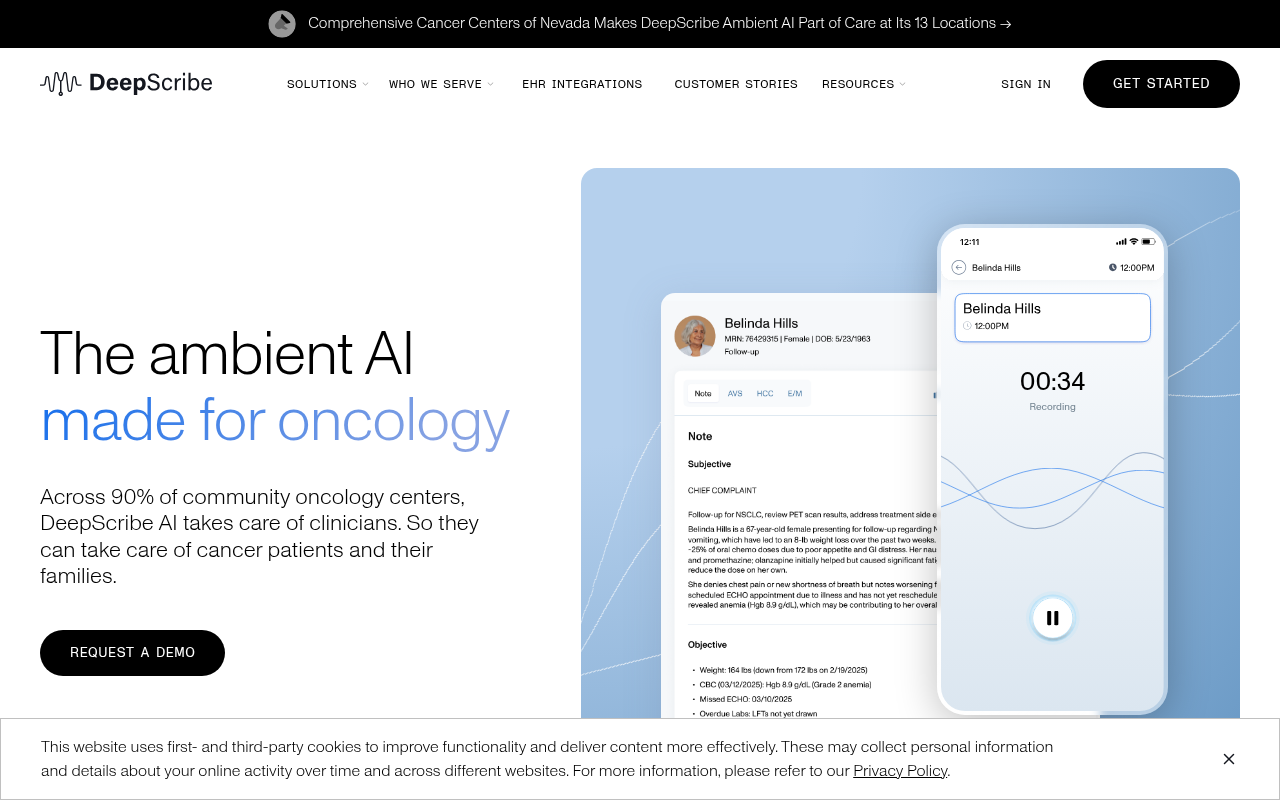
The independent practice, clinical, and infrastructure tiers each serve a structurally different buyer. Freed AI explicitly positions itself for independent practices and community clinics, with a flat monthly subscription designed for individual clinicians who want ambient scribing without IT involvement, starting at $39/month. GoodFirms corroborates its positioning as a consumer-facing ambient tool. DeepScribe targets clinical-grade enterprise deployments with tiered seat pricing that scales to practice size, suited to multi-provider groups that need documentation consistency across specialties.
AWS HealthScribe operates as an API-layer infrastructure tool, priced per minute of transcription, built for health systems with developer resources to assemble a custom solution rather than deploy an off-the-shelf product. A practice administrator evaluating these three is not comparing equivalent products; they are choosing which layer of the stack they want to own and operate. For practices that want clinical-grade output, automated E&M coding, real-time denial alerts, EHR integration, and AI customization, without the developer overhead of building on an API layer, the relevant comparison is not AWS HealthScribe at all.
The decision is which ambient, EHR-integrated platform delivers specialty-trained documentation at a billing model that matches actual encounter volume, so the cost per note shrinks across every clinical day rather than spiking on the busiest ones.
Related Reading
- Hipaa Compliant Ai Scribe
- Top Medical Scribe Companies
- Ai Scribe Cost
- How Does An Ai Scribe Work
The Revenue Leak That Makes Scribe Cost Comparisons Incomplete
According to the AMBCI Coding Productivity Benchmarks: Industry-Wide Report, only approximately 55% of E&M visits are accurately documented industry-wide, so the average practice forfeits reimbursement on nearly half of all encounters. When true product cost is gated behind a discovery conversation, administrators are forced to estimate ROI on incomplete information, a structural disadvantage that makes the hidden revenue leakage from documentation inaccuracy even harder to surface and quantify.
Image: The Revenue Leak That Makes Scribe Cost Comparisons Incomplete
Why Only About Half of E&M Visits Are Accurately Documented
The result is systematic undercoding: real clinical work performed, real reimbursement forfeited. iScribe Health's ambient listening and conversational AI is designed specifically for this moment, capturing the clinical encounter as it happens so the provider is not reconstructing a faded conversation at the end of a long shift.
For a practice running 20 providers at even moderate visit volume, the cumulative leakage across undercoded encounters is not a rounding error.
iScribe Health's E&M Coding Intelligence and Automated E&M Coding work at the point of note completion, after the AI drafts the encounter summary, to improve coding precision and directly impact that revenue equation. Because the tool integrates with supported EHRs, the coding intelligence layer operates within the workflow providers already use, with no parallel documentation process required.
iScribe's 941-Encounter Audit - Overcoding Is as Dangerous as Undercoding
An iScribe Health audit of 941 encounters at the Center for Sports Medicine & Orthopaedics, Chattanooga surfaced a 33% overcoding rate and a 54.8% provider-AI agreement rate. A substantial share of visits were coded at a higher complexity level than the documentation supported, and until they ran the trial, no one in the building knew the split (AMBCI Coding Productivity Benchmarks: Industry-Wide 2025 Report). That finding carries two compounding implications:
- It creates direct compliance exposure: CMS and OIG audits target exactly this pattern, and the financial penalties for systematic overcoding can far exceed the revenue that was incorrectly captured.
- It reveals that inaccuracy is a two-directional risk that no pricing table can flag.
iScribe Health's Real-Time Denial Alerts address both directions of this risk at the encounter level, surfacing documentation gaps or mismatches before a claim is submitted rather than after a denial or audit letter arrives.
Reframing the ROI Question - Which Scribing Model Captures the Most Revenue
When AI-scribe-integrated coding precision closes even a fraction of the documentation accuracy gap, AMBCI benchmarking data suggests that recovered reimbursement at the practice level can materially offset subscription cost, converting the tool from a pure expense line into a net revenue driver for practices running significant encounter volumes. The CombineHealth E/M Coding Guide reinforces this framing: E&M coding decisions made at the note level cascade directly into reimbursement outcomes, making documentation accuracy the most consequential variable in the revenue cycle.
Practices evaluating iScribe Health's orthopedic documentation workflows, particularly those already running a supported EHR and looking for a seamless ambient documentation experience, have found this reframe changes the approval conversation entirely. Which scribing model recovers the most revenue is the question the 941-encounter audit was designed to answer, and it is the one any administrator building a scribe cost comparison should answer first.
How AI Medical Scribes Work Including HIPAA Compliance and EHR Integration
Clearing the compliance and integration checklist for an AI medical scribe feels, to most practice administrators, like a project that belongs on next quarter's agenda, yet the clinical and financial risks of deferring that work accumulate with every encounter documented in the meantime.

From Ambient Audio to Signed Note - The Four-Step Workflow That Requires No Manual Dictation
This workflow matters most in high-volume practices where physicians, nurse practitioners, and clinical staff regularly spend two or more hours charting outside of patient care time, a daily tax on clinical capacity that compounds across every encounter, every day. iScribe Health's ambient listening and conversational AI is built for that environment, delivering value when a practice or health system is already running a supported EHR and wants a seamless ambient documentation experience.
Not all ambient scribes deliver that value equally. Practices we work with have encountered a real and underappreciated risk with lower-quality tools: AI scribes that hallucinate clinical content, inserting fabricated details such as incorrect diagnoses, wrong anatomical laterality, or entirely fictitious medication references directly into permanent EHR records.
iScribe Health's AI customization layer is designed to reduce this surface area, and the physician review step, reading, editing if needed, and signing, remains the essential final gate before any note enters the permanent record.
The HIPAA Compliance Checklist AI Scribe Vendors Must Clear Before You Sign Anything
Evaluating a vendor's HIPAA posture requires more than a self-attestation letter. According to eGrove Systems' September analysis, any AI tool handling protected health information must operate under a signed Business Associate Agreement, paired with documented safeguards across three domains: administrative controls, physical security, and technical protections including end-to-end encryption, role-based access controls, and audit trails.
Beyond the BAA itself, you also need to confirm PHI retention policy, data residency, breach notification timelines, and evidence of third-party security audits such as SOC 2 Type II. eGrove Systems notes that vendors who cannot produce this documentation upfront are not ready to be your business associate. Holding that standard from the first conversation protects your organization before any contract is signed.
For IT and EHR administrators evaluating iScribe Health, compliance integrity is a core expertise point: the platform is designed to enhance compliance integrity at every layer, giving clinical informatics teams the documented controls they need to clear an internal security review without starting from scratch.
Direct EHR Push vs. Copy-Paste Workflows - Why Integration Depth Changes Documentation Quality
Copy-paste workflows create a deceptively invisible problem: transcription error during transfer, and structural mismatch between the AI's output format and the EHR's field schema. Direct EHR integration eliminates both failure points by writing the note into the record rather than alongside it.
The note populates structured fields automatically, preserving the clinical specificity that drives accurate coding. iScribe Health's EHR integration and automated E&M coding intelligence work together at the point of note completion, after the AI drafts the encounter summary, so that E&M level assignment is derived from the structured, discrete data that lives in the EHR record, not from a free-text block pasted in from an external tool. That distinction has a direct downstream effect on reimbursement accuracy and audit defensibility.
iScribe Health's ambient documentation experience is built for practices already running supported EHR platforms; the integration layer is pre-built rather than custom-developed, so implementation timelines reflect that readiness.
Which Scribe Model Wins on Total Cost for Your Practice Size
Three numbers settle the scribing model question for most practices: monthly encounter volume, current scribe turnover rate, and EHR integration depth, and together they point clearly toward the right model for a given practice size.

The Three-Variable Decision Tree That Resolves the Model Question by Practice Size
Solo and small practices (one to three providers) almost never justify the fixed overhead of a human scribe program. MyProResources Healthcare notes that for solo and small practices, AI medical scribe subscriptions win on cost and flexibility because low patient volume cannot support the fixed overhead of a full-time or part-time human scribe, whether in-person or virtual. A part-time human scribe, once you add payroll taxes and onboarding, lands closer to $25,000 to $35,000 for the same period.
For mid-size practices of four to fourteen providers, EHR integration depth becomes the deciding factor. MyProResources Healthcare identifies it as the swing variable: practices running heavily customized EHR workflows may find virtual scribes justify their higher per-hour cost, while those on standard configurations capture more revenue per dollar from AI.
At the enterprise level of fifteen or more providers, volume itself resolves the question. MyProResources Healthcare concludes that enterprise AI with EHR-native integration delivers scalable documentation automation and coding precision at a cost per note that human scribing models cannot match at volume. At fifteen-plus providers, the compounding effect of accurate coding across thousands of additional annual encounters means the AI model's revenue advantage multiplies in direct proportion to volume.
Why "Is a Medical Scribe Worth It?" Is the Wrong Question
The right question is: which model captures the most revenue per dollar spent? Documentation inaccuracy on nearly half of all encounters is the real budget leak, not the subscription fee. Framing the decision as a cost comparison obscures the revenue dimension entirely. It is comparing two revenue outcomes, because iScribe Health's 941-encounter audit at the Center for Sports Medicine and Orthopaedics surfaced a 33% overcoding rate that the existing documentation workflow had not flagged, illustrating how coding-precision reviews embedded in an AI scribing model can surface revenue and compliance exposure that human scribing programs typically do not include.
- Solo practices escaping turnover overhead
- Multi-provider groups where documentation consistency drives coding accuracy at scale
iScribe Health's automated E&M coding is purpose-built for exactly this profile, delivering specialty-specific coding precision with a 94% provider acceptance rate across the practice sizes where AI's financial advantage is most decisive.
Related Reading
- Best Ai Scribe For Athenahealth
- Ai Medical Scribes With E&m Coding Built In
- Ai Scribe Accuracy
- Do Ai Scribes Reduce Claim Denials?
Next steps
If your benchmarking process keeps landing on a monthly scribe fee while your physicians are still charting past 9 p.m. the path forward starts with measuring what you lose, not just what you spend. The wage line was never the real cost. The fully loaded annual cost of a single in-person scribe runs $45,000 to $65,000 before management overhead is counted, and only about 55% of E&M visits are accurately documented industry-wide, meaning nearly half of all encounters are leaving reimbursement on the table before anyone opens a comparison spreadsheet.
The fully loaded scribe cost calculation means the sticker price understates true spend by a factor that compounds with every turnover cycle. The 55% documentation accuracy rate means the correct ROI unit is dollars recovered per encounter, not dollars saved on the subscription fee. Together, they point to a cost-comparison model that folds in recruitment overhead, coding precision, and after-hours charting burden before any vendor fee enters the calculation.
Start with the Best AI medical scribe for orthopedic practices page, where iScribe Health benchmarks its per-encounter cost model against what your practice currently spends, including the revenue leakage that no rate card has ever shown you.
Frequently Asked Questions
What does a single in-person medical scribe actually cost per year when you factor in everything?
The fully loaded annual cost of a single in-person medical scribe runs $45,000 to $65,000 once payroll taxes, health benefits, paid time off, onboarding, and ongoing training are factored in. That's a significant jump from the direct wage floor of $36,000 to $45,000, driven by an employer burden multiplier of 1.25x to 1.4x of base salary, and it still doesn't include recurring replacement costs each time a scribe leaves.
Why does scribe turnover cost so much more than just posting a new job?
Replacing a single clinical support employee costs $3,000 to $8,000 per event once administrative hours and lost productivity are counted, and that's before factoring in the four-to-six week ramp-up period during which note quality hasn't yet stabilized and physician review time is still elevated. Because entry-level scribe roles churn at rates exceeding 25-30% annually, a practice cycling through multiple scribes in eighteen months absorbs that full replacement cost each time, compounding the total well beyond what the original rate card suggested.
How much physician time is actually lost to after-hours charting even when a scribe is in place?
Physicians across specialties report spending two to three hours after clinic completing notes, a burden the AMA's survey data confirms remains one of the top contributors to physician burnout even in practices that already employ scribes. At a conservative physician opportunity cost of $150 to $300 per hour, two hours of nightly charting across a five-day week represents $1,500 to $3,000 in lost productive capacity every week, a number that never appears on any scribe budget line.
What hidden management costs does running a scribe program add on top of the scribe's wage?
Someone has to schedule scribes, audit note quality, handle call-outs, and manage performance, and that person's salary is a separately compensated labor category entirely apart from any scribe rate card. Industry operations data suggests scribe program oversight consumes five to ten hours per week in a multi-provider practice, and with Medical and Health Services Managers earning annual mean wages ranging from $125,860 in Pennsylvania to $179,160 in New York, that oversight adds up to a five-figure annual cost no vendor invoice will ever show.
Does switching to a cheaper AI scribe automatically solve the cost problem?
Not necessarily, practices that reach for the cheapest available AI model often discover that low sticker-price costs mask high omission rates, where critical clinical details get dropped from the note entirely. Those omissions surface downstream as liability exposure, additional physician review time, and in some cases claim denials that require a full rework cycle, meaning the true cost ends up far higher than the sticker price suggested. A total-cost-of-ownership evaluation, one that accounts for documentation accuracy, physician review burden, and denial risk, is the right framework for comparing any scribing model.