13 CPT Code for Vasectomy Facts Billers Need to Know
Billers, get the CPT code for vasectomy right and cut denials with cleaner claims built on airtight documentation.


Most vasectomy claim denials have nothing to do with the code. Here is where the revenue actually leaks, and what billers need to fix before the claim ever leaves the practice.
Urology practices submit hundreds of thousands of vasectomy claims each year, and a surprising share stall or fail at the payer level. For practice administrators watching cash flow, that cycle is a revenue problem with a root cause most teams never find.
The instinct is to go back to the code set. That instinct is wrong. Roughly 30 to 40 percent of medical claim denials trace to documentation deficiencies rather than code selection errors, so a large portion of vasectomy denials survive a code correction and come back again.

Billers who only fix the code are solving the symptom, not the source.
30 to 40 percent
of claim denials stem from documentation gaps
When a vasectomy claim denies, remittance codes most commonly cite missing or insufficient documentation, not an invalid procedure code. A note that reads "vasectomy performed without complications" gives a payer auditor almost nothing to work with; it fails the claim even when the code is correct. Urology billing guidance consistently holds that post-vasectomy follow-up encounters require the original operative note to carry specific clinical detail linking each visit to the procedure; one thin note can cascade into multiple denials across a 90-day global period.
The hidden cost goes beyond rework. Industry benchmarks place the administrative cost of reworking a single denied claim at roughly $25 or more in staff time, a figure that compounds quickly across monthly vasectomy volume. The documentation gap is what AI-powered scribing tools like iScribe Health's E&M Coding Intelligence are built to close at the point of care, before the claim ever reaches the clearinghouse.
$25
average cost to rework one denied claim
Key takeaways
- CPT 55250 covers both unilateral and bilateral vasectomy in a single code, billers who don't read the full descriptor routinely miscalculate reimbursement and create compliance exposure they never see coming.
- Z30.2, not Z98.52, is the correct primary diagnosis for a vasectomy procedure encounter; placing the wrong code on the claim-day submission generates a medical necessity denial that no appeal strategy fixes as efficiently as getting it right the first time.
- Laparoscopic vasectomy and vasectomy reversal each carry their own CPT codes, collapsing either into CPT 55250 is the single most auditable mistake a urology practice can make.
- Modifier 25 denials on same-day E/M claims are created at the point of care, not at the clearinghouse; appealing without fixing the provider's note template reproduces the same denial at scale.
- A 941-encounter AI-assisted audit of one urology group found a 33% overcoding rate, the billers had selected the correct code, but the operative notes hadn't supported it.
- Prior authorization gaps sit upstream of the claim itself, meaning a perfectly coded vasectomy claim can still die at the payer level before a biller ever touches it.
- iScribe Health's E&M Coding Intelligence closes the documentation gap directly by building coding recommendations from the complete clinical narrative in real time, so the note that leaves the room is the note that supports the claim.
CPT 55250 Vasectomy Billing Facts Every Biller Must Have Memorized
CPT 55250 is one of the most looked-up codes in urology billing, and that familiarity is exactly what makes it dangerous.
"Patients billed under CPT 55250 are being charged an additional ~$250 for post-op semen testing kits, even though the global surgical package for CPT 55250 is generally understood to include post-operative care and follow-up testing."
— what we hear from medical billing professionals

CPT 55250 Is the One and Only Standard Code for Vasectomy, Unilateral or Bilateral
CPT 55250 is the single correct code for a vasectomy, regardless of how many sides are treated. There is no separate code for a bilateral vasectomy, and no modifier is required to distinguish a unilateral from a bilateral procedure. Any clinical distinction must come from somewhere upstream, whether that's the diagnosis code pairing, the supporting documentation, or a payer-level policy.
The Full AMA Descriptor Tells You Exactly What 55250 Already Pays For
The official AMA descriptor for CPT that same figure reads: "Vasectomy, unilateral or bilateral (separate procedure), including postoperative semen examination(s)." (AMA CPT Code Book) "Unilateral or bilateral" eliminates any laterality ambiguity.
Postoperative Semen Analysis Is Bundled and Billing It Separately Triggers an Overpayment
The postoperative semen examination is explicitly included in the code descriptor, meaning any attempt to bill CPT 89300 (semen analysis) as a standalone service after a 55250 encounter is an unbundling error. Despite this, patients undergoing vasectomy are routinely being charged an additional ~$250 for post-vasectomy semen testing kits, even though the global surgical package for CPT 55250 already covers post-operative follow-up and semen examination under the descriptor.
The 90-Day Global Period Quietly Absorbs More Visits Than Billers Expect
According to the CMS Medicare Physician Fee Schedule Global Surgery Policy, these services cannot be billed separately.
Billing any of these as separate E/M encounters without a qualifying modifier and documented medical necessity for a new, unrelated problem is a recoverable overpayment on audit. iScribe Health's Real-Time Denial Alerts surface these global period conflicts at the point of claim preparation, before they reach the payer, so the biller can apply the correct modifier or remove the duplicate service rather than managing the denial and repayment downstream.
No-Scalpel Vasectomy Uses the Same CPT 55250 and Technique Is Irrelevant to the Code
No-scalpel vasectomy uses the same CPT that same figure as a conventional scalpel vasectomy, and the technique distinction carries no weight at the code level.
Why the Descriptor Gap Is Where Revenue Actually Leaks
This is precisely where iScribe Health's Ambient AI Documentation removes the gap.
Using Ambient Listening and Conversational AI, iScribe Health captures the complete clinical narrative in real time and, at the point of note completion, drafts an encounter summary that already contains the laterality confirmation, technique detail, and post-operative instruction documentation that make every descriptor fact actionable, not theoretical.
Related Reading
- Urology Billing Software
- Best Urology Emr
- Urology Coding Cheat Sheet
- Ai Scribe Comparison
- Urology Billing Codes
ICD-10 Codes for Vasectomy That Pair Correctly With CPT 55250
Z30.2 is the correct primary diagnosis code for a vasectomy procedure encounter. Yet billing teams routinely place Z98.52 on the procedure-day claim, receive a medical necessity denial, and then spend hours working the appeal without realizing the fix was a single code swap upstream. Z30.2 (Encounter for Sterilization) captures the reason for the visit at the time the procedure is performed, and it is the only defensible primary diagnosis to pair with CPT that same figure.
The confusion is understandable. Both codes reference vasectomy. Both appear in the same general neighborhood of the ICD-10-CM index. But they describe different clinical moments, and payer claim-editing logic treats them as non-interchangeable. In high-volume practices where clinicians are already charting two or more hours outside of patient care time, this kind of upstream coding inconsistency compounds quietly, one misplaced code per provider, multiplied across every encounter, eroding revenue in ways that only surface at the denial stage.
1. Z30.2 - Encounter for Sterilization (Primary Diagnosis Code for CPT 55250)
Z30.2 belongs on every CPT 55250 claim submitted for the procedure encounter itself. As the Vinali Group's May 2025 denial analysis confirms, this code directly describes the reason for the visit at the time sterilization is performed, giving payer adjudication systems the clinical justification they require. Improving coding consistency across providers, particularly in multi-physician practices where charting habits vary, is one of the most direct levers available to protect that justification at scale.
The one practical limitation: Z30.2 establishes the correct encounter reason, but payer adjudication does not stop there. Some commercial plans and Medicaid managed care organizations, as documented in payer-specific coverage policies, require the accompanying operative note or pre-procedure documentation to explicitly state the patient's sterilization intent, informed consent, and clinical context before the claim clears without a request for additional information. A correctly coded claim built on a thin operative note still denies, and the denial reason points back to documentation, not the code.
2. Z98.52 - Vasectomy Status (Post-Procedure and Historical Documentation Only)
Z98.52 documents that a patient has previously undergone a vasectomy. It belongs in the patient's problem list, in a future primary care encounter, or as a secondary code when a separate condition is being evaluated in a patient with known sterilization history. The Vinali Group's 2025 analysis is explicit: Z98.52 is not appropriate as the primary diagnosis for the procedure encounter itself. Placing it in the primary position on a CPT that same figure claim inverts the clinical timeline and signals to the payer that the procedure already happened, triggering an automatic edit.
This is precisely where coding precision directly impacts revenue. A single transposed code, status where encounter is required, converts a clean claim into a denial that demands appeal time, staff attention, and follow-up documentation gathering that could have been avoided entirely if the note had surfaced the encounter reason clearly from the outset.
A single transposed code, status where encounter is required, converts a clean claim into a denial that demands appeal time, staff attention, and follow-up documentation gathering that could have been avoided entirely if the note had surfaced the encounter reason clearly from the outset.
3. Z31.0 - Encounter for Reversal of Previous Sterilization (Related but Distinct Code)
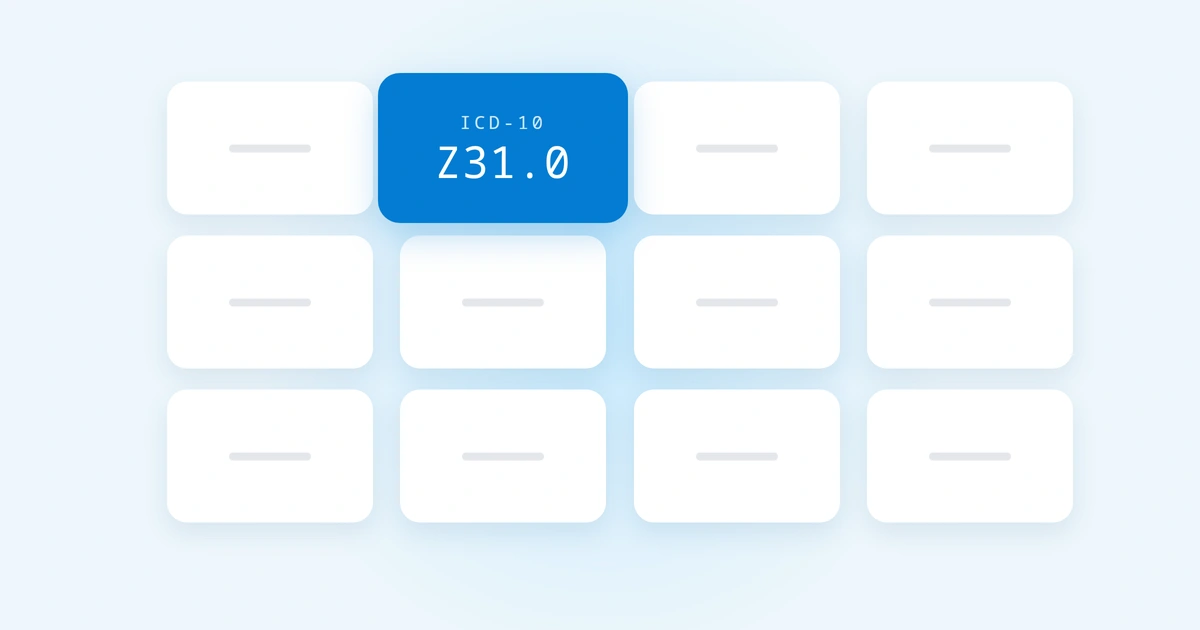
Z31.0 pairs with vasectomy reversal procedures (CPT 55400), not with CPT 55250. It appears here because billers who handle both procedure types sometimes pull it by mistake when a patient's chart shows prior sterilization history alongside a new procedure request. Using Z31.0 on a CPT that same figure claim creates a code-to-procedure mismatch that payers flag immediately. Treat it as a hard boundary: Z31.0 is reversal territory only, covered in detail in the next section of this reference.
4. Payer-Specific Medical Necessity Language Requirements Alongside Z30.2
Selecting Z30.2 correctly is necessary but not always sufficient. Certain commercial payers and Medicaid programs require the operative note or supporting documentation to include explicit sterilization-intent language, patient consent confirmation, and sometimes a waiting-period attestation before they will adjudicate the claim cleanly. The gap is visibility into what the note actually contains versus what the payer's policy requires.
Working natively within supported EHRs, iScribe Health's ambient listening and conversational AI reads the complete clinical narrative captured during the encounter and surfaces missing sterilization-intent language, absent consent references, and incomplete procedure descriptions in real time. Real-Time Denial Alerts flag the specific documentation gaps that payer policies require, so Z30.2 and the note supporting it are aligned from the start rather than reconciled after a denial arrives.
5. AAPC and Payer Policy Consensus - Z30.2 for Procedure, Z98.52 for History

The coding community's position is consistent: Z30.2 owns the procedure encounter; Z98.52 owns the historical record. This distinction is not a gray area or a matter of coder preference. The Vinali Group's 2025 denial analysis frames incorrect or mismatched diagnosis codes, specifically status codes used in place of encounter codes, as a primary driver of claim denials that code-only fixes cannot resolve.
The real failure point is upstream: when a provider's note does not explicitly record the encounter reason as an active sterilization event, the coder has no clinical language to anchor Z30.2 with confidence. The denial that follows is a documentation failure wearing a coding disguise. Most practices respond by retraining coders. That helps, but it does not close the gap between what the provider documented and what the payer needs to see, and it does nothing to improve coding consistency across providers whose charting habits naturally diverge over time.
iScribe Health's E&M Coding Intelligence and Automated E&M Coding capabilities are designed to work across every encounter and every day of clinical practice, with the greatest effect in high-volume practices and health systems where that inconsistency accumulates fastest. Because iScribe Health integrates directly with the practice's existing EHR, there is no parallel workflow to manage: the documentation intelligence operates within the environment clinicians are already using, surfacing coding precision improvements as a byproduct of the encounter itself rather than as a downstream correction exercise.
Getting Z30.2 onto the claim correctly is a necessary win, but it only covers the most straightforward vasectomy scenario. The moment a patient's chart involves a laparoscopic approach, a staged procedure, or a reversal request, the coding calculus changes entirely, and the codes billers reach for most confidently are often the wrong ones.
Laparoscopic Vasectomy CPT Code and Reversal Codes Billers Get Wrong
Three coding lanes sit beneath the surface of vasectomy billing, and collapsing them into CPT that same figure is the single most auditable mistake a urology practice can make. Each lane carries its own documentation requirements, payer review process, and compliance exposure.
1. CPT 55559 - The Only Correct Code When Vasectomy Goes Laparoscopic
CPT 55559 (unlisted laparoscopy procedure, spermatic cord) is the correct code when a vasectomy is performed laparoscopically, not 55250. As Eminence RCM's urology billing guide confirms, there is no dedicated CPT code for laparoscopic vasectomy, so 55559 triggers manual payer review every time. That review lives or dies on the operative note: a human reviewer with no benchmark code to reference will deny the claim if the note omits procedural specificity.
2. CPT 55400 - Vasectomy Reversal Lives in a Completely Separate Code Family
Vasectomy reversal uses CPT 55400 (vasovasostomy) or CPT 55405 (vasoepididymostomy) depending on the anatomical site reconstructed, and neither code has any relationship to the 55250 family. Eminence RCM notes that that same figure carries distinct medical necessity and documentation requirements from standard vasectomy codes. Payers frequently require prior authorization for reversal, and submitting without it is a denial waiting to happen regardless of how clean the code selection is.
3. Staged Vasectomy Procedures Require Two Separate Claims - Not One

Reporting both stages of a staged vasectomy on a single claim is a well-documented billing error. Eminence RCM is explicit: staged procedures require two separate operative reports and two separate claim submissions. The second stage submitted on a shared claim reads as a duplicate to payer editing systems and triggers an automatic denial. Modifier 58 (staged procedure) must accompany the second claim, and each submission needs its own supporting operative report.
4. Using CPT 55250 for a Laparoscopic Approach Is Incorrect and Audit-Ready
CPT that same figure describes an open or standard vasectomy. Applying it to a laparoscopic approach creates a direct mismatch between the operative note and the submitted code. Eminence RCM flags this explicitly as incorrect and auditable. The risk is not just a single denial; post-payment audit programs that identify technique-documentation mismatches can trigger recoupment across an entire claim history, turning one miscoded encounter into a multi-claim exposure. iScribe Health's Real-Time Denial Alerts surface these mismatches before a claim ever leaves the practice, giving coders the window to correct the record rather than defend it after the fact.
5. No Endoscopic Vasectomy-Specific Code Exists - Unlisted Is the Only Compliant Path
The same logic that applies to laparoscopic vasectomy extends to endoscopic approaches: no specific CPT code exists, and CureCoder's urology coding reference confirms that CPT that same figure is the only compliant path. The tradeoff is real. Unlisted codes reimburse inconsistently across payers, and reimbursement rates vary based entirely on the strength of the supporting documentation. Practices that rely on manually dictated operative notes routinely omit the procedural detail that makes a that same figure cover letter defensible, and that documentation gap is where most laparoscopic vasectomy revenue quietly disappears.
That gap is also where iScribe Health's Ambient Listening and Conversational AI changes the outcome. When a surgeon performs this procedure, the operative note must do the persuasive work that a specific code would otherwise do automatically. iScribe Health captures the complete clinical narrative in real time through ambient AI documentation, so the procedural specificity a payer reviewer needs is already in the record before the claim is ever built, not reconstructed from memory at end of day.
For high-volume urology practices where clinicians are regularly charting two or more hours outside of patient care time, that shift is compounding: every encounter produces a richer, more defensible note without adding to physician workload. The result is a cleaner path to getting paid faster, across every patient encounter and every day of clinical practice.
For practices already running a supported EHR, iScribe Health's EHR Integration means the ambient documentation experience is seamless. The AI-drafted encounter summary materializes at the point of note completion and feeds directly into the coding workflow, including iScribe Health's E&M Coding Intelligence, which applies to the correct code selections rather than leaving that judgment to memory or manual review.
Getting the procedure code right is only half the claim. The other half is knowing which evaluation and management codes and modifiers belong alongside it, and that is where a second category of vasectomy billing errors quietly accumulates. The next section maps exactly which E/M codes are defensible on vasectomy claims and which modifier combinations payers flag on sight.
E/M Codes and Modifiers That Belong on Vasectomy Claims
Modifier 25 denials on vasectomy claims have a structural problem that most billing teams miss: the denial is created at the point of care, not at the point of claim submission. Fixing the modifier after the fact, or appealing without touching the provider's same-day note template, reproduces the same denial at scale. The note is the claim. Every modifier and E/M code on a vasectomy claim lives or dies on whether the clinical documentation explicitly supports it.
1. Modifier 25 on Pre-Op E/M Visits (CPT 99202-99215) - Separately Billable Only With Distinct Documentation

Modifier 25 is required when a pre-operative E/M visit is billed on the same day as CPT 55250; the visit must represent a significant, separately identifiable service with its own documented medical decision-making process, distinct from routine pre-procedure assessment. Appending modifier 25 without that note support is widely documented in urology billing guidance as a primary audit trigger for payer review and claim denial, a point reinforced by Medxcode, which identifies missing or insufficient documentation as the root cause of most modifier 25 rejections. A three-sentence dictation will not survive medical review, regardless of how correctly the modifier is applied. The note must stand alone.
One downstream coding confusion that practices we work with regularly encounter: the vasectomy pre-operative consultation, billed as a 99203 office visit, is sometimes misprocessed by the insurer as applying against the patient's annual preventive exam benefit, causing the subsequent annual physical (99396) to be denied or cost-shifted to the patient as already used. That misprocessing is a benefit-category confusion that originates when the same-day E/M note lacks enough specificity to clearly distinguish a problem-oriented visit from a wellness encounter. A well-documented, separately identifiable medical decision-making narrative in the 99203 note is the first line of defense against that confusion cascading into a patient-facing billing complaint and a downstream denial on the annual physical.
Improving coding consistency at the point of note completion, before the claim leaves the practice, is the only reliable way to prevent it.
Vinali Group further confirms that modifier 25 errors in 2026 payer reviews consistently trace back to documentation that fails to demonstrate a distinct service, underscoring why fixing the modifier without fixing the note does not resolve the denial.
2. Modifier 52 (Reduced Services) - Applied When Bilateral Vasectomy Converts to Unilateral Intraoperatively

Modifier 52 applies when a planned bilateral vasectomy is completed on only one side due to intraoperative findings, signaling reduced services to the payer. The operative note must document the specific reason the contralateral side was not completed; without that language, payers treat the claim as a standard submission and deny the modifier as unsupported. Practices that attempt to append modifier 52 without a corresponding operative note explanation consistently face rejections, because the payer has no documentation basis to approve a fee reduction rather than a full denial.
3. HCPCS A4550 (Surgical Trays) - Separately Billable in Office-Based Vasectomy Settings, Payer Policy Permitting

HCPCS A4550 covers surgical trays and is separately billable only in office-based vasectomy settings; it is bundled into the facility fee in ASC and hospital outpatient environments, making it irrelevant for the majority of vasectomy claims outside the office. Payer policy on A4550 varies significantly, and Medicare bundles it into the procedure, so a surgical tray line submitted to Medicare generates a predictable denial. Verify coverage before billing this line, and document the tray's use in the procedure note to support the charge.
The common thread across all three is note quality. As denial pattern analysis from revenue cycle organizations consistently confirms, claim denials tied to E/M services billed alongside procedures stem not from incorrect code selection alone, but from missing or insufficient documentation that fails to demonstrate a distinct service separate from the procedure's pre-operative work, a finding Medxcode echoes directly in its modifier 25 guidance. Fixing the modifier without fixing the note does not resolve the denial.
Most practices recognize they need modifier 25 documentation. The gap is awareness of what that documentation requires. A provider's same-day note, dictated in three sentences between patients, cannot demonstrate the separately identifiable medical decision-making that survives a payer audit.
iScribe Health's E&M Coding Intelligence reads the complete clinical narrative captured during the encounter, via Ambient Listening / Conversational AI that works inside the practice's existing EHR through native EHR Integration, and flags whether the documented medical decision-making is substantive enough to support a separately identifiable E/M service. The biller sees a Real-Time Denial Alert and a documentation warning before the claim goes out, not after the denial comes back. That flag materializes at the point of note completion, after the AI drafts the encounter summary, which is exactly the moment a correction costs nothing and an oversight costs a denial cycle.
This is most impactful in high-volume practices where clinicians are regularly charting two or more hours outside of patient care time and the same-day E/M note is the piece most likely to be rushed, the same conditions that turn a three-sentence dictation into a repeated modifier 25 denial at scale. Point-of-care flagging is the highest-leverage intervention available to practices trying to improve coding consistency without adding administrative headcount.
Getting E/M codes and modifiers right keeps the claim technically clean. But a clean claim still fails if the payer's coverage policy excludes vasectomy outright or demands prior authorization the practice never obtained. The next section maps the insurance coverage landscape and the prior auth workflows that quietly drain vasectomy cash flow even when the coding is perfect.
Related Reading
- Hipaa Compliant Ai Scribe
- Top Medical Scribe Companies
- How Does An Ai Scribe Work
- Medical Scribe Cost
- Ai Scribe Cost
Insurance Coverage for Vasectomy and the Prior Auth Workflows That Slow Cash Flow

Medicare's Categorical Exclusion of Elective Vasectomy and What It Means for Patient Financial Counseling
Medicare excludes elective vasectomy from coverage, and that exclusion has direct operational consequences for any practice serving Medicare beneficiaries. Claims submitted for the CPT codes that classify elective sterilization will be denied, and practices must inform patients of their financial liability before the procedure is performed. Collecting a signed Advance Beneficiary Notice of Noncoverage before scheduling is therefore not optional.
- Provide clear financial counseling before scheduling
- Collect signed ABNs before the procedure
- Set realistic coverage expectations at the time of scheduling
Commercial Payer Patchwork and Why Prior Auth Requirements Vary Claim by Claim
Commercial coverage is far less uniform. Some plans classify vasectomy as a preventive benefit and waive prior authorization entirely, while others require it without exception.
That inconsistency creates real administrative drag. UnitedHealth Group has moved to cut prior-authorization requirements across a range of services, a signal that the industry acknowledges the administrative burden these requirements impose, though many payers have not followed.
The Prior Auth Denial Trigger That Lives in the Clinical Note
Denials often originate in the documentation itself. Payers write their medical-necessity criteria in specific clinical language, and when the procedure note does not mirror that language, the auth reviewer has no basis to approve the request, even when the underlying clinical picture is identical.
Key takeaway: The gap is visibility.
This is where iScribe Health's E&M Coding Intelligence surfaces the gap at the point of documentation. When iScribe Health is running inside a practice's supported EHR through its EHR Integration, that flag appears inside the existing clinical workflow, not as a separate step.
The Documentation Gap That Makes Correct Vasectomy Coding Irrelevant

What a 941-Encounter Audit Revealed About the Gap Between Provider Intent and Note Content
The audit covered 941 vasectomy encounters, and its findings were consistent with a well-documented industry pattern.
According to industry data, incomplete or insufficient documentation is one of the most common medical billing errors, occurring when the clinical record does not adequately support the services billed, leading to claim denials, audits, and potential compliance violations. That pattern held throughout the audit findings.
Vasectomy's clinical variability, established in the AUA Vasectomy Guideline (Sharlip, Belker et al.), means the procedure routinely generates multi-encounter billing scenarios, each requiring its own complete documentation to withstand scrutiny.
The Three Clinical Data Points Every Vasectomy Note Must Carry to Survive Audit
The documentation failures the audit exposed were, at their root, not coding failures. As Simbo AI's November 2024 analysis confirms, when clinical notes lack sufficient detail, coders cannot assign accurate codes regardless of their expertise, so the documentation gap precedes and drives the coding failure. Three elements were missing most often:
- Laterality, which side was treated
- Technique, conventional versus no-scalpel
- Anesthesia type, documented explicitly
This is precisely the struggle iScribe Health is built to address. When a practice or health system is already running a supported EHR, iScribe Health materializes as a seamless ambient documentation layer. Its Ambient AI captures the clinical conversation in real time and, at the point of note completion, after the AI drafts the encounter summary, surfaces the gaps that matter: missing laterality, undocumented technique, absent anesthesia notation.
The fix was upstream. iScribe Health operationalizes that same principle at scale, replacing a manual checklist with AI that reads the full clinical narrative and flags deficiencies before the encounter summary is signed.
Why Overcoding Goes Undetected Until a Payer Audit Forces the Reckoning
iScribe Health's clinical documentation intelligence, delivered through its E&M Coding Intelligence and Real-Time Denial Alerts, reads the full clinical narrative and flags missing laterality, technique, and anesthesia elements before the claim is submitted, surfacing the mismatch at the one moment it can still be corrected. The PubMed-indexed research on vasectomy outcomes underscores how procedural specificity, the exact clinical details that distinguish one vasectomy encounter from another, must be captured contemporaneously to be meaningful.
A 33% overcoding rate is instructive because, until they ran the audit, no one in the building knew the gap existed. That silence is exactly what iScribe Health's ambient documentation and real-time flagging are designed to close before adjudication.
Related Reading
- Best Ai Scribe For Athenahealth
- Ai Medical Scribes With E&m Coding Built In
- Ai Scribe Accuracy
- Do Ai Scribes Reduce Claim Denials?
How AI-Powered E&M Coding Intelligence Closes the Vasectomy Documentation Gap
Most administrators who invest in coder training expect the denials to stop. They rarely do. The reason, as the documentation audit data established earlier in this article, is that the clinical note closes the moment the provider leaves the room, and no amount of billing expertise reopens it. iScribe Health's E&M Coding Intelligence addresses that window directly, building coding recommendations from the complete clinical narrative before the claim is ever assembled.

Why Coding Recommendations Built From the Full Clinical Narrative Catch What Finalized Notes Miss
A finalized note is a snapshot. By the time a biller touches it, the provider has moved on to the next patient, the next day, or the next week. AI-powered coding recommendations built from the live clinical narrative capture intent at the point of care, not after it. As OmniMD's billing analysis confirms, documentation deficiencies upstream of the coding step are a root cause of denials that code corrections alone cannot fix. The gap is visibility.
Point-of-Care Correction vs. Retrospective Audit, Where Vasectomy Revenue Is Actually Recovered
Retrospective audits find problems after the payer has already acted. A denied CPT claim requires a corrected note, a supporting appeal letter, a resubmission, and a waiting period, assuming the payer accepts the correction at all. Point-of-care correction is designed to reduce or eliminate most of those steps.
When the system surfaces absent laterality, undocumented technique, or missing post-procedure instructions while the provider is still in the building and the note is still editable, there is no denial to appeal and no corrected claim to resubmit. The fix happens before the claim is built. Fixing a missing word costs seconds. Reworking a denied claim costs, according to industry research, administrative time that compounds across every procedural claim the practice submits.
The documentation layer is the first and most determinative step in the revenue cycle. The trade-off worth naming honestly: this approach requires provider engagement during documentation, not after it. Practices with low EHR adoption or minimal provider buy-in will see limited gains until that foundation is in place.
Closing the documentation gap is a revenue decision.
Next steps
If your vasectomy claims keep denying after every code correction, the path forward starts with fixing what happens before the claim is built. CPT 55250's built-in laterality neutrality means the procedure code itself is almost never the source of the denial. The denial traces back to what the operative note failed to capture: missing laterality, undocumented technique, or no clinical language to anchor Z30.2 as an active sterilization encounter rather than a historical status.
Modifier 25 denials are structurally created at the point of care, which means appealing them without rewriting the same-day note template reproduces the same denial on the next claim. The documentation gap that makes correct coding irrelevant is diagnosable before the claim ever leaves the practice. Those two realities point to one action: closing the gap at the source, during documentation, not after adjudication.
Start with a one-month vasectomy denial audit using the four-element checklist from the documentation section above, then explore Best AI medical scribe for orthopedic practices to understand how ambient documentation and real-time coding flags surface missing clinical detail before submission. When the note reliably reflects what was performed, every downstream step, from diagnosis pairing to modifier application to payer audit response, operates on accurate inputs rather than reconstructed memory.
Frequently Asked Questions
Does billing a bilateral vasectomy require a different CPT code or a modifier compared to a unilateral one?
No. CPT 55250 covers vasectomy whether performed unilaterally or bilaterally, and no modifier is required to distinguish between the two. The AMA CPT Code Book builds laterality neutrality directly into the descriptor, so a single code is used regardless of how many sides are treated.
Can I bill separately for the post-vasectomy semen analysis after submitting CPT 55250?
No. The postoperative semen examination is explicitly included in the CPT 55250 descriptor, so billing CPT 89300 as a standalone service after a 55250 encounter is an unbundling error. Payers treat this as an overpayment and it is a known audit trigger.
What's the difference between Z30.2 and Z98.52, and which one goes on the procedure-day claim?
Z30.2 (Encounter for Sterilization) is the correct primary diagnosis for the procedure-day claim because it captures the reason for the visit at the time sterilization is performed. Z98.52 (Vasectomy Status) documents that a patient has previously undergone a vasectomy and belongs in the problem list or a future encounter, placing it in the primary position on a CPT 55250 claim signals to the payer that the procedure already happened, triggering an automatic edit.
My vasectomy claims are being denied even though I'm using the right CPT code, what's actually causing the denials?
The root cause is most likely documentation deficiencies, not code selection errors. Industry data shows that roughly 30 to 40 percent of medical claim denials trace to missing or insufficient documentation, and a note that simply reads 'vasectomy performed without complications' gives a payer auditor almost nothing to work with, even when the code itself is correct.
Which CPT code is used for a vasectomy reversal, and can Z31.0 be used with CPT 55250?
Vasectomy reversal pairs with CPT 55400, and Z31.0 (Encounter for Reversal of Previous Sterilization) is its companion diagnosis code. Z31.0 should never appear on a CPT 55250 claim, doing so creates a code-to-procedure mismatch that payers flag immediately.