CPT Code 99215 Explained: Criteria, MDM, and Examples
CPT code 99215 criteria, MDM pathways, and billing rules practice administrators need to capture every dollar they have earned.


Billing 99215 wrong is not a denial problem. It is a silent compliance liability, and the fix starts before you write the first word of the note.
CPT code 99215 is the highest-level evaluation and management (E/M) code for established patient office or outpatient visits. The common assumption among practice administrators and billing decision-makers is that physicians know when a visit is 99215-level, and if they document it, the code is defensible, and that any real problem would show up in denials. Every word in that definition is a hard boundary.
Get the patient classification wrong before you write a single line of the note, and the code is already misapplied. The distinction matters most under pressure. Clinicians seeing 20 or 30 patients a day are tempted to treat that same figure as a shorthand for "that was a hard visit."
Scope, patient status, and setting are fixed criteria, and coding recommendations built from the complete clinical narrative are only as defensible as the eligibility decision made first. See our AI medical scribe for how this works in practice.
CPT code 99215 applies exclusively to established patients seen in an office or outpatient setting. Per the AMA CPT Code Set, an established patient is one who has received professional services from the same physician, or a physician of the same specialty in the same group practice, within the past three years. That three-year rule is auditable.
A patient returning after a four-year gap is a new patient and belongs in the 9920x series. Hospital inpatient visits, emergency department encounters, and observation stays each carry their own E/M families. That same figure does not cross those lines.
Image: What CPT Code 99215 Actually Covers for Established Office Visits
The AMA's 2021 E/M guideline updates removed history and physical exam as level-selection drivers entirely. Code selection now rests on two auditable pathways: medical decision-making complexity or total provider time on the date of service. Physician perception of difficulty is not a pathway.
Neither is note length. The encounter complexity lives in the room. The code lives in the chart.
The AAPC guidance is direct: overcoding a new-patient code for an established patient generates a repayment demand; undercoding in the other direction generates silent, permanent revenue loss. The compliance exposure is asymmetric, and payers flag classification errors on audit, not just on denial. Understanding what that same figure covers, and what it explicitly excludes, is only the first layer.
The more consequential question is how a visit actually qualifies, because that same figure can be reached through two distinct pathways, and the one your physician documents determines not just reimbursement, but audit defensibility.
Key takeaways
- CPT 99215 requires high-complexity medical decision making across three distinct MDM elements, failing even one quietly drops the claim to 99214, with no denial to flag it.
- Industry data shows only about 55% of E&M visits are accurately documented, and an audit of one ortho group surfaced a 33% overcoding rate the practice had no idea existed.
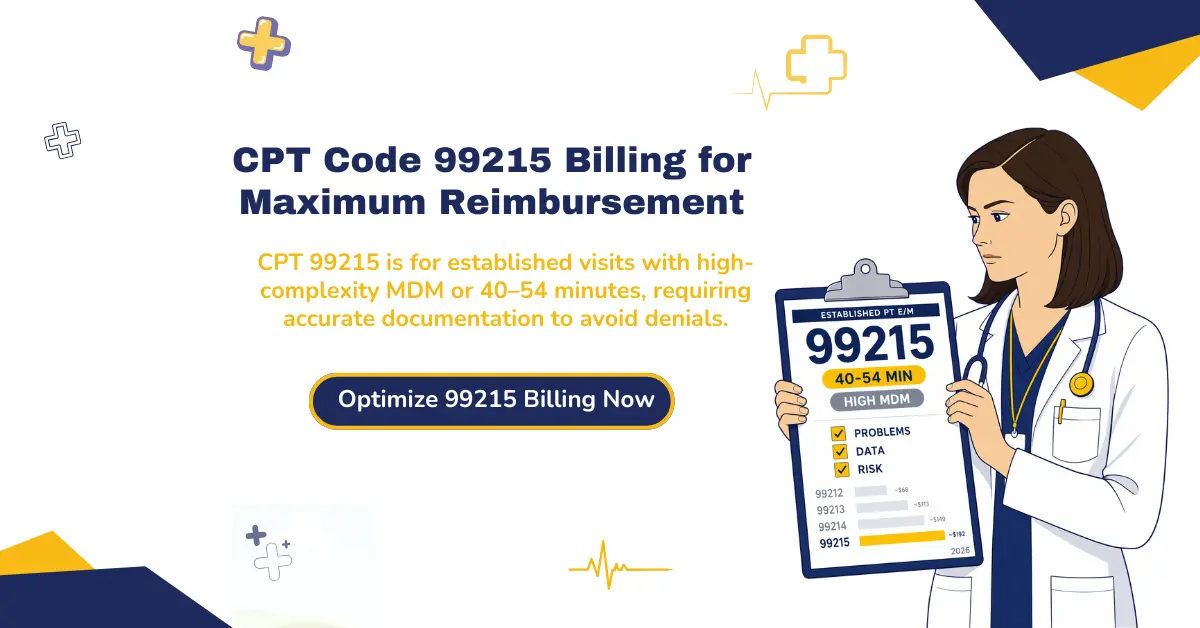
- Two legally separate pathways exist for billing 99215, MDM or total provider time (40-54 minutes on the same calendar date), and conflating them creates direct audit liability, not just a coding preference.
- The MDM reasoning that justifies a 99215 almost always happens in the room; the problem is that it rarely survives intact to the finalized note.
- Undercoding to 99214 generates no denial, no audit flag, and no alert, which is exactly why legitimate reimbursement disappears from practices invisibly, visit after visit.
- The $44 per-encounter gap between 99214 and 99215 is separated by a single MDM tier; across a busy practice, that gap compounds into material annual revenue loss from visits that were already earned.
- iScribe Health's E&M Coding Intelligence closes the documentation gap by building coding recommendations from the complete clinical narrative, not just the finalized note, so the complexity that happened in the room is actually captured before the claim goes out.
The Two Pathways to Qualify for Billing 99215
According to industry data practice, the 2021 CPT E/M guidelines established that office and outpatient visit code selection is based on either Medical Decision Making (MDM) or total time, not a combination of history, exam, and MDM points as under the prior 1995/1997 rules.
When a note conflates elements of both pathways without clearly establishing either, it creates ambiguity in the record, and that ambiguity is exactly what a Recovery Audit Contractor flags.

The risk is compounded by when and how notes are actually written. Research shows that physicians spend 1.2 hours outside of clinic hours on days with scheduled patients, while only 57.8% of their total EHR time occurs during clinic hours.
A note drafted under end-of-day fatigue is far more likely to describe a complex encounter without ever declaring the MDM basis, or to omit a total time figure entirely. That silent liability compounds across every high-volume day. iScribe Health's ambient AI documentation is designed to reduce post-visit charting time, so the note gets drafted at the point of care, not reconstructed from memory after hours, preserving the clinical reasoning that makes either pathway defensible.
8%
of their total EHR time occurs during clinic hours
Documentation quality alone, however, does not guarantee reimbursement. Some major commercial payers, including certain BCBS and HCSC companies, have implemented blanket automated policies that downcode high-level E&M claims to 99213, an algorithmic action that undermines both the MDM pathway and the time pathway regardless of how well the note is written. iScribe Health's Real-Time Denial Alerts surface that pattern as it emerges, allowing practices to identify the systematic downcode, build an appeal posture with the correct pathway evidence already in the note, and act before the denial volume becomes a revenue crisis.
At the point of note completion, after iScribe Health's AI drafts the encounter summary, its E/M Coding Intelligence surfaces which pathway the note actually supports before the encounter closes, turning a silent audit liability into a correctable gap at the point of care. That real-time check matters most when the underlying MDM criteria are themselves easy to underdocument.
Choosing the MDM pathway means satisfying at least two of three specific elements at the high-complexity level.
The Three MDM Elements That Determine 99215 Eligibility
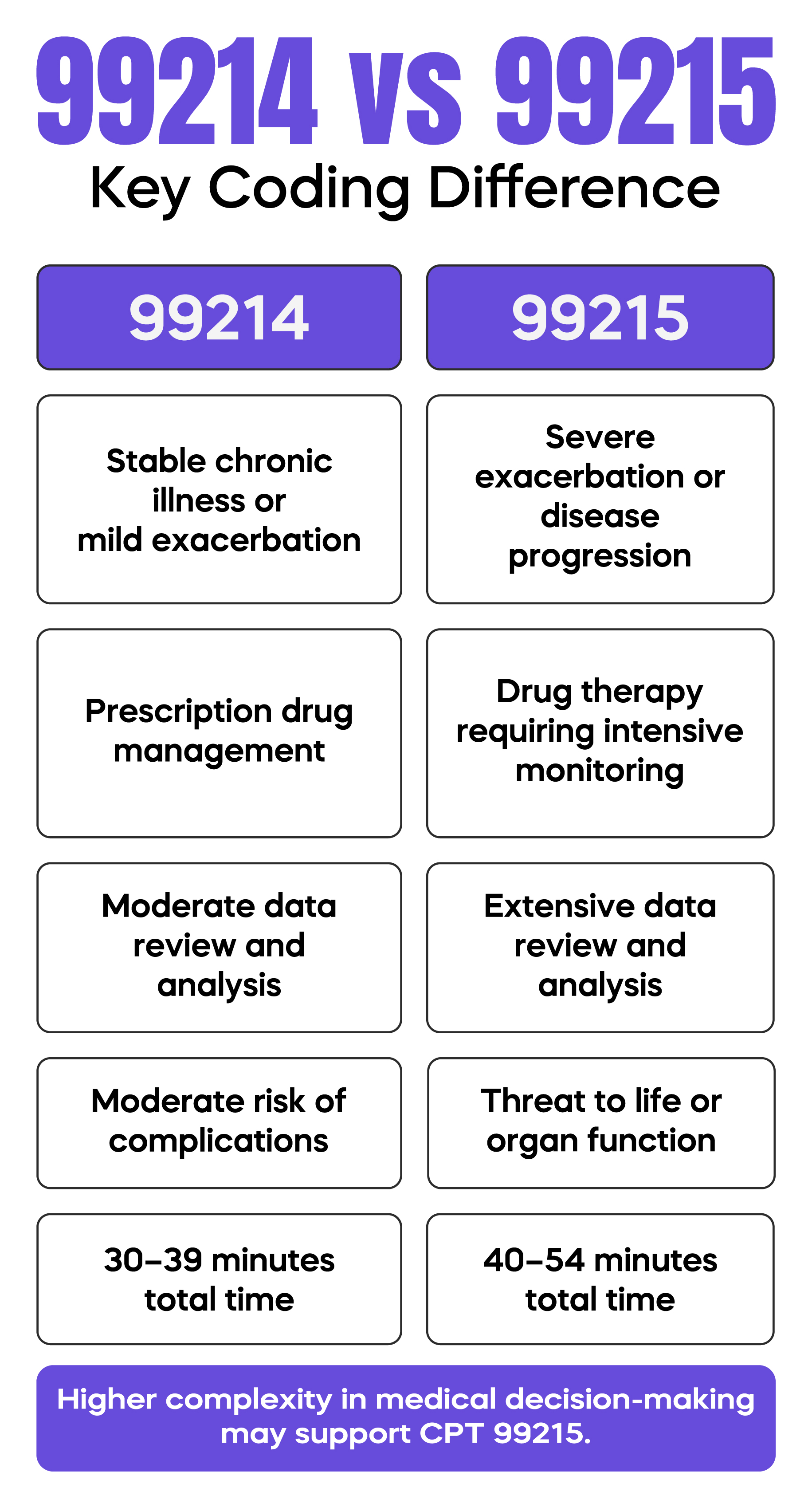
According to the AMA CPT E/M Office Visit Guidelines, high-complexity medical decision-making requires meeting at least 2 of 3 discrete elements at the high-complexity level: problems addressed, data reviewed and analyzed, and risk of complications or morbidity. Meeting only one element, regardless of how severe the clinical picture looks, drops the visit to 99214.
That last point is where most billing staff get caught. Payers do not infer MDM complexity from diagnosis codes. Each element must be explicitly documented in the clinical note with language that maps to the AMA's high-complexity definitions. A note that lists a serious diagnosis and a treatment plan but omits the reasoning behind each element fails the structured, three-part evidentiary test, even when the encounter itself was genuinely complex. The gap is not effort. The gap is visibility.
A compounding problem surfaces in practices where NPs carry a significant share of the patient load. Notes documented by NPs more often reflect lower MDM complexity, yet when those encounters are lengthy, the temptation is to justify 99214 or 99215 on time alone. That mismatch between MDM-based eligibility and time-based billing is one of the most reliable audit triggers a practice can generate, and it is largely invisible until a payer flags it. iScribe Health's E&M Coding Intelligence is designed to surface exactly this kind of discrepancy at the point of note completion, before the claim is submitted, so the practice is never relying on a time-based pathway to carry a note whose MDM language cannot independently support the level billed.
1. Problems Addressed - Chronic Illness With Severe Exacerbation or Immediate Threat to Life
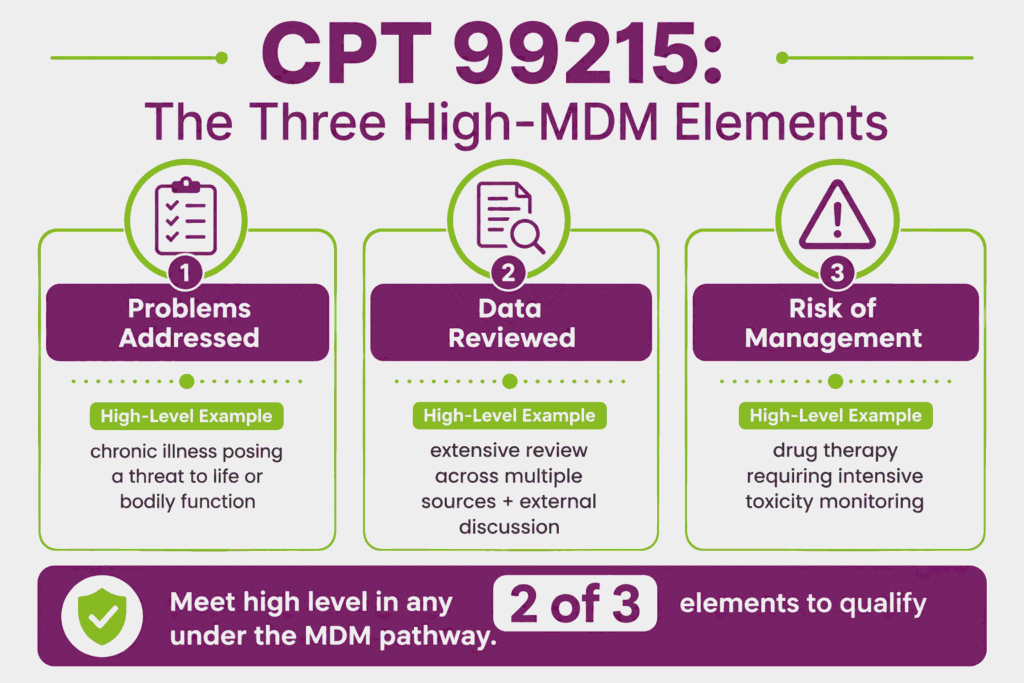
Element 1 sets a high bar. Per the AMA CPT E/M Office Visit Guidelines, the problems addressed must involve a chronic illness with severe exacerbation, progression, or treatment side effects, or an acute condition posing a threat to life or bodily function. A patient with COPD presenting in acute respiratory failure, requiring an immediate decision on escalation of care, qualifies. A stable COPD follow-up does not, even if the diagnosis code looks identical on the claim.
2. Data Reviewed and Analyzed - Independent Interpretation of Tests or External Provider Discussion
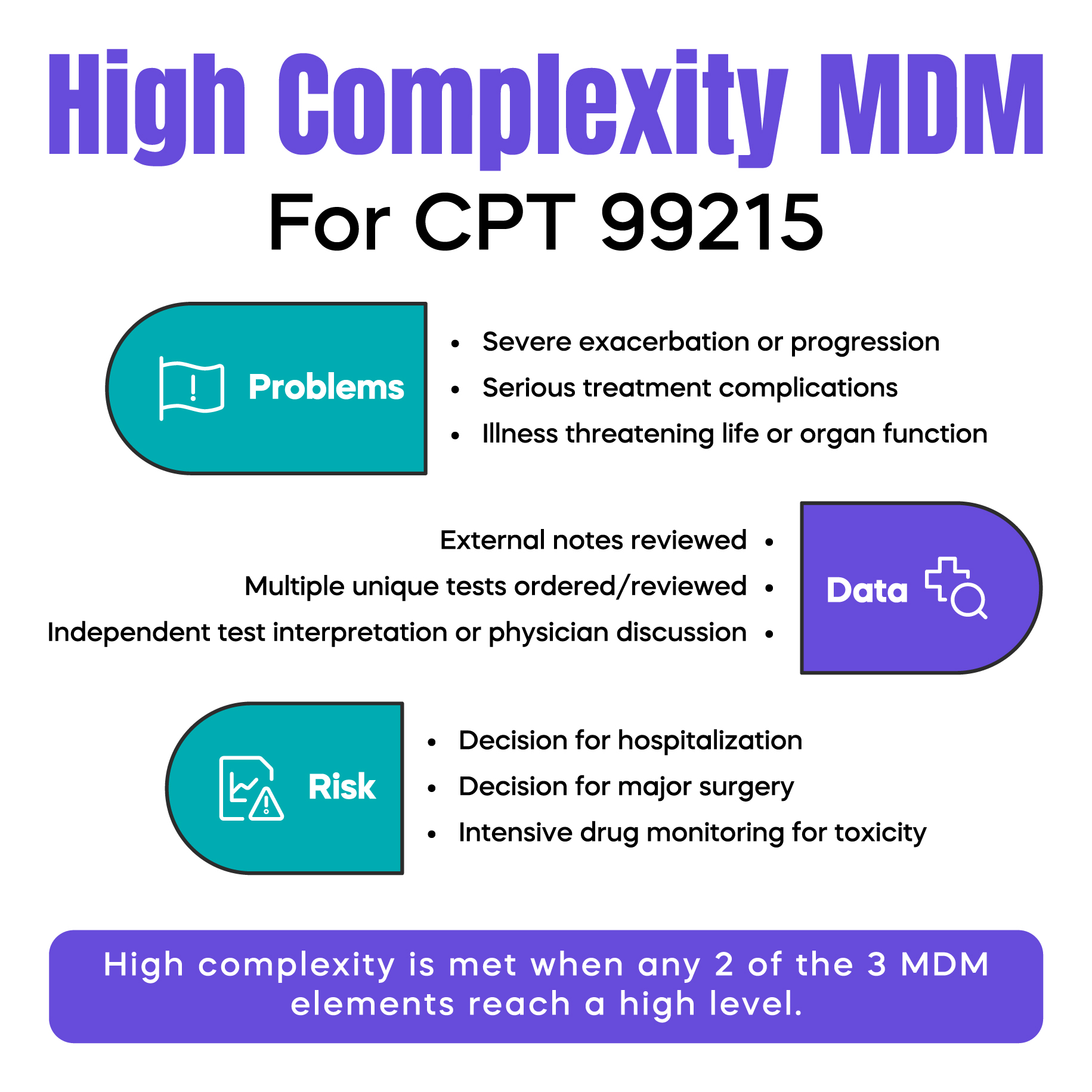
Element 2 is the most frequently underdocumented of the three, and the distinction is precise. Reviewing a lab result that another provider ordered does not satisfy high complexity. The AMA CPT E/M Office Visit Guidelines require either independent interpretation of a test performed by another clinician, or a substantive discussion of management or test interpretation with an external provider.
Physicians who document "labs reviewed" without specifying what they independently interpreted, or which consultant they discussed findings with, lose Element 2 credit entirely on audit. iScribe Health's Ambient AI Documentation captures the physician's spoken reasoning during the encounter, including references to external test results and consultant conversations, and drafts that language directly into the note, so the evidentiary trail exists without requiring the physician to reconstruct it after the visit.
3. Risk of Complications or Morbidity - High-Risk Management Options Such as Major Surgery or Drug Toxicity Monitoring
Element 3 demands explicit documentation of the management risk, not just the clinical complexity. The AMA CPT E/M Office Visit Guidelines (that same figure MDM Risk Table) list specific qualifying scenarios: drug therapy requiring intensive monitoring for toxicity, a decision regarding elective major surgery with identified patient or procedure risk factors, or a decision regarding hospitalization. A physician weighing continued high-dose immunosuppressant therapy against elective surgery risk qualifies, but only if the note names the risk factors and the reasoning, not just the plan.
Most physicians document what they did clinically but not why each element met the high-complexity threshold. That omission is invisible at the time of billing and only surfaces when a payer audits the claim or when a practice runs a prospective coding review. By then, the revenue is gone.
For high-volume practices and health systems where clinicians routinely chart two or more hours outside of patient care, that upstream check also reduces the post-visit documentation burden that drives burnout, freeing physicians to see more patients without carrying the cognitive weight of retrospective note repair. Because iScribe Health integrates directly with the practice's existing EHR, this workflow materializes without requiring a platform change, the ambient listening layer captures the encounter, the AI drafts the note, and the coding intelligence runs its MDM check, all within the system the practice already uses.
MDM is only one of two valid pathways to that same figure, and for many practice types, the time-based pathway is both easier to document and harder to get wrong. The next section maps exactly which activities count toward the that same figure time threshold and which ones, despite feeling like clinical work, are invisible to the payer.
What Activities Count Toward the 99215 Time Threshold
The 40-54 minute window is broad, but it only stays open if every countable minute happens on the same calendar date and gets recorded before midnight.

The 40-54 Minute Rule - What the Clock Is Actually Measuring
Total provider time on the date of service is the operative measure for time-based billing of that same figure. According to the 2024 Medicare Physician Fee Schedule Final Rule (CMS), the threshold is 40-54 minutes of total provider time on the date of the encounter. A physician who spends 12 minutes reviewing a complex chart before the patient arrives, 22 minutes face-to-face, and 8 minutes coordinating a specialist referral and closing the note on the same day has logged 42 total minutes.
The same physician who finishes the note the next morning has 34 countable minutes, falling short of the threshold entirely.
This is where ambient documentation changes the compliance math in a practical way. iScribe Health's Ambient Listening and Conversational AI captures the encounter in real time, so the AI-drafted note is ready for review at the point of care rather than reconstructed from memory at 11 p.m. Less after-hours charting also means more accurate time totals: the minutes spent on documentation are logged on the correct calendar date because the documentation is done on the correct calendar date.
Which Same-Day Activities Count and Which Ones Do Not
The 2024 Medicare Physician Fee Schedule Final Rule (CMS) confirms that countable activities include reviewing records, ordering and reviewing tests, clinical documentation, care coordination, and counseling, provided all occur on the date of service. Activities performed on any other date do not count toward the threshold, regardless of how directly they relate to the encounter.
When Time Exceeds 54 Minutes - Billing CPT 99417 and HCPCS G2212
When total provider time exceeds 54 minutes, prolonged service add-on codes apply in 15-minute increments on top of 99215. Per the Medicare Physician Fee Schedule Final Rule (CMS), the correct add-on code depends on payer: CPT 99417 applies for commercial payers, while HCPCS G2212 applies for Medicare. These codes are not interchangeable, and billing 99417 to Medicare is a common error that results in claim rejection.
One unit of the add-on code is billable at 69 total minutes (54 minutes plus a full 15-minute increment). A second unit requires 84 minutes, and the increment must be fully met before an additional unit is claimed.
For practices already running a supported EHR, iScribe Health integrates directly into that environment, so the add-on code logic is applied within the same workflow the provider already uses, with no separate system to check and no manual cross-reference against payer rules.
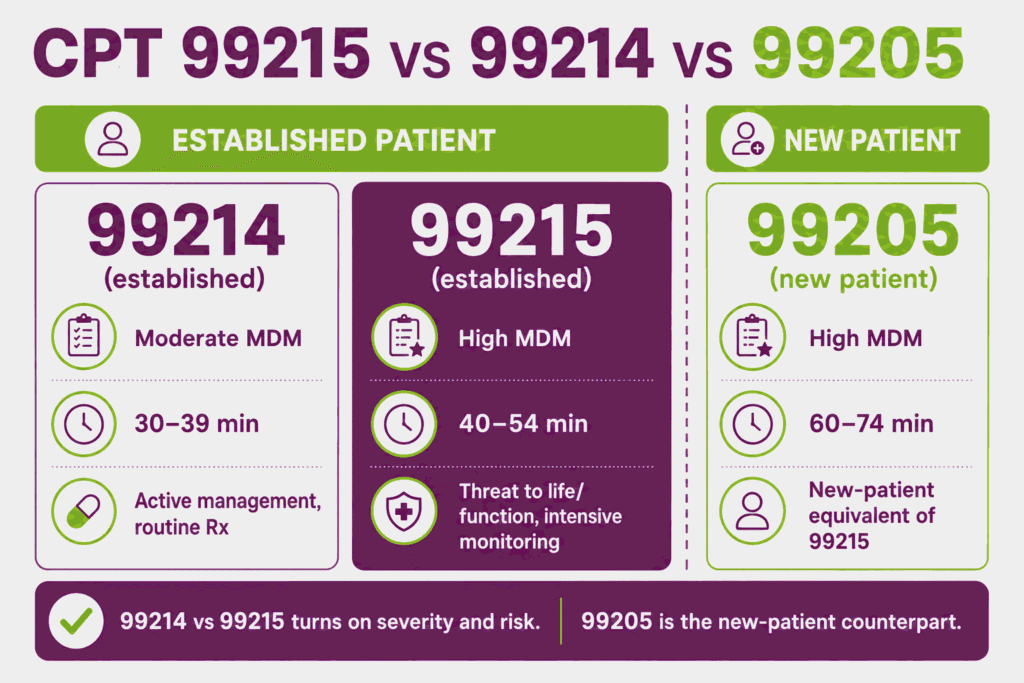
How 99215 Compares to 99214 in Complexity, Time, and Reimbursement

The One MDM Tier and $44 Per-Encounter Gap That Separates 99214 from 99215
According to the SolvEdge Medicare Reimbursement Rates 2026: Physician Fee Schedule Guide, Medicare pays approximately $192 for 99215 in the office/non-facility setting versus approximately $148 for 99214, a difference of roughly $44 per encounter.
The exposure is especially acute at high-volume practices and health systems, precisely the environments where iScribe Health's ambient AI documentation and E&M coding intelligence are most impactful, surfacing code-level accuracy across every encounter, every day.
When that complexity lands on billing staff without real-time clinical context, coding errors persist across high patient volumes. iScribe Health's automated E&M coding intelligence generates code-level recommendations from the complete clinical narrative at the point of note completion, before the claim is submitted, so the correction logic is embedded in the workflow rather than left to retrospective review.
Why 99215 Attracts Automated Downcoding and 99214 Does Not
The downcoding problem extends beyond selective payer behavior: some major commercial payers have implemented blanket automated policies that downcode high-level E&M claims across the board, directly suppressing reimbursement for higher-complexity visits regardless of documentation quality.
iScribe Health's real-time denial alerts give practices visibility into exactly this problem, flagging claim-level risk before submission so that documentation gaps can be addressed while the encounter is still actionable. Combined with EHR integration that embeds directly into the practice's existing workflow, the system ensures accurate, compliant medical coding across high patient volumes without adding documentation burden to already-stretched clinical teams.
How HCPCS G2211 Makes the 99215 Revenue Ceiling Higher Than Most Practices Realize
iScribe Health's E&M coding intelligence, built on ambient listening and conversational AI that captures the complete real-time clinical narrative before the note is finalized, creates the structural opportunity to surface both the $44 per-encounter difference and the G2211 add-on at the point of care.
The $44 per-encounter gap is only recoverable if the documentation reflects what happened in the room, and that is where most practices quietly lose the code before the claim is ever submitted.
Related Reading
- Cpt Code 99233
- Cpt Code 99203
- Cpt Code 99232
- Cpt Code 99244
- Cpt Code 99221
- Cpt Code 99205
- Cpt Code 99223
- Cpt Code 99202
- Cpt Code 99222
Documentation Errors That Silently Downcode 99215 to 99214
Roughly half of all E&M visits contain documentation errors that affect the final code level, according to the CMS E&M Documentation Guidelines Review. The common assumption among practice administrators and billing decision-makers is that if physicians know a visit is that same figure-level and document it, the code is defensible, and that if there were a real problem, it would show up in denials. That assumption is wrong on both counts.
That figure is not a denial rate. It does not show up in your remittance advice. It surfaces only when someone pulls the charts and reads them against the MDM criteria the physician actually had to meet.
The gap between what happened in the exam room and what the note proves happened is where that same figure revenue quietly converts to 99214 revenue, every day.
Practice administrators often assume that if the clinical complexity was real, the documentation will reflect it. In practice, the complexity lives in the physician's head, and the note gets written two hours later under time pressure. The result is a claim that looks complete but fails the 2-of-3 MDM test on review. iScribe Health's ambient AI documentation is most impactful in high-volume practices where clinicians regularly chart two or more hours outside of patient care time, the environments where this gap is widest and the revenue consequence is largest.
1. Documenting Only Diagnosis and Plan While Omitting MDM Reasoning
The most common MDM documentation gap is structural, not accidental. According to the CMS E&M Documentation Guidelines Review, physicians frequently document the diagnosis and the treatment plan while omitting the diagnostic reasoning, the data they weighed, and the risk rationale that justifies high-complexity MDM. A note that records the diagnosis and the adjusted medication with a follow-up interval captures the outcome. It does not capture the complexity.
Auditors and payer algorithms do not infer complexity from a diagnosis code. If the note does not show the reasoning, the reasoning did not happen, legally speaking. That is how a defensible that same figure becomes an indefensible one before the claim ever reaches a reviewer.
iScribe Health's ambient listening and conversational AI captures clinical reasoning at the point of care, before fatigue, compression, and time pressure strip the MDM nuance from the note. The goal is to surface what physicians already said and thought, in real time, so the note reflects the encounter rather than a reconstructed summary of it. The result is more defensible documentation, built from the encounter itself rather than assembled after it ends.
2. After-Hours Charting That Strips In-Room MDM Nuance
Physicians seeing high patient volumes routinely finish their notes hours after the last appointment. Fatigue is not the only problem. The specific clinical logic that justified a that same figure level, the differential considered and discarded, the risk of a medication adjustment weighed against the patient's comorbidities, is contextual and time-sensitive. It does not reconstruct cleanly at 9 p.m.
What gets written instead is a compressed summary. The diagnosis is there. The plan is there. The MDM reasoning that would satisfy an auditor is gone.
iScribe Health is designed to close exactly this gap. Ambient documentation captured during the encounter means that by the time the physician reviews and finalizes the AI-drafted note, the reasoning is already present, not recalled, not reconstructed. For practices running a supported EHR, iScribe Health's EHR integration materializes seamlessly inside existing workflows, so the ambient documentation layer does not add a new system for care teams to navigate during peak census periods.
Standardizing clinical documentation quality across the practice becomes a workflow outcome, not a training initiative.
3. Failing to Identify Which External Data or Consultants Were Reviewed
MDM Element 2 requires documented evidence of data reviewed or analyzed. Generic language fails this test. Phrases like "reviewed prior records" or "consulted with specialist" are routinely rejected by auditors because they name no specific record, no specific test result, and no specific provider.
The CMS E&M Documentation Guidelines Review is explicit: failing to name the external data source or the consulting provider eliminates credit for Element 2 entirely. A note can fail the 2-of-3 MDM test on this element alone, with no denial triggered at billing. The claim pays at that same figure. No one flags it. Because iScribe Health's ambient AI listens across the full encounter, references to specific test results, named specialists, or external records that the physician voices in the room are captured in the draft, rather than dropped when the physician switches to a compressed after-hours summary that omits them.
4. Industry Data: 55% Accurate Documentation Rate and a 33% Overcoding Rate in One Ortho Audit
Industry benchmarking data corroborates what the CMS E&M Documentation Guidelines Review found: a substantial portion of E&M visits contain errors that affect code assignment, with undercoding and overcoding simultaneously common across most practices, neither showing up in denial reports. That is not a rounding error. It means nearly half of all encounters carry some documentation deficiency.
The problem runs in both directions. A CMS E&M audit of a single orthopedic group surfaced a 33% overcoding rate across 941 encounters, meaning providers claimed 99215 on visits where the documentation supported only 99214, a pattern CMS and OIG auditors explicitly look for when selecting practices for review. Neither failure mode appears in denial reports. Both are invisible until a retrospective audit forces the review.
5. Thin MDM Documentation Triggering Automated Payer Downcoding and Retrospective Audit Exposure
Payers, including major commercial insurers such as BCBS, now run algorithmic review on E&M claims before payment. A that same figure claim with thin MDM documentation, no named data sources, no documented risk rationale, can be automatically adjudicated at 99214 without a denial notice. Practice administrators and billing teams we work with regularly encounter this: the remittance reflects the lower code, with no explanation and no denial to appeal.
The same algorithmic logic that silently reduces that same figure to 99213 applies with equal force to 99215, regardless of the clinical complexity that actually occurred or the time the physician spent with the patient. iScribe Health's real-time denial alerts surface these downcoding patterns so practices are not discovering the problem only during a retrospective audit, by which point the exposure already spans months of billing history.
Retrospective audit exposure compounds the risk. When an OIG or payer audit pulls a sample of that same figure claims and finds a pattern of unsupported documentation, the resulting repayment demand covers every encounter in the audit window, not just the flagged sample. The financial consequence is a repayment demand across months of billing, for a documentation failure that was invisible the entire time.
Each of these errors shares a common root: the clinical complexity existed, but the documentation workflow had no mechanism to capture it in real time. The next section shows exactly how iScribe Health's AI-powered documentation closes that gap by capturing what physicians already did before the note ever closes.
How AI-Powered Documentation Captures 99215-Level MDM Before the Note Closes
Once the note closes, the ceiling is set, and everything that happened in the room but never reached the record is invisible to coders and auditors alike.

Why AI Documentation Tools Close the Compliance Gap Training Never Can
The core synthesis here is critical: the root failure mode of that same figure compliance is physician ignorance of the rules less often than it is the structural impossibility of asking a physician to simultaneously deliver high-complexity care and architect, in real time, a note that explicitly satisfies each of three discrete MDM elements against an external AMA scoring table. That structural impossibility is the actual compliance gap, and no amount of coder training closes it.
The Ceiling Is the Note, Not the Encounter
A skilled coder works from what is written, not what occurred. ArtiGen Healthcare Automation's December 2025 review states it plainly: "when documentation is incomplete or inconsistent with the level of service actually rendered, the visit is billed at a lower code level regardless of the clinical complexity of the encounter."
A physician who verbally weighed three differential diagnoses, reviewed outside imaging, and considered surgical referral risk has performed high-complexity MDM. If none of that reasoning appears explicitly in the note, however, it cannot be coded or defended.
Ambient Capture Locks In Diagnostic Reasoning Before the Encounter Window Closes
Physicians spend a significant portion of their time on post-visit documentation per encounter, typically after clinic hours, when the specificity of in-room reasoning has already faded. Ambient capture addresses this directly by recording clinical reasoning at the moment it occurs rather than relying on reconstruction after the fact.
When a physician says aloud that they are weighing medication toxicity against a surgical consult, an ambient documentation layer can record both the differential considered and the risk rationale. Language supporting MDM Element 3 is then present in the note without requiring the physician to stop and structure documentation mid-encounter.
Prospective Coding Intelligence Flags Under-Documented 99215 Visits Before the Claim Leaves the Practice
That is the exact function iScribe Health's E&M Coding Intelligence performs upstream: because it is designed to build coding recommendations from the complete ambient narrative, not the finalized note alone, it is positioned to surface under-documented that same figure visits before submission. Intervening at that stage preserves both compliance and revenue without requiring rework after the claim has already been submitted.
The documentation gap is a structural problem. It requires a structural solution built into the documentation workflow itself.
Next steps
If your physicians are mentally performing high-complexity MDM but the finalized note never captures the diagnostic reasoning, the data sources reviewed, or the risk rationale that would satisfy each of the three discrete MDM elements, the revenue from those visits is already gone. Undercoded claims generate no denial, no audit flag, and no moment of friction that prompts a second look. The path forward starts with capturing MDM complexity before the note closes, not recovering it afterward. Start with our AI medical scribe.
The structural impossibility of asking a physician to simultaneously deliver complex care and architect a note that explicitly satisfies each MDM element means training alone cannot close the gap. At the same time, the roughly $44 per-encounter reimbursement difference between 99215 and 99214 compounds across every provider and every working day, in both directions at once, with neither overcoding liability nor undercoding loss visible in denial rates. Together, those two realities point to a documentation solution that operates upstream of the finalized note, capturing clinical reasoning in real time before the encounter window closes.
Start with an AI medical scribe that captures MDM reasoning at the point of care and surfaces the appropriate code level before the note is finalized. Pull your last 90 days of 99214 claims, identify visits where the clinical narrative suggests high-complexity MDM, and multiply that count by the per-encounter gap. That number is your baseline. iScribe Health's ambient documentation and E&M coding intelligence are built to close it.
Frequently Asked Questions
Does history and physical exam still factor into whether a visit qualifies as 99215?
No. The AMA's 2021 E/M guideline updates removed history and physical exam as level-selection drivers entirely. Code selection now rests solely on medical decision-making complexity or total provider time on the date of service.
If my physician documents a serious diagnosis and a detailed treatment plan, is that enough to support 99215 under the MDM pathway?
Not on its own. High-complexity MDM requires meeting at least 2 of 3 discrete elements, problems addressed, data reviewed and analyzed, and risk of complications or morbidity, and each must be explicitly documented with language that maps to the AMA's high-complexity definitions. A note that lists a serious diagnosis and a treatment plan but omits the reasoning behind each element fails the structured test, even when the encounter itself was genuinely complex.
If I finish charting after midnight, does that time still count toward the 99215 time threshold?
No. The clock stops at midnight, any documentation completed on a different calendar date contributes zero minutes to the prior day's encounter. A physician who starts a note at 11:45 p.m. and finishes at 12:05 a.m. loses those final minutes, which could drop the visit below the 40-minute threshold needed for 99215.
How is 99215 different from 99214, and what actually separates them on audit?
99215 Requires meeting at least 2 of 3 MDM elements at the high-complexity level, or 40-54 minutes of total provider time on the date of service. Meeting only one MDM element, regardless of how severe the clinical picture looks, drops the visit to 99214. Payers do not infer complexity from diagnosis codes; each element must be explicitly documented in the clinical note.
Can a patient who hasn't been seen in four years be billed under 99215?
No. An established patient is one who has received professional services from the same physician, or a physician of the same specialty in the same group practice, within the past three years. A patient returning after a four-year gap is classified as a new patient and belongs in the 9920x series, coding them as established and using 99215 generates a repayment demand on audit.