7 Things to Know About CPT Code 99204 for New Patients
CPT code 99204 billing gaps cost practices real money. See what billing teams need to close the documentation gap and capture rightful reimbursement.


Most Level 4 new patient visits get billed as Level 3. The problem is not coder error. It is documentation that never captured the right clinical detail in the first place.
The common assumption is that the fix is better coder training, if the people reviewing claims understood 99204's MDM thresholds more precisely, they would catch and upgrade the codes before submission. But the real problem sits upstream, in how clinical documentation is captured during the encounter itself. CPT code 99204 sits at the center of new patient billing, yet most practices treat its definition as a reference fact rather than a clinical instruction. That distinction costs real money. See our AI medical scribe for how this works in practice.
"Patients are confused about what CPT Code 99204 actually covers for new patient office visits, especially when it is billed alongside add-on psychotherapy codes like 90838, making it hard to evaluate whether charges are legitimate. "New patient" means no professional service from the provider or the same group specialty within the prior three years. "Moderate MDM" is the clinical threshold that most encounters will live or die on."

The AMA's 2021 E/M guideline revision clarified that a medically appropriate history and physical exam are still required, but they no longer determine the E/M level. MDM complexity and total time are the only two levers. That shift transferred the documentation burden directly onto clinical reasoning, which is exactly where rushed notes fail first. Understanding what the code actually requires, and when those requirements must be met, is the foundation every billing team needs before anything else.
Where the Level 3 vs. Level 4 Boundary Costs Real Money Per the AMA CPT 2024 guidelines, 99203 requires low MDM (or 30 to 44 minutes), while 99204 requires moderate MDM (or 45 to 59 minutes). The gap between Level 2 and Level 4 is the most consequential boundary in new patient billing.
A first-time patient presenting with uncontrolled Type 2 diabetes, hypertension, and a new medication adjustment is the textbook moderate-MDM scenario. Without documentation capturing each element explicitly, the code defaults to Level 3 and the revenue difference disappears. This is not a coding error that surfaces at audit, it is a documentation gap that is locked in the moment the note is finalized.
Why MDM Must Be Captured as It Unfolds, Not Reconstructed After The moderate-MDM descriptor reads like a static definition, so billing teams treat it as a post-visit checklist. That sequence silently drains revenue, because MDM complexity must be captured as it unfolds, not reconstructed after the fact. A note capturing only the conclusion, "adjusted medication, follow up in three months", supports Level 3 at best. The gap is not effort. The gap is visibility.
Key takeaways
- CPT 99204 requires medical decision-making of moderate complexity, two or more chronic conditions, prescription drug management, or independent interpretation of test results, and missing any one element drops the claim to 99203.
- Roughly 45% of qualifying Level 4 new patient visits get billed as 99203, not because providers misread the criteria, but because rushed documentation fails to capture the complexity that was actually delivered.
- The revenue leak is not a coding problem, it is a capture problem. The differential diagnosis, the data reviewed, the risk-based treatment decision: all of it surfaces verbally during the visit and disappears before the note closes.
- Better coder training does not fix undercoding when the source documentation never reflected the encounter's true complexity. Retrospective audits can flag the pattern, but they cannot recover most of what was already billed.
- Every 99203 billed on a qualifying Level 4 visit is a predictable loss, not an ambiguous one, and at high patient volumes it compounds into a reimbursement integrity problem that end-of-month reviews cannot fully reverse.
- iScribe Health's Automated E&M Coding closes the capture gap by generating E&M codes directly from clinical documentation in real time, so the complexity that happened in the room is reflected in the code before the note ever closes.
7 Things Every Billing Team Needs to Know About CPT Code 99204
Forty-five percent. That is the share of qualifying Level 4 new patient visits that, according to a published analysis on hospitalist CPT codes, end up billed as 99203 instead of 99204, not because the clinical work fell short, but because the documentation did. For a billing team, that number is a checklist problem, and the checklist starts with seven facts.
1. New Patient Only: 99204 Requires No Prior Service Within 3 Years from Same Group or Specialty
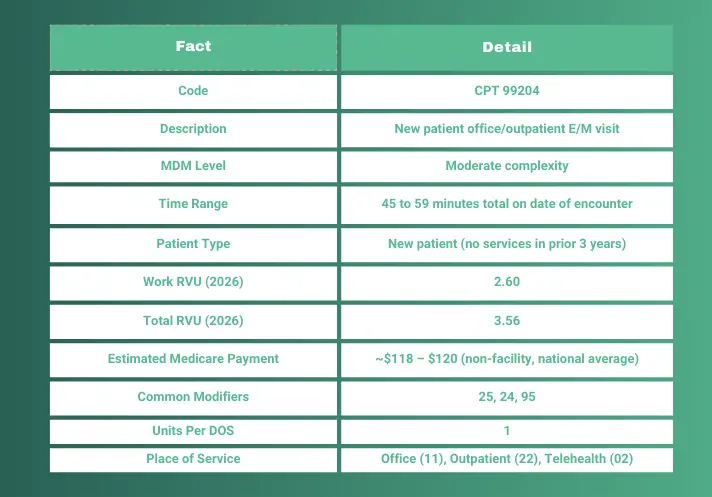
CPT code 99204 is strictly reserved for new patients, defined as individuals who have not received any professional services from the billing provider, or any provider of the same specialty within the same group practice, within the preceding three years. The parallel established-patient code is 99214. Billing teams must verify patient history before assignment; misclassifying an established patient as new is a top audit trigger and can result in overpayment recoupment.
2. Two Pathways to 99204 - Moderate MDM or 45-59 Minutes of Total Encounter Time
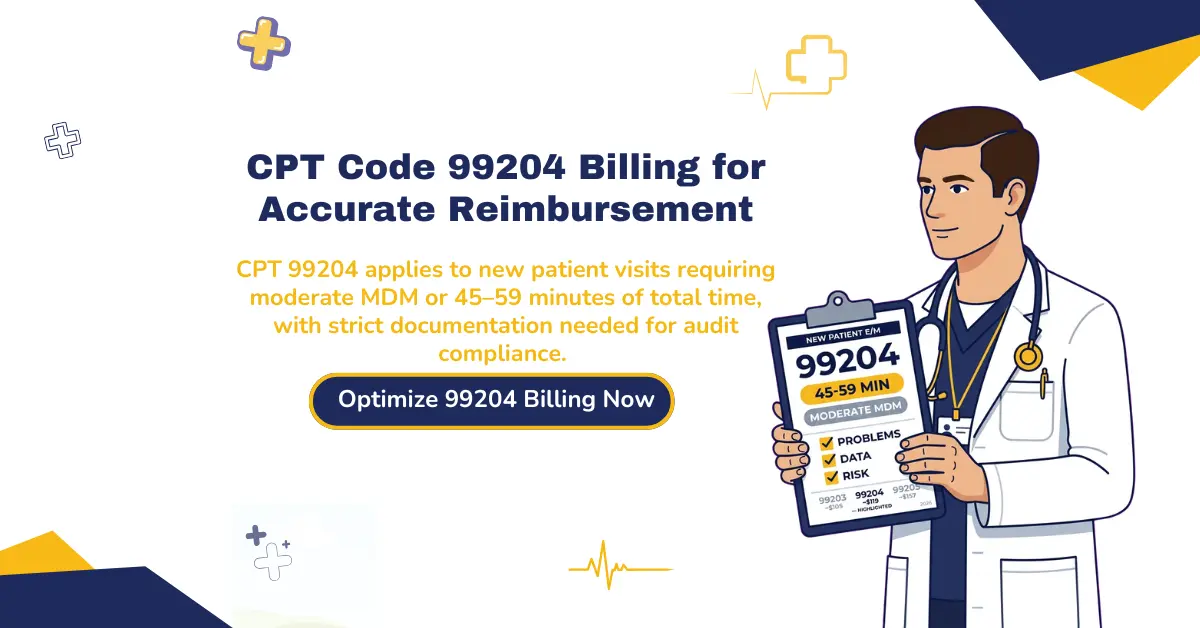
Billing teams sometimes treat time-based billing as a fallback when MDM documentation is thin. It is an equally valid primary pathway, but it carries its own documentation burden. Total time must include all time personally spent by the billing provider on the date of the encounter, including pre-visit chart review and post-visit care coordination, not just face-to-face minutes.
If the physician documents total time with a brief narrative of activities, that claim is defensible. If the note captures time without identifying the component activities, it is not. Choose the pathway that the documentation supports, and confirm that choice before submission.
This is a practical pressure point in high-volume practices and health systems where clinicians regularly chart significant time outside of patient care. When physicians are moving through a full census, the discipline required to narrative-capture time components for every encounter competes directly with the next patient. IT and EHR administrators who have streamlined clinical workflows to reduce that friction, for example, by integrating ambient documentation tools that capture time-stamped activity as the encounter unfolds, see measurably more defensible time-based claims reach submission without retrospective reconstruction.
3. Moderate MDM Requires Meeting Two of Three Elements at the Moderate Threshold
Moderate medical decision making for 99204 is not an all-or-nothing determination, providers must satisfy at least two of three MDM elements at the moderate level: number and complexity of problems addressed, amount and complexity of data reviewed and analyzed, and risk of complications or morbidity. A single chronic illness with exacerbation, review of external records, or prescription drug management can each contribute. The tradeoff is that coders must evaluate each element independently and document evidence for each one met.
4. History and Physical Exam No Longer Drive Level Selection Under Post-2021 AMA Guidelines
A critical shift in the 2021 AMA E/M overhaul removed history and physical exam as level-determining factors for office-based E/M codes. Documentation of a medically appropriate history and exam is still required, auditors will flag its complete absence, but the depth or comprehensiveness of those elements no longer determines whether a visit qualifies as 99204. Billing teams still coaching providers to document extensive review of systems for level justification are wasting documentation effort and missing the actual MDM or time requirements that matter.
5. 2024 Medicare Reimbursement for 99204 - Approximately $167-$172 Non-Facility, Locality-Adjusted

The 2024 Medicare Physician Fee Schedule sets the non-facility reimbursement rate for 99204 at approximately $167 to $172, with variation by geographic locality. The comparable rate for 99203 is meaningfully lower per visit. Across a practice billing a high volume of new patient visits each month, a systematic downgrade rate of 45% translates to thousands of dollars in monthly revenue loss on Medicare claims alone, before applying commercial payer multipliers.
45%
of Level 4 visits wrongly billed as 99203
A related confusion that surfaces in billing departments: new patient visits billed under 99204 frequently carry a contracted or negotiated rate discount that a subsequent established patient visit for the same individual does not. This inconsistency reflects the payer's contracted fee schedule structure, but it creates internal questions about billing consistency that consume administrative time and erode confidence in the process. Understanding that the discount applies at the payer-contract level, not at the claim level, is the clarification that stops the cycle. The per-visit gap between 99204 and 99203 is still the dollar figure to bring to any internal conversation about investing in documentation improvement workflows.
6. Payer-Proof MDM Documentation - Explicitly Record Problem Complexity, Data Sources, and Risk Category
Coder expertise and documentation completeness are not interchangeable. The American Medical Association E/M Guidelines are explicit: MDM must be documented in the medical record at the time of the encounter and cannot be inferred or reconstructed by a coder after the note closes. This means a billing team that trains its coders to recognize moderate MDM still has zero recovery leverage if the physician never documented the complexity during the visit. The note must name the problems addressed with their complexity, identify data sources reviewed, and state the risk category.
A claim where the coder "knows" the visit was complex but the note does not show it is a claim that will not survive audit. This is where iScribe Health's Ambient AI Documentation and EHR Integration create a direct revenue connection. The platform uses Ambient Listening and Conversational AI to capture MDM elements as the encounter unfolds, then integrates that structured content directly into the supported EHR, so the billing team receives a note that supports the code rather than a note they have to work around.
Clinical informatics teams and IT/EHR administrators implementing iScribe Health describe the core operational benefit this way: care teams can maintain documentation quality even during peak census periods, because the capture burden shifts from post-encounter recall to real-time ambient documentation. At note completion, iScribe Health's Automated E/M Coding surfaces the appropriate code level, and Real-Time Denial Alerts flag documentation gaps before the claim is submitted, not after a payer rejects it.
7. The Undercoding Gap: ~45% of Qualifying Level 4 New Patient Visits Are Billed as 99203 Due to Documentation Failure
The revenue consequence of getting any of the six facts above wrong is concrete. A new patient visit for a patient with three chronic conditions, where the physician's note contains no documentable MDM evidence, gives the coder nothing to support 99204, even if the encounter fully qualified. Most billing teams accept that MDM documentation gaps are a provider education problem to be solved with training and retrospective audits.
The hidden cost is that when physicians carry a full daily patient load, the window to capture codeable complexity closes the moment the patient walks out. Retrospective recovery is expensive, incomplete, and audit-risky. The gap is visibility, and it closes only at the point of care. iScribe Health is most impactful in exactly this environment, high-volume practices and health systems where clinicians regularly chart two or more hours outside of patient care time, because the benefit is ongoing, realized across every patient encounter and every day of clinical practice, as a structural change to how documentation reaches the billing team.
Each of these seven facts has a dollar sign attached to it. Get any one wrong and the revenue consequence is immediate and recurring. Knowing the rules and capturing the evidence that proves you followed them are two different problems, and the second one is where most practices quietly lose reimbursement, which is exactly what the next section unpacks.
Related Reading
- Cpt Code 99233
- Cpt Code 99203
- Cpt Code 99232
- Cpt Code 99244
- Cpt Code 99205
- Cpt Code 99221
- Cpt Code 99202
- Cpt Code 99223
- Cpt Code 99222
Why Accurate 99204 Documentation Starts in the Room Not the Billing Queue
The common assumption among practice administrators and billing decision-makers is that a sharp billing team can catch undercoding patterns during claim review and correct them before money walks out the door, that the fix is better coder training, and that if the people reviewing claims understood 99204's MDM thresholds more precisely, they would catch and upgrade the codes before submission. That assumption mislocates the problem. The revenue loss from undercoded 99204 visits isn't discovered in the billing queue.

The Claim Submission Window Closes Before the Billing Team Sees the Problem
Medicare's timely filing deadline for fee-for-service claims is one year from the date of service, a window that sounds generous until you account for how billing review actually works, as industry research has detailed regarding the Affordable Care Act's reduction of that deadline. Most undercoding patterns don't surface from a single claim. They emerge from aggregate data: a coding audit, a quarterly variance report, a payer-mix analysis. By the time a billing team has enough volume to spot that a provider is consistently billing 99203 on visits that qualified for 99204, weeks or months of claims are already filed and closed.
The gap is not effort. The gap is visibility, and by the time visibility arrives, the window is shut.
The gap is not effort. The gap is visibility, and by the time visibility arrives, the window is shut.
Why MDM Complexity Collapses Under Documentation Drag
Medical Decision Making is the most defensible path to 99204, and also the most vulnerable to what happens between the encounter and the final note. When MDM rationale is deferred, the clinical reasoning that drove the visit's complexity, the differential narrowing, the risk weighting, the data reviewed, compresses into shorthand that no coder can reliably translate into a qualifying level of complexity.
This is a core pressure point for coders and providers alike: when documentation is sparse or incomplete, a missing chief complaint, no explicit treatment plan, a vague clinical narrative with no recorded risk assessment, determining whether a visit qualifies for 99204 becomes genuinely impossible to do with confidence. Faced with that ambiguity, the coder cannot upgrade what the note doesn't support. It resolves in the direction of the lower, safer code.
The pattern is recognizable: a genuinely complex encounter reduced to a few lines of plan text, with no explicit documentation of the number and complexity of problems addressed, no articulation of data reviewed, and no recorded risk assessment. The OIG has consistently flagged retrospective reconstruction of clinical rationale as both unreliable and audit-risky.
Key takeaway: Documentation drag doesn't just lose revenue on individual claims. It systematically suppresses the practice's 99204 capture rate across every provider who defers charting.
iScribe Health's Ambient AI Documentation addresses this at the source. Rather than waiting until the end of the evening, when clinical memory has faded and note-writing competes with personal time, iScribe Health's ambient listening and conversational AI captures the encounter in real time, so the AI-drafted summary is available at the point of note completion, after the encounter but before the billing window starts its countdown. The goal is straightforward: complete notes by end-of-clinic, not end-of-evening. When that happens consistently, the MDM rationale that justifies 99204 is preserved while it is still clinically accurate and auditably complete.
How Intra-Practice Billing Variability Creates Audit Exposure
Consider a multispecialty group where some internists consistently bill 99204 on a substantial share of new patient encounters and another bills it at a far lower rate. That variance doesn't trigger a coaching conversation with the low biller. It triggers a payer audit on the high billers, because statistical outlier detection compares coding patterns within peer groups. Inconsistent MDM documentation across providers doesn't just suppress revenue for the under-documenters; it creates E/M audit risk for the ones doing it right. Standardizing clinical documentation quality across the practice is the only way to protect both groups simultaneously.
Most practices handle this with periodic coder education and provider feedback loops, both of which operate after the note is already closed and the claim already filed. iScribe Health's Automated E&M Coding and E&M Coding Intelligence address this by capturing clinical complexity and generating MDM-anchored documentation structure during the encounter itself, before the note closes and the billing window starts its countdown. Because iScribe Health materializes within a practice's existing supported EHR as a seamless ambient documentation layer, there is no parallel workflow for clinicians to learn and no separate system for billing staff to reconcile.
The result is more defensible documentation, produced consistently, across every provider in the practice, not as a training outcome that degrades over time, but as a structural feature of how notes are generated on every patient encounter, every day.
This real-time capture approach directly targets the documentation-drag mechanism that the OIG has identified as a driver of unsupportable E&M level reconstruction. When clinical complexity is captured at the moment it occurs, it doesn't have to be reconstructed later. The hidden cost of deferring that work isn't inconvenience. It is a permanent, unrecoverable revenue loss on every encounter where the note couldn't support the code the visit actually earned.
The documentation failure that costs a practice a 99204 reimbursement isn't a billing error. It is a documentation timing error, and it is the only kind of error that has to be solved before the encounter ends.
How Real-Time Clinical Documentation Captures 99204 Complexity Before the Note Closes
Every physician who delivers a Level 4 encounter already has the evidence for 99204. The differential diagnosis, the data sources reviewed, the risk-based treatment decision, all of it surfaces verbally during the visit and then quietly disappears before the note is finalized. The documentation gap is a capture failure, and it is costing practices real money on every affected encounter.

Why MDM Elements Disappear Between the Exam Room and the Typed Note
The pattern is well established across the market: physicians frequently verbalize clinical reasoning, including differential diagnoses, data reviewed, and risk-based treatment decisions, during the encounter but fail to translate that reasoning into typed notes under time pressure, resulting in a documented complexity level lower than the care actually provided. That gap is structural, not incidental.
The three MDM elements most commonly lost are also the three that separate 99203 from 99204:
- The number and acuity of problems addressed
- The data sources actually reviewed
- The risk level of the treatment decision made
A physician who verbally reasons through a prescription drug management decision and a specialist referral during the visit captures both as discrete MDM data points in real time, or loses them entirely when reconstructing a SOAP note post-clinic. The mechanism of loss is the same in either case: deferred documentation under time pressure.
The Documentation-First Architecture Capturing Complexity During the Visit
The distinction between practices that consistently bill 99204 and those that default to 99203 often comes down to when documentation happens. The practice that records MDM complexity during the encounter monetizes it. The practice that defers to post-visit reconstruction donates it.
A documentation workflow built around ambient documentation operates hands-free during the visit. The physician speaks naturally with the patient, and the clinical reasoning, including problem acuity, data reviewed, and risk decisions, is captured as it happens, not summarized hours later from memory. The result is a note that reflects the actual encounter rather than a compressed reconstruction of it.
How Automated E&M Coding Assigns the Right Code From Captured MDM Elements
Most teams handle this by relying on billing staff to infer complexity from whatever the note contains. The hidden cost is that coders can only code what documentation supports, and a note reconstructed from memory rarely contains the MDM specificity that distinguishes 99204 from 99203.
Broader industry trends confirm that when MDM elements are fully captured at the point of care, coding tools can assign 99204 correctly rather than defaulting to the lower, safer 99203. An AI medical scribe that captures problem acuity, data reviewed, and risk language during the visit gives automated E&M coding the complete clinical evidence it needs to assign the right code with confidence, so the defensively undercoded fallback becomes avoidable.
The documentation architecture described here is a revenue recovery mechanism. The next section puts a dollar figure on what happens when that mechanism is not in place, and what a practice stands to recover when it is.
Related Reading
- Cpt Code 99284
- Cpt Code 99396
- Cpt Code 99395
- Cpt Code 99385
- Cpt Code 99499
- Cpt Code 99386
- Cpt Code 99283
- Cpt Code 99024
Next steps
If your billing team is catching undercoded 99204 visits only after the filing window has closed, the path forward starts with shifting documentation quality control to the point of care, before the note is finalized and before the claim is submitted. Start with our AI medical scribe.
The AMA prohibits coders from inferring or reconstructing MDM after the note closes, which means coder expertise and documentation completeness are not interchangeable safeguards. At the same time, physicians routinely verbalize the differential diagnoses, data reviewed, and risk-based decisions that satisfy moderate MDM criteria during the encounter, but time pressure causes that reasoning to go unrecorded. Together, these two facts point to one conclusion: the only intervention that reliably closes the 99204 gap is one that captures clinical reasoning in real time, at the moment it is spoken, not hours later when the cognitive context is gone and the claim window is already ticking.
Start with an AI medical scribe built for clinical-grade ambient documentation. When MDM complexity is captured during the encounter, automated E&M coding can return that same figure with confidence rather than defaulting to the lower, safer 99203, and the entire downstream billing workflow, including coder review time, audit exposure, and denial risk, compresses in proportion to how completely the note was written at the point of care.
Frequently Asked Questions
Does a thorough history and physical exam help justify billing 99204?
No. Under the AMA E/M Guidelines revised in 2021, history and physical exam documentation no longer determines the E/M level. A medically appropriate history and exam must still appear in the note, but level selection is driven entirely by moderate medical decision making or total encounter time of 45 to 59 minutes.
What's the easiest way to remember what qualifies as moderate MDM for 99204?
You need to meet at least two of three MDM elements at the moderate level: the number and complexity of problems addressed, the amount and complexity of data reviewed, and the risk of complications. Meeting only one element, even at a high level, does not qualify, so the billing team should be able to map every 99204 claim to at least two documented MDM elements before submission.
Can I bill 99204 using time instead of MDM if the documentation is thin?
Time-based billing is an equally valid primary pathway, not a fallback, but it carries its own documentation burden. Total time must include all time personally spent by the billing provider on the date of the encounter, including pre-visit chart review and post-visit care coordination, and the note must identify the component activities, not just state a total number of minutes.
How much revenue am I actually losing if my practice is consistently undercoding 99204 as 99203?
The 2024 Medicare Physician Fee Schedule sets the non-facility reimbursement rate for 99204 at approximately $167 to $172, meaningfully higher than the comparable rate for 99203. With roughly 45% of qualifying Level 4 new patient visits being billed as 99203 due to documentation failure, that per-visit gap multiplies into thousands of dollars in monthly revenue loss on Medicare claims alone, before applying commercial payer multipliers.
Is it possible to recover revenue from undercoded 99204 claims after they've already been submitted?
In most cases, no. Once a claim's filing deadline has passed, payers deny late submissions outright regardless of clinical merit or documentation quality, making the revenue from that encounter typically unrecoverable. Because undercoding patterns usually only surface through aggregate data like quarterly audits or variance reports, weeks or months of claims can already be filed and closed before the problem is visible, which is why the post emphasizes capturing MDM documentation at the point of care, not after the fact.