CPT Code 96372 Definition and Billing Guide 2026
CPT code 96372 billing trips up practices. Avoid the denials that billing teams miss until it is too late.


96372 denials rarely start in the billing queue. They start in a sparse provider note from hours earlier, and by then the window to fix them is already closed.
The common assumption among practice administrators and billing decision-makers is that 96372 denials are a coding and modifier problem: if the team learns the right rules and scrubs claims more carefully before submission, the denial rate will drop. The reality is more conditional than that framing suggests. Route of administration, drug type, and who performed the injection all determine whether 96372 is the correct code at all, and that determination has to happen at the point of care, not reconstructed hours later from a sparse note. See our AI medical scribe for how this works in practice.
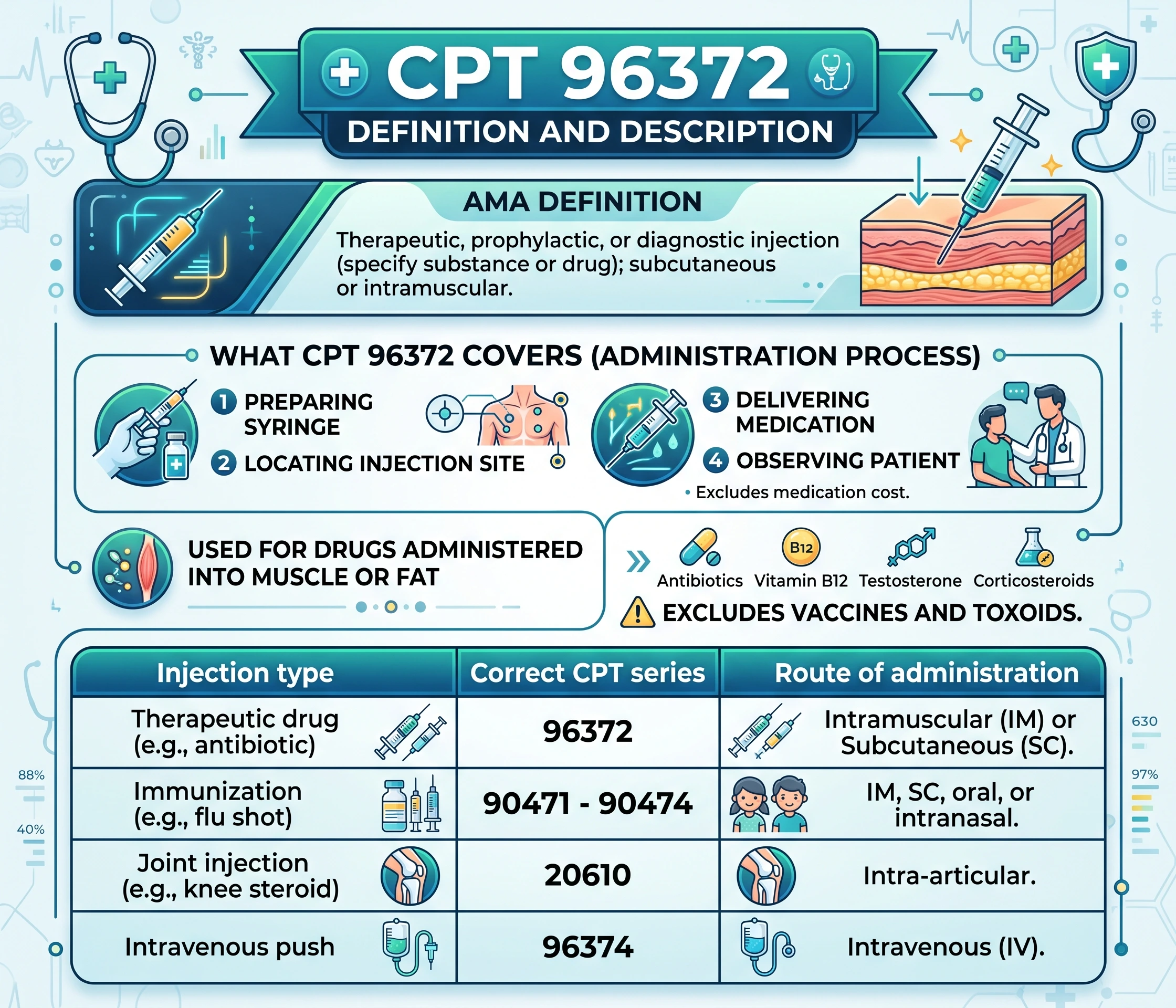
The AMA CPT codebook defines that same figure as a therapeutic, prophylactic, or diagnostic injection administered via the subcutaneous or intramuscular route, covering a single injection per administration. Three words in that descriptor carry real clinical weight: therapeutic, prophylactic, and diagnostic. They tell you the injection must serve a defined medical purpose tied to a patient's diagnosis, not simply represent a drug that happened to be given by needle.
That distinction places the coding decision in the exam room, not the billing queue. A note that records only "Toradol given IM" is clinically thin. A note that connects the drug, the route, and the clinical indication gives the billing team something to actually work with.
Providers who rely on real-time clinical capture are better positioned to lock in the specifics payers actually audit, because the window to get it right closes when the encounter ends.

Per the AMA CPT codebook, that same figure explicitly excludes intravenous push and infusion services (96374-96379), immunization administration (90471-90474), and drugs typically self-administered, such as routine home insulin injections. Billing staff who conflate that same figure with immunization administration codes introduce a denial pattern that traces back to a code selection error, not a modifier error. Two cases trip up billing teams regularly.
First, a patient who self-injects insulin at home cannot be billed under 96372; the code requires clinical staff administration. Second, an IV push falls outside that same figure entirely regardless of whether the drug could theoretically be given IM. The route determines the code, and the note has to name the route explicitly for that determination to hold up under audit.
Key takeaways
- CPT 96372 denials are almost never a coding error, they trace back to a provider note that failed to capture route of administration, drug identity, or who performed the injection before the claim was ever built.
- By the time a biller flags a deficient 96372 claim, the encounter is hours or days old and the clinical detail needed to fix it is gone, rework costs an average of $25 per claim in administrative labor, and that compounds fast across high-volume injection practices.
- Payers auditing 96372 aren't confirming that an injection happened; they're confirming that five specific documentation elements exist in the note, and missing any single one is sufficient grounds for denial regardless of modifier accuracy.
- The J-code for the drug and the administration fee for 96372 are separate revenue streams with separate documentation requirements; most practices protect one and leave the other exposed.
- A 90-day pull from your practice management system will show whether your 96372 denial pattern is random or structural, structural means the documentation gap repeats at the point of care, not the clearinghouse.
- iScribe Health's AI-powered scribing captures the clinical narrative in real time, inside your EHR, so the five elements payers audit are present in the note before the encounter closes, not reconstructed after a denial arrives.
CPT 96372 Billing Guidelines Practices Consistently Misapply
By the time a biller spots the deficiency and flags the claim, the encounter is hours or days old, the provider's recall has faded, and the clinical note already contains the gap that made denial inevitable.

Modifier 25 and the Same-Day E/M Service
When a patient receives a therapeutic injection on the same day as an office visit, Modifier 25 must be appended to the E/M code to signal that a significant, separately identifiable evaluation and management service occurred. A note that documents only the injection administration with a 99213 attached will be denied, because the note does not demonstrate separate medical decision-making.
The CMS NCCI Policy Manual is explicit: both services must be documented as distinct and medically necessary.
Because iScribe's Ambient Listening / Conversational AI captures the physician's clinical reasoning in real time, during the encounter itself, the distinct medical decision-making that Modifier 25 demands is recorded before the claim is ever built. At the point of note completion, iScribe captures physician dialogue and patient context during the visit to generate clinical notes in under 30 seconds, and the provider reviews a structured document that already reflects the separate clinical rationale for the office visit, eliminating the documentation gap before it can become a denial.
Why 96372 Is Reported Once Per Encounter
The code is reported once per encounter regardless of injection count, and the injectable drugs are billed separately using the appropriate J-codes for each substance administered.
This reflects how the CMS NCCI Policy Manual defines the administration code: it covers the administration service for the encounter, not for each individual syringe.
iScribe Health's E&M Coding Intelligence and Real-Time Denial Alerts surface unit-count mismatches before a claim leaves the practice, giving billing staff the opportunity to correct errors while the encounter detail is still fresh.
J-Codes and the Drug Billing Separation Rule
A persistent source of denials involves lorazepam injection: practices that continue to bill J2001 for lorazepam are using a discontinued code. J2001 was replaced by J2060, and claims submitted under J2001 are rejected on the basis of an invalid code, not a clinical documentation gap.
iScribe Health's Ambient AI Documentation captures the specific drug identity and route of administration at the moment of care, giving coders the accurate, current information needed to select the correct J-code from the outset.
The Vaccine-vs.-Therapeutic Distinction That Separates 96372 From 90471
Practices we work with tell us the ambiguity typically originates not in the billing team's knowledge but in notes that simply record "injection given" without specifying drug name or clinical indication. iScribe Health's Ambient Listening captures that specificity in the provider's own words during the encounter: drug identity, clinical purpose, and route, so the coder never has to guess whether the substance was a vaccine or a therapeutic agent.
Modifier 59 and CPT 96372 - When to Use It and What the Note Must Prove
Modifier 59 signals that a procedure or service is distinct from another service billed on the same date, typically because it was performed on a different anatomical site or at a different session.
iScribe Health's Ambient AI Documentation captures site-specific and indication-specific language at the point of care, the exact clinical detail that makes Modifier 59 defensible on audit, so the record is complete well before a reviewer ever requests it.
What CPT 96372 Includes and Excludes in the 2026 Code Set

What the 96372 Administration Fee Already Covers So You Don't Double-Bill It
The documentation gap that creates downstream denials is a charting workflow problem. iScribe Health's Ambient Listening and Conversational AI captures the route, supervision, and medical necessity language at the point of care, so by the time the encounter summary is drafted, the note already contains what the claim requires, before the biller ever touches it.
What Must Be Billed Separately and the Modifier That Makes It Legal
The modifier is necessary but not sufficient; the note must show that the E/M was a distinct clinical service. iScribe Health's E&M Coding Intelligence supports exactly this distinction: at the point of note completion, after the AI drafts the encounter summary, it applies automated E&M coding logic that surfaces the documentation needed to substantiate a separately identifiable service, reducing the risk that a legitimate Modifier 25 claim goes unsupported and gets denied.
CPT 96372 in the 2026 Code Set - Active Status and Quarterly NCCI Edit Changes to Monitor
This is the same environment where SLPs and other clinicians have felt the acute impact of disruptive CPT code changes, changes that affect clinical workflow and revenue with little runway to adapt.
iScribe Health's Real-Time Denial Alerts address this directly. Because the system integrates with supported EHRs and operates across every patient encounter on an ongoing basis, it does not rely on a periodic manual review to stay current, and edit changes are reflected in claim-level guidance as they take effect.
iScribe Health's ambient AI documentation captures the route, supervision, and medical necessity language at the point of care, so the note already contains what each quarterly edit cycle requires before the claim is ever built.
Documentation Requirements for CPT 96372 That Payers Actually Audit
Five elements appear in every Part B News audit guide for CPT that same figure, and the absence of any single one is sufficient grounds for denial, regardless of whether the correct modifiers were attached and the claim scrubbed clean before submission. That last part is the piece most billing teams miss: payers auditing that same figure claims are not confirming that an injection occurred. They are confirming that the medical record proves why that specific drug, at that specific route and dose, was clinically necessary for that patient's documented diagnosis at that visit.
Why CPT 96372 Documentation Must Be Captured at the Point of Care, Not After the Encounter
Once the encounter ends, the provider reconstructs the clinical narrative from memory rather than direct observation, introducing a structural accuracy risk that modifier training and claim scrubbing cannot correct. Route, site, and medical necessity rationale are real-time observations; they degrade the moment the patient leaves the room. Part B News confirms that rushed post-visit charting systematically omits exactly these elements, and their absence triggers denial independent of everything else the billing team does downstream.
Point-of-care capture is the earliest intervention available, and it is the only one that addresses the gap before it reaches the billing queue. iScribe Health's ambient listening and conversational AI surfaces audit candidates upstream, flagging documentation gaps at the point of note completion, after the AI drafts the encounter summary, so that missing elements are caught while the clinical context is still fresh. For practices already operating a supported EHR, EHR Integration means this capability drops into the existing workflow without a parallel charting environment. Structured templates and real-time ambient scribing both serve the point-of-care capture function; the right choice depends on injection volume and existing workflow.
1. The Five Clinical Elements Payers Audit in Every CPT Code 96372 Claim
Per industry research, a defensible that same figure note must capture five specific elements: drug name and dose, route of administration stated explicitly as SQ or IM, injection site, a diagnosis-linked medical necessity rationale, and a supervising provider statement. Payers audit for all five. The absence of any single element is sufficient grounds for denial, independent of modifier accuracy or pre-submission claim scrubbing. Billing staff who treat these as clerical details rather than auditable clinical observations are solving the wrong problem. Creating more defensible documentation begins with understanding that all five elements must be present in the record before the encounter closes, not reconstructed afterward.
2. Documentation That Proves an Injection Happened vs. Documentation That Proves It Was Medically Necessary

Part B News draws a sharp line between these two documentation standards: one confirms a procedure occurred, the other confirms it was clinically justified. A note reading "B12 injection given" satisfies the first standard and fails the second. A note reading "IM cyanocobalamin to right deltoid for confirmed B12 deficiency (ICD-10 E53.8), oral supplementation contraindicated due to malabsorption" satisfies both. Payers adjudicate against the second standard, which means procedural confirmation alone cannot prevent denial regardless of how cleanly the claim was coded. Practices that want to reduce audit risk must close this gap at the source, in the clinical note itself, during the encounter.
3. Point-of-Care Documentation as the Only Reliable Capture Window for CPT 96372
Once the patient leaves the room, the clinical narrative shifts from direct observation to memory reconstruction, a structural accuracy risk that disproportionately affects the nuanced elements payers audit. For CPT Code 96372, point-of-care documentation is the only window in which route, site, medical necessity rationale, and provider attestation can be captured with observed accuracy. Post-encounter charting is not a documentation style preference; it is a systematic fidelity problem with measurable denial consequences.
4. Complete CPT Code 96372 Documentation Requirements - What Must Appear in the Medical Record
The five required elements function as a linked chain, not an independent checklist. Drug name and dose anchor the J-code claim. Route of administration confirms the code is applicable.
Injection site establishes procedural specificity. Diagnosis-linked medical necessity connects the clinical decision to the patient's documented condition. The supervising provider statement satisfies the medical oversight requirement for reimbursement under Medicare and most commercial contracts.
Part B News (DecisionHealth) confirms that payers evaluate all five elements and that any single gap exposes the entire claim, independent of modifier accuracy or pre-submission claim scrubbing.
Practices that use iScribe Health's ambient AI documentation to capture these elements during the encounter, with EHR Integration delivering the AI-drafted note directly into their existing system at the point of note completion, create more defensible documentation across every patient encounter and every day of clinical practice. That ongoing, per-encounter benefit is where audit risk reduction compounds: not in a one-time chart review, but in the elimination of the structural documentation gap before it ever reaches the billing queue.
Related Reading
- Cpt Code 10060
- Cpt Code 12001
- Cpt Code 11200
Common CPT 96372 Claim Denials and How to Prevent Them Before Submission
When any one of those five elements is missing, the financial damage extends well beyond the rejected line item. Per industry benchmarking data, reworking a single denied claim can run into tens of dollars or more per claim in staff time, appeals overhead, and delayed cash flow, with costs varying by practice size and claim complexity. Multiply that across a billing queue where CPT that same figure denials are routine, and the number becomes a revenue problem with a documentation origin, one that grows more acute in high-volume practices where clinicians are already charting two or more hours outside of patient care time.
The five denial types below share one upstream cause: the provider note reached the biller without the clinical specificity needed to apply the rules. Coders do not invent injection routes, diagnosis linkages, or supervision statements. They can only code what the note says. Accurate, compliant medical coding across high patient volumes depends entirely on that upstream note quality, which is why documentation discipline and coding intelligence must work together from the moment the encounter begins.
1. Missing Modifier 25 on Same-Day E/M - The Most Common CPT Code 96372 Denial
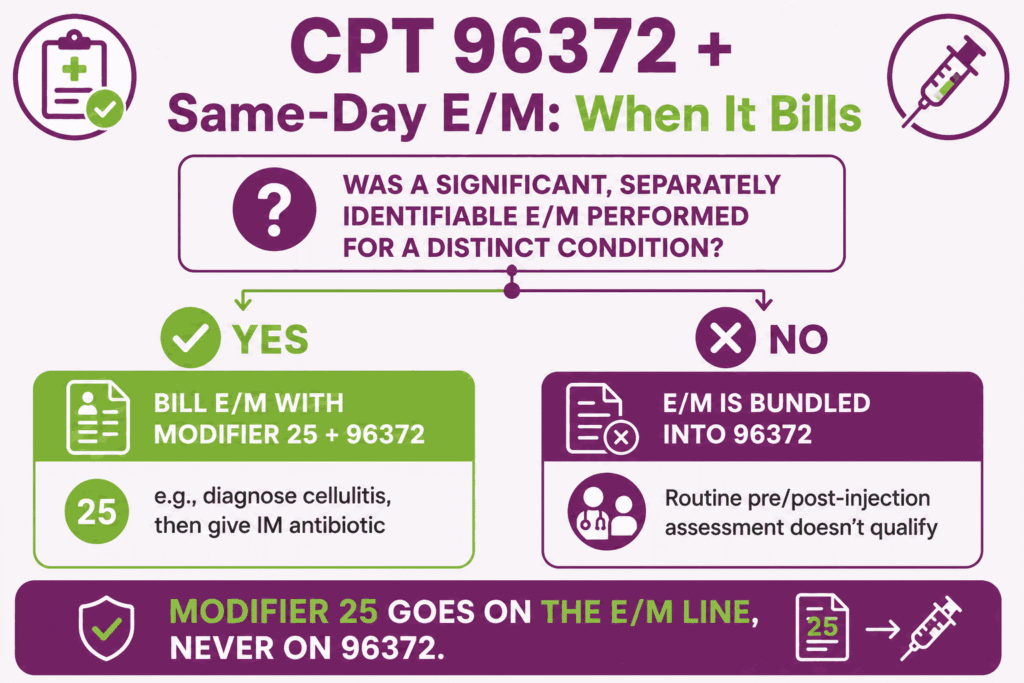
When the provider note folds the visit reason and the injection rationale into a single narrative, the biller has no clinical basis to assert a distinct E/M service. Prevention happens at the encounter: the provider documents the decision-making that prompted the visit independently from the injection order. iScribe Health's E&M Coding Intelligence flags this distinction at the point of note completion, after the AI drafts the encounter summary, so the separately identifiable service is explicit before the claim is ever built.
2. Wrong Code Selected - CPT 96372 vs. 90471 for Vaccines and vs. 96374 for IV Push

Code confusion between 96372, 90471, and 96374 produces immediate claim rejections because payers cross-check the billed code against the drug type and route. A vaccine administered intramuscularly belongs under 90471, not 96372. An intravenous push belongs under 96374. The fix is a note that explicitly states the drug category and administration route, giving the coder unambiguous selection criteria before the claim is built. Integral Clinic Solutions iScribe Health's Ambient Listening and Conversational AI captures route-of-administration language in real time during the encounter, surfacing it in the drafted summary so the coder never has to infer what the note left unstated.
3. Unbundling Errors - Billing Supply Codes Separately Alongside CPT Code 96372
Separately billing syringe supply codes (such as A4206) or J-codes when the payer bundles them into that same figure triggers automatic denial. The error looks like a coding mistake, but it originates when the note documents the drug and supplies without flagging the payer's bundling policy. Pre-submission, coders must verify each payer's bundling rules against the drug documented in the note. SPRY PT Practices billing multiple payers without payer-specific edits built into their workflow will keep hitting this denial repeatedly. iScribe Health's Real-Time Denial Alerts surface these bundling conflicts before a claim leaves the queue, giving billing staff an actionable flag rather than a post-submission rejection.
4. Inadequate Medical Necessity Documentation - When the Diagnosis Doesn't Support the Injection
A claim denied for medical necessity usually means the note documented what was administered but not why it was clinically indicated for a confirmed diagnosis. Payers audit the rationale, not just the act. A note that records "IM ketorolac administered" without linking it to a documented pain diagnosis and a clinical decision gives the payer no coverage hook. SPRY PT The prevention step is a diagnosis-linked rationale written during the encounter, not reconstructed afterward. iScribe Health's Ambient AI Documentation captures that clinical reasoning as it is spoken, embedding the diagnosis-to-treatment linkage in the note before the patient leaves the room, eliminating the addendum cycle that delays reimbursement by weeks and risks payer rejection when the correction appears self-serving.
5. Pre-Submission Checklist - Five Note Elements to Verify Before Every CPT Code 96372 Claim Goes Out

Before any that same figure claim leaves your queue, the note must confirm: drug name and dose, route of administration stated explicitly (subcutaneous or intramuscular), injection site, a diagnosis that supports medical necessity, and a supervising provider statement. Billing staff who receive notes missing any of these elements face a choice between holding the claim or submitting blind. Every addendum request consumes 15 to 30 minutes of provider time, delays reimbursement by weeks, and risks payer rejection if the addendum appears self-serving, a burden that compounds in high-volume practices where clinicians are already stretched thin.
At the point of note completion, after the AI drafts the encounter summary, the system validates that all five elements are present before the note moves downstream. For practices running a supported EHR, EHR Integration ensures this validation is embedded in the existing workflow, no parallel system, no duplicated entry. The note arrives at the biller complete, every time.
6. Medicare vs. Commercial Payer Variance in CPT Code 96372 Documentation Requirements

Medicare enforces a strict one-unit-per-encounter limit for that same figure regardless of injection count, while many commercial payers allow unit billing tied to each discrete injection with separate documentation. Practices operating under a single documentation template for all payers will either undercode commercial claims or trigger Medicare edits. The practical fix is a payer-specific documentation prompt that flags the correct unit and supervision standard at the point of care, not at the clearinghouse. iScribe Health's AI Customization capability allows practices to configure payer-specific documentation prompts that surface the correct unit and supervision language during the encounter itself, keeping coders aligned with each payer's rules across every patient visit and every day of clinical practice.
Preventing denials protects revenue, but it does not tell you how much a clean, fully documented that same figure claim should actually generate. The next section breaks down reimbursement rates by payer type and explains exactly which documentation variables move your payment up or down from the published fee schedule.
CPT 96372 Reimbursement Rates and What Determines Your Payment in 2026
Most practice administrators focus their energy on the contracted rate for the administration code and treat the rest as fixed, but that narrow focus leaves meaningful revenue unexamined.

Facility vs Non-Facility Rates and the Dollar Impact of Where You Administer the Injection
Those rate differences compound across high-volume injection schedules, making regular reimbursement audits essential. Simplifying that reimbursement audit, so payment discrepancies surface before they compound, is precisely the kind of workflow problem iScribe Health is built to address.
The J-Code Revenue You're Leaving on the Table When the Note Is Vague
Under Medicare Part B, the injectable drug is billed separately from the administration code using the appropriate J-code, reimbursed at ASP plus 6% according to the CMS Physician Fee Schedule Search Tool (2025), making the drug reimbursement the larger revenue component of the encounter in most cases. That reimbursement, however, depends on documentation that clearly identifies the drug, dose, and route, vague notes routinely trigger denials or downcoding on the J-code claim.
This is where iScribe Health's ambient documentation works directly on the problem. Through ambient listening and conversational AI, iScribe Health captures drug name, dose, and route at the point of care, closing the documentation gap before the encounter ends, not after a denial arrives. Because iScribe Health integrates with supported EHRs, the AI-drafted encounter summary materializes at the point of note completion, already containing the specificity that J-code adjudication requires.
Contracted rates for CPT codes commonly exceed Medicare but vary significantly by contract and region, making the CMS Physician Fee Schedule Search Tool a useful baseline for auditing whether your commercial agreements are paying at or above that floor.
Related Reading
- Cpt Code 71045
- Cpt Code 99406
- Cpt Code 17110
Why Fixing Your 96372 Denial Rate Starts in the Exam Room Not the Billing Queue
Closing the gap between those two moments is the intervention that moves the denial rate down for that same figure.
The most durable denial-prevention strategy for that same figure is closing the gap between where clinical information is generated and where it is recorded. No modifier training or clearinghouse edit can recover clinical facts that were never observed and recorded in the moment, so the denial prevention workflow must begin at the exam room encounter, not the billing queue.

How the Clinical Note Sets the Ceiling on What Billing Can Recover for CPT 96372
MGMA research has consistently found that documentation errors account for a larger share of claim denials than pure coding errors, which inverts the assumption most billing teams operate under. The clinical narrative the provider writes during or immediately after the encounter sets an absolute ceiling on what billing can recover. If the note doesn't establish route of administration, medical necessity rationale, or supervision status, the modifier logic your billing team knows cold becomes irrelevant. What the note omits, no downstream process can restore.
How Post-Visit Charting Creates the Documentation Gaps Payers Exploit
Research in health informatics has consistently found that physicians frequently complete encounter notes well after the patient leaves the room, relying on memory rather than real-time observation, with the delay introducing structural accuracy risks that downstream claim scrubbing cannot correct. That lag is where specificity disappears, and payers are positioned to exploit exactly those gaps.
For that same figure specifically, the omissions that trigger denials are not obscure edge cases. Payers need a reason to deny, and an incomplete note hands them one.
Capturing CPT 96372 Documentation in Real Time - How to Prevent Denials Before the Claim Is Built
A practice that captures the clinical narrative during the encounter, not after it, eliminates the memory-dependent reconstruction step where specificity is lost, and that shift alone changes what billing has to work with before a claim is ever built.
The compounding effect across every injection encounter where documentation was close enough to submit but not complete enough to survive audit is where the real cost accumulates. iScribe Health's AI medical scribe captures the clinical narrative in real time during the encounter, so route, necessity language, and supervision detail are already in the note before the provider moves to the next patient, not reconstructed an hour later when the specifics have blurred.
Next steps
If your denied 96372 claims keep coming back despite correct modifiers and clean pre-submission scrubs, the path forward starts with recognizing that the denial originates in the exam room, not the billing queue. Modifier accuracy is a filter applied to existing documentation. When the clinical note never captured route of administration, medical necessity rationale, or a supervising provider statement, that filter has nothing defensible to work with. Start with our AI medical scribe.
The five auditable elements payers require in every 96372 note are real-time clinical observations that exist only at the moment of care, not billing artifacts coders can reconstruct afterward. That fact alone makes post-visit charting the structural source of most that same figure denials. Combine it with the reality that the J-code drug claim, reimbursed at ASP plus 6% and typically the larger revenue item in the encounter, fails independently when the note lacks drug-specific documentation, and the compounding revenue loss becomes visible. Together, they point to one intervention: capturing the complete clinical narrative during the encounter itself, before the provider moves to the next patient.
Start with an AI medical scribe that captures route, necessity language, supervision detail, and drug specifics in real time, so the note the biller receives is already complete before the claim is ever built.
Frequently Asked Questions
If I give a patient three IM injections in one visit, do I bill 96372 three times?
No. CPT 96372 is reported once per encounter regardless of how many injections were administered. Each injectable drug is billed separately on its own J-code line, but the 96372 administration code covers the clinical act of administering an injection that day, not each individual syringe.
What's the difference between CPT 96372 and CPT 90471, and does it matter which one I use?
It matters significantly. CPT 90471 covers immunization administration for vaccine injections only, while CPT 96372 covers therapeutic, diagnostic, or prophylactic non-vaccine subcutaneous or intramuscular injections. The distinction is the type of substance being administered, not the route, billing a flu shot under 96372 or a ketorolac injection under 90471 is the wrong code in either case and can produce underpayments or trigger overpayment recovery.
When a patient gets an injection and an office visit on the same day, what does Modifier 25 actually require?
Modifier 25 must be appended to the E/M code to signal that a significant, separately identifiable evaluation and management service occurred on the same day as the injection. The payer is looking for clinical language in the provider note that proves the E/M addressed a problem distinct from the injection itself, the modifier alone is not sufficient if the note doesn't contain independent clinical reasoning for the office visit.
Do I bill the drug separately from 96372, or is it included in the administration code?
The drug is always billed separately. CPT 96372 bundles only the administration act, preparation, supplies, and nursing time, and the administered drug must appear as a separate line item using the appropriate J-code. Omitting the J-code leaves revenue on the table, and bundling the drug into 96372 triggers a rejection.
Can a patient who self-injects insulin at home be billed under 96372 during an office visit?
No. CPT 96372 requires clinical staff administration, so a drug that is typically self-administered, such as routine home insulin injections, is explicitly excluded from the code. Billing 96372 in that scenario is a code-selection error, not a modifier issue.