How to Use CPT Code 90471 for Immunization Billing
CPT code 90471 billing gaps start in the chart, not the claim. Help billing teams avoid documentation errors that cost reimbursement.


Most immunization billing errors start before the coder touches the chart. Here is what CPT 90471 actually requires in the clinical note, and where the gaps are costing practices revenue.
The common assumption among practice administrators and billing decision-makers is that if the billing team knows CPT 90471 cold, the add-on rules, the age exceptions, the modifier requirements, the claims will go out right. In practice, that assumption breaks down well before the claim reaches the biller, because the problem is documentation. See our AI medical scribe for how this works in practice.
CPT code 90471 covers the professional act of administering the first injectable vaccine. It does not cover the vaccine product, the office visit, or any additional injections given at the same encounter. That distinction sounds simple, but it is the exact point where immunization billing falls apart for most practices.
Understanding the code at a definitional level is the first step toward building claims that hold up under payer scrutiny, and it is where clinical documentation quality becomes the deciding variable long before a coder ever opens the chart.
CPT 90471 is defined by the AMA as: "Immunization administration (includes percutaneous, intradermal, subcutaneous, or intramuscular injections); one vaccine (single or combination vaccine/toxoid)." That definition describes a professional service, not a supply. The code exists to reimburse the clinical work surrounding the injection: the preparation, the physical administration, and the documentation of what was done and how.
The AMA's definition also specifies route. Percutaneous, intradermal, subcutaneous, intramuscular, each of those terms must appear somewhere in the clinical record for the code to be defensible. When the note reads "vaccine given" and nothing more, the code is technically unsupported, even if the coder applies it correctly.

CPT that same figure reimburses the administration service only. The vaccine product itself requires a separate, distinct CPT code billed on the same claim. As the AMA's preventive services reference makes clear, "the vaccine product is reported separately using its own CPT code." Research published in Vaccine confirmed that Medicaid reimbursement policy for adult immunizations treats the vaccine code and the administration code as distinct, separately billable components. A practice that bills only that same figure for an MMR encounter forfeits the supply reimbursement tied to the vaccine product code entirely, a systematic revenue loss that compounds across every vaccine encounter billed the same way.
The professional service that same figure describes has three components: preparation, physical administration, and post-administration documentation. Preparation includes verifying the correct vaccine, confirming immunization history, and drawing up the dose. Physical administration means the injection itself, including route and anatomic site.
Post-administration documentation covers the vaccine name, lot number, route, and patient instructions. When the note omits any component, the claim becomes either underbilled or audit-vulnerable, because the payer has no source document confirming a complete professional service was rendered. iScribe Health's AI-powered scribing captures all three components in real time, preparation, physical administration, and post-administration documentation, so the note the coder receives already reflects the full professional service.
The coder's job becomes confirmation, not reconstruction.
CPT 90472 is defined by the AMA as: "Immunization administration (includes percutaneous, intradermal, subcutaneous, or intramuscular injections); each additional vaccine (single or combination vaccine/toxoid)." That definition makes 90472 an add-on code, which means it cannot appear on a claim without 90471 as the primary service, and it cannot be billed as a standalone charge under any circumstance. Each additional injectable vaccine administered at the same encounter generates one unit of 90472, not one unit of 90471.
Coders who apply 90471 for every injection at a multi-vaccine visit are billing the primary code in a position it was never designed to occupy, producing claims that fail edit checks or trigger downcoding on adjudication. The route documentation requirement that applies to 90471 applies equally here: the clinical note must specify percutaneous, intradermal, subcutaneous, or intramuscular for each injection tied to an add-on unit, or the add-on charge is unsupported at the source document level regardless of how accurately the coder applies the code.
CPT 90473 covers the first intranasal or oral vaccine administered at an encounter; CPT 90474 is its add-on, covering each additional intranasal or oral vaccine at the same visit. The AMA defines both codes in parallel structure to the injectable pair, which means the same primary-and-add-on logic applies, the same route specificity requirement applies, and the same separate vaccine product billing requirement applies.
Where practices lose revenue in this code family is at the intersection of mixed-route encounters: a patient who receives an intramuscular influenza injection and an oral rotavirus vaccine at the same visit generates both 90471 and 90473, one primary code per route family, not one primary and one add-on. When the clinical note fails to distinguish route clearly for each vaccine administered, the coder cannot reconstruct the correct code pair from the documentation alone, and the encounter is either undercoded or held for clarification. iScribe Health's real-time AI scribing captures route, site, and vaccine identity for every administration event as it occurs, so mixed-route encounters produce notes that already contain the documentation architecture both code families require, eliminating the reconstruction problem before it reaches the coding queue.
Key takeaways
- CPT 90471 errors almost never start at the billing desk, they start in the clinical note, where missing or rushed documentation forces even experienced coders to guess.
- The code selection decision is three-variable: patient age, documented counseling status, and payer type. Miss any one, and the wrong code family gets applied regardless of coder training.
- Add-on code stacking for multiple vaccines in a single encounter produces inconsistent claims when different providers document the same visit differently, and that inconsistency becomes an audit finding, not a training opportunity.
- Modifier 25 errors on same-day E/M visits cost practices twice: once in the denied charge, and again in post-payment recoupment after a retrospective audit pulls the records.
- A 33% overcoding rate across 941 vaccine encounters at one orthopedic center went undetected until an automated audit ran, routine internal review missed it entirely.
- iScribe Health's AI-powered documentation captures the clinical detail CPT 90471 requires, counseling status, injection site, vaccine identity, in real time, so the note that reaches the biller is complete before the patient leaves the room.
CPT 90471 Billing Rules That Catch Most Practices Off Guard
CPT that same figure carries a specific set of billing rules, add-on logic, age exceptions, modifier requirements, and most billing teams know them well. What those rules also carry, less visibly, is a documentation fingerprint: a set of clinical details the note must contain before any of that coding knowledge can be applied without risk. When the note arrives compressed or reconstructed from memory, the rules the billing team knows perfectly become impossible to verify, and that is the gap where denials begin. In high-volume practices where clinicians are already charting well beyond patient care time, that reconstruction isn't an edge case; it's the default state of every encounter.
1. CPT Code 90471 Bills Only Once Per Day - Use 90472 for Every Additional Shot
One of the most costly CPT Code 90471 billing mistakes is reporting it multiple times on the same date of service. Regardless of how many vaccines a patient receives in a single visit, 90471 is limited to one unit per day. Each subsequent injection must be billed with add-on code 90472. Practices that miss this rule face systematic claim denials and potential overpayment recoupment audits.
2. Billing Is Per Physical Injection, Not Per Antigen - MMR Still Counts as One Unit
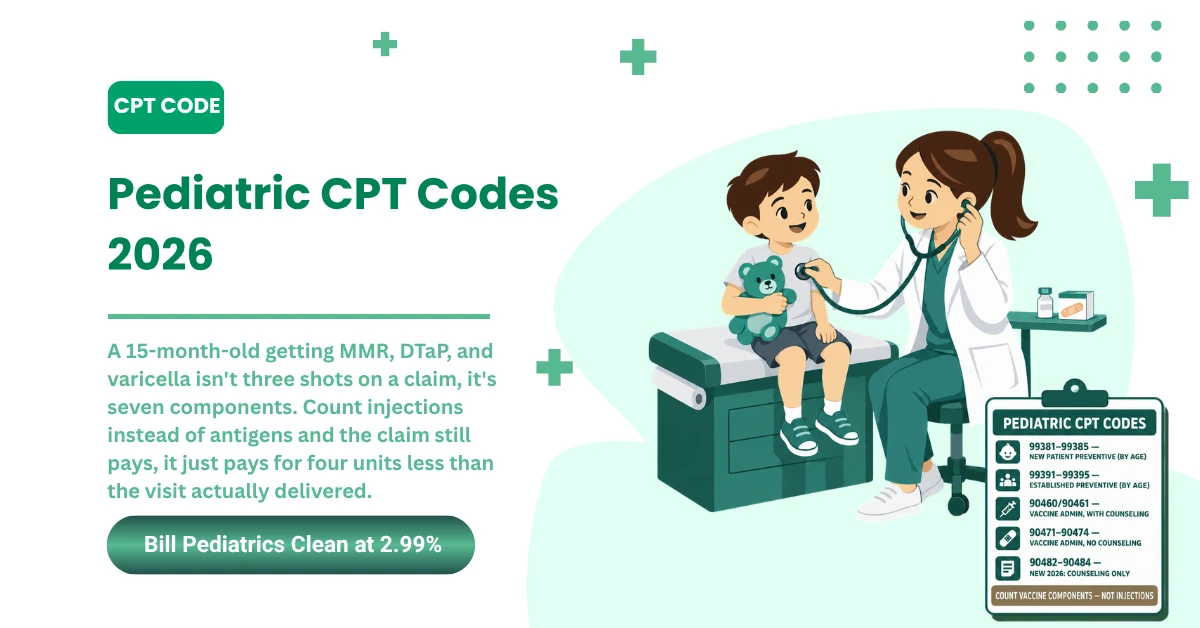
A frequent misunderstanding among billing staff is equating antigen count with billable units. CPT Code 90471 is tied to the physical act of injection, not the number of disease components in a vaccine. The MMR vaccine, which protects against measles, mumps, and rubella, is administered as a single injection and therefore counts as one unit of 90471, not three. Overcounting antigens leads to overbilling and audit exposure.
3. No Age Restriction When Face-to-Face Counseling Is Absent - Any Patient Qualifies
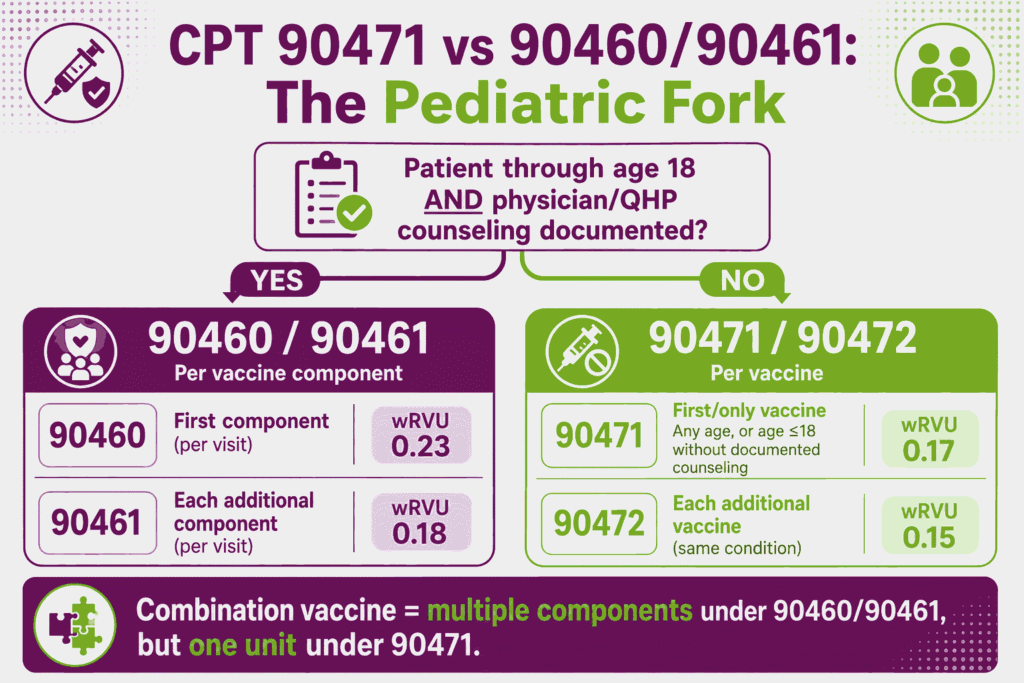
The age-restriction misconception costs adult immunization programs real revenue. CPT 90471 carries no age restriction when face-to-face physician counseling is not performed. Any patient qualifies, pediatric or adult, as long as counseling did not occur during that encounter. Per the Florida Medicaid Vaccine Administration Rates Policy (April 2021), this is a common source of silent claim errors when billing teams assume the age-based counseling requirement always applies.
The deciding variable is counseling status, not patient age. When counseling does occur for patients 18 and under, the code family shifts entirely. But when a nurse or MA administers a vaccine with no physician counseling involved, that same figure applies across the board. The clinical note must capture whether counseling occurred and by whom. Without that field, the coder has no reliable basis for the decision, and the wrong code goes out either way.
Most practices handle this through post-visit documentation review, but that review happens after the encounter is over and the detail is gone. The missing note element is what makes the rule unverifiable when a payer pulls records.
This is where the burden concentrates most heavily in high-volume practices: clinicians already charting well beyond patient care hours have no reliable margin to reconstruct a counseling-status judgment they didn't explicitly note in the moment. iScribe Health's ambient AI documentation is designed to capture route of administration, injection count, and counseling status in real time during the encounter, through ambient listening and conversational AI, so the documentation checkpoint is built into the workflow rather than added to an after-hours queue. At the point of note completion, after the AI drafts the encounter summary, iScribe's E&M Coding Intelligence and Real-Time Denial Alerts surface any gaps before the claim is submitted, giving billing teams a defensible record rather than a reconstructed one.
For practices already running a supported EHR, EHR integration means that record flows directly into the existing system without a parallel documentation step.
Each of these rules has a mirror image in the clinical note: a field that must be present for the code to hold up under scrutiny. Once a patient receives more than one vaccine in a single visit, a second code family enters the claim, and the documentation requirements multiply. The practices that keep those requirements met consistently are the ones where capture happens during the encounter, not after it.
Related Reading
- Urgent Care Cpt Codes
- Annual Wellness Visit Cpt Code
- Cpt Code 96372
Add-On Codes for Multiple Vaccines During the Same Encounter
Three injectable vaccines given in a single pediatric well visit. One billing team. Three different ways the claim gets built, depending on whose documentation they're working from.
That inconsistency is a documentation problem, and it surfaces at audit time in the worst possible way. The stakes are real: according to the CDC Morbidity and Mortality Weekly Report (MMWR), Vol. 66 No. 43, vaccine coverage among U.S. children remains high, so pediatric well visits are a sustained, high-volume workflow, and every claim built on inconsistent documentation represents compounding audit exposure across a large number of encounters per year.
1. CPT 90472 - Add-On Code for Each Additional Injectable Vaccine Beyond the First
CPT 90472 adds one billable unit for each injectable vaccine administered after the first, which is anchored to 90471 (as covered in the preceding section). A child receiving flu, Hep A, and varicella at a single visit generates one unit of that same figure plus two units of 90472, according to immunization billing guidance from the AAFP. The critical constraint: each unit follows the physical injection, not the antigen count. MMR counts as one unit, not three.
Coding consistency across providers breaks down at the add-on unit level, because this is where the same multi-vaccine encounter gets coded differently depending on which nurse documented it and which coder picked up the claim. iScribe Health's Ambient AI Documentation captures each vaccine administration event discretely in real time, so every add-on unit is anchored to its own clinical entry before the encounter closes, rather than reconstructed from a collapsed nursing note after the fact.
2. CPT 90473 - First Oral or Intranasal Immunization Administration Code
CPT 90473 covers the first vaccine administered orally or nasally, and it operates independently from the injectable code family. An adult visit combining intranasal FluMist with an intramuscular Tdap, for example, generates both 90473 (for the nasal route) and 90471 (for the injection), according to industry data. Sequencing matters here: payers vary on whether that same figure or 90471 leads the claim, so confirm payer-specific guidance before submitting.
Coding consistency across providers breaks down quickly at this point. When one provider dictates route explicitly and another relies on a templated nursing entry, the claim architecture differs on the same encounter type because the documentation differs, not the clinical facts. iScribe Health's Ambient Listening and Conversational AI captures route of administration as part of the live encounter narrative, reducing the provider-to-provider variation that drives inconsistent claim construction downstream.
3. Multi-Vaccine Encounter Documentation - Vaccine Name, Lot Number, Route, and Anatomic Site
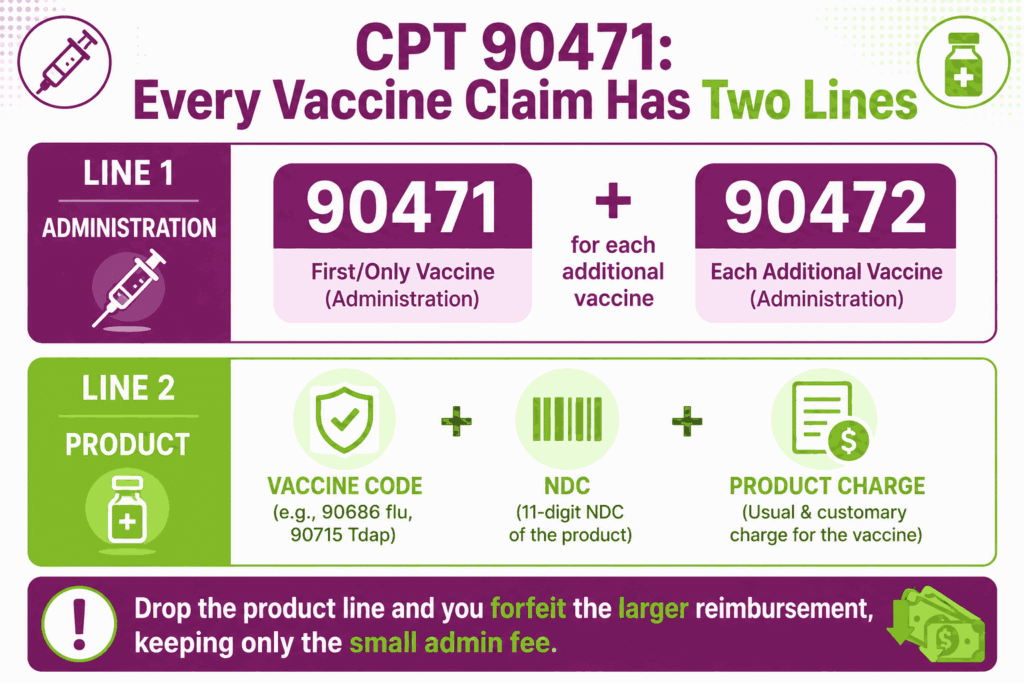
A coder who correctly identifies that multiple vaccines were given still cannot build a defensible 90472 claim without a clinical note that records, per injection: vaccine name, lot number, route of administration, and anatomic site. When nursing staff administer four vaccines and document them in a single templated entry, every add-on unit beyond the first becomes indefensible on audit. The note must anchor each unit individually before the claim is built, not reconstructed afterward from memory.
The CDC Morbidity and Mortality Weekly Report (MMWR), Vol. 66 No. 43 confirms that multi-vaccine well visits are the norm, not the exception, in pediatric practice, which means the documentation gap described above recurs at volume.
iScribe Health's ambient AI documentation accurately captures clinical notes during the patient encounter, producing a per-injection record that includes the specificity, name, lot number, route, and anatomic site an auditor requires for each add-on unit, generated at the point of care rather than after the encounter closes. Practices integrated with a supported EHR can have that structured note flow directly into the chart through iScribe Health's EHR Integration, so the per-injection detail is available to the coder without a separate documentation retrieval step.
4. FAQ - Can CPT 90471 Be Billed Twice for Two Injections at the Same Visit?
A common billing error is submitting two units of 90471 when a patient receives two injectable vaccines in one visit. The correct approach is to bill 90471 once for the first injection and 90472 for each subsequent injection. Payers will typically deny or bundle a second unit of 90471 billed on the same date of service. Understanding this distinction prevents claim rejections and potential compliance exposure for practices with high immunization volumes.
5. FAQ - Correct Coding for MenQuadfi (Meningococcal Vaccine) Administration

MenQuadfi, a meningococcal conjugate vaccine, is billed using its vaccine product code (e.g., 90734) paired with an administration code, 90471 if it is the first injectable vaccine given at that encounter, or 90472 if another injectable vaccine was already administered during the same visit. Coders must not bill 90471 twice simply because MenQuadfi is a separate product. The tradeoff: selecting the wrong administration code based on product identity rather than injection sequence is a frequent audit finding.
Patient Age Considerations and Payer Exceptions That Override 90471
Age alone does not determine which vaccine administration code applies. The decision gate is two-variable: age plus documented counseling status. A third dimension, payer type, can override both. Miss any one of the three, and a fully trained coder will still select the wrong code family.
"Providers are unaware that 90471 applies specifically to adult patients, and a separate code set (90460/90461) applies to pediatric patients, leading to missed or incorrect billing."
— what we hear from medical billing professionals
One of the most persistent struggles in pediatric billing is the assumption that confirming a patient's age settles the code family entirely. Providers and billing teams routinely bill CPT that same figure for pediatric patients when 90460 is the correct code, not out of ignorance of the rules, but because age-based code selection creates genuine confusion at the point of documentation. The result is either missed revenue or a claim that misrepresents the encounter.
1. Use 90460 (Plus 90461 Add-On) Instead of CPT Code 90471 for Patients 18 and Younger Receiving Face-to-Face Counseling
When a physician or other qualified healthcare professional provides face-to-face vaccine counseling to a patient aged 18 or younger, CPT code 90471 is not the correct choice, the encounter falls under the 90460/90461 code family. The counseling element fundamentally changes the coding pathway. The tradeoff: if counseling is not documented as face-to-face and physician-led, the practice loses eligibility for 90460 and must revert to 90471.
2. Medicare Requires G0008, G0009, and G0010 - Not CPT Code 90471 - for Flu, Pneumococcal, and Hepatitis B Vaccines
Medicare does not recognize CPT code 90471 for three of the most commonly administered vaccines: influenza (G0008), pneumococcal (G0009), and hepatitis B (G0010). Billing 90471 for these vaccines to Medicare will result in denial. Practices that serve a high Medicare population must build payer-specific edits into their billing workflow to catch these substitutions before claim submission, as the workaround is non-negotiable for this payer.
3. The Pediatric vs. Adult Coding Decision Tree Hinges on Counseling Documentation, Not Age Alone
A common assumption among billing teams is that confirming a patient's age settles the code family. In practice, age is only the first axis. As AAPC's My Pediatric Coding Alert makes clear, coders must confirm whether counseling occurred and who provided it before any code selection is valid.
A 10-year-old who receives a vaccine without documented provider counseling does not qualify for that same figure. The selection between code families is a two-variable matrix that coder training addresses only halfway: coders learn the rules, but the clinical note must independently confirm both variables. When it does not, even a fully trained coder is forced to choose by assumption.
iScribe Health's ambient listening captures the counseling interaction as it happens, preserving who provided it, that it occurred face-to-face, and in the context of which vaccine, so the note is complete before coding begins, not reconstructed after the fact.
4. Pair ICD-10-CM Code Z23 With CPT Code 90471 for Routine Preventive Immunization Encounters Across Commercial and Medicare Payers
Z23, Encounter for immunization, is the correct ICD-10-CM diagnosis code to link with vaccine administration claims, including those using CPT code 90471, across both commercial and Medicare payers. Using an unrelated or overly specific diagnosis code in place of Z23 for a routine immunization visit is a frequent cause of medical necessity denials. The limitation: Z23 applies to routine preventive encounters only; therapeutic or catch-up immunizations in clinically complex patients may require additional specificity.
5. State Medicaid and Commercial Payer Exceptions Can Override CPT Code 90471 Eligibility Regardless of Age or Counseling Status
Beyond Medicare's G-code mandates and the pediatric 90460 pathway, individual state Medicaid programs and commercial payers may impose their own coverage rules that supersede standard CPT code 90471 billing, including bundling 90471 into the E/M or preventive visit payment, requiring prior authorization for certain vaccines, or mandating alternative codes entirely. Practices must maintain payer-specific fee schedule lookups and verify coverage policies annually, as these exceptions are not standardized and change frequently.
Related Reading
- Cpt Code 10060
- Cpt Code 12001
- Cpt Code 11200
How to Bill Immunization Administration Alongside a Same-Day Office Visit
Appending Modifier 25 to the wrong code is one of the most audited billing mistakes in primary care, and it costs practices twice: once in the denied E/M charge, and again in the post-payment recoupment that follows a records pull.

Modifier 25 Belongs on the E/M Code, Not on 90471
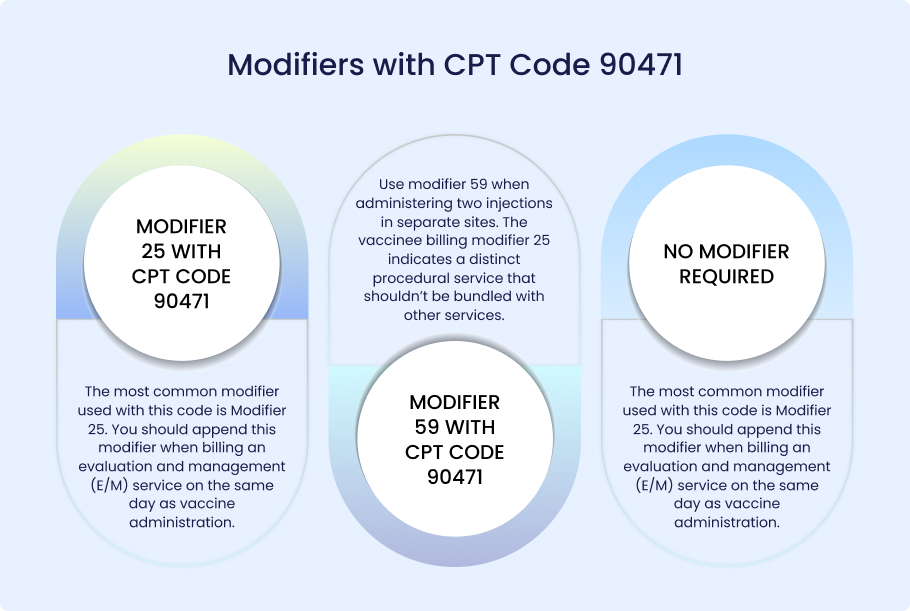
Modifier 25 attaches to the evaluation and management code, never to the administration code. Across the market, it must be appended to the E/M code when a separately identifiable evaluation and management service is performed on the same day as an immunization administration.
What Separately Identifiable Actually Requires in the Clinical Note
If the note describes only the vaccine encounter, Modifier 25 creates audit exposure rather than protecting the claim. PRC PMD Medical Billing's 2024 analysis states this directly: the E/M service billed with Modifier 25 must reflect medical decision-making or history and exam that is distinct and separate from the pre-service work inherent to the procedure itself.
Practices that train coders to append Modifier 25 correctly but do not enforce what the physician must write are solving only the billing half of a two-sided documentation problem. Research confirms the scale of this burden: primary care physicians spent almost 6 hours in the EHR per day, including 1.4 hours outside of normal clinic hours.
iScribe Health's ambient AI documentation is designed to deliver the greatest value in exactly this environment: a completely hands-free documentation experience during the encounter that captures the distinct E/M narrative and the vaccine administration record in real time, so the clinical detail that supports a Modifier 25 attestation exists before the claim is built rather than being reconstructed from memory afterward.
The Four-Component Claim Stack for a Same-Day Office Visit and Immunization
The correct code combination, what most teams working this encounter type report as the standard approach, is: an E/M code with Modifier 25, the administration code, and the vaccine product code, each requiring its own documentation anchor in the medical record.
iScribe Health's ambient listening captures each of these documentation anchors conversationally during the visit, and Real-Time Denial Alerts surface coding inconsistencies before a claim goes out, so the pattern of a Modifier 25 attestation unsupported by a distinct E/M narrative is caught at the encounter level rather than discovered in a payer audit weeks later.
Why Vaccine Coding Errors Survive Coder Training and What Actually Fixes Them
A 33% overcoding rate discovered across 941 vaccine encounters at Center for Sports Medicine & Orthopaedics did not surface through routine internal review, and that single finding reframes the entire conversation about vaccine billing compliance: the problem was never what coders knew. The problem was what the clinical note failed to say before the coder ever opened the chart.

Why the Same Coder Produces Different Codes for Identical Vaccine Encounters
When three providers document the same multi-vaccine encounter three different ways, route of administration appears in one note, is absent in the second, and counseling is mentioned in the third but not the first. The coder receives three structurally different documents and, applying identical training to each, produces three different codes. That is not a training failure. That is a documentation consistency failure, and no amount of coder education changes what arrives in the queue.
The Invisible Compliance Gap - How Overcoding and Undercoding Hide Until a Payer Pulls Records
Errors in both directions, overcoding and undercoding, share one trait: they are silent until external pressure exposes them. A practice billing team that passes every that same figure quiz will still produce variable claims because the deficiency lives upstream, in the note, not downstream in the coder's decision. Research from the same orthopedic audit confirms that compliance failures of this scale remain invisible without automated audit infrastructure. "Until they ran the trial, no one in the building knew the split."
This is the structural gap that training-based interventions cannot close. Errors enter the revenue cycle from at least two directions simultaneously: upstream from documentation deficiencies and downstream from payer adjudication anomalies. Addressing only coder knowledge leaves both vectors open.
The Structural Fix - Enforcing Documentation Completeness at the Point of Care
By the time the deficiency is visible, the claim is already built on a flawed foundation. Ambient AI documentation platforms with real-time coding validation close this gap by enforcing completeness at the point of care, capturing route, injection count, and counseling status before the note is finalized.
iScribe Health's AI medical scribe applies automated E&M coding logic in real time, so the note arriving at the coder's queue already contains the clinical detail required to produce a defensible, accurate claim without a second pass. The tool earns its place when documentation inconsistency across multiple providers is the actual driver of claim variance.
Related Reading
- Cpt Code 71045
- Cpt Code 99406
- Cpt Code 17110
Next steps
If your vaccine encounters keep producing denials despite a billing team that knows the code rules, the path forward starts with fixing documentation before the claim is built, not after. Start with our AI medical scribe.
The orthopedic audit finding, a 33% overcoding rate invisible until automated review ran, shows that coder proficiency does not prevent errors born upstream in the clinical note. The Modifier 25 analysis reinforces the same point: practices that train coders to append the modifier correctly but never enforce what the physician must write in the note are solving only the billing half of a two-sided documentation problem. Together, they point to one intervention: capturing route of administration, injection count, counseling status, and vaccine identity at the point of care, so the note arriving at the billing queue already contains the specificity each code requires.
Start with iScribe Health. After each encounter, the ambient AI drafts a structured note containing the clinical detail that makes a defensible 90471 claim possible, and the E&M Coding Intelligence layer surfaces any gaps before the claim is submitted.
Frequently Asked Questions
Can CPT 90471 be billed twice in the same visit if two vaccines were given?
No. CPT 90471 can only be billed once per encounter, regardless of how many vaccines are given. Every injection after the first must be billed under add-on code 90472, one unit per additional injection.
What is the difference between the vaccine product code and CPT 90471?
CPT 90471 covers the professional administration service, preparation, the physical injection, and post-administration documentation. The vaccine product itself requires a separate, distinct CPT code billed on the same claim. A practice that bills only 90471 and omits the vaccine product code forfeits the supply reimbursement tied to that product code entirely.
Does CPT 90471 apply to adult patients, or is there an age cutoff?
CPT 90471 carries no age restriction when face-to-face physician counseling is not performed, so it applies to any patient, pediatric or adult, as long as counseling did not occur during the encounter. When face-to-face counseling is provided to a patient 18 years or younger, the code family shifts to CPT 90460 instead.
If a patient gets an MMR shot, how many units of 90471 should be billed?
One unit. Billing is per physical injection, not per antigen. MMR covers measles, mumps, and rubella but is delivered as a single injection, so it counts as one unit of 90471, billing it three times for one MMR injection is a textbook overpayment.
What clinical details does a note need to support a 90471 claim through an audit?
The note must document the route of administration (percutaneous, intradermal, subcutaneous, or intramuscular), the specific vaccine administered, whether counseling occurred and by whom, and, for each additional injection, the vaccine name, lot number, route, and anatomic site. When the note reads only 'vaccine given,' the code is technically unsupported even if the coder applies it correctly.