CPT Code 31231 Explained: Nasal Endoscopy Definition Guide
CPT code 31231 claims fail audit when notes cannot hold up. Billing teams, close the documentation gap before the review arrives.


Getting CPT 31231 right is the easy part. The claims that fail audit almost always have the correct code and a note that cannot defend it.
Billing teams that code ENT encounters daily treat CPT 31231 as a clean lookup, and it is. The dangerous assumption is that a correct code means a safe claim, and that documentation quality is the provider's problem rather than a billing variable. Claims that return for audit rarely fail because the coder picked the wrong number.
They fail because the note behind the correct number cannot survive scrutiny. That is where the real exposure lives. See our AI medical scribe for how this works in practice.

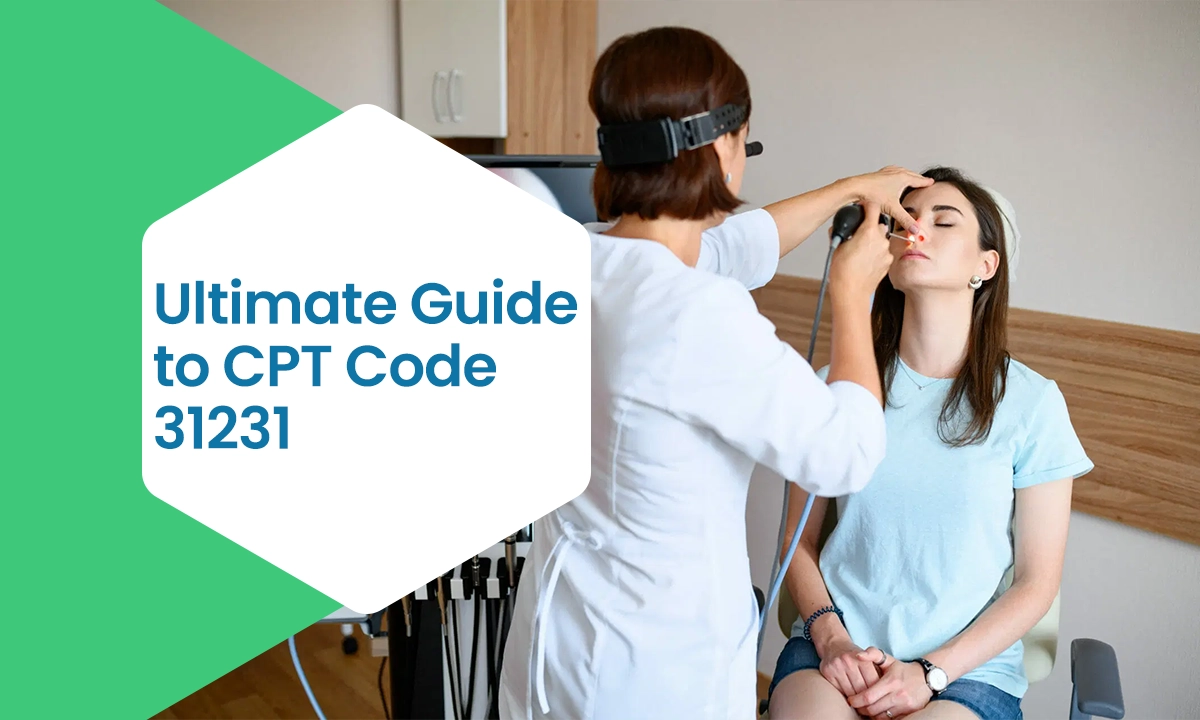
CPT 31231 describes a diagnostic nasal endoscopy, unilateral or bilateral, in which a provider visualizes the turbinates, meatus, septum, and nasopharynx without therapeutic intervention. Because no surgical work is done, the code's entire legitimacy rests on documentation supporting both medical necessity and examination completeness. A note that reads "nasal endoscopy performed, no intervention" with no anatomical findings is correctly coded and completely indefensible.
The code gets the claim through the door. The note is what keeps the payment.
Payers auditing claims ask whether the note specifies the scope type used, the structures visualized, and the clinical indication that justified the procedure. Those are documentation variables, not coding variables.
According to AMBCI (2025), approximately 45% of E&M visits industry-wide carry documentation deficiencies, with roughly 55% accurately documented. ENT practices are especially exposed because nasal endoscopy notes are high-volume and frequently templated. When the same boilerplate language appears across dozens of claims, auditors read it as a pattern flag, not clinical evidence.
45%
of E&M visits carry documentation deficiencies
Providers completing notes from memory hours after an encounter routinely omit the granular anatomical detail that makes a claim defensible. That is where AI-powered ambient scribing changes the equation: capturing the provider's real-time narration during the encounter, including structures visualized and findings per structure, before memory decay sets in and before the claim leaves the practice.
Getting the code right is table stakes. The harder question is whether the note behind it would survive a payer's scrutiny of every structure the endoscope passed.
Key takeaways
- CPT 31231 is one of the cleaner code lookups in ENT billing, and that familiarity is exactly what makes it a quiet audit risk when the documentation behind it doesn't hold up.
- A correctly selected 31231 code attached to a thin procedure note is still a denial waiting to happen; payers and OIG reviewers evaluate the documentation, not just the code.
- The four adjacent codes most often confused with 31231, including 31233 and therapeutic endoscopy codes, all hinge on whether a specific clinical act occurred and whether the operative note explicitly confirms it.
- Roughly 55% of E&M visits industry-wide are accurately documented, which means a diagnostic nasal endoscopy note that doesn't capture what the provider considered and ruled out is leaving complexity, and reimbursement, on the table.
- Most 31231 notes that fail audit weren't written carelessly; they were written hours after the encounter, from memory, by a provider who had already seen a dozen more patients since the scope came out.
- iScribe Health's AI-powered scribing captures clinical detail in real time, during the encounter, so the documentation behind every 31231 claim reflects what actually happened, before the note has a chance to go thin.
The Nasal Endoscopy Procedure Description Every Billing Note Must Reflect
The scope enters the naris and travels a defined anatomical route.

What the Scope Actually Traverses in a 31231 Note
According to industry data, a defensible that same figure note must name the inferior turbinate, middle turbinate, nasal septum, nasopharynx, and meatus by structure, not by category. It reflects the anatomical path a rigid or flexible endoscope takes during a complete diagnostic nasal endoscopy, and each named structure represents a discrete clinical observation the provider is expected to make and record.
CPT 31231 codes the completeness of visualization, not just the presence of a scope in the nasal cavity.
iScribe Health's Ambient AI Documentation captures real-time verbal observations during the exam through Ambient Listening / Conversational AI, producing a structured note that names each structure as the provider narrates findings. Because the AI drafts the encounter summary at the point of note completion, integrated directly into the practice's supported EHR, the record reflects the granular anatomical detail that compliance requires before memory decay flattens it into generic language.
Secretion Character as Diagnostic Data in the Procedure Note
The American Academy of Otolaryngology, Head and Neck Surgery Clinical Practice Guidelines state that the presence, character, and apparent source of mucus observed during nasal endoscopy constitute clinical findings that must appear in the procedure note, because they directly support the medical necessity justification for the 31231 claim. Thin, clear secretions pooling in the middle meatus point toward a different differential than thick, mucopurulent discharge tracking from the sphenoethmoidal recess.
iScribe Health's EHR Integration ensures that the AI-drafted note, including full secretion characterization and anatomical source identification narrated in real time, enters the permanent record in a format every subsequent provider can act on.
How Vague Anatomy Language Becomes an Audit Pattern
OIG Compliance Program Guidance for Physician Practices identifies templated notes stating "nasal cavity examined" without named structures as insufficient to demonstrate diagnostic completeness.
The California Department of Health Care Services 2023 SFHP Audit Report confirmed that missing or vague procedure descriptions were a primary driver of claim denials and overpayment findings, separate from any question of whether the code itself was correctly selected. Providers completing notes from memory at end-of-clinic routinely compress a multi-structure exam into a single phrase because reconstructing granular anatomical detail hours later is cognitively expensive.
CPT that same figure performed during the 90-day global surgery period following septoplasty or FESS is not separately billable unless the documentation clearly establishes a distinct, medically necessary reason for the scope that is unrelated to normal post-operative care.
iScribe Health's Real-Time Denial Alerts surface these risks at the point of note completion, before the claim is submitted, giving the provider and coding team the opportunity to correct the record while the clinical encounter is still fresh. Combined with Automated E&M Coding and E&M Coding Intelligence, the platform ensures that the code selected matches the documentation that exists in the note, not the documentation the provider intended to write.
Diagnostic vs Therapeutic Nasal Endoscopy and Where the Coding Line Falls
The HHS Office of Inspector General's audit methodology requires that every submitted code trace to explicit, contemporaneous documentation; when the note cannot independently substantiate what happened, the code selection becomes irrelevant to whether the practice keeps its payment.

What "Diagnostic Only" Actually Means in the Operative Note and What Disqualifies It
CPT 31231 permits observation and assessment, nothing more. The provider may advance the scope, characterize structures, and document findings. A provider who visualizes a small polyp, probes it to assess consistency, but leaves it in place is still within that same figure, provided the note explicitly states that the polyp was identified and no resection was performed at that encounter.
What disqualifies a note from that same figure is any language that implies action: "secretions cleared," "tissue sampled."
The Undercoding Trap When a Minor Maneuver Goes Undocumented
When a provider performs even a minor therapeutic maneuver but the note reads only as a diagnostic encounter, the claim is simultaneously undercoded and indefensible. Coding precision affects revenue in both directions: under-documented therapeutic encounters leak reimbursement, while over-stated diagnostic notes invite HHS Office of Inspector General scrutiny.
The failure mode is predictable, and it is one that clinicians we work with in high-volume ENT practices face every day.
Making the Diagnostic-vs-Therapeutic Call Audit-Proof
Two documentation elements make a 31231 claim defensible at audit. First, the note must describe the structures visualized with enough anatomical specificity to prove the scope traveled the required route. An auditor treats that gap as unresolved ambiguity, and unresolved ambiguity resolves against the practice, a dynamic the HHS Office of Inspector General has demonstrated repeatedly in audit findings across specialties.
When a therapeutic code applies instead, the note must name the intervention, describe the technique, and confirm the anatomical site. The AMA CPT Code Set is unambiguous on this point: documentation must support the specific code selected, not merely be consistent with it.
iScribe Health's ambient AI scribing captures the encounter in real time through ambient listening and conversational AI, so the note reflects exactly what occurred, including the explicit "no intervention was performed" language that makes a that same figure claim audit-proof, or the precise procedural detail that justifies a therapeutic code upgrade.
Related CPT Codes That Coders Confuse with 31231
Diagnostic nasal endoscopy generates a cluster of procedurally similar codes where the billing risk lives not in picking the wrong code on paper but in failing to document the specific anatomical detail that separates one code from another. The codes most commonly confused with 31231 share overlapping clinical territory around the nasal cavity and sinuses, and each pairing below exposes a distinct documentation gap that auditors actively target. Knowing exactly where those lines fall, and why note language so often fails to confirm them, is where accurate claim submission either holds or breaks down.
Four adjacent codes generate the majority of that same figure audit exposure in ENT billing, and the differentiating factor in every case is the same: whether a specific clinical act occurred and whether the operative note explicitly confirms it.
1. CPT 31233 vs. CPT Code 31231 - Sinusoscopy Requires Actual Sinus Entry
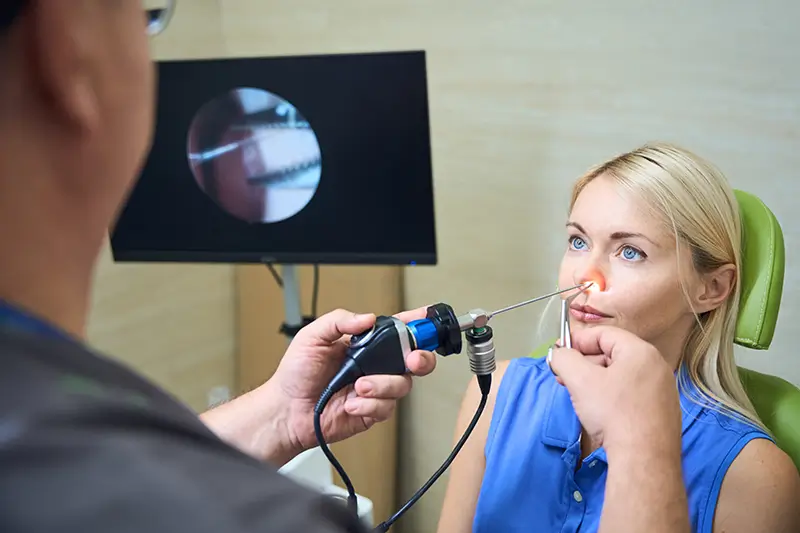
31233 covers diagnostic nasal endoscopy with entry into the maxillary sinus via the natural ostium. That same figure covers visualization that stops at the nasal cavity. The audit risk is billing 31233 when the note fails to confirm the scope crossed the ostium.
That documentation gap converts a plausible code into an unsubstantiated upcode. Auditors flag exactly this pattern, and HHS Office of Inspector General (OIG) findings confirm that documentation errors, not code selection errors, drive the bulk of improper payment findings. Billing teams working at high patient volumes face this risk on every encounter: when note language is drafted from memory after a full clinic day, imprecise phrasing slips through precisely because the clinical act felt complete, even if the documentation language does not confirm it.
iScribe Health's Ambient Listening and AI-drafted encounter summaries capture the physician's real-time language at the point of care, so the note reflects what actually occurred, scope entry confirmed or not, before the claim is ever touched.
2. CPT 31256 vs. CPT 31267 - Partial vs. Total Maxillary Antrostomy Extent
The difference between 31256 (partial maxillary antrostomy) and 31267 (total, with removal of tissue from the infundibulum) hinges on the anatomical extent of the procedure documented in the operative note. Billing teams that treat these as interchangeable based on procedure time rather than documented scope create a measurable miscoding pattern. If the note does not specify which tissue was addressed and whether the infundibulum was cleared, neither code is defensible.
The extent of dissection must be named explicitly, not implied. In high-volume ENT practices, where clinicians regularly chart well outside of patient care time, the risk of an incomplete operative note is structural. iScribe Health's Ambient AI Documentation drafts the encounter summary at the point of note completion, embedding anatomical specificity from the physician's own spoken language, so the infundibulum reference appears in the record because the surgeon said it, not because a coder reconstructed it later.
3. CPT 31575 (Flexible Laryngoscopy) - When It Can and Cannot Be Co-Billed with 31231

A coder billing 31231 and 31575 on the same claim for an encounter where the provider scoped both the nose and larynx faces a bundling decision that modifier documentation must resolve. These codes can be billed together, but only when the operative note confirms two anatomically distinct procedures with separate indications. Without that explicit separation in the note, payers apply bundling logic and reduce or deny the secondary code.
The Codapedia framework governing payment adjustment rules for multiple procedures and CCI edits applies automatically at the claim level. The note must do the work before the claim is submitted. iScribe Health's Real-Time Denial Alerts surface this gap at the point of coding, flagging when two endoscopy codes appear on the same claim without the modifier-supporting language in the note, so the billing team can resolve it before it reaches the payer.
4. CCI Bundling Rules for CPT Code 31231 - What Cannot Be Billed Separately on the Same Claim
The most dangerous confusion around nasal endoscopy CPT codes is the invisible bundling and modifier error that occurs when that same figure appears alongside an E&M or a related endoscopy code on the same claim. 9 million in overpayments across a two-year window, and CCI edits convert a correctly selected standalone 31231 into an improper claim the moment a second procedure appears without adequate modifier support.
Correct code selection does not protect a claim when the modifier strategy and documentation narrative are misaligned. iScribe Health's E&M Coding Intelligence and Automated E&M Coding are built to close this gap: the system evaluates the documented encounter against the claim structure in real time, catching modifier misalignment before it becomes a remittance denial.
5. CPT 31237 (Nasal Endoscopy with Biopsy) - Frequently Miscoded Instead of 31231 When Tissue Is Sampled
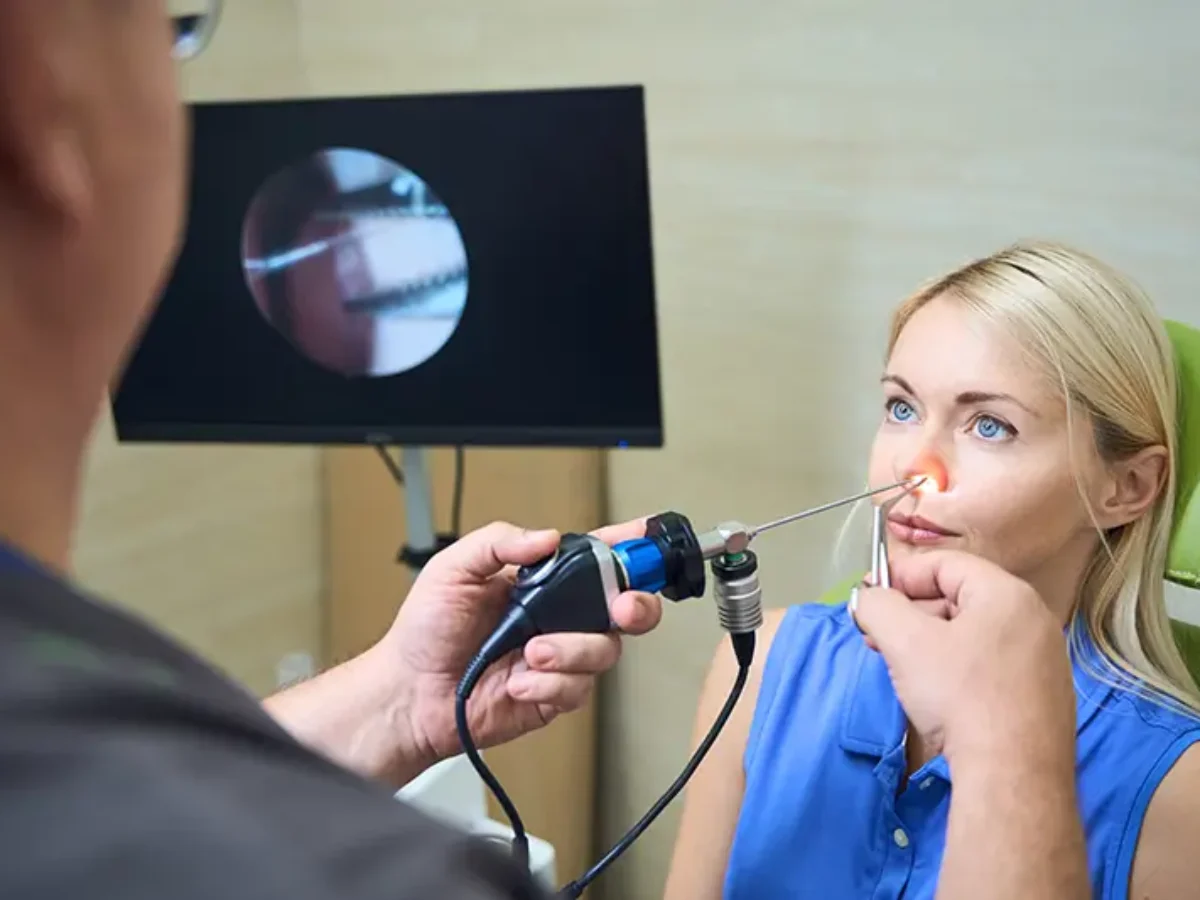
31237 applies only when tissue is obtained and sent to pathology. That same figure applies when the provider looks, assesses, and documents findings without sampling. The operative note must contain an explicit statement that a specimen was collected and submitted, not just that tissue appeared abnormal.
This is a distinction billing teams at high patient volumes miss with regularity: when a physician documents findings quickly and confirmation that tissue was collected and submitted is absent, coders face an underdocumented claim that cannot defensibly support 31237. iScribe Health's Ambient Listening captures this language in real time, at the point of the encounter, because documentation errors, not coding intent, are what create improper payment exposure. The confirmation must appear in the note before the claim is submitted, and iScribe Health's EHR Integration ensures the AI-drafted summary lands directly in the patient record without a separate transcription step that might lose that detail.
Knowing which adjacent codes create audit exposure is the first layer of protection. Knowing exactly which documentation elements must appear on the claim before it leaves the practice is what actually keeps denials off the remittance. The next section maps the specific coding and billing guidelines that govern CPT that same figure claim submission, structured as a pre-submission checklist billing decision-makers can put directly into their QA workflow.
Related Reading
- Cpt Code 31575
- Cpt Code 30520
Coding and Billing Guidelines for 31231 That Protect Claims at Audit
The harder, costlier problem is that a correct CPT code attached to a thin procedure note is still a denial waiting to happen, because payers and OIG reviewers evaluate the documentation behind the code, not just the code itself. For billing decision-makers, the coding and billing guidelines for that same figure are best understood as a documentation QA checklist, not a coder's lookup table.

Medical Necessity Is the First Line an Auditor Reads, Not the Last
Clinicians who chart extensively outside of patient care time are under real pressure to move quickly through note completion, and a rushed indication statement is often the first element that gets compressed into a single inadequate sentence. iScribe Health's Ambient Listening / Conversational AI captures clinical detail in real time during the encounter itself, so the indication, stated by the physician in the room in clinical terms, is drafted into the encounter summary automatically.
Bilateral Scope, Single Unit - How 31231 Reporting Works Regardless of Which Side Was Examined
Avenue Billing Services confirms that CPT that same figure is reported as a single unit per encounter regardless of whether one or both sides of the nasal cavity were examined; bilateral performance does not change the unit count, and modifiers do not alter this rule. Appending modifier 50, LT, or RT does not increase reimbursement and can trigger a payer edit that delays the claim.
Beyond modifier discipline, place-of-service accuracy carries its own reimbursement consequences: the same that same figure procedure billed at POS 11 (office) versus POS 22 (outpatient hospital) carries different reimbursement rates under Medicare's facility and non-facility fee schedule rules.
iScribe Health's Real-Time Denial Alerts are designed to surface exactly these structural claim errors at the point of note completion, after the AI drafts the encounter summary, so that a modifier or place-of-service mismatch is flagged before submission rather than discovered in a remittance.
The Audit-Ready 31231 Note Checklist - What Must Appear Before the Claim Leaves the Practice
An audit-defensible that same figure note must simultaneously carry two distinct evidentiary burdens: diagnostic completeness (every named anatomical structure visualized and recorded) and affirmative confirmation of therapeutic restraint (an explicit statement that no intervention was performed).
Avenue Billing Services specifies the required elements: clinical indication, named structures visualized, per-structure findings, notation of any specimens, and an explicit no-intervention statement when the scope was purely diagnostic.
This is where surfacing audit candidates upstream pays its dividend. iScribe Health's E&M Coding Intelligence and Automated E&M Coding evaluate the drafted note against documentation requirements at the point of note completion, so a that same figure note missing a per-structure finding or a no-intervention statement is flagged before it reaches the biller, not after it reaches the payer.
Why Incomplete ENT Documentation Turns a Clean 31231 Code into an Audit Liability
Only approximately 55% of evaluation and management visits are accurately documented industry-wide, so nearly half of all clinical encounters carry documentation that cannot fully support the services billed.

The Undercoding Trap When a Comprehensive Scope Produces a Partial Note
Across the market, undercoding on diagnostic nasal endoscopy claims occurs when a provider performs a full anatomical survey but the note captures only the chief finding; without documentation of the complete nasal cavity examination, the coder cannot substantiate the scope of that same figure and must either downcode or request an addendum.
This is precisely the documentation gap that iScribe Health's Ambient AI Documentation is designed to close. Rather than waiting for a provider to reconstruct findings from memory after a full schedule of scopes, iScribe Health's Ambient Listening and Conversational AI captures the encounter in real time, so that turbinate assessment, septal position, mucosal character, and vault evaluation are recorded at the moment of observation, not hours later.
Templated Notes and the Audit Pattern Flag Payers Are Trained to Spot
Billing and compliance teams report this consistently: templated procedure notes that appear identical across multiple patients are a recognized audit trigger. When records requested for that same figure claims look indistinguishable from one encounter to the next, reviewers flag the pattern as evidence that documentation was generated rather than clinically driven, shifting the claim from defensible to presumptively non-compliant.
iScribe Health addresses this directly, generating notes that reflect the specific clinical language and findings of each individual encounter rather than reproducing a fixed template across patients.
The Real Root Cause - Why the Documentation Workflow Is the Structural Failure Point
Broader industry trends are direct on this point: the root cause of that same figure documentation failures is the provider's post-encounter documentation workflow, with notes completed from memory after the visit routinely omitting the structural anatomical detail that makes the code defensible under payer scrutiny.
Research found that documentation completeness at the point of care is a primary determinant of downstream coding accuracy, and coders working from incomplete notes are constrained before they process a single line item](https://posthumanism.co.uk/jp/article/view/3086).
High-volume ENT practices where clinicians routinely chart well outside of patient care time carry that burden daily. iScribe Health's ambient documentation is most impactful in exactly that environment: it is an ongoing capability realized across every patient encounter, reducing the time providers spend on documentation so more time can be spent on patient care, and ensuring that the time saved does not come at the cost of the clinical specificity that keeps that same figure claims defensible.
No coder can fix what was never recorded. iScribe Health's EHR Integration places the AI-drafted note directly inside the provider's existing workflow when the practice is already running a supported EHR, so there is no parallel system to adopt and no additional friction added to a schedule that already runs long.
How AI Medical Scribing Captures the Clinical Detail That Makes 31231 Claims Stick
The note that fails a that same figure audit was almost never written badly on purpose. It was written late, from memory, by a provider who had already seen a dozen more patients since the scope came out.
"AI medical scribes can hallucinate or fabricate clinical details (e.g. references to substances never discussed), which directly undermines the accuracy of documentation needed to support 31231 claims."
— what we hear from behavioral health billing professionals

Most ENT providers finish their clinical documentation hours after the encounter, often in the evening or on days off. Research published in the Journal of General Internal Medicine found that physicians complete EHR documentation extensively outside scheduled work hours, including on days off, confirming that notes are reconstructed from memory rather than captured in real time. That reconstruction window is exactly where that same figure claims lose their audit defensibility.
Why Memory Decay Between the Exam Room and the EHR Is a 31231 Billing Risk
The structures a provider visualized during a nasal endoscopy, the character of secretions from the right middle meatus, the position of the septum, the mucosal texture of each turbinate, are granular details that degrade quickly without contemporaneous capture. A note written three hours later tends to collapse that specificity into phrases like "nasal cavity examined, no acute findings." That kind of language documents the act of looking, not the diagnostic completeness the code requires.
What determines audit defensibility is whether the note reflects what was seen with enough granularity to prove it. When the note is written determines how much of that visibility survives.
How Real-Time Narration Closes the Gap Between What the Provider Saw and What the Auditor Needs to See
Ambient scribing during a nasal endoscopy encounter eliminates the temporal distance between the clinical event and its documentation. When a provider narrates findings as the scope moves, an AI medical scribe structures that narration into a note naming every required element: laterality, turbinate assessment, septal position, mucosal character, secretion type and source, and the explicit "no intervention performed" statement. The provider's live narration becomes the source record, not a memory of it.
A note built from real-time capture carries the procedural granularity that a reconstructed note cannot reliably reproduce, and that distinction between a narrated note and a recalled one is what separates a defensible 31231 claim from a vulnerable one. The remaining question is whether your practice has that system in place before the next audit cycle opens.
Next steps
If your 31231 claims are passing the clearinghouse but failing at audit, the path forward starts with closing the gap between what the provider saw and what the note can prove. Correct code selection is the entry requirement. The documentation behind it is what determines whether the payment stays. Start with our AI medical scribe.
The OIG-confirmed $4.9 million in modifier-driven overpayments makes clear that a correctly selected code offers no protection when the modifier strategy and documentation narrative are misaligned. And the research showing that notes are routinely completed outside scheduled work hours confirms that the granular anatomical detail a 31231 claim requires, including named structures, per-structure findings, and an explicit no-intervention statement, is most likely to disappear precisely when the documentation workload is highest. Together, those two realities point to one fix: capture clinical detail at the moment of the encounter, not hours after it.
Start with an AI medical scribe that records findings in real time, so the note arriving at your billing queue already contains the procedural specificity that keeps a that same figure claim defensible when an auditor requests the record.
Frequently Asked Questions
If a provider looks at a polyp during a nasal endoscopy but doesn't remove it, can they still bill CPT 31231?
Yes, but only if the note explicitly states that the polyp was identified and no resection was performed at that encounter. That affirmative negative statement is not optional; it is the specific sentence an auditor looks for to confirm the code is defensible.
What structures does the note actually have to name for a 31231 claim to hold up?
A defensible 31231 note must name the inferior turbinate, middle turbinate, nasal septum, nasopharynx, and meatus individually, not just reference the nasal cavity as a category. Each named structure represents a discrete clinical observation the provider is expected to make and record.
Why does secretion detail matter so much in a nasal endoscopy note, isn't it just background information?
No, the American Academy of Otolaryngology, Head and Neck Surgery Clinical Practice Guidelines state that the presence, character, and apparent source of mucus observed during nasal endoscopy are clinical findings that must appear in the procedure note because they directly support the medical necessity justification for the 31231 claim. Thin, clear secretions pooling in the middle meatus point toward a different differential than thick, mucopurulent discharge tracking from the sphenoethmoidal recess, and omitting that distinction removes the clinical reasoning the payer needs to validate the scope.
Is CPT 31231 separately billable if the patient just had septoplasty or sinus surgery?
Not automatically, CPT 31231 performed during the 90-day global surgery period following septoplasty or FESS is not separately billable unless the documentation clearly establishes a distinct, medically necessary reason for the scope that is unrelated to normal post-operative care. When the note is vague, the payer will treat the claim as routine follow-up and deny it or demand repayment.
If the coder picks the right code and the claim goes through, why does documentation quality still matter?
Because payers auditing 31231 claims do not primarily ask whether the coder selected the right CPT, they ask whether the note specifies the scope type used, the structures visualized, and the clinical indication that justified the procedure. A claim built on a correctly coded but thin note can be denied or result in an overpayment finding months after the payment was received, as confirmed by the California Department of Health Care Services 2023 SFHP Audit Report, which identified missing or vague procedure descriptions as a primary driver of claim denials independent of whether the code itself was correctly selected.