CPT Code 27130 Explained: Billing and Coverage Rules
CPT code 27130 billing gaps start in the exam room. Billing teams, see where documentation risk hides before claims are denied.


CPT 27130 denials rarely start in the billing queue. They start in the exam room, and most practices never see the leak until an audit surfaces it.
Hundreds of thousands of total hip arthroplasties are performed in the United States each year, and that volume is projected to climb sharply. Between 2000 and 2019, the estimated annual volume of THA increased by 177%. For orthopedic practices, CPT 27130 is one of the highest-revenue line items in the queue, reviewed closely by every major payer, and increasingly scrutinized under bundled payment models that compound the financial consequences of a single documentation gap. See our AI medical scribe for how this works in practice.
CPT 27130 represents primary, first-time Total Hip Arthroplasty (THA): the surgical removal of a damaged femoral head and acetabulum, replaced with prosthetic components. "Primary" is the operative word. It signals to the payer that no prior hip hardware exists, no prior hip surgery is being converted, and no revision is being performed. According to the CMS Medicare Coverage Database (Noridian Healthcare Solutions, September 2025), CPT 27130 is defined specifically as the procedure code for this first-time replacement and is distinct from all revision and conversion codes. Payers treat a wrong-code submission between that same figure and its relatives as a recoupment trigger, not a clerical correction.

The common assumption is that a denial means a coder selected the wrong code or missed a modifier, and that tighter training and stricter checklists will fix it. That assumption is expensive. The leak starts upstream: when a pre-operative note fails to capture functional limitation severity, conservative treatment failure, or radiographic findings in sufficient detail, the claim arrives without the medical necessity scaffolding CMS requires. No modifier strategy closes that gap, and because it lives in the exam room rather than the billing queue, it stays invisible to standard pre-submission reviews.
As Arthroplasty Today (January 2022) documents, under bundled payment models, payers scrutinize the clinical justification embedded in claims documentation; inadequate narrative support for medical necessity is a primary driver of payment risk and recoupment exposure, independent of whether the procedural code itself was correctly assigned.
Key takeaways
- CPT 27130 covers total hip arthroplasty as a bundled procedure, separately billing intraoperative components triggers NCCI edits and opens every related claim to recoupment audit, not just the one that was flagged.
- Confusing 27130 with related hip arthroplasty codes isn't treated as a clerical error by payers; it's treated as a billing integrity violation, with financial exposure landing months after the original payment.
- Since CMS removed 27130 from the Inpatient-Only list in 2020, outpatient and ASC reimbursement pathways are open, but so is a new layer of site-of-service denial risk most billing teams aren't tracking.
- Laterality modifiers and ICD-10 diagnosis codes function as a single compliance gate on 27130 claims: when side-specificity isn't captured at the point of care, both fail together before a human reviewer ever reads the record.
- CMS Targeted Probe and Educate audit findings show that a substantial share of musculoskeletal surgical denials trace back to documentation gaps that exist before the claim is ever built, appeals can't reconstruct narrative that was never captured.
- The real denial problem isn't in the billing queue, it's in the exam room, where the clinical evidence that justifies medical necessity either gets captured or it doesn't.
- iScribe Health's E&M Coding Intelligence closes that gap by generating AI-powered coding recommendations from the complete clinical narrative in real time, not from the finalized note after the encounter is over, when the evidence needed to justify 27130 is already fixed in the record.
The Official CPT 27130 Descriptor and What the Code Scope Includes
They are risking a recoupment audit on every claim where a separately billed intraoperative service triggered a National Correct Coding Initiative (NCCI) edit.

The Verbatim AMA Descriptor and Why Every Word in It Is a Billing Boundary
The American Medical Association CPT Code Book defines CPT that same figure as: "Arthroplasty, acetabular and proximal femoral prosthetic replacement (total hip arthroplasty), with or without autograft or allograft."
For billing teams managing high patient volumes, the pressure to maximize reimbursement on complex orthopedic cases creates a real pull toward separately billing every visible intraoperative decision, but that instinct, applied here, produces the exact unbundling pattern that NCCI edits are designed to catch.
What the Code Scope Swallows Whole - Fixation Methods, Surgical Approaches, and Bundled Intraoperative Services
Standard intraoperative fluoroscopic guidance, bone preparation and reaming, wound irrigation, and primary hardware implantation are all bundled within CPT that same figure and cannot be billed separately. A biller who submits CPT 77002 (fluoroscopic guidance) alongside a 27130 claim triggers an automatic NCCI edit rejection, because CMS treats that service as included in the primary procedure's valuation.
The American Medical Association CPT Code Set confirms that cemented, uncemented, and hybrid fixation approaches are all captured under 27130's single descriptor.
Related Hip Replacement CPT Codes That Billers Confuse with 27130
Payers do not treat a wrong-code submission between CPT that same figure and its related hip arthroplasty codes as a clerical fix. They treat it as a billing integrity violation, subject to post-payment audit and recoupment. The financial exposure lands months after the claim is paid, and by then the operative note that could have justified the correct code is exactly as incomplete as it was on day one.
Each code in this family maps to a distinct clinical scenario, and the operative note must carry explicit signals to land on the right one. Inconsistency in how those signals are captured, varying by surgeon, by day, by encounter volume, is the structural reason coding precision breaks down and directly impacts revenue. Here is where billing teams consistently lose ground.
1. CPT 27125 (Hemiarthroplasty) vs. CPT Code 27130 - The Partial vs. Total Hip Replacement Coding Trap
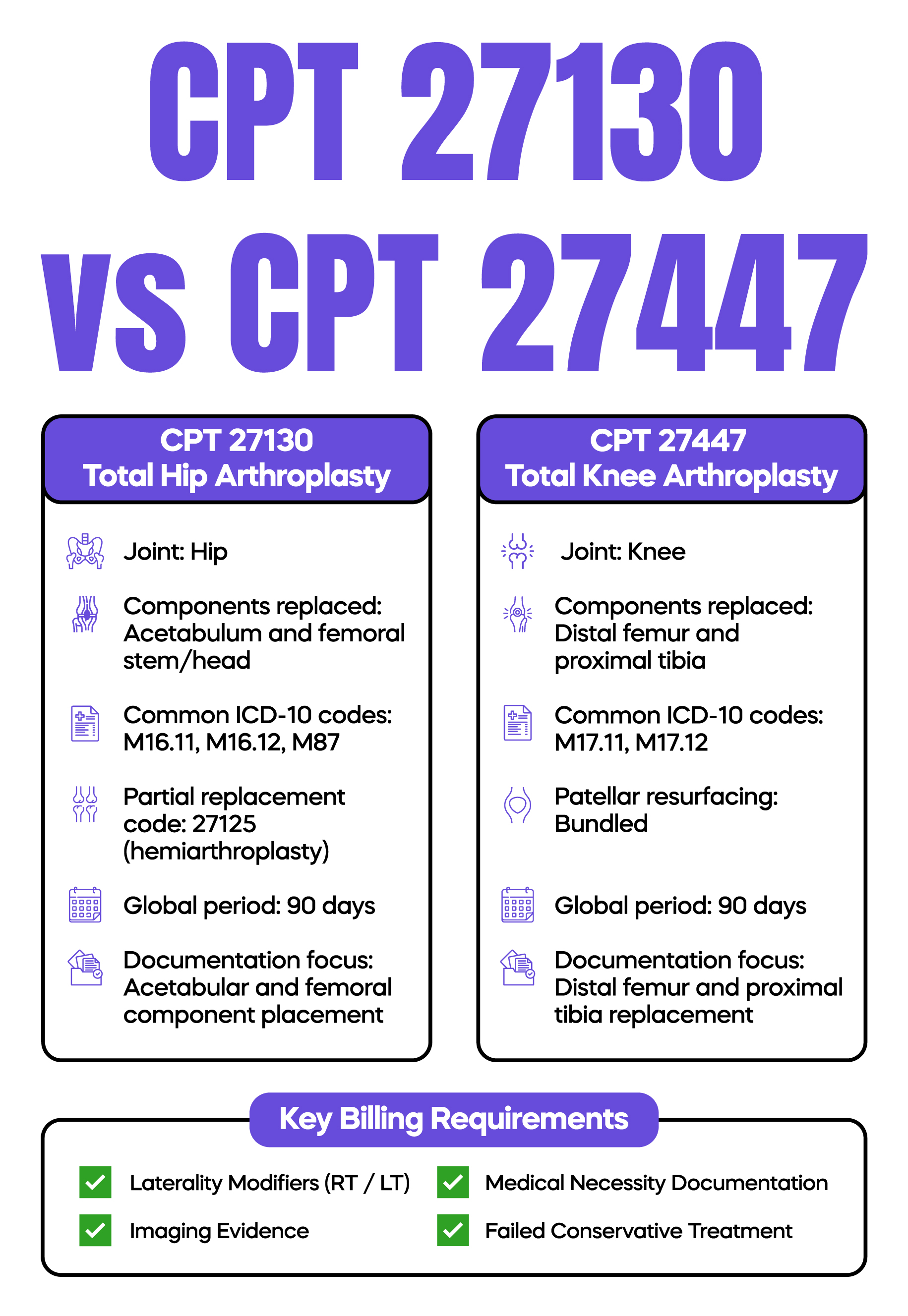
CPT 27125 vs 27130 is the highest-frequency wrong-code pairing in orthopedic billing. CPT that same figure covers replacement of the femoral head only; CPT 27130 requires both acetabular and femoral components. The documentation signal is a component count in the operative note. When the note describes only femoral head replacement but that same figure is submitted, payers flag it on records review, and the recoupment follows.
The practical problem is that the operative note never stated the component count explicitly. A coder who never saw that detail cannot select the right code. This is a coding consistency failure that originates in the clinical record, not the billing queue.
2. CPT 27132 (Conversion to Total Hip Arthroplasty) vs. CPT Code 27130 - Prior Hardware Is the Clinical Signal
CPT 27132 conversion is the correct code when a patient carries prior hip hardware, including a prior femoral neck ORIF or hemiarthroplasty, and the surgeon converts that construct to a full total hip arthroplasty. CPT that same figure is reserved for a true primary procedure on a native hip. The distinguishing signal is prior surgical history, which must appear explicitly in the operative note and the pre-operative record. When that history is absent from the documentation, coders default to that same figure, and payers recoup after records review confirms the prior hardware.
Improving coding consistency across providers means ensuring that this prior surgical history is captured uniformly on every conversion encounter, not only when a surgeon happens to narrate it. iScribe's EHR Integration surfaces relevant patient history at the point of documentation, and the Ambient Listening layer captures the surgeon's verbal reference to prior hardware in the moment it is stated, embedding it in the AI-drafted encounter summary before the note is finalized.
3. CPT 27134 (Revision, Both Components) - Never a Substitute for CPT Code 27130's Primary Procedure Status
CPT 27134 covers revision of both the acetabular and femoral components in a previously implanted total hip arthroplasty. It is structurally incompatible with CPT that same figure, which is reserved exclusively for a first-time primary procedure. The operative note must state the revision rationale explicitly, including component failure, loosening, or instability, along with confirmation that a prior total hip construct existed. Submitting that same figure on a revision encounter, or 27134 on a primary, produces a wrong-code submission that no modifier corrects.
The AMA CPT Editorial Panel and CMS NCCI identify this class of primary-versus-revision miscoding as among the most consequential in orthopedic ambulatory settings precisely because the error is invisible at submission; it only surfaces when the payer pulls the record. iScribe's Real-Time Denial Alerts apply E&M Coding Intelligence at the point of note completion, after the AI drafts the encounter summary, flagging the documentation gap before the claim is ever built rather than after the remittance arrives.
4. CPT 27137 and 27138 (Single-Component Revisions) - Component-Specific Revision Codes That Cannot Replace CPT Code 27130
CPT 27137 covers revision of the acetabular component only; CPT 27138 covers revision of the femoral component only. Both require the operative note to specify which component was revised and why, with the prior implant history confirmed in the record. Neither code is interchangeable with CPT that same figure. The practical risk: when operative notes describe a revision without specifying component scope, coders face an underdocumented choice between 27137, 27138, and 27134, and some default incorrectly to 27130 as the most familiar code in the family.
This is a coding precision failure with a direct revenue consequence. A that same figure submitted on a single-component revision encounter carries a materially different reimbursement rate and triggers audit exposure on both sides. Improving coding precision to directly impact revenue requires that the operative note resolve the component scope question before it reaches the coder. iScribe's Automated E&M Coding and AI Customization, calibrated to orthopedic encounter patterns, are designed to surface this specificity requirement in the AI-drafted note at finalization, so the coder receives a record that already distinguishes acetabular-only from femoral-only from both-component revision.
5. Wrong-Code Submissions Between 27130 and Its Revision Relatives Trigger Recoupment, Not Clerical Correction
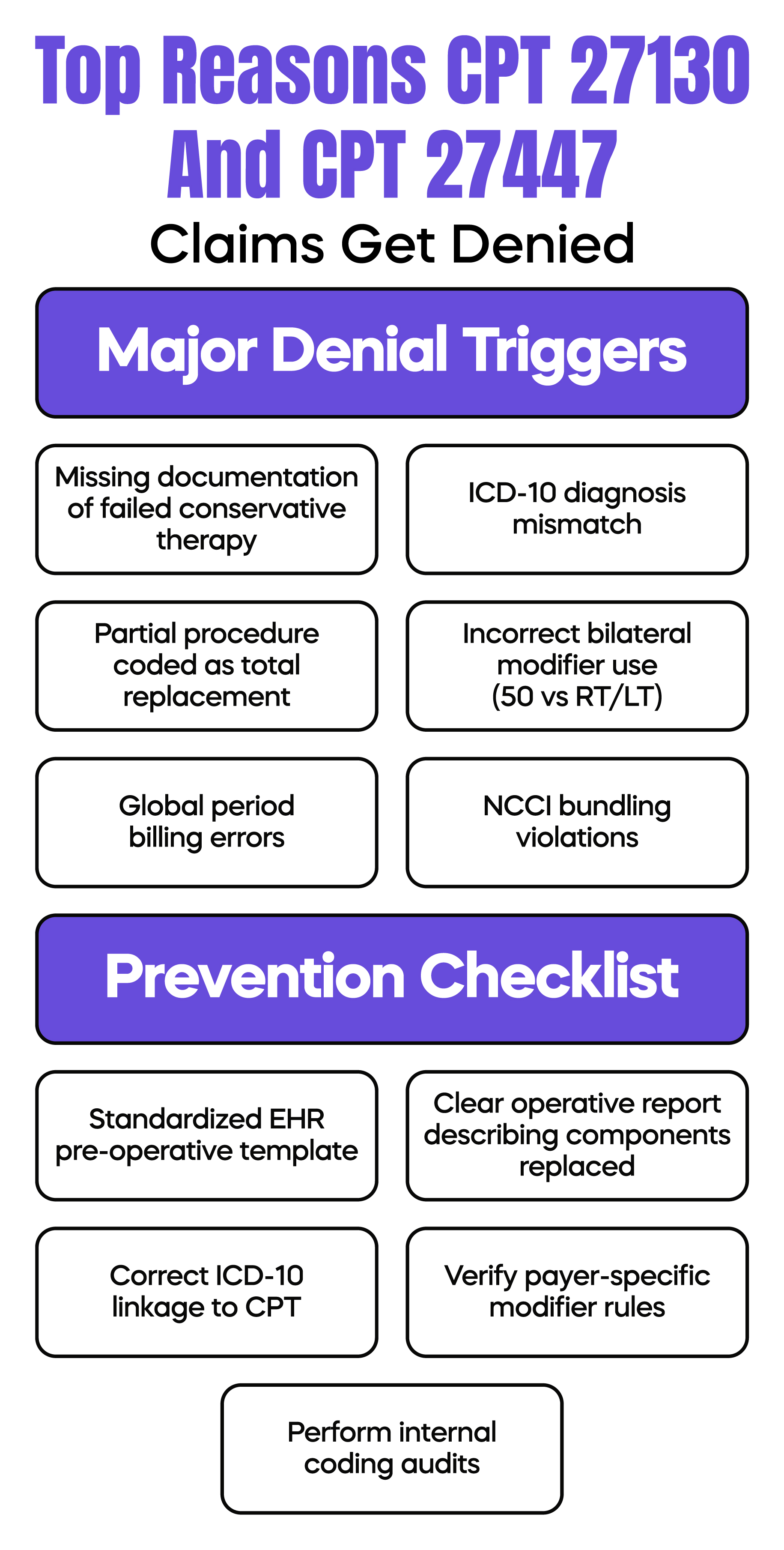
The highest-frequency errors here are downstream consequences of clinical documentation that never captured the scope of replacement or the patient's prior surgical history. A coder who never saw the component count or the prior hardware history cannot select the right code from the partial vs. total hip replacement coding family. Checklist compliance after the note is finalized cannot reconstruct evidence that was never recorded.
This is where point-of-care documentation intelligence addresses the structural problem. iScribe's Ambient AI Documentation captures component count, prior surgical history, and conversion rationale in real time through Conversational AI that listens to the live encounter, so the clinical signals that separate a primary that same figure from a 27132 conversion or a 27134 revision are embedded in the record before the claim is ever built. The E&M Coding Intelligence layer then applies coding logic at note completion, and Real-Time Denial Alerts flag documentation gaps while the encounter is still correctable.
This benefit is ongoing, realized across every patient encounter and every day of clinical practice, and is most impactful in high-volume practices or health systems where clinicians regularly chart two or more hours outside of patient care time. For practices already running a supported EHR, EHR Integration makes this a seamless ambient documentation experience with no parallel workflow to maintain.
The result is an AI medical scribe improving coding precision across providers before the claim reaches adjudication.
Selecting the right code from this family is only the first compliance checkpoint. Once that same figure is confirmed as the correct code, the claim still needs to survive modifier validation and the 90-day global package rules before it reaches adjudication. That is where the next layer of denial risk lives, and it is the focus of the section ahead.
Related Reading
- Cpt Code 20550
- Cpt Code 29881
- Cpt Code 29827
Modifier Requirements and the 90-Day Global Package Rules for CPT 27130

RT and LT Modifiers Are Not Optional and ICD-10 Laterality Must Match or the Claim Dies on Arrival
iScribe Health's Ambient AI Documentation and E&M Coding Intelligence work together to close that gap at the source.
For practices running a supported EHR, this is a seamless experience: iScribe Health's EHR Integration means the structured, laterality-confirmed note lands directly in the chart without a secondary data-entry step.
What the 90-Day Global Surgical Package Bundles and the Narrow Exceptions Billers Routinely Miss
According to the AAPC My General Surgery Coding Alert, the package bundles the pre-operative evaluation on the day of surgery, the intraoperative procedure itself, and all routine post-operative care. An unplanned return to the OR during the global period requires modifier 78; without it, the claim is denied as already bundled. An unrelated procedure performed during the global period requires modifier 79 to be billed separately.
Surgeons managing high post-operative caseloads, where return visits, unrelated encounters, and occasional unplanned OR events stack up across a 90-day window, are the practices most likely to lose modifier 78 or 79 revenue simply because the clinical record didn't clearly establish the unplanned or unrelated nature of the service at the time it was delivered. iScribe Health's ambient documentation captures those clinical details in the moment they occur, so the note that supports modifier 78 or 79 exists before the billing team ever touches the claim.
Billing a Separate E/M During the Global Period When Modifier 24 Works and When It Gets Rejected
Appending modifier 24 at billing without contemporaneous documentation doesn't create a defensible claim, and that gap is precisely where modifier 24 revenue evaporates.
iScribe Health's Ambient Listening / Conversational AI captures the clinical rationale for that visit in real time, and the E&M Coding Intelligence confirms that a distinct, unrelated diagnosis is present in the note before it's finalized. The result is that modifier 24 is appended at billing with contemporaneous documentation already in the record, reconstructed before a denial posts.
CMS Payment Rules and Inpatient vs Outpatient Eligibility for CPT 27130

Pros and cons at a glance
✓ Pros
- Opened outpatient hospital and ASC reimbursement pathways for the first time.
- Created three separate payment settings with materially different facility payment amounts.
- Made site-of-service selection a direct revenue variable affecting budget planning.
✗ Cons
- Created new denial exposure most billing teams don't see coming.
- Did not guarantee outpatient payment; every claim remains subject to medical necessity review.
- Site-of-service denials originate upstream of billing and cannot be fixed retroactively.
Missing pre-operative safety documentation cannot be substituted by coder corrections or modifiers
Three Payment Settings, Three Distinct Payment Amounts
That removal created three distinct payment settings, each carrying materially different facility payment amounts. Inpatient cases are paid under MS-DRG 470 (without major complication or comorbidity) or MS-DRG 469 (with MCC) through the Inpatient Prospective Payment System.
The Documentation Obligation the IPO Removal Created
The rule that expanded site-of-service options also created a corresponding documentation obligation. According to the CMS CY2020 Outpatient Prospective Payment System and ASC Payment System Final Rule, every outpatient or ASC claim for CPT that same figure remains subject to medical necessity review, and payers require that the patient's clinical profile, including comorbidities, anesthesia risk classification, and anticipated recovery within a 23-hour observation window, be affirmatively documented before the case is scheduled.
Why Retroactive Fixes Fail
That documentation requirement cannot be satisfied after the fact.
As confirmed by the CMS Medicare Claims Processing Manual and MAC Local Coverage Article guidance on IPO removal, Medicare Administrative Contractors evaluate whether outpatient safety criteria were met at the time of scheduling, not at the time of billing review.
iScribe Health addresses this at the source. Using ambient listening and conversational AI, iScribe Health's AI medical scribe captures the patient encounter in real time and, at the point of note completion, drafts an encounter summary that embeds patient-specific safety criteria and site-of-service rationale directly into the record, before the procedure is scheduled. Understanding where the CMS CY2020 Outpatient Prospective Payment System Final Rule allows CPT that same figure to be billed is only half the equation; ensuring the documentation exists to defend that placement is what determines whether the claim holds.
The Denial Reasons and Documentation Requirements That Decide CPT 27130 Claims
CMS Targeted Probe and Educate audit reviews of musculoskeletal surgical claims consistently find that a substantial share of denials, across multiple provider cohorts reviewed under the program, are attributable to reasons that exist entirely outside the billing queue, according to published CMS Targeted Probe and Educate (TPE) Program guidance. The operative note may be present. The modifier may be correct. The ICD-10 laterality may match. And the claim still fails, because the clinical narrative never captured what CMS reviewers actually look for.
1. Insufficient Documentation of Failed Conservative Treatment - The Leading TPE Denial Trigger for CPT Code 27130
CMS Targeted Probe and Educate Program reviews consistently identify the absence of a documented conservative treatment timeline as the single most frequent denial driver for total hip arthroplasty claims. Payers, including BCBS plans that require a minimum of three to six months of documented non-surgical care before approving THA, treat a missing or vague treatment history as automatic grounds for medical necessity denial. "Patient failed conservative management" written as a single phrase in the pre-op note does not satisfy that threshold. Reviewers expect specific treatment modalities, documented start and end dates, prescribing providers, and an explicit statement of why each modality was discontinued.
The failure pattern is consistent: the physician knows the patient tried physical therapy for four months and two cortisone injections. That history exists in scattered visit notes from a referring provider. It was never consolidated into the pre-operative record in a form a TPE reviewer can follow without reconstructing it themselves. That reconstruction is not the reviewer's job.
This is the documentation gap that practices we work with describe most frequently: the clinical knowledge is there, but it never makes it into the record in a form that creates defensible documentation. Every encounter where the conservative treatment narrative is left fragmented or buried in a referral note is a future denial that no billing team can prevent after the fact. iScribe Health's Ambient Listening and Conversational AI captures the full clinical conversation at the point of care, so that the conservative treatment timeline the physician discusses with the patient is structured into the note before the encounter closes, not reconstructed weeks later under audit pressure.
2. Missing Functional Limitation Severity Detail - The Quiet Denial Driver That Billing Teams Rarely Catch

Billing teams scanning for denial risk almost never flag this one, because the note looks complete. A phrase describing hip pain in general terms appears in the pre-op narrative and passes a surface-level review. It fails a TPE audit.
What CMS reviewers require is activity-of-daily-living specificity: how far can the patient walk before pain stops them, can they climb stairs, dress independently, sleep through the night? The CMS Medicare Benefit Policy Manual is explicit that functional limitation documentation must connect the impairment to specific ADL deficits, not describe pain in general terms. The gap is not effort. The gap is visibility. Physicians know the functional picture; the clinical narrative simply never captured it in the language payers require.
Standardizing clinical documentation quality across a practice, so that every pre-op note reflects ADL-specific functional limitation language, not just the notes from the most documentation-conscious physicians, is one of the core documentation challenges high-volume practices face. iScribe Health's E&M Coding Intelligence and Real-Time Denial Alerts address this directly: at the point of note completion, after the AI drafts the encounter summary, the system surfaces missing ADL-specific language before the note is finalized and the physician leaves the room. The physician is still present. The detail can be captured then, not assembled during appeal.
3. Medical Necessity Criteria Checklist - Radiographic Findings, ADL Impact, and Exhausted Non-Surgical Options Must All Appear Pre-Submission
Three elements must be present in the record before the claim is submitted, not assembled during appeal.
First, radiographic findings graded to a severity level: documented osteoarthritis grade (Kellgren-Lawrence or equivalent) or confirmed avascular necrosis, with imaging dated and referenced in the pre-op note. Second, ADL-specific functional limitation: named activities the patient can no longer perform, with a functional scale score (Harris Hip Score, WOMAC, or Oxford Hip Score) where available. Third, exhausted non-surgical options: a dated, provider-specific account of conservative care with documented outcomes for each modality. Per CMS Targeted Probe and Educate Program guidance, absence of any single element is sufficient grounds for denial, regardless of how cleanly the claim was coded.
Ensuring accurate, compliant medical coding across high patient volumes to maximize reimbursement and minimize claim denials requires that all three elements are present consistently, not just when a particular physician happens to document thoroughly. iScribe Health's Automated E&M Coding and EHR Integration embed this standard into the workflow itself, operating within a practice's supported EHR so that the checklist is applied at every encounter, not selectively.
4. The Upstream Root Cause - Clinical Narrative Gaps Created at the Point of Care, Not at the Billing Stage
CMS Targeted Probe and Educate (TPE) Program findings are direct on this point: the dominant denial driver is a clinical narrative gap created during the pre-operative visit and operative note, not a coding error introduced at the billing stage. CMS TPE program results for musculoskeletal and surgical claims have documented elevated error rates across multiple provider cohorts, with insufficient clinical documentation to support medical necessity identified as the predominant driver, directly contradicting the assumption that coder training and pre-submission checklists are the primary fix.
No pre-submission checklist can recover documentation that was never written. A billing team reviewing a note that "appears complete" has no way to know that the functional limitation language is too generic, or that the conservative treatment history references a separate chart the reviewer will never see. The CMS Medicare Claims Processing Manual confirms that correct ICD-10 laterality and accurate modifier application cannot substitute for absent clinical narrative content.
Practices that chart at high volume face an additional layer of risk: when physicians are carrying documentation burdens of two or more hours of after-hours charting per day, the cognitive bandwidth required to ensure every pre-op note contains all three TPE-required elements is simply not available. iScribe Health's Ambient Listening reduces that after-hours documentation load, and its Real-Time Denial Alerts surface gaps at note completion, when the fix is a conversation, not a legal risk.
5. Denial Prevention Requires Documentation Standards Embedded at the Pre-Op Visit and Operative Note - Not Added During Billing Review
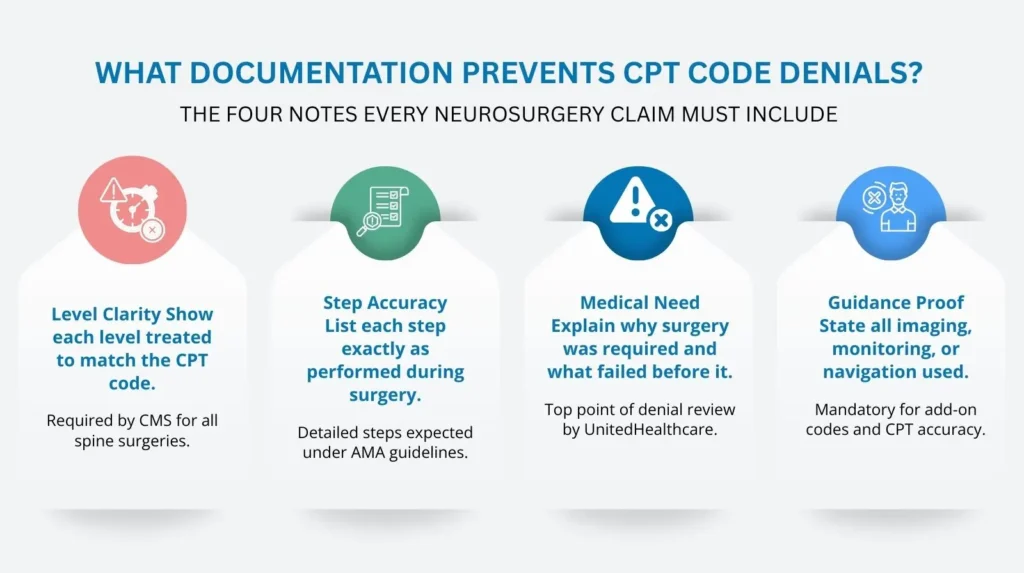
Most practices assume their pre-submission review catches these gaps. In practice, by the time the claim reaches the billing team, the pre-op visit is weeks behind the physician. Reconstructing a conservative treatment timeline or adding ADL specificity after the fact carries real legal risk, because it means modifying a medical record to support a claim rather than reflecting what was documented at the time of care.
The evidence payers require can be captured then, not reconstructed under audit pressure. For health systems and practices already running a supported EHR, iScribe Health's EHR Integration means this capability materializes within the existing workflow, with no parallel documentation system to manage.
The pattern is consistent: every denial category CMS Targeted Probe and Educate Program reviewers flag for CPT that same figure traces back to a moment in the clinical encounter when the right detail wasn't recorded, not a moment in the billing queue when the wrong code was selected. The next section examines exactly how AI-assisted documentation intelligence intercepts that gap before it becomes a denial.
CPT 27130 Medical Necessity Documentation Checklist (Pre-Submission)
Use this checklist against every CPT that same figure pre-operative note before the claim is built:
- Radiographic Findings → What Payers Require: Osteoarthritis grade (Kellgren-Lawrence or equivalent) or confirmed AVN, with imaging date referenced in the pre-op note → Present in Record? ☐ Yes ☐ No.
- ADL-Specific Functional Limitation → What Payers Require: Named activities the patient can no longer perform (e.g. walking distance, stair climbing, dressing); functional scale score (Harris Hip, WOMAC, or Oxford Hip) where available → Present in Record? ☐ Yes ☐ No.
- Conservative Treatment Timeline → What Payers Require: Each modality listed with start/end dates, prescribing provider, and documented outcome; minimum 3–6 months per most BCBS and CMS TPE standards → Present in Record? ☐ Yes ☐ No.
- ICD-10 Laterality → What Payers Require: M16.11 (right) or M16.12 (left) matches the RT/LT modifier on the claim → Present in Record? ☐ Yes ☐ No.
- Primary vs. Revision Confirmation → What Payers Require: Operative note explicitly states no prior hip hardware and no prior hip surgery being converted → Present in Record? ☐ Yes ☐ No.
- Site-of-Service Rationale (Outpatient/ASC Only) → What Payers Require: ASA classification, functional status assessment, and outpatient risk rationale documented pre-operatively → Present in Record? ☐ Yes ☐ No.
- Bundled Service Scope → What Payers Require: No separately billed graft, fluoroscopic guidance (77002), or fixation line items on the same claim → Present in Record? ☐ Yes ☐ No.
All seven elements must be affirmatively present before submission. Absence of any single element is sufficient grounds for CMS TPE denial regardless of code accuracy.
How AI Coding Intelligence Closes the Clinical Narrative Gap Before Claims Leave the Practice
By the time a claim reaches the billing queue, the clinical evidence that justifies medical necessity either exists in the record or it doesn't, and no amount of appeals-stage remediation can reconstruct narrative that was never captured in the first place.
"Clinicians spend more time correcting and modifying AI-generated documentation than it would take to write notes manually, suggesting AI tools are not yet closing the clinical narrative gap efficiently before claims are finalized."
— what we hear from healthcare revenue cycle professionals

What 941 Live CPT 27130 Encounters Reveal About Systematic Overcoding Risk in Surgical Billing
An 8% provider AI agreement rate and a 33% overcoding rate on surgical encounters represent a compliance and revenue-integrity risk that was invisible to the billing team operating without AI-assisted coding oversight, until they ran the trial.
It is what systematic documentation gaps produce at scale, across hundreds of encounters, when the clinical narrative captured at the point of care is thinner than what the procedure actually warranted.
Why CPT 27130 Denials Originate in the Exam Room, Not the Billing Queue
When a surgeon verbally documents failed physical therapy, cortisone injection history, and functional limitation severity during a pre-op visit, that clinical reasoning exists for roughly the length of the appointment.
The biller never sees it. The claim goes out without the medical necessity scaffolding CMS requires for CPT that same figure, and no pre-submission checklist can manufacture evidence that was never recorded. Billing-side corrections address the symptom; they cannot address the source.
How Real-Time Documentation Prevents the CPT 27130 Evidence Gaps Payers Exploit
iScribe Health's E&M Coding Intelligence generates AI-powered coding recommendations from the complete clinical narrative captured in real time, so that functional limitation detail, conservative treatment failure history, and medical necessity rationale are present in the record before the coder builds the claim. (Case on file with iScribe Health; client details available under NDA upon request.)
That upstream completeness changes what the entire billing workflow has to absorb. As the TPE audit findings established earlier confirm, payers are actively reviewing CPT that same figure claims for exactly this evidence. When it exists in the record before the claim is built, the pre-submission remediation loop that billing teams currently absorb as hidden labor cost simply does not occur.
Related Reading
- Cpt Code 27447
Next steps
If your orthopedic billing team is absorbing CPT 27130 denials despite accurate modifiers and clean ICD-10 laterality, the path forward starts with fixing what lives upstream of the billing queue: the clinical narrative itself. Start with our AI medical scribe.
The 33% overcoding rate surfaced across 941 live surgical encounters means documentation gaps are producing systematic coding distortion that billing-stage checklists cannot detect, let alone correct. The TPE audit pattern confirms the same direction: payers deny CPT 27130 claims because functional limitation severity, failed conservative treatment history, and medical necessity rationale were never recorded at the point of care, not because a coder selected the wrong modifier. Together, these findings point to one action: capturing that clinical evidence in real time, during the encounter, before the claim is ever assembled.
Start with iScribe Health. The ambient documentation layer records the full clinical narrative as the encounter happens, E&M Coding Intelligence surfaces gaps before the note is finalized, and Real-Time Denial Alerts flag claim-level risk before submission. For practices already running a supported EHR, the integration requires no parallel workflow. The conservative treatment timeline, ADL-specific functional limitation detail, and site-of-service rationale that CMS reviewers require are present in the record on first submission, not reconstructed under appeal pressure.
Frequently Asked Questions
What's the difference between CPT 27125 and CPT 27130?
CPT 27125 covers replacement of the femoral head only, while CPT 27130 requires both acetabular and femoral components to be replaced. The operative note must explicitly state the component count, when it doesn't, coders lose the evidence needed to select the right code, and payers recoup after a records review confirms the mismatch.
When should I use CPT 27132 instead of 27130 for a hip replacement?
Use CPT 27132 when a patient already has prior hip hardware, such as a prior femoral neck ORIF or hemiarthroplasty, and the surgeon converts that construct to a full total hip arthroplasty. CPT 27130 is reserved exclusively for a true primary procedure on a native hip, and the distinction hinges on prior surgical history being explicitly documented in both the operative note and the pre-operative record.
What intraoperative services are already bundled into CPT 27130 and can't be billed separately?
Standard intraoperative fluoroscopic guidance, bone preparation and reaming, wound irrigation, primary hardware implantation, and any autograft or allograft decisions are all bundled within CPT 27130. For example, separately billing CPT 77002 for fluoroscopic guidance alongside a 27130 claim triggers an automatic NCCI edit rejection, because CMS treats that service as already included in the primary procedure's valuation.
Does it matter whether the surgeon used a cemented, uncemented, or hybrid fixation technique for billing 27130?
No, the AMA CPT descriptor for 27130 is technique-neutral, and cemented, uncemented, and hybrid fixation approaches are all captured under the single code. No modifier exists to flag technique variation as a separate billable event, and billing additional line items based on fixation method constitutes unbundling, which is a documented OIG audit priority.
Can I use CPT 27130 for a revision if both hip components are being replaced?
No. CPT 27130 is reserved exclusively for a first-time primary procedure on a native hip. When both the acetabular and femoral components of a previously implanted total hip arthroplasty are being revised, the correct code is CPT 27134, and the operative note must explicitly document the revision rationale, such as component failure, loosening, or instability, along with confirmation that a prior total hip construct existed.