CPT Code 12001 Explained: Types, Uses, and What to Expect
CPT code 12001 is often miscoded, not from carelessness but from missing data. Billing teams, see where the gap really starts.


CPT 12001 is the most miscoded wound repair code in urgent care, and the problem starts at the point of care, not the billing queue. Here is what the code actually requires and where practices lose revenue before a coder ever sees the chart.
Industry billing audits consistently find that a significant share of wound repair claims entering the billing queue with missing clinical details default to the lowest defensible code, costing practices real reimbursement on procedures they performed correctly. CPT code 12001 sits at the center of that pattern. It is the most frequently billed simple wound repair code in urgent care and emergency department settings, and it is also one of the most consistently miscoded, because the failure is structural and starts well before a coder ever opens the chart. See our AI medical scribe for how this works in practice.
The common assumption among practice administrators and billing decision-makers is that this is a knowledge problem, that the fix is better coder training, and that if the billing team has a clear CPT 12001 reference and escalation rules for intermediate and complex codes, the loop closes and claims go out clean. The gap is visibility. No amount of downstream coding expertise can reconstruct clinical data that was never captured at the point of care. A provider who exits the encounter having documented only "laceration repaired" has already compromised the claim, regardless of what the billing team does next.

No amount of downstream coding expertise can reconstruct clinical data that was never captured at the point of care. According to a TCI Outpatient Facility Coding Newsletter, CPT that same figure covers simple repair of superficial wounds of the scalp, neck, axillae, external genitalia, trunk, and extremities (including hands and feet), measuring 2.5 cm or less in length.
The repair must involve only the epidermis, dermis, or subcutaneous tissue, with no significant involvement of deeper structures. Adhesive strips alone do not qualify. Face, ears, eyelids, nose, lips, and mucous membranes fall under entirely different code ranges. Any repair requiring layered closure escalates out of that same figure territory immediately.
The scale of the problem is not anecdotal. CMS Federal IDR public use files analyzed via IDR Explorer show that CPT that same figure generated 7,851 federal IDR disputes in the benchmark dataset, placing it among the highest-volume wound-repair codes in the federal dispute pipeline. That volume signals systematic underpayment across the industry. When a note lacks specificity on laceration length or tissue layer involvement, coders have no basis to assign or defend that same figure versus a higher-complexity code, and the claim defaults downward. Payers also flag high-volume that same figure billers for audit, raising compliance exposure alongside the revenue loss.
7,851
Federal IDR disputes tied to CPT 12001
Automated scribing that captures wound dimensions, anatomical site, and repair method in real time closes the gap before it ever reaches the billing queue, without adding documentation burden to the provider. Coder training alone cannot close it.
Key takeaways
- CPT 12001 covers simple, single-layer closure of wounds 2.5 cm or less on the scalp, neck, axillae, external genitalia, trunk, and extremities, cross any of those boundaries and you're in a different code family with different reimbursement rates.
- The measurement math is straightforward; the documentation discipline to capture wound length, anatomical site, and repair method in real time is not, and when that discipline slips, no amount of coder training recovers the revenue.
- Only ~55% of E&M visits are accurately documented, and CPT 12001 is a textbook casualty: claims arrive in the billing queue with missing clinical details and default to the lowest defensible code, not the one the provider earned.
- Downcoding isn't the only exposure, a 941-encounter audit found 33% of procedural visit codes were overcoded, creating a compliance risk that had been invisible under a manual documentation workflow for months.
- The moment of origin for a denied wound repair claim is inside the exam room, not at the clearinghouse, if wound length, site, and repair complexity don't make it into the note before the provider moves to the next patient, they're gone.
- iScribe Health's Automated E&M Coding closes that gap by generating accurate codes directly from clinical documentation in real time, so the details that determine CPT 12001 reimbursement are captured at the point of care, before the claim ever leaves the room.
What Is the Exact Definition of CPT Code 12001

The AMA's Exact Language on Simple Repair of Superficial Wounds
CPT 12001 is defined by the American Medical Association CPT Code Set as simple repair of superficial wounds of the scalp, neck, axillae, external genitalia, trunk, and extremities, measuring 2.5 cm or less. "Simple" carries a precise clinical meaning here: single-layer closure of the epidermis, dermis, or subcutaneous tissue, without involvement of deeper structures such as fascia or muscle. The AMA publishes and maintains the full CPT code set, and the American Medical Association CPT Assistant newsletter provides the authoritative guidance practitioners and coders must follow when applying this code.
The moment a repair requires layered closure of deeper tissue, the encounter exits 12001 territory entirely, as the next section on complexity tiers covers in detail.
One of the most persistent struggles for clinicians and coders new to wound repair billing is simply not knowing what the AMA's own language requires, and discovering the gap only after a claim is denied. Understanding those requirements from the outset is the most reliable way to avoid that outcome.
Sutures, Staples, and Tissue Adhesive as the Three Qualifying Closure Methods
According to industry data and Medical Association CPT Assistant guidance, the closure methods eligible under CPT 12001 are sutures, staples, and tissue adhesives such as Dermabond. Each method must be clearly documented in the clinical note for the code to hold up under review.
This is precisely where iScribe Health's Ambient Listening and Conversational AI changes the outcome. By capturing the provider-patient encounter in real time and capturing physician dialogue and patient context during the visit to generate clinical notes in under 30 seconds, iScribe surfaces those clinically specific details, closure method, tissue layer, wound dimensions, that coders need to assign CPT 12001 with confidence. The result is documentation that supports the code from the moment the encounter ends.
Why Wound Exploration and Debris Debridement Are Bundled Into CPT 12001
Billing them separately is one of the more common bundling errors the AMA flags in audit reviews. The only scenario where debridement becomes separately reportable is when it exceeds simple surface-level exploration and meets the threshold for CPT 11042, which is a meaningfully higher clinical bar.
Clinicians new to wound repair coding frequently face this exact situation: the note reads like a more complex encounter than the code allows, and the billing team has no reliable way to distinguish bundled services from legitimately billable ones. iScribe Health's Real-Time Denial Alerts are designed to catch these mismatches before a claim leaves the practice, flagging when documentation patterns suggest a bundling error is likely. That early intervention keeps denials from compounding across a billing cycle.
Anatomical Site Groupings That Determine Whether CPT 12001 Applies
CPT that same figure covers scalp, neck, axillae, external genitalia, trunk, and extremities including hands and feet. That is the complete anatomical boundary of the code. Cross it, and you are in a different code family with different reimbursement rates and different documentation expectations.
The exclusions are equally precise. Wounds of the face, ears, eyelids, nose, lips, and mucous membranes route to CPT 12011 through 12018, a separate code range built around the distinct clinical and cosmetic considerations those sites carry. Site confusion between these two groups is a documented source of wrong-code claims in emergency department laceration repair billing, and it is a primary axis of code selection.
What Makes Site Confusion a Systemic Risk
Consider a single urgent care visit: a patient presents with a stapled scalp laceration and a sutured lip wound from the same fall. The scalp repair belongs to that same figure's anatomical group. The lip repair belongs to 12011. Both repairs may be simple closures of identical length, but they cannot share a code, and they cannot be approximated from a note that reads "facial and scalp lacerations repaired." The coder is not the failure point in that scenario. The documentation was already incomplete before the note was finalized.
Anatomical site is not a detail a billing team can infer from context. When a provider documents "arm laceration" without specifying whether the wound is on the trunk-adjacent axilla or a distal extremity, the note is technically billable territory for that same figure, but only if the coder can confirm the site with certainty. Vague notation is an audit liability. As the AAPC Medical Billing and Coding Forum has documented, correct repair-level code selection requires precise anatomical site documentation at the encounter level, not retrospective reconstruction.
1. Scalp, Neck, Axillae, Trunk, and Extremities Including Hands and Feet - The CPT 12001 Covered Site Group
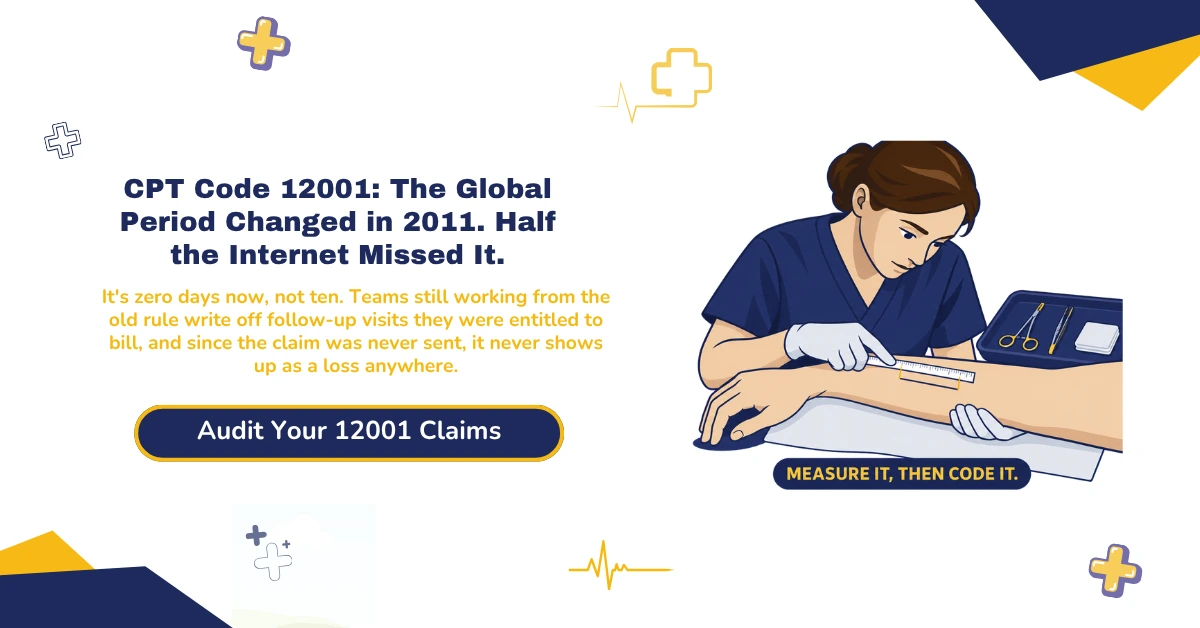
CPT Code 12001 applies exclusively to simple repairs performed on the scalp, neck, axillae, external genitalia, trunk, and extremities, including hands and feet. Coders and clinicians must confirm the wound falls within this anatomical grouping before assigning the code. The key limitation is that hands and feet, though intuitively 'extremity' sites, are explicitly included here, which surprises many practitioners who assume they require a separate code range.
2. Face, Ears, Eyelids, Nose, Lips, and Mucous Membranes - The Excluded Sites That Redirect to CPT 12011-12018

Wounds on the face, ears, eyelids, nose, lips, and mucous membranes are explicitly excluded from CPT 12001 and instead fall under the 12011-12018 code range for simple facial repairs. This distinction exists because cosmetic and functional outcomes at these sites carry higher clinical stakes, justifying a separate code family. The common billing error is applying 12001 to an ear or lip laceration simply because the repair complexity appears equivalent.
3. ER Laceration Repair Scenarios Where Site Confusion Drives Wrong-Code Selection
Site confusion between the that same figure and 12011 code families is a documented source of coding errors in emergency department laceration repair billing. The ER is where this risk concentrates: high patient volume, terse notes, and multi-wound presentations create the conditions where a provider documents wound sites in shorthand and moves on. That notation is not sufficient to separate a that same figure-eligible scalp repair from a 12011-required lip repair. The coder inherits an irresolvable ambiguity. iScribe Health's ambient listening captures the provider's real-time narration of each wound site during the encounter itself, so by the time the AI-drafted note is complete, each repair is already mapped to a named anatomical location rather than a shorthand phrase a billing team must interpret later.
4. The Two-Bucket Anatomical Site Framework - How CPT Groups Body Regions to Separate 12001 from Facial Repair Codes
CPT's wound repair section is organized around two primary anatomical buckets: the trunk-and-extremity group (CPT 12001-12007) and the face-and-specialized-structure group (CPT 12011-12018). Understanding this binary framework helps coders make fast, accurate decisions at the point of code assignment rather than looking up each site individually. The limitation is that the scalp straddles intuitive expectations, it belongs to the 12001 group, not the facial group, which is a frequent source of miscoding.
Wound Size Thresholds and Multiple Wound Measurement Rules for CPT 12001

CPT 12001's Hard Ceiling of 2.5 cm as a Billing Boundary
The more common problem, however, is documentation that uses language like "about 1.5 cm" or "small lac, repaired," which, as Codapedia's laceration repair coding guidance makes clear, produces coding ambiguity because precise centimeter measurements are required to assign the correct repair code.
iScribe Health's ambient AI documentation captures the encounter in real time through conversational AI, so the closure method, the centimeter measurement, and the anatomic site are drafted into the note as the provider speaks rather than reconstructed from memory after the patient has left, removing the vagueness that most commonly undermines CPT 12001 claims.
The Aggregation Rule That Catches Coders Off Guard
When a patient presents with multiple wounds in the same anatomic billing area, their lengths are summed to determine the correct code level. They aggregate to 2.7 cm, which moves the claim to CPT 12002 (2.6 to 7.5 cm), as Codapedia confirms. That shift only becomes visible to the coder when every individual measurement is recorded in the note.
The coder cannot reconstruct the correct total from a note that never captured it. iScribe Health's ambient listening technology keeps pace with the clinical conversation in real time, so each measurement stated aloud, whether for a single irregular wound or multiple lacerations repaired in the same session, is captured and available when the AI drafts the encounter summary at the point of note completion.
Two Data Points That Make or Break a CPT 12001 Claim
Both must appear explicitly in the note, because neither can be inferred or assumed during coding.
Billing teams that encounter notes missing a precise measurement or anatomic site must either send the note back for an addendum or code conservatively, and either path introduces delay or revenue loss.
iScribe Health's ambient AI documentation, integrated directly into supported EHRs, captures the centimeter measurement, the anatomic location, and the closure method in real time during the encounter, so the note arrives at the coder's queue with all three fields already populated.
Wound Repair Complexity Tiers and When to Escalate Beyond CPT 12001
Three clinical decisions made at the bedside determine which wound repair tier applies: how many tissue layers the provider closed, whether the wound was heavily contaminated, and whether deeper structures were involved. Coders cannot infer any of those facts. They can only assign the tier the provider's note explicitly supports. This means the revenue leakage from downcoding wound repairs is a documentation gap that presents as a coding error, and it is structurally invisible to any intervention that targets only the billing team. The clinical distinction between simple, intermediate, and complex wound repair is decided in the treatment room, at the moment the provider chooses whether to close in one layer or multiple layers and whether deeper structures are involved.
1. Simple Repair (CPT 12001-12021) - Superficial Skin and Subcutaneous Tissue Only
Single-layer closure of the epidermis, dermis, or subcutaneous tissue without deeper structural involvement defines this tier, according to the Journal of Urgent Care Medicine. The critical documentation signal is the phrase "single-layer closure" paired with confirmation that no deeper structures were involved. A note that says only "laceration repaired" gives the coder nothing to work with and forces a default to this lowest tier, regardless of what actually happened in the treatment room.
This is where high-volume urgent care clinicians face the sharpest exposure. When a provider is seeing a full panel and carrying a significant after-hours charting burden, the instinct is to document quickly, and quick documentation almost always omits the tier-determinative language. iScribe Health's ambient AI documentation captures the provider's spoken observations in real time, during the encounter, so that phrases like "single-layer closure, no deeper structural involvement" appear in the draft note before the provider ever opens a chart after hours.
2. Tissue Layer Depth as the Primary Escalation Trigger Out of CPT 12001 Territory
Intermediate repair (CPT 12031-12057) applies when the provider closes one or more deeper layers of subcutaneous tissue and superficial fascia in addition to the skin, or performs single-layer closure of a heavily contaminated wound requiring extensive cleaning, per the Journal of Urgent Care Medicine. Consider a 2.0 cm forearm laceration requiring layered closure of subcutaneous tissue plus skin: that is a CPT 12031-range claim, not CPT 12001. Without the words "layered closure" or "subcutaneous involvement" in the note, the coder sees only a simple repair and codes accordingly. The revenue difference between those two tiers is real, and the gap is created entirely upstream of the billing desk.
iScribe Health's ambient listening and conversational AI delivers the most value when a practice is already running a supported EHR and wants a seamless documentation experience. It integrates directly into that existing workflow through EHR integration, so there is no separate interface for the provider to manage. The AI drafts the encounter summary at the point of note completion, embedding the layered-closure language the coder needs without adding a single step to the provider's visit flow.
3. Coder-Actionable Decision Rules - Simple vs. Intermediate vs. Complex Repair
Complex repair (CPT 13100-13160) requires documentation of more than layered closure: scar revision, extensive undermining, retention sutures, or involvement of bone, cartilage, tendons, or nerves, as defined by the Journal of Urgent Care Medicine. The escalation from intermediate to complex is a judgment call the coder cannot make independently. The provider's note must name the specific structural involvement.
Practices where providers are seeing high patient volumes and spending significant time on after-hours documentation are most likely to see these structural details dropped. iScribe Health delivers its greatest value in that environment. A hands-free documentation experience during the visit means the provider narrates what they observe (tendon exposure, cartilage involvement, retention sutures placed) and those observations are captured in the AI-drafted note before the encounter closes, rather than discovered as a gap during a billing addenda request.
4. CPT 11042 Wound Debridement - Separately Reportable When Debridement Exceeds Simple Exploration
Debridement is bundled into the wound repair code when it amounts to routine cleaning. It becomes separately reportable under CPT that same figure only when the provider performs debridement of subcutaneous tissue beyond what is implicit in the repair itself, per the Journal of Urgent Care Medicine. Additional payer guidance on what constitutes medically necessary separately reportable debridement is established in the CMS Medicare Coverage Database, Billing and Coding: Wound and Ulcer Care (A58565), Noridian Healthcare Solutions. The documentation must clearly establish that the debridement was a distinct service with its own medical necessity. Without that language, payers routinely bundle it into the repair code and the separate claim is denied.
This is a documentation gap that presents as a coder training failure. iScribe Health's real-time denial alerts surface this pattern at the point of note completion, the moment the AI drafts the encounter summary, so the provider can confirm the distinct medical necessity language is present before the claim ever reaches the billing team. That intervention point is the only one that works, because by the time the denial arrives, a clean recovery path rarely exists.
5. Modifier -25 Requirement for a Separately Identifiable E/M on the Same Date as Wound Repair
When a provider performs a significant, separately identifiable evaluation and management service on the same date as CPT 12001, such as assessing an unrelated condition or making a new diagnosis beyond the wound itself, Modifier -25 must be appended to the E/M code. Without it, payers will deny the E/M as bundled into the procedure. The key limitation: the E/M must be documented as distinct from the pre-procedure assessment inherent to performing the repair itself.
Related Reading
- Cpt Code 10060
- Cpt Code 11200
The Documentation Workflow That Keeps CPT 12001 Claims Defensible at Audit
The common assumption among practice administrators and billing decision-makers is that the fix is better coder training. If the billing team has a clear CPT that same figure reference and escalation rules for intermediate and complex codes, the loop closes and claims go out clean. But by the time a billing team flags a CPT that same figure claim for missing information, the provider has moved on to three more patients. The documentation window has closed.
According to the HHS 2025 Medicare Fee-for-Service Improper Payments Report, insufficient documentation is a primary driver of Medicare improper payments, with $28.8 billion in erroneous payments identified in 2025 alone, and inadequate clinical specificity cited as the root cause. That number reframes the problem entirely: the billing team is not the last line of defense. The provider is.
There is a more troubling dimension to this that practices rarely surface internally. Patients regularly receive bills with CPT that same figure applied even when no actual wound closure, no sutures, no staples, no tissue adhesive, was performed. That is a documentation problem that would not withstand even a routine audit inquiry. It signals that the encounter note failed to establish the clinical basis for the code before it ever reached the billing team, which is precisely the documentation specificity gap the HHS 2025 Medicare Fee-for-Service Improper Payments Report identifies as the systemic driver of improper payment exposure.
1. Five Non-Negotiable Documentation Elements Every CPT Code 12001 Note Must Contain
A defensible CPT 12001 claim requires five discrete data points captured at the point of care: exact wound length in centimeters, precise anatomical site, repair method (sutures, staples, or tissue adhesive), tissue layer depth confirming single-layer closure, and an explicit statement that no layered repair was performed. Missing even one element gives payers grounds to downcode or deny. The tradeoff is documentation time at an already-busy encounter.
2. The Audit Exposure Created When Multiple Providers Code the Same Laceration Differently
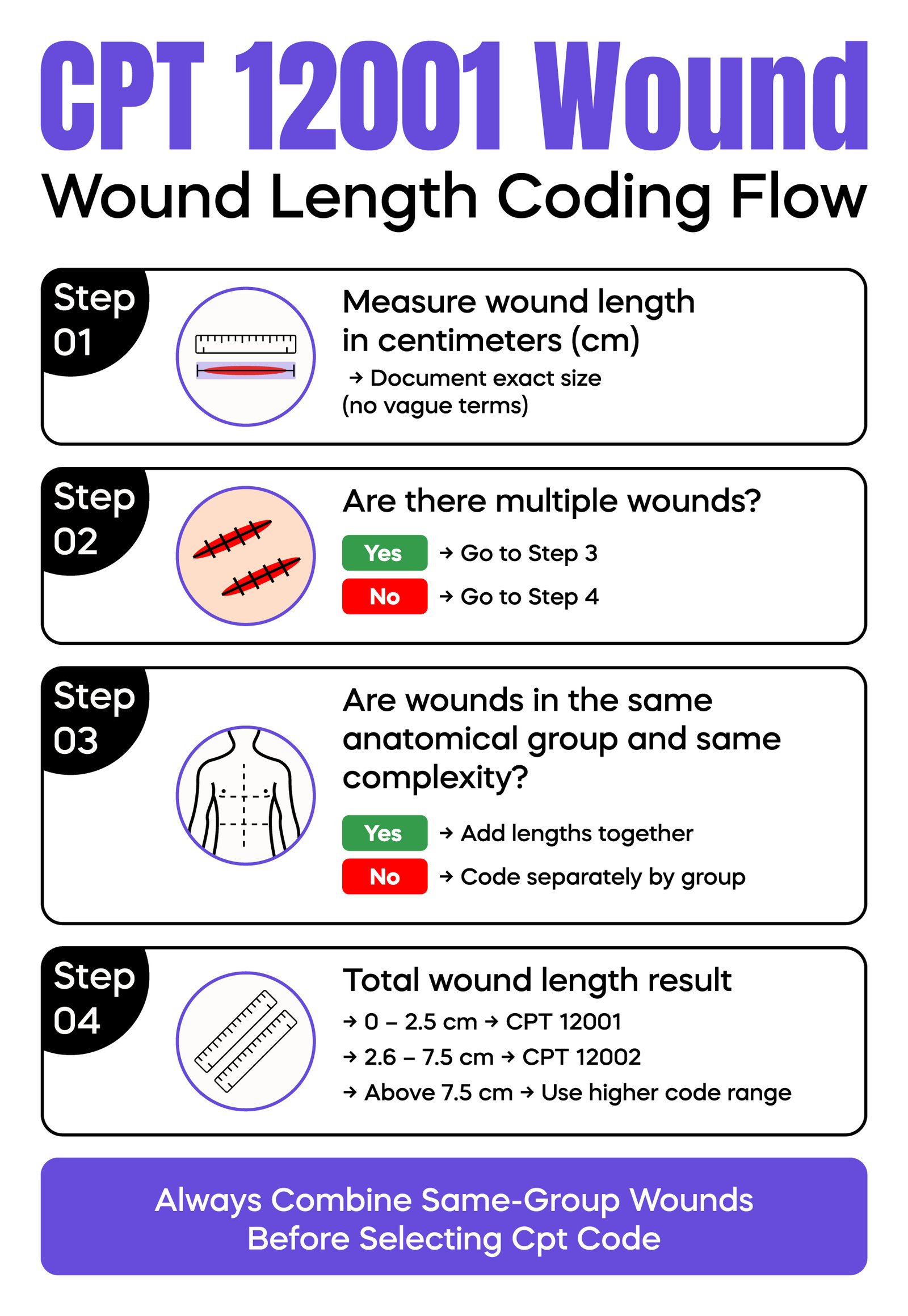
Consider a multi-provider urgent care group where Provider A documents "wound repaired, 2 cm, forearm" and Provider B documents "simple lac repair" for clinically identical presentations. The billing team codes them differently. That inconsistency is both a revenue problem and an audit pattern. The HHS that same figure Medicare Fee-for-Service Improper Payments Report confirms that CMS uses payment error data to target audit resources toward claim patterns that deviate from expected documentation norms. High-volume CPT that same figure billers with thin or variable documentation are exactly the pattern that triggers focused review.
The gap is visibility. Most practices have no encounter-level audit data showing how often two providers document the same wound type differently. iScribe Health's ambient listening and conversational AI captures the same structured data fields, wound length, anatomical site, repair method, tissue layer depth, closure type, across every provider and every encounter, creating the documentation consistency that reduces the inter-provider variability audit examiners look for. Until practices have that kind of systematic capture in place, the inconsistency compounds silently.
3. Downstream Claim Consequences When CPT 12001 Documentation Is Skipped Entirely
A skipped documentation element does not just delay one claim. It creates a cascade. The addenda request consumes billing staff time, interrupts the provider's clinical day, and often returns incomplete because memory of a wound repaired 72 hours ago is unreliable.
When the addenda fails to satisfy payer requirements, the claim is either denied outright or downgraded. The HHS that same figure Medicare Fee-for-Service Improper Payments Report identifies claims where the medical record does not support the service billed, including missing wound measurements and repair method, as a flagged category subject to payment recovery. Recovery means money already deposited is clawed back.
iScribe Health's Real-Time Denial Alerts surface those exposure points at the moment of note completion, before the claim ever enters the reimbursement workflow, so the cascade never starts.
4. Standardized Documentation Workflow That Eliminates CPT 12001 Variability at the Source
Most providers handle wound repair documentation through free-text habit, which means every provider's note looks different. The real barrier in a high-volume urgent care or ED setting is time pressure at the point of care. When the suture kit comes out, a structured prompt for each of the five required elements needs to surface automatically, not appear as a checkbox a tired provider fills out after the patient leaves.
iScribe Health's ambient AI documentation, built on ambient listening and conversational AI that integrates directly with the practice's supported EHR, captures wound length, anatomical site, repair method, tissue layer depth, and closure type in real time during the encounter. The AI drafts the encounter summary, Automated E&M Coding applies the appropriate code against what the documentation actually supports, and the claim is fully defensible before the provider ever steps out of the room. The addenda cycle ends. The billing team bottleneck clears. And the audit pattern that flags practices for focused review, the inconsistent, thin, or unsupported CPT that same figure documentation the HHS report specifically identifies, never forms in the first place.
Every element covered here represents a gap that currently exists somewhere in your CPT that same figure workflow, and most practices have no visibility into how often those gaps are silently costing them reimbursement. The next section quantifies what that invisible revenue leakage looks like, and how automated documentation closes it before the claim ever leaves the room.
Why CPT 12001 Reimbursement Integrity Depends on Real-Time Documentation, Not Post-Encounter Review
The structural flaw in most current workflows is the assumption that documentation can be completed, reviewed, or corrected after the clinical moment has passed. It cannot be done reliably, and not in a way that survives audit scrutiny. CMS auditors are not evaluating whether a provider eventually produced a compliant note. They are evaluating whether the note generated at the time of service reflects the clinical reality of what occurred. An addenda submitted days later, after a denial trigger or a billing team flag, carries a different evidentiary weight than a contemporaneous record, and payers treat it accordingly.
The HHS 2025 Medicare Fee-for-Service Improper Payments Report does not identify post-encounter correction as a mitigation strategy. It identifies real-time documentation specificity as the standard against which claims are measured. That distinction matters operationally because it relocates the compliance checkpoint from the billing queue, where it currently sits in most practices, to the encounter itself.
A wound length recorded in the room during the repair is a clinical observation. The same measurement entered two days later in response to a denial is a reconstruction, and reconstructions are exactly what focused audit review is designed to expose. iScribe Health's ambient AI documentation closes that gap by capturing all five required elements during the encounter in real time, so the note that reaches the billing team is already the note that would satisfy an auditor, with no dependence on provider memory or staff follow-up to become defensible.
How Automated Documentation Catches the CPT 12001 Revenue Leakage Most Practices Never See
A sports medicine practice auditing 941 encounters found something that stopped their billing team cold: [the same pattern holds.ncbi.nlm.nih.gov/articles/PMC9134459/), not undercoded, creating a compliance exposure that had been invisible under their manual documentation workflow for months.

The 33% Overcoding Finding That Reframes Documentation Automation as a Compliance Tool
The Center for Sports Medicine & Orthopaedics analysis, reviewed by Physicians Revenue Group, confirmed exactly this pattern at scale: manual documentation creates a structurally unreliable handoff between what the provider did clinically and what the billing team can defensibly code. Overcoding at 33% across 941 encounters is what coding precision looks like without a real-time documentation layer underneath it. The Center for Sports Medicine & Orthopaedics, Chattanooga trial also found a 54.8% provider, AI agreement rate across those same encounters, and until they ran the trial, no one in the building knew the split between undercoded and overcoded claims, or which providers were driving which direction.
iScribe Health's Automated E&M Coding intelligence is designed to close that gap at the point of note completion, after the AI drafts the encounter summary and before the claim ever enters the billing queue. The goal is to improve coding precision in a way that directly impacts revenue, which means catching both undercoded wound repairs and the CPT that same figure claims where no qualifying repair was performed at all. iScribe Health's E&M Coding Intelligence surfaces that signal in real time, not six months later in a payer audit.
How Real-Time Coding Intelligence Captures the Four CPT 12001 Data Fields Before the Note Is Finalized
Four clinical data points determine whether a wound repair claim is defensible: wound length in centimeters, anatomical site, repair method, and tissue layer depth. All four must be present and accurate before the note is finalized.
iScribe Health's Ambient Listening and Conversational AI captures all four required fields in real time during the encounter, surfacing any gaps before the note is ever submitted to the billing queue.
iScribe Health integrates directly with supported EHRs, so this workflow materializes without requiring a parallel documentation system or a manual data-transfer step, keeping the provider's existing process intact while adding a structured capture layer beneath it.
Why Standardized Documentation Output Closes the Inconsistent-Coding Audit Gap Across Providers
Inconsistent provider charting habits are the root cause of the audit gap most practices cannot see from inside their own workflow. The same 2 cm laceration on the forearm gets documented differently depending on who is in the room: one provider records wound length, site, and repair method precisely; another omits one or more of those fields and moves on, leaving the billing team to code from an incomplete record.
Standardizing clinical documentation quality across the practice is one of the three core outcomes iScribe Health is built to deliver. Practices using iScribe Health's AI-assisted ambient documentation produce the same structured data fields for the same laceration encounter regardless of which provider is in the room. The documentation output is driven by the tool's capture logic rather than individual provider charting habits, closing the inconsistent-coding audit gap that manual workflows leave open.
Related Reading
- Cpt Code 71045
- Cpt Code 99406
- Cpt Code 17110
Next steps
If your billing team is still sending wound repair notes back to providers for missing measurements and site details, the path forward starts with capturing those data points during the encounter, before the note is ever finalized. Start with our AI medical scribe.
The aggregation rule for multiple wound repairs means that a provider who documents each laceration individually without noting shared billing zones leaves the coder unable to sum the lengths correctly, and a claim that should have escalated beyond CPT 12001 never does. The 33% overcoding finding from the Center for Sports Medicine and Orthopaedics audit means the error runs in both directions simultaneously, creating compliance exposure and revenue loss that manual workflows cannot detect until a payer pulls the records. Together, they point to a single intervention: structured, real-time documentation capture at the point of care, where the clinical intelligence that makes a claim defensible actually exists.
Start with the AI medical scribe from iScribe Health. The ambient layer listens during the encounter, drafts the encounter summary with wound length, anatomical site, repair method, and tissue layer depth already populated, and E&M coding intelligence reviews the output before the claim leaves the room. The addenda cycle ends. The billing queue clears with complete notes instead of flagged ones. For urgent care groups and ambulatory practices already running a supported EHR, the integration slots into the existing workflow without a parallel system or additional steps for the provider.
Frequently Asked Questions
What exactly makes a wound repair qualify for CPT 12001 instead of a higher code?
CPT 12001 requires a single-layer closure of the epidermis, dermis, or subcutaneous tissue, with no involvement of deeper structures like fascia or muscle, on the scalp, neck, axillae, external genitalia, trunk, or extremities including hands and feet, measuring 2.5 cm or less. The moment a repair requires layered closure of deeper tissue, the encounter exits 12001 territory entirely and must be coded to a higher-complexity code.
Can I bill separately for wound exploration or debridement performed during the same visit as a 12001 repair?
No. Simple exploration of the wound and superficial debridement of debris are considered bundled components of CPT 12001 and cannot be billed as separate line items. The only scenario where debridement becomes separately reportable is when it exceeds simple surface-level exploration and meets the threshold for CPT 11042, which is a meaningfully higher clinical bar.
If a patient has both a scalp laceration and a lip laceration from the same injury, can I use 12001 for both?
No. The scalp repair belongs to CPT 12001's anatomical group, while the lip repair falls under CPT 12011 through 12018, a separate code range for wounds of the face, ears, eyelids, nose, lips, and mucous membranes. Both repairs may be simple closures of identical length, but they cannot share a code.
Does closing a wound with Steri-Strips or a bandage qualify for CPT 12001?
No. The closure methods eligible under CPT 12001 are sutures, staples, and tissue adhesives such as Dermabond. Adhesive strips, including Steri-Strips, do not qualify, and a claim billed after closure with only a bandage or adhesive strip is considered miscoded.
Why do so many CPT 12001 claims end up undercoded even when the procedure was done correctly?
The root cause is incomplete documentation at the point of care, not coder error. When providers document only shorthand like 'laceration repaired' without specifying wound length, anatomical site, tissue layers involved, or closure method, coders have no basis to assign or defend 12001 versus a higher-complexity code, and the claim defaults downward. No amount of downstream coding expertise can reconstruct clinical data that was never captured during the encounter.