CPT Code 10060 Explained: What It Covers and When to Bill
CPT code 10060 denials cost billing teams real money. See the documentation gaps auditors flag and how to close them before claims go out.


The note, not the coder, is why CPT 10060 claims deny. Here is what the documentation must capture before the chart closes.
Billing teams routinely treat CPT code 10060 as one of the lower-risk codes in their queue. Most practice administrators and billing decision-makers think CPT 10060 denial and undercoding problems are a coder knowledge issue. If the biller understands the code, the claim goes out right. It covers a minor procedure, the clinical picture is usually clear, and the descriptor sounds straightforward. That assumption is where the problem starts.
"Providers cannot easily determine patient responsibility at the CPT code level for procedures like Incision and Drainage (I&D), meaning CPT 10060 coverage details are not readily surfaced by standard eligibility tools."
— what we hear from medical billing professionals
See our AI medical scribe for how this works in practice. The word "simple" in the CPT descriptor is doing specific clinical work, not giving anyone permission to submit a thin note. When providers document an I&D encounter as though the code is self-explanatory, they produce records that omit the exact elements payers audit. A correctly performed procedure then generates a technically deficient claim, and the denial arrives weeks later with no obvious upstream cause.
Image: What CPT Code 10060 Actually Covers in an I&D Encounter
Practices using ambient AI documentation to capture encounters in real time close that gap before the note is ever finalized. carbuncle, suppurative hidradenitis, cutaneous or subcutaneous abscess, cyst, furuncle, or paronychia); simple or single." Every phrase in that descriptor is a billing boundary.
"Incision and drainage" specifies the procedural mechanism. "Abscess" specifies the collection type. "Simple or single" specifies the complexity and lesion count threshold.
Miss any one of those elements in the clinical note, and the documentation no longer supports the code, regardless of what the physician actually did in the room.
The parenthetical examples are not an exhaustive list. What they share is a common procedural logic: an incision is made, purulent material is drained, and the collection is a single, uncomplicated site. A note that simply states "abscess I&D performed" without specifying site, size, or drainage character gives the auditor nothing to verify.
CPT that same figure covers drainage of a collection through an incision. It does not cover removal of tissue. When a provider excises a cyst wall or removes surrounding tissue during the same encounter, that work falls under a different code family entirely.
Submitting that same figure for a procedure that included tissue excision misrepresents the service rendered.
The failure point is the note. Providers dictate quickly between patients, and a one-line note feels sufficient for a two-minute procedure. What it does is strip the clinical specificity that payers require to confirm medical necessity. By the time the denial arrives, the encounter is weeks old and reconstruction is expensive. The documentation has to capture what happened before the chart closes, not after the denial lands.
Key takeaways
- CPT 10060 covers incision and drainage of a simple or single abscess, but 'simple' is a clinical determination that has to be documented, not assumed because the encounter felt routine.
- Sixty percent of medical billing denials trace to incomplete or inaccurate clinical documentation; for CPT 10060, the revenue gap opens the moment an I&D encounter note fails to capture anatomical location, abscess complexity, or the decision-making that justified the procedure.
- Modifier 25 is the mechanism that makes a same-day E&M separately payable, but it only holds up when the note proves a significant, separately identifiable evaluation occurred before the procedure started.
- CPT 10060, 10140, and 10160 are not interchangeable billing options; selecting the wrong code is a potential misrepresentation of the service rendered, not a minor reimbursement variant.
- Four services are already bundled into every CPT 10060 reimbursement, billing them separately without meeting the specific unbundling criteria triggers automatic NCCI edits.
- Thin documentation doesn't get partial credit from a payer reviewer; it gets a denial or a downcode, regardless of what the physician actually managed in the room.
- iScribe Health's Automated E&M Coding generates E&M codes directly from clinical documentation in real time, so the complexity a provider manages during an I&D encounter is captured at the point of care, before a coder ever touches the claim.
What Simple or Single Means for CPT 10060 Billing Eligibility
Paronychia drainage documented without specifying whether one nail fold or multiple were involved leaves the coder in an impossible position: the note is thin, the complexity is unknown, and the claim goes out under CPT 10060 because silence gets read as simplicity.

What Simple or Single Actually Requires in Clinical and Billing Terms
CPT 10060 covers a straightforward incision and drainage of one lesion without complex secondary wound management, and the record must support all three of the following:
- one lesion
- straightforward incision
- no complex secondary management
When paronychia drainage is documented without specifying single versus multiple nail folds, the coder cannot confirm that CPT 10060 applies, and the claim is effectively built on an assumption.
Where CPT 10060 Ends and CPT 10061 Begins
CPT 10061 applies to complicated or multiple abscesses. Procedures requiring extensive packing, multiple incisions, or drain placement escalate the correct code from 10060 to 10061, and failure to document these elements, or their absence, is the root cause of coding variability and claim denials across providers performing the same procedure.
Why the Same I&D Gets Paid for One Provider and Denied for Another
Two physicians perform clinically identical abscess drainages in the same urgent care center on the same afternoon. One documents lesion count, incision approach, and wound management; the other does not, and that gap alone determines which claim is paid.
Key takeaway: Across the market, the distinction between simple and complicated hinges on what the physician documents; underdocumented charts produce denials regardless of coder competence.
iScribe Health uses ambient listening and conversational AI to capture procedural detail in real time during the encounter. At the point of note completion, when the AI drafts the encounter summary, the documented proof that "simple or single" requires is already in the chart rather than a silence that coders are forced to interpret as simplicity.
What Services Are Bundled Into CPT 10060 Reimbursement

Four Services Already Paid Inside Every CPT 10060 Reimbursement
- Local anesthesia (lidocaine infiltration)
- Skin preparation and cleaning
- The initial routine wound dressing
- The incision and drainage itself
When the underlying note doesn't explicitly capture each of those four components, billing staff are left guessing at what was actually performed. That guesswork is where unbundling errors originate, and where the administrative cost accumulates encounter by encounter. iScribe Health's Ambient AI Documentation captures the full encounter conversation in real time and, at the point of note completion, after the AI drafts the encounter summary, surfaces structured prompts that flag whether all four bundled components are reflected in the note, before the claim is ever built.
The 10-Day Global Period and Follow-Up Billing After an I&D
The note must clearly reflect that the follow-up visit falls within that global window and addresses only routine post-procedure care. Without it, a separately billed follow-up visit will be denied regardless of what actually occurred clinically. iScribe Health's Real-Time Denial Alerts are designed to flag exactly this scenario, identifying when a follow-up encounter is being coded in a way that conflicts with the active global period, so the issue is resolved before submission rather than during costly rework after denial.
NCCI Edits Are the Enforcement Mechanism, Not a Payer Preference
NCCI edits are federal policy applied uniformly across Medicare and most Medicaid programs, which means they are not negotiable at the payer level. As the AAPC Knowledge Center confirms, services bundled under a primary CPT code cannot be unbundled and billed separately without a valid modifier and clinical justification.
Key takeaway: The documentation is the control point, not the coding desk. When the note doesn't explicitly capture that local anesthesia, skin prep, and the initial dressing were performed as part of the I&D encounter, billing staff are left guessing, and that guesswork is where unbundling errors originate.
For high-volume practices where clinicians are regularly charting well outside of patient care time, this documentation gap compounds across every encounter of every day. iScribe Health's Ambient Listening and E&M Coding Intelligence work together to surface those gaps at the point of care, before the claim is built, so the note already reflects the complete service picture, including the four bundled components that NCCI policy treats as non-separately-billable.
Related Abscess CPT Codes That Billers Confuse With CPT 10060
Three codes, three distinct clinical scenarios, and zero interchangeability. Billers who treat CPT that same figure, CPT 10140, and CPT 10160 as flexible options for any drainage encounter are not making a minor reimbursement choice. According to the AMA CPT Code Set, selecting the wrong code among these three is a potential misrepresentation of the service rendered, not a billing variant.
The distinguishing factor is the nature of the collection and the procedural method combined. When a provider drains a post-surgical seroma and the team submits CPT that same figure, the ICD-10 diagnosis code (seroma) creates an immediate mismatch with the abscess I&D code selected, a crosswalk conflict that payer edits are built to catch. The error is authored in the exam room when the note fails to specify what type of fluid collection was present.
1. CPT 10140 - Incision and Drainage of Hematoma, Seroma, or Fluid Collection (Not an Abscess)
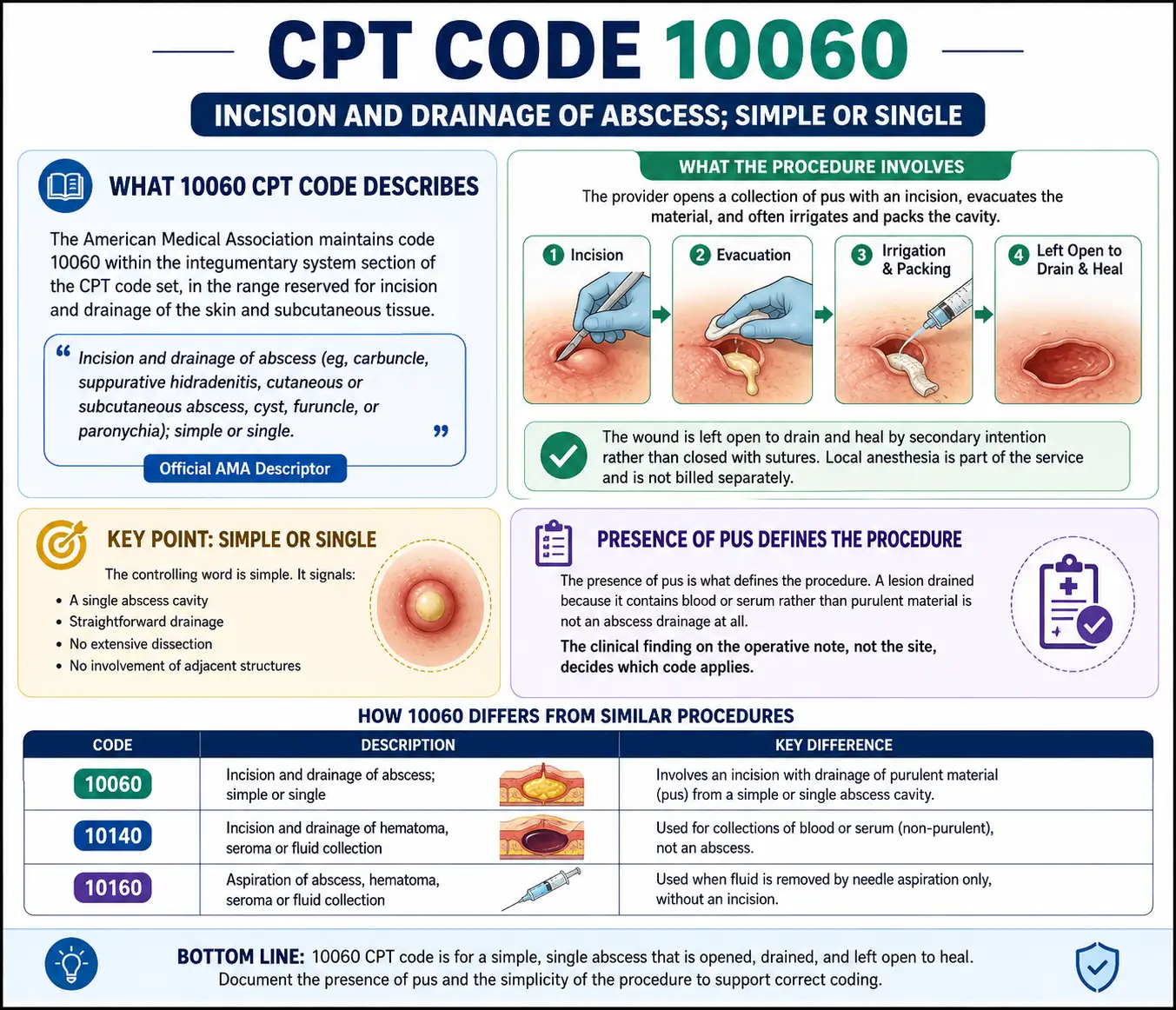
CPT 10140 covers incision and drainage of a hematoma, seroma, or non-infected fluid collection. The AMA CPT Code Set confirms that the nature of the collection, not just the surgical approach, determines whether 10140 or 10060 is correct. A post-traumatic hematoma drained by open incision belongs here, not under 10060. Submitting that same figure for this encounter misrepresents the clinical scenario entirely.
2. CPT 10160 - Puncture Aspiration Without Incision, Confused With Open I&D Under CPT 10060
CPT 10160 describes puncture aspiration of an abscess, hematoma, bulla, or cyst using a needle only. Per the AMA CPT Code Set, no incision is made, which makes it procedurally distinct from both that same figure and 10140. When a provider's note is ambiguous about whether a scalpel was used, the biller is structurally blocked from selecting the right code regardless of their coding knowledge.
3. The 10140-vs-10060 Distinction Hinges on Collection Type, Not Technique - A Commonly Missed Nuance
The most frequent substitution error between these codes happens because billers focus on what the provider did (opened and drained) rather than what was drained. Per the AMA CPT Code Set, a coder who conflates CPT that same figure and CPT 10140 is misrepresenting the clinical encounter, not selecting a billing variant. Open incision technique is shared by both codes.
The correct split is the collection: infected abscess goes to that same figure; hematoma, seroma, or sterile fluid collection goes to 10140. A note that documents only "incision and drainage of fluid collection" without specifying infection status makes that split impossible to defend. iScribe Health's E&M Coding Intelligence is designed to surface exactly this distinction, flagging when the drafted note lacks the collection-type language required to support the code the encounter warrants, so that coding precision is built into the documentation before it reaches the billing team.
4. Selecting the Wrong Related Code Is a Compliance Risk Payers Actively Audit - Not Just a Billing Inefficiency
A one-time substitution between that same figure, 10140, and 10160 is a billing error. A pattern of substitution across a provider's claims history is an audit signal. The AMA CPT Code Set is direct: incorrect selection among these three codes constitutes a compliance risk subject to payer audit because each maps to a distinct clinical scenario.
When the ICD-10 diagnosis code (seroma, hematoma) consistently mismatches the CPT selected (abscess I&D), payer crosswalk edits detect that pattern at scale. The downstream exposure, including recoupment and prepayment review, far exceeds the reimbursement delta between codes. iScribe Health's Real-Time Denial Alerts surface these mismatch signals before claims leave the practice, converting what would become a compliance pattern into a correctable documentation event at the encounter level.
Treating substitution errors as correctable clerical issues understates the actual risk. The revenue and compliance exposure is controlled by treating them as a documentation process problem that ambient AI can prevent.
5. Side-by-Side Comparison of CPT 10060, 10140, and 10160 - Key Differences Every Abscess Biller Must Know
Three variables separate these codes cleanly: collection type, procedural method, and the clinical documentation required to support each. CPT that same figure requires an infected abscess and an open incision. CPT that same figure requires a hematoma, seroma, or sterile fluid collection and an open incision.
CPT 10160 requires any aspiratable collection (abscess, hematoma, bulla, or cyst) but specifically a needle puncture with no incision, per the AMA CPT Code Set. The practical limitation: all three distinctions depend entirely on language the clinical note must supply. If the note omits infection status, collection type, or instrument used, no billing-side knowledge resolves the ambiguity; the coding error is already locked in.
iScribe Health's ambient AI documentation, realized across every patient encounter and every day of clinical practice, ensures that collection type, infection status, and procedural instrument are captured in the note at the point of care, so the coder receives a record that already contains the three variables that determine which of these codes is defensible.
Related Reading
- Cpt Code 12001
- Cpt Code 11200
Documentation Requirements That Make or Break a CPT 10060 Claim

The Four Note Elements Payers Audit Before Approving a 10060 Claim
Documentation must substantiate medical necessity for CPT 10060 by capturing four specific elements: lesion location, size and appearance, nature of the collection, and the character and volume of fluid drained. According to Rhode Island Medical Billing Services, payers deny claims when notes lack specificity about the nature of the collection and the complexity managed; all four elements are required. That gap is widest in high-volume settings, where the clinical detail that makes a defensible claim possible never makes it into the note because there was no structured moment to capture it. iScribe Health's ambient AI documentation is most beneficial in this setting, where the gap between what happened in the room and what appears in the note is widest.
How a Thin Note Produces the Wrong Code Before the Biller Ever Sees It
Rhode Island Medical Billing Services identifies this sequence directly: the documentation gap is the root cause of miscoding, because when the clinical note is thin, the code submitted may be wrong before it ever reaches the biller. The result is that the biller receives inconsistent inputs and produces inconsistent outputs. iScribe Health's ambient AI documentation creates more defensible documentation and standardizes clinical documentation quality across the practice, so the note that reaches the coder contains the same structured clinical detail regardless of which provider saw the patient.
Real Audit Data Confirming the Documentation Gap Is Not Theoretical
Key takeaway: One in three claims was wrong before the biller touched it, which means coding accuracy reviews and biller retraining address the wrong layer of the problem.
The error originates at documentation capture, so the solution must also live there. iScribe Health captures physician dialogue and patient context during the visit to generate clinical notes in under 30 seconds, ensuring the structured detail required for a defensible claim is present before the note is ever finalized.
Element
What to Document
Why It Matters
Anatomical site
Named location (e.g. right index finger, left axilla)
Required for site-specific L02.x ICD-10 assignment
Lesion size and appearance
Dimensions and visual description (e.g. 2 cm erythematous, fluctuant abscess)
Supports the "simple" threshold and medical necessity
Collection type
Confirm purulent/infected (not seroma, hematoma, or sterile fluid)
Prevents CPT that same figure / 10140 / 10160 mismatch denials
Single vs. multiple lesions
Explicitly state "single lesion" or count if multiple
Determines that same figure vs. 10061 eligibility
Fluid character and volume
Color, consistency, estimated volume drained
Distinguishes abscess from cyst; supports extent of service
Absence of complex management
Confirm no drain placed, no extensive packing, no multiple incisions
Documents "simple" complexity
Modifier 25 support (if E&M billed same day)
Document distinct clinical reasoning separate from pre-procedure assessment
Makes Modifier 25 defensible at audit
CPT 10060 Billing Guidelines for Modifiers and Same-Day E&M Services

Modifier 25 and Same-Day E&M Revenue
Key takeaway: Omitting Modifier 25 on a same-day E&M commonly forfeits $80 to $120 per encounter under standard Medicare fee schedule rates, a repeating, preventable revenue loss that compounds quietly across hundreds of visits.
When Modifier 59 or XS Is Required
When a CPT claim is billed alongside a separate, distinct procedure on the same date, Modifier 59 or its more specific subset XS signals that the I&D represents a unique procedural service not bundled with the other line item. Payer-specific bundling edits vary considerably, however, and commercial contracts do not uniformly follow Medicare's National Correct Coding Initiative logic. Practices that assume Medicare policy translates to commercial payers will face denial patterns they cannot explain from coding rules alone. iScribe Health's Real-Time Denial Alerts are designed to surface these payer-specific conflicts at the claim level, before submission, so billing teams can act on modifier discrepancies rather than discover them in a remittance weeks later.
The Documentation-Modifier Link
The same I&D procedure, performed by two physicians in the same practice, can produce one paid claim and one denial, and the difference almost always traces back to documentation quality rather than coding error.
That separation has to exist in the record before the claim is submitted, not after a denial prompts a retrospective review.
iScribe Health's Ambient Listening and Conversational AI captures the distinct clinical reasoning in real time during the encounter, and the platform's Automated E&M Coding applies that structured content toward the appropriate code selection. Because iScribe Health integrates directly with supported EHRs, the AI-drafted encounter summary lands inside the existing clinical workflow without requiring a separate documentation step.
ICD-10 Codes That Support Medical Necessity for CPT 10060 Claims
L02.x codes, cutaneous abscess by anatomical site, are the primary ICD-10 family that establishes medical necessity for CPT that same figure claims. The right code is only assignable when the clinical note explicitly names the anatomical location and confirms the nature of the collection. When the note reads "drained abscess" without further detail, the coder has no compliant basis for anything other than an unspecified code, and that shortcut is increasingly triggering automated payer edits, a pattern that compounds painfully across high patient volumes where even a small percentage of unspecified codes translates to a material block of preventable denials.
1. L02.x - Cutaneous Abscess Codes - The Primary ICD-10 Family for CPT 10060
L02.x codes cover cutaneous abscess by anatomical site and are the most frequently paired ICD-10 family for CPT that same figure claims. Per industry data, each L02.x code must reflect the anatomical site documented in the clinical note. A claim submitted with L02.91 (unspecified) when the note documented a finger abscess misses the site-specific code L02.51x, which reduces denial risk and satisfies medical necessity more precisely. The distinction is most consequential in high-volume practices where chief medical officers and practice administrators are trying to ensure accurate, compliant medical coding across every encounter, not just the ones where a thorough note happened to land.
2. L72.x - Follicular Cyst Codes - When an Infected Cyst Drives the 10060 Encounter
L72.x codes apply when an infected follicular cyst, not a classic cutaneous abscess, is the documented condition driving the incision and drainage. DecisionHealth Part B News confirms L72.x as a covered ICD-10 pairing for CPT that same figure when the clinical note supports it. The tradeoff: if the provider documents "abscess" without specifying cyst origin, defaulting to L72.x is unsupported and creates a diagnosis-procedure mismatch that payer edits will catch. This is precisely the kind of downstream coding failure that originates at the point of documentation, not at the billing desk, and that iScribe Health's ambient listening and E&M Coding Intelligence are positioned to intercept before the note ever reaches a coder.
3. Diagnosis-Procedure Code Mismatch - How Seroma and Hematoma Codes Trigger Automatic 10060 Denials
Pairing CPT that same figure with a seroma or hematoma diagnosis code is one of the most common and preventable denial triggers in outpatient billing. DecisionHealth Part B News notes that those conditions do not map to a simple abscess incision and drainage procedure, so payers flag the combination through automated edits before a human reviewer ever sees the claim. The fix is not a coding correction; it is a documentation correction.
When the note never confirmed whether the collection was infectious or post-procedural, the coder is left guessing, and in a high-volume practice where physicians are already charting two or more hours outside of patient care time, that ambiguity in the note is not an exception; it is a predictable byproduct of documentation fatigue. iScribe Health's Real-Time Denial Alerts surface these mismatches at the point of note completion, after the AI drafts the encounter summary, giving the physician a concrete opportunity to clarify the nature of the collection before the claim is ever built.
4. Medicare LCD Contractor Policies - How Novitas and CGS Define Covered ICD-10 Ranges for CPT 10060
Covered ICD-10 ranges for CPT that same figure are not uniform across Medicare. DecisionHealth Part B News confirms that Local Coverage Determinations issued by contractors such as Novitas and CGS specify distinct covered diagnosis code lists, meaning a claim compliant in one jurisdiction may deny in another. Practices billing across MAC boundaries carry compounding exposure here.
A diagnosis code that passes Novitas edits may not satisfy CGS LCD criteria, and the difference is invisible until the denial arrives. For practice administrators and chief medical officers managing multi-site or multi-jurisdiction operations, this variability is one of the structural reasons that ICD-10 accuracy cannot be solved by coder training alone. The clinical note has to arrive at coding with enough specificity to satisfy the strictest applicable LCD, every time.
5. Anatomical Site Specificity Failures - How Unspecified ICD-10 Codes Compound Clinical Documentation Gaps for 10060
The ICD-10 denial is the final symptom of a documentation failure that began when the provider never recorded where the abscess was. DecisionHealth Part B News identifies this as a compounding failure: no site in the note means no site-specific code; no site-specific code means LCD criteria go unmet; and an LCD-noncompliant claim denies even when CPT selection and modifiers are correct. This is the gap that billing-side ICD-10 training cannot fix, because by the time the coder sees the note, the information that should have been captured in the room is already gone.
The platform's conversational AI listens at the point of care, drafts the encounter summary, and, through its EHR Integration, delivers a structured note into the practice's existing supported EHR without requiring providers to change their workflow. Because iScribe Health is designed for a seamless ambient documentation experience within the EHR a practice is already running, the anatomical detail the physician stated aloud is captured and surfaced in the note the coder actually receives. The result: coders can assign the correct L02 subcategory from the CPT that same figure covered diagnosis code set rather than defaulting to an unspecified code because the note left the site blank.
Removing the unspecified-code shortcut upstream is what makes LCD-compliant ICD-10 assignment consistent across every provider in a group, not just the thorough ones, and it is what allows chief medical officers and practice administrators to maximize reimbursement and minimize claim denials across high patient volumes without adding to physician documentation burden.
Every ICD-10 pairing problem traced in this section leads back to the same upstream failure: a clinical note that did not capture what the physician actually documented in the room. The next section shows how fixing that documentation layer, before the claim is ever built, is the structural intervention that makes correct CPT that same figure billing repeatable at scale.
Related Reading
- Cpt Code 71045
- Cpt Code 99406
- Cpt Code 17110
How Automated Documentation Closes the CPT 10060 Revenue Gap Before the Claim Is Built
By the time a claim is rejected, the encounter that caused it is long over.

Why CPT 10060 Denials Start in the Exam Room, Not the Billing Queue
Sixty percent of medical billing denials trace directly to incomplete or inaccurate clinical documentation, according to industry research on upstream claim failure points. The denial is created the moment an I&D encounter closes without capturing abscess site, fluid character, or cavity count.
The root cause is a structural disconnect between clinical workflow and coding requirements. I-Conic Solutions identifies this mismatch precisely: coding denials stem from a gap between what the physician performed and what the clinical note records, a gap billing teams cannot close after the fact without returning to the provider for addenda. At that point, the provider is three patients ahead, the detail is gone from memory, and the claim goes out thin or gets held.
Key takeaway: Sixty percent of medical billing denials trace to incomplete or inaccurate clinical documentation, and no coder knowledge recovers what the documentation never captured.
The gap is visibility. If the note contains nothing more than a procedural acknowledgment with no clinical specifics, the biller has no raw material to work with.
How to Capture the Complexity Elements That Determine the Correct CPT 10060 Code
An AI medical scribe operating during the encounter prompts for and records the exact elements that determine code selection, including:
- Anatomical site
- Lesion size and appearance
- Fluid character
- Single versus multiple cavity status
- Any packing or irrigation performed
This is where coding variability across providers collapses. In an urgent care group with multiple physicians and mid-level providers, one clinician's thorough documentation gets paid while another's identical procedure gets denied. Automated scribing is designed to standardize what every note captures before the encounter closes, with the goal of making correct CPT coding repeatable at scale rather than dependent on individual documentation habits.
How to Eliminate the Post-Encounter Reconciliation Loop That Delays CPT 10060 Reimbursement
I-Conic Solutions frames it directly: the reconciliation loop between clinical documentation and submitted codes is a high-friction, delay-inducing cycle that can only be structurally resolved by capturing complete clinical detail at the point of care. Every addendum request, every held claim represents compounding administrative cost on top of delayed cash.
Upstream documentation capture makes denial appeal workflows and additional coder training sessions unnecessary. Complete clinical detail at the point of care is the intervention.
Next steps
If your billing staff are regularly chasing documentation that was never captured in the first place, the path forward starts with fixing what the clinical note records before the encounter closes. Denial prevention on CPT 10060 is not a coding competency problem. As the body of this post establishes, a 33% overcoding rate at a single practice traced directly to notes that never captured the four payer-required elements, and ICD-10 denials on anatomical site compound that failure further because no billing-side correction can insert a site the physician never recorded. Start with our AI medical scribe.
The finding that most CPT 10060 denials originate in the exam room, not the billing queue, means retraining coders addresses the wrong layer. The finding that Modifier 25 is only as defensible as the documentation behind it means modifier compliance depends on whether the note independently substantiated a distinct E&M service during the encounter. Together, they point to one intervention: capturing the complete clinical picture at the point of care, before the note is finalized and the claim is built.
Start with iScribe Health's AI medical scribe to close the documentation gap at the encounter level. Once ambient listening captures anatomical site, fluid character, complexity indicators, and distinct E&M reasoning in real time, the note that reaches your coder already contains the elements that make a first-submission CPT 10060 claim defensible, and the post-encounter reconciliation loop that delays reimbursement compresses accordingly.
Frequently Asked Questions
What's the actual difference between CPT 10060 and CPT 10061?
CPT 10060 covers a simple or single abscess drainage, one lesion, a straightforward incision, and no complex secondary management such as extensive packing, drain placement, or multiple incisions. CPT 10061 applies when any of those complexity factors are present, and failure to document either their presence or absence in the clinical note is the root cause of miscoding between the two codes.
Does CPT 10060 cover paronychia drainage?
Yes, paronychia is listed among the parenthetical examples in the CPT 10060 descriptor. However, the note must specify whether a single nail fold or multiple nail folds were involved, because leaving that detail out means the coder cannot confirm the "simple or single" threshold is met, which can produce a denial or force the coder to guess.
Can I separately bill for the local anesthesia or the wound dressing on a CPT 10060 claim?
No. Local anesthesia, skin preparation, the initial routine wound dressing, and the incision and drainage itself are all bundled into the single CPT 10060 reimbursement under NCCI guidelines and cannot be billed as separate line items. Attempting to do so, for example, billing CPT 99070 for the initial dressing, triggers an automatic NCCI edit and a denial.
If I need to bill a follow-up visit after an abscess I&D, when is that allowed?
CPT 10060 carries a 10-day minor procedure global period, so all routine follow-up care within that window is already included in the original reimbursement and cannot be billed separately. A follow-up visit is only separately billable if it addresses a new problem or a complication genuinely distinct from the original procedure, and that distinction must be clearly documented in the clinical note.
How is CPT 10060 different from CPT 10160?
CPT 10060 requires an open incision to drain an infected, purulent abscess, while CPT 10160 describes puncture aspiration of an abscess, hematoma, bulla, or cyst using a needle only, no incision is made. When a provider's note is ambiguous about whether a scalpel was used, the biller cannot select the correct code regardless of their coding knowledge, which means the distinction must be captured in the clinical documentation.