13 Best Urology EMR Software Systems Ranked for 2026
Best urology EMR systems ranked for 2026, helping clinicians cut after-hours charting and reduce documentation burden after every encounter.


Specialty templates were supposed to fix urology charting. They didn't. Here's why the real bottleneck is a capture problem, and which systems actually solve it.
Urologists who run thorough EMR demos, check every box on the feature list, and still find themselves finishing voiding diary notes and urodynamics summaries at 10 PM are not making bad purchasing decisions. They are solving the wrong problem. The common assumption is that selecting a urology-specific EMR with the right templates, urodynamics, prostate exams, voiding diaries, will solve their documentation burden, because specialty templates reduce the manual input required per note. Yet the criteria that dominate urology EHR evaluation, scheduling dashboards, template libraries, billing module depth, simply do not predict what happens after the last patient leaves the room. For practices exploring AI-powered clinical documentation as a complement to their EMR, this distinction matters enormously.
Standard EMR buying guides measure what is easy to count. As broader market patterns make clear, conventional EMR evaluations focus on scheduling, billing, and template counts rather than post-encounter documentation burden, so the metrics used to compare vendors do not reflect the actual time cost urologists absorb after clinic hours. Every shortlisted vendor clears these table-stakes criteria.

The real differentiator never appears on the demo scorecard. Urologists spend 2 to 3 hours after clinic completing charts that specialty-specific templates were supposed to streamline. Implementation gaps mean specialty-specific templates do not automatically reduce documentation burden for clinicians.
Templates reduce what you type; they do not eliminate when you type it. Closing that gap requires a documentation layer that captures the encounter as it happens, so the note is ready before the patient reaches the parking lot. Most EMR evaluations never ask whether that layer exists.
Key takeaways
- Urologists finishing charts at 10 PM are not choosing the wrong EMR, they are solving the wrong problem. Specialty templates reduce manual input; they do not write the note.
- Urology-specific templates, urodynamics, prostate exams, voiding diaries, are the price of entry for any credible urology EMR, not a differentiator worth paying a premium for.
- The real benchmark for any urology EMR is how much after-hours charting it eliminates, not how many specialty-specific screens appear in the demo.
- Claim denials in urology start in the chart, not the billing queue, a rushed or incomplete note gives coders nothing solid to work with, and that gap shows up in reimbursement weeks later.
- Practice size and hospital affiliation determine EMR fit more than any feature comparison will; enterprise systems and specialty-specific platforms carry fundamentally different trade-offs for independent versus health-system-affiliated urology groups.
- 55% of U.S. physicians report debilitating burnout, with administrative burden as the primary driver, an EMR stores the note, but it does not reduce the time it takes to write one.
- iScribe Health's AI-powered documentation layer works inside your existing EHR to capture and complete urology notes in real time during the encounter, so the note is signed before the patient reaches the parking lot, not hours after clinic ends.
What Unique Features Urology EMR Software Needs Beyond General EHR Systems
Specialty-specific templates are the price of entry for urology EMR software. A general EHR that forces free-text entry for a pressure-flow urodynamics study or lacks a structured voiding diary module adds minutes of manual work to every relevant encounter, compounding across dozens of patients each week into a documentation burden that quietly erodes clinic efficiency and physician wellbeing.

The Urology-Specific Feature Floor for Templates, Imaging, and Voiding Diaries
Urology EMR software needs structured templates for urodynamic testing, prostate exams, and voiding diaries as a baseline clinical requirement. Without a dedicated urodynamic template capturing detrusor pressure, flow rate, and post-void residual in a structured format, the urologist defaults to free-text, slower, less consistent, and harder to audit.
PACS integration is equally non-negotiable, as imaging workflows for renal ultrasounds, cystoscopies, and CT urograms must move seamlessly between the imaging system and the clinical record without manual re-entry.
EMR vs EHR in a Urology Context Where Interoperability Across Settings Is Non-Negotiable
The distinction between an EMR and an EHR matters more in urology than in many other specialties. An EMR is an internal clinical record confined to one practice or facility, while an EHR enables interoperability across care settings. For urologists who split time between outpatient clinics, surgical centers, and hospital rounds, that interoperability is a practical daily requirement. A urology EHR mobile app with iOS and Android support lets the urologist access and update records at the bedside during rounds, not hours later at a desktop terminal.
Why Urology EMR Feature Checklists Don't Reduce After-Hours Charting
In Memrizz (2025), 78% of physicians waste 20 or more hours weekly on documentation tasks, a figure that holds even in practices running specialty-specific templates.
78%
of physicians waste 20 or more hours weekly on documentation
Key takeaway: Templates reduce what you type. They do nothing about when you type it, which is why the vast majority of physicians still waste significant hours weekly on documentation even with specialty-specific systems in place.
Industry research corroborates this, linking excessive EHR data entry directly to physician burnout, a pattern most acute in high-volume practices where clinicians regularly chart two or more hours outside of patient care time.
This is precisely where IT and EHR administrators, along with clinical informatics teams, increasingly intervene: not to swap out the core EHR, but to layer ambient AI documentation on top of it to decrease the administrative burden associated with EHR data entry.
iScribe Health sits on top of any supported urology EMR as an ambient AI scribing solution, capturing the encounter in real time and drafting a structured note without requiring the physician to type during or after the visit. At the point of note completion, after the AI drafts the encounter summary, iScribe Health's Automated E&M Coding and E&M Coding Intelligence layer evaluates the note for coding accuracy, while Real-Time Denial Alerts flag potential claim issues before submission, reducing both rework and revenue leakage downstream.
The ranked list that follows scores all 13 systems against these criteria, with documentation velocity treated as a first-class requirement alongside every specialty-specific feature.
Related Reading
- Urology Billing Software
- Ai Scribe Comparison
- Cpt Code For Vasectomy
- Urology Billing Codes
- Urology Coding Cheat Sheet
13 Best Urology EMR Software Systems Ranked for 2026
Urologists lose a significant portion of each day to clinical documentation, a pattern consistently surfaced across physician burnout surveys, and a meaningful share of that time falls after the last patient leaves the building. That number is the real benchmark for evaluating any EMR system, not the count of specialty-specific screens in the demo.
The status-quo assumption is understandable: more urology templates should mean less typing, which should mean less time charting. The reality is more frustrating. Templates reduce discrete data-entry fields.
The post-encounter charting gap persists because it is a capture problem. The note does not exist until the physician authors it, and no template library changes that. A system with many urology-specific forms that still sends you home with significant after-hours chart reconciliation is a worse documentation tool than a leaner platform paired with an AI layer that generates the structured note from the exam-room conversation in real time.
That distinction shapes the ranking below. Each platform is assessed on four criteria:
- Specialty-specific depth
- Billing integration
- Interoperability
- Documentation velocity, meaning how much post-encounter charting burden the system actually removes, not just how many templates it ships with
How Documentation Velocity Affects Your Urology EMR Ranking
Most EMR comparison guides treat documentation speed as a secondary feature, something mentioned after scheduling dashboards and billing modules. Physician burnout data argues otherwise. Urology practices that still require providers to reconcile visit details into structured charts after clinic ends are experiencing a compounding problem: every encounter that does not close before the next one begins adds to an end-of-day debt that accumulates across the week. The platforms below are ranked with that debt explicitly in view.
Every system on this list ships with a template library, and templates do accelerate note-starting. But urologists who still spend significant time after clinic finishing charts are experiencing a documentation gap that no EMR on this list fully closes on its own. That is the gap ambient AI scribing is built to seal, turning the exam-room conversation into a signed, structured note before the next patient is roomed, regardless of which EMR sits underneath it.
The 13 Best Urology EMR Platforms Ranked
The following platforms span the full range of urology practice types, from solo independents to large academic health systems, and are ordered by how well each balances specialty-specific depth, billing integration, interoperability, and documentation velocity.
1. ModMed (EMA) - Best Urology EMR for Independent Specialty Practices
ModMed's EMA platform earns the top slot for independent urology groups because its adaptive learning engine builds a personalized charting profile from each provider's documentation patterns, progressively reducing the keystrokes required per encounter over time. The mobile interface is purpose-built for specialty workflows, and the system's urology-specific content library covers urodynamics, prostate staging, and voiding dysfunction out of the box. The real tradeoff: practices inside large hospital networks will find ModMed's interoperability footprint narrower than enterprise alternatives.
2. UroChart EHR - Best Urology-Exclusive EMR for Subspecialty Depth
UroChart EHR is the only EMR on this list built exclusively for urology, which means every template, every workflow, and every reporting module was designed for urological care from the ground up. UroChart's vendor documentation and urology specialty society references (including AUA product listings) confirm its urology-exclusive architecture, distinguishing it from adapted general EHR platforms. Tailored templates for UTIs, prostate cancer staging, voiding dysfunction, and urodynamic testing are standard, not add-ons. For subspecialty-heavy practices, that depth is differentiated. The limitation is equally clear: practices that need robust interoperability with a broader hospital network or multi-specialty referral ecosystem will find UroChart's connectivity options constrained compared to cloud-native platforms.
3. athenaOne - Best Urology EMR for Interoperability and Revenue Cycle
AthenaOne's interoperability advantage is structural. The platform connects providers and care sites across the U.S. at a scale that makes it among the largest ambulatory care networks available and the strongest choice on this list when seamless communication between a urology clinic and its referral partners is a daily operational requirement. Its urology-focused templates are solid, and the revenue cycle management layer is tightly integrated. The tradeoff for smaller independent practices is complexity: athenaOne's depth is most valuable when the practice has the administrative bandwidth to configure and maintain it.
4. DocVilla - Best Urology EMR for Small Practices Needing All-in-One Functionality
DocVilla packages comprehensive urology templates, including bladder scan documentation and erectile dysfunction questionnaires, alongside built-in telehealth, integrated billing for urology-specific CPT and ICD-10 codes, and procedure tracking in a single platform designed for small practice economics. For a small urology group that wants to avoid stitching together separate billing, telehealth, and documentation tools, DocVilla's consolidated approach reduces operational overhead meaningfully. Practices expecting enterprise-grade interoperability or deep health system integration will need to look elsewhere.
5. Epic Systems - Best Urology EMR for Large Hospital Networks and Academic Centers
Epic Systems is the dominant EMR choice for large hospital networks and academic urology departments, and that position reflects real infrastructure advantages: deep integration across inpatient and outpatient settings, robust research and registry support, and the organizational credibility that comes with widespread adoption in academic medicine. For hospital-employed urologists or those affiliated with a large health system, Epic is often the default for good structural reasons. The honest tradeoff for independent or small-group urology practices is that Epic's urology workflows require significant custom configuration to match the out-of-the-box specialty depth that purpose-built platforms provide.
6. AdvancedMD - Best Urology EMR for Midmarket Practices Prioritizing Billing Automation
AdvancedMD markets itself to enterprise and group practices, offering dedicated solutions including a testing sandbox, ODBC data warehouse, open API architecture, multi-location management, and CRM integrations aimed at enterprise-scale infrastructure. Its billing automation layer handles claim scrubbing, denial management, and urology-specific code sets with enough depth to reduce revenue cycle friction for midsize provider groups. The scheduling and patient engagement modules are competent. The documentation experience, however, is not the platform's strongest dimension: providers in practices that run high-volume clinic days will likely find post-encounter charting time is not materially reduced compared to simpler alternatives.
7. Kareo (Tebra) - Best Urology EMR for Solo Practitioners and Micro-Practices

Kareo, now operating under the Tebra brand, is built for the economics and workflow of solo and micro-practice medicine. Setup is faster than enterprise platforms, the billing module handles urology CPT codes without requiring a dedicated RCM team, and the per-provider cost structure is accessible for a one-to-two physician practice. The ceiling is visible: Kareo does not offer the subspecialty documentation depth that a high-volume urology practice needs, and its interoperability options are limited for practices with complex referral or hospital-affiliation requirements.
8. Greenway Health - Best Urology EMR for Practices Requiring On-Premise Deployment
Greenway Health's primary differentiator on this list is its on-premise deployment option, which matters for practices operating under institutional data governance policies that restrict cloud-hosted clinical data. The platform covers standard urology workflows and integrates billing and scheduling competently. Practices without a specific on-premise requirement will find cloud-native alternatives offer faster updates, better mobile access, and lower infrastructure maintenance costs. Greenway is the right call when the deployment model is a non-negotiable constraint, not when it is a preference.
9. DrChrono - Best Urology EMR for Mobile-First Charting on iPad
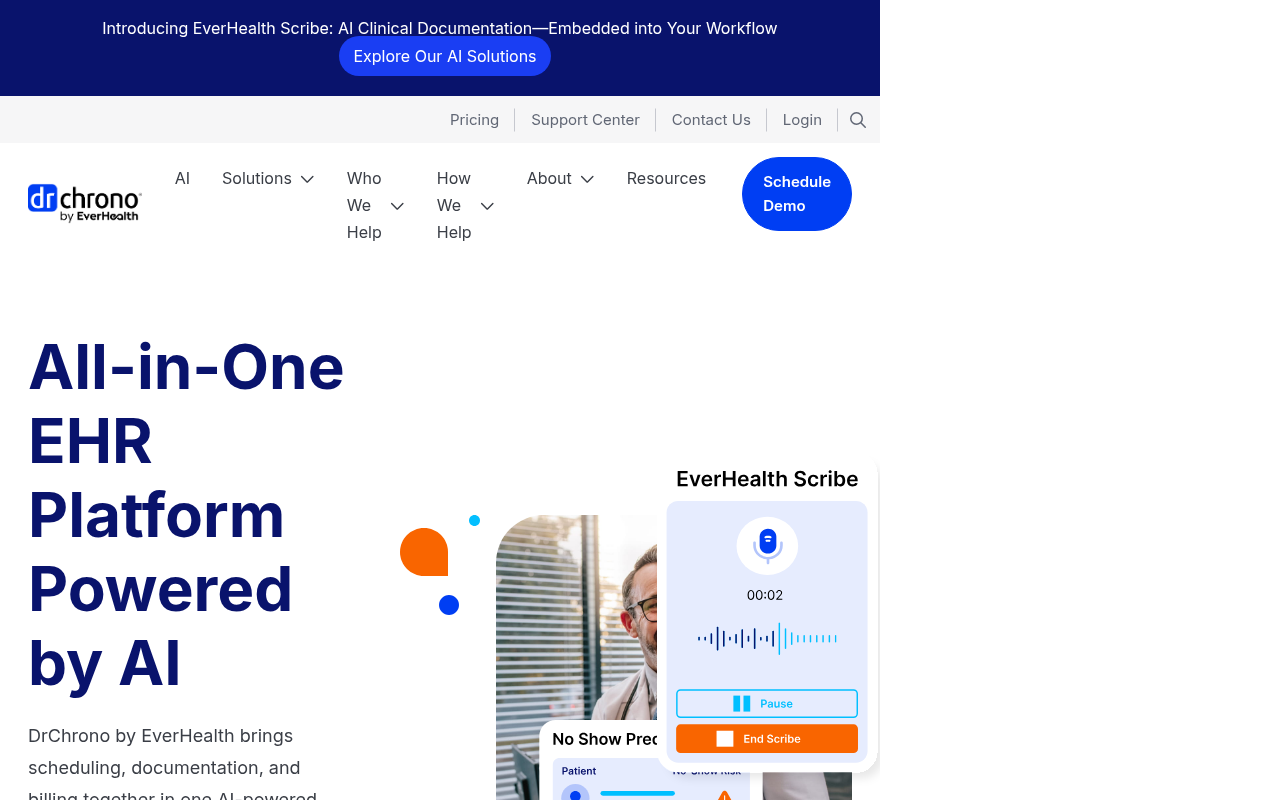
DrChrono's architecture is iPad-native, which makes it a strong fit for urologists who move between exam rooms, procedure suites, and hospital settings and want a consistent charting experience on a single device. The platform supports urology-relevant templates and integrates with medical device inputs. The practical limitation is that DrChrono's specialty depth in urology is not as granular as purpose-built platforms: practices with complex urodynamic documentation or subspecialty reporting requirements will find the template library requires more customization effort than UroChart or ModMed.
10. NextGen Healthcare - Best Urology EMR for Multi-Specialty Group Practices
NextGen is built for the operational complexity of multi-specialty group practices, where a single platform needs to serve urology, primary care, and ancillary services without requiring separate systems for each. Its interoperability and population health tools are well-developed, and the billing module handles cross-specialty coding with reasonable accuracy. For a urology-only practice, NextGen's breadth is more overhead than advantage. It earns its place on this list when urology is one specialty within a larger group that needs a shared infrastructure.
11. CureMD - Best Urology EMR for Integrated Telehealth and Patient Engagement

CureMD integrates telehealth, patient portal, and clinical documentation in a single platform, which makes it a practical choice for urology practices that have expanded virtual care offerings and want to manage in-person and remote encounters in one system. The urology template library covers standard workflows. The platform's billing integration is functional. Practices that run primarily in-person, high-volume urology clinics with minimal telehealth volume will not extract enough value from CureMD's core differentiator to justify the platform over alternatives with deeper specialty documentation support.
12. Practice Fusion - Best Budget Urology EMR for Cost-Conscious Independent Practices

Practice Fusion occupies the budget tier of this list for a specific reason: its per-provider cost is among the lowest of any cloud-based urology EMR option, making it accessible for independent practices operating under tight margin constraints. The tradeoff is feature depth. Urology-specific templates exist but are not as granular as specialty-built platforms, and the revenue cycle tools require third-party integration for practices with complex billing needs. Practice Fusion belongs on the shortlist when cost is the binding constraint and the practice has clinical staff who can absorb the documentation gap the platform leaves open.
13. Veradigm (Allscripts) - Best Urology EMR for Health System-Affiliated Outpatient Clinics
Veradigm, formerly Allscripts, is most valuable in outpatient urology clinics that operate within or alongside a larger health system infrastructure. Its data connectivity and analytics capabilities are well-suited to practices that need to report into health system dashboards, participate in value-based care arrangements, or maintain clean data pipelines to a hospital parent. For fully independent urology practices without health system affiliation, Veradigm's complexity-to-benefit ratio tilts unfavorably compared to specialty-focused or mid-market alternatives on this list.
Each of these 13 systems earns its place on this list, but knowing which one is right for your practice requires a different lens than feature comparison alone. The next section gives you a decision framework built around the one variable most EMR evaluations ignore: which system type leaves the smallest documentation gap after the clinic day ends.
Related Reading
- Hipaa Compliant Ai Scribe
- Top Medical Scribe Companies
- How Does An Ai Scribe Work
- Medical Scribe Cost
- Ai Scribe Cost
How to Choose Between Specialty-Specific and Enterprise Urology EMR Systems
Practice size and hospital affiliation determine more about your EMR fit than any feature comparison ever will. The real question is whether your chosen system leaves you composing notes at 10 PM or walking out of clinic with documentation done.

Three Decision Axes That Actually Determine Your System Type
The ideal choice depends on whether you need a specialty-specific solution or a large enterprise system, and three variables settle that faster than any demo: practice size, hospital affiliation, and IT infrastructure. Small independent groups of two to five urologists typically lack a dedicated IT team, making the lighter implementation footprint of a specialty-specific system a genuine operational advantage.
Specialty-Specific vs. Enterprise - Where Each System Type Wins and Where It Silently Loses Documentation Time
But the silent cost surfaces within months: specialty-specific platforms carry meaningful interoperability constraints when the practice has any hospital affiliation, because HL7 FHIR integration with large health network infrastructure remains inconsistent across smaller vendors. Enterprise systems like Epic solve that connectivity problem cleanly, which is why they dominate academic medical centers and hospital-employed physician settings.
Solo and small-group practices get the most from specialty-specific systems when implementation speed and urology-native workflows outweigh interoperability depth. Multi-site independent groups sit in the hardest position, needing enterprise-grade connectivity without enterprise-scale IT budgets.
This burden is heaviest in high-volume practices and health systems where clinicians regularly chart two or more hours outside of patient care time, the exact setting where physician burnout compounds fastest and where the structural cost of the wrong documentation workflow becomes most visible on the income statement.
That is precisely the gap where iScribe Health's ambient AI documentation operates.
For high-volume urology practices already running a supported EHR, iScribe Health also layers in E&M Coding Intelligence and Automated E&M Coding at note completion, surfacing Real-Time Denial Alerts before a claim ever leaves the practice, closing the documentation-to-revenue gap inline rather than in a separate billing workflow.
Choosing the right system type closes the structural fit problem.
Medical Billing and Revenue Cycle Features Every Urology EMR Must Include
They start in the chart, hours earlier, when a rushed or incomplete note gave the coder nothing solid to work with.
"Urology practices may engage in fraudulent billing practices that lead to major False Claims Act violations, highlighting the need for EMR systems with built-in compliance and audit trail features to prevent improper claim submissions."
— what we hear from urology practice administrators

Urology-Specific CPT and ICD-10 Libraries as the Billing Floor
Resilient Medical Billing Solutions' 2024 billing guidelines identify the following as the core procedures requiring precise CPT-to-ICD-10 matching:
- Cystoscopy
- Urodynamic studies
- Lithotripsy
- Prostate interventions
Improving coding precision directly impacts revenue, and it is one of the clearest levers available to Chief Medical Officers, practice administrators, and individual physicians who want to lower the operational costs of documentation and transcription without sacrificing accuracy. iScribe Health's E&M Coding Intelligence and Automated E&M Coding capabilities are designed to operate at exactly this layer: translating a completed ambient encounter summary into structured, codeable output rather than leaving that translation to a biller working from a fragmentary free-text note.
How Chart Inaccuracies Become Coding Errors Before the Claim Is Submitted
According to industry research, documentation inaccuracies at the chart level are a primary driver of coding errors. When clinical notes are incomplete or imprecise, coders cannot assign the correct CPT or ICD-10 codes, producing undercoding, overcoding, or outright denials.
Key takeaway: NAHRI's 2024 research found that upcoding rates are higher in outpatient physician office settings and are becoming more common, a compliance risk that has led to significant False Claims Act violations for practices without a systematic audit trail built into the documentation workflow.
This is not a theoretical compliance risk for urology practices: billing inaccuracies at this level of pattern have led to significant False Claims Act violations, and the practices most exposed are those without a systematic audit trail built into the documentation workflow itself.
iScribe Health's approach addresses the constraint no RCM feature can override: the accuracy of the note that feeds the billing system. Billing module upgrades and clearinghouse integrations matter, but they operate downstream of a documentation foundation that iScribe Health builds at the moment of care, not hours after it.
AI-Powered Clinical Documentation That Closes the Urology Charting Gap
Templates define the shape of a urology note, but structure alone cannot close the charting gap. Every field in a cystoscopy template, every AUA symptom score row, every voiding diary cell still requires a physician to fill it in after the encounter ends, which is why urologists with genuinely well-configured systems still report finishing charts long after the last patient leaves.

Why Urology EMR Templates Still Leave You Charting After Hours
According to industry research, physicians lose more than 20 hours per week to documentation tasks, with that burden identified as a primary driver of burnout across specialties.
Key takeaway: Templates compress what you type. They do not change when you type it, and physicians are still losing more than 20 hours per week to documentation tasks as a result.
There is a second cost that rarely gets named: the split-attention tax. Every moment a physician spends glancing at a screen during an encounter is a moment taken from the patient, and that cost compounds across every appointment in a full clinic day, not just at 10 PM when the inbox finally gets cleared.
How Ambient AI Documentation Works Inside Your Urology EMR Workflow
Ambient AI documentation addresses both the timing problem and the attention problem by moving capture into the encounter itself. As Memrizz's review describes, ambient scribing tools work as follows:
- Capture the clinical encounter in real time via microphone
- Automatically generate a structured note
- Allow the physician to review and sign, eliminating the separate after-hours charting session entirely
These tools layer onto whichever EMR the practice already uses. No platform switch. No workflow rebuild.
Why General AI Scribes Fall Short in Urology Specialty Coding
General-purpose ambient scribes handle documentation speed well. Where they fall short is specialty coding accuracy: urology encounters carry procedure-specific language tied to CPT codes for cystoscopy, urodynamics, prostate interventions, and lithotripsy that a generalist model was not trained to map precisely. A note that captures the conversation accurately but codes the procedure incorrectly still produces a claim problem downstream.
An ambient documentation layer purpose-built for urology closes both gaps simultaneously: real-time capture that ends pajama-time charting, paired with specialty coding intelligence that produces cleaner claims from the source note. That combination is most valuable in high-volume practices, where documentation errors accumulate fastest and the after-hours charting queue grows longest.
The EMR decision narrows your options; the documentation layer determines your daily reality.
Related Reading
- Best Ai Scribe For Athenahealth
- Ai Scribe Accuracy
- Ai Medical Scribes With E&m Coding Built In
- Do Ai Scribes Reduce Claim Denials?
Next steps
If your clinic day ends with a stack of unsigned charts and a voiding diary half-finished at 10 PM, the path forward starts with recognizing that the bottleneck was never the template. It was the real-time capture gap between what happened in the exam room and what got committed to the chart.
Specialty templates reduce what you type, but the cognitive labor of composing the note is the actual bottleneck, meaning no EMR on this list closes the after-hours charting gap on its own. Urology's billing accuracy problem sits directly downstream of documentation timing, not downstream of which billing module your EMR includes, meaning incomplete notes authored hours after the encounter produce the coding errors that become claim denials. Together, these two realities point to one next step: adding an ambient AI documentation layer that captures the encounter as it happens and generates a structured, codeable note before the patient reaches the front desk.
Start with Best AI medical scribe for orthopedic practices to see how ambient documentation layers onto your existing EMR without a platform switch. The note is ready to review at the point of encounter completion, E&M coding intelligence runs inline at note completion, and Real-Time Denial Alerts surface claim issues before submission rather than after.
Frequently Asked Questions
Is there a urology EMR with a mobile app that works on both iPhone and Android?
Yes, a urology EHR mobile app with iOS and Android support lets urologists access and update records at the bedside during rounds rather than hours later at a desktop terminal. The post flags mobile access as a key interoperability requirement, not a nice-to-have, because urology patients are often seen across multiple care settings in the same week.
Which EMR on this list is the best fit for a small urology practice?
The post highlights DocVilla as designed for small practice economics, bundling urology templates, built-in telehealth, and integrated billing for urology-specific CPT and ICD-10 codes in a single platform to reduce operational overhead. Kareo (Tebra) is also noted for solo and micro-practices, with a faster setup and an accessible per-provider cost structure, though it lacks the subspecialty documentation depth of purpose-built platforms.
Does switching to a urology-specific EMR actually reduce the after-hours charting I'm doing?
Not on its own, the post is direct on this point: templates reduce what you type but do nothing about when you type it, which is why 78% of physicians still waste 20 or more hours weekly on documentation even with specialty-specific systems in place. The post identifies the real fix as adding an ambient AI documentation layer, like iScribe Health, on top of your existing EMR so the note is ready to review before the patient reaches the front desk, no rip-and-replace of your current system required.
Does any EMR on this list include telehealth built in?
Yes, DocVilla is the platform on this list specifically noted as including built-in telehealth alongside its urology templates and integrated billing, making it the option the post identifies for small practices that want to avoid stitching together separate tools.
Why does interoperability matter so much for urology compared to other specialties?
Urology practices operate across multiple care settings, so a post-operative patient seen at the hospital on Monday and at the clinic on Thursday should not require manual reconciliation of two separate records, that gap is clinical, not just administrative. The post also draws a clear distinction between an EMR, which is confined to one practice or facility, and an EHR, which enables interoperability across care settings, framing true EHR-level connectivity as a non-negotiable for urology rather than an optional upgrade.