Annual Wellness Visit CPT Code Billing & Reference Guide
Annual Wellness Visit CPT code errors cost billers real money. Close the gap with the coding reference built for billing decision-makers.


Most AWV billing failures aren't coding errors. They're structural: wrong code family, missing required elements, and denials that trace back to the point of care, not the billing queue.
A significant share of Medicare beneficiaries eligible for the Annual Wellness Visit never receive one billed on their behalf, according to utilization data. The common assumption among practice administrators and billing decision-makers is that AWV billing failures are a coding knowledge problem: if the biller knows the right HCPCS code and eligibility window, the claim will be paid. That assumption is wrong. The gap is a billing problem rooted in a structural misunderstanding of what the AWV actually is.
Most billing teams treat the AWV as a Medicare-flavored physical. The logic feels reasonable: it is a preventive visit, it involves a physician, and the patient considers it a routine annual visit. But that framing is where the revenue loss begins.
The Annual Wellness Visit is a Medicare-specific health planning service. Medicare designed it to produce a personalized prevention plan, not to assess presenting complaints or perform a head-to-toe clinical review. It is governed by HCPCS codes G0438 and G0439, not the CPT 99381-99429 preventive medicine series.
Submitting 99397 for a Medicare patient's annual visit does not just underbill; it triggers an automated denial before a claims reviewer ever opens the record.

The covered components are equally distinct. A standard preventive visit has no mandatory cognitive screening, no required health risk assessment, and no obligation to produce a written prevention plan. The AWV requires all three, plus a review of functional ability, a current provider list, and biometric measurements. Missing a single required element does not reduce reimbursement. It invalidates the claim on audit.
Missing a single required element does not reduce reimbursement. It invalidates the claim on audit.
The IPPE, billed under G0402, is the one-time "Welcome to Medicare" visit available in the first 12 months of Part B enrollment. The Initial AWV (G0438) becomes available only after those 12 months have passed. Billing G0438 for a patient who received an IPPE within the prior year is a frequency-limit denial waiting to happen.
The financial cost compounds quickly. A practice miscategorizing even a portion of its AWV-eligible visits is forfeiting substantial reimbursement that was already earned clinically. Preventing denials requires understanding what a service must include and how it must be documented, not merely knowing which billing code to apply. The fix has to happen at the point of care, before the encounter closes, not at the billing queue afterward.
Key takeaways
- Four HCPCS codes govern every Medicare AWV claim, G0438, G0439, G0402, and G0468, and swapping even one based on a rejection notice, without fixing the underlying documentation, just delays the same denial.
- Most AWV revenue losses aren't coding errors. They're documentation gaps: a missing health risk assessment field, an incomplete screening checklist, or a thin note that can't support anything beyond the base code.
- Medicare's 12-month Part B enrollment rule kills more AWV claims than wrong codes do, and the denial arrives as a flat rejection on a claim your team coded correctly.
- The AWV encounter note sets the billing ceiling the moment it's finalized. CMS treats the AWV as all-or-nothing, so one missing required element fails the claim exactly the same way five missing elements do.
- A fully documented AWV isn't a single-line reimbursement, it's a revenue stack that includes add-on codes for chronic care, advance care planning, and cognitive assessments most practices never capture.
- Under the 2023 CMS Final RADV Audit Rule, documentation deficiencies found in a sample of records can be extrapolated across an entire plan's book of business, turning a single thin note into a systemic financial exposure.
- iScribe Health's AI-powered scribing captures AWV documentation in real time, at the point of care, so the note that reaches the coder already contains the clinical evidence needed to bill the correct code and defend it on audit.
AWV CPT and HCPCS Codes Every Billing Team Must Know
That fix begins with the physician, and it begins with the codes. Four codes govern every Medicare Annual Wellness Visit claim, and knowing which one applies to which encounter is the floor of clean AWV billing.
1. G0438 - Initial Annual Wellness Visit - First-Ever Medicare AWV, Not First Practice Visit
G0438 covers the first AWV ever billed under Medicare Part B for a given beneficiary, regardless of how long that patient has been seen at your practice. "Initial" is a Medicare lifetime designation, not a practice-relationship designation. A patient enrolled in Medicare Part B for 13 months who has never received an AWV gets G0438, whether it is their first visit to your clinic or their fiftieth. Per the CMS Medicare Benefit Policy Manual, the approximate national non-facility reimbursement is $174, with no patient cost-sharing when the provider accepts assignment. Required components include a health risk assessment, medical and family history, current provider list, biometric measurements, cognitive screening, and a written personalized prevention plan.
$174
Initial AWV reimbursement, no patient cost-sharing
One of the most persistent sources of G0438 errors is structural: AWV visits are frequently delegated to nurse practitioners, which means the billing physicians often have limited hands-on exposure to the workflow. When the physician who signs the note did not conduct the visit, and the NP who did is unfamiliar with Medicare's specific documentation requirements, required elements get underspecified or missed entirely. iScribe Health's Ambient Listening and Conversational AI addresses this at the point of care, capturing each required component in real time regardless of which qualified clinician is conducting the encounter, so that note quality is not a function of individual familiarity with AWV billing workflows.
2. G0136 - SDOH Risk Assessment Add-On - When to Append and Its Reimbursement Impact

G0136 is separately reimbursable when a standardized, evidence-based Social Determinants of Health screening tool is administered during the same AWV encounter. Since 2024, CMS health risk assessment guidelines have formally incorporated SDOH screening as a component, giving practices a concrete add-on revenue opportunity per the CMS Medicare Learning Network. Appending G0136 to G0439 requires distinct documentation of the screening tool used and its results; a vague note entry will not survive a MAC audit.
Most billing teams that miss this code do so because the documentation needed to defend it was never captured at the point of care. iScribe Health's E&M Coding Intelligence and Real-Time Denial Alerts work together to close this gap: the system flags when a G0136-defensible screening has occurred during the encounter and surfaces the add-on opportunity before the claim is built, not after a denial arrives weeks later with no audit trail back to the root cause.
3. CPT 99381-99429 Preventive Medicine Codes - Why They Don't Apply to Medicare AWV and When They Legitimately Co-Appear
CPT codes 99381 through 99429 are commercial and private-payer preventive medicine codes. Medicare does not recognize them for AWV billing, and submitting one in place of G0438 or G0439 is a denial waiting to happen. They can legitimately appear on the same claim only when a patient carries secondary commercial insurance covering a preventive service that Medicare Part B does not, or when a non-Medicare payer is involved in the same encounter.
The confusion here is persistent and structural. Billing staff who delegate AWV visits to nurse practitioners sometimes inherit claims built on the wrong code family, and the denial arrives weeks later with no clear audit trail back to the root cause. This is a coding consistency problem at its core, one that iScribe Health's Automated E&M Coding directly targets by standardizing code selection across providers and care team roles, so that the code family applied to a Medicare AWV does not depend on which staff member assembled the claim.
4. Quick-Reference Code Table - AWV HCPCS Codes, Visit Type, Frequency Rule, and Key Documentation Requirement
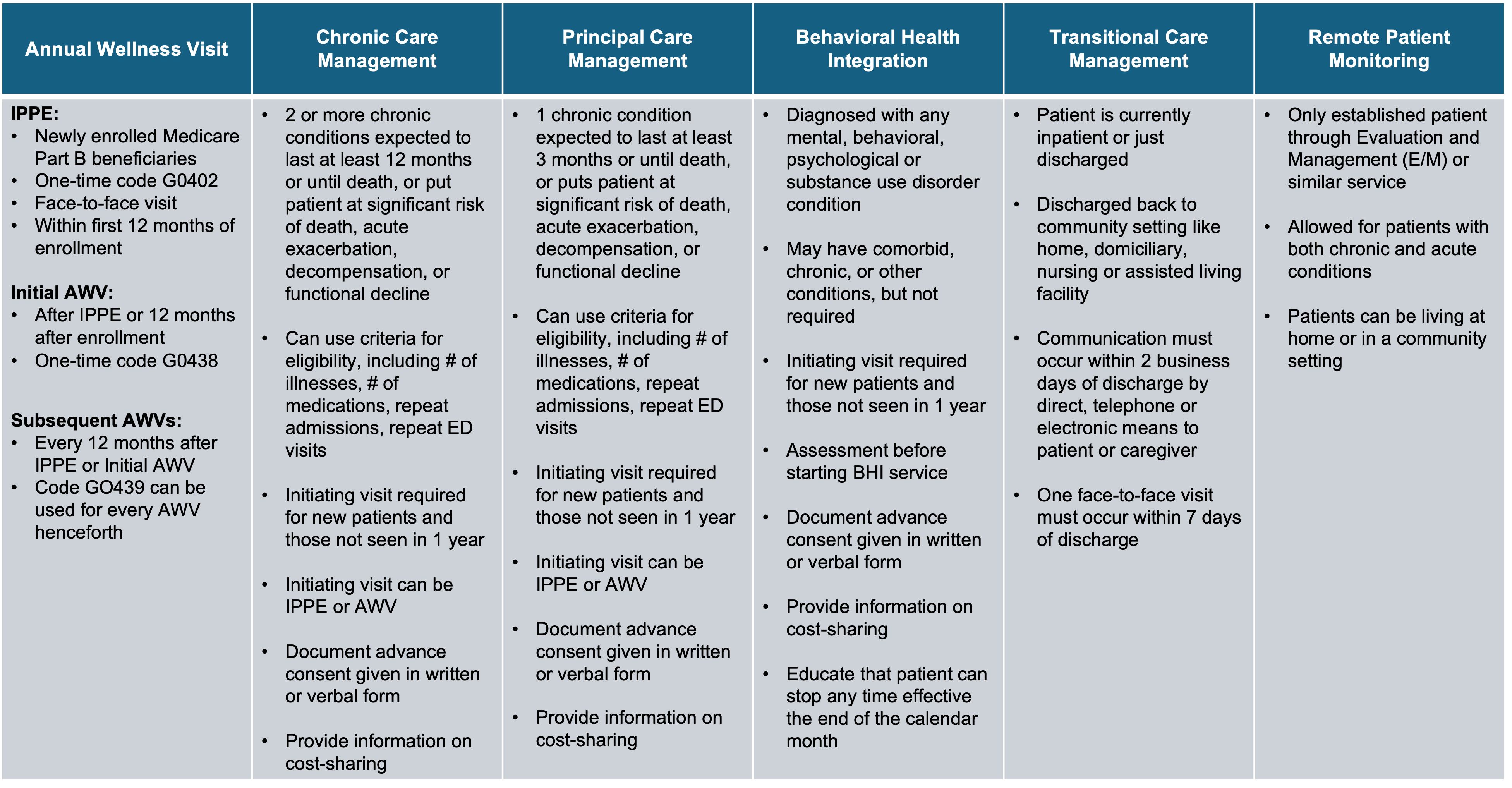
- G0438 – Initial AWV → Frequency: Once per lifetime (after 12+ months of Part B) → Approx. 2026 Non-Facility Rate: See current CMS fee schedule → Documentation: Full HRA, cognitive screen, and personalized prevention plan.
- G0439 – Subsequent AWV → Frequency: Once every 12 months → Approx. 2026 Non-Facility Rate: See current CMS fee schedule → Documentation: Updated HRA and updated prevention plan.
- G0402 – IPPE (Welcome to Medicare) → Frequency: Once per lifetime (first 12 months of Part B) → Approx. 2026 Non-Facility Rate: See current CMS fee schedule → Documentation: Can include a once-in-a-lifetime screening EKG.
- G0136 – SDOH Risk Assessment Add-on → Frequency: Appended to G0438 or G0439 → Approx. 2026 Non-Facility Rate: Separately reimbursable → Documentation: Standardized SDOH tool documented with results.
- 99497 – Advance Care Planning (First 30 Minutes) → Frequency: Optional AWV add-on → Approx. 2026 Non-Facility Rate: Separately reimbursable → Documentation: Minimum time threshold documented.
Rate references are drawn from the CMS Medicare Learning Network and the CMS Medicare Benefit Policy Manual.
The table above is the easy part. What billing teams consistently underestimate is that correctly selecting G0438 or G0439 does nothing to protect a claim if the underlying note never captured every required component with enough specificity to survive a MAC review. CERT audit data shows that correctly coded AWV claims were still denied when the medical record failed to document all required elements, which means code selection accuracy cannot rescue revenue that was never documented in the first place.
Most practices handle this by relying on physicians to complete AWV notes after the encounter, under time pressure, from memory. The consequence is structural. Required elements get compressed, cognitive screening results go unrecorded, and the SDOH screening that would have supported a G0136 add-on never makes it into the chart.
By the time the claim is built, the coding ceiling has already been set by an incomplete note. iScribe Health's AI medical scribe captures each required AWV element in real time during the encounter, regardless of whether the visit is conducted by a physician or a delegated NP, so the note that reaches the billing queue already maps cleanly to G0438 or G0439, with add-on codes defensible rather than speculative. For IT and clinical informatics teams, this also means a consistent documentation standard across every provider in the practice, rather than one that varies by individual AWV familiarity or charting habit.
Knowing which code to use is only half the equation. The other half is knowing exactly which visit history triggers G0438 versus G0439, a distinction that looks simple on paper but causes more first-pass denials than almost any other AWV billing error. That decision tree is what the next section breaks down.
Initial vs Subsequent AWV - The Distinction That Causes Most Claim Denials
The distinction between the IPPE, the Initial AWV, and the Subsequent AWV is a pre-submission workflow that must run against each patient's Medicare history before a claim is ever assembled.
That confusion is compounded by the

Subsequent AWV distinction being poorly understood at the point of care, and in practices where clinicians are already charting two or more hours outside of patient care time, there is no bandwidth left to audit coding logic in real time. iScribe Health's AI scribing layer is most impactful in these high-volume environments, where ensuring accurate, compliant medical coding across large patient volumes is the difference between sustainable reimbursement and a denial backlog that compounds weekly.
G0402, G0438, and G0439 on a Timeline
These three codes follow a strict sequential logic. The WPS Medicare CERT Review (reported by Indiana State Medical Association) confirmed that billing G0438 within 12 months of a G0402 is a documented denial pattern, not an edge case.
The One-Lifetime Rule for G0438 and the Denial It Triggers
That denial is not appealable on the merits.
A Pre-Submission Decision Tree for Every AWV Claim
If no, move to question 2.
Question 3: Does the note support all required AWV elements? The WPS Medicare CERT Review (reported by Indiana State Medical Association) found that documentation deficiencies drove denials even on correctly coded claims, making note completeness as critical as code selection.
In high-volume practices, where the same clinician may conduct dozens of AWVs per month and regularly charts two or more hours outside of patient care time, manually confirming every required element against every chart is where compliance breaks down. iScribe Health's Ambient AI Documentation layer listens during the encounter and builds a structured, real-time clinical record; at the point of note completion, after the AI drafts the encounter summary, the pre-submission check on required AWV elements becomes a fast confirmation rather than a manual chart review. Combined with Real-Time Denial Alerts and E&M Coding Intelligence, the workflow is designed to catch sequencing and documentation gaps before a claim is ever assembled, so denials do not accumulate in the rejection queue.
Medicare Coverage and Eligibility Requirements for the AWV

The 12-Month Part B Enrollment Rule and How Miscounting It Kills the Entire Claim
The boundary is exact: a patient who became Part B eligible on March 1 of one year cannot be billed for an Initial AWV until March 2 of the following year. Bill on March 1 and the claim denies.
Calendar-Year Frequency Limits, Eligibility Windows, and Same-Year Duplicate Denial Risk
iScribe Health's Real-Time Denial Alerts are designed to close exactly that gap. Integrated directly into the EHR through iScribe Health's EHR Integration layer, the system surfaces AWV eligibility context, including the patient's last AWV date, at the point of care, before the visit is documented and before the claim enters the queue.
Modifier 33, Zero Cost-Sharing, and Why Medicare Advantage Plans Add a Layer of Complexity
Modifier 33 signals to the payer that a service is a preventive benefit, waiving the patient's cost-sharing obligation.
Medicare Advantage plans introduce additional complexity beyond these baseline rules. Every MA plan must cover the AWV, but individual plans impose their own prior-authorization requirements and coverage rules that operate independently of published CMS calendar-year logic.
The gap is visibility into each plan's individualized rules before the patient is ever scheduled. iScribe Health's clinical documentation layer, built on Ambient Listening and Conversational AI and delivered through EHR Integration at the point of note completion, is designed to flag that eligibility context in real time, before the claim is already in the queue.
Related Reading
- Cpt Code 10060
- Cpt Code 11200
- Cpt Code 12001
AWV Documentation Requirements That Determine What You Can Bill

The Seven Required AWV Components and What Documented Actually Means for Each
The PPP must be written and patient-specific; a printed generic handout with no individualized recommendations does not satisfy the requirement. This is where iScribe Health's ambient AI documentation changes the equation: the AI listens to the encounter in real time and structures the AWV note around the exact required components as the visit unfolds, so nothing is left to reconstruct from memory at the end of a long day.
Same-Day E&M With G0439 and the Separate-and-Identifiable Documentation Test
As Part B Insider / TCI explains, modifier 25 must be appended to the E&M code, and the note must contain a distinct chief complaint, history, assessment, and plan for that problem, written apart from the AWV components. Modifier 25 signals intent; the documentation is the proof.
That uncertainty reflects how rarely coding guidance translates into clear, visit-level documentation habits. iScribe Health's E&M Coding Intelligence and Automated E&M Coding surface the appropriate coding pathway at the point of note completion, after the AI drafts the encounter summary, so the clinician can see whether a separately identifiable problem was documented in a way that supports the add-on claim, before the chart ever reaches the billing queue.
How One Missing Field Voids the Whole AWV Claim
Missing a single required element does not reduce the AWV reimbursement proportionally; it voids the claim entirely.
iScribe Health's ambient AI documentation is most beneficial when clinicians are seeing high patient volumes and spending significant time on after-hours documentation. Those are the conditions under which required fields are most likely to be missed, and complete structured capture at the point of care is the most reliable safeguard against that risk.
AWV Reimbursement Rates and the Revenue You Recover When Documentation Holds Up

How Medicare Calculates G0438 and G0439 Reimbursement
The conversion factor itself shifts annually when CMS revises the Physician Fee Schedule, so a rate that held last year is an approximation this year, not a reliable planning figure.
HCC Risk Adjustment Revenue Lost When the AWV Is Rushed
Beyond the direct payment, the AWV is one of the highest-yield opportunities to capture Hierarchical Condition Category diagnoses that drive risk-adjusted revenue throughout the plan year. A documentation failure that triggers a full clawback wipes out not just the base AWV payment but every add-on code billed that visit; the financial cost scales with total encounter complexity, not just the AWV line item.
iScribe Health's ambient AI scribing captures the clinical narrative at the point of care, so the note that exits the encounter already contains the chronic-condition specificity and SDOH screening detail that makes every layer of the revenue stack defensible.
How Documentation Workflow Failures Turn Correct AWV Codes Into Denied Claims
According to industry data, the average claim denial rate sits at 10 to 15%, with documentation deficiencies cited as a leading root cause, not code selection errors.
"Billing staff apply modifier -25 to the wrong code (G0439 instead of 99214), a documentation/workflow error that directly causes claim denials even when the underlying AWV coding intent is correct."
— what we hear from medical billing professionals

The Post-Encounter Note Lag Where Required AWV Elements Quietly Disappear
What most billing teams report bears out consistently: documentation errors, not coding knowledge gaps, are the primary operational root cause of claim denials, specifically because post-encounter note completion under time pressure compresses or omits required elements. That pattern repeats across practice sizes and EHR platforms alike.
That is not a training problem. iScribe Health's ambient AI documentation is designed specifically for that environment: the system listens to the encounter in real time and drafts the encounter summary at the point of note completion, before the physician moves to the next room and the memory of required AWV elements begins to compress. By integrating directly with the practice's existing EHR, iScribe Health makes this a seamless part of the workflow rather than an additional layer for already-stretched care teams, which means documentation quality holds even during peak census periods when the pressure to abbreviate is highest.
The Translation Gap Why Coders Can Only Bill What the Note Actually Says
- Undercode and accept the revenue loss.
- Flag the chart for an addendum and absorb the delay.
Both options carry a cost. Across the market, even expert coders cannot bill for clinical complexity that was never captured in the note, because the billing ceiling is set at documentation, not at the coding queue. The note is the constraint, and no amount of coding expertise overcomes a compressed record.
That single misplacement triggers a denial even when the clinical and coding intent behind the visit was entirely correct.
iScribe Health's E&M coding intelligence addresses this at the point of note completion, where the AI-drafted summary gives the coding team a complete, structured record to work from rather than a compressed note that forces interpretive decisions, reducing the conditions under which modifier placement errors occur.
Retrospective Documentation and Audit Exposure Why Fixing the Note After the Fact Fails
When a denial arrives and the note is incomplete, the available remediation options are limited and each carries risk. Broader industry guidance is direct: retrospective addition of missing AWV elements after a claim is flagged creates audit exposure, and the note must be complete before submission, not amended afterward.
The reason so many practices end up in this position is structural: the note is finalized under time pressure, the missing elements are not discovered until the denial arrives, and by then the only remediation available carries audit risk. iScribe Health's ambient documentation closes that gap at the source, ensuring the record is complete before the encounter window closes rather than after the claim is returned.
Related Reading
- Cpt Code 71045
- Cpt Code 99406
- Cpt Code 17110
How AI Scribing Captures the AWV Documentation That Gets Practices Paid
A coder staring at a thin AWV note doesn't have a coding problem. As the documentation-failure analysis established in §6, the gap originates at the encounter level, not the billing queue.

Real-Time Capture - How AI Scribing Populates Every Required AWV Element During the Encounter
Across the market, AI medical scribes capture all required AWV elements in real time during the encounter, recording health risk assessment responses, cognitive screening results, SDOH flags, and chronic-condition updates as the conversation happens rather than reconstructing them from memory afterward. When documentation is assembled retrospectively, that reconstruction is where detail collapses, and the chronic-condition update that would justify a same-day E&M never makes it into the chart at all. Real-time capture eliminates that compression, automatically populating required AWV fields so the note reflects what actually happened before the patient leaves the room.
Audit Defensibility - Why Timestamped Encounter-Concurrent Notes Outperform Retrospective Addenda
Retrospective addenda are a compliance risk, not a remedy. What most teams report bears this out directly: encounter-concurrent notes, regardless of how they are generated, are structurally stronger for audit defense because they demonstrate that required elements were captured at the time of service, not inserted after a denial triggered a chart review. The hidden cost of the addenda workflow isn't the extra step; it's compounding audit exposure across every amended AWV in the portfolio, and systematic revenue compression when coders default conservative because the chart won't support the higher code they know was clinically justified.
iScribe Health's AI medical scribe closes that gap at the source, so the note the coder receives is already coded-ready.
Next steps
If your AWV claims are coming back denied despite correct HCPCS code selection, the path forward starts with fixing what happens before the note is finalized. CERT audit data confirms that correctly coded claims were still denied when required documentation elements were missing from the medical record, meaning code selection accuracy alone cannot rescue revenue that was never captured in the first place. Start with our AI medical scribe.
The all-or-nothing documentation rule means a single missing field, whether a cognitive screening result or an SDOH assessment, voids the entire claim and every add-on code billed that day. At the same time, encounter-concurrent notes are structurally stronger for audit defense than retrospective addenda, which carry compliance risk rather than resolving it. Together, those two realities point to one corrective action: capturing every required AWV element in real time, during the encounter, before the note is finalized and the billing ceiling is set permanently.
Start with an AI medical scribe that listens during the encounter and drafts a complete, structured summary at the point of note completion, so the chart your billing team receives already maps to G0438, G0439, and any defensible add-on codes, without relying on after-hours reconstruction from memory.
Frequently Asked Questions
What exactly is a Medicare Annual Wellness Visit, and is it the same as a physical?
No, the Annual Wellness Visit is a Medicare-specific health planning service designed to produce a personalized prevention plan, not a physical examination. Unlike a standard preventive visit, it requires a health risk assessment, cognitive screening, a review of functional ability, a current provider list, biometric measurements, and a written personalized prevention plan.
What CPT or HCPCS code covers the initial Annual Wellness Visit?
The initial AWV is billed under HCPCS code G0438, not any CPT code. G0438 is a once-per-lifetime Medicare designation, it applies to the first AWV ever billed under a beneficiary's Medicare ID, regardless of how long the patient has been seen at your practice, and carries an approximate national non-facility reimbursement of $174 with no patient cost-sharing when the provider accepts assignment.
Does Medicare pay for CPT code 99397 when a patient comes in for their annual wellness visit?
No. Medicare does not recognize CPT codes 99381-99429 (the preventive medicine series) for AWV billing, and submitting 99397 for a Medicare patient's annual visit triggers an automated denial. The correct codes are G0438 (initial) or G0439 (subsequent).
Can I bill for a Social Determinants of Health screening on top of the regular AWV code?
Yes, G0136 is separately reimbursable when a standardized, evidence-based SDOH screening tool is administered during the same AWV encounter. Appending G0136 to G0438 or G0439 requires distinct documentation of the screening tool used and its results; a vague note entry will not survive a MAC audit.
How do I know whether to bill G0438 or G0439 for a patient I've seen before?
Run three pre-submission checks: first, confirm whether G0438 has ever been billed under the patient's Medicare ID, if it has, only G0439 is an option (assuming 12 months have passed since the last AWV); second, confirm the patient has not had a G0402 IPPE within the past 12 months, since G0438 is not payable until those 12 months have elapsed; third, verify the note documents all required AWV elements before submitting. Skipping the patient history check and correcting the code after a denial is fixing the wrong problem.