Ambient Digital Scribe Tools Reviewed: Top Picks for 2026
Ambient digital scribe tools reviewed for 2026, helping physicians eliminate after-hours charting and documentation burden before burnout sets in.


Your charts don't suffer because you're short on time. They suffer because the moment the encounter ends, so does your memory of it.
Most physicians who stay up until midnight finishing charts believe the same thing: if they could just find one more hour, the notes would be better. The common assumption is that documentation is fundamentally a time problem: if physicians could just find more hours in the day, they could chart accurately and completely. The logic feels airtight.
More time equals more complete documentation. Except the evidence says otherwise, and any clinician who has stared at a half-finished SOAP note at 11 PM, genuinely unsure whether a patient described three days of symptoms or five, already knows the uncomfortable truth. The problem was never the clock.

It was the moment the encounter ended. A 2017 study found that physicians spent more than half of their total working hours on EHR and desk work, averaging over 27 hours per week. After-hours charting added to that total without improving documentation quality proportionally.
See our AI medical scribe for how this works in practice.
The extra hours reflected deferred capture, not better accuracy. A hospitalist finishing 14 notes at 11 PM, realizing she can no longer recall whether a patient mentioned three-day or five-day symptom onset, is not suffering from a time shortage. She is suffering from a memory problem that started the moment she walked out of that exam room.
Clinical memory is not a recording. It is a reconstruction. The conversational details that anchor accurate E&M coding, the complexity indicators, the nuanced history that separates a level-3 visit from a level-4, begin fading within minutes of the encounter ending.
By the time a physician opens the EHR at home, what remains is an outline, not a portrait. This is what makes documentation drag so costly: it quietly caps coding accuracy and reimbursement defensibility on every chart it touches. Adding further context, the same study found that physicians with insufficient time for documentation are 2.8 times more likely to report symptoms of burnout.
"Clinicians spend significant time editing AI-generated notes because the output doesn't reflect what they actually intended, suggesting the problem originates in how context is set up before documentation begins."
Key takeaways
- Documentation is a capture problem, not a time problem, by the time a physician sits down to chart, the clinical complexity that drives accurate E&M coding has already faded.
- Notes written from memory an hour after an encounter don't fail because the physician was careless; they fail because the detail was never preserved in the first place.
- Templates, dictation, and human scribes all hit the same ceiling: they depend on the physician to reconstruct the encounter after it ends, not capture it while it happens.
- An ambient digital scribe records what happens in the room, the full provider-patient conversation, not just what the physician chooses to dictate, and that distinction changes what gets coded.
- After-hours charting isn't just a burnout issue; every note finished from memory is a documentation gap that compounds into missed reimbursement and cleaner claims left on the table.
- Not all ambient scribe platforms perform equally, published research on standardized ambulatory encounters found significant variability between platforms, making head-to-head evaluation on documentation quality essential before committing.
- iScribe Health's Ambient Listening AI closes the capture gap by passively listening to the natural provider-patient conversation, no scripted commands, no button-pressing, and converting that dialogue into structured clinical notes automatically, inside your EHR, in real time.
Why Traditional Documentation Methods (Templates, Dictation, Human Scribes) Hit a Silent Ceiling
Spend enough time reviewing clinical notes written from memory and a pattern becomes clear: the notes that miss billable complexity are not the ones written by careless physicians. They are the ones written an hour after the encounter ended, when the diagnostic reasoning that felt obvious in the room has quietly dissolved. According to a 2024 study published in JAMA Internal Medicine, physicians averaged 4.5 hours per day on EHR-based documentation during clinic hours alone, and documentation burden remained a leading driver of burnout even as that time increased. More hours did not fix the problem. The method was the problem.

Templates Fragment Clinical Attention at the Exact Moment It Costs the Most
Structured templates were designed to make documentation faster and more consistent. The trade-off is attention. When a physician clicks through a template mid-encounter, cognitive load splits between the patient and the screen at the precise moment clinical complexity peaks. A nuanced medication response, an offhand symptom the patient mentions while putting on their coat, a shift in affect that changes the differential: these details live in the conversation, not in a dropdown menu. Template-based documentation does not capture what falls between the fields.
The evidence on just how much structured methods miss is stark. Traditional diagnosis codes captured only a minority of clinically documented self-harm history, with the majority of clinically relevant information buried in free-text records, systematically invisible to any structured, field-based approach. Self-harm history is one domain, but the underlying dynamic is not specialty-specific: when documentation depends on discrete fields and dropdown selections, the majority of clinical nuance generated during the encounter never makes it into the structured record. For practices trying to standardize clinical documentation quality across their provider base, this is not a marginal inefficiency. It is a foundational failure of the method.
Key takeaway: When documentation depends on discrete fields and dropdown selections, the majority of clinical nuance generated during the encounter never makes it into the structured record, a foundational failure of the method, not a marginal inefficiency.
iScribe Health's Ambient Listening and Conversational AI addresses this directly. Rather than asking physicians to divide attention between patient and screen, the AI listens to the clinical conversation as it happens and drafts the encounter summary after the visit, at the point of note completion, without interrupting care. The physician stays present. The clinical detail that lives in the room stays in the note.
Post-Visit Dictation Inherits a Memory Decay Problem, Not a Speed Problem
Dictation after a visit feels efficient because the physician controls the pace. The real cost is invisible. Memory for clinical detail degrades quickly after an encounter ends, and the richest diagnostic reasoning, the kind that justifies a higher E&M level, fades fastest. A physician dictating three patients later is reconstructing, not reporting. Even when clinicians believe they have captured the full picture, a significant share of clinically relevant detail present during the encounter does not appear in the final note.
This problem compounds in high-volume practices where clinicians regularly chart two or more hours outside of patient care time. In those environments, post-visit dictation is not an occasional workaround; it is the structural norm, and the cumulative documentation gap across hundreds of encounters per month is substantial. iScribe Health's ambient AI documentation is most impactful precisely in these settings, because it converts every encounter, ongoing, across every patient and every day of clinical practice, into a real-time capture opportunity rather than a memory reconstruction exercise. The result is defensible documentation built from what was actually said and assessed in the room, not assembled afterward from what the physician can still recall.
The Hidden Reimbursement Ceiling, How Incomplete Capture Limits E&M Level and RVU Potential
Undercoding is rarely intentional. It is the downstream consequence of notes that do not fully reflect the medical decision-making that actually occurred. When clinical complexity is not captured at the moment it exists, the note cannot support the E&M level the visit warranted. The same JAMA Internal Medicine research that quantified physician documentation burden makes clear that volume of time spent on EHR tasks does not translate into higher-quality capture; it translates into more time spent on a flawed process. Incomplete capture at the point of care is one of the primary drivers of systemic undercoding, because a note written from degraded memory or constrained by template fields simply cannot reconstruct the full complexity of medical decision-making that took place.
iScribe Health's Automated E&M Coding and E&M Coding Intelligence work at the point of note completion, after the AI drafts the encounter summary, to surface the appropriate coding level supported by the documentation that was actually captured. Real-Time Denial Alerts flag documentation gaps before claims leave the practice, not after a denial arrives weeks later. The combined effect is more defensible documentation and a coding ceiling that reflects the care that was delivered, not the fraction of it that survived the documentation process. For practices also carrying the operational cost of medical scribing or transcription services, the shift to ambient AI documentation reduces those costs directly, reallocating resources without sacrificing, and typically improving, the completeness of the clinical record.
What Is an Ambient Digital Scribe, and How the Technology Actually Works
Here is a distinction that reshapes how physicians evaluate every documentation tool they consider: an ambient digital scribe does not record what the physician says. It records what happens in the room. That single difference separates ambient listening AI from every prior documentation method, and understanding it is the starting point for evaluating whether the technology solves the right problem.

Pros and cons at a glance
AI ambient scribes can improve clinical documentation quality and reduce administrative burden, but their value depends on accurate capture and deep EHR integration:
- Time savings – AI ambient scribes can save physicians approximately 16 minutes per eight hours of patient care, but savings may be modest when time reduction is the only reason for adoption.
- Better documentation quality – Capturing notes during clinically rich conversations can improve detail, but incomplete capture may reduce E&M coding accuracy and increase audit exposure.
- Richer clinical detail – Real-time capture can preserve nuanced HPI details, exact symptom language, and co-morbidities that might otherwise be missed.
- Bidirectional EHR integration – Structured notes can flow directly into the correct EHR fields, while tools that rely on copy-paste can simply shift the documentation burden rather than eliminate it.
- Workflow efficiency – True integration preserves the time benefit and capture quality; manual workarounds can quickly erode both.
Traditional voice dictation asks the physician to perform. The physician narrates, the tool transcribes, and the quality of the note is bounded by what the physician chooses to say out loud. Ambient listening inverts this entirely. The microphone is open before the first question is asked, and it stays open through the patient's offhand comment about new-onset fatigue, the family member's interjection, and the physician's verbal reasoning. Nothing requires scripted commands or deliberate narration.
This matters because the clinical richness that drives accurate documentation lives in the conversation itself, not in the physician's post-hoc summary of it. Research published in the Annals of Family Medicine found that EHR interaction during encounters is a communication and presence problem, not purely a time problem: the act of encoding in real time competes directly with eye contact and active listening, regardless of total hours available. Ambient listening removes the physician from that encoding loop entirely, and that removal is most consequential in high-volume practices or health systems where clinicians regularly chart two or more hours outside of patient care time, compounding the attention cost across every encounter of every day.
iScribe Health's AI medical scribe runs passively across the full encounter, capturing physician questions, patient responses, and the diagnostic reasoning that emerges in the back-and-forth, none of which requires the physician to trigger a recording or narrate a summary. The value is ongoing, realized across every patient encounter and every day of clinical practice.
Speaker Diarization and Clinical NLP
Speaker diarization is the process by which the AI assigns each spoken segment to a specific voice, distinguishing the physician's questions from the patient's answers. Accuracy in this step determines whether a patient's symptom description gets attributed correctly or gets lost in the noise. Current medical conversation AI achieves diarization accuracy rates that make clinical deployment viable, though performance varies across accents, overlapping speech, and noisy exam environments, an honest limitation worth naming.
Clinical NLP then filters the diarized transcript for content that belongs in the note. It is trained to recognize symptom language, medication references, dosing instructions, and diagnostic reasoning while ignoring small talk and administrative filler. The result is extraction, not transcription. At the point of note completion, after the AI drafts the encounter summary, iScribe Health layers in automated E&M coding intelligence, mapping the documented content to the appropriate evaluation and management level and surfacing real-time denial alerts before the claim ever leaves the practice. This means the ambient documentation pass and the coding pass happen in sequence, not in separate workflows that create reconciliation work downstream.
That integration is most seamless when the practice or health system is already running a supported EHR. iScribe Health is built around EHR integration as a core capability, materializing its full value when the ambient AI output flows directly into the physician's existing charting environment rather than requiring copy-paste steps or a parallel documentation stream.
The Core Structural Fix
The OHSU/Casey Eye Institute data illustrates the scale of the problem: nearly half of per-patient EHR documentation time was consumed during the visit itself, pulling physician attention toward a screen instead of a patient.
Key takeaway: Nearly half of per-patient EHR documentation time is consumed during the visit itself. Eliminating intra-visit charting doesn't just recover minutes; it changes the quality of attention available to every patient in the room.
When documentation runs passively in the background, the physician is freed from that real-time encoding burden, and the downstream effect compounds. Across a high-volume schedule, eliminating intra-visit charting time does not just recover minutes; it changes the quality of attention available to every patient in the room, which is precisely what industry research identifies as the mechanism driving burnout and communication degradation in EHR-heavy practices.
Benefits for Clinicians, EHR Integration, and Which Clinical Settings Gain the Most
Ambient scribes promise clinicians time back, but the more consequential question is what happens to documentation quality when capture occurs in the room rather than hours later. The answer has direct implications for E&M coding accuracy, audit exposure, and the clinical settings where that gap between real-time and retrospective documentation is widest. What follows examines where the compounding value actually lives, how ambient scribe output connects to EHR workflows, and which practice environments have the most to gain.

Time Savings Are the Headline, Completeness Is the Compounding Return
Physicians evaluating ambient scribes often start with a simple question: how many minutes will this save per visit? That framing misses where the real clinical and financial value compounds. The more defensible gain is not clock hours recovered during the day; it is the completeness of what gets captured while the encounter is still happening. A 2026 multi-site study found that AI ambient scribes saved physicians approximately 16 minutes per eight hours of patient care across five academic medical centers. That is a real benefit, but a modest one when used as the sole justification for adoption.
16 min Saved per 8 hours of patient care
Key takeaway: The deeper return isn't 16 minutes saved per shift; it's note quality at the moment of clinical richness. Incomplete capture suppresses E&M coding accuracy and raises audit exposure in ways that never appear on a time-savings dashboard.
The deeper return is what happens to note quality when documentation occurs at the moment of clinical richness rather than at 9 PM from memory. The nuanced HPI detail, the patient's exact symptom language, the co-morbidity mentioned in passing: all of it degrades within minutes of the encounter ending. Incomplete capture does not just slow documentation; it suppresses E&M coding accuracy and raises audit exposure in ways that never appear on a time-savings dashboard.
Incomplete capture does not just slow documentation; it suppresses E&M coding accuracy and raises audit exposure in ways that never appear on a time-savings dashboard.
What EHR Integration Actually Means - Bidirectional Sync vs. Copy-Paste Theater
Not all ambient scribe integrations are created equal. A tool that produces a transcript or free-text summary and stops there simply relocates the documentation burden. The physician still manually maps content into discrete EHR fields, copy-paste theater rather than true integration.
Bidirectional sync means the structured note pushes directly into the correct fields of Epic, Cerner, or athenahealth, preserving specialty-mapped clinical content without a second pass. The copy-paste workaround erodes a significant share of the time benefit and much of the capture fidelity that made the tool worth adopting, a pattern consistent with findings from industry research, which identified note completeness as one of the primary axes on which ambient scribe platforms diverge. Platforms like iScribe Health are built specifically to push structured, specialty-mapped notes directly into the EHR at the point of clinical richness, so coding accuracy is preserved without manual remediation.
Where Ambient Scribing Delivers the Clearest ROI
Primary care is where benefits concentrate most visibly. High patient volume, broad diagnostic scope, and chronic disease complexity mean every encounter carries meaningful documentation risk if capture is deferred. A primary care physician seeing a high volume of patients daily cannot reconstruct the clinical texture of each visit from memory. The ROI is not just time; it is cumulative coding accuracy across hundreds of encounters per month. For specialties where the HPI is the note, ambient scribing faces its hardest test and delivers its clearest proof of value.
Related Reading
Best Ambient Digital Scribe Tools Compared - Top Picks for 2026
The instinct to compare ambient digital scribe tools on integrations, pricing tiers, and star ratings is understandable. It is also how practices end up trading one documentation problem for a more expensive one. Industry research testing ambient digital scribe platforms against standardized simulated ambulatory encounters found significant inter-platform and intra-platform variability in three clinically consequential dimensions:
- Note accuracy
- Clinical safety flag detection
- Note completeness
Time-saved-per-encounter scores, the metric most vendor marketing leads with, told physicians almost nothing about whether a generated note would hold up under coding scrutiny or flag a dangerous omission. That finding reframes the entire comparison. The question is not which tool looks cleanest in a demo.
The question is which tool produces notes that are accurate enough to bill confidently, complete enough to defend in an audit, and safe enough to sign without a line-by-line reconstruction.
How to Evaluate Ambient Digital Scribe Accuracy, Completeness, and Safety Before You Buy
Most physicians shopping ambient scribes feel the correction burden acutely but underestimate its compounding cost. Every minute spent rewriting a vague or clinically thin AI note is the capture problem reasserting itself in a new form. The ambient listening engine at iScribe Health is purpose-built to close that gap at the source, structuring clinical complexity into coding-ready notes during the encounter so post-visit review is a confirmation, not a reconstruction.
That distinction matters most when a physician is seeing 20-plus patients daily and has zero margin for after-hours cleanup. The five tools below are evaluated against the three axes the Mayo Clinic Proceedings study established, plus two practice-level dimensions that independent and ambulatory physicians consistently cite as deciding factors: EHR compatibility breadth and total cost of ownership.
1. iScribe Health - Best Ambient Digital Scribe for Medical Coding & Clinical Efficiency
Its ambient listening engine captures clinical complexity hands-free during the encounter, producing structured, coding-ready notes without requiring voice commands or post-visit reconstruction. The same industry evaluation framework measured note accuracy, clinical safety flag detection, and completeness across simulated ambulatory encounters; iScribe Health's structured, specialty-mapped output is built to address the three axes where inter-platform variability was highest.
The clearest limitation: physicians on unsupported EHR systems will need to confirm compatibility before committing, since the value materializes most fully when the practice is already running a supported platform.
2. Nuance DAX Copilot - Best Ambient Digital Scribe for Enterprise EHR Integration

Nuance DAX Copilot is the incumbent benchmark for large health systems, with deep Epic integration and templates spanning more than 40 medical specialties. Multiple industry studies document meaningful reductions in documentation time per encounter, making it credible on the time-savings axis. The real tradeoff for independent or small practices is structural: the pricing model and onboarding complexity are sized for enterprise procurement teams, not a five-physician group managing its own IT.
3. Abridge - Best Ambient Digital Scribe for Conversational AI Accuracy

Abridge has built a documented reputation for conversational AI accuracy. Its deployment across major academic medical centers and Epic-integrated workflows is cited in peer-reviewed implementation reports, with patient-facing summary sharing and multi-language support distinguishing it from narrower tools. It integrates with Epic and is positioned toward academic medical centers and larger systems. Pricing varies by deployment size. It is a strong pick when patient communication features and linguistic diversity matter as much as documentation throughput.
4. Suki AI - Best Ambient Digital Scribe for Independent & Small-Practice Physicians
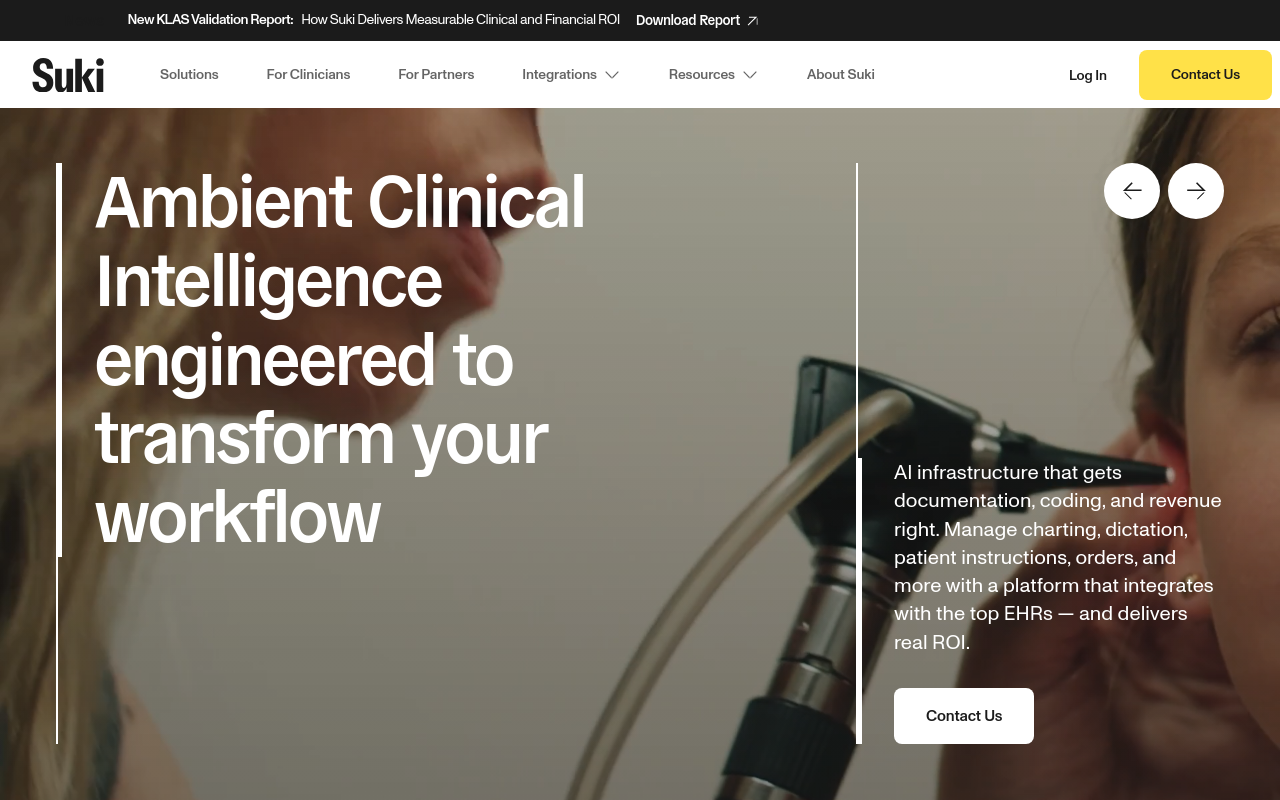
Suki AI targets independent physicians who need broad EHR compatibility without enterprise-level commitment, offering voice-command workflows at pricing sized for independent and small-practice use. Its compatibility across multiple EHR systems makes it a practical option for practices not anchored to Epic or Cerner. The voice-command model is a meaningful tradeoff: physicians who want fully passive, hands-free ambient capture will find Suki's interaction model closer to structured dictation than true ambient listening, which affects the correction-effort load over time.
5. PatientNotes AI - Best Ambient Digital Scribe for Cost-Conscious Ambulatory Clinics
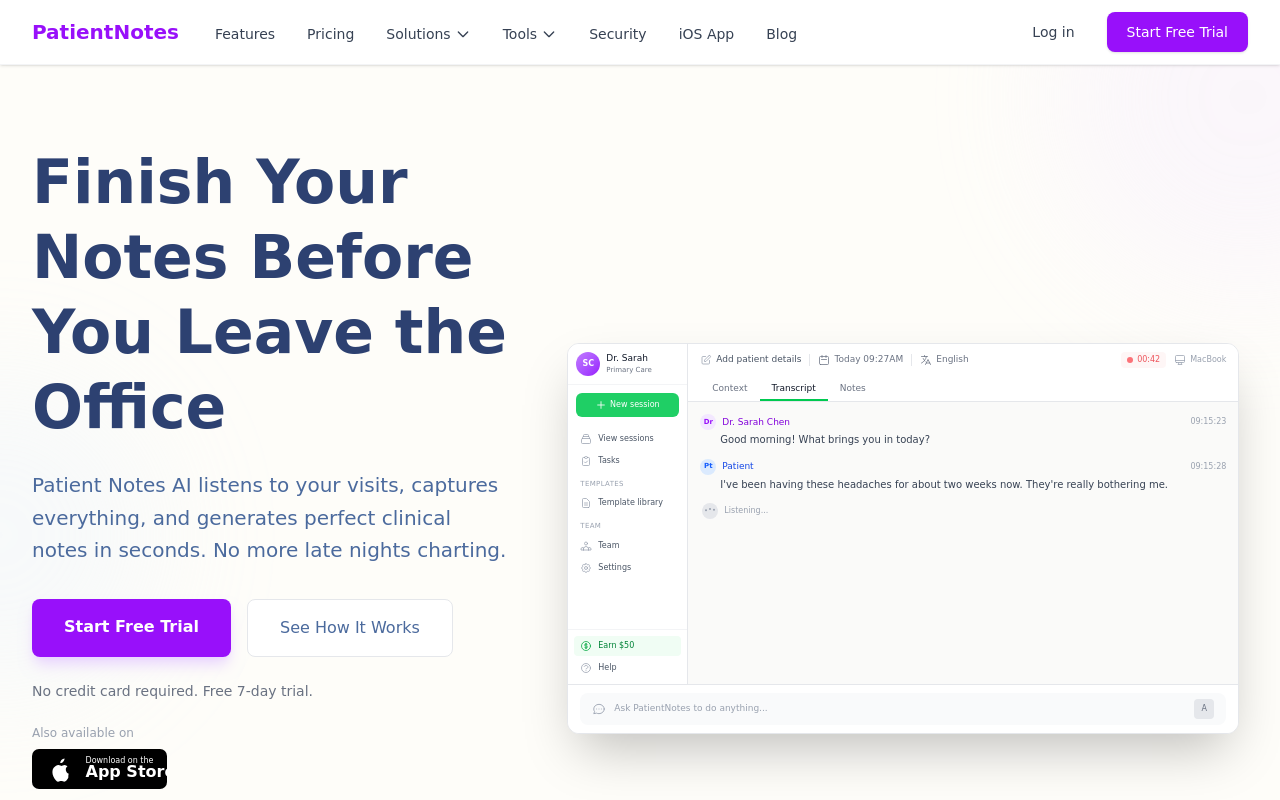
PatientNotes AI positions itself as the budget-accessible ambient digital scribe, offering SOAP note generation, ICD-10 coding support, and custom templates starting at a low per-user monthly rate. It's the right pick for ambulatory clinics and telehealth providers that need HIPAA-compliant ambient documentation without enterprise-level spend. The tradeoff is that its ambient listening accuracy in noisy clinical environments lags behind premium competitors, and it lacks native EHR push for major platforms.
How to Choose the Right Ambient Digital Scribe for Your Practice - Without Getting Burned by a Bad Fit
Not all ambient digital scribes deliver the same results, and the difference between a strong fit and a poor one shows up quickly in documentation quality, workflow friction, and downstream revenue. Choosing an ambient scribe on price and brand recognition is a reasonable starting point, but it is also how physicians end up trading one documentation burden for another. The selection decision is not a scheduling-efficiency question; it is a documentation quality and workflow-fit question, and getting it wrong has real costs, particularly for individual physicians and advanced practice providers who are already charting two or more hours outside of patient care time each day.
The Three Selection Axes That Determine Fit
A quality improvement study of 263 physicians found that outcomes from ambient AI scribe adoption varied meaningfully across specialty contexts and practice environments, confirming that tool fit, not category membership, determines results. A tool that performs well for a high-volume primary care panel may produce notes requiring heavy editing in a rheumatology or psychiatry setting where clinical narrative complexity is significantly higher. The practical selection framework collapses to three axes:
- Does it integrate natively with your EHR?
- Does its NLP model understand your specialty's note structure?
- How much correction effort will it generate per note?
For Chief Medical Officers, practice administrators, and individual physicians evaluating iScribe Health, the EHR integration axis is where fit becomes concrete: iScribe Health's EHR integration materializes its value when the practice or health system is already running a supported EHR and wants a seamless ambient documentation experience, meaning the AI-drafted encounter summary lands directly in the clinician's workflow at the point of note completion, without manual export steps or copy-paste friction. For high-volume practices where the goal is to increase practice efficiency and patient throughput without adding headcount, that frictionless handoff is not a convenience feature; it is the mechanism that makes per-encounter time savings accumulate across every patient encounter and every day of clinical practice.
Red Flag #1, Ambient as Dictation in Disguise
A tool that requires voice commands to trigger documentation is not an ambient scribe; it is structured dictation with a modern label. Passive, hands-free listening architecture is the non-negotiable baseline, delivering the greatest value when physicians want zero workflow interruption between clinical conversation and note generation. iScribe Health's ambient listening and conversational AI capability is designed precisely around this principle: the documentation process runs in the background of the encounter, not as an interruption to it.
Red Flag #2, No HIPAA Business Associate Agreement on File
A missing BAA is a disqualifying condition, not a procurement formality. Recording patient encounters and transmitting audio to a third-party vendor without a signed BAA creates direct exposure under HIPAA's Privacy and Security Rules. Confirm the BAA exists and is signed before a single encounter is captured.
Red Flag #3, Documentation Accuracy That Stops at the Note
A scribe that produces a clean narrative but leaves E&M coding and denial risk entirely to the clinician has solved only half the documentation problem. The Olson et al. research frames administrative burden reduction as the core value proposition of ambient AI, and coding errors and claim denials are administrative burden. A tool evaluated without examining what happens after the note is drafted can quietly generate downstream revenue loss that offsets any time savings at the point of care.
iScribe Health addresses this directly: automated E&M coding intelligence and real-time denial alerts operate at the point of note completion, after the AI drafts the encounter summary. For practice administrators and CMOs overseeing high-volume practices where clinicians regularly chart two or more hours outside of patient care time, this integration of documentation and revenue-cycle safeguards into a single workflow is the difference between a scribe that reduces one burden and a platform that removes the documentation-to-reimbursement burden chain entirely.
Related Reading
- Best Medical Dictation Software
- Medical Coding Automation
- EHR Documentation Burden
- AI Medical Dictation Data Security
Next steps
If your charts are losing clinical detail before you ever open the EHR, the path forward starts with capturing documentation at the moment clinical complexity peaks, not hours later when memory has already degraded it.
The research is clear that ambient scribes save only about 16 minutes per eight-hour day in clock time, meaning time savings alone will not differentiate tools or justify adoption. What does differentiate tools is whether they eliminate the after-hours deferral loop that degrades note fidelity, and whether their note accuracy holds up under coding scrutiny across your specific specialty. Those two factors point to the same action: evaluating an ambient scribe on documentation quality and EHR workflow fit, not on scheduling efficiency or marketing claims.
Start with AI medical scribe from iScribe Health to see how ambient listening, specialty-mapped note output, and automated E&M coding intelligence work together in a single clinical workflow.
Frequently Asked Questions
If I'm already spending hours charting, why isn't my documentation getting more accurate over time?
More time spent charting doesn't fix the underlying problem, memory decay does. The post cites research showing that after-hours EHR use did not improve documentation quality proportionally; the extra hours reflected deferred capture, not better accuracy. By the time a physician opens the EHR at home, what remains is an outline, not a portrait of the encounter.
How is an ambient digital scribe actually different from just dictating my notes after a visit?
Post-visit dictation asks the physician to reconstruct the encounter from memory, which degrades quickly after the patient leaves, the diagnostic reasoning that justifies a higher E&M level fades fastest. An ambient digital scribe listens passively across the full encounter as it happens, capturing physician questions, patient responses, and clinical reasoning in real time, so the note is built from what was actually said rather than what the physician can still recall.
What's the real financial risk of notes that don't fully capture what happened in the visit?
Undercoding is the primary downstream consequence: when clinical complexity isn't captured at the moment it exists, the note can't support the E&M level the visit actually warranted. The post also notes that real-time denial alerts, like those built into iScribe Health, flag documentation gaps before claims leave the practice, not after a denial arrives weeks later, making the documentation more defensible at the point of coding.
Does the AI know which voice belongs to the doctor and which belongs to the patient?
Yes, this is handled through a process called speaker diarization, which assigns each spoken segment to a specific voice so that a patient's symptom description is attributed correctly and not lost in the transcript. The post notes that current medical conversation AI achieves diarization accuracy rates that make clinical deployment viable, while honestly flagging that performance can vary across accents, overlapping speech, and noisy exam environments.
Will an ambient scribe work if my practice doesn't copy-paste notes into the EHR manually?
The post is explicit that tools without true EHR integration simply relocate the documentation burden via copy-paste, eroding both the time benefit and capture fidelity. iScribe Health is built around EHR integration as a core capability, with bidirectional sync that pushes structured notes directly into the correct EHR fields, so the ambient AI output flows into the physician's existing charting environment rather than requiring a parallel documentation stream.