AI Scribe vs Human Scribe: Which Is Right for You?
AI scribe vs human scribe, compared for practice administrators ready to stop the documentation burden costing them money they haven't noticed losing.


The hourly rate on your scribe budget is the most visible cost. It is rarely the largest one.
Physicians in the United States spend an average of two to three hours on EHR documentation for every hour of direct patient care, and that burden doesn't shrink when a human scribe joins the team. A 2017 study published in Annals of Family Medicine found that primary care physicians spend nearly 2 hours on EHR tasks per hour of direct patient care. The common assumption is that pajama time is a physician behavior problem solvable by adding or optimizing human scribe coverage, so administrators keep tweaking scheduling and training rather than questioning whether the scribe model itself is the bottleneck.
The problem isn't scheduling. It's structural. For practice administrators weighing their next documentation decision, the real question isn't "which staffing model is more convenient?"

It's "which model stops costing us money we haven't noticed losing yet?" That reframe matters because the financial exposure is hiding in plain sight. Even the best-run human scribe program carries a ceiling that no amount of optimization removes.
Understanding that ceiling is the starting point for every comparison that follows, including how AI-powered scribing handles urology documentation in ways a human scribe structurally cannot. Here's the mechanism most administrators miss. A human scribe captures what they hear, filtered through their training, their experience level, and the cognitive load of the moment.
That filtered version then requires physician review before the note is finalized, a hand-off layer that Health Data Management identifies as the structural bottleneck driving after-hours charting, not physician behavior.
The physician isn't finishing notes at 10 PM because they're disorganized. They're finishing notes because the scribe's draft is a starting point, not a finished product. That hand-off creates a documentation ceiling. Billable details mentioned once, mid-encounter, and not captured are gone. The result is undercoding, systematic, invisible, and directly traceable to the model. As Grow Urology noted, treating this as a personnel problem and responding with more training misdiagnoses the root cause entirely.
After-hours charting is significantly associated with physician burnout, according to Healthcare IT News, which means documentation model choice also carries a retention dimension that belongs in any honest evaluation. Five dimensions separate a rigorous evaluation from a staffing swap, and as the full cost accounting in the next section shows, hourly cost is rarely the largest one:
- Coding accuracy
- Audit exposure
- Total cost of ownership
- Workflow integration
- Specialty fit
Key takeaways
- Human scribe programs carry a salary line that's visible and a true cost stack, recruiting, turnover, training, and missed coding accuracy, that rarely appears on the same spreadsheet.
- Physicians spend nearly two hours on EHR tasks for every hour of direct patient care, and adding a human scribe doesn't reduce that ratio; it just shifts who does the typing.
- The real documentation ceiling isn't productivity, it's coding accuracy. A 33% overcoding rate across audited encounters happens inside practices that believe their notes are fine because the notes are getting done.
- AI scribes capture the full clinical encounter in real time, which is the only way to stop undercoding before it compounds quietly across hundreds of visits and thousands of dollars in lost reimbursement.
- Human scribes hold a genuine edge in high-acuity settings where real-time contextual judgment matters, that advantage is real, narrow, and non-transferable to high-volume ambulatory workflows.
- Encounter structure and daily patient volume predict AI scribe ROI more reliably than any cost-per-hour comparison; matching the model to the specialty is what separates a successful rollout from a failed one.
- iScribe Health's AI-powered scribing works inside your EHR to deliver real-time documentation and coding support, closing the gap between notes that are done and notes that are right, at scale.
What Human Scribe Programs Actually Cost When You Count Everything
The hourly rate is visible, the model is familiar, and the risk of adopting new technology feels far greater than the risk of hiring a person.

The Full Cost Stack Most Administrators Never Add Up
Human scribes cost $15-$30 per hour at the headline rate, but that figure is the floor. According to CompTool's 2025 compensation data, the median annual salary for a medical scribe runs $36,000-$40,000, and total employment cost including benefits, payroll taxes, and supervision overhead typically runs 1.25-1.4x base salary, pushing the true per-scribe cost to $45,000-$56,000 before a single recruitment or onboarding dollar is counted. Stack in the costs administrators rarely attribute to the scribe model itself: job posting fees, interviewer time, background checks, and the 2-4 weeks of paid training every new hire requires before they're independently productive.
A 5-physician practice that loses two scribes in one year absorbs $12,000 or more in recruitment and re-training costs alone. The all-in annual cost per scribe reaches $33,000 on the low end for part-time arrangements and climbs well past $76,000 for full-time positions in higher-cost markets.
Key takeaway: One of the clearest advantages of ambient AI documentation is lower operational costs, realized across every patient encounter and every day of clinical practice.
Turnover and Scheduling Fragility as a Compounding Tax on Your Practice
As the ACMSO Medical Scribe Career Outlook 2026-27 documents, high turnover compounds training costs: each departing scribe erases the onboarding investment and forces the practice to restart the full recruitment, hiring, and training cycle, disrupting provider continuity in the process. Every sick day, no-show, or resignation creates an immediate documentation bottleneck, and the practices least able to absorb that disruption are often the busiest ones.
Clinicians seeing high patient volumes, the practices where a documentation solution would deliver the most value, are also the ones most exposed when a scribe calls out or resigns, because there is no slack in the schedule to absorb the disruption.
Why Human Scribes Don't Actually Eliminate Pajama Time
A human scribe in the room does not remove the physician's documentation burden. It relocates it.
The hand-off dependency built into the scribe model means that any gap in the scribe's attention during an encounter lands back on the physician after hours. The ACMSO Medical Scribe Career Outlook 2026-27 is direct on this point: the scribe model creates a hand-off dependency, so pajama time persists as a structural feature of the model rather than a physician behavior problem. If the scribe missed clinical nuance during the encounter, the physician must reconstruct it from memory at 9 p.m., often defaulting to a lower-acuity code to avoid the uncertainty.
IScribe for urology practices is most beneficial precisely in this scenario, when clinicians are seeing high patient volumes and spending significant time on after-hours documentation. Real-Time Denial Alerts and automated E&M coding intelligence are surfaced at that same moment, reducing the risk of the after-hours coding guesswork that quietly suppresses reimbursement when a scribe misses clinical nuance.
AI Scribe vs Human Scribe Cost Comparison Every Practice Administrator Needs

Annual and Monthly Figures What AI Scribes Actually Cost vs a Human Scribe's Full Loaded Cost
According to the S10.AI Resource Library, human scribes carry a total employment cost of $33,000 to $76,000 or more annually when wages, taxes, benefits, and overhead are included. At the midpoint, a single human scribe costs a practice roughly $54,000 per year. A mid-tier AI scribe subscription runs closer to $2,400.
$54,000
True annual cost of one human scribe
- AI scribe (entry tier)
Monthly Cost (per provider): $30
Annual Cost (per provider): $360
- AI scribe (mid tier)
Monthly Cost (per provider): $100
Annual Cost (per provider): $1,200
- AI scribe (premium tier)
Monthly Cost (per provider): $300
Annual Cost (per provider): $3,600
- Human scribe (base salary only)
Monthly Cost (per provider): $2,400 to $4,000
Annual Cost (per provider): $28,800 to $48,000
- Human scribe (fully loaded)
Monthly Cost (per provider): $3,167 to $6,333+
Annual Cost (per provider): $38,000 to $76,000+
Setup Time and Availability - Why Instant Deployment Changes the ROI Clock
Human scribes require a recruiting lead time followed by two to four weeks of paid training before they contribute meaningfully to documentation output. By contrast, AI scribes offer 24/7 availability and are operational from day one, with no onboarding ramp (S10.AI Resource Library).
Key takeaway: The ROI clock on a human scribe starts after training completes, which means every departure pushes the breakeven point further out.
That dynamic compounds with turnover: every week a replacement scribe spends in onboarding is another week of after-hours charting absorbed by the physician. iScribe Health's ambient listening and conversational AI layer is designed to address exactly this: the platform is active at the point of the encounter, capturing documentation in real time so that the note is drafted by the time the visit ends, not reconstructed at 9 p.m.
Critically, iScribe Health fits most naturally when a practice or health system is already running a supported EHR and wants a seamless ambient documentation experience. EHR integration is built into the deployment model, so time-to-value is not extended by a post-launch configuration project.
The Per-Encounter Lens - How Scalability Breaks the Linear Cost Model
Unlike human scribes, who are bound to a single provider at a time, AI scribes scale across an entire practice without proportional headcount additions (S10.AI Resource Library). A mid-tier AI subscription at $1,200 per year brings that figure closer to $0.15 to $0.20 per encounter at the same volume (S10.AI Resource Library).
The per-encounter frame also surfaces where iScribe Health's feature architecture compounds the cost story.
That compounding effect is obscured when administrators treat scribing as a simple fixed expense. Practices with very low patient volume or highly complex documentation requiring real-time clinical judgment may find the human model still justifies its cost in specific contexts. iScribe Health's impact is most pronounced in high-volume practices or health systems where clinicians regularly chart two or more hours outside of patient care time, environments where the per-encounter savings stack daily across every provider on the platform.
Accuracy and Documentation Quality Where AI and Human Scribes Actually Diverge
A 33% overcoding rate across 941 audited encounters is not a technology failure, and understanding why requires looking at where each model actually breaks down.

Where Human Scribes Genuinely Win on Clinical Nuance
Human scribes excel at complex contextual understanding in ways that are genuinely difficult to replicate. A seasoned scribe in the room can read a physician's hesitation, catch an unstated clinical concern, and adjust documentation emphasis accordingly. That capability depends heavily on experience level, and a newer scribe may miss exactly those signals.
The downstream consequence is documentation quality that fluctuates with personnel, inconsistent across providers, inconsistent across days, and nearly impossible to standardize at the practice level without a systematic review layer that most practices never build.
How AI Scribes Use Speech Recognition and NLP to Deliver Fatigue-Free Consistency
AI scribes combine ambient listening and conversational AI with large language models and natural language processing to capture and structure clinical notes in real time, directly inside the Electronic Health Record (EHR). Because the system processes audio continuously without attention degradation, note quality at encounter 40 of a busy Thursday is structurally identical to note quality at encounter one.
Consistency is the core structural advantage, though it is not unconditional. Multi-accented speech, cross-talk from support staff, and highly complex clinical scenarios where context is implicit rather than spoken can all introduce transcription and coding errors.
The 941-Encounter Audit Exposing the Real Coding Accuracy Gap
A June audit published on PubMed (PMID 40565474) covering 941 encounters found a 33% overcoding rate and provider-AI agreement of only 54.8% at baseline, so nearly half of all encounters carried a discrepancy between what the AI documented and what the provider intended. Those errors only became visible because an audit was run. Without one, they accumulate silently.
That is precisely where iScribe Health's E&M Coding Intelligence addresses the gap directly. Rather than treating coding review as a retrospective audit function, iScribe Health builds it into the documentation process itself, catching discrepancies before they reach the claim.
HIPAA Compliance Is Not a Differentiator Between Scribe Models
Both AI and human scribe programs must meet the same HIPAA standard. Accuracy and consistency are necessary conditions for a documentation system, but they are not sufficient reasons to switch.
Related Reading
- Orthopedic Surgery Billing
- Orthopedic Billing And Coding
Main Advantages of AI Scribes Beyond the Cost Savings Headline
AI scribes deliver four structural advantages that no amount of scribe scheduling optimization can replicate. The subscription price, as the effective-rate audit elsewhere in this guide shows, is genuinely the smallest part of the value.
"Documentation is widely considered 'the most miserable part of medical practice,' making time savings a highly compelling advantage of AI scribes beyond cost."
— what we hear from medical professionals
1. Real-Time Ambient Capture Eliminates the Documentation Hand-Off Layer

Unlike a human scribe who captures notes and hands them off for physician review and correction, AI scribes structure clinical documentation as the encounter unfolds. For high-volume practices where documentation lag creates billing delays and compliance risk, this is a decisive operational advantage. The tradeoff: AI-generated notes still require a physician attestation step, so the review burden is reduced but not fully eliminated.
2. Reduced After-Hours Charting by Removing the Human-Scribe Correction Cycle

Physicians finishing charts at 9 p.m. are, in most cases, reconstructing clinical context from notes drafted by a fatigued person at the end of a long shift. Unlike human scribe workflows that require a post-encounter editing cycle before sign-off, AI ambient capture reduces end-of-day review to confirmation rather than reconstruction. For high-volume practices, that difference compounds across every provider, every day. The honest limitation: practices with significant background noise or overlapping speakers may see AI output that still requires meaningful review time.
3. 24/7 Availability and Instant Scalability With Zero Scheduling Overhead
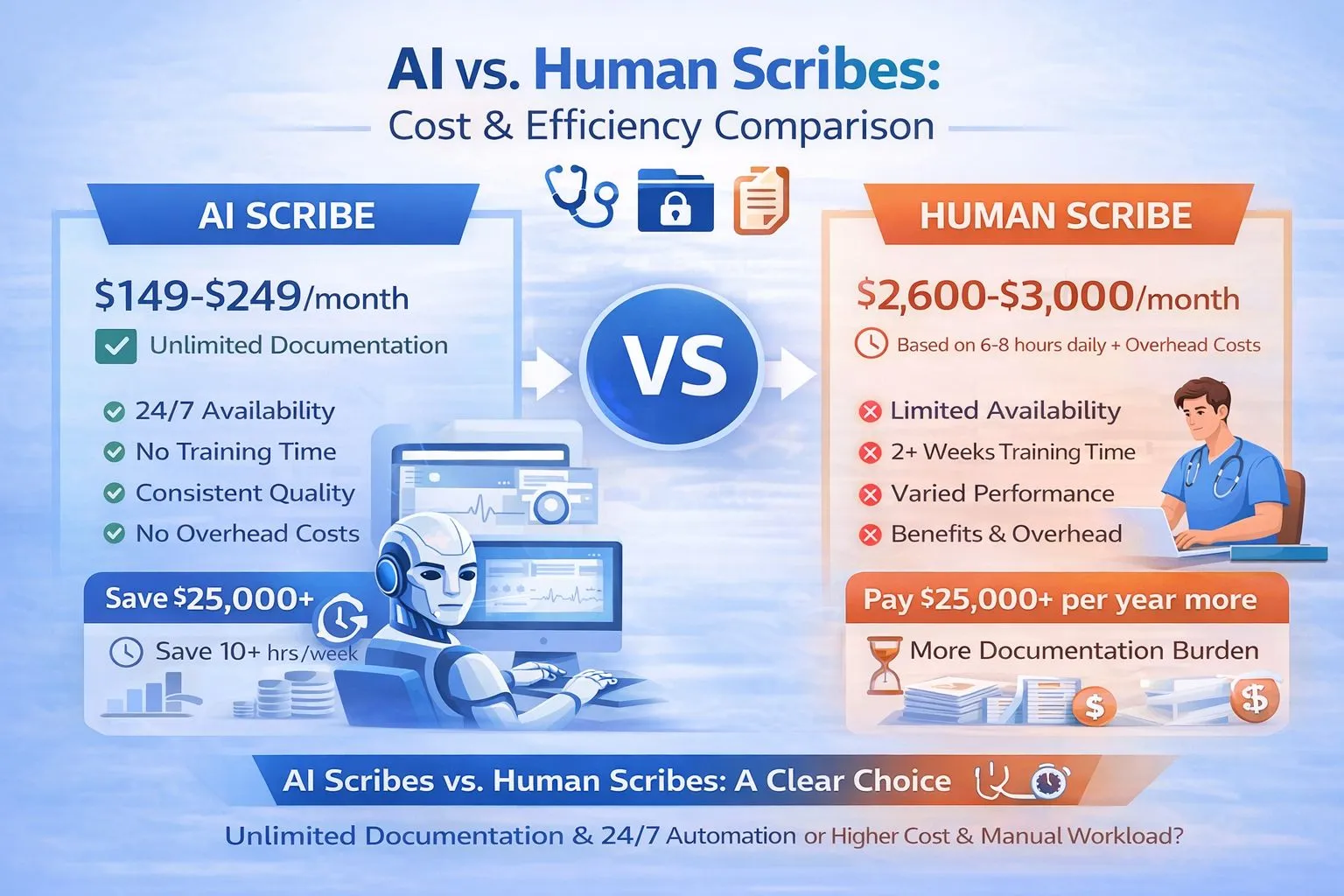
AI scribes scale instantly across any number of providers without scheduling coordination, sick-day gaps, or onboarding ramp-up time, structural constraints that human scribe programs cannot eliminate regardless of how well managed they are. A single absent human scribe cascades into documentation backlogs that physicians absorb personally. AI availability is a fixed property of the model, most valuable when patient volume is unpredictable or provider count is growing.
4. Consistent Output Quality Regardless of Time, Volume, or Staff Turnover
AI scribe output quality does not degrade with time of day, provider volume, or staff turnover, maintaining documentation uniformity across every encounter in a way human scribe teams cannot reliably replicate. A human scribe's note at hour nine of a shift carries more variance than their note at hour two; that variance is where coding drift starts. Practices running iScribe Health in high-volume ambulatory settings see this consistency advantage sharpen as daily encounter counts rise, because AI output holds its structure whether the provider sees twelve patients or thirty.
Where Human Scribes Still Outperform AI in Clinical Settings
Human scribes retain meaningful performance advantages over AI documentation tools in specific clinical environments, and understanding exactly where those advantages apply is essential before any practice commits to a documentation strategy. The five contexts where that advantage is most concrete are below.
1. Real-Time Contextual Adaptability in High-Acuity, Noise-Degraded Environments
Real-time contextual adaptability is the human scribe's clearest performance edge, and it matters most where acoustic conditions actively degrade AI capture.
ER scribes must adapt immediately to rapidly shifting clinical priorities in environments where overlapping alarms, multi-provider crosstalk, and physical chaos are the norm. AI ambient capture reconstructs encounters from audio; a seasoned human scribe reads the room as it moves. Most beneficial when: trauma bays, urgent care surges, or any setting where background noise and simultaneous conversations are structural, not occasional.
2. Dual-Role Capability - Documentation Plus Clerical and Administrative Support

Human scribe benefits in emergency and lean outpatient settings extend well past note quality into consult coordination, order queue management, and direct patient communication. VMeDx confirms that ER scribes routinely support care team coordination and ancillary clerical tasks alongside documentation. That dual-role output can offset a meaningful share of the higher per-hour cost in high-volume, understaffed environments. Every absent or departing scribe removes both functions simultaneously, creating a documentation and logistics gap no AI tool currently fills on the administrative side.
3. In-Person vs. Remote Human Scribe Models - Latency and Accuracy Trade-Offs
Physical presence gives in-person scribes direct observational access to the clinical environment, including patient affect, provider body language, and real-time interaction, that remote scribes must reconstruct from video or audio feeds. VMeDx notes that this direct environmental access is a structural advantage of in-person clinical documentation models. Remote human scribes reduce cost but introduce latency and context gaps that compound in complex, fast-moving encounters. For high-acuity or relationship-intensive settings, the in-person model holds a genuine quality edge; for structured, predictable outpatient encounters, that edge narrows considerably.
4. Specialty-Seasoned Human Scribes Outpacing Early-Stage AI in Niche Clinical Domains

Accumulated specialty expertise is a real, time-bounded advantage. VMeDx's research confirms that experienced ER scribes develop documentation fluency specific to emergency medicine terminology and clinical priorities in ways early-stage AI deployments have not yet matched. Administrators routinely underweight a critical caveat: that competency resets entirely with each departure, returning clinical documentation quality to a new-hire baseline on a recurring cycle. Human scribes outperform AI at the top of their competency curve, and turnover means most practices rarely operate there consistently.
5. Human Scribe Judgment in Ethically Sensitive or Legally Complex Encounter Documentation
Scribe additional tasks in mental health evaluations, abuse disclosures, and end-of-life conversations include knowing what to omit. Experienced human scribes apply editorial discretion that shapes medico-legal exposure in ways AI systems, which document what they capture, are not yet consistently calibrated to manage. That judgment is a genuine clinical adaptability advantage in high-sensitivity encounters. It is also narrow: it applies to a small subset of total encounter volume, and it does not transfer across scribes, so the discretion walks out the door with each resignation.
AI Scribe Limitations Practices Should Evaluate Before Switching
That discretion advantage, real but narrow and non-transferable, sits alongside a separate category of risk: limitations in AI scribe systems that short pilots simply do not surface. Five such limitations exist, and each one carries a distinct operational cost.
1. Speech Recognition Degradation in Noisy, Accented, or Fast-Paced Clinical Encounters

In the AI scribe vs human scribe debate, one persistent AI limitation is acoustic sensitivity. AI scribes can underperform when encounters involve non-native accents, overlapping voices, exam-room background noise, or rapidly shifting clinical context. Human scribes adapt in real time; AI models may produce transcription errors that cascade into documentation inaccuracies. Practices with diverse patient populations or high-acuity environments should pilot-test recognition accuracy before committing to a full switch.
2. Physician Adoption Friction and Behavioral Change Management Burden
Practices that underestimate this ramp period often misread early productivity loss as a platform failure rather than a change management gap, and abandon the tool before it reaches steady-state performance. Physicians must adjust how they speak and interact with the system over several weeks before efficiency metrics stabilize, so adoption timelines should be built into any implementation plan from the outset.
3. Baseline Accuracy Drift Requiring Active Calibration and Physician Review Workflows
A trend consistent with the audit data above shows AI-provider agreement well below full alignment at baseline. That gap does not announce itself; it accumulates quietly as undercoded claims across hundreds of encounters before anyone flags a pattern. Practices that adopt without a systematic auditing workflow trade one form of documentation error for another, and the revenue leakage only becomes visible in retrospective billing analysis months after go-live.
4. Uneven Specialty Depth Across AI Scribe Platforms - Urology, Orthopedics, and Beyond

Based on what practices in procedure-heavy specialties consistently report, general-purpose NLP models miss specialty-specific coding nuance in fields like urology and orthopedics, creating downstream billing risk that standard pilots never surface. Procedure-heavy specialties depend on precise terminology capture for accurate E&M coding; a model trained on broad clinical language may document the encounter accurately in plain terms while still miscoding the billable complexity. Practices should pressure-test vocabulary depth against their actual encounter types before committing.
5. HIPAA Compliance, Data Residency, and Security Vetting Requirements

That is an unfunded compliance mandate, not a solved problem. Cloud-based audio capture of protected health information requires explicit contractual safeguards, and the practice bears the enforcement exposure if those safeguards are absent. Practices evaluating urology-specific AI documentation should confirm that physician review checkpoints and specialty-tuned NLP are built into the platform architecture rather than treated as the practice's own operational responsibility after implementation.
Which Scribe Type Fits Your Practice Specialty and Patient Volume
Specialty type, encounter volume, and note complexity each pull the decision in a specific direction; choosing without accounting for them means either overpaying for capability you do not need or underinvesting in support where the documentation burden is heaviest.

High-Volume Ambulatory Specialties Where AI Scribes Deliver Immediate ROI
AI scribe fit is strongest when a practice runs repeatable, template-driven encounters at scale. Primary care provider panel size, as defined by the MCHP Concept Dictionary and Glossary for Population-Based Research, University of Manitoba, reflects the volume and complexity a single provider is expected to manage across an ambulatory day, and in high-panel settings that volume is exactly where AI consistency compounds.
In high-volume practices where clinicians regularly chart two or more hours outside of patient care time, that burden is a direct drag on capacity, compensation, and physician longevity. iScribe Health's ambient listening engine addresses this at the source: it captures the encounter conversation in real time, so the AI-drafted note is ready at the point of note completion rather than waiting for an after-hours charting session.
Where the practice is already running a supported EHR, iScribe Health's EHR integration materializes as a seamless ambient documentation layer, with no parallel workflow, no copy-paste handoff, and structured notes flowing directly into the existing system.
Emergency Medicine, Behavioral Health, and Subspecialties Where Hybrid Models Hold
In settings defined by high acuity, unpredictable narrative complexity, or significant behavioral health documentation requirements, a purely AI-driven approach introduces risk that outweighs its efficiency gains. Hybrid models, where AI handles structured intake and human scribes manage complex narrative sections, are more realistic and more defensible from a compliance standpoint.
That pressure is most acute in practices running 25-plus encounters per provider per day, which is precisely why the right model selection matters before deployment, not after a failed rollout.
A Four-Variable Self-Selection Framework for Practice Administrators
- Daily encounter volume per provider: above 25 encounters, AI ROI compounds and the efficiency gains, increased practice throughput without adding headcount, are realized across every patient encounter and every day of clinical practice; below 15, calibration overhead delays payback.
- Encounter template repeatability: significant variation by visit type extends AI tuning time.
- Specialty acuity distribution: high procedural or behavioral complexity shifts the balance toward hybrid.
- Practice size: a single-provider subspecialty clinic faces a calibration burden that an eight-provider ambulatory group absorbs across a larger note base.
For practices and health systems already on a supported EHR, iScribe Health's integration removes one of the most common adoption barriers, the fear of a disruptive parallel system, and its automated E&M coding with real-time denial alerts extends the ROI calculation beyond physician time saved to include downstream revenue integrity.
Related Reading
- Surgery Center Emr
- Medical Scribe Cost
Next steps
If your after-hours charting persists even with a scribe program in place, the path forward starts with recognizing that the hand-off layer is the problem, not the personnel inside it. Human scribes defer the documentation burden to after the encounter. They do not remove it. That structural distinction is what separates scheduling optimization from an actual solution.
The 941-encounter audit finding a 33% overcoding rate and only 54.8% provider-AI agreement at baseline matters here because those errors only became visible when an audit was run. Human scribe documentation carries no equivalent systematic review, meaning comparable variance is almost certainly accumulating in your current notes, undetected. At the same time, the per-encounter cost gap between a fully loaded human scribe ($45,000 to $56,000 annually, reset with every departure) and a flat AI subscription means the financial exposure compounds in two directions simultaneously: undercoded revenue and inflating staffing costs that no optimization cycle reverses. Together, these point to a documentation model change, not another round of scribe training or scheduling adjustments.
Start with Best AI medical scribe for urology practices at iScribe Health. Urology's high encounter volume and bounded specialty terminology are precisely the conditions where ambient capture holds its consistency advantage across every provider and every patient encounter, and where automated E&M coding stops coding drift before it reaches the claim.
Frequently Asked Questions
Does adding a human scribe actually eliminate after-hours charting?
No, a human scribe relocates the documentation burden rather than removing it. Even when a scribe handles real-time note drafting, physicians still carry a mandatory review-and-sign layer after hours, and if the scribe missed clinical nuance during the encounter, the physician must reconstruct it from memory at 9 p.m., often defaulting to a lower-acuity code to avoid the uncertainty.
How long does it take to get a human scribe up and running compared to an AI scribe?
Human scribes require a recruiting lead time followed by two to four weeks of paid training before they contribute meaningfully to documentation output, and that ramp period resets every time a scribe resigns. AI scribes are operational from day one with no onboarding ramp and offer 24/7 availability, meaning the ROI clock starts immediately rather than after training completes.
What does a human scribe program actually cost when you count everything, not just the hourly rate?
The headline rate of $15-$30 per hour is the floor, not the ceiling. When wages, payroll taxes, benefits, supervision overhead, recruiting fees, and turnover resets are included, the fully loaded annual cost per scribe runs $38,000 to $76,000 or more, and most administrators find that turnover and coverage gaps inflate the scribe budget line by 30 to 50 percent before the year ends.
Is there a point where the cost of AI scribing clearly beats a human scribe on a per-visit basis?
At higher patient volumes the gap becomes dramatic. A practice running 30 encounters per day per provider at a $54,000 annual human scribe cost pays roughly $6 to $8 per documented encounter, while a mid-tier AI subscription at $1,200 per year brings that figure closer to $0.15 to $0.20 per encounter at the same volume. Unlike a human scribe program, an AI subscription cost stays flat and does not grow proportionally as the practice adds providers or visits.
Are there situations where keeping a human scribe still makes sense?
Yes, the post acknowledges that AI scribing is not the right fit for every workflow. Practices with very low patient volume or highly complex documentation requiring real-time clinical judgment may find the human model still justifies its cost in specific contexts. The per-encounter savings of AI scribing stack most meaningfully in high-volume practices or health systems where clinicians regularly chart two or more hours outside of patient care time.