AI Scribe Cost Breakdown: Top Plans and Prices for 2026
AI scribe cost varies from $39 to $300-plus monthly, and EHR integration determines whether your practice saves or loses revenue in 2026.


The subscription is the smallest number in the equation. The costs that actually move the needle, from undercoded visits to physician turnover, never appear on a vendor's pricing page.
Most healthcare practice administrators and operations leaders believe the cost decision is purely a staffing substitution calculation, swap the human scribe dollar for the AI scribe dollar, and if the savings aren't immediately obvious, the existing workflow wins by default. That spread alone should signal that "AI scribe cost" is not a single number. It is a decision with compounding financial consequences that extend far beyond the subscription invoice, and practices that treat it as a simple line-item swap consistently leave money on the table.
AI medical scribes cost between $39 and $300-plus per provider per month, with the majority of individual-provider plans clustering in the $79 to $150 range. markets. Enterprise deployments targeting health systems with deep EHR integration, specialty-specific templates, and dedicated implementation support regularly exceed that ceiling.
Per-encounter charges, onboarding fees, and EHR integration costs sit outside the headline subscription figure and vary significantly by vendor. The subscription line item is the smallest variable in the real cost equation. The larger figures, including undercoded visits, denied claims from documentation gaps, and physician turnover driven by documentation burden, never appear on a vendor's pricing page.
Yet they routinely dwarf the subscription cost. Physician replacement costs average between $500,000 and $1,000,000 per departure when recruiting, onboarding, and lost productivity are counted together. That makes a $99-per-month subscription look like rounding error.
The subscription line item is the smallest variable in the real cost equation. A low-cost AI scribe that lacks direct EHR integration quietly generates a second cost center, with staff time spent on copy-paste workflows and documentation gaps that trigger denials.

iScribe Health's native EHR integration eliminates that overhead by pushing finalized notes directly into the correct patient chart, so the true per-encounter cost runs lower than the subscription line item alone suggests. AI medical scribe pricing follows three distinct tiers, each with meaningfully different feature sets and integration depth. Entry-level plans, often free or under $50 per month, serve solo providers with limited note volume and minimal EHR connectivity.
Professional plans in the $79 to $150 range cover unlimited notes, basic EHR push, and HIPAA compliance. Enterprise tiers start above $200 and scale to $1,500-plus per provider per month for health-system deployments requiring custom workflows and deep integration support. Tier selection determines whether the ROI math works in a practice's favor or against it.
Key takeaways
- The sticker price of an AI scribe plan is almost never the real cost, undercoded visits, denied claims, and physician burnout are already draining revenue before a single subscription invoice arrives.
- Practices that treat AI scribe cost as a staffing substitution calculation consistently underestimate ROI by an order of magnitude, because they count the line item and ignore the revenue recovery.
- Tier selection is a workflow decision disguised as a budget decision, a plan without true EHR push doesn't reduce documentation burden; it creates a new manual bottleneck at the worst moment of the clinical day.
- Hidden charges, EHR integration setup, per-provider scaling fees, and middleware licensing, routinely inflate total cost of ownership well beyond the headline rate, with implementation alone running $15,000 to $70,000 depending on complexity.
- The integration model buried in a contract quietly determines whether claims get cleaner or denials quietly climb, encounter by encounter.
- Comparing AI scribe cost to human scribe cost only at the payroll line misses recruitment cycles, benefits, turnover replacement, and the revenue lost to incomplete documentation, the wage is the floor, not the ceiling.
- iScribe Health's EHR integration closes the loop by pushing AI-generated notes directly into the correct patient chart across major EHR platforms, no copy-paste, no duplicate entry, no new manual step added to an already pressed clinical workflow.
AI Scribe Pricing Tiers Every Buyer Should Map Before Signing
Tier selection is a workflow decision disguised as a budget decision. A practice running 30 encounters per day that signs a plan without true EHR push does not save money; it creates a new manual bottleneck at exactly the moment clinicians are most pressed for time. And the pricing complexity compounds beyond the headline rate: many platforms stack charges by role, separate fees for creators versus viewers, additional costs for role changes or SSO, making the real total unpredictable and painful at scale before a single note is ever completed. Before any vendor conversation, map your documentation volume and integration requirements to the three structural tiers that define what you actually get.
1. Free/Entry Tier - $0/Month for Solo Providers and Trial Use

Free-tier plans are real, not just limited trials. Heidi Health offers a permanent free tier giving clinicians access to ambient documentation at no cost, making it a credible starting point for solo practitioners or residents evaluating the technology. Free plans typically cap monthly note volume and omit EHR push entirely.
Heidi Health's free tier is a useful on-ramp: it gives clinicians hands-on access to ambient documentation with no financial commitment, making it one of the only platforms that lets a solo provider validate the technology against real patient encounters before spending a dollar. The trade-off is volume. Free plans typically cap monthly notes and omit EHR push, so a practice running more than a handful of encounters per week will outgrow the tier quickly and need to upgrade or accept manual workarounds.
2. Mid-Tier Professional Plans - $79-$150/Month for Individual Providers
This is the tier most individual providers actually buy. The AI Health Guide's April analysis places mid-tier professional plans at $79 to $150 per month, with unlimited note generation, basic EHR push functionality, and HIPAA compliance included. Heidi Health's clinician plan sits at that same figure per month annually, a concrete example of what this band delivers. Buyers frequently overlook that "basic EHR push" at this tier often means structured output that a clinician copies into the chart, not a direct write to the patient record.
For a practice running 20 or more encounters daily, that copy-paste step adds back the manual friction the subscription was supposed to eliminate. In high-volume practices where clinicians are already charting two or more hours outside of patient care time, that friction is a direct driver of physician burnout. Most practices sign a mid-tier plan assuming the note lands in the chart automatically, then discover the gap on day one. iScribe Health's direct EHR integration closes that gap at the tier where most practices operate: when a supported EHR is already in place, iScribe Health's ambient listening and conversational AI capture the encounter, and at the point of note completion, after the AI drafts the encounter summary, the documentation flows directly into the record without a manual copy-paste step.
The workflow mapped during evaluation is the workflow delivered in production, and the operational cost savings from eliminating that transcription bottleneck are realized across every patient encounter from day one.
3. Enterprise/Health-System Tier - $200-$1,500+/Month Per Provider
Enterprise plans are defined not by price but by integration depth. This tier delivers deep EHR integration, custom specialty-specific templates, configurable workflows, and dedicated implementation support. That infrastructure is non-negotiable for a multi-specialty, multi-site health system, and it is also where role-based pricing stacking becomes a serious budget risk: platforms that charge separately for creators, viewers, SSO access, and role changes can push per-provider costs well beyond the published headline range before implementation is even complete. IT and clinical informatics teams need to pressure-test the full pricing structure, not just the per-seat rate, before signing.
The real risk at this tier beyond pricing is underutilization: contracts typically run 12 to 24 months with per-seat minimums, meaning a 30-provider group that signs enterprise seats but onboards only 18 providers in year one pays for capacity it never uses. For health systems where the priority is governing documentation standards across providers and locations, iScribe Health's EHR integration and AI customization capabilities are most impactful when the practice or health system is already running a supported EHR, removing implementation guesswork and accelerating the path to realized savings. iScribe Health's E&M Coding Intelligence and Automated E&M Coding also operate at this tier's scale, with Real-Time Denial Alerts that reduce downstream revenue leakage that no scribe subscription line item ever captures.
4. Must-Have vs. Optional Feature Map Across All AI Scribe Pricing Tiers
Free tier: ambient transcription, note output, note volume cap. No EHR push, no HIPAA BAA in most cases, no specialty templates. Best for evaluation only.
Mid-tier: unlimited notes, basic EHR push (verify whether this means direct write or structured copy-paste output), HIPAA BAA, standard templates. Sufficient for a single clinician on a supported EHR, and where iScribe Health's direct EHR connection removes the copy-paste gap that otherwise erases the efficiency gain.
Enterprise: bidirectional EHR integration, custom templates by specialty, multi-site workflow configuration, dedicated support, compliance reporting, and E&M coding automation with denial alerting.
5. Full AI Scribe Cost Range Summary - From $0 to $1,500+/Month Per Provider
The subscription price is the most visible cost, not the total cost. The market spans from $0 at the free tier through $79 to $150 per month at mid-tier to $200 to $1,500 or more per provider per month at the enterprise level. Usage-based models also exist: AWS HealthScribe, for example, bills at $0.10 per minute, a structure worth considering for low-volume or variable-encounter practices.
What no headline price includes is EHR integration setup, custom API work, role-based add-ons for SSO and viewer seats, or the productivity dip during onboarding, costs that can collectively exceed the first year of subscription fees. Administrators who compare the monthly subscription to a human scribe's hourly wage are comparing two different cost objects.
Mapping tiers to workflow is the prerequisite. The next question is which named platforms live at each price point and what their real numbers look like. The next section puts specific vendors, published prices, and plan structures side by side so buyers can move from tier awareness to a shortlist.
Related Reading
- Urology Billing Software
- Best Urology Emr
- Urology Coding Cheat Sheet
- Cpt Code For Vasectomy
- Ai Scribe Comparison
- Urology Billing Codes
Top AI Scribe Plans and Prices Compared for 2026
Sorting vendors by monthly sticker price is the fastest way to pick the wrong AI scribe platform. The pricing model, flat subscription, usage-based consumption, or enterprise seat, determines whether your budget stays predictable at 20 visits per day or quietly doubles by month three. According to s10.ai's 2025 AI medical scribe pricing analysis, published costs across the major platforms span from $39 per month to well above $1,500 per provider, and every tier carries a different risk profile for practice administrators who own the budget decision.
The table below maps each vendor to its pricing model and the volume threshold where that model starts working against you.
1. iScribe Health - Best AI Scribe for Reducing Physician Burnout
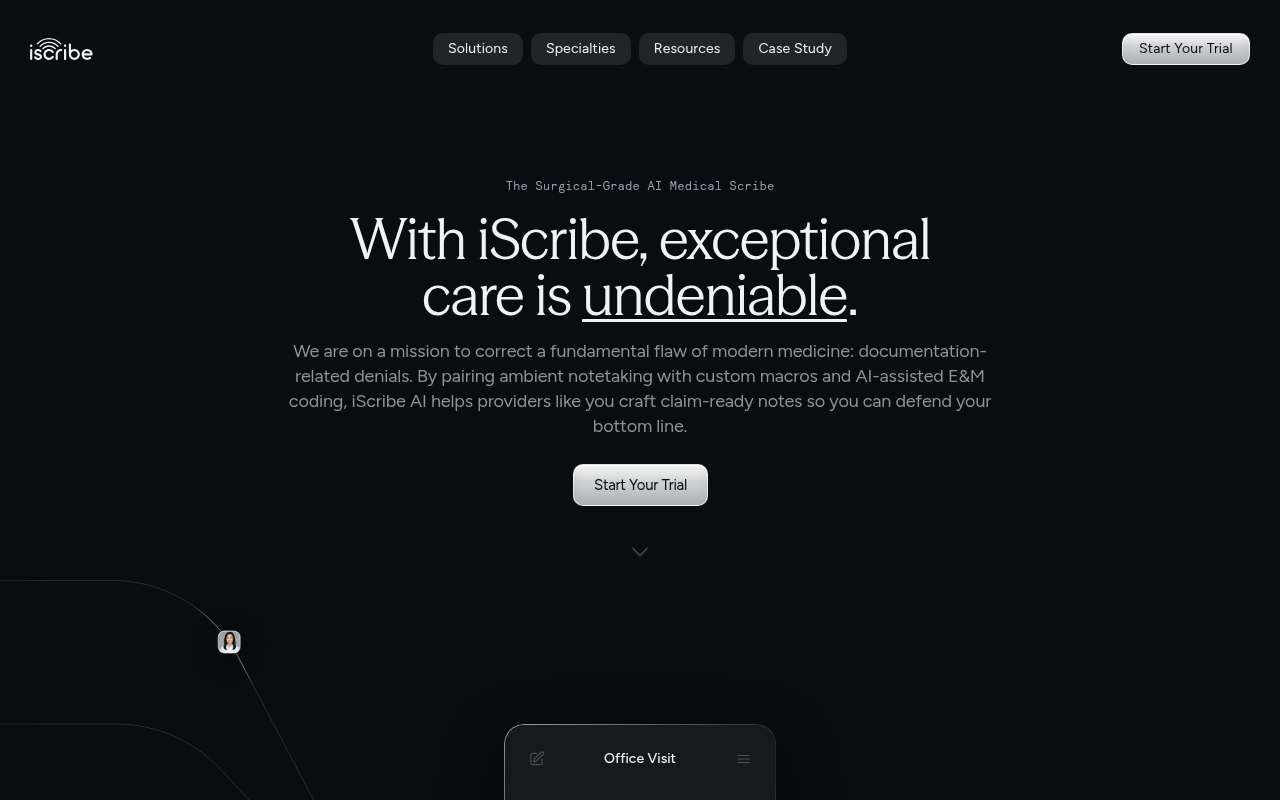
Most practices evaluating AI scribes focus on the monthly subscription line and miss the integration variable that actually determines ROI. iScribe Health is purpose-built around the capabilities that move that ROI number most meaningfully: Ambient AI Documentation, EHR Integration, Automated E&M Coding, and Real-Time Denial Alerts. That combination is engineered to lower the operational costs associated with medical scribing and transcription by eliminating the downstream billing friction that copy-paste errors create.
For high-volume ambulatory and orthopedic settings, iScribe Health's direct EHR write-back delivers its full value when the practice is already running a supported EHR and wants a seamless ambient documentation experience, with no manual chart entry and no structured-data gaps between the AI's output and the biller's queue. The platform's E&M Coding Intelligence and Automated E&M Coding engage at the point of note completion, after the AI drafts the encounter summary, which means accurate level assignment happens before the claim is ever built. Real-Time Denial Alerts then surface coding or documentation issues in the moment, before they become a remittance-advice problem three weeks later.
iScribe Health's Ambient Listening and Conversational AI captures the encounter naturally, so the documentation burden shifts away from the physician without requiring a change in bedside behavior.
For a solo clinician doing eight visits, that integration depth is overkill. For a group running 25 or more encounters per day on a supported EHR, a $99 per month subscription that still costs a physician 10 to 15 minutes per encounter is the more expensive outcome, and it is the outcome that iScribe Health's architecture is specifically designed to prevent.
2. Freed - Best Solo-Clinician AI Scribe at $39-$119/Month

According to s10.ai's 2025 pricing review, Freed's own page confirms pricing starts at $39/month for the AI Scribe but does not list a $119/month tier; it also offers a separate Front Desk product starting at $149/month, and explicitly serves both individual clinicians and group/clinic plans, making any upper-tier figure above $39 unverifiable from Freed's own page. Freed earns strong clinician satisfaction scores for its note quality and ease of setup, independent physicians consistently cite minimal onboarding friction and natural-sounding SOAP note output as standout strengths. It is the right shortlist pick for solo or small-group providers who want fast deployment and low commitment.
Practices that need centralized billing oversight, Automated E&M Coding, or deep EHR write-back across multiple providers will find its current architecture better suited to individual clinician use than enterprise group management.
3. Scribeberry Pro - Best Canadian-Compliant AI Scribe at $99/Month
S10.ai's that same figure analysis places Scribeberry Pro at $99 per month, with specialty-specific note templates and multilingual support as the primary differentiators at that price point. For Canadian practices navigating provincial privacy requirements, that compliance positioning matters more than the headline cost. The tradeoff is limited EHR integration depth compared to enterprise-tier platforms, which means documentation still requires manual chart entry in many workflows, and manual chart entry is precisely where operational scribing costs persist rather than decline.
4. Commure Scribe - Best Mid-Range AI Scribe at $59-$89/Month for Ambulatory Care
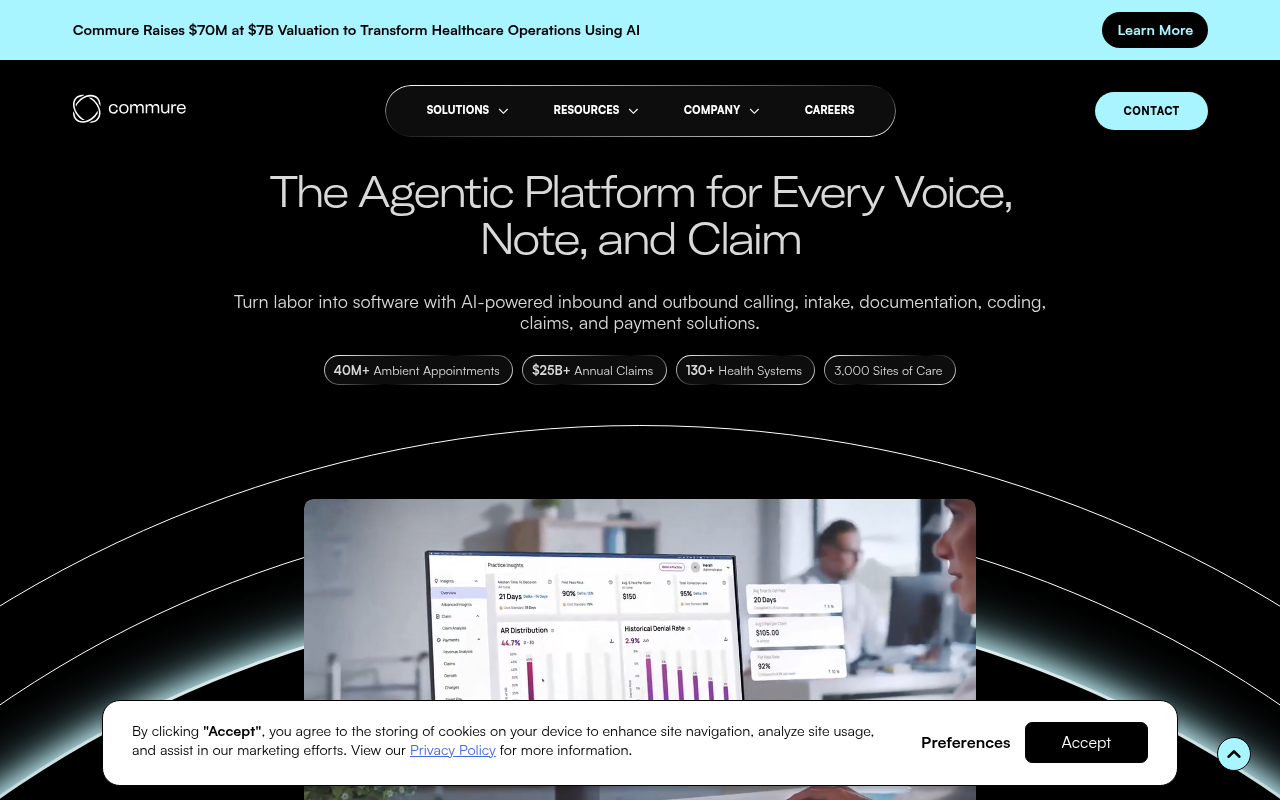
Commure Scribe occupies the $59 to $89 per month range with a universal speech-to-cursor positioning, meaning it works across any text field rather than pushing structured data into specific EHR fields. That flexibility makes it accessible for ambulatory outpatient settings that want ambient dictation without a complex integration project. The limitation is the same as its strength: universal cursor placement does not produce the structured, coded output that practices need for clean claims and accurate E&M level assignment, the gap that purpose-built Automated E&M Coding and Real-Time Denial Alerts are designed to close.
5. Suki and Abridge - Upper Professional Band AI Scribes at $200-$600/Month
This band reflects platforms that have moved beyond basic transcription into workflow integration, with per-provider pricing that scales predictably for group practices. The that same figure to $600 per month range typically includes deeper EHR connectivity and specialty template libraries. Most beneficial for practices with 5 to 20 providers who need more than a solo-clinician tool but cannot justify health-system-scale deployment costs; the per-provider licensing structure means a 10-provider group is committing $2,000 to $6,000 per month before any implementation fees.
6. Nuance DAX Copilot and DeepScribe - Enterprise AI Scribe Tiers at $350-$1,500+/Month
According to s10.ai's 2025 pricing analysis, Nuance DAX Copilot and DeepScribe anchor the enterprise ceiling at $350 to $1,500 or more per provider per month, with cost driven by Epic and Cerner deep integration requirements and health-system-scale deployment support. The upper bound reflects dedicated implementation resources and custom workflow configuration, not just transcription volume. Nuance DAX Copilot benefits from Microsoft's deep Epic integration investment and is widely regarded as the most mature enterprise ambient documentation platform available, with published clinical evidence from large health system deployments.
DeepScribe has differentiated on specialty-specific model training and high accuracy benchmarks in complex documentation environments. Both are the right fit for health systems with existing enterprise EHR contracts and the IT infrastructure to support that deployment depth. For independent or small-group practices without those enterprise requirements, the pricing and implementation overhead at this tier typically exceed what the workflow actually demands.
7. AWS HealthScribe - Usage-Based AI Scribe Pricing at $0.10/Minute
S10.ai's 2025 analysis confirms AWS HealthScribe at $0.10 per minute of transcribed audio, which sounds low until the math runs at clinical volume. A practice running 40 encounters per day at an average of 15 minutes each generates 600 minutes of audio daily, translating to $60 per day or roughly $1,320 per month before any API integration or developer overhead. Usage-based pricing fits developer teams building custom clinical applications; for a practice administrator who needs budget predictability, the monthly variance makes financial planning genuinely difficult.
The prices above are what vendors publish, but every number in this table has a shadow figure that does not appear on any pricing page. The next section maps the hidden costs that routinely inflate month-one expectations: implementation fees, EHR integration surcharges, per-provider seat multipliers, and the documentation gaps that turn a missed integration into a billing denial.
Hidden AI Scribe Costs That Inflate the Real Price After Month One
Most healthcare practice administrators and operations leaders believe the cost decision is purely a staffing substitution calculation: swap the human scribe dollar for the AI scribe dollar, and if the savings aren't immediately obvious, the existing workflow wins by default. What follows after signing is a cascade of charges that vendors rarely volunteer upfront: EHR integration work, licensing model mismatches, onboarding disruption, compliance overhead, and specialty customization fees that collectively add 40 to 200 percent on top of the headline price. Based on our market understanding, that range holds across practice sizes and specialties.
Before that cascade hits, it is worth naming the clinical context where these costs are most consequential. iScribe Health's ambient AI medical scribe is most beneficial when clinicians are seeing high patient volumes and spending significant time on after-hours documentation, the exact environment where hidden vendor fees compound fastest and the productivity cost of a poorly managed rollout is highest. Practices where physicians regularly chart two or more hours outside of patient care time are the ones that feel every pricing surprise most acutely, because the documentation burden is already eroding work-life balance before a single integration invoice arrives.
1. EHR Integration Fees - The Setup and Maintenance Costs Vendors Bury in the Fine Print
Hidden EHR integration costs are the single largest gap between what a vendor quotes and what a practice actually pays. Custom API work, IT resource time, and ongoing maintenance are rarely included in the subscription price, yet they are almost always required for a real clinical deployment. Industry estimates for custom integration projects run from $5,000 to $25,000 as a one-time setup cost, with recurring maintenance fees layered on top.
Most practices discover this only after go-live, when notes are not landing in the correct chart and billing staff are manually reconciling documentation gaps that trigger downstream claim denials. iScribe Health builds native EHR connectivity into its subscription rather than quoting it as a separate line item, a capability that materializes fully when the practice or health system is already running a supported EHR and wants a seamless ambient documentation experience. The integration cost is known before the contract is signed. Real-Time Denial Alerts, a core feature of the platform, depend on that clean EHR connection; without it, the alerts cannot surface at the moment they matter most, at the point of note completion, after the AI drafts the encounter summary.
2. Per-Provider vs. Per-Seat Licensing - How the Wrong Model Quietly Doubles Your Bill as You Grow
Licensing structure is a cost that compounds invisibly. The choice between per-provider and per-seat models significantly affects how costs scale as headcount grows, and administrators frequently overlook this when making initial purchase decisions. A per-provider model at $99 per month sounds reasonable for a solo practice.
At eight providers, that becomes $792 per month before a single integration fee is counted. Add part-time physicians, rotating residents, or mid-level providers, and the math shifts again. Practices that sign a per-provider contract during a growth phase often find their AI scribe bill outpacing their revenue gains within the first year.
This dynamic is sharpest in high-volume practices and health systems, the same environments where iScribe Health's ambient documentation and Automated E&M Coding Intelligence deliver the most sustained impact, realized across every patient encounter and every day of clinical practice. A licensing structure that penalizes growth undercuts those gains before they reach the income statement.
3. Implementation and Onboarding Costs - Training Time, Workflow Disruption, and the Productivity Dip Nobody Budgets For
The productivity dip during AI scribe onboarding is real, measurable, and almost never included in vendor ROI projections. Implementation and onboarding represent a substantial hidden cost category, encompassing staff training, workflow reconfiguration, and transition-period productivity loss. Median time-to-comfort is under one week, and most providers are signing notes on day two.
The administrators and operations leaders we work with at high-volume practices describe this period precisely: clinicians who were already charting two or more hours after hours find that number climbing further during rollout before it falls. That is the moment when physician burnout risk peaks and when a vendor's onboarding quality is the only buffer between a successful deployment and a contract cancellation. iScribe Health's ambient listening and conversational AI is designed to reduce after-hours charting, eliminating pajama time, but that benefit is only realized if onboarding is treated as a structured implementation process rather than a one-time webinar. Vendors that skip that structure transfer the full cost of the transition dip directly to the practice.
4. HIPAA Compliance Overhead - BAA Gaps, Security Audits, and the Cost When a Vendor's Posture Shifts
HIPAA compliance overhead is not a one-time checkbox. Business Associate Agreements must be reviewed, data residency questions must be answered, and breach notification SLAs must be contractually defined before any AI scribe touches protected health information. When a vendor's compliance posture shifts, such as after an acquisition or a platform architecture change, practices can find themselves renegotiating BAAs mid-contract or conducting unplanned security audits at their own expense.
The Office for Civil Rights has issued penalties averaging well into the hundreds of thousands of dollars for HIPAA violations tied to third-party vendor relationships, making BAA gaps a financial exposure, not just a compliance formality. For a platform like iScribe Health, where ambient listening captures protected health information continuously across every patient encounter, evaluating a vendor's security posture as rigorously as its feature set is the foundation on which physician burnout reduction and documentation efficiency are built. Reducing audit risk and maintaining compliance integrity must be confirmed before the ambient microphone is ever activated.
5. Specialty-Specific Customization Fees - The Add-On Charges for Templates Beyond the Default Library
Default template libraries rarely cover the documentation depth that orthopedic, psychiatric, or dermatology practices require. Specialty-specific modules, when offered at all, are typically priced as add-ons ranging from $500 to $3,000 per specialty, per deployment. A multi-specialty group practice evaluating a platform on its headline price may not realize until implementation that the templates covering their highest-volume service lines sit behind an additional paywall. That gap matters operationally: a template that does not capture the right procedure-specific language produces notes that undercode, and undercoded notes mean reduced reimbursement on every affected encounter.
iScribe Health's AI Customization capability addresses this directly. Rather than treating specialty depth as a tiered upsell, the platform's customization layer is built to adapt documentation to the specific clinical language and coding patterns a given specialty requires. Combined with E&M Coding Intelligence operating at the point of note completion, the system works to ensure that the AI-drafted encounter summary reflects the documentation specificity that accurate reimbursement demands, regardless of specialty.
---
Every hidden cost catalogued here assumes you are replacing nothing. But most practices are not starting from zero. They are running a human scribe program with its own invisible cost stack: recruitment, turnover, supervision hours, and the documentation inconsistency that quietly bleeds revenue. The next section counts all of it.
How AI Scribe Cost Compares to Human Scribe Cost When You Count Everything
But the wage is the floor, and everything stacked above it, recruitment cycles, benefits, turnover replacement, undercoded visits, and denied claims that slip through documentation gaps, is what makes the real cost gap between human and AI scribing an order of magnitude wider than any headline comparison suggests.

The core synthesis here is counterintuitive but arithmetically unavoidable: when enterprise-tier AI scribe pricing is measured against the true all-in cost of a human scribe, $2,500-$4,000+/month once recruitment, benefits, payroll taxes, and turnover replacement are included, the gap that looked close at headline prices inverts entirely, and the supposedly expensive AI tier becomes the cheaper option before any revenue-side gains are counted.
Human Scribe Cost Starts at $2,500-$4,000, and That's Just the Floor
According to PayScale's data, the median annual base pay for a medical scribe with coding skills sits at $35,744, with the 90th percentile reaching $49,088, and those figures cover wages only. Add employer-side payroll taxes (roughly 7.65% for FICA alone), health benefits, paid time off, and onboarding time, and the true monthly cost per provider climbs to $2,500 to $4,000 or more, as the ACMSO Medical Scribe Career Outlook 2026-27 documents. Those figures also exclude the supervision time physicians and administrators absorb whenever a scribe requires correction, retraining, or replacement, a recurring overhead that rarely appears in budget line items but accumulates steadily across a practice year.
The supervision burden carries costs that most budget conversations miss. iScribe Health is designed to deliver a hands-free documentation experience during the visit: ambient listening captures the encounter in real time, the AI drafts the note, and the physician's only remaining task is review, eliminating the coordination layer that human scribes require.
The Invisible Cost Stack from Undercoding and Claim Denials
A single undercoded E&M visit in primary care can mean the difference between a Level 3 and Level 4 code, a gap worth $30 to $60 per encounter depending on payer mix.
That is where iScribe Health's direct EHR integration and E&M Coding Intelligence close the gap. For practices already running a supported EHR, iScribe Health materializes as a seamless ambient documentation experience: structured, complete notes are pushed into the correct chart field at the point of note completion, giving billing teams accurate documentation before a claim is ever submitted. The platform's Real-Time Denial Alerts and Automated E&M Coding add a second layer of protection, catching the undercoding and documentation gaps that silently erode revenue in human-scribe workflows before they become write-offs.
Side-by-Side AI Scribe Subscription vs. Human Scribe Total Cost of Ownership
- Base compensation → Human Scribe: $2,900–$4,100 per provider/month (wages, taxes, and benefits) → AI Scribe: Subscription fee only.
- Recruitment and onboarding → Human Scribe: Periodic costs of $1,500–$3,000 per cycle → AI Scribe: None.
- Turnover replacement → Human Scribe: Frequent replacement as scribes cycle out regularly → AI Scribe: None.
- Undercoding and denial losses → Human Scribe: Untracked losses absorbed silently → AI Scribe: Reduced through automated E&M coding and real-time denial alerts.
- Supervision overhead → Human Scribe: Ongoing physician or administrative time → AI Scribe: Minimal, with hands-free ambient documentation.
Using the industry-documented all-in human scribe cost of $2,500 to $4,000 per provider per month (ACMSO Medical Scribe Career Outlook 2026-27) against a mid-tier AI scribe subscription, a 5-provider primary care group can realistically eliminate the majority of direct scribe labor cost, a gap that compounds further once recovered revenue from more accurate coding is counted. For most groups at that scale, the math resolves well before any productivity or patient-throughput gains enter the calculation.
Related Reading
- Hipaa Compliant Ai Scribe
- Top Medical Scribe Companies
- How Does An Ai Scribe Work
- Medical Scribe Cost
Why EHR Integration Is the AI Scribe Cost Factor That Makes or Breaks ROI
Practice administrators who treat EHR integration as a technical footnote often discover the real cost only after claim denials start climbing and no one can trace them back to the source.
"Providers face the challenge of needing AI scribe solutions that integrate with multiple EHR systems simultaneously (e.g. Athena for outpatient and Cerner for inpatient), making EHR compatibility a critical and complex cost/ROI factor."
— what we hear from healthcare providers

Native vs. Middleware vs. Copy-Paste Integration Models and What Each Costs After Go-Live
Across the market, implementation timeline, IT resource ownership, and native platform support are the variables that drive total cost of ownership beyond licensing fees. iScribe Health's EHR Integration materializes specifically when the practice or health system is already running a supported EHR and wants a seamless ambient documentation experience. The integration is designed to eliminate the EHR data entry burden that physicians, nurse practitioners, and clinical staff carry every day.
For IT and EHR administrators and clinical informatics teams, that vagueness translates directly into failed note routing, manual reconciliation work, and documentation gaps that don't surface until a denial arrives. iScribe Health's integration model is designed to address this by targeting practices already operating on supported EHRs, so the ambient documentation experience, from conversational AI capture through automated E&M coding, routes into the correct chart without the manual intervention that copy-paste and middleware models require.
The iScribe Orthopedic Audit That Reframes the Integration Question
In one documented orthopedic deployment, iScribe Health's direct-push EHR integration surfaced systematic coding inconsistencies that the practice's prior workflow had not flagged, including a finding at Center for Sports Medicine & Orthopaedics, Chattanooga: 941 encounters analyzed, 54.8% provider/AI agreement, 33% overcoding rate found. Those inconsistencies had been invisible precisely because the prior integration model lacked the fidelity to connect documentation patterns to coding outcomes in real time.
This is where iScribe Health's E&M Coding Intelligence and Real-Time Denial Alerts become operationally significant, catching discrepancies at the point of documentation rather than weeks later when a denial has already entered the revenue cycle.
Five Integration Questions to Put in Every Vendor RFP Before You Discuss Price
First, ask which EHR systems the vendor supports natively and request a current, version-specific compatibility list. Second: who owns IT resources during implementation, and what is the realistic timeline to go-live?
AI Scribe Buyer Questions Answered Before You Request a Quote

Free Trials and Freemium Tiers - What They Test vs. What a Real Practice Needs
What administrators often discover too late confirms what broader market patterns make plain: free or trial tiers of AI SaaS solutions in healthcare are commonly feature-limited demos rather than production-ready tools, a pattern sometimes called the "free-tier trap." If they hesitate, the trial data is not transferable to your compliance posture, and your pilot results are not predictive of production performance. iScribe Health's ambient listening and conversational AI is designed to materialize its full value when the practice is already running a supported EHR, not in a sandboxed demo, because the productivity gains that reduce operational costs and address physician burnout only appear when the ambient layer is operating inside a real clinical workflow, across real patient encounters.
Build vs. Buy - When IT Proposes a Custom Integration and What That Actually Costs
The Research and Markets global forecast for AI-powered clinical documentation underscores that operational cost reduction is one of the primary drivers pushing health systems toward integrated SaaS over self-managed builds, because the maintenance burden of a custom stack erases the savings it was supposed to generate.
iScribe Health's EHR integration and AI customization capabilities are built to operate that way: the ambient documentation layer, E&M coding intelligence, and real-time denial alerts function within the supported EHR environment, not alongside it through a fragile middleware dependency.
HIPAA Compliance Checklist - The Four Questions Every Vendor Must Answer Before You Sign
As a baseline standard across the industry, every AI scribe vendor must confirm a signed BAA, clearly defined data residency terms, and a breach notification SLA before contract execution.
Related Reading
- Best Ai Scribe For Athenahealth
- Ai Medical Scribes With E&m Coding Built In
- Ai Scribe Accuracy
- Do Ai Scribes Reduce Claim Denials?
Next steps
If your budget justification keeps stalling because the AI scribe subscription looks similar to what you already spend on transcription, the path forward starts with measuring what incomplete documentation costs per encounter before comparing any vendor's monthly fee.
The hidden first-year surcharge insight makes one implication clear: EHR integration fees, custom API work, and onboarding disruption collectively dwarf the subscription itself, so comparing headline prices to a human scribe's hourly wage is comparing two fundamentally different cost objects. The all-in human scribe cost insight makes another implication clear: once recruitment, benefits, payroll taxes, and turnover replacement are counted, the supposedly expensive AI tier inverts the comparison entirely and becomes the cheaper option before a single revenue-side gain is counted. Together, they point to running your own three-layer audit first: sticker price, total cost of ownership, and revenue recovery from undercoding and denied claims.
Start with Best AI medical scribe for orthopedic practices to see how direct-push EHR integration, point-of-completion E&M coding, and real-time denial alerts hold up against your current denial rate and after-hours charting hours. When those numbers are on the table, the subscription fee stops looking like the decision and starts looking like the smallest variable in it.
Frequently Asked Questions
Are there really free AI medical scribe options, or is 'free' just a trial?
Free-tier plans are real, not just limited trials. Heidi Health offers a permanent free tier giving clinicians access to ambient documentation at no cost, making it a credible starting point for solo practitioners or residents evaluating the technology. The honest trade-off is that free plans typically cap monthly note volume and omit EHR push entirely, so a practice running more than a handful of encounters per week will outgrow the tier quickly.
What costs does the monthly subscription price NOT include?
The subscription price excludes EHR integration setup, custom API work, role-based add-ons for SSO and viewer seats, and the productivity dip during onboarding, costs that can collectively exceed the first year of subscription fees. Beyond those line items, the larger financial risks are undercoded visits, denied claims from documentation gaps, and physician turnover, none of which ever appear on a vendor's pricing page yet routinely dwarf the subscription cost.
How does AI scribe pricing differ between a solo practice and a health system?
Solo and individual-provider plans cluster in the $79 to $150 per month range and cover unlimited notes, basic EHR push, and HIPAA compliance, while enterprise deployments for health systems start above $200 and can reach $1,500 or more per provider per month for deep EHR integration, custom specialty-specific templates, and dedicated implementation support. Enterprise contracts also typically run 12 to 24 months with per-seat minimums, meaning a group that signs enterprise seats but onboards fewer providers than planned pays for capacity it never uses.
What hidden costs should I watch for in enterprise AI scribe contracts?
Many platforms stack charges by role, separate fees for creators versus viewers, additional costs for role changes or SSO, making the real total unpredictable and painful at scale before a single note is ever completed. IT and clinical informatics teams need to pressure-test the full pricing structure, not just the per-seat rate, before signing.
Which AI scribe approach is best for a high-volume specialty practice that needs accurate billing?
For high-volume ambulatory and specialty settings, the critical capability is direct EHR write-back combined with automated E&M coding and real-time denial alerts, the combination iScribe Health is purpose-built to deliver. iScribe Health's E&M Coding Intelligence and Automated E&M Coding engage at the point of note completion, and Real-Time Denial Alerts surface coding or documentation issues in the moment before they become a remittance-advice problem weeks later, which is precisely the revenue leakage that no subscription line item alone ever captures.