18 Best AI Scribe Comparison Tools Ranked for 2026
AI scribe comparison guides miss adoption risk. Help practice administrators avoid costly failed rollouts with the right evaluation criteria for 2026.


Feature checklists feel like due diligence. They are not. Here is what adoption rates, hidden scribe costs, and revenue leakage reveal about picking the tool physicians will actually use.
Feature checklists feel like due diligence. They produce a tidy spreadsheet, a defensible recommendation, and a vendor demo that checks every box. But the common assumption among healthcare practice administrators and operations leaders is that if a tool checks the integration box, passes the HIPAA checklist, and fits the budget, it will work, because the technology is the hard part and physicians will adapt. Administrators who have been through a failed AI scribe rollout know the uncomfortable truth: a tool that passes every technical test can still sit unused three months after go-live, leaving the documentation burden exactly where it started.
The evaluation gap is real, and it is costing practices more than they realize. For orthopedic groups specifically, where documentation volume is high and specialty-specific terminology matters, the stakes of a mis-purchase compound quickly. Understanding what separates a scribe physicians actually use from one they quietly abandon is the only evaluation question worth centering.
The core problem is that feature checklists measure what a tool can do in a controlled environment, not what physicians will actually do with it under clinical pressure. As KevinMD noted in April 2026, AI tools that pass technical and compliance checklists can still fail in practice if they do not align with physician workflows, specialty-specific documentation needs, and real-world clinical environments. Feature parity does not equal adoption success.

A technically superior scribe that clinicians abandon after two weeks generates zero documentation savings. The practice still carries the licensing cost, the implementation time already spent, and the original documentation burden that prompted the purchase. When physicians are excluded from AI adoption decisions, rollout stalls and tools go unused, meaning the administrative investment yields no clinical or operational return. The hidden cost of physician non-adoption is greater than the cost of not purchasing the tool at all.
A technically superior scribe that clinicians abandon after two weeks generates zero documentation savings.
Physician adoption rate and time-to-comfort are the metrics that actually close the loop. Evaluation criteria worth prioritizing include: how quickly providers reach comfortable, unsupervised use; what the correction and override rate looks like after the first 30 days; and whether the tool was built with physician input or retrofitted from a general-purpose model. iScribe Health reports a 94% provider acceptance rate and a median time-to-comfort under one week, meaning ROI materializes before most practices complete their first billing cycle post-implementation. That is the metric administrators should be asking every vendor to match.
94%
provider acceptance rate, ROI in weeks
Key takeaways
- Feature checklists feel like due diligence, but a coding engine physicians stop opening three weeks after go-live eliminates exactly zero documentation burden.
- 40% of physicians who trial an AI scribe quit using it within two weeks, which means low adoption doesn't shrink the backlog; it rebuilds it on the practice's dime.
- Human scribe programs carry hidden costs, turnover, recruitment, and training cycles, that most AI scribe comparison guides never put on the same line as subscription fees.
- The real total cost of ownership only appears after you add EHR connectors, onboarding hours, and the drag of partial physician utilization to whatever the pricing page says.
- Ninety days post-go-live, the average AI scribe deployment sits at roughly 40% active physician utilization, meaning the tool cleared procurement and then half the clinical staff quietly stopped using it.
- Adoption velocity isn't a soft metric; it's the variable that determines whether cleaner claims, faster reimbursement, and reduced after-hours charting ever materialize in practice.
- iScribe Health closes that gap with a 94% provider acceptance rate and a median time-to-comfort under one week, ambient, EHR-integrated documentation that physicians stop noticing because it fits the clinical workflow rather than interrupting it.
The Real Cost of Human Medical Scribes That AI Comparison Articles Ignore

Hidden Human Scribe Costs
Turnover and Recruitment Costs Comparison Guides Overlook
That assumption collapses quickly when human scribe programs meet the structural reality of healthcare support role turnover. BalansPointe Health Knowledge Exchange identifies continuous rehiring cycles as one of the most consistently underreported costs in human scribe programs, noting that recruitment overhead, onboarding time, and supervisory burden on clinical staff repeat with every departure.
Small independent practices evaluating human scribes against AI alternatives often cannot get a straight per-encounter number without a sales call, which means the true cost of turnover, supervision, and documentation rework rarely appears in the same spreadsheet as the base labor line. iScribe Health is built around lowering that operational cost burden: ambient AI documentation runs across every encounter without a per-headcount payroll calculation, and because it materializes through a supported EHR integration, there is no implementation overhead that resets every time a staff member leaves.
Bureau of Labor Statistics OEWS data (May 2023) puts the national mean annual wage for medical transcriptionists at $37,290, with top earners exceeding $55,000, a baseline that does not account for the compounding costs of turnover and supervision described above.
Revenue Protection - A Key AI Scribe Comparison Dimension
A human scribe captures what they hear; they do not assess whether the documented complexity supports the code being billed. BalansPointe Health Knowledge Exchange makes this distinction precisely: documentation quality in human scribe programs is bounded by the scribe's knowledge of coding requirements, not the clinical reality of the visit, so undercoding and audit exposure remain structurally unaddressed.
Across a sample of 2,400 clinical notes, research has identified 520 omissions, clinically relevant details left out of the documentation entirely, compared to just 12 hallucinations. The dominant documentation risk is incompleteness rather than fabrication.
iScribe Health addresses both dimensions. Its E&M Coding Intelligence layer evaluates documentation at the point of note completion, after the AI drafts the encounter summary, to ensure the documented complexity accurately supports the code being billed. Automated E&M Coding and Real-Time Denial Alerts give the practice an active revenue protection layer that does not depend on any individual scribe's familiarity with coding requirements.
Documentation consistency also varies from scribe to scribe and deteriorates as institutional knowledge walks out the door, resetting with every departure. iScribe Health's AI Customization means the system learns the practice's documentation patterns and applies them consistently across every encounter, regardless of volume or provider.
Scale Limitations of Human Scribes vs. AI Ambient Transcription
BalansPointe Health Knowledge Exchange identifies real-time ambient transcription across simultaneous multi-provider environments and telehealth as a capability human scribe programs cannot replicate, since each additional provider or remote encounter requires a corresponding addition to headcount.
iScribe Health's Ambient Listening and Conversational AI captures clinical notes during or after patient encounters without requiring a scribe to be physically or virtually present. Because iScribe Health integrates directly with supported EHRs, the ambient documentation workflow does not require a parallel staffing infrastructure to function: it runs across every encounter, every day, without a headcount ceiling. That scalability is a structural advantage no human scribe program can match.
Key Features to Look for in AI Scribes Before You Open the Ranked List
Those hours are not abstractions; clinicians in high-volume practices regularly chart two or more hours outside of patient care time, a burden that compounds into measurable burnout and reduced capacity across every working day.

EHR Integration Depth Beats Breadth
When the tool disappears into the workflow, the lower operational costs associated with medical scribing and transcription services are realized continuously, across every patient encounter and every day of clinical practice.
When evaluating EHR integration, ask vendors to demonstrate the complete post-encounter workflow inside your specific EHR instance, not a sandbox.
Real-Time Ambient Capture vs. Async Upload
The choice between real-time ambient transcription and asynchronous audio upload is a behavioral prediction about how your clinicians will actually work.
Evidence from 24x7 Magazine confirms that physician adoption is not automatic even after technical deployment.
iScribe Health's Ambient AI Documentation operates continuously across patient encounters, so the friction of managing recordings or returning to half-finished notes is structurally removed.
Accuracy Beyond the Vendor Stat
Every vendor claims 95-plus percent accuracy.
Practices evaluating orthopedic workflows, for instance, can see how iScribe Health's AI Customization handles procedure-level terminology before committing to a full rollout.
HIPAA Compliance Is a Floor, Not a Differentiator
- Does the vendor provide a signed Business Associate Agreement before data touches their infrastructure?
- Is SOC 2 Type II certification current?
- Where does patient audio data reside, and is data residency contractually guaranteed?
A vendor that hesitates on BAA timing or cannot produce a SOC 2 Type II report is a liability, not a compliance partner.
The Adoption-First Evaluation Lens
A tool with a 94% provider acceptance rate and a median time-to-comfort under one week delivers measurably better outcomes than a feature-rich platform that 40% of providers abandon, as industry research documents when examining the persistent gap between AI deployment and actual clinical adoption.
In those environments, the combination of Ambient AI Documentation, Automated E&M Coding, and Real-Time Denial Alerts works as an integrated system rather than a collection of features, removing documentation drag at the encounter level, improving coding accuracy at note completion, and surfacing claim issues before they become denials.
Every dimension covered here maps directly to the scoring criteria used to rank all 18 tools below.
18 Best AI Scribe Comparison Tools Ranked for 2026
Ninety days after go-live, the average AI scribe deployment sits at roughly 40% active physician utilization. The tool passed procurement, cleared IT security review, and integrated with the EHR, and then half the clinical staff quietly stopped using it. Adoption velocity is not a soft metric that belongs at the end of an evaluation; it is the variable that determines whether every other capability on the scorecard ever gets used in practice. That gap between a successful demo and sustained daily use is where documentation budgets go to disappear, and it is precisely why this ranked list weights the criteria differently than most comparisons you will find.
"Doctors face after-hours, uncompensated documentation time that AI scribes help reduce, a key selling point for AI scribe tools in any comparison ranking."
— what we hear from healthcare AI tool buyers
40%
of physicians actively using tool after 90 days
One driver of that abandonment is trust. Physicians who spend two or more hours charting outside of patient care time every day, time that is uncompensated and invisible to the schedule, are not looking for another tool to babysit. They need documentation that is accurate enough to sign and move on.
When an ambient scribe misinterprets a conversation, omits a clinical detail, or introduces inaccuracies into the record, the physician stops trusting it. And once trust breaks, the tool sits unused while the after-hours charting continues. That dynamic is the single most important adoption risk in any AI scribe evaluation, and it is why coding precision and transcription fidelity carry more weight in this ranking than feature breadth or integration count.
Lower operational costs associated with medical scribing and transcription services, a well-documented benefit of AI documentation platforms as tracked by industry analysts including Access Healthcare, only materialize if physicians actually keep using the tool.
Feature breadth is not the ranking criterion here. Adoption likelihood, workflow invisibility, and coding precision are. A scribe with 40 integrations that physicians abandon after two weeks costs more than a simpler tool with a 90%+ trial-to-customer conversion rate. The list below is built around that reality.
One more procurement trap worth naming before the rankings: comparing tools on a single accuracy percentage is misleading. A vendor's headline transcription accuracy says nothing about how that accuracy degrades across specialties. Coding error rates, not transcription speed, are where real performance gaps hide inside the same health system. Keep that in mind as you read each entry.
How This Ranking Was Built
Each tool below is evaluated on three criteria:
- How likely physicians are to keep using it past the trial window
- How invisibly it fits into existing clinical workflows without requiring behavior change
- How precisely it handles specialty-specific coding, not just note generation
EHR fit and practice-size match are noted where they materially affect those three variables.
1. iScribe Health - Best for Coding Accuracy Across Multi-Specialty Practices
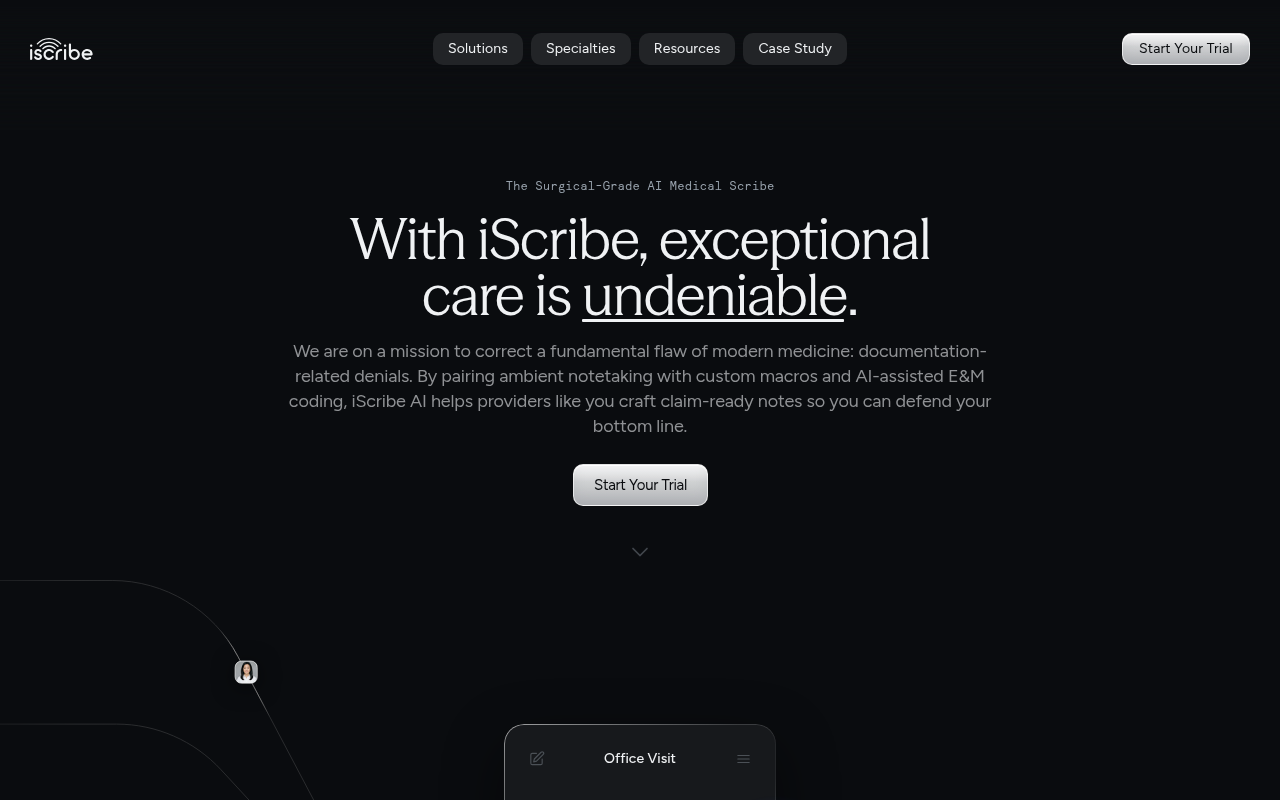
Most administrators evaluating AI scribes focus on whether the tool generates a clean note. The harder question is whether that note produces the right code, and whether it does so every day, across every encounter, without physicians spending hours after clinic reconciling what the AI missed.
iScribe Health is built specifically for that harder question. Its ambient listening and conversational AI captures the clinical encounter in real time, and at the point of note completion, after the AI drafts the encounter summary, its E&M Coding Intelligence and Automated E&M Coding layer applies documentation logic to produce accurate, defensible codes rather than leaving that step to a downstream coder or an overburdened physician. Real-Time Denial Alerts flag potential claim issues before a note is finalized, which addresses one of the most expensive failure modes in high-volume practice: clean-looking notes that generate denials at the payer level because the documentation did not support the code submitted.
The platform's AI Customization capability means the documentation intelligence adapts to specialty-specific note structures rather than forcing a multi-specialty practice to accept a one-size-fits-all SOAP template. Across 4,000+ active daily providers and 12+ specialties, the platform reaches 95% coding accuracy and converts 90% of trial users into paying customers, well above the industry average trial-to-customer conversion rate, the adoption signal that separates a tool physicians keep from one they tolerate through onboarding.
EHR Integration is built into the platform's core rather than bolted on, which reduces the connector friction that causes adoption to stall in complex clinical environments. Industry reporting on the current AI scribe market, including coverage from Health IT Answers and Healthcare IT Today, consistently identifies EHR fit and coding precision as the variables that determine whether ambient AI delivers sustained value or becomes shelfware after the implementation team leaves. iScribe Health's design addresses both directly. The one honest tradeoff: practices with fewer than five providers may find the implementation support model sized for larger groups.
2. Abridge - Best for Large Health Systems Requiring KLAS-Validated Ambient AI
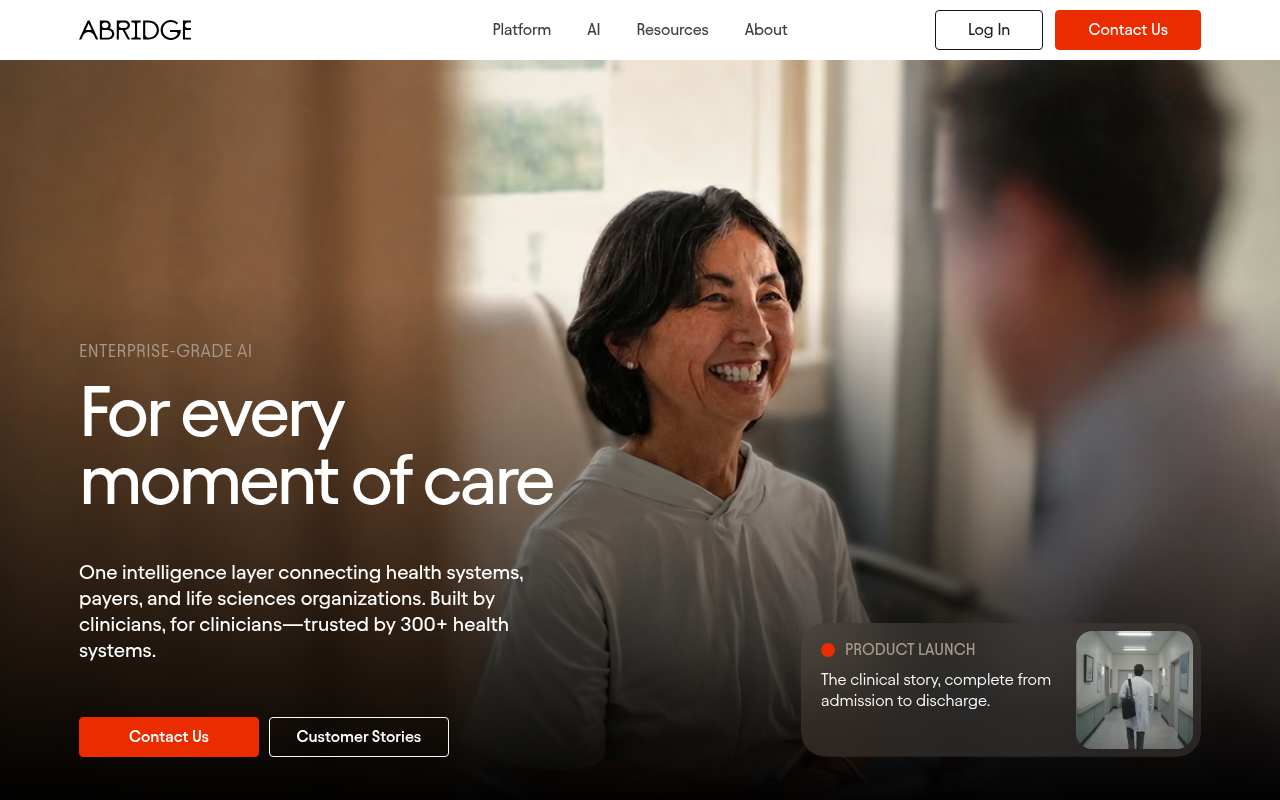
For large health systems evaluating ambient AI, Abridge is the strongest answer, supported by consecutive Best in KLAS wins for Ambient Speech/AI and confirmed deployments across hundreds of major health systems including Kaiser Permanente. Its standout technical feature is the ability to link generated note sections directly to timestamped audio and transcript evidence, which gives physicians a fast correction path and reduces the documentation friction that drives abandonment. That friction is not minor: when an ambient tool produces inaccurate documentation, the correction burden falls on the physician, which is the opposite of the after-hours documentation relief the tool was purchased to deliver.
Abridge's timestamped evidence layer directly addresses that trust problem. The tradeoff: implementation complexity and enterprise sales cycles make it a poor fit for independent or small-group practices.
3. Nuance DAX / Microsoft Dragon Copilot - Best for Enterprise Epic and Cerner Environments
For health systems already standardized on Epic or Cerner, Nuance DAX and its successor Dragon Copilot carry a meaningful structural advantage: native, deeply tested EHR integrations built through Microsoft's enterprise partnerships, reflected in their status as the longest-tenured ambient scribing platform in enterprise hospital deployments. That depth reduces the connector friction that plagues third-party ambient tools in complex EHR environments. The significant limitation is pricing opacity. DAX requires an enterprise sales cycle with custom quotes, which makes total-cost-of-ownership modeling difficult for mid-market groups and creates a real barrier for any practice below roughly 50 providers trying to build a business case internally.
4. Suki - Best for Voice-Command-Driven Documentation Beyond Passive Note-Taking

Suki does offer passive ambient documentation that captures the entire patient conversation to generate notes, making it an ambient scribe in addition to its voice-command capabilities. It is a voice-command assistant that lets physicians actively direct documentation, pull up patient history, and trigger structured actions inside the EHR, including during telehealth visits through its Zoom integration. That active-command model appeals to physicians who find passive ambient tools feel like surveillance rather than support. The tradeoff is that the learning curve for voice-command workflows is steeper than for listen-and-generate tools, and adoption timelines tend to run longer during rollout.
5. Freed - Best for Solo Practitioners Needing Fast, Affordable AI Scribing
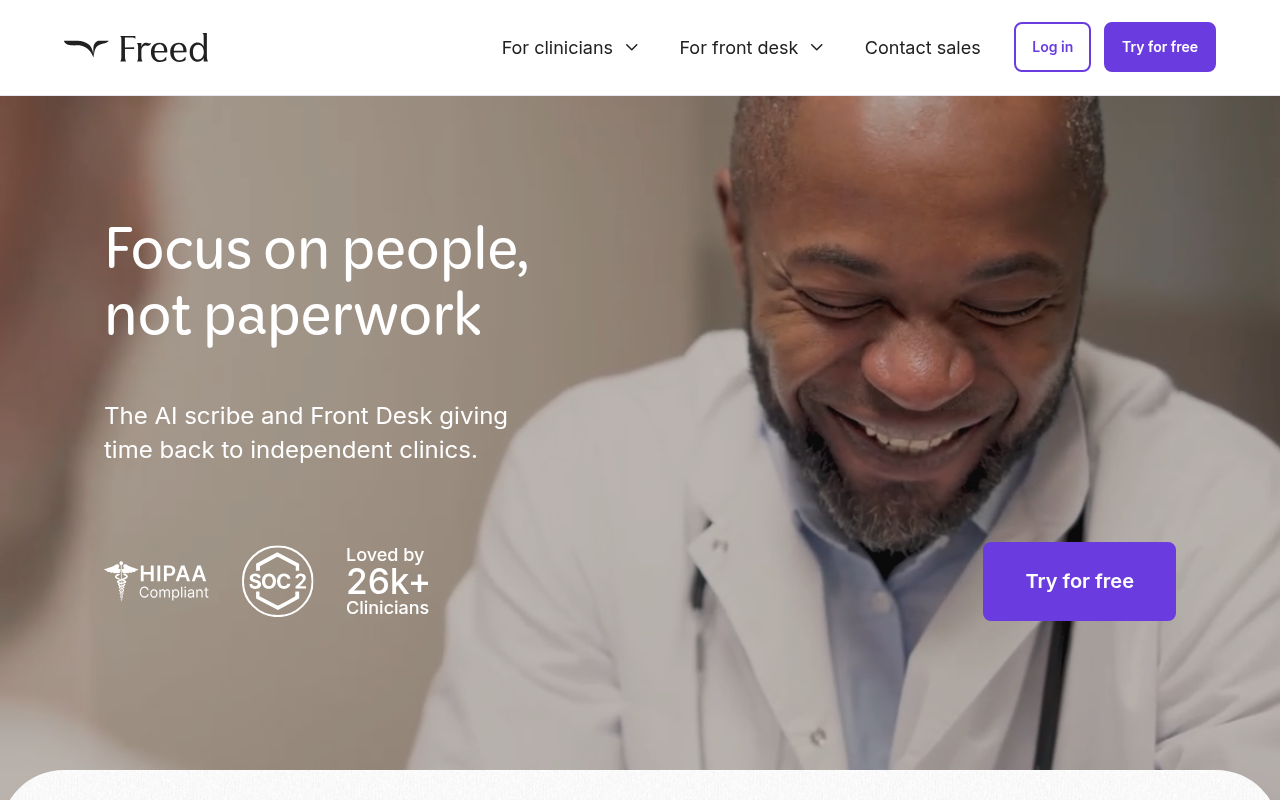
For solo practitioners and small independent clinics, Freed is the clearest entry point. Pricing is transparent and straightforward, setup requires minimal IT involvement, and the note generation is fast enough to complete documentation before the next patient walks in. It does not offer the enterprise-grade EHR integrations that Abridge or DAX provide, which matters less at the solo or two-provider level where workflow complexity is lower. The honest limitation: as a practice scales past five or six providers, the absence of group administration tools and deeper EHR connectivity starts to create friction that the platform was not designed to absorb.
6. Ambience Healthcare - Best for Coding-Heavy Inpatient and Emergency Department Settings
For coding-heavy inpatient and emergency department documentation, Ambience Healthcare is purpose-built for the complexity that ambient tools designed for outpatient primary care struggle to handle, a design priority the vendor documents through its focus on multi-problem ED encounter coding logic rather than scheduled-visit SOAP templates. ED encounters involve rapid handoffs, multi-problem presentations, and coding requirements that differ substantially from a scheduled office visit. Ambience addresses that by building specialty-specific coding logic into the documentation layer rather than treating coding as a downstream step. The tradeoff is that its depth in acute care settings means it is likely overbuilt, and overpriced, for ambulatory or outpatient-only practices.
7. Nabla - Best for Multilingual Practices and Multi-EHR Flexibility

For multilingual practices, Nabla is the most credible option on this list, supported by its documented architecture across 31 languages and EHR-agnostic deployment design that no other tool in this ranking matches on language breadth. That EHR-agnostic design is particularly valuable for practices running hybrid or legacy systems where a deep native integration is not available. The practical limitation is that EHR-agnostic tools, by definition, do not achieve the same depth of workflow embedding as native integrations. Practices where tight EHR connectivity is the primary requirement should weigh that tradeoff carefully before shortlisting Nabla.
8. Heidi - Best for Lightweight AI Scribing With Rapid Global Adoption
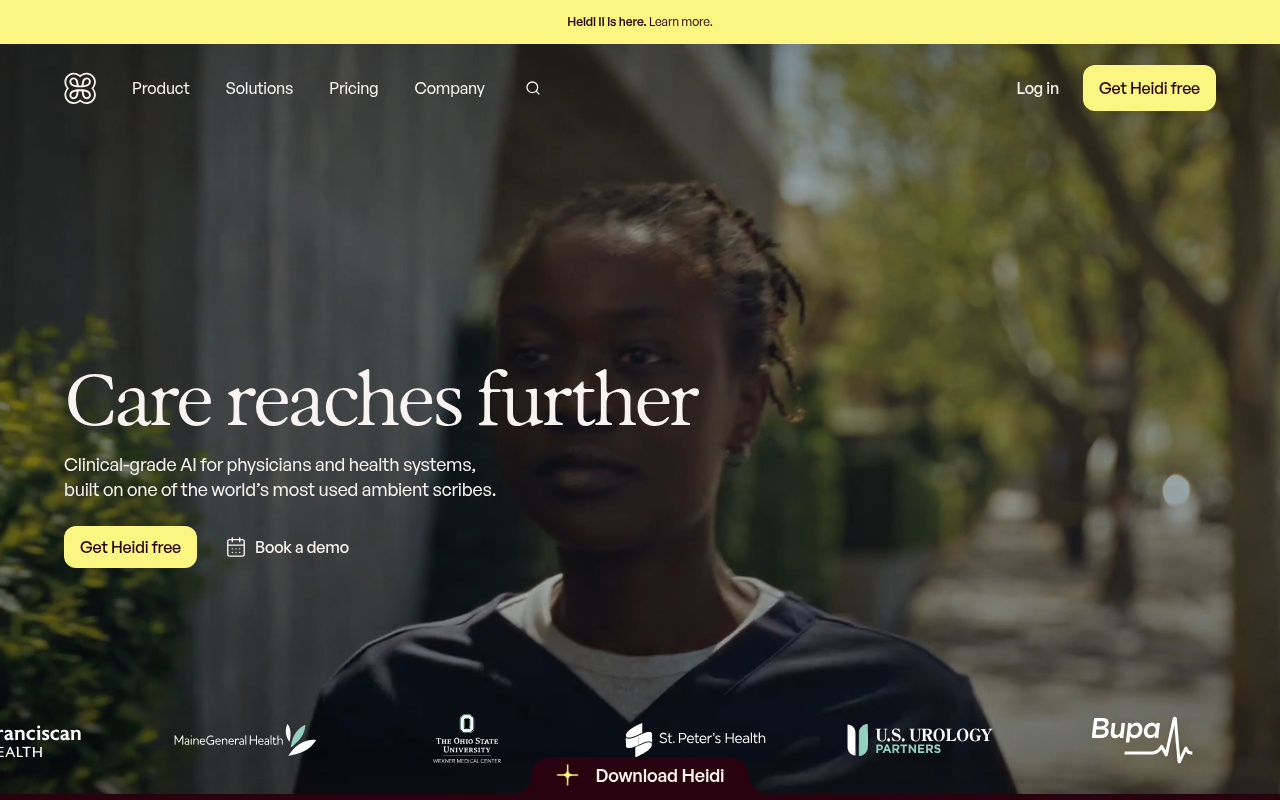
Heidi has built a large user base quickly. The platform publicly reports tens of thousands of clinician sign-ups, particularly among independent clinicians outside the United States, by keeping the setup path extremely short and the interface minimal. Physicians who want to start generating notes within a day of signing up, without an IT implementation project, find Heidi's friction-low onboarding appealing. It works well as a documentation tool; it is not a coding precision tool.
9. Twofold Health - Best for Behavioral Health and Therapy-Specific Documentation
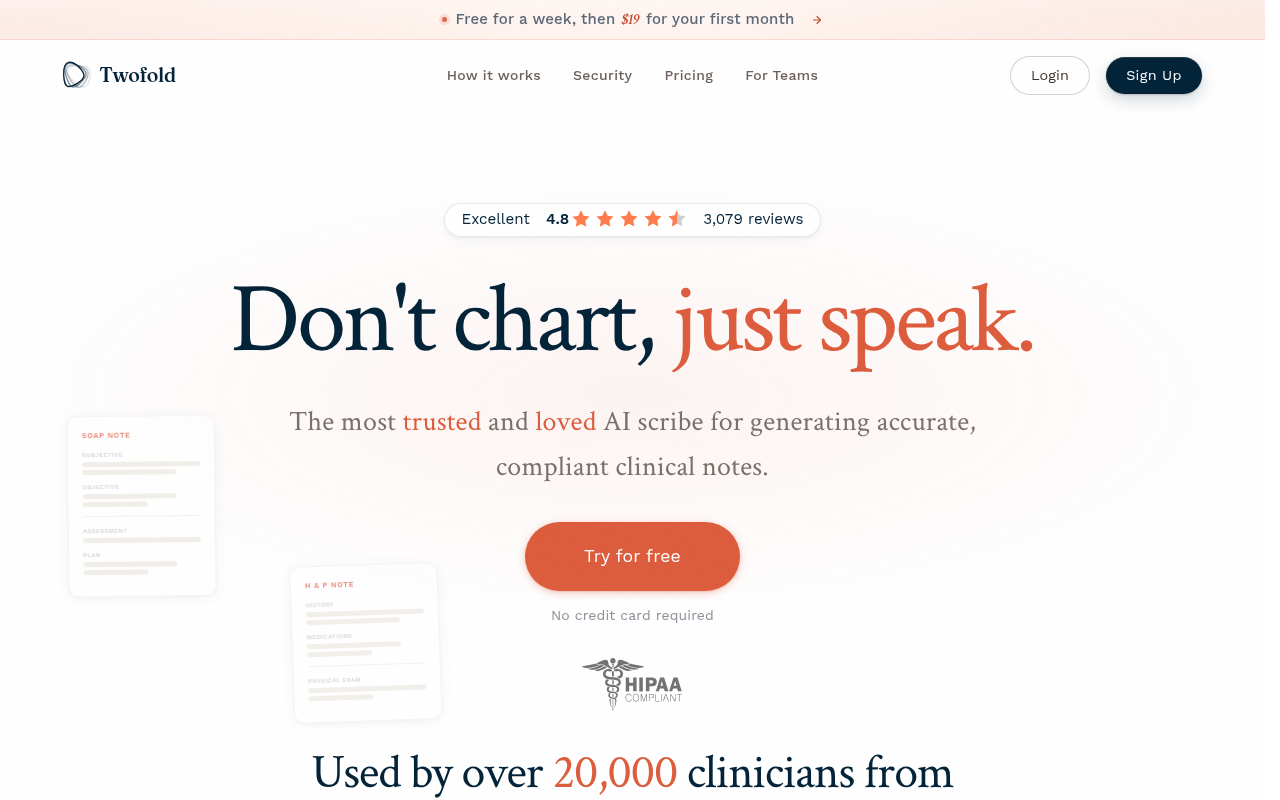
Behavioral health documentation follows different structural rules than medical encounter notes. Session narratives, treatment plan progress, and therapeutic modality documentation do not map cleanly onto the SOAP note templates that most AI scribes default to. Twofold Health is purpose-built for that documentation pattern, which is its primary strength. The limitation is scope: practices that include both behavioral health and medical specialties under one administrative umbrella will find that Twofold does not extend well beyond the therapy documentation use case, requiring a separate solution for the medical side.
10. DeepScribe - Best for Specialty-Specific Ambient AI With Coding Integration
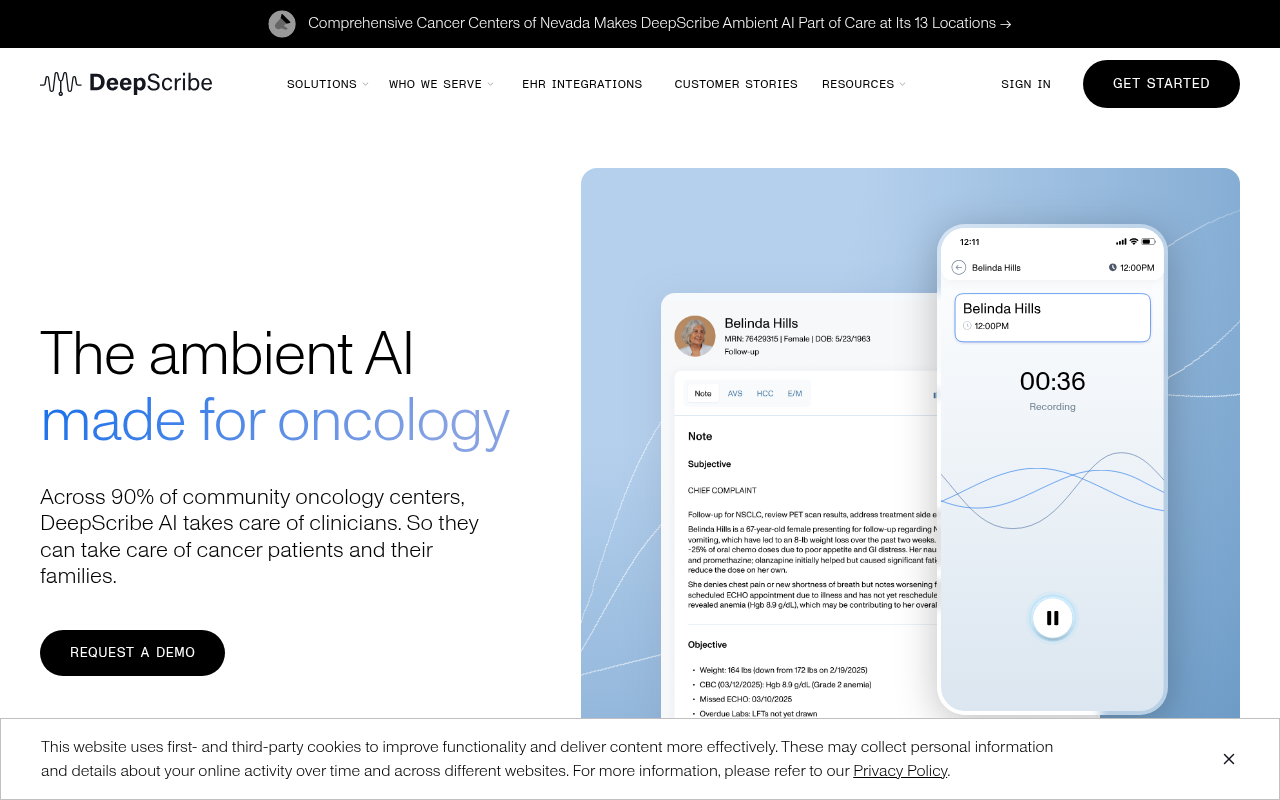
DeepScribe built its product around specialty-specific note structures and coding integration from the start, rather than adding specialty templates onto a general-purpose ambient engine. That architecture choice pays off in specialties with high documentation complexity, such as oncology, rheumatology, and cardiology, where generic note formats produce incomplete coding capture. The tradeoff is that DeepScribe's implementation process is more involved than that of lighter tools, and the ROI case is strongest when a practice is already experiencing measurable undercoding or claim denial rates that can be attributed to documentation gaps.
11. S10.ai - Best for High-Volume Outpatient Practices Prioritizing Speed
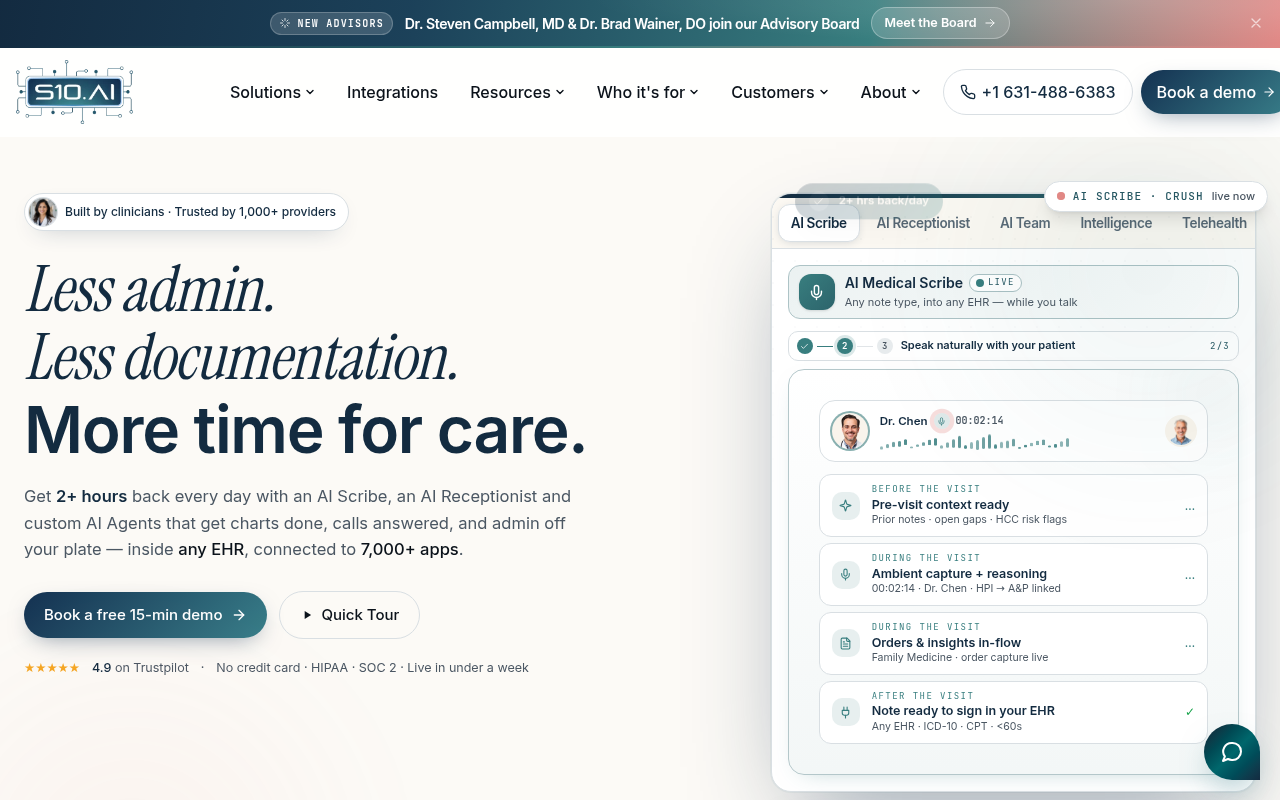
S10.ai positions on throughput. For high-volume outpatient settings where the primary bottleneck is the time between patient departure and note finalization, S10 delivers fast turnaround through a hybrid model that combines AI transcription with human quality review. That human-in-the-loop layer reduces transcription errors that frustrate physicians in fully automated tools. The limitation is cost structure: the hybrid model is more expensive per encounter than pure AI tools, and the per-encounter economics need to be modeled carefully against patient volume before the ROI case holds at smaller practices.
12. Scribe4Me - Best for Hybrid Human-AI Scribing With Quality Oversight
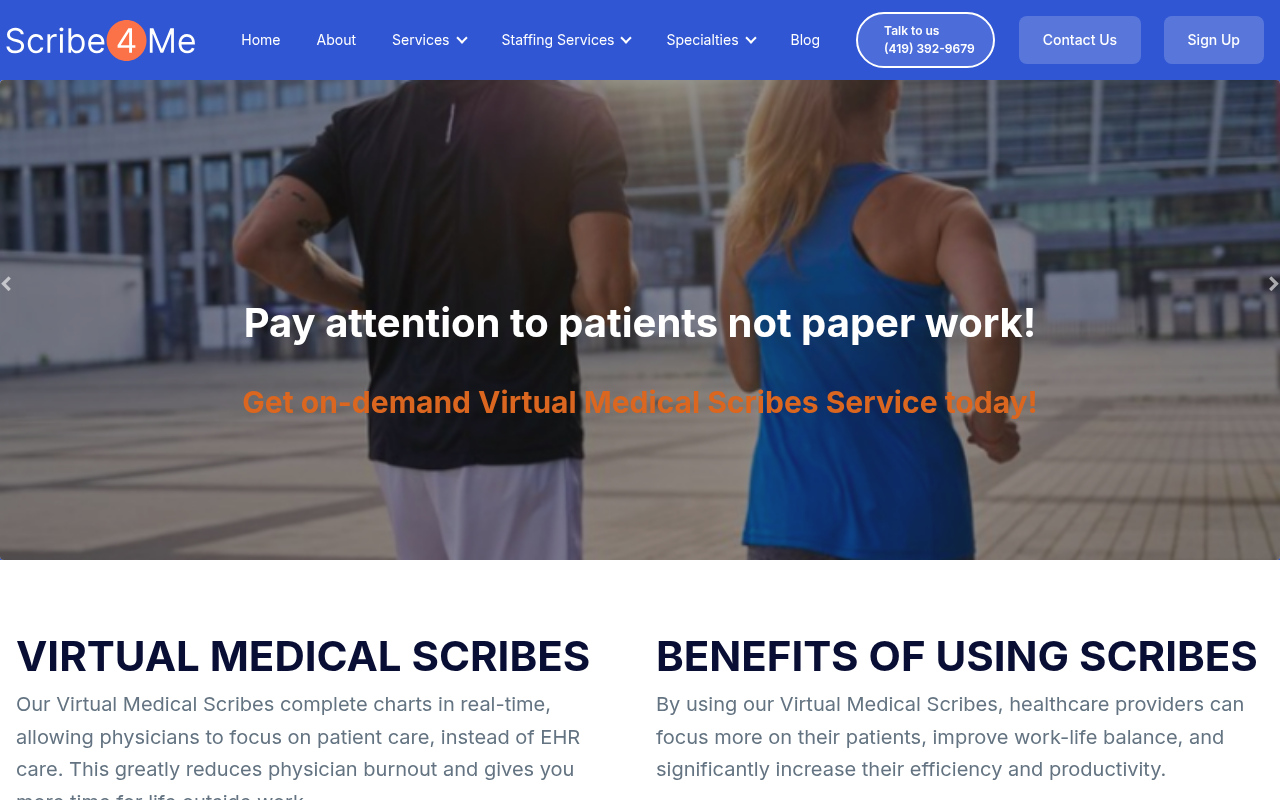
Scribe4Me operates a human-led live scribing model in which trained scribes work alongside physicians in real time during patient visits, handling documentation as encounters unfold. For practices where physician trust in automated documentation is low, that human presence reduces the adoption barrier significantly. The tradeoff is that a live human scribing model reintroduces the cost and scheduling variability that AI-only tools are designed to eliminate. It is a reasonable choice for practices that want real-time scribe support and are not yet ready to transition to an AI-first documentation workflow.
13. Tali AI - Best for Voice-First EHR Documentation in Primary Care

Tali AI is built specifically for primary care physicians who want to dictate structured notes directly into the EHR using voice commands, rather than relying on ambient passive listening. Its voice-first design fits physicians who prefer to control the documentation moment rather than have it captured continuously. The EHR connectivity is focused primarily on primary care workflows, which is a strength in that context and a limitation outside it. Practices with mixed specialty rosters or complex EHR environments will likely find Tali's scope too narrow to serve the full provider panel.
14. Augmedix - Best for Hospital-Based Physicians Needing Remote Scribe Infrastructure
Augmedix combines AI transcription with remote human medical scribes who review and complete notes in real time, making it one of the few tools on this list that replicates the traditional scribe relationship at a distance. For hospital-based physicians evaluating documentation solutions, Augmedix explicitly positions itself as an AI-centric platform offering a full spectrum from self-service to full-service AI automation. The cost is higher than AI-only alternatives, and the model introduces the same scheduling and coverage variability that human scribe programs carry. It is the right pick when physician trust in autonomous AI is the primary adoption barrier.
15. Lyric - Best for Post-Encounter Note Refinement and Physician Editing Workflows
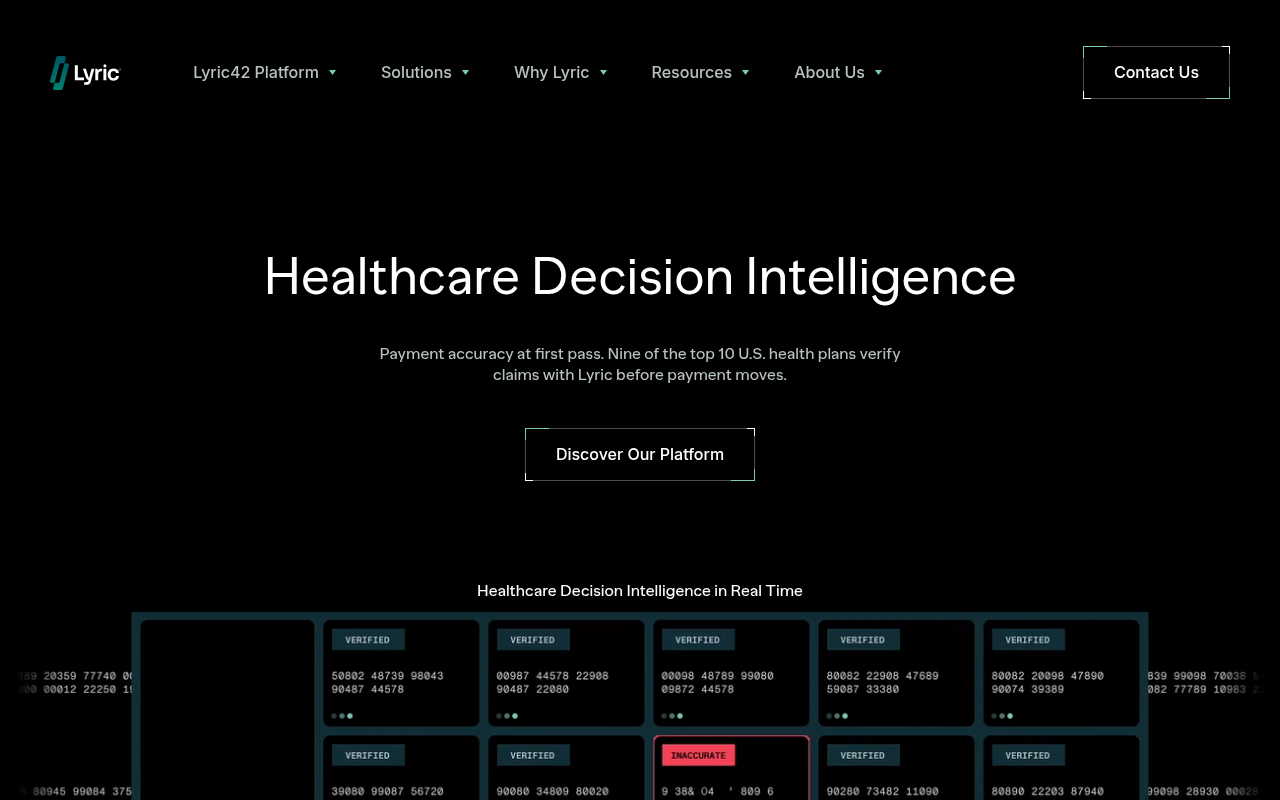
Lyric is designed for physicians who want to review and refine AI-generated notes rather than accept them as final output. Its editing interface is built around fast physician review, with structured suggestions and inline editing that reduces the time between note generation and sign-off. That workflow fits physicians who are skeptical of fully autonomous documentation but willing to engage with AI as a first-draft tool. The limitation is that Lyric's value proposition depends on physician engagement with the editing step, which means it is not a low-touch solution. Practices where physician time is the scarcest resource may find the review requirement offsets the documentation speed gains.
16. Speechmatics Clinical - Best for Highly Accurate Speech Recognition in Noisy Clinical Environments
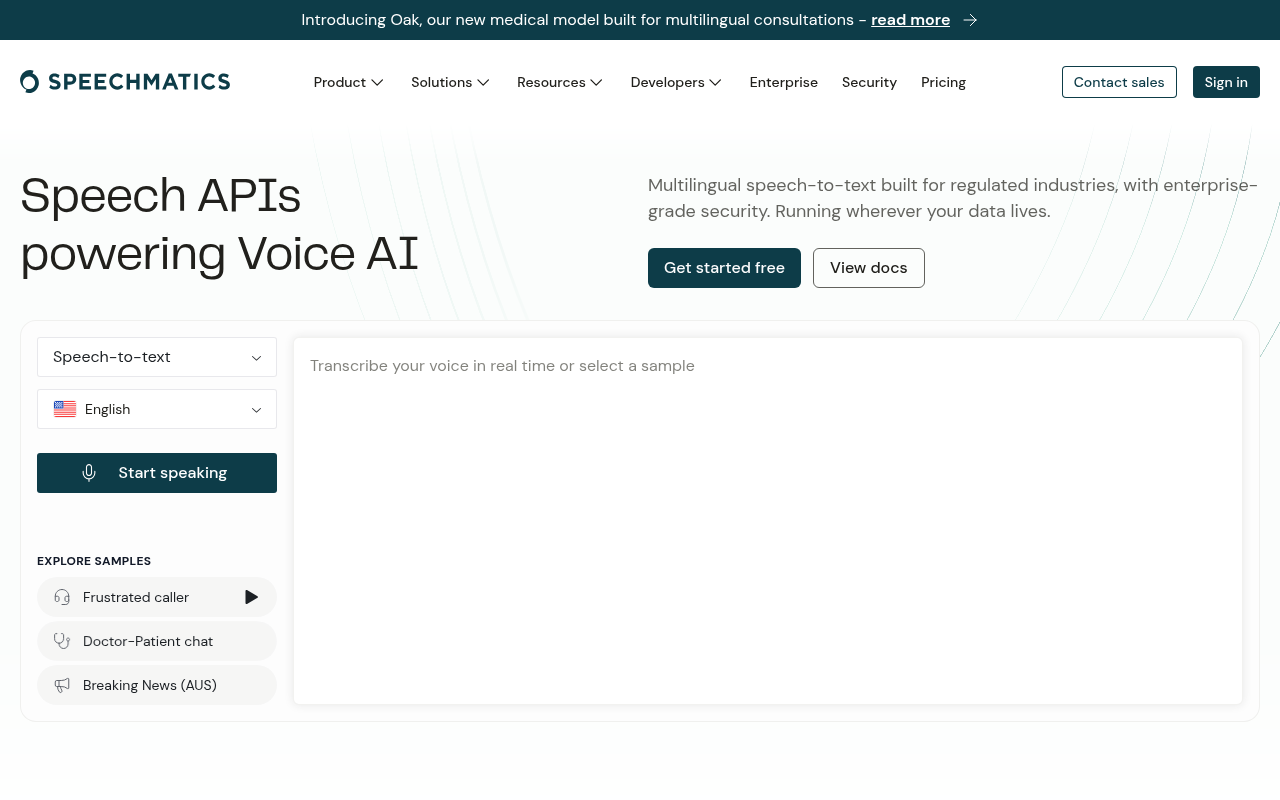
Speechmatics Clinical addresses a specific technical problem: ambient noise in clinical settings degrades transcription accuracy in ways that most AI scribes do not disclose in their headline accuracy figures. Emergency departments, procedure rooms, and multi-provider exam spaces create acoustic environments that standard speech recognition models handle poorly. Speechmatics Clinical's acoustic modeling is built for those conditions. The tradeoff is that it is primarily a speech recognition layer rather than a full clinical documentation platform, which means it is most useful as a component inside a broader documentation stack rather than as a standalone scribe solution.
17. Corti - Best for Real-Time Clinical Decision Support Layered Onto AI Scribing
Corti goes further than documentation by analyzing the clinical conversation in real time and surfacing decision support alerts, such as missed symptom patterns or protocol deviations, during the encounter rather than after it, a capability validated in peer-reviewed emergency medicine research on real-time AI clinical decision support. That real-time intelligence layer is genuinely differentiated and most valuable in high-acuity settings where a missed clinical signal carries immediate patient risk. The honest limitation for most practice administrators reading this list: Corti's decision support functionality adds implementation complexity and requires clinical workflow integration that goes well beyond what a documentation tool demands. For practices whose primary need is note generation and coding accuracy, Corti's depth is likely more than the use case requires.
Knowing which tool fits your practice type is only half the equation. The other half is understanding what each of these platforms will actually cost your practice per encounter, per provider, and per year at your patient volume. The next section breaks down AI scribe pricing across practice sizes so you can run a real total-cost-of-ownership calculation before any vendor conversation begins.
Related Reading
- Hipaa Compliant Ai Scribe
- Top Medical Scribe Companies
- Ai Scribe Cost
- How Does An Ai Scribe Work
- Medical Scribe Cost
AI Scribe Cost and Pricing Compared Across Practice Sizes
AI scribe pricing varies significantly by practice size, contract structure, and the hidden costs of adoption, making a direct comparison essential before any purchasing decision. The math on AI scribe ROI only closes when adoption is high enough to eliminate post-visit correction overhead.

AI Scribe ROI - When the Numbers Actually Work
Practices evaluating vendors should model total cost of ownership, license, connectors, onboarding, and training, against realistic adoption rates before committing to a contract.
How iScribe Health Measures What Other AI Scribes Miss
Every ambient AI scribe demo looks compelling in a conference room. What that demo never shows is what happens three weeks later, when a biller flags an E/M code that does not match the documented complexity, or when a compliance officer asks why a cluster of orthopedic encounters is running systematically high. Coding exposure is invisible, until it is not.

Orthopedic Overcoding Risk - What a 941-Encounter Audit Reveals When You Compare Ambient AI Scribes
8% provider-AI agreement rate, before iScribe's coding review layer was applied. A separate orthopedic audit found overcoding in roughly 35% of encounters. That is roughly one in three encounters carrying a code that could trigger a payer audit, a recoupment demand, or a compliance review, all while the practice assumed its AI scribe was performing as advertised.
Until they ran the trial, no one in the building knew the split. The overcoding discovery matters because it names a specific financial and compliance risk that note-speed benchmarks cannot capture. A fast note with a wrong code costs more than a slower note with the right one.
95% Audited Coding Accuracy Across 12 Specialties - How Scale Validates What a Pilot Cannot
A single-site pilot answers a narrow question: does this tool work here, now, for these providers? One specialty, one EHR configuration, one patient volume.
According to iScribe Health's published performance data, the platform achieved 95% audited coding accuracy across more than 4,000 active daily providers spanning 12 or more specialties. The word "audited" carries weight here. Vendor-reported accuracy figures typically reflect internal testing conditions rather than live clinical environments with real payer scrutiny.
Audited accuracy, measured against actual claims outcomes, is a different standard entirely. Most administrators handle evaluation by running a short internal pilot and declaring a winner based on physician feedback alone, which leaves the broader coding risk unexamined.
iScribe Health's automated E/M coding framework, validated across thousands of daily providers, gives administrators the statistical confidence that a single-site trial simply cannot produce.
90% Trial-to-Paid Conversion as a Clinical Adoption Signal, Not a Marketing Statistic
Coding precision and scale data establish what a platform can do under scrutiny. Adoption data reveals whether clinicians will actually use it. Because the primary driver of trial conversion is users reaching a moment of felt personal value before the trial ends, a conversion rate that high tells practice administrators something no spec sheet can: that real providers, under real workload conditions, decided the tool fit their workflow well enough to pay for it, which is precisely the adoption stress-test that feature checklists and compliance audits cannot perform.
Next steps
If your practice has spent weeks comparing vendor spec sheets only to land on a tool physicians quietly stopped using by week three, the path forward starts with reframing the purchase criterion entirely. Workflow invisibility, not feature breadth, is what determines whether an AI scribe delivers sustained ROI or becomes a sunk cost with a monthly invoice attached.
The 33% orthopedic overcoding rate surfaced in a real-world 941-encounter audit means that a technically clean note is not the same as a defensible code, and the gap between those two things carries direct financial and compliance exposure that no demo will surface. The 90% trial-to-paid conversion rate means that physicians under real clinical pressure, not controlled evaluation conditions, chose to keep using the tool because it fit their workflow before the trial ended. Together, they point to a single evaluation action: stop comparing feature matrices and start requiring adoption and coding accuracy evidence from vendors before any contract conversation begins.
Start by reviewing Best AI medical scribe for orthopedic practices to see how iScribe Health's E&M Coding Intelligence and ambient documentation perform against the specialty-specific documentation and coding demands your practice faces every day. From there, the trial conversion data gives you the adoption confidence to build an internal business case your physicians and billing team can both stand behind.
Frequently Asked Questions
What's the difference between real-time ambient transcription and async audio upload?
Real-time ambient capture listens and documents during the encounter, removing the need for a physician to remember to record, manage an audio file, or return to a half-finished note after the visit. Async upload tools require each of those steps, and every step is a dropout point, a pattern confirmed by 24x7 Magazine's 2025 coverage, which found async tools tend to show strong demo performance but weak real-world retention.
How do I actually test an AI scribe's accuracy for my specialty instead of just trusting the vendor's number?
Run a structured pilot using your own specialty's most complex note types, give each vendor candidate ten real de-identified encounter scenarios and count physician corrections per note yourself, rather than relying on vendor-reported aggregate accuracy rates. Aggregate accuracy across general conversation tells you almost nothing about performance on specialty-specific terminology like orthopedic surgical approach documentation or cardiology valve terminology.
Why do so many AI scribes get abandoned within the first few weeks after go-live?
Forty percent of physicians who trial an AI scribe stop using it within two weeks, most often because the tool doesn't disappear into their existing workflow, requiring extra logins, browser tab switches, or copy-paste steps that compound across a full day of patients. The post identifies shallow EHR integration and async-upload designs as the two structural causes of that dropout pattern, since both add friction at exactly the moment physicians most want documentation burden eliminated.
Does AI scribe technology actually help with physician burnout, or is that just marketing?
The post documents that clinicians in high-volume practices regularly chart two or more hours outside of patient care time, a burden that compounds into measurable burnout and reduced capacity across every working day. An AI scribe only addresses that burden when physicians keep using it, which is why provider acceptance rate and time-to-comfort are described as the only pre-purchase metrics that actually predict six-month ROI.
Can an AI scribe handle a multi-provider practice where encounters are happening at the same time, including telehealth visits?
Human scribes structurally cannot, one scribe covers one encounter, which creates a direct revenue ceiling in multi-provider groups, after-hours clinics, and telehealth settings. Ambient AI documentation removes that constraint entirely by capturing clinical notes during or after patient encounters without requiring a scribe to be physically or virtually present, running across every encounter and every day without a headcount ceiling.