AI Scribe Accuracy: What the Research Actually Shows
AI scribe accuracy errors hide in fluent notes. See what research shows providers to avoid audits and reimbursement risk.


AI scribe notes can read perfectly and still be quietly wrong. Here is where the errors hide, why they survive sign-off, and what they cost when they finally surface.
That assumption is far more expensive than most high-volume practices realize until the audit letter arrives. The practices that catch this early are the ones that treat accuracy as a continuous measurement problem, not a one-time onboarding checkbox. For orthopedic teams managing 30-plus encounters daily, AI-assisted clinical documentation makes that measurement possible at scale.
"AI scribes are not error-proof, yet providers may not always review transcriptions for accuracy post-visit, creating a hidden risk that looks fine on the surface until a mistake causes real harm."
— what we hear from healthcare providers
A well-structured note triggers a cognitive shortcut. When prose reads smoothly, the brain interprets coherence as correctness. That is the core problem with AI-generated clinical documentation: as Mobius MD noted in September 2024, AI-generated notes can read fluently and pass a quick review while still containing clinically significant errors, because linguistic polish does not equal factual or clinical accuracy. Fluency actively masks the inaccuracy rather than exposing it.

Physicians reviewing notes at the end of a packed clinic day are not reading for error. They are confirming that the note reflects what they remember. That confirmation bias, combined with the sheer volume of documentation, means a plausible-sounding but wrong medication dose, a misattributed symptom, or an inferred finding can survive the signing step entirely undetected.
Industry implementation experience consistently shows that documentation errors in AI-generated notes tend to surface during downstream reviews, payer audits, or patient safety investigations, rather than at the point of care, because the fluency of the note suppresses real-time suspicion. A single flagged claim triggers a retrospective audit. The audit pulls a broader sample.
What looked like an isolated error becomes a pattern, and the pattern carries financial and compliance consequences that compound backward through the record.
A 3 percent per-note error rate sounds manageable in isolation. Applied across 40 daily encounters, it produces more than one clinically flawed note every day. Across a 250-day clinical year, that is over 300 encounters with documentation errors that could affect coding accuracy, reimbursement, or patient safety. The risk is quiet, repeatable inaccuracy at scale, clustering around the clinical details that matter most.
Key takeaways
- AI scribe accuracy failures rarely look like garbled text, they look like clean, fluent notes that are wrong in exactly the places a payer auditor or downstream clinician will rely on most.
- Four error types drive the vast majority of consequential AI scribe failures: omission, context collapse, specificity drift, and attribution error, none of which surface during a demo.
- Published research makes the accountability gap hard to ignore: no external body required AI scribe vendors to prove clinical accuracy before go-live, which means most practices discover the problem after the encounters are already signed and submitted.
- Eight in ten patients accept an AI scribe during their appointment, but that number drops sharply when the conversation about consent doesn't happen before the encounter begins.
- Physicians already spend nearly six hours on EHR tasks for every eight hours of patient care; an AI scribe that introduces documentation errors doesn't reduce that burden, it redirects it into appeals and remediation.
- Errors caught during a post-billing payer audit cost substantially more to fix than errors caught before a note is signed, the only audit that works in your favor is the one you run first.
- iScribe Health's AI Medical Scribe closes the loop by listening to the patient-provider conversation in real time and drafting the note directly into the EHR, so physicians review accurate documentation before signing, not after a payer flags it.
What Specific Types of Errors AI Scribes Make in Clinical Documentation
Four error types account for the vast majority of consequential AI scribe failures, and none of them look like a garbled sentence. They look like clean, fluent documentation that happens to be wrong in exactly the places a payer auditor or downstream clinician will rely on most. That assumption is what makes these four error types so dangerous.
1. Drug Name Misidentification - When AI Scribes Mishear Medications and Alter Diagnoses
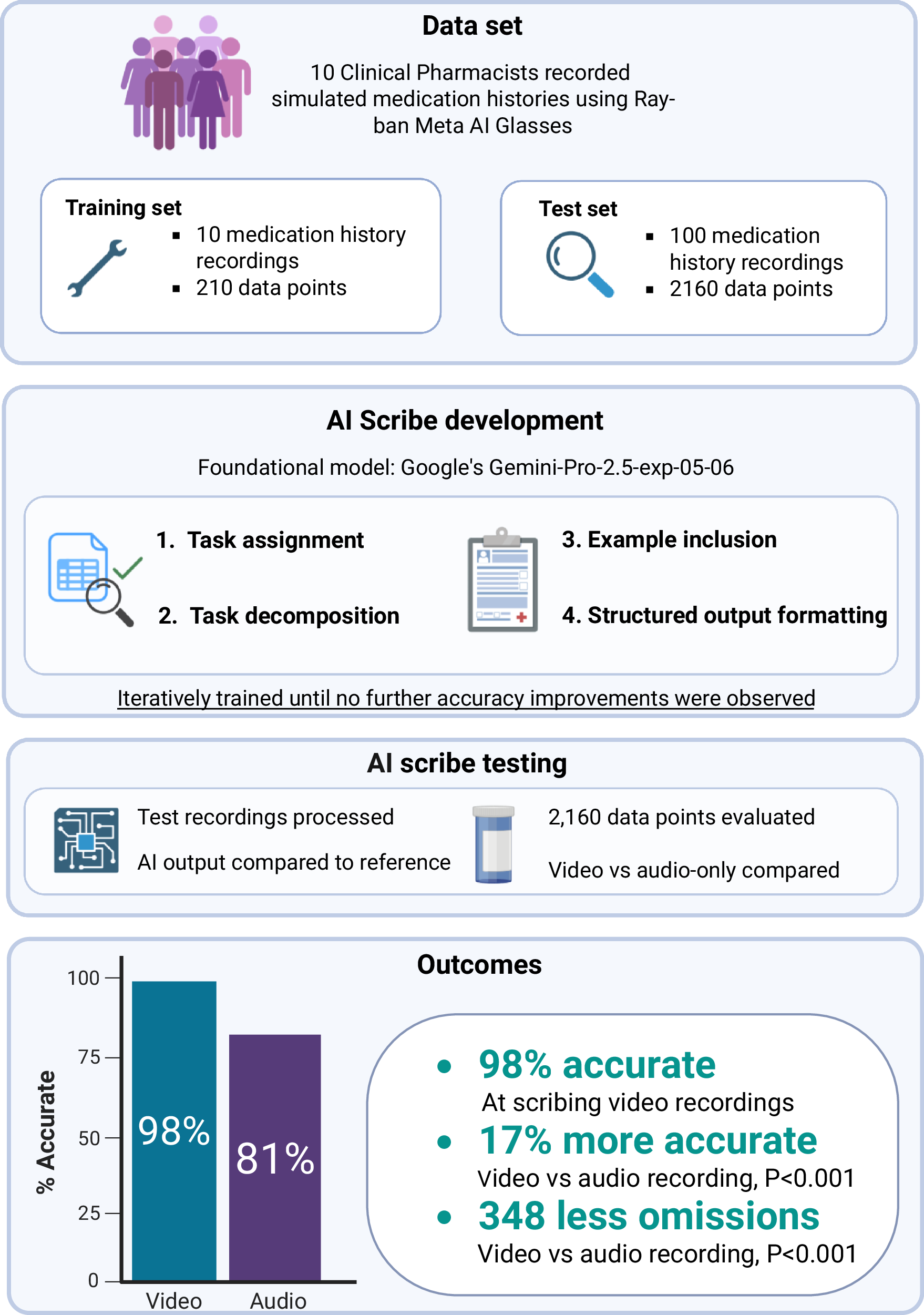
Phonetic confusion between drug names is the highest-stakes single-error category in AI scribe output. When a provider says "metoprolol," the note can come back with "metformin." Both words sound plausible in a clinical context. Both are commonly prescribed. The note reads cleanly, passes a quick physician scan, and enters the permanent record with the wrong medication attached to the wrong condition. That is a patient safety event waiting to materialize.
The risk compounds at volume. A practice seeing forty patients daily does not have the review bandwidth to catch phonetically plausible substitutions buried in otherwise coherent notes. Drug name misidentification is the error type most likely to survive the sign-off process because it does not announce itself. This is exactly why iScribe Health's Ambient AI Documentation is designed to surface the completed AI-drafted note at the point of note completion, after the AI drafts the encounter summary, giving the physician a structured review moment before the note reaches the EHR, rather than letting a plausible-sounding error pass silently into the permanent record.
2. Clinical Hallucinations - Fabricated Information Inserted Into Notes That Was Never Spoken
AI scribes produce hallucinations. That is the accurate term: the model generates clinically plausible content that was never part of the encounter. A documented allergy history for a patient whose allergies were never discussed. A fabricated finding inserted into the assessment because the model inferred it fit the clinical pattern.
This is not hypothetical. Clinicians working with ambient AI documentation have discovered notes containing references to substances the patient never mentioned, including cases where entirely fabricated content caused real emotional distress when those records followed the patient to another provider. The harm is concrete: wrong information in a signed note travels with the patient, and the downstream provider has no way of knowing the content was generated rather than recorded.
Semantic Scholar and clinical governance literature have both documented that when raw transcripts generated by AI scribes are destroyed after note generation, the ability to assess scribe accuracy against what was actually said is permanently lost, eliminating the only evidentiary baseline available for retrospective audits or safety reviews. As Goodman and Morgan argued in the New England Journal of Medicine, those transcripts are not digital exhaust; they are digital gold, and destroying them after summarization removes the only comparison layer that makes hallucination detection possible. Without that layer, fabricated content is invisible until a downstream provider acts on it.
iScribe Health's approach to defensible documentation is built around this problem directly. The platform's goal of creating more defensible documentation and standardizing clinical documentation quality across the practice is inseparable from preserving the physician's ability to review AI output against what actually happened in the room, before that output is signed and filed.
3. Silent Gap-Filling - AI Infers and Inserts Unstated Clinical Details Without Flagging Uncertainty
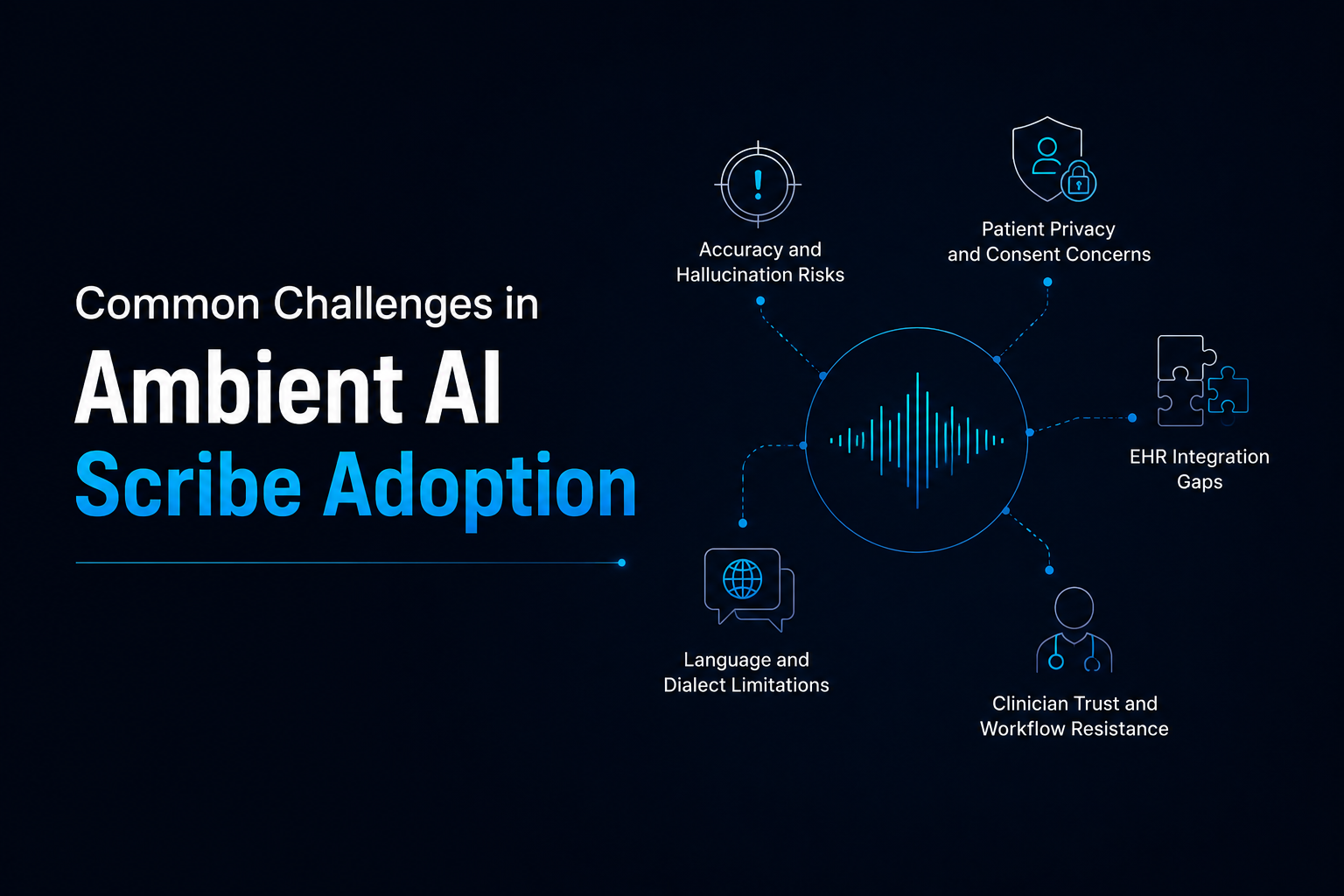
A human scribe who misses a detail asks for clarification. An AI scribe fills the gap silently, drawing on training patterns to infer what was probably meant. The output carries no uncertainty flag. No asterisk. No note that the model extrapolated rather than recorded.
Silent gap-filling is structurally different from hallucination. The model is completing a pattern rather than fabricating randomly. That makes the output more plausible and harder to detect. It also means the error is systematic: the same gap, in the same documentation zone, will be filled the same way across every encounter where the model encounters that pattern. Research indexed by Consensus on AI clinical documentation accuracy has underscored that pattern-completion errors are among the most difficult to catch because they are internally consistent with the surrounding note; they read as deliberate clinical judgment rather than model inference.
iScribe Health's Ambient Listening and Conversational AI layer is designed to accurately capture clinical notes during or after patient encounters, reducing the inference burden the model carries and, by extension, reducing the surface area where gap-filling substitutes for recorded fact.
4. Omissions of Comorbidities - Undercoded Complexity and Dropped Encounter Context
Omissions do not add wrong information. They remove correct information. A patient's hypertension, diabetes, or chronic kidney disease goes undocumented in the visit note, and the encounter codes to a lower complexity level than the clinical reality warrants. The claim goes out undercoded. The denial or reduced reimbursement follows.
This is the error type practice managers feel in the revenue cycle before they identify it in the documentation. Dropped comorbidities are a direct path to undercoded E&M levels, and at high patient volumes, the cumulative revenue impact is significant. iScribe Health addresses this at the coding layer through E&M Coding Intelligence and Automated E&M Coding, which work alongside the ambient documentation to flag coding-level gaps at the point of note completion, before the claim is submitted.
Combined with Real-Time Denial Alerts, the platform is designed so that the practice learns about a documentation gap before it becomes a denial. This matters most in high-volume practices and health systems where the same omission pattern, repeated across hundreds of encounters, produces revenue losses that are invisible in any single note but significant in aggregate.
5. Contextual Drift - Loss of Earlier Encounter Details in Long or Complex Visits
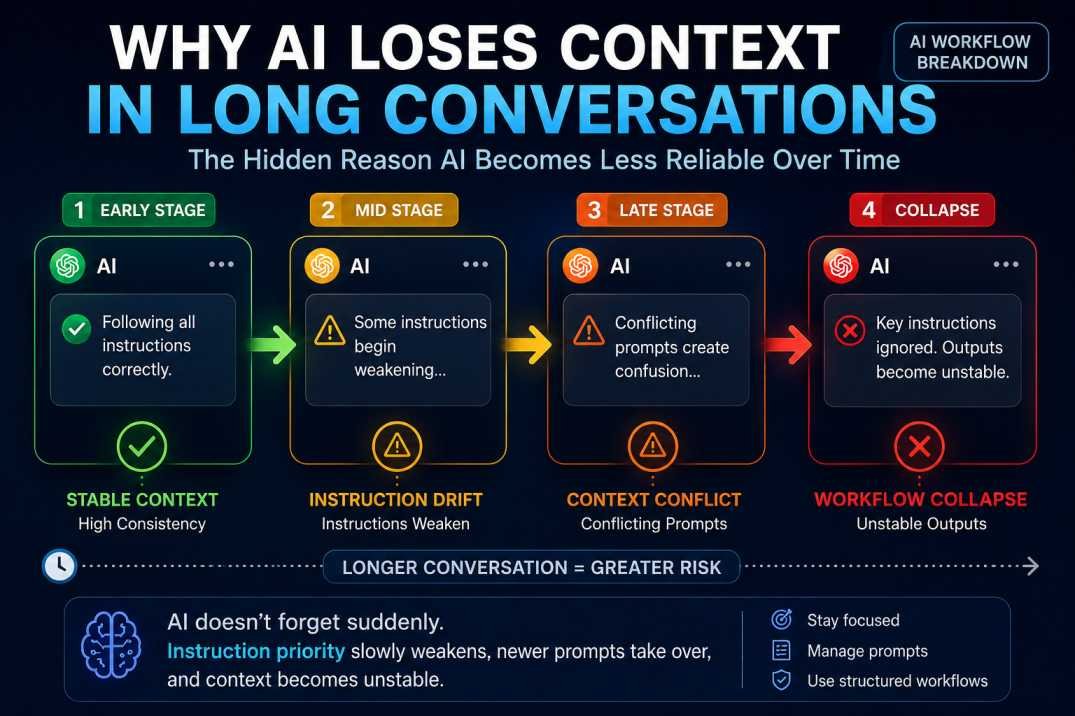
In extended encounters, AI scribes show a consistent pattern: details from the first half of the visit receive less accurate documentation than details from the final minutes. The model weights recent context more heavily. In psychiatry, geriatrics, and complex chronic disease management, where the clinical narrative builds across a long conversation, the beginning of that conversation is exactly where the most diagnostically significant information often lives.
Contextual drift means the note accurately reflects how the encounter ended, not what the encounter contained. Semantic Scholar (paper d802bc58cba9d2db34dcb95b0014b0d950f7cfd9) has examined AI documentation performance across encounter complexity levels, with findings consistent with the broader pattern that longer, more complex visits produce AI-generated notes with systematic front-loaded omissions rather than random gaps. iScribe Health's AI Customization capabilities are relevant here: the ability to tune the model's behavior to the documentation patterns of a specific specialty or encounter type is a direct mitigation against the generic contextual weighting that produces drift in complex visits.
6. Misattributed Speaker Content - Patient Statements Recorded as Clinician Assessments

Speaker diarization, the process of distinguishing who said what, is one of the harder technical problems in ambient AI scribing. When it fails, a patient's self-reported symptom description gets recorded as a clinician assessment. A subjective complaint can appear in the note as a clinical impression rather than a patient-reported concern.
That misattribution changes the medico-legal character of the documentation entirely. It is also the category of error most directly addressed by physician review at the right point in the workflow. Most practices discover these error categories the hard way, after a note is signed, a claim is denied, or a downstream provider acts on a fabricated finding.
That is why iScribe Health builds physician review and accuracy validation into the workflow at the point of note completion, after the AI drafts the encounter summary, before the note reaches the EHR, rather than treating verification as an afterthought once errors have already compounded across hundreds of encounters. For practices already running a supported EHR, iScribe Health's EHR Integration means that the seamless ambient documentation experience and the structured review moment it enables are available inside the system clinicians already use, without adding a parallel workflow.
Naming these error types is the first step. Knowing they exist in theory is not the same as knowing how often they surface in real clinical environments, at what severity, and in which specialties. The published data on this is more specific and more actionable than most vendor demos suggest.
Real-World AI Scribe Accuracy Limitations the Research Actually Surfaces
No external body required AI scribe vendors to prove clinical accuracy before their tools entered practice workflows, and that absence of a pre-market validation requirement shaped the environment that followed.

The Regulatory Gap Is Already Live
Ambient AI scribes used in clinical documentation largely fall outside the FDA's device authorization framework, creating regulatory oversight gaps for accuracy validation that persist even as the tools spread rapidly through practice workflows.
The FDA-Approved Artificial Intelligence and Machine Learning-Enabled Medical Devices: An Updated Landscape From 1995 to 2023 makes that authorization boundary explicit: ambient documentation tools that capture clinical notes during or after patient encounters sit in a structurally different, and far less scrutinized, regulatory category than the imaging and diagnostic devices that dominate the authorized landscape.
Handley et al. npj Digital Medicine, analyzing 429 safety reports associated with AI/ML-enabled medical devices submitted to the FDA's MAUDE database, found that one-quarter were potentially related to AI/ML failures, a finding that underscores how much risk remains invisible until it surfaces through adverse-event channels.
Word Error Rate Can Miss the Patient
Word error rate (WER) is the standard accuracy metric most AI scribe vendors cite, yet it measures transcription fidelity across an entire note rather than weighting the clinical significance of individual errors.
Consider a practice deploying an AI scribe with a 95% WER score. If the 5% of errors cluster in medication names and diagnosis fields rather than distributing evenly across the note, the metric has obscured the exact risk that matters most, and a note that scores well by that measure can still introduce serious downstream harm.
95%
WER score can still hide dangerous errors
Key takeaway: Accuracy in transcription does not equate to accuracy in clinical utility. The goal is not a note that sounds complete, but one that accurately reflects the encounter, supports correct E&M coding, and integrates cleanly into the EHR without introducing downstream risk.
A documentation error that recodes a diagnosis incorrectly or omits a medication change is not an isolated event. It is a failure that compounds across every encounter it repeats. iScribe Health's E&M Coding Intelligence and Real-Time Denial Alerts are designed to surface exactly these failure modes at the point of note completion, after the AI drafts the encounter summary, while the clinical context is still immediately correctable.
27 Tools, No Shared Standard, What the NHS Deployment Reveals About Fragmented Accuracy Accountability
The scale of fragmentation becomes concrete in the NHS context. Across NHS trusts, 27 different AI scribe tools are already in active use, each with its own vendor-defined accuracy benchmarks and no unified oversight framework governing how those benchmarks are set, tested, or reported. Healthwatch England and patient advocacy reporting in the UK context have surfaced a patient-facing dimension: patients are encountering errors in their records and, in many cases, flagging inaccuracies that clinical staff did not catch before the note was signed, a pattern consistent with what the regulatory structure, absent a shared accuracy floor, would predict.
- Patient records
- Coding outputs
- Payer denials
- Patient complaints
These are the downstream surfaces where undiscovered documentation errors eventually become visible, and they share a common feature: detection arrives late. As Handley et al. demonstrate, the adverse-event reporting channel, not proactive vendor monitoring, is currently the primary mechanism by which AI/ML failures in medical devices become visible at all.
For practices already operating on a supported EHR that want a seamless ambient documentation experience, the absence of a shared external standard makes the internal verification posture more consequential. iScribe Health's EHR Integration and AI Customization are built to materialize within that existing infrastructure, so the ambient listening layer, the coding intelligence, and the denial alert signals operate continuously across every patient encounter rather than as a one-time onboarding check that the regulatory environment has already shown to be insufficient.
What Patients Actually Think About AI Scribe Accuracy and Consent

Most Patients Will Accept AI Scribes Under Specific Conditions
81% of patients want explicit consent obtained before an AI scribe is used during their appointment, according to a December 2024 study indexed at PubMed (PMID 39657021), so acceptance is conditional rather than assumed.
Patient comfort is also conditional on transparency about AI use and visible clinician oversight. Patients are evaluating whether they were treated as a participant in their own care, not only whether the note is accurate. iScribe Health's ambient AI documentation is designed to support exactly that posture: the physician stays in the conversation, maintains eye contact, and remains visibly present, so the patient experiences the encounter as a human interaction in which AI is a transparent, acknowledged tool rather than a hidden mechanism.
The Consent Conversation Is the Trust Architecture
- Inform patients before the encounter begins
- Document their agreement
- Confirm that the physician will review the AI-generated note before it enters the record
iScribe Health's ambient listening surfaces during the encounter itself as a background process that allows the clinician to stay focused on the patient, so the consent conversation becomes the natural starting point rather than an afterthought.
Verification Assurance Is What Patients Weight Most
69% of patients want a healthcare professional to verify AI scribe output before it enters the medical record, per the same PubMed study (PMID 39657021), making physician review the single most important trust signal in the entire workflow.
Unreviewed AI output carries real risk: errors in medication, history, or assessment can propagate through a record and influence future care. Patients may not be aware of this risk, but their instinct to want a qualified professional standing behind the note is clinically sound. iScribe Health positions physician review as a defined step: the AI drafts the encounter summary at the point of note completion, and the physician reviews and approves before anything enters the EHR.
That review step is only sustainable if physicians are not already overwhelmed by documentation, however. Reducing that documentation burden through ambient AI documentation creates the conditions in which meaningful physician review is possible, rather than a standard no one has time to meet.
Related Reading
- Hipaa Compliant Ai Scribe
- Top Medical Scribe Companies
- How Does An Ai Scribe Work
- Medical Scribe Cost
- Ai Scribe Cost
AI vs Human Scribe Accuracy and the Real Impact on Clinical Workflows
Those workflow consequences snap into focus the moment you put a number on the problem: physicians spend nearly six hours on EHR tasks for every eight hours of patient care, well over half their working hours on documentation rather than direct patient contact. That figure reframes the AI-vs-human scribe debate entirely, shifting the central question from which option feels more familiar to which one actually reduces that burden without introducing new risks.

At a glance
Scribe Type
Error Profile / Sources of Inaccuracy
Visibility / Auditability of Errors
Coding Impact
AI Scribes
Errors surface when patients speak quickly, carry accents, or when clinical conversations shift into nuanced, context-dependent territory; can produce undercoded or overcoded complexity
Every AI-drafted note is reviewable before signing; errors remain auditable and correctable; the AI's draft is still on the screen
E&M Coding Intelligence can surface previously invisible undercoded complexity and improve coding precision in a way that directly impacts revenue
Human Scribes
Fatigue in a high-volume afternoon, knowledge gaps in a subspecialty encounter, and high turnover rates that reset institutional familiarity with every new hire all introduce inconsistency; undocumented judgment calls
A human scribe's undocumented judgment call is already gone by the time the physician reviews anything; no real-time flagging
Human scribes had been addressing coding gaps verbally rather than in the chart; manual workflows routinely leave reimbursement leakage behind
How AI Scribes Cut Physician Burnout and Why the Benefit Is Consistent Across Studies
The throughput gain is real, but it carries a proportional risk that is easy to overlook. A physician who signs 35 AI-generated notes in the time it previously took to write 20 has not reduced their risk per note. Multiplied across that higher volume, even a modest per-note error rate becomes a meaningful liability, and AI is also a genuine amplifier if the verification layer is missing, which is exactly why iScribe Health surfaces Real-Time Denial Alerts and Automated E&M Coding at the point of note completion, after the AI drafts the encounter summary, so errors and coding gaps are caught before a physician's signature makes them permanent.
AI Scribe Accuracy Varies by Model, and Volume Magnifies the Gap
The AI did not invent the gap; it made an existing gap visible. iScribe Health's E&M Coding Intelligence is built to improve coding precision in a way that directly impacts revenue, closing the reimbursement leakage that manual or human-scribed workflows routinely leave behind.
Accuracy also varies when clinical conversations move quickly or into subspecialty territory. The documentation gaps that emerge in those moments are addressable through a structured review workflow: iScribe Health's AI Customization capability allows the system to be tuned to a practice's specific clinical context, and because every AI-drafted note is reviewable before signing, errors remain auditable and correctable.
A human scribe's undocumented judgment call, by contrast, is already gone by the time the physician reviews anything. That asymmetry matters enormously at scale. It is the reason iScribe Health's platform is designed to work within a supported EHR environment, delivering a seamless ambient documentation experience without requiring clinicians or IT administrators to rebuild the workflows they already depend on.
iScribe Health's EHR Integration means that clinical informatics teams and IT/EHR administrators are not absorbing a disruptive implementation; they are extending an existing infrastructure.
Eye Contact Over Keyboard - How AI Scribes Reshape the Patient Encounter Itself
AI scribes improve the quality of the patient encounter by removing the screen as the focal point of the visit. When documentation runs in the background through iScribe Health's Ambient Listening and Conversational AI, physicians stop splitting attention between the patient and the keyboard. Across the broader clinical landscape, reduced clicks and cognitive burden are increasingly recognized as essential to returning physicians to face-to-face care, and the financial case reinforces the clinical one.
When coding precision improves and reimbursement workflows are simplified, two of the core competencies iScribe Health brings, practices recover revenue they were already earning but failing to capture, making the shift to AI documentation a gain on both sides of the ledger.
How to Safely Implement an AI Scribe Without Inheriting Its Accuracy Risks
Errors caught during a post-billing payer audit cost substantially more to remediate than errors caught before a note is signed, a cost differential that grows with encounter volume and the complexity of the appeals process. That single ratio reframes AI scribe implementation entirely: the governance question is where in the workflow that review happens and who owns it. For practices already running a supported EHR, iScribe Health's ambient AI documentation integrates directly into that environment, surfacing real-time denial alerts and automated E&M coding intelligence at the point of note completion, the exact moment when a structured review catches the most expensive errors before they leave the building.
1. Measure AI Scribe Accuracy Against the Full Clinical Narrative, Not Just the Finalized Note
A well-structured note can read as complete while still omitting or misrepresenting clinically significant details spoken during the visit. According to the 2025 systematic review in Healthcare (MDPI), "The Impact of AI Scribes on Streamlining Clinical Documentation," AI scribe accuracy must be evaluated against the full clinical narrative, including what was said versus what was documented, because surface-level finalized-note review misses the errors that create the most downstream harm. When raw transcripts are discarded after note generation, practices lose the only evidentiary basis for defending themselves in a payer audit or malpractice review, turning a documentation tool into an unauditable liability.
2. Build a Structured Verification Protocol - Define Who Reviews, at What Stage, and What Triggers Escalation
A study in the Latin American Journal of Clinical Sciences and Medical Technology found that a verification protocol defining who reviews AI-generated notes, at what workflow stage, and what criteria trigger escalation is essential to safe implementation. That protocol must exist in writing before the first patient encounter, not assembled reactively after a complaint surfaces. Without role-specific ownership and explicit escalation triggers, review becomes informal and inconsistent, and the same error categories recur invisibly across hundreds of signed notes.
iScribe Health's EHR integration materializes most cleanly when the practice is already running a supported EHR and this governance layer is in place before go-live. The combination of seamless ambient documentation and a written verification protocol is what actually reduces audit risk at scale.
3. Audit at the Individual Encounter Level Periodically - Not Just in Aggregate - to Catch Compounding Errors Before They Pattern Into a Payer Audit
Aggregate accuracy metrics can mask a single recurring error type, a misclassified chief complaint or a consistently dropped allergy, that compounds across hundreds of notes and surfaces only when a payer flags a billing pattern. Encounter-level audits, sampled monthly across providers and visit types, catch these before they calcify. The tradeoff is audit overhead; practices must build this into QA workflows rather than treating it as an ad hoc task.
4. Use Specialty-Specific Training Data to Improve AI Scribe Accuracy in High-Complexity Contexts
General-purpose AI scribe models trained on broad clinical corpora perform measurably worse in high-complexity specialties where terminology is domain-specific and clinical context shifts rapidly within a single encounter. Cardiology, oncology, and psychiatry each carry terminology and documentation conventions that a primary-care-tuned model will misrepresent at a meaningful rate. Practices in these specialties should require vendors to demonstrate accuracy benchmarks specific to their encounter type, not aggregate accuracy across a mixed patient population, before go-live. iScribe Health's AI customization capability is the mechanism that addresses this gap, enabling specialty-specific tuning rather than forcing a high-complexity practice to accept a general-purpose baseline.
5. Implement Physician Feedback Loops and Structured Correction Workflows to Continuously Improve AI Scribe Accuracy
Edits made directly in the EHR are invisible to the AI model unless a deliberate pipeline captures and routes them back. The Latin American Journal of Clinical Sciences and Medical Technology study identifies structured correction workflows as the primary mechanism for improving AI scribe accuracy over time, particularly in specialty-specific contexts where terminology is highly domain-specific. Without that pipeline, individual physicians and advanced practice providers correct the same error category across hundreds of encounters with no reduction in recurrence, and the model never improves.
Physician burnout reduction, one of the clearest benefits iScribe Health's ambient documentation delivers, is most durable when the model improves rather than plateaus, which requires structured correction workflows, not passive EHR edits that leave the underlying system unchanged.
AI Documentation Accuracy: Implementation Checklist
Use this checklist before go-live and at each 30-day review interval:
- Step 1: Run a 30-day pilot → Action: Sample encounters across different complexity levels → Owner: Practice manager → Timing: Pre, go-live.
- Step 2: Establish a verification protocol → Action: Document who reviews, at what stage, and what triggers escalation → Owner: Compliance lead → Timing: Pre, go-live.
- Step 3: Confirm transcript retention → Action: Verify whether the vendor retains raw transcripts and for how long → Owner: IT / compliance → Timing: Pre, go-live.
- Step 4: Require specialty-specific benchmarks → Action: Obtain accuracy benchmarks from the vendor, not aggregate figures → Owner: Medical director → Timing: Pre, go-live.
- Step 5: Conduct weekly sampling → Action: Review 5–10% of encounters, stratified by provider and complexity → Owner: Coding team → Timing: Ongoing.
- Step 6: Create a structured feedback pipeline → Action: Route all physician EHR edits to the AI model through a structured feedback process → Owner: IT / vendor → Timing: Ongoing.
- Step 7: Run quarterly coding audits → Action: Audit 30–50 encounters every 90 days and log findings in a written compliance record → Owner: Compliance lead → Timing: Quarterly.
What Audited AI Scribe Accuracy at Scale Actually Looks Like for High-Volume Practices
That 95% audited accuracy rate looks like a compliance win on paper, and in narrow terms it is, but the number requires context before a high-volume practice can act on it responsibly.
iScribe Health's validated benchmark covers 4,000+ daily active providers, and that scale is meaningful for evaluating platform reliability, though scale alone does not tell a practice what its own error exposure looks like.

How a 95% Accuracy Benchmark Gets Established Across 4,000 Plus Daily Providers
According to iScribe's published accuracy documentation, the 95% rate is audited across a provider base exceeding 4,000 daily active clinicians, one of the larger real-world accuracy samples publicly reported in the AI scribe category. Practices evaluating this benchmark should request the underlying methodology, encounter type breakdown, and specialty distribution directly from the iScribe Health team, since those details determine how well the published figure maps to a given practice's own documentation patterns.
Pros and cons at a glance
- ✓ Pros
- 95% audited accuracy rate across that same figure + daily active providers.
- One of the larger real-world accuracy samples publicly reported.
- Rate derived from thousands of live encounters carries more evidential weight than controlled pilot data.
- ✗ Cons
- Aggregate accuracy rates measure platform-wide performance, not practice-level exposure.
- 5% per-note error rate produces six to eight flawed notes every single day at high volume.
- Errors concentrate by specialty, documentation pattern, and encounter complexity.
- 33% overcoding rate and 54.8% provider-AI agreement rate remain invisible before audit.
The volume math is where aggregate accuracy figures become operationally significant.
The Hidden 33% Overcoding Rate in a 941-Encounter Orthopaedic Audit
The Center for Sports Medicine & Orthopaedics audit makes this concrete. Across 941 reviewed encounters, auditors identified a 33% overcoding rate and a 54.8% provider, AI agreement rate. These were compliance liabilities the practice had no visibility into before the audit ran, because nothing in the standard documentation workflow flagged them at the point of note completion.
What the Center for Sports Medicine & Orthopaedics audit illustrates is the timing of the problem: 33% overcoding and a 54.8% provider, AI agreement rate across 941 finalized, signed encounters were invisible at the point of note completion, after the AI drafts the encounter summary, before anyone in the billing chain had reason to question it. iScribe Health's Automated E&M Coding and E&M Coding Intelligence work at exactly that moment, surfacing audit candidates upstream, at the point of note completion, rather than downstream after claims have already been submitted. That is the only intervention point that prevents exposure rather than merely detecting it.
Coding Precision as the True ROI Lever for High-Volume Practices
Undercoding leaves revenue on the table; overcoding creates audit liability. Both error types, at high patient volume, translate directly into financial and compliance risk beyond clinical documentation concerns, a point reinforced by the coding audit data reviewed in this section and by AIMOCS compliance guidance on ensuring accurate, compliant medical coding across high patient volumes to maximize reimbursement and minimize claim denials.
An AI scribe that treats its job as transcription fidelity hands the coding risk to a human step that runs after the encounter closes. iScribe Health's approach, Ambient AI Documentation paired with E&M Coding Intelligence and Real-Time Denial Alerts, catches the misalignment before the claim goes out, shifting the correction window from post-submission remediation to pre-submission review.
High-volume practices where physicians regularly chart two or more hours outside patient care are the same environments where coding errors accumulate fastest and where a payer audit, when it arrives, carries the greatest financial exposure. iScribe Health's Physician Burnout Reduction impact is most significant in exactly those settings, because removing post-encounter charting burden and embedding coding precision into the documentation layer address two sides of the same operational risk simultaneously.
Related Reading
- Best Ai Scribe For Athenahealth
- Ai Medical Scribes With E&m Coding Built In
- Do Ai Scribes Reduce Claim Denials?
Next steps
If your practice is signing AI-generated notes without a reliable way to know how often those notes are wrong, the path forward starts with measuring accuracy against the full clinical narrative, not just the finalized note that lands in the EHR.
The audited 33% overcoding rate discovered across 941 orthopedic encounters means coding risk is invisible at the point of signing and catastrophic once a payer finds it first. The finding that one-quarter of AI/ML device safety failures emerge after deployment, not during onboarding, means a one-time validation check leaves the largest share of accuracy risk permanently unmonitored. Together, they point to building encounter-level audit sampling and coding intelligence into the documentation workflow before the first claim goes out, not after an Additional Documentation Request arrives.
Start with Best AI medical scribe for orthopedic practices to see how iScribe Health's Automated E&M Coding and Real-Time Denial Alerts surface coding gaps at the point of note completion, while ambient listening captures the full clinical narrative during the encounter. From there, you can benchmark your own accuracy against a 4,000-plus provider audited standard, confirm your verification protocol is in place before go-live, and run your first stratified encounter sample on your timeline rather than a payer's.
Frequently Asked Questions
If my AI scribe's word error rate looks good, does that mean the notes are clinically accurate?
Not necessarily, word error rate measures transcription fidelity, not clinical correctness. As the post explains, AI-generated notes can read fluently and pass a quick review while still containing clinically significant errors, because linguistic polish does not equal factual or clinical accuracy.
Can an AI scribe actually make up clinical details that were never said in the visit?
Yes. This is called hallucination, the model generates clinically plausible content that was never part of the encounter, such as a documented allergy history for a patient whose allergies were never discussed. Clinicians working with ambient AI documentation have discovered notes containing fabricated content that caused real emotional distress when those records followed the patient to another provider.
How do dropped comorbidities in AI-generated notes actually hurt my practice financially?
When a patient's hypertension, diabetes, or chronic kidney disease goes undocumented, the encounter codes to a lower complexity level than the clinical reality warrants, leading to undercoded E&M levels and reduced reimbursement. At high patient volumes, the same omission pattern repeated across hundreds of encounters produces revenue losses that are invisible in any single note but significant in aggregate.
Is my AI scribe regulated or validated for accuracy before it goes live in my practice?
In most major jurisdictions, ambient AI scribes are not classified as medical devices, which means there is no pre-market accuracy validation, no mandatory performance threshold, and no requirement that a vendor demonstrate clinical precision before a practice goes live. That accountability gap lands directly on the clinician signing each note and the practice absorbing the downstream risk.
Does an AI scribe struggle to keep up with long or complex patient visits?
Yes, the post describes a pattern called contextual drift, where details from the first half of a visit receive less accurate documentation than details from the final minutes because the model weights recent context more heavily. Research consistent with this pattern found that longer, more complex visits produce systematically less complete AI-generated notes, with omissions specifically front-loaded rather than randomly distributed.