Urology Medical Coding Best Practices Guide 2026
Urology Medical Coding gaps drain revenue fast so billing leaders can finally gain visibility and capture every dollar they deserve.


Urology coding spans three separate code sets in every encounter, and the costly risk is not overcoding. It is the documentation gaps that quietly drain reimbursement before a claim ever reaches the billing queue.
Urology medical coding is one of the most code-dense specialties in ambulatory medicine, and the common assumption among practice administrators and billing decision-makers is that the coder is the last line of defense: if they are skilled and certified, the revenue capture problem is solved. In reality, the risk most practice administrators lose sleep over (audit exposure from overcoding) is actually the less common threat. The more frequent and more costly problem runs in the opposite direction: a specialty this broad, touching this many organ systems and supply categories, creates systematic undercapture that compounds quietly across thousands of encounters each year. See our AI medical scribe for how this works in practice.
Each represents a separate billing decision, and missing any one of them means leaving reimbursement on the table. A single cystoscopy with biopsy visit, for example, may require a CPT® surgical code, an E&M code with Modifier -25, a precise ICD-10-CM diagnosis code, and a HCPCS supply code for the catheter used post-procedure. A single encounter can involve multiple coding decisions.

The CPT® subsection covering the urinary system spans codes 50010 through 53899 and is organized across multiple anatomical subheadings: kidneys, ureters, bladder, and urethra. Each anatomical subgroup carries its own bundling rules, modifier requirements, and documentation standards. A practice billing across even a fraction of these subsections is managing dozens of distinct coding environments simultaneously, not a single unified rulebook. The failure point is usually structural, not individual. ICD-10-CM diagnosis specificity compounds this: a vague or mismatched diagnosis code is the second most common denial driver in urology, and it originates in the clinical note before it ever reaches the billing queue.
Modifier application is the third most common denial driver, and in urology it operates differently than in most other specialties because the global surgery package intersects so frequently with ongoing disease management. A patient returning within the 90-day global period of a ureteroscopy for a separate, unrelated urinary complaint requires Modifier -24 on the E&M to distinguish that visit from routine postoperative care. A patient seen the same day for a significant, separately identifiable evaluation before a minor urological procedure requires Modifier -25 on the E&M, not as an optional add-on but as a prerequisite for that code to survive adjudication.
The problem is that these modifiers are not interchangeable, and the documentation burden attached to each is distinct. Modifier -25 requires that the note demonstrate medical necessity for the evaluation independent of the procedure decision. Modifier -24 requires that the note establish the visit addressed a problem unrelated to the original surgical indication. When coders apply the correct modifier but the clinical documentation does not support the specific modifier chosen, the claim denies on audit even though the service was legitimate and the modifier selection was technically accurate. The failure is upstream, in the structure of the note, not in the billing queue.
Supply and device coding through HCPCS Level II is the category where urology loses more reimbursement per encounter than any other ambulatory specialty, because the volume and variety of supplies used in urological procedures is substantially higher than in most office-based settings. Catheters, drainage bags, irrigation solutions, stent retrieval devices, and incontinence supplies each carry distinct HCPCS codes with their own unit definitions, coverage criteria, and documentation requirements. The systematic failure is not that practices ignore supply coding entirely but that they apply it inconsistently, capturing it on high-volume procedure days and omitting it on lighter schedules when the billing workflow is less structured.
A Foley catheter placed post-cystoscopy is billable under A4338 or A4340 depending on catheter type, but only when the note documents medical necessity for the specific device used. An indwelling ureteral stent placed during ureteroscopy may generate a separate HCPCS line that many practices routinely absorb into the surgical package when it is in fact separately reimbursable. Across a practice performing several hundred urological procedures per month, the cumulative revenue impact of inconsistent supply capture is material and almost entirely invisible until a formal charge audit surfaces the pattern.
Laterality and anatomical specificity in ICD-10-CM coding represent the fourth structural failure point, and urology is among the specialties most exposed to it because so many of its conditions are inherently unilateral. Kidney stones, renal masses, ureteral obstructions, and hydronephrosis all require laterality designation in ICD-10-CM, and the code set provides distinct codes for right, left, bilateral, and unspecified presentations. Payers increasingly use unspecified laterality codes as a soft denial trigger, either rejecting the claim outright or downgrading reimbursement pending additional documentation.
The clinical note almost always contains the laterality information; the failure occurs in the translation step, when a coder working at volume defaults to the unspecified code because the laterality designation requires one additional lookup. At scale, this pattern produces a denial rate on urological diagnosis codes that is structurally higher than it needs to be, driven not by documentation gaps but by workflow shortcuts that are entirely correctable with the right audit and feedback process in place.
Key takeaways
- Urology is one of the most code-dense specialties in ambulatory medicine, and the real audit risk isn't overcoding, it's the systematic undercoding that happens when clinical complexity never makes it into the finalized note.
- CPT 55700 is eliminated entirely on January 1, 2026. Any claim submitted against it after that date returns an automated rejection with no correction path, not a grace period, a hard stop.
- Industry research shows only ~55% of E&M visits are accurately documented even in high-performing urology organizations, meaning the revenue gap isn't a coder knowledge problem, it's a documentation capture problem.
- Modifier -25 denials in urology trace back to the same root cause: the medical necessity reasoning that justified a separate E&M was never documented at the point of care, so no coder can reconstruct it after the fact.
- Every finalized note is a fixed artifact. Whatever clinical detail the provider didn't capture during the encounter sets the ceiling the coder works beneath, and no amount of training raises that ceiling.
- iScribe Health's E&M Coding Intelligence closes that gap by generating coding recommendations from the complete clinical narrative captured in real time, not from the compressed, finalized note the coder receives at the end of the day.
2026 Urology Coding Updates - The Prostate Biopsy Overhaul You Can't Afford to Miss
January 1, 2026 is not a grace-period deadline for prostate biopsy coding updates. It is the date that CPT 55700 stops existing entirely, and any claim submitted against it returns an automated rejection with no path to correction after the fact. The common assumption among practice administrators and billing decision-makers is that the coder is the last line of defense: if they are skilled and certified, the revenue capture problem is solved. The prostate biopsy overhaul is the clearest signal yet that this assumption is wrong, and that static coding workflows carry a real and measurable financial cost.

CPT 55700 Is Gone - What the Nine Replacement Codes Require From Your Notes
In 2026, CPT 55700 is deleted and replaced by nine new codes, 55707 through 55715, differentiated by biopsy technique (systematic, targeted, or combined) and imaging guidance method (ultrasound, MRI fusion, or no imaging), as established in the 2025 urology coding alert. That is not a descriptor revision. That is a structural replacement requiring the finalized note to specify approach, needle methodology, and guidance modality with a precision the old single-code workflow never demanded.
A practice still routing all prostate biopsies to CPT 55700 after January 1 will not receive a low-reimbursement payment. It will receive a rejection, full stop. The deeper problem is that selecting the correct code from 55707–55715 depends entirely on clinical detail that must be captured during the encounter.
If the operative note records "prostate biopsy performed" without specifying guidance method, no coder, however skilled or credentialed, can reconstruct the correct code from a post-encounter addendum. The documentation gap is the coding gap. This is exactly the pressure urology practices and health systems we work with feel most acutely at high patient volumes: the clinical detail required for accurate, compliant coding needs to be present in the note at the moment it is finalized, not chased down hours later through addenda or provider callbacks.
When clinicians are regularly charting two or more hours outside of patient care time, the risk of documentation gaps compounds with every procedure added to the schedule. iScribe Health's Ambient Listening and Conversational AI captures the clinical specifics of the encounter in real time, approach, guidance modality, needle methodology, so that the note arriving at the point of coding already contains what the new 55707–55715 structure demands. That reduces time spent on documentation so more time can be spent on patient care, and it means E&M Coding Intelligence and Automated E&M Coding are working from complete clinical detail rather than incomplete records.
At the point of note completion, after the AI drafts the encounter summary, the system surfaces the granular specifics coders need to assign the correct code with confidence, helping ensure accurate, compliant medical coding across high patient volumes to maximize reimbursement and minimize claim denials. For practices already running a supported EHR, EHR Integration means this workflow is seamless: no separate documentation platform, no duplicate entry, and no additional friction for care teams trying to maintain documentation quality even during peak census periods.
Imaging Guidance Is Now Bundled - Billing It Separately Triggers an NCCI Edit Denial
Imaging guidance is now bundled into the new 2026 prostate biopsy codes. Billing a separate imaging guidance code alongside 55707–55715 triggers an NCCI edit denial automatically, as reflected in broader coding guidance on the 2026 code set. This is a common reflex error: coders trained under the 55700 structure learned to bill imaging guidance as a separate line item, and that muscle memory becomes a denial trigger under the new framework. iScribe Health's Real-Time Denial Alerts are designed to flag exactly this category of automated edit before a claim goes out the door, so the correction happens at submission, not after a rejection has already closed the reimbursement window.
Most Common Urology CPT Codes Explained, and Where Practices Miscapture Them
The Real Urology Billing Problem Is Documentation Capture, Not Coder Knowledge
The most common urology CPT codes are not a mystery to experienced coders. Code selection is only as accurate as what was documented at the point of care, and no coder can reconstruct a string-dangle description or a biopsy approach route that was never captured.
Annual CPT volatility, exemplified by the 2026 deletion of CPT 55700 and replacement with nine new technique- and imaging-differentiated codes, does not primarily create a coder knowledge problem; it creates a documentation capture problem. Coders cannot select among 55707–55715 without knowing the biopsy technique and imaging guidance method used, yet these clinical details must be captured in real time by the provider. A coder trained on all nine new codes still fails if the operative note omits the technique used.
The failure point is upstream of the billing queue, not inside it. That upstream failure is not only a revenue problem, it is a physician workload problem. In high-volume urology practices where clinicians are regularly charting two or more hours outside of patient care time, the documentation burden accumulates across every encounter of every day.
Providers who see high patient volumes and spend significant time on after-hours charting are the ones most likely to produce abbreviated notes that omit the precise clinical detail coders need, not because they are careless, but because time and cognitive load at the end of a packed schedule work against completeness. iScribe Health's ambient AI documentation is most impactful in exactly this environment: practices and health systems where that two-plus-hour after-hours charting pattern is the norm, and where closing the documentation gap at the point of care has the largest compounding effect on both billing accuracy and physician burnout reduction. iScribe Health's ambient listening and conversational AI captures clinical detail during the encounter itself.
At the point of note completion, after the AI drafts the encounter summary, E&M coding intelligence and real-time denial alerts surface documentation gaps, such as a missing biopsy technique or absent surgical history, before the note is finalized. This is the moment in the workflow when a one-sentence fix is easiest to make and most consequential for the claim. For practices already running a supported EHR, the integration is seamless, so the ambient documentation experience does not require a parallel charting workflow.
1. CPT 52000 - Diagnostic Cystoscopy and the Bundling Trap That Costs Practices Thousands
CPT 52000 is the highest-volume cystoscopy code in urology billing, and it is also the most frequently bundled incorrectly. When a therapeutic procedure follows a diagnostic cystoscopy in the same session, 52000 is considered included and cannot be billed separately. The denial trigger is not coder error.
It is a note that fails to document whether the cystoscopy was purely diagnostic or the entry point for a therapeutic intervention, leaving the claim exposed to automatic NCCI edit denials. Industry analysis of urology denial patterns consistently identifies this documentation omission, not coder knowledge, as the root cause of CPT 52000 bundling denials. iScribe Health's real-time denial alerts flag this gap at note completion, so the provider can confirm the procedure's intent in the note before it ever reaches the billing queue.
2. CPT 52310 vs. 52315 - Ureteral Stent Removal and the Dangle-String Decision Point
The split between 52310 (simple stent removal) and 52315 (complicated removal) depends entirely on one clinical detail: whether the stent had an external string accessible without instrumentation. If the provider removed a string-dangle stent but the note omits that description, coders default to 52315 or, more commonly, 52310, creating either an overcoding exposure or an underpayment. The documentation fix takes one sentence.
The revenue difference is material across high-volume practices, and the risk is highest precisely in those practices where clinicians are seeing the most patients and have the least margin for after-hours charting. iScribe Health's ambient AI captures conversational clinical detail during the encounter, so a remark made aloud about string access during the procedure is preserved in the draft note rather than lost by end of day. Urology-specific denial rate analysis identifies this single-detail omission as a recurring, preventable revenue leak.
3. CPT 52601 vs. 52630 - TURP Code Nuances That Drive Denial Rates in Prostate Billing
CPT 52601 covers the initial TURP; 52630 covers repeat resection of residual or regrowth tissue. Payers require explicit documentation of prior TURP history in the clinical note to support 52630. Without it, the claim is either denied or downcoded to 52601, which misrepresents the procedure and creates audit exposure on resubmission. Industry data on urology denial rates consistently points to missing surgical history as the primary documentation gap for TURP coding, not coder knowledge. iScribe Health's E&M coding intelligence and automated E&M coding, surfaced at the point of note completion after the AI drafts the encounter summary, can flag the absence of documented prior TURP history before the note is finalized, converting what is typically a post-denial correction into a pre-bill quality check.
4. CPT 55700, 55705, and 55706 - Prostate Biopsy Route Determines Which Code Is Defensible
Three prostate biopsy CPT codes exist in urology medical coding, but approach dictates selection: 55700 for needle biopsy, 55705 for incisional, and 55706 for saturation biopsy. Perineal biopsies are almost exclusively coded with 55700, yet coders frequently misassign 55706 when multiple cores are taken, inflating claims. Documentation must specify needle approach and core count to survive audit scrutiny under any of these codes.
5. Urodynamics CPT Codes 51725 to 51798 - The Supervision-and-Interpretation Billing Pitfall
Urodynamics encompasses a family of CPT codes requiring precise component billing, cystometrogram, uroflowmetry, electromyography, and more. The most common urology medical coding error is billing the global code when only the professional component was performed, or failing to append modifier -26 when a hospital owns the equipment. CMS coverage policies require documented medical necessity for each individual component billed, not just the composite study.
6. J-Stent Removal and Replacement - When One Encounter Requires Two Separate CPT Codes
When a urologist removes an existing J-stent and places a new one in the same session, urology medical coding requires reporting both the removal and insertion codes, not a single exchange code. Practices routinely underbill by coding only the placement, leaving the removal reimbursement on the table. Payers do allow both codes with proper operative documentation, but the note must clearly describe two distinct procedural steps.
7. Cystoscopy with Biopsy Add-On Codes - Avoiding the Standalone Billing Error on 52204 and 52224
CPT 52204 (cystoscopy with biopsy) and 52224 (cystoscopy with fulguration of lesion) are among the highest-volume surgical cystoscopy codes in urology medical coding, yet both are routinely miscaptured when coders bill 52000 alongside them. These codes are complete procedures that include the diagnostic component; appending 52000 creates an unbundling violation. The tradeoff is that lesion size and number must be documented to justify the correct code tier.
Related Reading
- Orthopedic Coding Guidelines
- Medical Coding Automation
- E&m Coding Cheat Sheet
- Orthopedic Medical Coding
- Urology Coding Guidelines
Modifier Usage in Urology Billing - Which Modifiers Are Essential and When to Apply Each
Modifier Errors in Urology Billing Have a Reputation Problem
The assumption, repeated in coding audits and denial reviews alike, is that the wrong modifier got applied because the coder didn't know the rule. The evidence points somewhere else entirely. Modifier -25 denials in urology are a documentation problem, not a coder competency problem; the independent decision-making narrative is missing because it was never captured at the point of care. Because the denial is built into the clinical note before the coder ever sees it, no modifier training program can retroactively create the independent medical decision-making narrative that was never captured.
1. Modifier 25 - Billing a Separate E/M on the Same Day as a Urology Procedure
Modifier -25 is the most frequently misapplied modifier in urology billing, and the most frequently misdiagnosed denial cause. When a urologist performs a cystoscopy and separately evaluates a new complaint like hematuria in the same visit, Modifier -25 on the E/M is correct. The denial, almost never traces back to the coder applying it incorrectly.
It traces back to the physician's note failing to document independent history, exam, and medical decision-making for the separate problem. The coder selected the right modifier. The clinical note gave them nothing to defend it with.
This is precisely where iScribe Health's Ambient AI Documentation closes the gap. Because iScribe Health delivers the greatest value when physicians want a completely hands-free documentation experience during the visit, the AI listens to the encounter in real time and drafts a structured encounter summary that captures independent history, exam findings, and medical decision-making as they actually occur, not reconstructed after the fact. At the point of note completion, after the AI drafts the encounter summary, iScribe Health's E&M Coding Intelligence reviews that documentation against Modifier -25 requirements before the claim is ever built.
The result is that the note contains the separate-problem narrative the coder needs, rather than arriving at the billing desk already stripped of it.
2. Modifier 59 - Distinguishing Separate Urological Procedures to Bypass Bundling Edits
Modifier -59 overrides an NCCI bundling edit only when the procedures are genuinely distinct in session, anatomy, or clinical indication, and the note must say so explicitly. When a more specific X-modifier applies (XE for separate encounter, XS for separate structure, XP for separate practitioner, XU for unusual non-overlapping service), Modifier -59 is the wrong tool.
The distinction between -59 and the X-modifiers is not a coding knowledge gap; it is a documentation specificity gap. iScribe Health's Ambient Listening and Conversational AI captures the anatomical and procedural distinctions a physician articulates during the encounter, separate structure, separate indication, separate session, and surfaces them in the drafted note with the specificity that supports the correct X-modifier selection downstream. Combined with Real-Time Denial Alerts, the platform flags bundling-edit exposure at the moment of note completion rather than after a remittance advice arrives weeks later.
This is especially impactful in high-volume urology practices where clinicians regularly chart two or more hours outside of patient care time; removing the documentation specificity burden from after-hours charting means the note is built correctly the first time, not corrected under denial pressure.
3. Modifier 50 - Reporting Bilateral Urological Procedures on Paired Organs
Modifier 50 is used in urology medical coding when a procedure is performed bilaterally, for example, bilateral ureteroscopy or bilateral vasectomy, and the CPT code does not inherently describe a bilateral service. Applying it correctly typically yields 150% of the single-procedure fee. The key tradeoff is that some payers require two line items with Modifier 50 on the second, while others want a single line, making payer-specific verification mandatory before submission.
4. Modifier 51 - Stacking Multiple Urology Surgical Procedures in a Single Operative Session
When a urologist performs multiple distinct surgical procedures during one operative encounter, such as a TURBT combined with a cystoscopy with fulguration, Modifier 51 is appended to the secondary procedure codes to indicate multiple procedures. Payers typically reimburse the primary at 100% and apply a reduction to subsequent procedures. The limitation is that many CPT codes are designated 'Modifier 51 Exempt,' requiring coders to verify status before applying it.
5. Modifiers 73 and 74 - Handling Discontinued Urology Procedures at Facility Level
In urology medical coding at the facility level, Modifier 73 applies when a procedure is cancelled after the patient is prepped but before anesthesia is administered, while Modifier 74 covers discontinuation after anesthesia induction. These are facility-only modifiers critical for recovering partial reimbursement on aborted urological procedures like PCNL or TURP. The tradeoff is that physicians use Modifier 52 instead, confusing the two sets is a common and costly billing error.
Documentation Best Practices for Urology Coding and the Upstream Gap That Even Great Coders Can't Fix
Every finalized urology note that reaches a coder is already a fixed artifact. Whatever clinical detail the provider captured, or failed to capture, during the encounter is the ceiling the coder works beneath. Understanding that ceiling, and what raises or lowers it, is where accurate urology coding actually begins.
Because the medical decision-making complexity that justifies a higher E&M level is lost or compressed before the note is finalized, and because post-visit coding audits arrive after the encounter is closed, the feedback loop that could correct physician documentation behavior never closes in time to affect the revenue outcome. The only intervention point that can actually change the outcome is real-time documentation capture during the encounter itself, which is precisely where iScribe Health's Ambient AI Documentation and E&M Coding Intelligence are designed to operate.

The Five Documentation Elements Every Urology Encounter Must Contain
"Patients are asked to pay physician fees upfront before surgery with zero written documentation, no date of service, no description, no invoice, making it impossible to verify what they're paying for."
Accurate urology coding requires that every encounter clearly document five elements: the specific diagnosis with supporting clinical justification, laterality for any paired organ or bilateral structure, procedure technique with sufficient specificity to support the selected CPT code, the complexity of medical decision-making (MDM), and data reviewed (labs, imaging, prior records). Across the market, documentation blind spots, including incomplete MDM, missing laterality, and absent technique detail, originate at the point of care and are structurally unrecoverable by the time the finalized note reaches the billing queue. When even one of these five elements is absent, the coder's only defensible option is to code to the lower level of specificity.
That is not a coder failure. That is a documentation failure that happened hours earlier. In high-volume urology practices where clinicians routinely chart two or more hours outside of patient care time, the compounding effect is severe: fatigue drives compression, compression drives omission, and omission drives downcoding, encounter after encounter, day after day.
iScribe Health's Ambient Listening and Conversational AI captures the clinical narrative in real time during the encounter, so the AI-drafted summary is available at the point of note completion, not reconstructed from memory at the end of the evening. The practical result is what iScribe Health's expertise framework calls completing notes by end-of-clinic, not end-of-evening, which structurally reduces the documentation decay that makes undercoding inevitable. For practices already running a supported EHR, iScribe Health's EHR Integration works as an ambient documentation experience layered into the existing workflow, no new login, no parallel system, no behavioral change forced on the provider.
The ambient layer listens, drafts, and surfaces the five required elements before the note is closed, creating what iScribe Health describes as more defensible documentation at the only moment it can still be changed.
Diagnosis-to-Procedure Mismatches and ICD-10 Code Z01.818
Diagnosis-to-procedure mismatches are the second most common denial driver in urology billing, and they are created before the coder ever opens the note. A pre-procedural visit must be coded with Z01.818 (encounter for pre-procedural examination) and explicitly linked to the planned procedure. Without that explicit connection, the claim arrives at the payer with a procedure code that has no supported clinical justification.
Coding guidelines specify Z01.818 for pre-procedural exams, and payers cross-reference it. This gap has a downstream patient-facing consequence that urology practices often underestimate: when pre-procedural documentation is incomplete, patients are sometimes asked to pay physician fees upfront before surgery with no written documentation, no date of service, no description, no invoice, making it impossible for them to verify what they are paying for or for the practice to defend the charge if it is disputed. Documenting the Z01.818 linkage at the point of documentation closes that vulnerability on both sides of the claim.
iScribe Health's Real-Time Denial Alerts surface audit candidates upstream, flagging missing diagnosis-to-procedure linkages before the note is finalized, so the fix is made by the provider who has the clinical context, not escalated to a coder who does not. The fix is not a smarter coder; it is a provider who documents the clinical rationale before closing the note, supported by a system that prompts for it in the moment.
MDM Complexity - The Hardest Element to Reconstruct
MDM complexity is the documentation element most frequently incomplete and the one most impossible to recover after the encounter closes. Coders describe this frustration consistently: a provider insists the visit was highly complex, but the finalized note contains a two-line assessment with no documentation of the diagnostic options considered, the risk of the management selected, or the volume of data reviewed. What most urology teams report confirms that this pattern is not an exception, it is the structural norm in practices where documentation happens after the clinical reasoning has faded.
iScribe Health's Automated E&M Coding and E&M Coding Intelligence address this at the source. At the point of note completion, after the AI drafts the encounter summary, the system applies E&M coding intelligence to the captured narrative, surfacing the MDM elements that are present and flagging the ones that are absent while the provider can still act on them. This is what iScribe Health means by surfacing audit candidates upstream: the goal is not to catch undercoding after a payer rejects the claim, but to prevent the documentation gap from existing in the first place.
In high-volume practices, where this failure repeats across dozens of encounters per day, the revenue impact of closing that loop consistently, on every encounter, every day of clinical practice, is material and ongoing.
Urology Coder Training, CUC Certification, and the Tools That Keep Practices Current
Training a urology coder to CUC standard is a real investment. The AAPC's Certified Urology Coder (CUC) credential requires a prerequisite CPC certification, then tests across CPT procedure coding, ICD-10-CM diagnosis coding, HCPCS Level II supply codes, modifier usage, and urology-specific clinical scenarios. Passing signals genuine specialty fluency, and practices that carry CUC-credentialed staff do see measurable gains in code accuracy and denial reduction compared to general coders working urology encounters without specialty training, a pattern consistent with AAPC's published data showing specialty-specific credentialing reduces denial rates in high-complexity procedural specialties.
The problem is structural, not personal. Even in high-performing urology organizations, only ~55% of E&M visits are accurately documented, meaning a credentialed coder is regularly starting from incomplete raw material nearly half the time.
A practice with credentialed coders still running elevated denial rates often traces the root cause to operative notes missing technique detail or MDM complexity that was never captured at the point of care, a pattern consistent with what urology billing data across high-volume practices routinely reveals. Better training cannot recover what the note never contained. The familiar response is to layer on more tools: the AUA's CodingToday platform, compliance auditing software, and ongoing education.
These are not optional extras. AUA CodingToday surfaces code updates months before go-live, and audit platforms like Healthicity Audit Manager+ catch billing errors before they become payer disputes. Each layer adds real value.
None of them solves the upstream gap. That is where automated E&M coding support changes the equation, specifically for practices whose physicians are completing notes after leaving the exam room rather than capturing clinical reasoning in real time. iScribe Health's E&M Coding Intelligence works from the complete clinical narrative captured during the encounter, before the note is finalized and before MDM complexity is lost to memory compression.
The credentialed coder then applies their expertise to a complete record, not a reconstructed one. The gap is not effort. The gap is visibility, and it closes at the point of care, not in the billing queue.
Credentialing and audit infrastructure define the floor of urology coding performance. The ceiling is set before the coder ever opens a chart. The next section explains what to look for when evaluating point-of-care documentation tools for urology billing, and how real-time capture addresses the upstream gap that training and auditing cannot reach.
1. iScribe Health - AI-Powered Urology Medical Coding Support at the Point of Care
It's the right pick for urology practices seeking to reduce claim denials and accelerate revenue cycle throughput. The primary tradeoff is that AI suggestions still require human review by a credentialed coder to meet compliance standards.
2. AAPC CUC Certification - Gold Standard Credential for Urology Coders

The AAPC Certified Urology Coder (CUC) credential is the most recognized specialty certification in urology medical coding, validating expertise in urological CPT codes, payer policies, and compliance. It's ideal for coders already holding a CPC who want to command higher salaries and demonstrate specialty-specific competency. The key limitation is that candidates must pass a rigorous proctored exam, requiring substantial dedicated preparation time.
3. AUA Practice Management & Coding Education - Specialty Society Training for Urology Teams

The American Urological Association's Institute for Leadership and Business offers customized urology medical coding seminars, webinars, and practice management resources developed by urologists and coding experts. This is the right resource for urology group practices and hospital-based urology departments that need team-wide education tailored to real clinical workflows. The limitation is that AUA resources are primarily designed for physician-facing education and may not fully substitute for coder-specific credentialing pathways.
4. Healthicity Audit Manager+: Compliance Auditing Software for Urology Coding Accuracy
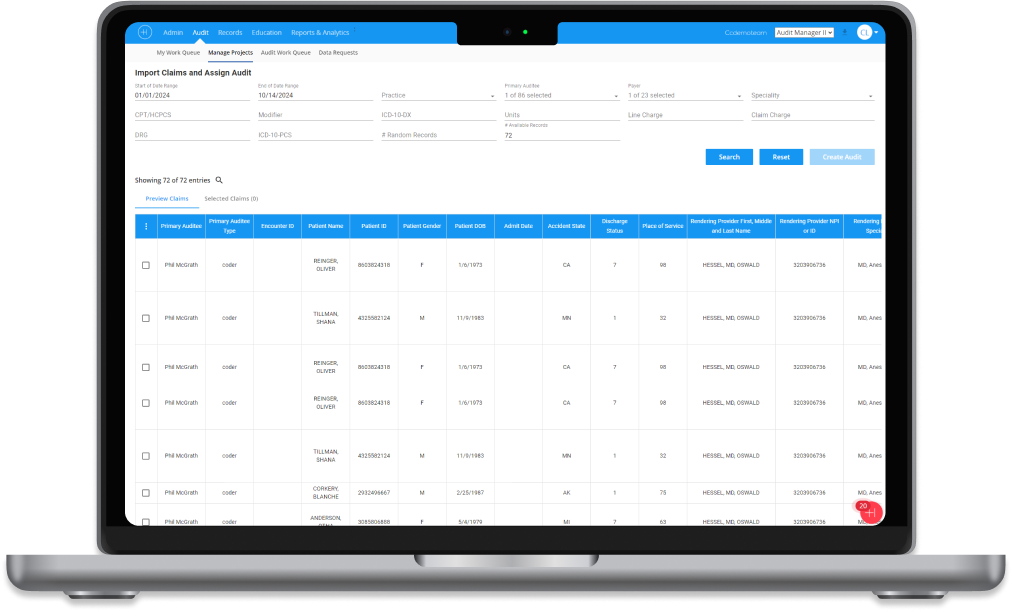
Healthicity's Audit Manager+ enables urology practices and compliance teams to conduct systematic coding and documentation audits, identify billing risk patterns, and track coder performance over time through customizable audit workflows. It's the right tool for compliance officers and revenue cycle managers who need ongoing post-payment and pre-bill audit infrastructure rather than one-time reviews. The tradeoff is that it functions as an auditing platform, not a coding assistant, so it complements but does not replace trained urology coders.
Related Reading
- Best Medical Coding Software
- Ai Medical Coding Companies
- Medical Coding Outsourcing Companies
- Medical Coding Optimization
How iScribe's E&M Coding Intelligence Closes the Documentation Gap Urology Practices Can't Train Away
That distance opens the moment a urologist moves from one room to the next. The reasoning that justified a higher-complexity level, the nuanced risk assessment, the differential the physician worked through aloud and then compressed into a phrase, none of it waits for documentation time. By the time the note is finalized, the clinical thinking has already been edited down to what memory and templates can reconstruct, and the revenue attached to that thinking goes with it. The gap is not a billing problem or a coding problem. It is a documentation problem that accumulates encounter by encounter, invisibly, until the pattern shows up as flat revenue numbers that more coder training never seems to fix.
Why the Finalized Note Is Already a Lossy Record
By the time a coder opens a chart, the encounter has already been compressed. The urologist weighed comorbidities, stratified risk, and worked through a differential, but the note captured the conclusion, not the reasoning. Across the market, this structural lag between clinical intent and coded claim is the root cause of persistent undercoding, not coder error.
A credentialed coder working from an incomplete note is doing skilled work on impoverished material. The gap is not effort. The gap is visibility.
That visibility problem compounds in high-volume practices where clinicians regularly chart two or more hours outside of patient care time. Each post-visit documentation session is a compression exercise: the physician reconstructs from memory what the ambient clinical conversation already contained. iScribe Health's Ambient Listening and Conversational AI captures that conversation in real time, so the encounter summary the AI drafts at the point of note completion reflects the full clinical narrative, the comorbidity weighting, the risk stratification, the differential, not only its conclusion.
The result is documentation quality that is standardized across the practice, not dependent on how much time a physician had between rooms.
How E&M Coding Intelligence Reads the Full Clinical Narrative
Most practices handle this by investing in periodic audits and CUC-credentialed staff, which addresses coder competency but leaves the upstream capture problem untouched. What most teams report is that documentation deficiencies contribute to E&M downcoding or denial in roughly one in three urology claims. AI-driven point-of-care documentation does more than speed up note-taking; it closes the structural lag between clinical intent and coded claim that drives those deficiencies.
iScribe Health's Automated E&M Coding works at exactly this upstream point. After the AI drafts the encounter summary, the E&M Coding Intelligence layer reads the full clinical narrative, not a template-compressed version of it, and surfaces the appropriate complexity level before the claim is submitted. Because the system integrates directly with the practice's supported EHR, that coded output flows into the existing workflow without a separate reconciliation step, and Real-Time Denial Alerts flag documentation gaps before they become remittance advice.
The downstream effect is twofold: coders receive materially richer notes to work from, and physicians spend less time on post-visit documentation, freeing capacity to see more patients without the cognitive cost of extended after-hours charting. Both outcomes are realized not as a one-time audit finding but across every patient encounter and every day of clinical practice.
Next steps
If your urology practice keeps seeing flat revenue numbers despite credentialed coders and regular training, the path forward starts with fixing documentation at the point of care, not downstream in the billing queue. Start with our AI medical scribe.
The CUC credential presupposes complete clinical documentation exists, but industry data shows only about 55% of E&M visits are accurately documented even in high-performing urology organizations, meaning credentialed coders are structurally working from incomplete inputs nearly half the time. Modifier -25 denials follow the same pattern: the coder's selection is often correct, and the denial exists because the physician's note never captured independent medical decision-making to support it. Together, these two realities point to the same corrective action, which is capturing clinical complexity during the encounter, before the documentation window closes.
Start with an AI medical scribe that listens to the encounter in real time, drafts the note before the physician leaves the room, and surfaces E&M coding intelligence and denial alerts at the moment of note completion, when the missing detail can still be added. The result is a materially richer note arriving at your billing queue on every encounter, every day of clinical practice.
Frequently Asked Questions
What actually changes with prostate biopsy coding in 2026, is it just a descriptor update?
It is a full structural replacement, not a descriptor revision. CPT 55700 is deleted entirely on January 1, 2026, and replaced by nine new codes (55707–55715) differentiated by biopsy technique (systematic, targeted, or combined) and imaging guidance method (ultrasound, MRI fusion, or none). Any claim submitted against 55700 after that date returns an automated rejection with no path to correction.
If I bill imaging guidance separately alongside the new 2026 prostate biopsy codes, will it get paid?
No, imaging guidance is now bundled into the new 55707–55715 codes, so billing it as a separate line item triggers an NCCI edit denial automatically. This is flagged in the post as a common reflex error among coders trained under the old 55700 structure, where separate imaging guidance billing was standard practice.
Why do Modifier -25 claims in urology get denied even when the coder applies it correctly?
The denial almost never originates with the coder, it traces back to the physician's note failing to document independent history, exam findings, and medical decision-making for the separate problem evaluated on the same day. The coder can select the right modifier, but if the clinical note doesn't contain the documentation to defend it, the claim is exposed regardless.
What are the three code sets a urologist's billing team needs to manage on every single encounter?
Every urology encounter draws from CPT codes for procedures and E&M visits, ICD-10-CM codes for diagnosis specificity, and HCPCS Level II codes for supplies and equipment. The post notes that a single cystoscopy with biopsy visit can require all three, plus a modifier, four separate coding decisions from one encounter, and missing any one of them means leaving reimbursement on the table.
How can ambient AI documentation actually reduce urology claim denials, isn't that a coder's job?
The post argues that most urology denials originate upstream of the coder, in documentation gaps created at the point of care. Ambient AI captures clinical specifics, such as biopsy technique, imaging guidance method, or string-dangle status for stent removal, during the encounter itself, so the note arriving at the billing queue already contains the detail coders need to assign the correct, defensible code. iScribe Health's ambient listening and conversational AI is designed to close exactly this gap, with real-time denial alerts flagging missing documentation before the note is finalized.