Orthopedic Medical Coding Cheat Sheet and Practical Guide 2026
Orthopedic medical coding gaps cost billing teams real revenue. See how automated E&M coding closes the visibility gap and cleans claims.


Orthopedic claims deny at rates up to 15%, and undercoding never triggers a single alert. Here is where the revenue disappears, and how to stop it.
Orthopedic medical coding sits at the intersection of clinical precision and financial performance, and most practice administrators underestimate how much that intersection costs them. Every encounter generates a claim. Every claim depends on documentation that was either captured completely or wasn't.
The gap between those two outcomes is where revenue disappears quietly, encounter by encounter, month after month. The common assumption is that trained coders catch errors before they become denials. The reality is harder to accept: coders can only code what the documentation supports.

See our AI medical scribe for how this works in practice.
High Denial Rates Driven by Documentation Gaps and Coding Complexity
Orthopedic and musculoskeletal claims carry denial rates in the 10 to 15 percent range, among the highest across medical specialties, a pattern documented consistently in orthopedic revenue cycle benchmarking. When a physician's note is incomplete at the point of care, no amount of coder expertise recovers the revenue that was never captured. Miss a required element in any of these coding systems and the claim stalls.
A single fracture diagnosis can branch into dozens of ICD-10-CM permutations based on bone, side, displacement, and whether the encounter is initial, subsequent, or sequela. CPT and HCPCS Level II code selection carries the same burden: orthopedic coding requires precise specificity around laterality, fracture type, and encounter stage at a level that most general medical coding simply does not demand.
54.8% Provider-AI coding agreement across 941 encounters
Undercoding Erodes Revenue Without Triggering Any Visible Alert
Undercoding compounds the damage silently. A practice billing 99213 for encounters that qualify as 99214 loses reimbursement on every affected claim, a gap that accumulates invisibly across an orthopedic schedule because:
- No denial letter surfaces it.
- No remittance remark code flags it.
- The encounter closes as if it paid correctly.
Key takeaways
- Orthopedic coding errors aren't mostly about undertrained coders, they're about documentation gaps that no one catches until a payer pulls the record.
- A real-world AI analysis of 941 encounters at a Center for Sports Medicine and Orthopaedics found a 33% overcoding rate and only 54.8% provider–AI agreement, inside a practice that considered its revenue cycle healthy.
- Every 99213 posted on a visit that warranted a 99214 is a silent loss, no denial letter, no remittance flag, just revenue that closes out and disappears.
- Modifier selection and ICD-10 specificity aren't lookup tasks; both require the encounter note to explicitly support the code before a payer will pay it.
- Unspecified diagnosis codes don't just slow reimbursement, they surface as a pattern in chart audits and trigger prior authorization denials that compound over time.
- iScribe Health's Automated E&M Coding analyzes clinical documentation in real time and generates E&M codes based on coding intelligence, closing the gap between what happened in the exam room and what actually gets billed.
Essential Orthopedic CPT Codes Reference - Joint Replacements, Arthroscopy, and Fracture Care
Think of your orthopedic CPT code list as a denial probability map, not a reference sheet. Every code cluster carries a distinct documentation requirement, and when that requirement is missing from the operative or clinical note, the claim fails regardless of how experienced your coder is. The gap is not effort. The gap is visibility into what the encounter actually captured, and, increasingly, the gap is the documentation process itself. Orthopedic practices demand strong CPT code fluency as a baseline operational requirement across administrative and clinical roles; when that fluency isn't matched by documentation that reliably surfaces the right detail at the point of care, revenue leaks at scale and providers spend hours charting instead of treating patients.
1. Joint Replacement CPT Codes (27130, 27447, 23472): Total Hip, Knee, and Shoulder Arthroplasty
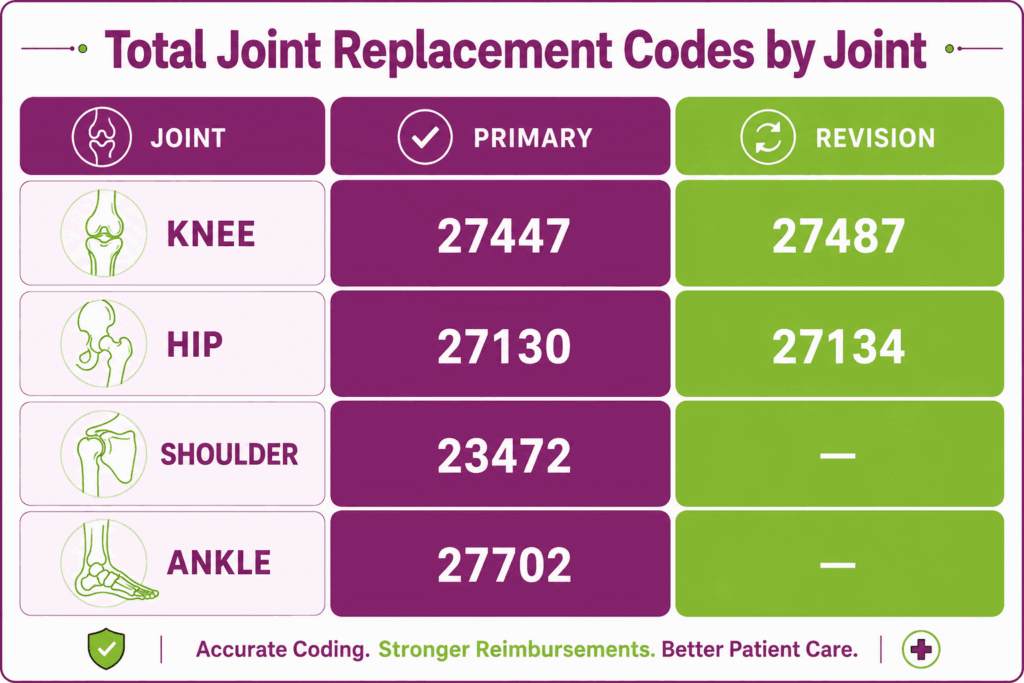
CPT 27447 (total knee arthroplasty) is one of the highest-reimbursement codes in orthopedic billing and one of the most scrutinized by Medicare. Denials on this code trace most often to three structural documentation failures: no documented history of failed conservative treatment, missing laterality in the ICD-10 pairing, and unbundling errors when associated procedures are billed alongside it. Industry analysis of total knee replacement billing denials consistently points to these same root causes, meaning they are predictable, pattern-driven failures, not random ones.
CPT 27447 is among the procedures published in Medicare's Procedure Price Lookup tool, making national payment benchmarks publicly accessible to payers, auditors, and Recovery Audit Contractors alike, which means charge master misalignment on this code carries visibility risk beyond the individual claim. This is precisely where iScribe Health's ambient AI documentation changes the calculus. Rather than relying on a physician to manually reconstruct encounter detail after the fact, iScribe's Ambient Listening and Conversational AI captures the clinical narrative in real time, and at the point of note completion, after the AI drafts the encounter summary, the system applies E&M Coding Intelligence to surface the documentation elements a high-value claim like CPT 27447 requires.
The result is improved coding precision that directly impacts revenue, and time returned to physicians who would otherwise spend two or more hours charting outside of patient care. CPT 27130 (total hip arthroplasty) and CPT 23472 (shoulder arthroplasty) carry the same prior authorization and medical necessity documentation burden. A charge master that hasn't been reconciled against the AMA's 2026 CPT updates compounds the risk, because an outdated code pairing can trigger a denial that no modifier will fix after the fact.
iScribe Health's Real-Time Denial Alerts flag these technical mismatches before submission, giving practices the upstream visibility to correct a claim rather than appeal it.
2. Knee Arthroscopy CPT Code 29881 - Meniscectomy Billing, NCCI Bundling Rules, and Denial Prevention
CPT 29881 (knee arthroscopy with meniscectomy, medial or lateral) is where compartment documentation determines whether the claim pays at all. The difference between 29881 (single compartment) and 29880 (both compartments) is one character in the operative note, but the reimbursement delta is meaningful under Medicare's national payment rates, making undercoding this distinction a recurring monthly revenue loss across a busy orthopedic practice.
The orthopedic practices we work with routinely face this exact failure mode: the clinical detail was present in the room, but it never made it into the note with enough specificity for a coder to act on it. iScribe Health's ambient documentation captures compartment-level procedural detail as the encounter unfolds, so that by the time the AI-drafted note reaches the coder, the distinction between single- and dual-compartment treatment is already explicit. That improvement in coding consistency across providers directly reduces the pattern of undercoding that compounds into significant monthly revenue loss.
NCCI bundling rules are the second risk layer: CPT 29881 bundled incorrectly with diagnostic arthroscopy codes (29870 series) generates denials that take weeks to appeal. The documentation failures driving these denials are upstream problems, and iScribe's EHR Integration ensures that the structured encounter data captured by the ambient AI flows directly into the practice's existing workflow without a separate documentation step, removing the transcription gaps where bundling errors are born.
3. Fracture Care CPT Coding - Closed vs. Open Treatment, Global Period Rules, and Manipulation Modifiers
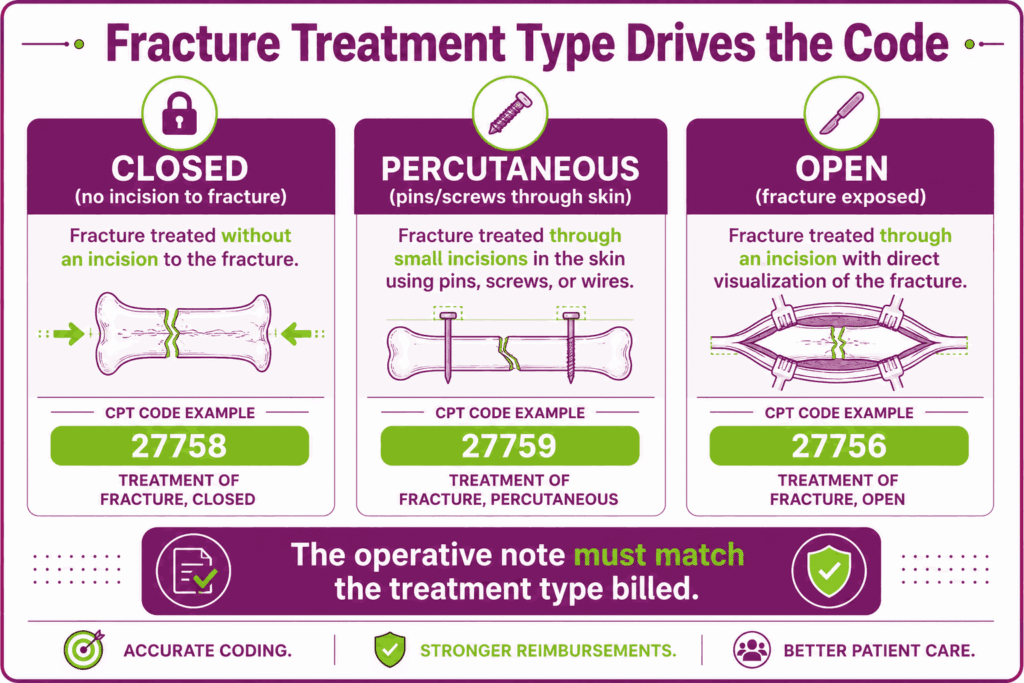
Fracture care coding requires the operative or clinical note to specify five elements: bone, anatomical location, fracture type (open or closed), displacement status, and laterality. The 4 A's framework used in fracture documentation (Alignment, Apposition, Apparatus, and Activity) gives practices a structured checklist for ensuring those elements are present before a claim is submitted. In high-volume orthopedic settings, the operational reality is that physicians charting two or more hours outside of patient care time are the ones most likely to produce abbreviated fracture notes, the ones that omit displacement status or laterality because the physician is documenting from memory at the end of a long day rather than from a real-time capture of what was actually said and observed.
iScribe Health is most impactful precisely in these high-volume environments, where ambient documentation is active across every patient encounter and the burden of fracture note completeness shifts from physician recall to real-time AI capture. The 90-day global period attached to most fracture care codes is where underpayment compounds quietly. Recurring denial analysis in orthopedic billing identifies global period mismanagement as a leading source of both compliance exposure and lost revenue, particularly when follow-up visits are billed without Modifier 24 during the post-operative window.
iScribe Health's Real-Time Denial Alerts surface these global period conflicts at the claim level before submission, giving coders the signal they need to apply the correct modifier rather than discover the error on an EOB weeks later. The AMA's 2026 CPT update cycle introduced new and revised musculoskeletal codes affecting fracture care and joint procedures; practices that have not reconciled their charge masters against these updates risk submitting claims on retired or restructured codes that payers will deny on technical grounds before clinical review ever occurs. iScribe Health's Automated E&M Coding and coding intelligence layer are designed to improve coding precision in exactly this environment, keeping the codes that surface from documentation aligned with current payer expectations, and reducing the time physicians spend on documentation so more of their day can be spent on patient care.
Modifier Usage in Orthopedic Billing - The Four Modifiers That Make or Break Your Claims
Modifier selection breaks down the moment a coder treats it as a lookup rather than a decision. The right modifier depends on three things at once: where the patient sits in the global surgical period, what the payer's bundling edits actually allow, and whether the encounter note explicitly supports a distinct or separately identifiable service. Get any one of those wrong, and a correctly selected CPT code still produces a denial.
Incorrect or missing modifiers are consistently cited as a top billing error in orthopedic practices, directly causing denied or reduced payments on claims, and in high-volume practices, where clinicians are already charting two or more hours outside of patient care time, the documentation gaps that trigger those denials compound daily across every encounter. iScribe Health's Ambient Listening and E&M Coding Intelligence are designed to close that gap at the source: accurate, compliant documentation generated at the point of note completion, before a claim ever reaches the clearinghouse.
1. Modifier 59 - Distinguishing Distinct Procedural Services in Orthopedic Billing
In orthopedic medical coding, Modifier 59 is the workhorse modifier used to bypass bundling edits when two procedures are genuinely distinct, different anatomical sites, separate incisions, or non-overlapping sessions. It's essential for billing multiple joint injections or concurrent soft-tissue and bone procedures. The critical tradeoff: overuse invites audits, and CMS now prefers the more specific X{EPSU} subset modifiers when applicable.
ICD-10 Diagnosis Coding for Orthopedics - Specificity Requirements That Directly Affect Reimbursement
Orthopedic diagnosis coding carries a specificity burden that most other specialties don't face at the same scale, where laterality, fracture detail, and joint-specific documentation aren't optional refinements but the difference between a supported code and one that quietly undermines authorization, audit defense, and reimbursement. The failure point is rarely the coder. It's the upstream documentation gaps that make the right code unsupportable before the claim is ever built.

Diagnosis Coding in Orthopedics - Where Revenue Integrity Is Built or Quietly Dismantled
Diagnosis coding in orthopedics is where revenue integrity either gets built or quietly dismantled, and most practices don't realize the damage until a prior authorization gets denied or a chart audit surfaces a pattern of unspecified codes. The assumption that a "close enough" ICD-10 code will process cleanly is one of the most expensive beliefs in orthopedic billing, because the cost isn't always a rejection. Sometimes it's a suppressed E/M level, a failed joint replacement auth, or a workers' comp claim that collapses under scrutiny months after the encounter.
Because ICD-10-CM coders cannot infer or assume clinical details absent from documentation, and because procedure-specific elements like laterality, implant detail, and fracture care notation are routinely missed in retrospective notes, coder knowledge level becomes irrelevant when the raw documentation input is systematically incomplete. Training coders to recognize the right codes does not resolve the upstream capture failure that makes those codes unsupportable. One of the most persistent upstream failures orthopedic practices face is the laterality gap.
ICD-10 does include unspecified laterality codes for orthopedic diagnoses, but right vs. left limb and joint injuries have distinct code paths, and yet clinicians frequently dictate "knee" without specifying side, leaving coders caught between an unspecified code they know is inadequate and a specific code the documentation won't support. This isn't a coder problem.
It is a documentation capture problem that resolves only at the point of the clinical encounter. iScribe Health's Ambient Listening / Conversational AI captures spoken clinical detail, including laterality, in real time, so that when the AI drafts the encounter summary, the side is already in the note. The coder never has to choose between specificity and supportability.
ICD-10 Specificity Is a Reimbursement Lever, Not Just a Compliance Requirement
"Payers are automating claim denials by matching ICD-10 diagnosis codes to procedure codes without any clinical review, effectively bypassing physician judgment and resulting in 100% denial rates on appeals."
The core problem here is structural, not educational: orthopedic coding errors are not primarily generated at the coding desk, they are locked in during the clinical encounter itself.
When a diagnosis code omits laterality, fracture displacement status, or encounter type, it doesn't just invite a rejection. It actively weakens the medical necessity justification for higher-value procedures and lowers the defensible E/M level. ICD-10-CM guidelines require that codes be assigned to the highest level of specificity the documentation supports.
Unspecified codes are only appropriate when the clinical record genuinely lacks detail. Using them when detail exists is a documentation failure, not a coding choice. The reimbursement stakes attached to that failure are rising sharply.
Payers are now automating claim denials by matching ICD-10 diagnosis codes to procedure codes algorithmically, without any clinical review, effectively bypassing physician judgment and producing near-total denial rates on certain claim types, with appeals faring no better when the underlying documentation specificity was never there to begin with. When a denial is triggered by an automated code-to-code mismatch, no amount of clinical argument in the appeal overrides the missing seventh character or the absent laterality designator. The documentation had to be right the first time.
iScribe Health's Real-Time Denial Alerts surface these mismatches at the point of note completion, after the AI drafts the encounter summary and before the claim is built, so the practice can correct documentation at the source rather than fight it in the appeals queue.
The Four Axes Every Orthopedic ICD-10 Code Must Satisfy
Every orthopedic ICD-10 code should satisfy four specificity axes before it reaches a claim: laterality, fracture displacement type, anatomical site precision, and encounter stage. Missing any one of them creates a code that payers can reject on technical grounds alone, without ever reviewing the clinical record. The coder cannot infer laterality.
The documentation has to say it. iScribe Health's E&M Coding Intelligence and Automated E&M Coding are built precisely around this reality. Rather than asking a coder to reconstruct specificity from an incomplete note, iScribe Health works at the point where specificity is either captured or lost, the clinical encounter itself, ensuring that the AI-drafted note contains the axis-level detail that downstream coding requires.
For practices already running a supported EHR, EHR Integration means this enriched documentation flows directly into the existing workflow without a parallel charting burden.
How Undercoded Diagnoses Suppress E/M Level Justification
The connection between ICD-10 specificity and E/M reimbursement is direct and underappreciated. When the diagnosis code is unspecified, a generic knee pain code rather than a lateralized, encounter-staged, site-specific code, the medical necessity justification for a 99214 or a higher-value procedure authorization weakens at the payer level. Coders cannot compensate for a vague diagnosis by selecting a more specific procedure code; the diagnosis anchors the entire claim's clinical story, and an unspecified anchor invites downcoding, prior auth rejection, and audit exposure that a more precisely documented encounter would not face.
This is where iScribe Health's commitment to ensuring reimbursement integrity and simplifying reimbursement and payment workflows becomes operationally concrete. In high-volume orthopedic practices, where clinicians regularly spend two or more hours charting outside of patient care time, the ambient documentation model replaces retrospective, detail-starved dictation with real-time AI capture. The result is not only physician burnout reduction from eliminated after-hours charting; it is a structurally richer note that satisfies all four coding axes before it ever reaches the billing team.
Reimbursement integrity, in other words, is not enforced downstream, it is built into the encounter itself. That structural shift is what separates a practice that consistently codes to the highest supportable specificity level from one that discovers its coding pattern only when a chart audit surfaces it.
ICD-10 Specificity Checklist, Four Axes Every Orthopedic Code Must Satisfy Before Submission
Accurate ICD-10 coding depends on documenting the clinical details that distinguish specific codes from generic or incomplete ones:
- Laterality → Explicitly document right, left, or bilateral → Failure: Note says “knee” without specifying the side.
- Fracture displacement → Specify displaced or nondisplaced → Failure: A generic fracture code is used.
- Anatomical site precision → Document the bone and specific sub-region, such as the medial femoral condyle → Failure: An unspecified site code is assigned.
- Encounter stage → Specify initial (A), subsequent (D), or sequela (S) → Failure: Stage is omitted, potentially resulting in claim rejection or coding issues.
If any axis is missing from the clinical note, the coder cannot assign the correct code; documentation must be corrected at the source before submission. iScribe Health's ambient AI captures each axis in the room, in the physician's own words, at the only moment in the revenue cycle when correction costs nothing.
Evaluation and Management Coding for Orthopedics - Recovering the Revenue Hiding in Your 99213s
The common assumption among practice administrators and billing decision-makers is that if the coding team just gets better trained or the templates get tightened, the problem will self-correct. But every dollar lost to E/M undercoding is invisible on the day it happens. There is no denial letter, no remittance remark code, no audit flag.
The encounter closes, the 99213 posts, and the practice moves on, never knowing the visit supported a 99214. Multiply that across a full orthopedic schedule and the monthly loss is not a rounding error. It is a structural revenue problem hiding inside documentation habits, and it is one that iScribe Health's ambient AI documentation and E&M coding intelligence are built specifically to surface and correct at the point of note completion, before the encounter ever posts.

How the 2021 AMA E/M Framework Changed What Complexity Means for Orthopedic Visits
The 2021 AMA E/M office visit coding revisions removed history and physical exam element counting as the basis for code selection. Under the revised framework, Medical Decision Making (MDM) alone determines whether a visit is a 99213 or a 99214. That shift matters enormously for orthopedics, because a visit involving prescription drug management, imaging review, or an undiagnosed problem with uncertain prognosis now qualifies for moderate-complexity MDM regardless of how brief the physical exam documentation is.
The AMA's MDM table explicitly lists prescription drug management and ordering or reviewing diagnostic results as moderate-complexity data elements. Most orthopedic encounters hit those thresholds routinely, yet coding consistency across those encounters remains one of the most persistent revenue cycle failures in the specialty. iScribe Health's automated E&M coding intelligence integrates directly with your existing EHR and applies the MDM framework to every completed note.
Because iScribe operates through ambient listening and conversational AI, capturing the encounter as it happens, the AI draft already contains the clinical detail that coders need to assign the correct level. Practices and health systems already running a supported EHR get this as a seamless ambient documentation experience layered on top of workflows they are already using.
Why Orthopedic Encounters Routinely Qualify for 99214 and Get Billed as 99213 Anyway
The clinical complexity is present. The documentation is not. A post-op visit where the provider adjusts two medications, reviews new imaging, and addresses an emerging complication is a 99214 on its clinical merits.
If the note reads "patient doing well, follow up in 4 weeks," the coder has no legitimate basis to assign anything above a 99213. CMS physician utilization data, which is publicly available at the provider level, consistently shows orthopedic E/M code distributions weighted toward lower-complexity visits at rates that industry revenue cycle analysts have characterized as inconsistent with the documented complexity of orthopedic patient panels, a pattern that points to documentation gaps rather than a genuinely simpler patient mix. The gap is not effort.
The gap is visibility into what the encounter actually contained. This is precisely where iScribe Health's E&M coding intelligence improves coding consistency at scale. At the point of note completion, after the AI drafts the encounter summary, the system flags the MDM elements the note supports, surfacing the defensible code before the encounter closes.
For high-volume practices where clinicians regularly chart two or more hours outside of patient care time, this also directly reduces physician burnout: providers dictate or converse naturally during the visit, and iScribe translates that into a structured note that reflects the full clinical picture. The benefit is ongoing, realized across every patient encounter and every day of clinical practice.
MDM Documentation - The Three Elements That Determine Whether Your Note Supports the Code You Need
The AMA MDM table evaluates three columns: the number and complexity of problems addressed, the amount and complexity of data reviewed, and the risk of complications or morbidity. For moderate complexity (99214), a provider must meet or exceed the threshold in at least two of the three columns. In orthopedics, a patient presenting with a chronic musculoskeletal condition requiring prescription management and a new imaging order clears two columns without unusual effort.
The failure is not clinical; it is documentary. iScribe Health's ambient AI captures the prescription management discussion, the imaging order rationale, and the complexity of the problem being addressed, all in the natural flow of the encounter, and surfaces those elements in the structured note. When those elements are documented, the MDM level is visible and defensible.
When the AI-drafted note does not yet reflect sufficient MDM detail, real-time denial alerts flag the gap before the claim is submitted, giving the practice a chance to correct the record rather than chase a denial after the fact. EHR integration means none of this requires a parallel workflow: the AI customization adapts to your templates and documentation patterns, so the improvement in coding consistency compounds across the entire schedule rather than depending on individual coder vigilance visit by visit.
Related Reading
- Orthopedic Coding Guidelines
- Medical Coding Automation
- E&m Coding Cheat Sheet
- Urology Coding Guidelines
Common Orthopedic Coding Mistakes and Errors - Including the 33% Overcoding Rate No One Saw Coming
The common assumption among practice administrators and billing decision-makers is that if the coding team just gets better trained or the templates get tightened, the problem will self-correct. That assumption is so widely held in orthopedic practice management that it shapes hiring decisions, audit schedules, and compliance budgets. One recent review found only 54.8% agreement between provider-assigned codes and AI-validated codes, in a practice with credentialed staff already in place.
The errors were not a knowledge problem. They were invisible, accumulating encounter by encounter, until a systematic review finally created visibility. That striking overcoding rate did not show up in denial reports, because overcoded claims that payers initially accept look like revenue, not errors, until a Recovery Audit Contractor pulls the records.
One of the most persistent, and misread, dynamics in orthopedic billing is that payers systematically reimburse at lower code levels than what was billed, paying for a level 3 when a level 4 was appropriately documented, for example. Billing teams routinely interpret that gap as payer underpayment, when the root cause is often documentation that cannot support the higher code at audit. That misreading allows the exposure to compound silently.
Industry data on hospital denial rates and trends confirms that coding-related denials remain among the most persistent and costly failure modes in revenue cycle management. The financial exposure is real: False Claims Act enforcement actions tied to orthopedic upcoding have resulted in multi-million-dollar repayment settlements, with the Department of Justice consistently treating systematic overcoding as a compliance failure rather than an honest mistake. The structural cause is documentation drift.
When a surgeon documents a procedure from memory at the end of a clinic day, the note often reflects the category of work performed rather than the specific complexity level that a higher CPT code requires. Coders then assign the code the documentation suggests, not the code the actual procedure supports, and no one reviews every encounter before submission to catch the gap. This is precisely where iScribe Health's Ambient AI Documentation and E&M Coding Intelligence address the problem at the source.
Rather than waiting for a quarterly audit to surface drift, iScribe Health's ambient listening captures the encounter in real time. At the point of note completion, after the AI drafts the encounter summary, its Automated E&M Coding applies consistent, evidence-based code assignment before the claim is ever touched by a human coder. The result is improved coding consistency across every encounter, not just the ones flagged after a denial. For high-volume orthopedic practices where clinicians regularly chart two or more hours outside of patient care time, this also directly reduces the after-hours documentation burden that produces the rushed, memory-driven notes where overcoding risk concentrates.
1. Upcoding Surgical Procedures - The 33% Overcoding Rate Hiding in Plain Sight
In orthopedic medical coding, upcoding, billing a higher-complexity CPT than the documented procedure supports, accounts for a disproportionate share of audit findings. Internal reviews have flagged overcoding rates approaching 33% in some orthopedic practices, often tied to arthroscopic versus open procedure misclassification. The tradeoff: short-term revenue gains trigger payer audits, repayment demands, and potential False Claims Act exposure that far outweigh any billing upside.
2. Global Period Modifier Misuse - Billing Separately for Included Post-Op Services
The 90-day global surgical period bundles all routine post-operative care into the original procedure payment. Billing a separate E/M visit during that window without the correct modifier is one of the most consistent denial triggers in orthopedic billing. Modifier -24 (unrelated E/M during the global period) and Modifier -79 (unrelated procedure) are the correct tools, but they require documentation that explicitly establishes the visit as unrelated to the original surgery.
When that documentation is absent or vague, coders either skip the separate bill entirely, losing legitimate revenue, or submit without the modifier, generating a denial or, worse, a quiet overpayment that surfaces in an audit. iScribe Health's Real-Time Denial Alerts surface these modifier gaps before submission rather than after adjudication. When the AI-drafted note lacks the specificity needed to support a -24 or -79 modifier, the system flags it at note completion, the moment when a physician can still add the clinical detail that protects both the claim and the documentation record.
That upstream intervention is far less costly than working a denial or defending a post-payment audit finding. Orthopedic billing specialists identify global period modifier errors as a leading source of both avoidable denials and compliance exposure, precisely because the documentation requirement is clear but rarely enforced at the point of care without a systematic prompt.
3. NCCI Bundling Violations - Unbundling Component Codes That Payers Auto-Deny
The National Correct Coding Initiative (NCCI) establishes pairs of CPT codes that Medicare and most commercial payers will not reimburse separately when performed together in the same session. In orthopedics, the most common violation is unbundling arthroscopic component codes, billing a diagnostic arthroscopy alongside a therapeutic arthroscopy when the diagnostic scope is considered integral to the therapeutic procedure. Payers auto-deny these combinations at adjudication without clinical review, and appeals require operative note evidence that the procedures were genuinely distinct and separately reimbursable.
The denial rate burden associated with coding errors of this type continues to climb, making upstream prevention materially more valuable than downstream appeals work. The fix is upstream: coders and surgeons must know which code pairs are on the NCCI edit list before the operative note is finalized, not after the denial arrives. iScribe Health's E&M Coding Intelligence and EHR Integration bring that check into the documentation workflow itself, operating inside the supported EHR environment the practice is already using, so there is no separate tool to open and no additional step to remember.
When the AI drafts the encounter summary and applies Automated E&M Coding, NCCI edit awareness is part of the coding logic, not a separate audit that happens days later. Practices running a supported EHR get a seamless ambient documentation experience where the compliance check and the clinical note are completed in the same workflow, at the same moment, closing the window in which bundling violations accumulate invisibly.
4. ICD-10 Laterality and Specificity Errors - Unspecified Codes That Invite Automatic Downcoding
ICD-10 demands laterality, encounter type, and anatomical specificity that orthopedic coders frequently skip, defaulting to unspecified codes like M79.3 instead of site- and side-specific equivalents. Payers use these vague codes to justify downcoding or outright denial, and auditors treat them as documentation failures. The limitation for busy orthopedic practices is that specificity requires the physician's note to explicitly state side and structure, a documentation gap that coding alone cannot fix retroactively.
5. Multiple Procedure Reduction Rule Blindspots - Ignoring the Automatic 50% Fee Schedule Cut
When orthopedic surgeons perform multiple procedures in a single session, Medicare and most commercial payers automatically apply the multiple procedure reduction rule, reimbursing the secondary procedure at 50% of the fee schedule. Many orthopedic medical coding teams bill without accounting for this reduction, creating accounts receivable projections that never reconcile. The tradeoff is that practices can appeal reductions with medical necessity documentation, but few have a systematic process to identify which claims qualify for that appeal.
Documentation Requirements for Orthopedic Coding - How AI Scribing Closes the Gap Between the Encounter and the Claim
Orthopedic practices underpay themselves systematically, and the mechanism is structural rather than accidental, a finding consistent with CMS utilization data showing orthopedic practices bill 99213 at rates disproportionate to their patient complexity distribution, and confirmed in the iScribe Health 941-encounter trial where coding discrepancies went undetected until systematic AI review created visibility. The same documentation habits that produce visibility gaps at the coding stage are baked into how orthopedic encounters are recorded in the first place, not through negligence, but through workflows built around speed, templates optimized for throughput, and a clinical culture that treats the note as a communication tool rather than a financial instrument. The result is a predictable, repeatable pattern of undercoding that persists across providers, practice sizes, and EHR platforms, not because anyone is coding incorrectly, but because the documentation entering the coding workflow was never structured to support the specificity that accurate orthopedic billing demands.
Because the 2021 AMA revision anchored 99214/99215 selection entirely to Medical Decision Making complexity, the revenue gap between a correctly coded 99214 and an undercoded 99213 is determined at the moment of note completion, meaning when surgeons reconstruct MDM elements from memory during after-hours charting, the $16,000–$20,000 monthly revenue loss at 20 visits/day is a documentation workflow failure before a coder ever sees the chart. Small orthopedic practices experience this breakdown at scale. Physicians spend approximately two hours per day on clinical documentation outside of patient care hours, a burden significant enough that practices describe seeing "the good, the bad, and the ugly" across their documentation workflows.

That volume of after-hours charting means MDM elements are being reconstructed from memory at exactly the moment the 2021 AMA revision demands the greatest clinical specificity. The note a surgeon completes at 10pm is not the same note completed at 2pm in the room. That gap, between what happened in the encounter and what gets captured hours later from memory, is where orthopedic coding accuracy actually breaks down.
No coder, no matter how credentialed, can recover clinical specificity that was never written down. iScribe Health's Ambient AI Documentation addresses this at the source. By capturing clinical notes during the patient encounter itself, through ambient listening and conversational AI that requires no manual input, iScribe Health's AI scribing delivers the greatest value precisely when physicians want a completely hands-free documentation experience during the visit.
The AI drafts the encounter summary at the point of note completion, before after-hours memory compression has the opportunity to strip out the MDM specificity 99214 and 99215 selection requires. For high-volume practices where clinicians regularly chart two or more hours outside of patient care time, the impact is realized across every patient encounter and every day of clinical practice.
The Five Documentation Elements Orthopedic Claims Cannot Survive Without
Laterality, MDM complexity, implant detail, fracture care notation, and post-operative visit context are the five elements that determine whether a claim pays, downcodes, or denies. Payer audits consistently flag missing laterality as a top orthopedic denial trigger, and CMS documentation standards require that operative notes capture surgical technique, device specifics, and anatomical site at the highest available level of specificity. When any of these elements are absent, the coder's hands are tied before they touch the chart.
iScribe Health's E&M Coding Intelligence is designed to standardize clinical documentation quality across the practice, so that laterality, fracture care context, and post-operative visit framing are captured consistently, not variably depending on which provider is charting and how much time they have left at the end of the day. Real-Time Denial Alerts surface documentation gaps before a claim leaves the practice, giving clinicians and coders the opportunity to correct specificity failures at the point where correction is still possible.
After-Hours Charting and MDM Suppression
The 2021 AMA E/M revision anchored 99214 and 99215 selection entirely to Medical Decision Making complexity, specifically requiring documented evidence of problems addressed, data reviewed, and risk of complications. That means the revenue decision between a 99213 and a 99214 is made at the moment of note completion, not at coding. Physicians who spend approximately two hours per day on clinical documentation outside of patient care hours are reconstructing MDM elements from memory.
The specificity that justifies higher-acuity codes gets compressed. Across a full orthopedic schedule, that compression compounds into a significant, recurring monthly revenue loss, a documentation workflow failure, not a coder failure. iScribe Health's Automated E&M Coding operates at the point of note completion, after the AI drafts the encounter summary, applying E&M coding intelligence to the note while the clinical detail is still intact rather than waiting for a coder to interpret a memory-compressed record hours or days later.
Procedure-Specific Documentation Before the Coder Arrives
Operative notes must capture surgical approach, technique, implant manufacturer and lot number, anatomical landmarks, and any intraoperative findings before a coder opens the chart. According to orthopedic denial prevention analysis, these elements are routinely missed when notes are completed retrospectively, after the procedure, from memory, without reference to intraoperative records, because the surgeon's mental model of the case is accurate but the written output omits the granular specificity that CPT code assignment and payer audits require. Orthopedic surgery billing analysis reinforces that implant detail and anatomical specificity are among the most common sources of claim denials and audit exposure in surgical practices.
iScribe Health's ambient documentation captures clinical notes during or after patient encounters, giving surgeons a mechanism to record intraoperative detail at the moment it exists, rather than reconstructing it later. The AI Customization layer means the system can be tuned to the documentation patterns orthopedic and surgical encounters specifically require, so that the output arriving at the coding stage already contains the procedure-specific specificity that CPT assignment demands. The result is not a coder working harder on a thin note, it is a note that was never thin to begin with.
Related Reading
- Best Medical Coding Software
- Urology Medical Coding
- Ai Medical Coding Companies
- Medical Coding Outsourcing Companies
- Medical Coding Optimization
Next steps
If your orthopedic practice is losing revenue without a single denial letter to show for it, the path forward starts with fixing documentation at the point of care, not at the coding desk. Start with our AI medical scribe.
After-hours charting suppresses the MDM specificity that 99214 and 99215 selection requires, turning what should be moderate-complexity visits into undercoded 99213s before a coder ever opens the chart. These two failures operate simultaneously and invisibly: undercoding leaves reimbursement on the table with no denial to flag it, while overcoding builds audit liability that looks like revenue until a Recovery Audit Contractor pulls the records.
Neither shows up in a standard denial rate report, and neither resolves through coder training alone. Together, they point to a single corrective action: capturing clinical detail in real time, at the encounter, before memory compression strips out the specificity that defensible coding requires.
Start with an AI medical scribe built for clinical-grade documentation. Ambient listening captures laterality, MDM complexity, and procedure-specific detail as the encounter happens, and E&M coding intelligence applies consistent code validation at the point of note completion, before the claim is built and before the payer ever sees it.
Frequently Asked Questions
Why is orthopedic coding so much more complex than general medical coding?
Orthopedic coding demands a level of clinical specificity, laterality, fracture type, displacement status, and encounter stage, that most general medical coding simply does not require. A single fracture diagnosis, for example, can branch into dozens of ICD-10-CM permutations depending on bone, side, displacement, and whether the encounter is initial, subsequent, or sequela. That specificity must be captured in the clinical documentation at the point of care, because coders cannot infer or assume details that are absent from the note.
What documentation do I actually need to support billing a total knee or hip replacement?
For CPT 27447 (total knee arthroplasty), denials most often trace to three specific documentation failures: no documented history of failed conservative treatment, missing laterality in the ICD-10 pairing, and unbundling errors when associated procedures are billed alongside it. CPT 27130 (total hip arthroplasty) and CPT 23472 (shoulder arthroplasty) carry the same prior authorization and medical necessity documentation burden, and an outdated charge master that hasn't been reconciled against current CPT updates compounds the risk further.
What's the difference between CPT 29880 and 29881 for knee arthroscopy, and why does it matter for reimbursement?
CPT 29881 covers knee arthroscopy with meniscectomy in a single compartment, while CPT 29880 covers both compartments, and the reimbursement delta between them is meaningful under Medicare's national payment rates. The distinction comes down to one detail in the operative note, and if the compartment-level procedural detail isn't explicitly documented, a coder has no basis to bill the higher-value code, turning an underdocumented encounter into a recurring monthly revenue loss.
What are the five documentation elements required for fracture care coding?
The operative or clinical note must specify the bone, anatomical location, fracture type (open or closed), displacement status, and laterality. The post references the 4 A's framework, Alignment, Apposition, Apparatus, and Activity, as a structured checklist practices can use to confirm those elements are present before a claim is submitted.
When do I use Modifier -25, and what does the encounter note need to actually say?
Modifier -25 must be appended to an E/M service performed on the same day as a procedure, such as a corticosteroid joint injection billed under CPT 20610, to demonstrate the visit was a significant, separately identifiable evaluation beyond the procedure's pre- and post-operative care. The encounter note must document its own independent medical decision-making, not simply reference the injection; a brief procedure note with no distinct E/M documentation gives the coder nothing to support the modifier, and the E/M will be automatically bundled and denied.