Orthopedic Coding Guidelines Cheat Sheet 2026
Orthopedic coding guidelines for 2026 give billing teams visibility into the documentation gaps driving your practice's denials and lost reimbursement.


Knowing the right orthopedic CPT code is not the hard part. The claims that survive audit are built in the clinical note, not at the coding desk.
Orthopedic coding is one of the most technically demanding billing environments in outpatient medicine, and the common assumption is that if coders just had a more complete, up-to-date reference guide covering every CPT code, modifier, and ICD-10 change, coding accuracy and revenue integrity would follow. In reality, the gap between knowing the right code and successfully defending it on audit is wider than most practice administrators realize. The practices that consistently hold denial rates down are not the ones with the most detailed reference binders. See our AI medical scribe for how this works in practice.
They are the ones where clinical documentation captures the facts each code depends on, at the time of the encounter, before the claim is ever touched. Tools like AI-powered clinical documentation are increasingly how high-performing orthopedic practices close that gap at the source. In one orthopedic audit of 941 encounters, AI-assisted encounter review surfaced a substantial overcoding rate alongside documentation accuracy well below expectations, neither figure visible under the practice's prior manual review workflow.

A single knee arthroscopy encounter may require a CPT surgical code, a laterality modifier, an ICD-10-CM code with side and anatomical specificity, an NCCI bundling check, and a global period flag. CPT governs procedure description; ICD-10-CM governs diagnosis specificity; HCPCS governs supply and device reporting; NCCI governs what can be billed together at all. An error in any one layer can invalidate an otherwise correct decision in the others.
Orthopedic surgery carries claim denial rates of 10 to 15 percent, roughly double the broader outpatient average, and documentation deficiencies are the primary driver, not coder unfamiliarity with the codes themselves. Laterality is not optional; right, left, or bilateral must appear in both the ICD-10-CM selection and the clinical note. Surgical approach, specific bone, fracture displacement status, and encounter type each push the code to a different tier. A note that documents "knee pain, arthroscopy performed" is not a defensible clinical record. The failure point is that post-encounter documentation is too incomplete, too ambiguous, or too delayed to make the correct code defensible.
941 Encounters where AI surfaced hidden overcoding
Key takeaways
- Orthopedic coding is one of the most denial-vulnerable billing environments in outpatient medicine, not because coders don't know the rules, but because the clinical documentation handed to them often can't defend the code that was selected.
- A one-week AI audit of 941 orthopedic encounters found a 33% overcoding rate that no one inside the practice had detected, the problem was invisible until the data ran.
- A coder can correctly identify CPT 27447 for a total knee replacement and still generate a denial-vulnerable claim if the operative note doesn't support it. The code isn't the failure point; the documentation is.
- Laterality denials don't start in the billing queue. When a note reads 'knee pain' instead of 'right knee pain,' no modifier rule or updated cheat sheet fixes that, the specificity was never captured at the point of care.
- Every modifier appended to an orthopedic claim is a sworn statement to the payer. Auditors don't check whether you picked the right modifier; they check whether the note proves the fact the modifier promised.
- Global surgical period compliance and E/M level selection share one failure point: the clinical note either captures the facts that make the billing defensible, or it doesn't.
- iScribe Health's E&M Coding Intelligence closes the gap by generating coding recommendations from the complete clinical narrative, not just the finalized note, so documentation fidelity and code selection are aligned before the claim is ever submitted.
Orthopedic CPT Codes Reference - High-Volume Procedures, Correct Use, and 2026 Updates
Selecting the right orthopedic CPT code is the straightforward part. The denials that follow often trace back not to the code itself but to the operative note that was supposed to support it, and in high-volume orthopedic practices, incomplete documentation is less a knowledge gap than a workload problem built into how surgeons chart. This section covers correct code use and 2026 updates, but it also addresses the upstream documentation failures that make accurate coding insufficient on its own.
CPT Code Documentation Checklist - High-Volume Orthopedic Procedures
Use this checklist before submitting any claim for the codes below. Each row states the minimum documentation the operative or clinical note must contain for the claim to be audit-defensible. In practices where clinicians are charting 2+ hours outside patient care time, this checklist functions as a last-mile quality gate, and iScribe Health's Real-Time Denial Alerts are designed to automate it at the point of note completion.
For orthopedic procedures, coding accuracy depends on documenting the specific anatomical, procedural, and encounter details that support the CPT code:
- Total Knee Arthroplasty → CPT: [the same figure] → Document compartments replaced, implant system, surgical approach, and failed conservative treatment.
- Total Hip Arthroplasty → CPT: 27130 → Document surgical approach, acetabular and femoral components, and bearing surface.
- Knee Arthroscopy with Meniscectomy → CPT: 29881 → Document diagnostic vs. surgical intent, compartment treated, and whether the medial or lateral meniscus was treated.
- Shoulder Arthroscopy with Rotator Cuff Repair → CPT: 29827 → Document partial vs. full-thickness tear, tendons involved, and repair technique.
- Shoulder Arthroscopy with Debridement → CPT: 29822/29823 → Document the extent of debridement and distinguish the service from any concurrent repair.
- ORIF Femoral Shaft Fracture → CPT: 27245 → Document open vs. closed treatment, displaced vs. nondisplaced fracture, implant used, and the 7th-character encounter type (A/D/S).
- Arthrocentesis, Major Joint → CPT: 20610 → Document the joint, laterality, and whether image guidance was used, which affects add-on-code eligibility.
Before submission, confirm: (1) laterality appears in both the ICD-10-CM code AND the clinical note, (2) the modifier appended matches a documented clinical fact, and (3) the encounter type 7th character reflects active treatment vs. follow-up. These three checks are where audit exposure concentrates, and where documentation failures that began in a rushed operative note become claim denials that no coder can reverse after the fact.
1. CPT 27447 - Total Knee Arthroplasty: Billing Rules, Global Period, and 2026 Compliance

The core claim this section builds toward is worth stating directly: a coder armed with a complete CPT reference can correctly identify CPT 27447 for a total knee replacement and still generate a denial-vulnerable claim, because the operative note, not the code selection, is the operative failure point. When surgeon documentation omits the exact surgical approach, anatomical site, or distinction between planned versus performed procedure, no reference guide can bridge that gap at the coding desk. The result is a structural denial problem that lives upstream of the coder, and upstream of any billing workflow that doesn't address the note itself.
That upstream problem has a compounding effect in high-volume orthopedic practices. Clinicians who are seeing high patient volumes and regularly charting two or more hours outside of patient care time are not producing worse notes because they lack coding knowledge, they're producing incomplete notes because documentation is a manual burden layered on top of an already demanding clinical day. The documentation gaps that drive orthopedic denials are, in large part, a capacity and workflow problem, not a knowledge problem.
Pick up any orthopedic coding reference and CPT 27447 is right there on page one. The code is not the problem. What the reference cannot tell you is whether the operative note actually contains the approach, compartment detail, implant specifics, and documentation of failed conservative treatment that make the claim defensible when a Medicare contractor pulls it for review.
Industry billing analysis consistently identifies the leading cause of CPT 27447 denials not as a coder selecting the wrong number, but as a surgeon's note that never captured the documentation elements the code requires, approach, compartment detail, implant specifics, and evidence of prior conservative treatment. That distinction matters because CPT code selection in orthopedics is a documentation decision tree, not a lookup. The seven high-volume codes below each carry specific documentation conditions.
Meet them, and the claim holds. Miss one, and the code is audit-vulnerable regardless of who selected it. iScribe Health's Ambient AI Documentation and E&M Coding Intelligence are designed to close exactly this gap: at the point of note completion, after the AI drafts the encounter summary, the system surfaces the documentation elements required to make each code defensible, so the note is built to support accurate, compliant coding across high patient volumes, not reconstructed after the fact to rescue a denial.
CPT 27447, Total Knee Arthroplasty Joint replacement documentation must answer four questions before the claim is clean: which compartments were replaced, what implant system was used, what the surgical approach was, and what prior conservative treatment failed. Missing any one element creates authorization and audit exposure. CMS tracks CPT 27447 as one of its highest-volume outpatient orthopedic procedures, which means contractor scrutiny is proportionally higher than for lower-volume codes. When those documentation elements are absent, the denial follows predictably, and the fix has to happen in the note, not at the clearinghouse. iScribe Health's Real-Time Denial Alerts flag these gaps before the claim leaves the practice, at the moment the note is completed.
2. CPT 29881 - Knee Arthroscopy with Meniscectomy: NCCI Edits and Denial Prevention
Arthroscopy documentation must distinguish whether the procedure was diagnostic or surgical, identify which compartment was treated, and specify the meniscus involved (medial or lateral). When a diagnostic arthroscopy and a surgical arthroscopy are billed together without documented evidence of a separately identifiable service, the NCCI bundling edit fires automatically. iScribe Health's EHR Integration ensures that the AI-drafted note lands directly in the supported EHR at the point of completion, no copy-paste step where compartment and laterality detail gets dropped.
3. Rotator Cuff Repair CPT Codes (29827/23412): Open vs. Arthroscopic Coding Distinctions
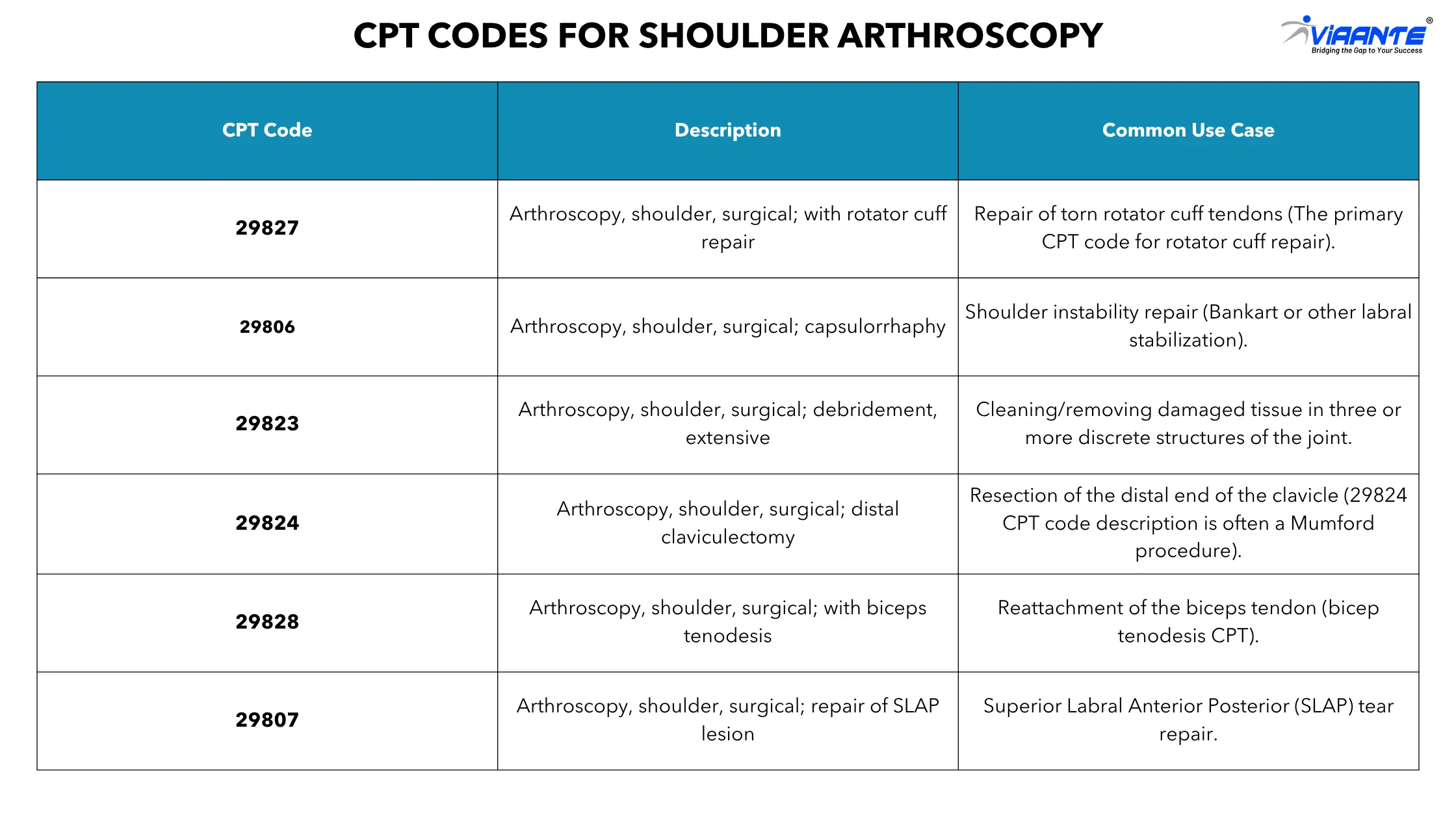
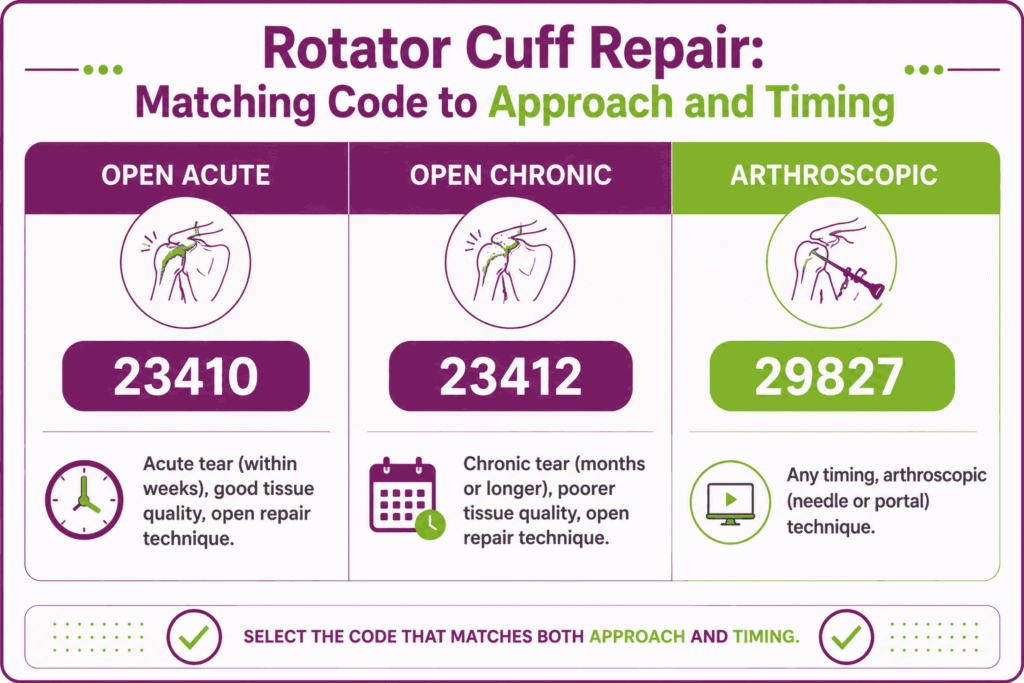
Rotator cuff repairs require coders to distinguish between arthroscopic (29827) and open (23412) approaches, a distinction that directly affects reimbursement rates and audit risk. Orthopedic coding guidelines also require documentation of tear size, tendon involvement, and whether the repair was partial or complete. Billing additional codes for acromioplasty or distal clavicle excision performed concurrently requires careful modifier application to avoid automatic bundling denials.
4. Lumbar Spinal Fusion CPT Codes (22630/22612): Approach, Level, and Instrumentation Reporting

Lumbar spinal fusion coding is among the most complex areas in orthopedic coding guidelines, requiring accurate reporting of surgical approach (anterior, posterior, or lateral), spinal level, and whether instrumentation or bone grafting was used. CPT 22630 covers posterior interbody fusion while 22612 covers posterolateral fusion, these are not interchangeable. Add-on codes for additional levels and instrumentation must be appended correctly or claims face systematic downcoding by Medicare contractors.
5. Orthopedic E/M Coding Under 2026 Guidelines - Medical Decision Making vs. Time-Based Selection
Since the 2021 E/M overhaul, orthopedic practices must select office visit codes (99202–99215) based on either medical decision making complexity or total provider time, not history and exam. For orthopedic coding guidelines, this means documenting the number and complexity of problems, data reviewed, and risk of complications. The tradeoff is that time-based billing requires meticulous time documentation, and MDM-based billing demands explicit problem complexity language that many orthopedic note templates still lack.
6. Joint Injection CPT Codes (20610/20611): Ultrasound Guidance, Modifier Use, and 2026 Payer Updates
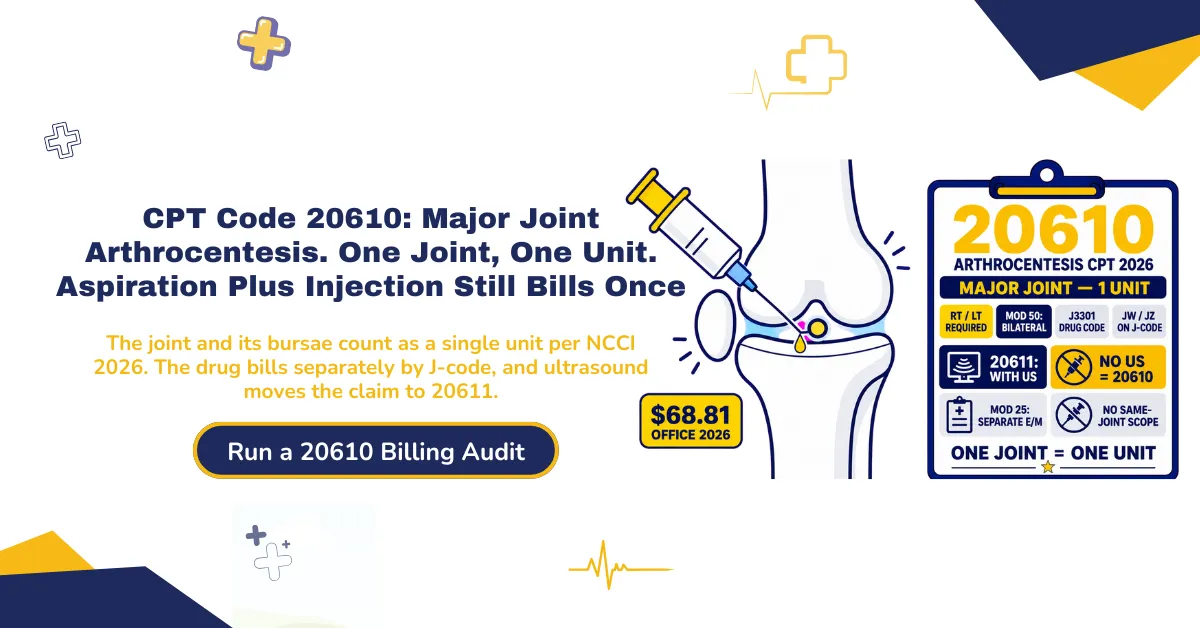
CPT 20610 covers aspiration or injection of a major joint without imaging guidance, while 20611 applies when ultrasound guidance with permanent image documentation is used. Orthopedic coding guidelines require that image documentation be stored in the medical record to support 20611 billing, practices billing 20611 without saved images face high recoupment risk. In 2026, several MACs have updated LCD policies requiring more explicit medical necessity language for repeat injections within the same joint within 90 days.
ICD-10-CM Orthopedic Coding Guidance - Laterality, Specificity, and 2026 Diagnosis Changes
Orthopedic coding accuracy lives or dies on the quality of what the physician documents before the claim is ever built, and the two cannot be treated as separate problems. This section works through the laterality and specificity requirements that drive the most common orthopedic denials, explains where the documentation gap actually forms, and shows how closing it at the point of care changes what coders have to work with downstream.
The Documentation-Coding Inseparability Problem
Orthopedic coders are often handed the blame for laterality denials. The cheat sheet gets updated, a training session gets scheduled, and the problem persists. That is because the root cause was never in the billing queue.
When a note reads "knee pain" instead of "right knee pain," no amount of ICD-10-CM fluency recovers the correct code. A coder who selects the textbook-correct fracture code can still produce an audit-vulnerable claim if the physician's note never supplied the laterality, reduction method, or stabilization details that anchor that code tier; correcting the coder without correcting the note solves nothing. One of the sharpest pain points orthopedic practices face is that physicians are pressed for time at the point of documentation, especially in high-volume settings where clinicians routinely chart two or more hours outside of patient care time.
Under that kind of pressure, a surgeon finishing a clinic day is not asking "did I document laterality on every encounter?" The specificity gap forms silently, at scale, one incomplete note at a time. iScribe Health's ambient AI documentation addresses this at the source: the platform listens conversationally during the encounter and drafts the encounter summary at the point of note completion, surfacing the clinical detail, side, fracture characteristics, encounter type, while the conversation is still live, before the note ever reaches a coder.
Practices already running a supported EHR can layer this in seamlessly, without rebuilding workflows, and the benefit compounds across every patient encounter and every day of clinical practice.
1. Always Specify Laterality or Face Claim Denials
ICD-10-CM orthopedic coding requires explicit laterality documentation, right, left, or bilateral, for nearly every musculoskeletal diagnosis. Coders working in orthopedic practices must query providers when operative notes or clinic records omit side-specific language. The tradeoff: laterality queries add documentation burden, but skipping them guarantees payer denials and downcoded claims that erode reimbursement.
2. Use 7th Character Extensions Correctly for Fracture Encounter Type
Orthopedic fracture codes demand a 7th character distinguishing initial encounter (A), subsequent encounter (D), or sequela (S), with additional specificity for healing status such as routine, delayed, or malunion. Misapplying 'A' to a follow-up visit is among the most audited orthopedic coding errors. The limitation is that providers must clearly document healing progress at each visit, or coders cannot accurately assign the correct extension.
3. Apply FY 2026 ICD-10-CM Diagnosis Code Changes Effective October 1, 2025
CMS releases annual ICD-10-CM updates each October, and FY 2026 includes new, revised, and deleted orthopedic diagnosis codes affecting musculoskeletal pain, contusion, and joint disorder categories. Orthopedic coders must audit their encounter form superbills and EHR code sets before October 1 to retire deleted codes and activate new ones. The tradeoff is that mid-year payer LCD updates may lag the code set, creating temporary coverage gaps.
4. Code Rotator Cuff Tears with Full M75.1 Subcategory Specificity
Rotator cuff syndrome codes under M75.1 require coders to capture laterality and distinguish complete from incomplete tears to satisfy payer medical necessity criteria for surgical authorization and physical therapy coverage. M75.121 (complete rotator cuff tear, right shoulder) exemplifies the specificity level payers expect. The key limitation is that imaging reports and operative notes must explicitly characterize tear completeness, vague documentation forces an unspecified code that risks prior-auth denial.
5. Assign Z47 Aftercare Codes Correctly Following Orthopedic Procedures
Post-operative orthopedic visits require Z47 aftercare codes, Z47.1 for joint replacement aftercare and Z47.89 for other orthopedic procedure aftercare, rather than the original injury or condition code once active treatment concludes. This distinction directly affects whether physical therapy and follow-up visits are reimbursed under the correct benefit category. The tradeoff is that coders must confirm the procedure type from the operative report, as selecting the wrong Z47 subcode triggers claim edits.
Correct Use of Modifiers in Orthopedic Coding: -RT/-LT, -50, -59, -25, and the X-Modifiers
Every modifier you append to an orthopedic claim is a sworn statement. It tells the payer that a specific clinical fact exists in the chart. Auditors do not check whether you selected the right modifier from the list; they check whether the note actually proves the fact the modifier promised.
That distinction is where most orthopedic practices lose money and accumulate compliance exposure without realizing it. NCCI edits validate code-pair logic, not whether the clinical note actually documents the complexity, distinct service, or anatomical distinction the modifier is claiming. This makes modifier cheat sheets a false assurance mechanism for practices that have not audited their encounter-level documentation fidelity. One of the most persistent struggles orthopedic practices face is that coding inconsistency does not announce itself, it accumulates silently across hundreds of encounters until a payer audit forces a reckoning.
Improving coding consistency is not a one-time project; it is a discipline that has to be embedded at the moment the note is written, because that is the only moment when the documentation gap can still be closed. According to compliance experts, the question of whether a modifier is "correct" is fundamentally a documentation question, not a code-selection question, and practices that conflate the two are carrying risk they have not yet measured. This is precisely the workflow problem iScribe Health is designed to address.
Because iScribe Health integrates ambient AI documentation directly into a supported EHR, the encounter summary is drafted by the time the physician finishes the patient visit, not reconstructed from memory two hours later when detail has faded. At the point of note completion, after the AI drafts the encounter summary, E&M Coding Intelligence and Real-Time Denial Alerts surface documentation gaps before the claim is submitted, not after it is denied. For high-volume orthopedic practices where clinicians regularly chart two or more hours outside of patient care time, that shift from reactive to proactive documentation has a compounding effect on coding consistency across every encounter, every day.
1. Modifiers -RT and -LT - Laterality Precision That Prevents Automatic Denials
Modifiers -RT and -LT are mandatory when a procedure is performed on one side of the body, and the laterality documented in the CPT modifier must match the laterality coded in the ICD-10-CM diagnosis. A mismatch between the modifier and the diagnosis laterality triggers an automatic payer edit before a human reviewer ever sees the claim. The documentation failure that drives these denials is not ignorance of the rule; it is a note that omits the specific side or uses ambiguous language like "operative knee" without naming right or left explicitly.
This is a documentation precision problem that compounds in high-volume practices. When a physician is charting under time pressure, or reconstructing notes after a full surgical day, ambiguous laterality language slips in, not because the surgeon does not know which side was operated on, but because the note-generation workflow does not enforce specificity at the point of capture. iScribe Health's ambient listening captures the clinical encounter in real time, and its EHR-integrated AI draft surfaces the laterality detail as it was spoken, making it far harder for "operative knee" to survive into a finalized note.
Real-Time Denial Alerts add a downstream check: if a laterality conflict is detectable before submission, the practice sees it before the payer does. Denial rates for these types of preventable edit failures remain a significant revenue drag for practices that have not closed the loop between documentation and billing.
2. Modifier -50 - Bilateral Procedure Billing Done Right in One Line Item
Modifier -50 signals that the same procedure was performed on both sides during the same operative session, billed as a single line item. Under Medicare, the reimbursement calculation is 150 percent of the single-procedure allowable, but commercial payers frequently diverge from that rule, with some requiring two separate line items and others applying their own bilateral payment policies. The documentation requirement is precise: the operative note must state bilateral intent explicitly, name both anatomical sites, and confirm that both sides were treated in the same session.
An operative note that describes only one side, or uses vague language about "bilateral involvement," gives the payer grounds to downcode to a unilateral procedure and recover the difference on audit. The challenge for most orthopedic practices is that the surgeon knows the bilateral intent; the documentation failure happens because the note does not say what the surgeon already knows. iScribe Health's ambient AI captures the full conversational context of the encounter, including the explicit naming of both anatomical sites, so that bilateral intent is in the note because it was said in the room, not because a coder tried to infer it afterward.
Compliance guidance on modifier -50 consistently points to the operative note as the single document that must carry the full bilateral proof. When that proof is built into the note automatically at point of care, the risk of a bilateral downcode on audit shrinks materially.
3. Modifier -59 - Unbundling Defense for Distinct Orthopedic Procedures
Use Modifier -59 to indicate a distinct procedural service that would otherwise be bundled under an NCCI Procedure-to-Procedure edit. The modifier is a documentation promise: it tells the payer that the two services were truly separate and that the operative or clinical note explicitly supports that distinction, a different anatomical site, different session, or different indication. When the note does not supply that supporting language, Modifier -59 creates audit exposure rather than resolving it.
The practices that carry the most -59 exposure are typically those where the physician performed a genuinely distinct service but the note did not document the separateness with enough specificity, different site, different indication, to survive scrutiny. That documentation gap is not a coding problem; it is a workflow problem. iScribe Health's ambient documentation captures the clinical rationale as the physician speaks it, and Automated E&M Coding with E&M Coding Intelligence flags the encounter-level signals that support or undermine a -59 appended claim before the claim leaves the practice.
Compliance experts note that Modifier -59 is among the highest-scrutiny modifiers in orthopedic billing precisely because it is so frequently appended without the underlying note support to defend it, making it the clearest example of why coding consistency has to be solved at the documentation layer, not the claim-submission layer.
4. Modifier -25 - Separating the E/M Visit from the Same-Day Orthopedic Procedure
Modifier -25 appended to an evaluation and management code signals that a significant, separately identifiable E/M service occurred on the same day as a procedure, a common scenario in orthopedic practices when a patient presents with a new complaint and also receives an injection or minor surgery. Without -25, payers bundle the E/M into the procedure's global package. The limitation: the E/M must be medically necessary and documented independently; using -25 as a routine revenue booster invites recoupment.
5. X-Modifiers (XE, XS, XP, XU): Granular Specificity to Replace Overused -59
CMS introduced the X{EPSU} modifiers, XE (separate encounter), XS (separate structure), XP (separate practitioner), XU (unusual non-overlapping service), as more precise alternatives to the broad -59 modifier under orthopedic coding guidelines. XS is particularly valuable in orthopedics when procedures address distinct anatomical structures in the same session, such as a knee and an ankle. The tradeoff: many commercial payers still do not recognize X-modifiers, requiring coders to verify payer-specific acceptance before substituting them for -59.
Related Reading
- E&m Coding Cheat Sheet
- Medical Coding Automation
- Orthopedic Medical Coding
- Urology Coding Guidelines
Global Surgical Periods, E/M Coding, and the Accurate Documentation Requirements That Protect Both
Global surgical periods and E/M level selection look like two separate compliance problems on paper. In practice, they share one failure point: the clinical note either captures the facts that make the billing defensible, or it does not. A practice can have every modifier rule memorized and still lose both battles at the encounter level. For high-volume orthopedic practices, that failure compounds fast, denial volumes routinely outpace what a billing team can realistically appeal, and the root cause is almost always inconsistent documentation rather than a gap in code knowledge.

Global Surgical Period Bundling - What Follow-Up Visits Are Included and the Documented Exceptions That Justify Separate Billing With Modifiers -24 and -79
Routine follow-up visits during a global surgical period are bundled into the original procedure payment. Separate billing is only permitted when the visit addresses an unrelated condition or an unrelated procedure, supported by modifier -24 or modifier -79 respectively. The documentation must explicitly state the visit is for an unrelated condition.
A patient returning three weeks post-TKA with new onset hip pain is a textbook qualifying scenario, but if the note does not name the unrelated condition and distinguish it from the surgical episode, the claim denies as bundled regardless of which modifier was appended. The modifier is not the defense. The note is.
This is precisely where inconsistency across a practice creates systemic exposure. When documentation quality varies by clinician, shift, or patient volume, some encounters will produce the language that makes the modifier defensible and others will not, and there is no reliable way to know which until a denial lands. iScribe Health's Ambient AI Documentation captures the full clinical conversation at the point of care and drafts the encounter summary before the physician leaves the room.
Because the AI draft is generated from what was actually said and examined, the note is far more likely to surface the specific language, the named unrelated condition, its distinction from the surgical episode, that makes a modifier -24 or -79 claim defensible on first submission. The goal is not to automate modifier selection; it is to standardize clinical documentation quality across the practice so that every encounter produces the evidentiary foundation billing requires.
MDM Over Exam - How the 2021 E/M Overhaul Shifted the Evidentiary Burden Entirely to the Clinical Narrative
Beginning January 1, 2021, CMS and the AMA replaced history and physical exam component counting with Medical Decision-Making (MDM) or total time as the basis for E/M level selection (PMC9392854). That shift sounds like a simplification. It is not.
It raised the documentation precision threshold considerably. To support a level-4 or level-5 visit under MDM, the note must explicitly capture the number and complexity of problems addressed, the data sources reviewed, and the level of risk involved in management. A note that summarizes the exam but leaves MDM elements implicit codes to a lower level on audit, regardless of how complex the encounter actually was.
iScribe Health's E&M Coding Intelligence is designed specifically for this gap. At the point of note completion, after the AI drafts the encounter summary, the system evaluates the documented MDM elements and surfaces the supported E/M level. If the draft note leaves complexity implicit where it needs to be explicit, the physician has an immediate opportunity to clarify before the note is finalized, rather than discovering the undercoding in a retrospective audit months later.
This is most impactful in high-volume practices where clinicians are regularly charting two or more hours outside of patient care time; under that kind of cognitive load, MDM documentation is the element most likely to be compressed or left implicit. Ambient listening removes the charting burden at the source, and E&M coding intelligence closes the loop by making the evidentiary gap visible in real time.
Why New Patient Orthopedic Visits Systematically Land at 99203 When the Clinical Facts Support 99204 or 99205
New patient orthopedic E/M undercoding is a documentation problem more often than a code-knowledge problem. An orthopedic surgeon who spends 35 minutes with a new patient presenting with multilevel spine degeneration, reviews prior imaging, and discusses prescription drug management has the clinical facts for 99205. If the note only summarizes the physical exam and chief complaint, it supports 99203.
The code selection follows the documentation, not the clinical reality. Industry data on E/M coding patterns in orthopedic practices consistently shows new patient visits clustering at 99203 even when the clinical facts documented, complexity of presenting problems, data reviewed, and management risk, would support 99204 or 99205 under MDM criteria (PMC9392854). The revenue difference per encounter is material, and at volume it represents a recoverable gap that most practices discover only after a retrospective audit.
Orthopedic practices we work with in high-volume environments face this systematically: the clinical complexity is real, the physician knows it, but the note produced under time pressure does not reflect it with the specificity MDM requires. iScribe Health addresses this at every encounter. The Ambient Listening layer captures the full conversation, the imaging reviewed, the differential considered, the management options discussed, and the AI drafts a note that reflects clinical reality rather than a compressed summary of it.
The Automated E&M Coding layer then maps the documented MDM elements to the supported level, so 99204 and 99205 encounters are identified at note completion rather than lost to systematic undercoding. Because the system integrates directly with supported EHRs, this process runs inside the existing clinical workflow with no additional documentation step required. The result is more defensible documentation and a coding posture that accurately reflects the care delivered, realized across every patient encounter, every day of practice.
Common Orthopedic Coding Mistakes and the One Your Cheat Sheet Will Never Catch
Live encounter data makes the discomfort concrete. Denials that survive every internal audit check are the most expensive kind, because they stay invisible until a payer or RAC auditor finds them first. The common assumption among practice administrators and billing decision-makers is that if coders just had a more complete, up-to-date reference guide covering every CPT code, modifier, and ICD-10 change, coding accuracy and revenue integrity would follow. But one of the hardest realities orthopedic practices face is that the rule was almost always knowable, and the documentation simply failed to satisfy it. The six errors below are the ones that surface most consistently in orthopedic billing reviews, and each one shares that same thread.
1. Unbundling Procedures That NCCI Considers Inclusive
NCCI Procedure-to-Procedure (PTP) edits automatically bundle code pairs that CMS considers inherently part of a single service. Billing both without a valid modifier triggers an automatic denial, regardless of whether the coder's reference guide lists both codes as separately billable. The denial is correct on the payer's side.
The coder knew the codes; the claim failed because the documentation did not establish that the two procedures were truly distinct, separate services that justified a modifier override. This is where ambient documentation changes the dynamic. iScribe Health's Ambient Listening and Conversational AI captures the clinical encounter in real time, so the specificity that justifies a modifier override, the surgeon's own words describing distinct procedural steps, is drafted into the note at the moment of care, not reconstructed hours later from memory.
When iScribe Health's E&M Coding Intelligence reviews the completed note, it flags NCCI-relevant documentation gaps before the claim is ever submitted, giving coders the foundation they need to defend a separately billed service. Practices that run high daily procedure volumes find this loop, ambient capture, AI-drafted summary, coding review, the most practical way to improve coding consistency across every encounter rather than catching NCCI mismatches only in retrospect. For a deeper look at how NCCI edits work in practice, this overview of NCCI edits in medical billing is a useful reference.
2. Misapplying Modifier 59 Instead of the Correct X-Modifier Subset
Modifier 59 remains technically valid, but CMS guidance established the X-modifier subsets, XE, XS, XP, and XU, specifically to signal why two procedures are distinct. Defaulting to Modifier 59 when an X-modifier applies more precisely flags the claim for targeted review. Uncertainty about which X-modifier applies almost always traces back to a note that does not describe the clinical distinction clearly enough to make the choice obvious.
iScribe Health's AI drafts the encounter summary at the point of note completion, after the encounter ends, capturing the clinical reasoning that separates two same-session procedures. When that reasoning is explicit in the note, not implied, the correct X-modifier becomes self-evident to the coding team rather than a judgment call made under time pressure. Real-Time Denial Alerts surface modifier-related risk before submission, so the practice corrects the documentation issue at the source rather than managing the denial downstream.
3. Billing Fracture Care and E/M Visits Without Proper Global Period Awareness
A follow-up visit during a 90-day global period is bundled into the surgical package by default. Billing it separately without Modifier 24 produces a denial that is entirely preventable. The documentation must affirmatively state that the visit addressed a condition unrelated to the original procedure.
When the note is vague or documents routine follow-up without distinguishing the clinical reason, the modifier has no foundation to stand on. Orthopedic practices with busy post-operative schedules face this problem at scale: a physician seeing a full panel of global-period patients at the end of a surgical day has little time to ensure each note explicitly articulates the separate clinical reason for a Modifier 24 visit. iScribe Health's Ambient Listening captures that clinical rationale during the visit itself.
The AI-drafted note surfaces the distinction, rather than burying it, so the Modifier 24 is documentarily defensible without the physician spending additional charting time outside of patient care.
4. Failing to Distinguish Open vs. Arthroscopic Procedure Codes for Rotator Cuff Repair
Open and arthroscopic rotator cuff repairs have entirely separate CPT code families, and conflating them is a common orthopedic coding error that cheat sheets rarely flag with enough specificity. Payers cross-reference operative reports, and a mismatch between the documented surgical approach and the submitted code triggers immediate denial or post-payment audit. The limitation is that coders must read operative notes carefully rather than relying on physician shorthand.
5. Ignoring Laterality and Anatomical Specificity in ICD-10 Diagnosis Coding
Orthopedic ICD-10 codes require precise laterality, left, right, bilateral, and anatomical detail that generic cheat sheets often collapse into a single catch-all code. Submitting an unspecified laterality code when a more specific one exists is a top denial trigger for orthopedic practices and flags claims for medical necessity review. The tradeoff is that coders must verify laterality directly from clinical documentation every time, adding workflow time.
6. Missing Denial Patterns Caused by Incomplete Prior Authorization for Orthopedic Surgery
A technically perfect CPT and ICD-10 claim still denies if prior authorization was not obtained, obtained for the wrong procedure, or expired before the service date, a process failure no coding cheat sheet addresses. Orthopedic practices see disproportionately high auth-related denials because procedures frequently change intraoperatively. The key limitation is that authorization management requires real-time coordination between clinical and billing staff, not just coder expertise.
Orthopedic Billing Best Practices in 2026 - From Cheat Sheet to Coding Intelligence
Closing that gap before a payer audit forces the issue requires more than a reference list of rules. It requires a workflow where documentation standards are verified at the point of care, not reconstructed after a denial. The best practices that follow treat the cheat sheet as a diagnostic baseline: a structured starting point that reveals what the encounter record still needs to defend the code, not a checklist to file and forget.
A cheat sheet tells your coders what the rules are. It cannot tell them whether the clinical note in front of them actually satisfies those rules. That gap is where orthopedic revenue quietly disappears, and no updated CPT list closes it.

Incorrect or missing modifiers are among the most recurring billing errors in orthopedic practices, producing denied or reduced payments that compound across high-volume schedules, and specialty-specific expertise, not generic billing knowledge, is what separates practices that catch these errors prospectively from those that absorb them as write-offs. The core synthesis this section advances: CDI programs and AI-driven documentation audit converge on the same structural truth that cheat-sheet orthodoxy obscures. Revenue integrity is a pre-submission, encounter-level problem, not a post-submission coding knowledge problem.
Practices that invest in reference guide quality while skipping encounter-level documentation review are optimizing the wrong variable; the FCA enforcement environment, where $5.7 billion in recoveries were tied to medically unnecessary or substandard-documented care, confirms that contemporaneous documentation quality is both the revenue mechanism and the legal defense, while the code reference is neither.
The Cheat Sheet Is the Floor, Not the Ceiling
Every coding rule in a reference guide is conditional. Modifier -25 fires correctly only when the note documents a significant, separately identifiable service. The 90-day global period rule applies cleanly only when the operative note specifies what was performed.
According to research published in PMC, coding accuracy is contingent on the completeness of the underlying clinical documentation, not merely on coders' knowledge of coding rules. The cheat sheet is the floor. Documentation fidelity is the ceiling.
Where orthopedic billing professionals run into trouble is not ignorance of the modifier rules. It is the structural mismatch between how notes are drafted and what payers require to honor those modifiers. A note dictated quickly between cases, or summarized in shorthand after a full clinic day, routinely omits the specificity that makes a modifier defensible. Tools like iScribe Health's E&M Coding Intelligence are designed to address exactly this: by applying coding logic at the point of note completion, after the AI drafts the encounter summary, the system flags documentation gaps before they become denial reasons, improving coding consistency across every encounter rather than relying on a retrospective audit to surface the pattern.
The Pre-Submission Documentation Review Shift
Most billing teams catch documentation problems after a claim is denied. By then, the revenue cycle has already absorbed the delay, the rework cost, and sometimes the write-off. The structural upgrade is moving that review upstream, to the encounter level, before submission. Clinical Documentation Improvement research consistently frames this as a pre-submission, encounter-level intervention rather than a post-claim correction exercise. The practices that protect revenue most effectively are not auditing claims; they are auditing documentation before claims exist.
This is precisely the interval iScribe Health's ambient AI documentation layer is built for. Because the system integrates with the practice's existing EHR and listens conversationally during the encounter, the encounter summary is structured and available for E&M coding review at the point of note completion, not hours later when physician recall has faded. Real-Time Denial Alerts surface payer-specific risk signals in the same workflow, so the orthopedic billing team is reviewing a documentation-complete record, not chasing addenda after a remittance lands. For high-volume practices where clinicians routinely chart two or more hours outside of patient care time, this shift is not marginal. It reclaims time while simultaneously hardening the documentation that revenue depends on.
How Overcoding and Undercoding Coexist in the Same Practice
The assumption that a practice either overcodes or undercodes is contradicted by encounter-level audit data. Both errors routinely appear in the same billing population because they share the same root cause: documentation that is incomplete in different directions. A surgeon who dictates a thorough operative narrative but summarizes the E/M decision-making process leaves complex new patient visits undercoded.
The same surgeon, billing a procedure the note does not fully support, overcodes the surgical claim. Reference guides do not surface this combination because they evaluate code selection rules in isolation, not documentation completeness across the full encounter record. Orthopedic denial management is complex enough that generic billing knowledge consistently proves insufficient, and specialty-specific denial prevention strategies underscore that orthopedic coding requires discipline-level expertise at every step.
iScribe Health's Automated E&M Coding applies that specialty-specific logic systematically, evaluating the encounter record as a whole rather than reviewing individual code selections in isolation. The result is a workflow where the overcoding and undercoding signals that coexist in the same practice are identified at the same moment, point of note completion, rather than discovered months apart through a payer audit or a targeted internal review.
Related Reading
- Urology Medical Coding
- Ai Medical Coding Companies
- Medical Coding Outsourcing Companies
- Best Medical Coding Software
- Medical Coding Optimization
Next steps
If your orthopedic practice is absorbing denials despite updated modifier rules and current CPT references on every desk, the path forward starts with recognizing that documentation fidelity, not coder knowledge, is the operative failure point. The 33% overcoding rate surfaced in one AI-assisted audit of 941 encounters was invisible to the practice's existing manual-review workflow, and no reference guide would have caught it. Start with our AI medical scribe.
The fact that modifier correctness and NCCI edit clearance operate on entirely different compliance planes means a claim can pass every automated bundling check and still misrepresent what the clinical note actually documents. The fact that ICD-10-CM's mandatory laterality architecture makes the documentation gap and the coding error structurally inseparable means correcting coders without correcting notes solves the wrong problem. Together, they point to a single intervention: closing the documentation gap at the point of care, before the claim exists.
Start with iScribe to capture clinical detail in real time and surface documentation gaps at note completion, where the physician can still act on them.
Frequently Asked Questions
Why do orthopedic claims get denied even when the coder picks the right CPT code?
The denial usually originates in the physician's note, not the code selection. When the operative note omits required details, such as surgical approach, compartment, implant specifics, or evidence of failed conservative treatment, the claim becomes audit-vulnerable regardless of which CPT code was chosen, because no coder can supply clinical facts that were never documented.
Does adding a -RT or -LT modifier to the procedure fix a laterality problem on the diagnosis side?
No. EmblemHealth's laterality coding policy makes clear that a -RT modifier on the procedure side does not rescue an unspecified ICD-10-CM diagnosis code on the same claim, both must align, and both depend on what the physician actually recorded in the note.
How important is the 7th character when coding a fracture, and what happens if I get it wrong?
It changes the reimbursement pathway entirely. A displaced femoral neck fracture coded as S72.001A (initial encounter, active treatment) versus S72.001D (subsequent encounter) signals whether the patient is receiving active treatment or follow-up care, and payers price them accordingly, with active-treatment encounters reimbursed at a higher rate and subsequent-encounter claims flagged when documentation does not support ongoing active management.
What's the most common reason shoulder arthroscopy claims get downcoded by payers?
Failing to document whether the rotator cuff tear was partial or full thickness is one of the most common documentation gaps in shoulder arthroscopy claims. Payers treat an ambiguous note as grounds to downcode the claim to the lesser procedure regardless of what was actually performed, so the operative note must state repair extent explicitly.
Why do orthopedic practices have higher claim denial rates than other specialties?
According to OmniMD (2026), orthopedic surgery carries claim denial rates of 10 to 15 percent, roughly double the industry average, and documentation deficiencies are the primary driver, not coder unfamiliarity with the codes themselves. The complexity of orthopedic coding means a single encounter may require a CPT surgical code, a laterality modifier, an ICD-10-CM code with anatomical specificity, an NCCI bundling check, and a global period flag, so a documentation failure in any one layer can invalidate an otherwise correct decision in the others.