E&M Coding Cheat Sheet: Quick Reference Guide 2026
Your E&M coding cheat sheet for 2026, built for billing teams where the gap is visibility, not effort, so every note captures reimbursement it earns.


A code grid on the wall won't fix a note that never captured the reasoning. Here's how MDM criteria actually determine your E&M level, and where most practices quietly lose revenue.
Most practice administrators and billing decision-makers believe that if their team just had a better cheat sheet or reference guide, their E&M coding accuracy would improve. Most practice administrators post an E&M code grid on every workstation and assume the coding problem is solved. It is not.
The grid tells your coder which number to assign once the clinical picture is clear. It cannot fill in the MDM reasoning, the risk documentation, or the data-review steps that were never captured in the first place. Having the correct code numbers available does not resolve the underlying documentation gap that causes miscoding; accurate E&M level selection requires that the clinical documentation itself supports the chosen code.
See our AI medical scribe for how this works in practice. Since the 2021 AMA guideline revisions (carried forward through 2026), history and physical exam elements no longer determine the level of an office or outpatient E&M service. Code selection rests entirely on either Medical Decision Making (MDM) or total time on the date of the encounter.
New patient codes run 99202 through 99205; established patient codes run 99211 through 99215. Note that 99211 is the one code in this family that does not require a physician or qualified provider, covering nurse-only visits like a blood pressure check. The MDM vs. time fork is where most practices lose money quietly.
Coders default to the code the provider verbally suggests, which is often 99213, because the note does not explicitly document the complexity that would support 99214. Roughly half of all E&M visits are miscoded, with undercoding concentrated at the 99213/99214 boundary. What most billing teams report, and what broader market patterns confirm, is that a pattern of undercoding can itself flag systemic documentation or billing problems, creating compliance exposure in both directions.
MDM complexity is scored across three elements:
- The number and complexity of problems addressed
- The amount and complexity of data reviewed
- The risk of complications or morbidity
Code level is determined by meeting the threshold on at least two of these three elements, a structure that rewards explicit, well-organized documentation over any static reference grid.
"Patients are blindsided by high-level E&M/critical care codes (e.g., 99291) applied to visits that feel routine, resulting in bills of $12,000+ for what seemed like a simple laceration repair."
roughly half of all E&M visits are miscoded
Key takeaways
- An E&M code grid tells your coder which number to assign, it cannot fill in the clinical reasoning that justifies the level in the first place.
- Roughly 55% of visits are miscoded even in practices that train staff and post reference tools at every workstation, because the problem lives in the note, not the lookup table.
- Medical decision making is only as defensible as the narrative behind it, a provider who adjusts a medication without documenting why handed the auditor a reduction before the claim was even submitted.
- Time-based coding is often the higher-revenue pathway for a given encounter, and most practices miss it entirely because the note never captures total time as the AMA defines it.
- Modifier 25, G2211, and inpatient code families each carry their own documentation requirements, mastering MDM levels does not protect revenue in those edge cases.
- iScribe Health's Automated E&M Coding reads the clinical documentation as it's created and generates the supported code in real time, closing the gap between what happened in the room and what the record can actually defend.
Medical Decision Making (MDM) Framework - How Code Level Is Actually Determined
Knowing the MDM table is not the same as coding defensibly. A provider can recite every row of the complexity grid and still produce a note that a payer auditor reduces on first review, because the code is only as strong as the clinical reasoning embedded in the narrative behind it. That gap between knowing the criteria and documenting them explicitly is where most E&M revenue quietly disappears, and it compounds fast across high patient volumes. Chief Medical Officers, practice administrators, and individual physicians working through iScribe Health routinely find that the real drain is not misunderstanding the rules, but failing to make qualifying evidence visible in the note at the moment it is written.

The 2-of-3 Rule - Why MDM Level Is a Threshold, Not a Checklist
MDM level is determined by meeting criteria in at least 2 of its 3 elements: number and complexity of problems addressed, amount and complexity of data reviewed, and risk of complications or morbidity. Meeting all three is not required. Meeting only one is not enough.
This threshold structure means a provider can anchor a code on strong problem complexity and clear risk documentation even when data reviewed is minimal, but every qualifying element must be explicitly visible in the note. If an auditor cannot score it from the text, it does not count. One compounding problem for practices billing across platforms: some billing systems enforce a minimum face-to-face time threshold that blocks invoice submission even when the visit fully qualifies under MDM criteria, a direct conflict between time-based and MDM-based coding logic that catches clinicians off guard.
Understanding that MDM stands entirely on its own, independent of visit duration, is not optional; it is the foundation of defensible coding in 2025. iScribe Health's E&M Coding Intelligence addresses this at the point of note completion. After the Ambient Listening AI drafts the encounter summary, the system scores the note against MDM criteria in real time, surfacing gaps before the claim is submitted, not after a denial arrives.
Problem Complexity Criteria by MDM Level - From Self-Limited to Severe Exacerbation
The number and complexity of problems addressed runs from Straightforward through High across four defined tiers. Straightforward MDM covers one self-limited or minor problem. Low complexity adds one stable chronic illness or two self-limited problems.
High complexity involves one or more chronic illnesses with severe exacerbation, or a condition that poses a threat to life or bodily function. A patient with Type 2 diabetes presenting with uncontrolled blood sugar and a new medication prescription meets Moderate problem complexity, but only if the note names the condition, the exacerbation, and the clinical reasoning that connects them. That last requirement, naming the condition, the exacerbation, and the reasoning, is precisely where ambient documentation earns its keep.
In high-volume practices where clinicians are regularly charting two or more hours outside of patient care time, the cognitive load of encoding clinical reasoning explicitly into prose is what gets cut. iScribe Health's Ambient AI Documentation captures the spoken encounter and surfaces the MDM-relevant elements in the draft note, so the physician reviews and confirms rather than constructs from scratch.
Data Requirements Decoded - What Minimal, Limited, Moderate, and Extensive Actually Demand
The amount and complexity of data reviewed is the element coders most frequently underestimate. Straightforward MDM requires minimal or no data. Low MDM requires limited data, typically one or two sources such as ordering a test or reviewing an external record.
High MDM requires extensive data, meaning three or more sources across multiple categories including independent interpretation of a test and discussion with an external provider. Vague phrases like "records reviewed" do not satisfy these thresholds. The note must name what was reviewed, where it came from, and what clinical decision it informed.
Payers are actively tightening scrutiny here. Cigna quietly expanded its medical review criteria in July in ways that directly affect how data documentation is evaluated at audit, a signal that generic language in the data element is increasingly indefensible. Ensuring accurate, compliant medical coding across high patient volumes to maximize reimbursement and minimize claim denials is not a one-time training exercise; it requires documentation infrastructure that enforces specificity on every encounter.
iScribe Health's EHR Integration means the ambient AI operates inside the existing clinical workflow, pulling structured data references into the note rather than leaving clinicians to reconstruct them from memory.
Moderate MDM's Two-Category Data Test - The Specification Most Coders Misread
This is the specification that generates the most audit exposure at the 99214 level. Category one covers review of external records, ordering tests, or reviewing the results of tests the provider ordered. Category two covers independent interpretation of a test, discussion of management with an external physician, or assessment of an independent historian.
A note that vaguely references "labs reviewed" without naming the source, the result, and the clinical decision it drove satisfies neither category and will not survive an audit at the 99214 level. Real-Time Denial Alerts within iScribe Health flag exactly this kind of exposure before the claim leaves the practice, reducing the downstream cost of medical scribing, transcription rework, and denial management that erodes margins when documentation fails at scale. Claim denials tied to insufficient documentation remain among the top revenue cycle vulnerabilities practices face in 2025, and the two-category data test at 99214 is a primary trigger.
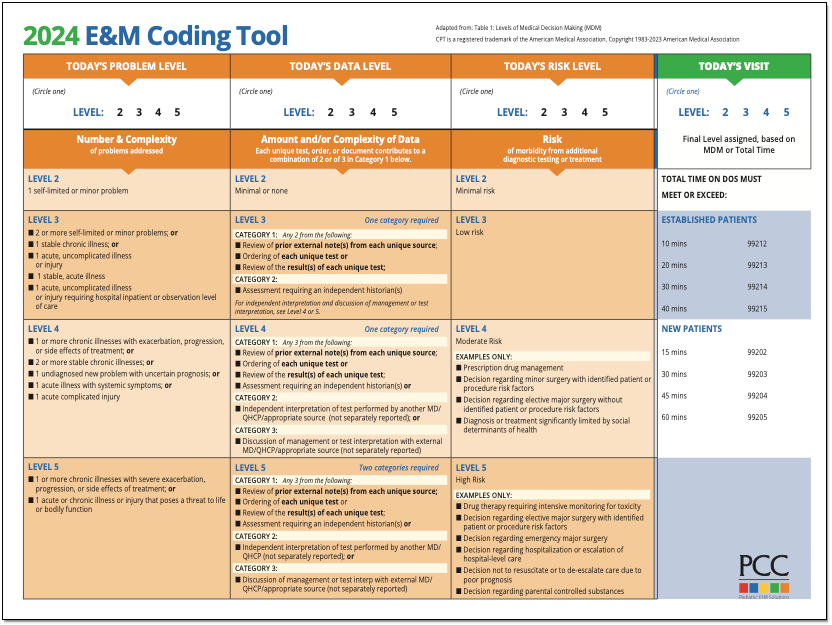
MDM level generally reflects the complexity of problems addressed, data reviewed, and risk of complications. For office/outpatient E/M coding, the level is determined by meeting the requirements of at least two of these three elements:
- Straightforward → 1 self-limited/minor problem → Minimal or no data → Minimal risk, such as OTC medication → 99202 / 99212.
- Low → 1 stable chronic illness or 2 self-limited problems → Limited data from 1–2 sources → Low risk, such as prescription treatment for an uncomplicated condition → 99203 / 99213.
- Moderate → 1+ chronic illness with exacerbation or a new problem with uncertain prognosis → Moderate data, including qualifying 2-category data → Moderate risk, such as prescription management for a chronic illness or treatment limited by SDOH → 99204 / 99214.
- High → 1+ chronic illness with severe exacerbation or a threat to life/bodily function → Extensive data, such as 3+ sources, independent interpretation, or discussion with an external provider → High risk, such as intensive toxicity monitoring or a hospitalization decision → 99205 / 99215.
Rule: Meet threshold in at least 2 of 3 columns to assign that MDM level. Meeting all 3 is not required; meeting only 1 is not sufficient.
Risk of Complications and Morbidity - The MDM Element Most Often Underdocumented
Prescription management is not self-documenting. A provider can adjust a patient's lisinopril dose, note the diagnosis, and sign the chart, and the note will still fail an audit if it never explains why that adjustment was clinically necessary. That gap between what happened in the room and what the record actually proves is where E&M revenue quietly disappears, and with CMS and OIG increasing scrutiny of E&M services, the cost of that gap is rising.

The Four MDM Risk Levels Defined
Under the AMA CPT framework, the risk of complications and morbidity element maps to four levels. Minimal covers self-limited conditions managed with over-the-counter drugs. Low covers prescription drug management for uncomplicated conditions and minor procedures without identified risk factors.
Moderate covers prescription drug management for a chronic illness, minor surgery with identified patient or procedure risk factors, or treatment significantly limited by social determinants of health. High covers drug therapy requiring intensive monitoring for toxicity, elective major surgery with identified risk factors, or decisions about hospitalization. Each level requires explicit documentation of the clinical reasoning that places the visit there.
The diagnosis code alone does not do it.
Why Risk Is the Tie-Breaker Between 99214 and 99215
Risk of complications and morbidity is not merely the most commonly omitted MDM element, it is the structural tie-breaker between Moderate and High MDM, which means its absence in the note doesn't just weaken a code; it collapses the entire justification for 99214 or 99215 regardless of how well the other two MDM elements are documented. A provider who manages a prescription drug for a chronic illness satisfies Moderate risk, which supports 99214, regardless of how the other two MDM elements score. Move that same patient to High risk, and the code becomes 99215.
The critical point, confirmed by coding compliance sources, is that auditors do not infer risk from the presence of a prescription or procedure order. Without explicit documentation of the clinical reasoning that justifies the risk level, the element is invisible on audit. An invisible element cannot support a higher code, no matter how complex the actual encounter was.
This is precisely where iScribe Health's E&M Coding Intelligence and Ambient AI Documentation work together to reduce audit risk. At the point of note completion, after the AI drafts the encounter summary, iScribe's coding intelligence layer evaluates whether the risk element is explicitly supported in the language of the note, flagging gaps before the claim ever reaches the billing queue.
The One-Sentence Documentation Fix
Consider a provider managing hypertension who adjusts a patient's lisinopril dose. If the note says "adjusted dose," the payer reads Low complexity. If the note says "adjusted lisinopril dose given suboptimal blood pressure control in the setting of established chronic hypertension, with monitoring planned for renal function and electrolytes," the note now supports Moderate risk and 99214.
That one sentence is the difference. The revenue gap between 99213 and 99214 under current Medicare rates is meaningful per encounter. Across a busy panel, that compounds fast, and as coding compliance research confirms, the cumulative financial impact of documentation errors is one of the most underestimated risks in a practice's revenue cycle.
iScribe's Ambient Listening / Conversational AI captures the clinical reasoning a provider voices in the room, the "suboptimal control," the "monitoring planned," the "given the patient's chronic course", and surfaces it in the drafted note rather than letting it evaporate between the encounter and the chart. That ambient capture is most impactful precisely in the high-volume settings where clinicians are seeing back-to-back patients and spending significant time on after-hours documentation: the conditions under which the one-sentence fix is most likely to go unwritten without a systematic assist.
Common Audit Pitfalls in Risk Documentation
The most frequent errors auditors flag in the risk element fall into three patterns. First, providers document the intervention but omit the clinical rationale, a prescription change appears in the plan without a single sentence explaining why the change was necessary given the patient's current condition. Second, notes record the presence of a chronic illness without naming the exacerbation, side-effect concern, or progression that elevates risk from Low to Moderate.
Third, providers address social determinants of health verbally in the encounter but never document that SDOH is actively limiting treatment options, a detail that, when written, independently satisfies Moderate risk under current AMA criteria. Each of these omissions is correctable at the point of documentation; none can be recovered retroactively from a billing queue. iScribe's Real-Time Denial Alerts and Automated E&M Coding address all three patterns at that correctable moment.
Because iScribe integrates directly with the practice's supported EHR, the alert reaches the provider inside the workflow they already use, no separate platform to check, no end-of-day queue to review. For practices already running a supported EHR that want a seamless ambient documentation experience, that integration is the on-ramp: the audit-risk reduction is ongoing, realized across every patient encounter and every day of clinical practice, not as a one-time configuration but as a continuous layer of E&M intelligence built into how notes are completed.
Time-Based E&M Coding Guidelines - When the Clock Beats MDM
The time pathway in E&M coding is not a fallback. For many encounters, it is the higher-revenue choice sitting in plain sight, unclaimed. The reason most practices miss it has nothing to do with effort and everything to do with what gets written in the note.

What Total Time Actually Means Under Current AMA Rules
Under the 2021 AMA guidelines, total time for office visit coding includes every minute the billing provider spends on the encounter on that calendar date, not just the minutes spent in the room with the patient. Reviewing prior records before the visit, ordering tests, interpreting results, documenting the note, and coordinating care with other providers all count. According to a 2022 analysis in PMC, this definition explicitly covers non-face-to-face work performed on the same date of service.
The catch: that time must be documented in the medical record. If it is not written down, it did not happen in the eyes of a payer audit. Providers who finish notes hours after the encounter, a pattern that is especially common in high-volume practices where clinicians regularly spend significant time charting outside of patient care time, can no longer accurately reconstruct total time spent.
The complex, heavily coordinated visits where time-based coding would most benefit them are precisely the ones most likely to have an undocumentable time figure, leaving MDM as the only defensible pathway and returning the provider to the documentation gap the time pathway was supposed to bypass. The root problem is sequencing: when documentation happens after the fact, the granular time blocks that support a defensible time-based claim dissolve. iScribe Health's ambient AI documentation is designed to close exactly that gap.
Because the platform uses ambient listening and conversational AI to capture the encounter in real time, during the visit, hands-free, the note is drafted by the point of encounter completion, not reconstructed hours later. For clinicians seeing high patient volumes who currently spend significant time on after-hours charting, this shift means the pre-visit record review, the in-room discussion, the same-day results interpretation, and the care-coordination work are captured while the provider's memory of them is intact and auditable, rather than compressed into a late-night summary that cannot reliably support a time-based code. The practical payoff is documented in the coding guidance at CodingIntel: the time pathway is only defensible when the note actually reflects how each block of time was spent.
New Patient Time Thresholds at a Glance For new patients, the time bands are: 99202 at 15 to 29 minutes, 99203 at 30 to 44 minutes, 99204 at 45 to 59 minutes, and 99205 at 60 to 74 minutes. A provider who spends time face-to-face but also reviews imaging and coordinates a specialist referral on the same day may accumulate enough total minutes to support a higher code, such as a 99204 rather than a 99202, a distinction that is not trivial across a full patient panel. That difference in reimbursement is not trivial across a full patient panel.
What makes this recoverable revenue so consistently missed is the documentation workflow, not the clinical reality. When a physician relies on pajama-time charting to close notes, the 20 minutes of pre-visit record review and same-day coordination are rarely broken out, they blur into a generic note that only supports the face-to-face level. iScribe Health's E&M Coding Intelligence evaluates the completed AI-drafted note at the point of note completion and surfaces the supportable code level, so the 48-minute 99204 encounter does not get filed as a 99202 by default.
Established Patient Thresholds and the 40-Minute Inflection Point
For established patients, the time bands are: 99211 for fewer than 10 minutes (nurse-only visits), 99212 at 10 to 19 minutes, 99213 at 20 to 29 minutes, 99214 at 30 to 39 minutes, and 99215 at 40 to 54 minutes. The 40-minute threshold is the inflection point most practices underuse. A provider who spends meaningful time face-to-face but also performs same-day care coordination, results review, and documentation may accumulate enough total time on record to support a 99215 rather than a 99213, provided the note actually documents how each block of time was spent.
Without that documentation, the claim can only be defended at the face-to-face level. This is where the intersection of physician burnout and revenue leakage becomes concrete. High-volume practices where providers are already charting well past clinic hours are the practices most likely to compress established-patient notes, and compressed notes are the ones least likely to capture the 18 minutes of coordination work that separates a 99213 from a 99215. The result is a documentation workflow that supports both accurate reimbursement and the work-life balance that comes from eliminating after-hours charting on every patient encounter, every day.
Related Reading
- Orthopedic Coding Guidelines
- Medical Coding Automation
- Orthopedic Medical Coding
- Urology Coding Guidelines
Modifier 25, HCPCS G2211, Inpatient Codes, and Specialty Variations - The Edge Cases That Cost Practices Money
Practices that master MDM levels and time thresholds often assume the hard work is done. It isn't. The codes that follow the "main" E&M rules, modifiers, add-ons, and specialty-specific families, are where revenue quietly disappears after a practice believes its coding is solid.
1. Modifier 25 - When 'Separate and Significant' Isn't Enough to Survive a Denial

Modifier 25 must be appended to an E&M code whenever a provider performs a significant, separately identifiable evaluation and management service on the same day as a procedure. Without it, the payer bundles the E&M into the procedure payment and the entire E&M fee disappears. A provider who removes a skin lesion and also addresses an unrelated chronic condition in the same visit collects nothing for that second service if Modifier 25 is missing.
Modifier sequencing is one of the most persistent failure points in medical billing. Coders who work through high-volume encounter days frequently misapply or omit Modifier 25 on edge-case visits, not because they don't know the rule, but because the documentation arriving at the coding desk doesn't clearly surface a distinct clinical decision. That gap between what the clinician did and what the note captures is where denials are born.
Claim denial rates vary meaningfully by specialty, and practices with high same-day procedure volume are disproportionately exposed when Modifier 25 documentation is inconsistent. The documentation standard is strict: CMS and major payer auditors require that the note clearly support a distinct clinical decision, a separately identifiable evaluation, not just a brief check-in coincident with the procedure. The trade-off is real audit exposure; payers flag Modifier 25 claims at higher rates precisely because under-documented "separate" services are a known billing vulnerability.
Modifier 25 documentation errors remain among the most cited medical billing vulnerabilities heading into 2026. iScribe Health's Ambient AI Documentation directly addresses this documentation gap. Because the AI captures the full clinical conversation at the point of care and drafts the encounter summary at note completion, the distinct clinical decisions that justify Modifier 25 are recorded in the note automatically, not reconstructed hours later from memory.
Paired with E&M Coding Intelligence and Real-Time Denial Alerts, the system flags Modifier 25 sequencing issues before the claim leaves the practice, improving coding consistency across every encounter rather than relying on a coder to catch what the note failed to convey.
2. HCPCS G2211 - The Add-On Code Most Primary Care Practices Are Still Leaving on the Table
HCPCS G2211 is a Medicare add-on code that captures the complexity of ongoing, longitudinal care management beyond a single visit's presenting problem. Adoption in primary care remains well below eligible volume, meaning many practices are systematically missing reimbursement on qualifying established-patient visits. One study found G2211 was applied at only 35.8% of annual wellness visits and 21.5% of transitional care visits, despite the code being considered nearly ubiquitous in its eligibility for primary care encounters.
The critical limitation: G2211 cannot be billed when the base E&M carries Modifier 25, unless the same-day procedure is a preventive service. For practices that routinely perform same-day device management or diagnostic procedures, this interaction forces a direct choice between the modifier and the add-on, with no coding mechanism to capture both. Specialty practices in endocrinology and diabetes care feel this most acutely.
iScribe Health's Automated E&M Coding and EHR Integration work together here: because the system operates inside a supported EHR and reviews the full drafted note at the point of completion, it can identify when G2211 eligibility exists and surface the Modifier 25 conflict in real time, before the coder has to choose blindly. The result is that practices stop leaving G2211 revenue on the table not through manual audits after the fact, but through consistent intelligence applied at every qualifying encounter.
3. Inpatient and Observation E&M Codes - Navigating the 2023 Consolidation That Still Confuses Billers
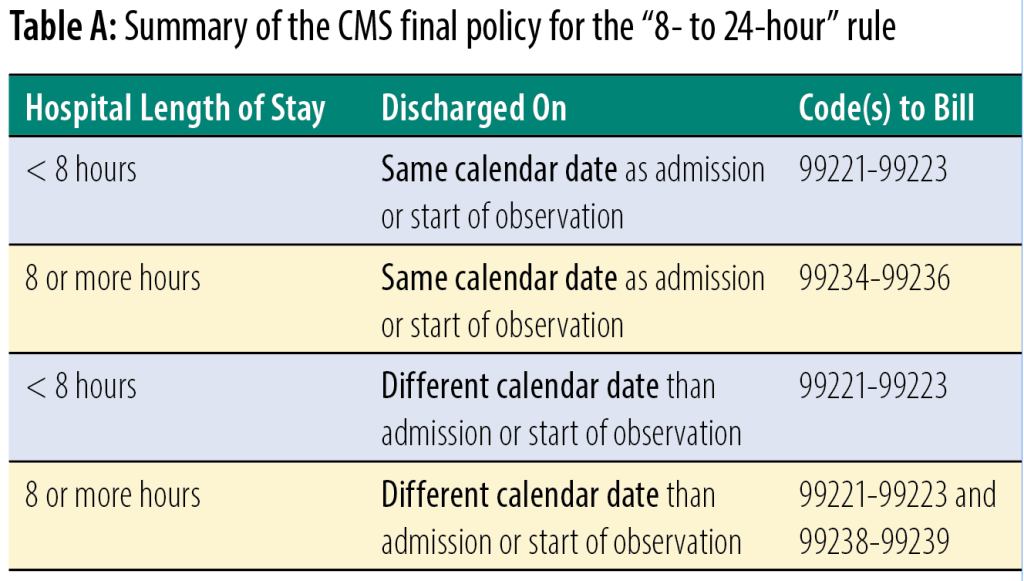
CMS's 2023 consolidation eliminated the separate observation code set and merged it into the inpatient hospital care code family, creating a single set of codes (99221–99223 for initial hospital care, 99231–99233 for subsequent care) that applies regardless of whether the patient's formal status is inpatient or observation. For billing teams accustomed to treating observation as a separate pathway, this consolidation continues to generate claim errors, most commonly, continued use of retired observation-specific codes or incorrect application of the new initial versus subsequent distinction when status changes mid-stay. Denial rates tied to inpatient and observation coding errors remain a significant revenue leak across specialties, particularly in high-volume hospital medicine and hospitalist programs.
Practices that admit patients to observation as a routine cost-control measure should audit their inpatient code usage against the 2023 unified framework before the next payer review cycle. iScribe Health's Real-Time Denial Alerts and E&M Coding Intelligence flag misapplied inpatient and observation codes at the claim level, and because iScribe Health materializes seamlessly within a supported EHR environment, the correction happens inside existing workflows, not as a separate remediation step outside the system clinicians already use.
4. Specialty E&M Variations - How Psychiatry, Surgery, and Emergency Medicine Each Break the Standard Cheat Sheet
Standard E&M coding guidelines don't apply uniformly across specialties. Surgeons face global period restrictions that block separate E&M billing within 90 days post-op without Modifier 24. Emergency physicians use their own code set (99281–99285) with facility-driven leveling. Psychiatrists must distinguish between E&M and psychotherapy add-on codes. The core tradeoff for any specialty-specific E&M cheat sheet: a one-size rule applied across specialties is the single most common source of avoidable claim denials.
Why Your E&M Cheat Sheet Can't Fix a 55% Miscoding Rate
E&M coding accuracy depends less on the reference tools a practice uses and more on whether the clinical documentation actually supports the code level being billed. That automatic rejection pattern scales quietly across thousands of claims before anyone notices a systemic problem, which is precisely what a 941-encounter audit conducted across multiple practice settings revealed. The audit found a significant overcoding rate even among practices that considered themselves compliant, organizations that had trained staff, used reference tools, and believed their documentation supported the levels they were billing. The common assumption among practice administrators and billing decision-makers is that if their team just had a better cheat sheet or reference guide, their E&M coding accuracy would improve.

The same pattern holds. Among the cases where they disagreed, a 33% overcoding rate was identified. These were not practices operating without resources.
They had access to coding references. The problem was not that providers picked the wrong code from the table. The problem was that the note did not contain the clinical evidence needed to defend the code they selected.
The overcoding rate carries two simultaneous costs: audit exposure on the overcoded visits and revenue loss on the undercoded ones. As industry billing analysts note, both exist in the same practice, often in the same provider's panel, because the root cause is structural, not individual. A reference tool cannot fix a structural problem; it can only surface the gap after the damage is already in the note.
The Cheat Sheet Paradox
A coding reference communicates criteria. It tells you that Moderate MDM requires prescription drug management for a chronic illness, or that High complexity requires a threat to life. What it cannot do is supply the documented reasoning that proves your patient encounter actually met those criteria.
That reasoning has to exist in the note before any reference is consulted. This is the core documentation gap in E&M coding. The cheat sheet assumes the clinical narrative is already there.
When it is not, the reference becomes a shortcut to a code the note cannot defend. A coder who picks a code from a well-designed grid is still exposed if the note reads "chronic hypertension, refill requested" with nothing more. Creating more defensible documentation, note language that explicitly connects clinical complexity to the decision-making level being billed, is not a training problem a cheat sheet solves.
It is a workflow problem. The narrative scaffolding that makes a note auditable has to be built at the point of care, not reconstructed from memory after the fact. iScribe Health's Ambient Listening and Conversational AI captures the encounter as it unfolds, so that the MDM rationale, the part that justifies the code level, is drafted into the note before the provider ever leaves the room, not omitted under time pressure and reconstructed later.
Point-of-Care Documentation Pressure
Why providers skip the MDM rationale that determines code level comes down to time. When a provider is moving between exam rooms every 15 to 20 minutes, the MDM rationale is the first thing that gets compressed. The problem complexity gets noted. The prescription gets recorded.
The reasoning connecting them, the part that justifies the code level, gets dropped. That omission is not negligence; it is physics. A provider documenting in real time under cognitive load, moving between patients, will preserve the clinical decision and drop the narrative scaffolding around it.
The scaffolding is exactly what an auditor reads first. This dynamic is most acute in high-volume practices and health systems where clinicians regularly chart two or more hours outside of patient care time, the precise environment where ambient documentation has its greatest impact, because every encounter adds to a compounding documentation deficit that no reference guide can close retroactively. iScribe Health's E&M Coding Intelligence engages at the point of note completion, after the AI drafts the encounter summary.
At that moment, before the note is signed, not after a denial arrives, the system surfaces whether the documented clinical reasoning actually supports the code level the encounter warrants. That timing matters. Catching a documentation gap at note completion is a fixable problem.
Catching it on an audit is a liability. By embedding this review directly into EHR Integration workflows that practices are already running, iScribe Health standardizes clinical documentation quality across the practice without adding a separate audit step that busy care teams will skip during peak census periods. The result is a documentation floor that holds even when volume is highest, which is exactly when the MDM rationale is most likely to get dropped without structural support in place.
How Automated E&M Coding Closes the Documentation Gap and Recovers the Revenue a Cheat Sheet Leaves Behind
The \$935 million in improper payments the U.S. healthcare system absorbs every week does not stem primarily from coders selecting the wrong table or misreading a guideline. A significant share traces back to a single, fixable problem: the clinical narrative arriving at the billing queue is too thin to support the code the visit actually earned.

Why the Code Is Always Downstream of the Note
The code a coder selects can never exceed what the note contains. When a provider documents a prescription change but omits the clinical reasoning behind it, the risk element for Moderate MDM disappears from the record entirely. No lookup table restores it. The gap is not effort. The gap is visibility into what happened at the point of care, before memory fades and the chart closes.
How to Capture the MDM Elements a Cheat Sheet Cannot Retrieve
The familiar approach is to let providers document after hours, then route the note to billing the next morning. The hidden cost is that reconstructed notes routinely drop the MDM details that separate a higher-level code from a 99213. AI medical scribe solutions that operate at the point of care, such as iScribe Health, are designed to capture clinical reasoning in real time during the encounter, embedding data sources, risk rationale, and problem complexity before the billing queue ever opens.
A 2024 systematic review in Perspectives in Health Information Management confirmed that AI documentation tools address the root cause of coding gaps by capturing complete clinical narratives in real time, a finding consistent with the structural problem this piece has traced from the MDM table through the audit floor. The code the system surfaces reflects what the visit was, not what the provider remembered to write two hours later. The core synthesis here is worth naming directly: the 55% miscoding rate documented in audited encounters persists not because providers lack access to coding references, but because the documentation deficit occurs upstream, at the point of care, under cognitive load, and no downstream lookup tool can populate the missing MDM narrative, risk rationale, or total time record that an audit will demand.
AI clinical documentation systems attack this problem at its actual origin, meaning the note arrives at the billing queue already containing defensible MDM elements rather than requiring a provider to reconstruct clinical intent from memory after the fact.
The Revenue Recovery Math
Undercoding is as financially damaging as overcoding, just in a direction that is easier to ignore. A practice that systematically bills a lower-level code for encounters that support 99214 is forfeiting meaningful reimbursement on every undercoded visit. Across a high-volume panel, that compounding shortfall represents substantial annual revenue the practice earned and never collected. That number does not appear on a denial report, which is why it goes unaddressed.
Next steps
If your encounters keep billing at 99213 when the visit clearly supports 99214, the path forward starts with fixing what the cheat sheet never could: the clinical narrative itself, captured at the point of care before the code is ever selected. Start with our AI medical scribe.
The 55% miscoding rate documented in audited encounters persists because the documentation deficit happens upstream, under cognitive load, where no reference tool can reach. That means a better grid on the exam room wall changes nothing about what arrives at the billing queue. The risk of complications element is the structural tie-breaker between Moderate and High MDM, and its absence collapses the entire justification for 99214 or 99215 regardless of how well every other element scores. Together, these two realities point to the same corrective action: capturing the clinical reasoning during the encounter, not reconstructing it afterward.
Start with an AI medical scribe that drafts the encounter summary in real time, so the risk rationale, data sources reviewed, and problem complexity are embedded in the note before the chart closes.
Frequently Asked Questions
Do history and physical exam still determine E&M code level in 2026?
No. Since the 2021 AMA guideline revisions, carried forward through 2026, history and physical exam elements no longer determine the level of an office or outpatient E&M service. Code selection now rests entirely on either Medical Decision Making (MDM) or total time on the date of the encounter.
Can I use total time instead of MDM to justify my E&M code?
Yes. The post describes MDM and total time on the date of the encounter as a fork, either method can independently support code selection. However, MDM stands entirely on its own, independent of visit duration, and some billing systems incorrectly enforce a minimum face-to-face time threshold that blocks submission even when the visit fully qualifies under MDM criteria.
What exactly makes a visit qualify for 99214 or 99215 under the MDM framework?
99214 Requires Moderate MDM, meaning the note must meet the threshold on at least two of three elements: one or more chronic illnesses with exacerbation or a new problem with uncertain prognosis (problems), the two-category data test (data), and prescription drug management for a chronic illness or treatment limited by SDOH (risk). 99215 requires High MDM, moving to that level typically hinges on the risk element, such as drug therapy requiring intensive toxicity monitoring or a decision about hospitalization.
What is the two-category data test, and why does it matter for 99214?
To meet Moderate data requirements for 99214, the note must satisfy at least one of two defined categories: category one covers ordering tests, reviewing their results, or reviewing external records; category two covers independent interpretation of a test, discussion of management with an external physician, or assessment of an independent historian. A note that vaguely references 'labs reviewed' without naming the source, the result, and the clinical decision it drove satisfies neither category and will not survive an audit at the 99214 level.
Why do so many notes get downgraded at the 99213/99214 boundary even when the visit was genuinely complex?
The post points to two compounding problems: coders default to the code the provider verbally suggests (often 99213) because the note does not explicitly document the complexity that would support 99214, and auditors do not infer risk or reasoning from the presence of a prescription or procedure order alone. Every qualifying MDM element must be explicitly visible in the note, if an auditor cannot score it from the text, it does not count.